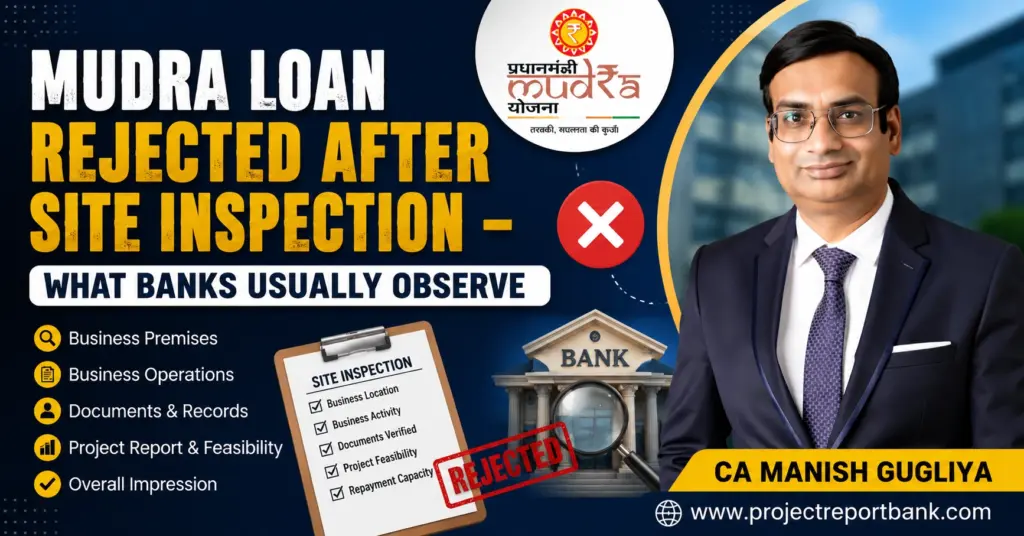
Key Takeaways
- A successful Mudra loan site inspection does not guarantee approval. The bank still evaluates viability, documentation consistency, credit history, and repayment capacity before final sanction.
- The most common reasons a Mudra loan is rejected after site inspection include: business not found at the stated address, fake or borrowed stock and machinery, mismatch between the project report and ground reality, weak cash flow, and poor applicant knowledge of the business model.
- Before the field officer visit, keep premises open and active, arrange basic documents on site, ensure your project report matches what the officer will actually see, and be ready to clearly explain your business and repayment plan.
- Rejection after inspection under Pradhan Mantri Mudra Yojana is usually not permanent. With corrections, better documentation, and a realistic project report, applicants can re-apply and improve their approval chances significantly.
Introduction – Why Mudra Loans Get Rejected Even After Site Inspection
In early 2024, a small fabrication unit owner in Indore walked into my office convinced his Mudra loan was “as good as sanctioned.” The bank had sent a field officer, the visit went smoothly, and the officer even praised his welding work. Two weeks later, he received a rejection SMS. The reason? His project report claimed monthly revenue of ₹2.5 lakh, but his bank statements showed barely ₹40,000 in average monthly credits. The site inspection was fine. The numbers were not.
This is a pattern I have seen repeatedly across twenty-plus years of handling Mudra loan project reports and MSME finance cases. Many applicants under the Pradhan Mantri Mudra Yojana assume that once the bank conducts a site inspection, approval is almost certain. That assumption is wrong.
A Mudra loan application can be rejected after a site inspection. The field visit is only one stage of credit appraisal. The final decision also depends on eligibility criteria, business viability, documents, past banking behaviour, and internal bank or financial institution policies. This article decodes what officers actually check and how you can avoid rejection.
Table of Contents
What Is a Mudra Loan Site Inspection and When Does It Happen?
Mudra loan site inspection – also called field verification or physical verification – is the bank’s on-ground visit to your business premises before sanction or final disbursement. It is conducted by a field officer, relationship manager, or sometimes a third-party verification agency appointed by the bank.
This visit typically happens after basic document scrutiny and initial credit appraisal, but before final approval under the mudra scheme. It is important to understand the difference between document verification (checking KYC, income proofs, GST, Udyam, project report at the branch) and physical verification (visiting the shop, factory, or godown to see real business activity).
Mudra loans are categorized by business stage: Shishu, Kishore, and Tarun. Shishu loans are up to ₹50,000 for startups, while Kishore loans range from ₹50,000 to ₹5 lakh for business expansion. Tarun loans cover the next phase, going upto Rs 10 lakh. For very small shishu loans, some lenders do a brief or telephonic check. For Kishore and Tarun categories, a formal site visit is almost always conducted.
Mudra loans are provided through banks, NBFCs, and microfinance institutions, including commercial banks and small finance banks. The scheme was launched on April 8, 2015, and is managed by the Micro Units Development and Refinance Agency, which functions as a refinance agency. The mudra scheme covers non corporate, non-farm small enterprises, and proprietorship and partnership firms can apply. Mudra loans support micro enterprises in manufacturing, trading, and services, and eligible businesses include food processing and agriculture allied units.
Why Banks Conduct Mudra Loan Site Inspections
Under PMMY, banks bear the credit risk for every loan extended. Since no collateral security is required for loans up to Rs. 10 lakhs, physical verification becomes the primary risk-control tool. Site inspections are conducted to verify the viability of the business.
Key objectives include:
- Verify business existence: Confirm that the business actually exists at the stated address and is operational – not just a name on paper.
- Cross-check application claims: Compare information in the loan application and project report with what the officer sees on ground – the nature of the proposed activity, scale, staff, stock, and machinery.
- Reduce fraud risk: Identify identity fraud, benami units, and potential diversion of funds. The loan must be for income-generating activities, and banks ensure financial assistance reaches the actual beneficiary micro unit.
- Informally assess repayment capacity: Observe sales activity, customer footfall, inventory movement, and the general seriousness of the entrepreneur.
A negative site inspection report is one of the most common operational reasons for Mudra loan rejection, separate from CIBIL or previous loan issues. According to the NITI Aayog assessment of PMMY, field verifications frequently surfaced discrepancies between proposals and actual business status.
What Banks Usually Observe During Mudra Loan Site Inspection
This section mirrors a typical internal Mudra loan inspection checklist, explained in practical terms. Officers don’t just “see the shop” – they mentally compare every visible detail with the application, project report, and bank statements.
Business Premises – Location, Ownership, and Basic Infrastructure
Officers check whether premises match the address given in the application, including shop number and PIN code. They examine ownership documents or rent agreement. Area size, accessibility, and visibility for customers are noted. Whether the space seems adequate for the stated turnover matters.
A locked shop or “under renovation” at the time of visit is a frequent reason for a negative site report. If you operate from rented premises, have a proper written rent agreement in the applicant’s name.
Actual Business Operations and Daily Activity
The officer informally observes whether customers are visiting, workers are present, and whether any production or service activity is genuinely happening. A salon with chairs, mirrors, and clients is convincing. A fabrication unit with welding machines in use, raw material, and finished items stacked for dispatch is convincing.
Entirely empty premises or just a few display pieces for “show” signal risk and can lead to rejection. For seasonal businesses (cold drink distribution in winter, for example), proactively explain seasonality and show supporting records.
Existing Stock and Inventory Movement
Officers look at quantity and type of stock – finished goods, raw material, packing material – checking if it matches business nature and claimed monthly turnover. Having absolutely no inventory in a trading or manufacturing business at the time of inspection, without proper explanation, is a serious red flag. The officer may casually ask about recent purchases and cross-relate answers with invoices or GST data later.
Machinery, Tools, and Equipment
For manufacturing or service units (printing press, bakery, workshop), site inspection focuses heavily on machinery actually installed and in working condition. Banks verify whether machinery values mentioned in the project report align with what they see and supporting invoices. Temporarily “borrowed” or rented-for-a-day machines can backfire badly if the officer notes the business does not truly own or regularly use them.
Business Signboard and Professional Identity
Officers check for a clear signboard displaying the business name, preferably matching the Mudra loan application, GST registration, and Udyam certificate. Absence of any signboard or a mismatched name without proper supporting documents creates doubt about the actual borrower. Simple, professional branding – a clean board, display of GST number if applicable – leaves a positive impression.
Documents and Records Available at Site
Key documents banks like to see at premises include recent purchase and sales invoices, GST returns printouts, Udyam Registration, Shop and Establishment licence, FSSAI for food units, electricity bill, rent agreement, and basic staff records. Incomplete documentation can lead to loan rejection, and missing registrations can result in application rejection.
For very small cash-based businesses, even simple handwritten bill books and purchase diaries are better than having no records at all. Officers sometimes take photos of important documents to attach with the inspection report.
Project Report Verification Against Ground Reality
Officers compare project report numbers – investment, capacity, expected monthly sales – with what they actually see. If a project report claims 500 customers per day for a small tea stall but the officer counts 5–10 during peak hours, projections are marked as unrealistic. Documentation consistency is crucial for loan approval. A major mismatch between the project report for Mudra loan and physical reality is a key reason for rejection due to non-viable business.
Financial Capacity, Bank Accounts, and Cash Flow Signals
While main financial analysis is done at the branch using bank statements and ITRs, the field officer also notes indirect signals: daily sales volume, typical ticket size, presence of staff, and stock level. Bank statements and financial records demonstrate business viability and revenue. Officers may ask basic questions on monthly expenses and expected EMI to judge whether cash flow can support repayment. Insufficient credit history may result in loan denial, and poor financial health of the applicant may lead to rejection.
Applicant’s Knowledge, Experience, and Overall Impression
The officer evaluates how confidently the applicant explains the business model, products, suppliers, customer profile, and repayment plan. Inability to answer basic questions – not knowing product purchase cost or selling price – is recorded as “poor business understanding.” The applicant need not have a specific educational qualification, but must demonstrate necessary skills and knowledge of the enterprise.
Prior relevant experience, honest and consistent replies, and cleanliness of premises all influence the “overall impression” box in the field inspection format. Transparency and professionalism signify seriousness to the officer.
Common Reasons Mudra Loans Are Rejected After Site Inspection
Many clients approach me only after receiving a rejection mentioning phrases like “adverse field verification” or “negative business inspection report.” Common reasons for rejection after a site inspection include business inactivity and poor credit history. Here are the patterns I see most frequently:
- Business not found at given address, premises closed repeatedly, or a different person running the unit. In a reported case, an SBI verification found that a footwear shop under the Kishore category did not exist at the declared address.
- Fake documentation: Forged invoices, manipulated Udyam certificate, or signboard with a different name than the applicant.
- Project report mismatch: Inflated investment, exaggerated sales, or machinery shown on paper but not installed. Discrepancies between the application and actual business conditions can lead to rejection.
- Operational weaknesses: No stock in a trading business, no machinery in a manufacturing unit, or very low sales compared to claimed turnover. Ineligible business activities can also cause application rejection.
- Financial red flags: Inconsistent answers, officer sensing that the loan may be diverted to personal use, or previous loan issues discovered during appraisal. Failure to meet eligibility criteria results in loan denial.
One or two minor issues may invite clarification. But multiple inconsistencies across address, documents, business activity, and finances almost always lead to rejection.
Mistakes Applicants Commonly Make During Mudra Loan Site Inspection
Many rejections arise not from fraud but from avoidable preparation mistakes:
- Keeping the shop closed during usual working hours or sending an uninformed staff member to handle the officer.
- Temporarily borrowing stock or machinery from a friend, placing empty cartons to appear fully stocked, or overstating daily sales. Banks may detect this through second visits or cross-checks.
- Not keeping even basic invoices at the site, not having the rent agreement handy, or failing to display GST certificate or Udyam Registration.
- Arguing with the officer, trying to impress with unrealistic numbers, or giving different answers from what is written in the loan application.
- Giving contradictory statements – for instance, the borrower says one monthly turnover figure while the spouse mentions another.
How to Prepare Before the Bank’s Mudra Loan Field Visit
Treat this as a practical pre-inspection checklist:
- Confirm the visit window with the branch and ensure your business remains open with normal operations during that time.
- Organize premises: Arrange stock neatly, clean the workspace, ensure machinery is working, and put up a clear signboard with your business name.
- Keep core documents accessible at premises: rent agreement copy, electricity bill, Udyam Registration, GST certificate, main licences, and recent bills.
- Be present personally or at minimum available on phone to answer questions. If a relative or staff attends, brief them on key details of the business and the loan application.
- Revisit your project report so figures like investment, monthly sales, and expected EMI are fresh in your memory and answers remain consistent.
- Prepare a one-page note explaining your business model, major suppliers, typical monthly expenses, and repayment plan.
Documents to Keep Ready for Mudra Loan Business Verification
While each bank has its own Mudra loan document checklist, a common core set strongly supports a positive inspection report:
| Category | Documents |
|---|---|
| Identity & Address | Aadhaar card, PAN card, electricity bill, property tax receipt, rent agreement |
| Business Registration | Udyam Registration, GST registration (if required), Shop & Establishment licence, FSSAI (for food units), municipal licence |
| Financial Records | Last 6–12 months bank statements, purchase and sales invoices, estimate books, latest ITR or profit & loss statement |
| Project-Related | Project report copy, machinery quotations or invoices, prior loan sanction letters |
Maintaining a dedicated business account can support loan applications. The more organized and complete the documentation, the higher the confidence level of the officer. It is essential to rectify documentation issues before reapplying for a loan if previously rejected. Individual borrowers who are uncomfortable preparing a detailed project report can seek professional help from a CA experienced in PMMY documentation.
What You Should Never Do During Mudra Loan Site Inspection
Banks and RBI take misrepresentation very seriously. Any attempt to stage-manage the inspection can lead not only to rejection but also internal blacklisting.
- Never show fake documents, forged invoices, or manipulated bank statements. Banks may later cross-verify with the GST portal or suppliers.
- Never borrow machinery or stock for one day just to “show” the officer, use another person’s shop as your own, or temporarily change signboards.
- Never give false information on turnover, profits, or staff size. Give realistic, defensible numbers even if they are modest.
- Giving different answers from what is written in your loan application or project report is treated as serious inconsistency.
- Offering any kind of personal favour or inducement to the officer is unethical and risky. Professional, transparent behaviour works far better.
Can Your Mudra Loan Still Be Approved After Minor Issues in Inspection?
Not every observation in the Mudra loan site inspection report is fatal. Banks distinguish between minor issues and serious red flags.
Examples of minor issues that may invite clarification rather than outright rejection:
- Slightly lower stock than expected
- Temporary absence of a staff member
- Small mismatch in signboard spelling
- Business being newly started with limited activity
In such cases, banks may ask for additional documents or a revised project report rather than rejecting the application. I have seen cases where additional invoices or proof of seasonal demand helped convert an initially doubtful report into approval. Honesty and a cooperative attitude with the field officer make it easier to overcome minor discrepancies discovered during Mudra loan physical verification.
What To Do If Your Mudra Loan Is Rejected After Site Inspection
Rejection after field verification usually does not permanently bar an applicant from availing the mudra scheme in future. The bank must communicate the reasons for rejection in writing. Applicants can appeal a loan rejection or reapply after corrections.
Step-by-step corrective action:
- Obtain the written reason from the branch – for example, business not found, non-viable project report, or address mismatch.
- Compare the bank’s remarks with your actual business situation. Identify what genuinely went wrong – closed shop, incomplete documents, unrealistic projections.
- Take corrective action: regularize tenancy with a proper rent agreement, improve documentation, align your project report with realistic numbers, increase visible business activity.
- You can approach the same bank with clarifications and improved documentation, or apply afresh to another bank or NBFC after 3–6 months once issues are resolved.
- Seek professional help from a CA or MSME consultant to prepare a bankable project report, especially if your previous rejection involved non-viable or inconsistent projections.
A healthy credit score indicates a better chance of loan approval when you reapply. If your credit needs improvement, focus on clearing any outstanding dues and building a satisfactory credit track record over the waiting period. Those who have successfully repaid previous loans on other credit facilities should highlight this in the new application.
Practical Tips from CA Manish Gugliya to Improve Approval Chances
Based on more than two decades of handling Mudra loan and MSME finance cases, here are tips that have made a real difference for my clients:
- Keep your business operating for at least a few months before applying. Avoid applying when your micro unit is still only on paper unless it is clearly a start-up with a proper plan.
- Maintain at least one active bank account used regularly for business, with clean transactions. Avoid unexplained heavy cash deposits just before application.
- Prepare a simple monthly cash flow statement, even on a notebook. Know your capacity to pay EMI.
- Update KYC and business registrations (Udyam, GST if applicable) before applying. Outdated registrations create unnecessary queries.
- Never copy project reports from the internet. They should reflect your real scale, pricing, and local market conditions. Banks will assess based on ground reality, not generic templates.
- If you have limited business experience, start with a smaller loan amount initially, show a good repayment track record for 12–18 months, then request enhancement.
- Women entrepreneurs, senior citizens, and first-time eligible borrowers under PMMY should be extra careful with documentation.
- Maintain basic books: daily sales register, purchase file, expense file. These small habits greatly impress officers during Mudra loan business inspection.
- Ensure your capital assets (machinery, equipment) match what you have declared to the bank.
- Treat the field officer as a partner in understanding your business. Answer calmly, admit what you don’t know, and provide follow-up documents promptly.
There are many success stories of micro enterprises engaged in trading, services, and manufacturing that initially struggled with the lending process but secured approval after proper preparation. The government through the ministry has designed the scheme to provide financial support to the sector that needs it most. Your role as the entrepreneur is to undertake preparation seriously so the processing goes smoothly.

Frequently Asked Questions on Mudra Loan Rejected After Site Inspection
These FAQs address practical questions that remain after reading the main article, focusing on inspection, re-application, and special situations.
Does a successful site visit guarantee that my Mudra loan will be sanctioned?
No. A positive site inspection is necessary but not sufficient. The bank still checks your CIBIL score, previous loans, business viability, credit guarantee requirements, and internal exposure limits before final approval. The sanctioned limit depends on overall credit appraisal, not just field verification. Many borrowers receive rejection due to other reasons – like multiple risks, a non-viable business model, or policy issues – even when the field report is generally okay.
How soon after site inspection does the bank usually take a decision?
In most public sector banks, the field officer submits the report within 2–5 working days. After that, the branch processes the file. A decision may typically take 7–15 days from the date of inspection if all documents and details are in order. Delays can occur if additional documents are requested or if the credit department workload is high. You have the right to politely follow up in writing. Use the application date as a reference point for tracking the timeline.
Will using a rented premises reduce my chances of getting Mudra loan approval?
Renting is very common for micro enterprises and does not reduce eligibility under Pradhan Mantri Mudra Yojana by itself. Problems arise only when there is no written rent agreement, the landlord is unwilling to acknowledge tenancy, or there is confusion over who actually controls the premises. A simple written agreement, rent receipts, and matching address documents are sufficient. Mudra loans are available for micro enterprises in various sectors regardless of whether premises are owned or rented, and the form of occupancy should be clearly stated.
What if my business is new and I have very low stock or sales during inspection?
For start-ups or very new units, low stock or footfall is understandable. But you must clearly communicate the start date, expected ramp-up, and show supporting documents like advance orders, enquiries, or machinery invoices. Having a realistic project report and being able to explain how the business will grow over the next 6–12 months is critical. Mudra loans range from Rs. 50,000 to Rs. 20 lakhs and are designed for micro enterprises at various stages, so banks do expect stage-appropriate activity, not necessarily a fully mature operation. Assets created from the loan should be clearly linked to income generation in your plan.
Can I apply at a different bank if one bank rejects my Mudra loan after site inspection?
Yes. The company or enterprise can apply at another bank, NBFC, or microfinance institution after addressing the reasons for rejection. However, be transparent about prior rejection if asked. Ensure your interest in the business is genuine and that every issue – whether covering loans, documentation gaps, or premises problems – is resolved before the fresh application. Mudra loans are availed through multiple lending channels, and each institution applies its own credit appraisal independently while following the broader guidelines of the scheme.
Conclusion
Mudra loan site inspection is not a mere formality. It is a structured process under PMMY to verify business reality, documents, and repayment potential. Most rejections after inspection stem from avoidable issues: business not found, poor documentation, unrealistic project reports, and weak or unclear cash flow.
Prepare deliberately. Keep premises active and organized. Maintain basic records. Ensure consistency between your documents and project report. Answer officers honestly. These are not extraordinary requirements – they are the basics that every enterprise should undertake as part of running a serious business.
With proper preparation and, where needed, professional guidance from an experienced CA or MSME consultant, many applicants who were initially rejected have later secured Mudra loans successfully. The final lending decision always rests with the respective bank or financial institution as per its credit policy and PMMY norms. But a well-prepared entrepreneur significantly improves the chances of approval.
About the Author
CA Manish Gugliya is a practicing Chartered Accountant with more than 20 years of experience in Project Report Preparation, CMA Data, Mudra Loan Consulting, MSME Finance, Business Planning, Startup Advisory, and Business Valuation. Through Project Report Bank, he has guided entrepreneurs across India in preparing bankable project reports and understanding practical aspects of bank loan appraisal and Mudra Loan approvals.
- Mudra Loan Rejected Due to Industry Specific Project Report Mistakes – What Banks Really Expect 2026


- Mudra Loan Rejected Because the Business Model Was Not Viable – How to Improve Your Project Report 2026

- Mudra Loan Rejected Due to Machinery Cost: Practical Guide to Fix & Avoid This Problem (2026)

- Mudra Loan Rejected Due to an Incomplete Business Plan 2026 – What Every Project Report Must Include

- Mudra Loan Rejected Due to Copy Paste Project Report – How Banks Detect Generic DPRs and What to Do Next

- Mudra Loan Rejected Due to Wrong Working Capital Calculation – How Banks Really Assess Your Requirement 2026

- Mudra Loan Rejected Because the Project Cost Was Incorrect – How to Estimate It Properly 2026
- Mudra Loan Rejected Due to Missing or Incorrect CMA Data – Complete Preparation Guide 2026

- Mudra Loan Rejected Because of Incorrect Financial Projections – Common Mistakes to Avoid 2026

- Mudra Loan Rejected Due to Unrealistic Project Report – How to Make It Bank-Ready (2026 Complete Guide)

- How to Prepare a Perfect Mudra Loan Document File Before Visiting the Bank 2026

- Mudra Loan Rejected Due to Signature Mismatch – Practical Guide 2026 by CA Manish Gugliya

- Mudra Loan Rejected Due to Missing Udyam Registration – Complete 2026 Guide by CA Manish Gugliya
- Mudra Loan Rejected Due to Invalid or Old Bank Statements – What Banks Expect (Explained by CA Manish Gugliya) 2026

- Mudra Loan KYC Documents: Complete Checklist to Avoid Rejection 2026