Key Takeaways
- Mudra loans under Pradhan Mantri Mudra Yojana (PMMY) are sanctioned by participating banks and other eligible lenders – not directly by MUDRA Ltd., which functions as a refinance and development agency under SIDBI.
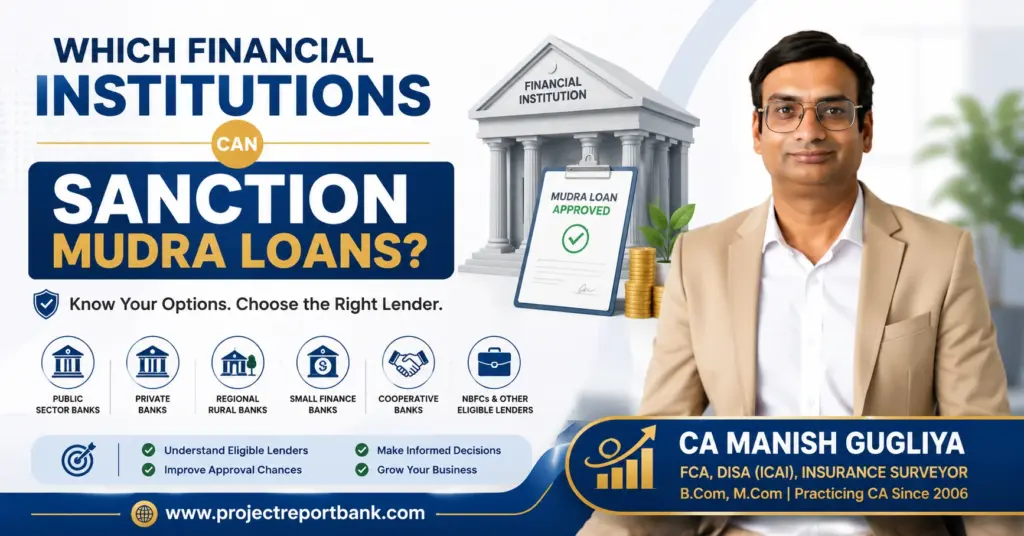
- Various financial institutions can sanction Mudra loans, including public sector banks, private sector banks, Regional Rural Banks, small finance banks, eligible cooperative banks, Non-Banking Financial Companies (NBFCs) and Microfinance Institutions (MFIs).
- Eligibility of a financial institution to participate in PMMY does not guarantee that every branch will process Mudra loans or that every applicant will receive sanction; the final credit decision rests with the lender’s internal appraisal.
- Choosing the right lender category (bank vs NBFC, public vs private, etc.) affects documentation expectations, processing time, turnaround and the lender’s comfort with the borrower’s business profile.
- This article draws on the practical knowledge of CA Manish Gugliya (FCA), a Chartered Accountant with over 20 years of experience in project reports, CMA data, MSME finance and Mudra loan consultancy.
Introduction: Why the Right Mudra Loan Lender Matters
Many applicants believe that Mudra loans can be sanctioned only by government banks, or that there is a “MUDRA office” that directly hands out loans to every applicant who walks in. Both assumptions are incorrect. The Pradhan Mantri Mudra Yojana PMMY, scheme launched on 8 April 2015, is a framework under which multiple categories of eligible lending institutions provide collateral-free business loans to non corporate, non farm sector micro enterprises engaged in manufacturing, trading and services – for income generation and employment creation.
Different institution types – public sector bank, private bank, Regional Rural Bank, Small Finance Bank, cooperative bank, NBFC, MFI – carry different risk appetites, documentation expectations and internal processes. The borrower’s choice of lender can materially affect turnaround time, comfort level and outcome.
As CA Manish Gugliya (FCA) with over 20 years of hands-on experience in project reports, CMA data and MSME finance, I regularly see applicants confused about where to apply for Mudra loans. This article will answer which financial institutions can sanction Mudra loans and how to choose the right one for your business.
What Is a Mudra Loan?
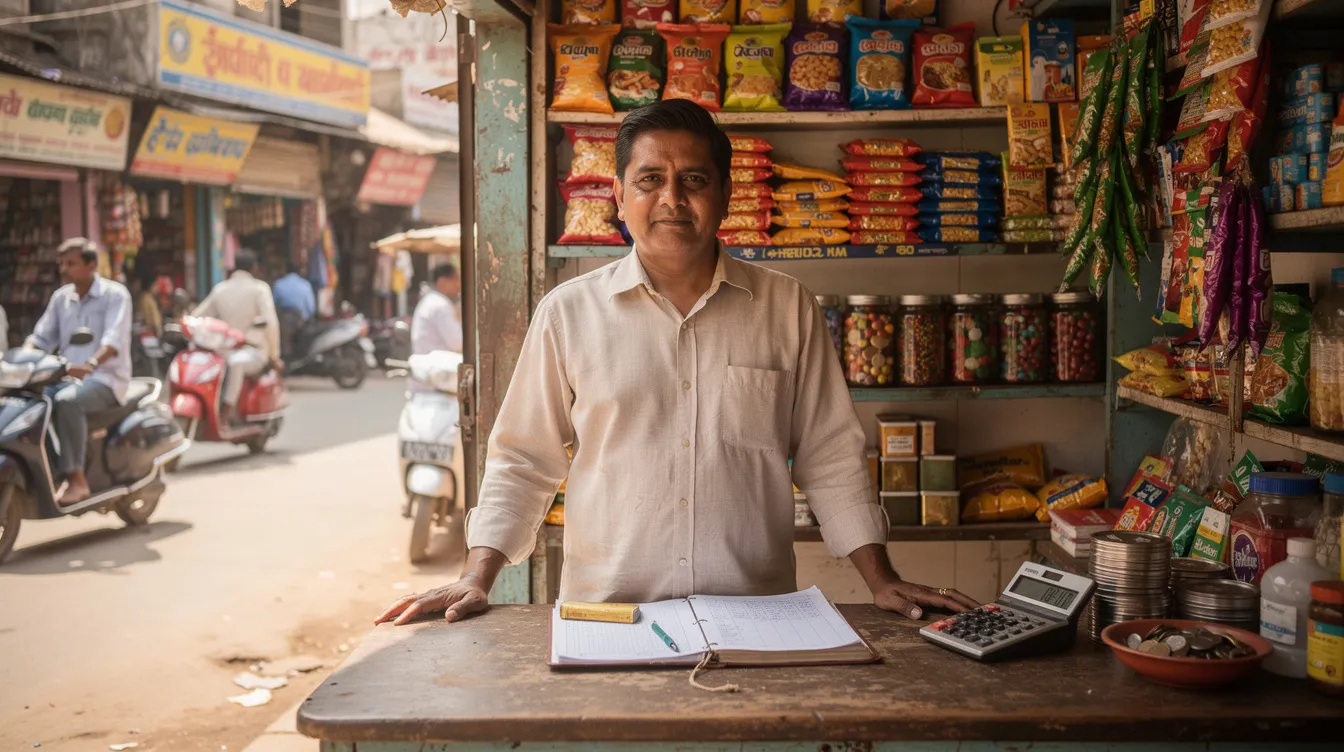
Mudra loans are business loans provided under the Pradhan Mantri Mudra Yojana to small and micro enterprises in the non farm sector for term loan and working capital needs. PMMY was launched on 8 April 2015 to support micro units in manufacturing trading and services, with a focus on income generation and employment creation. Eligible borrowers include proprietorship and partnership firms operating non-corporate small businesses. These loans are typically collateral-free – loans up to ₹10 lakh do not require collateral security.
Loans are available in four categories based on the stage of growth development and funding needs of the beneficiary micro unit:
- Shishu – upto Rs 50,000
- Kishore – from ₹50,001 to ₹5 lakh
- Tarun – from ₹5 lakh to ₹10 lakh
- Tarun Plus – from ₹10 lakh to ₹20 lakh (introduced in October 2024, available to those who have successfully repaid previous loans in the Tarun category)
The maximum loan amount under Mudra is ₹20 lakh for certain categories. For a detailed scheme overview, read What is PM Mudra Yojana?, and for product-wise details, see types of Mudra loans.
The rest of this article focuses specifically on which financial institutions are allowed to sanction these loans, not on general scheme features.
Table of Contents
Does MUDRA Directly Sanction Loans to Borrowers?
MUDRA Ltd. does not lend directly to customers. It is primarily a refinance and development institution – a subsidiary of SIDBI – that provides refinance support and sets guidelines for eligible lending institutions such as banks, NBFCs and MFIs.
The actual loan sanction, documentation and disbursement happen at the level of the participating lender. A typical borrower approaches an eligible bank or financial institution branch, submits a Mudra loan application, and the lender appraises the proposal under its own credit policies within the PMMY framework.
Visiting a “MUDRA office” expecting a direct cash loan is a common misunderstanding. Instead, borrowers should identify a participating bank, RRB, Small Finance Bank, cooperative bank, NBFC or MFI in their area that is currently offering Mudra loans. Institutional arrangements and eligible lender categories are periodically notified by the Department of Financial Services, so borrowers should rely on up-to-date official sources.
Which Financial Institutions Can Sanction Mudra Loans?
As per the prevailing PMMY framework, Mudra loans are sanctioned by participating banks and other regulated financial institutions – including public sector banks, private sector banks, Regional Rural Banks, small finance banks, eligible cooperative banks, Microfinance Institutions and NBFCs – not by MUDRA directly. Mudra loans are offered by banks, NBFCs, and MFIs across India.
It is important to distinguish between:
- A category being eligible under PMMY guidelines
- A specific institution opting to offer Mudra loan product offerings
- A particular branch actually accepting and processing applications
Within each participating institution, internal credit norms apply. Being an “eligible Mudra lender” does not force the bank or NBFC or MFI to approve every proposal. The following subsections walk through each major category.
Public Sector Banks
Public Sector Banks (PSBs) are government-majority-owned commercial banks with a wide branch network across India. They have been key participants in the Pradhan Mantri Mudra Yojana since 2015. Public Sector Banks include State Bank of India, Punjab National Bank, and Bank of Baroda, among others. Commercial banks like these typically serve a broader range of businesses.
Many applicants associate Mudra loans only with PSBs because of government ownership, visibility in publicity campaigns and strong presence in semi-urban and rural areas. Mudra loans from public sector banks are typically processed at the home branch or designated MSME or micro enterprises desks.
Practical considerations:
- Existing current or savings account holders may find it easier to share transaction history and obtain assessment
- PSBs may be suitable for borrowers with established banking relationships, consistent account conduct and proper records
- Sanction still depends on project viability, repayment capacity and internal credit policy
Applicants often ask whether to choose a public sector bank vs private bank for Mudra loan – the answer depends on individual circumstances. Do not assume that government ownership guarantees easier approval or that every PSB branch will actively process all PMMY categories.
Private Sector Banks
Several scheduled private sector banks are also notified participants in PMMY and can sanction Mudra loans to eligible micro and small enterprises. Private Sector Banks include HDFC Bank, ICICI Bank, and Axis Bank, among others. Documentation requirements vary by lender for PMMY loans, and private banks may apply relatively more standardised digital processes, specific product variants and sometimes faster communication.
A Mudra loan from a private bank may be more accessible for customers who already maintain a current or savings account or existing business loan with that bank. The lender can quickly review transaction patterns and working capital requirements.
Key points for applicants:
- Participation in PMMY does not mean every private bank branch is obliged to offer every Mudra category; availability of Shishu, Kishore and Tarun products can depend on location and internal strategy
- The borrower’s business profile, repayment capacity, credit history (CIBIL) and account behaviour remain critical for sanction decisions
- Approval is not automatic or guaranteed in either public or private banks
Compare overall suitability – relationship, comfort, service, documentation – rather than assuming private banks always reject or always process faster.
Regional Rural Banks
Regional Rural Banks (RRBs) are sponsored by larger commercial banks and operate mainly in rural and semi-rural areas. Regional Rural Banks serve rural and semi-urban customers and are important channels for Mudra loans to small traders, artisans, local service providers and micro manufacturing units.
Many rural entrepreneurs – such as small shopkeepers, dairy units, repair workshops and businesses in allied agricultural activities (excluding direct crop farming) – may find RRBs more familiar and accessible for PMMY loans.
RRBs follow PMMY guidelines as well as their sponsor bank’s policies, so Mudra loan eligibility criteria, margin requirements and repayment structure may differ slightly between one RRB and another. Even in RRBs, each proposal goes through credit appraisal. Prior relationship (such as a savings account or earlier small loans) can influence comfort level but not override risk assessment.
Borrowers should check with their local RRB branch whether it is currently authorised and active in sanctioning Shishu loans, Kishore or Tarun loans.
Small Finance Banks
Small finance banks are niche banks licensed by RBI with a mandate to focus on underserved segments – micro businesses, small traders, low-income households and informal-sector entrepreneurs. Small Finance Banks are aimed at serving unserved and underserved individuals.
Many SFBs participate in PMMY and can sanction Mudra loans, especially for very small borrowers, group-based lending models, or customers migrating from informal to formal credit. SFBs may have flexible outreach models – doorstep collection, business correspondents, local field officers – which can be convenient for beneficiary micro unit entrepreneurs with limited time or documentation capacity.
Practical cautions:
- Not every SFB branch or region will offer all Mudra loan categories; products and ticket sizes depend on the bank’s current focus
- Borrowers should assess interest rate, processing fees and repayment mode (weekly, fortnightly or monthly) while comparing SFBs with other Mudra loan banks
- Interest rates for PMMY loans vary by lender within regulatory guidelines
Cooperative Banks
Cooperative banks are member-owned, locally focused banks regulated by RBI and respective state or central authorities. Certain scheduled and eligible cooperative banks are permitted to participate in PMMY, subject to specific regulatory and scheme conditions.
Eligibility is not universal – a cooperative bank must be duly authorised under the current framework to extend Mudra loans. Many primary or small cooperatives might not be participants.
Borrowers should:
- Confirm with their cooperative bank branch whether that particular institution currently offers Mudra loan products, and if so, for which categories (Shishu, Kishore, Tarun) and ticket sizes
- Verify up-to-date participation through bank circulars, PMMY or MUDRA resources, or directly with the bank
- Recognise that cooperative banks can be relevant for local traders and micro enterprises with long-standing relationships in a cooperative ecosystem, but sanction will still follow credit underwriting norms
NBFCs
Certain regulated Non-Banking Financial Companies are recognised as eligible lending institutions under the Mudra and PMMY framework and may extend Mudra-linked business loans to micro enterprises. Non-Banking Financial Companies and Micro Finance Institutions are important for last-mile lending, particularly where borrowers have limited access to bank branches or operate informal businesses.
An NBFC’s lending model differs from banks:
- They may rely more on cash-flow based assessment, field visits, surrogate income evaluation and local market knowledge
- This can be useful for small traders or service units with limited formal financials
- Interest rates and other borrowing costs from NBFCs may differ from banks; borrowers should carefully compare effective cost, repayment frequency and total obligation
Availability of Mudra-branded products in an NBFC can vary. Some NBFCs may extend very small ticket shishu loans under PMMY, while others may focus on higher limits or different schemes.
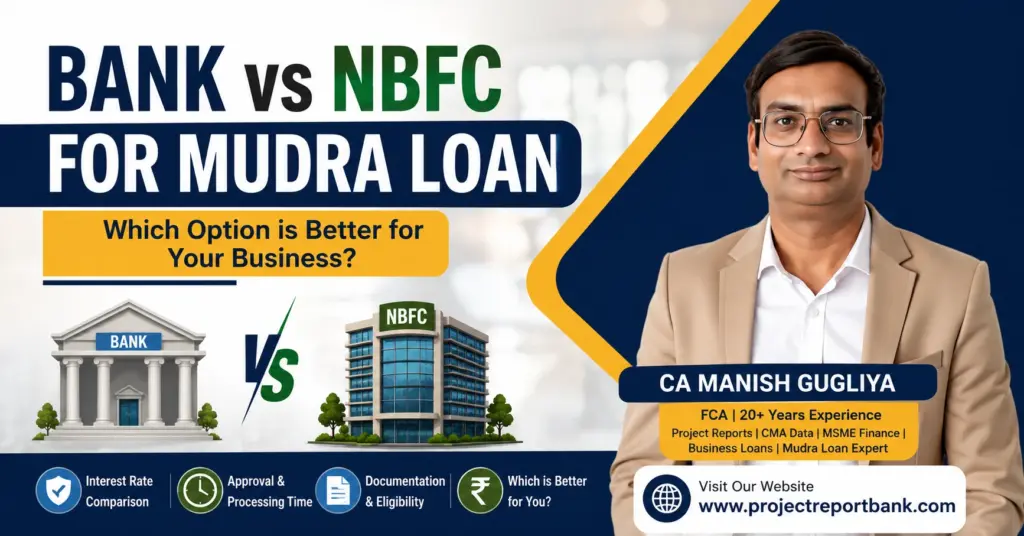
For applicants undecided between a bank and an NBFC, a deeper comparison is available at Bank vs NBFC for Mudra Loan. As with banks, an NBFC’s eligibility to participate does not mean it must sanction every application.
Microfinance Institutions and Other Eligible Lenders
Microfinance Institutions (MFIs) are entities – often NBFC-MFIs or not-for-profit organisations – that specialise in small-ticket loans to low-income households and micro entrepreneurs, frequently through group or joint-liability models. RRBs and MFIs primarily focus on financially underserved borrowers.
Many MFIs are part of the Mudra ecosystem and may provide Mudra-backed financial assistance for tiny enterprises such as home-based units, petty shops and very small service businesses.
PMMY notification recognises broad lender categories (commercial banks, RRBs, SFBs, cooperative banks, MFIs, NBFCs), but participation is institution-specific. Borrowers must confirm whether a particular MFI in their area actually offers Mudra loans at present. MFIs often focus on inclusivity and doorstep service but may have frequent repayment cycles and specific group formation requirements that borrowers should understand.
From a borrower’s perspective, the key point is to deal only with properly authorised, regulated lenders listed or endorsed by official channels.
Can Every Bank Sanction a Mudra Loan?
Not every bank or every branch automatically sanctions Mudra loans, even if the bank category appears in PMMY guidelines. There is a clear distinction between eligibility, participation and active product offering.
Consider these practical scenarios:
- A scheduled commercial bank is eligible under PMMY but may not offer Mudra loans at all branches – some branches handle only retail deposits
- A branch may process only Shishu loans and route higher Tarun loans to a regional credit office
- Processing time for loans may differ based on the lender’s category and internal capacity
What applicants should do:
- Check the bank’s official website or customer care for Mudra loan availability
- Ask at the local branch whether Mudra loans are currently being processed there
- Confirm internal limits and documentation requirements before preparing detailed paperwork
Even in an actively participating branch, sanction is never “on demand.” It is subject to scheme conditions, KYC, credit checks and viability assessment.
Who Actually Sanctions a Mudra Loan?
Within each lending institution, the sanction decision is taken by an authorised credit-sanctioning authority – not by MUDRA, and not always solely by the front-desk branch manager.
Depending on loan size (Shishu, Kishore or Tarun), bank policy and risk profile, the sanctioning authority may be:
- The branch manager (for smaller Shishu or low Kishore amounts)
- A branch credit committee
- A regional office or cluster credit hub
- A centralised credit-processing cell (for higher Tarun or Tarun Plus amounts)
The usual internal flow works like this: application and documents are collected at the branch, preliminary assessment is done, the proposal is recommended, and then it is approved or sanctioned by the designated authority as per delegation of powers. The stages – “application received,” “under process,” “recommended,” “approved,” “sanctioned” and “disbursed” – are different steps. A sanction letter is not the same as final disbursement.
For a deeper process explanation, read difference between Mudra loan approval, sanction and disbursement.
Applicants should keep communication in writing (email, SMS, letters) and should not rely only on verbal assurances when interpreting their loan status.
Bank vs NBFC – Where Should You Apply for a Mudra Loan?
Both banks and eligible NBFCs can participate in Mudra lending. The better choice depends on the applicant’s business profile, ticket size, documentation strength and preferred repayment pattern.
| Factor | Banks | NBFCs |
|---|---|---|
| Interest cost | Generally lower | May be higher |
| Documentation | Stricter formal requirements | More flexible for informal income |
| Processing | Can be slower for some categories | Often faster field-based assessment |
| Repayment frequency | Monthly (typically) | Weekly, fortnightly or monthly |
| Existing relationship | Valued highly in appraisal | Less weight on banking history |
Existing banking relationship, current account turnover and a satisfactory credit track record with a bank can be valuable in bank-based Mudra loan appraisal. NBFCs may place more weight on field assessment and projected cash flows.
Avoid choosing solely based on who promises “no rejection” or “instant Mudra loan.” For a deeper comparison, read the detailed Bank vs NBFC comparison for Mudra Loan.
Public Sector Bank vs Private Bank for Mudra Loan
Both public and private sector banks are part of PMMY and can sanction Mudra loans. No category is universally “best” for every borrower.
- PSBs often have wider rural reach and long-standing MSME branches
- Private banks may have more digital interfaces and sometimes faster responses
- The deciding factor should be where the applicant has a stable account, how well the bank understands the industry, and how comfortable the borrower is with the bank’s documentation and service style
Avoid misconceptions such as “government banks always approve Mudra loans” or “private banks never do Mudra loans.” Individual proposal quality and credit norms matter more than ownership.
For a dedicated comparison, read Public Sector Bank vs Private Bank for Mudra Loan.
How to Choose the Right Financial Institution for Your Mudra Loan

Practical guidance for choosing the right lender:
- Start with your existing bank – where you maintain a current or savings account with transaction history. This simplifies understanding of business turnover and working capital needs.
- Evaluate lender familiarity – some branches are experienced with traders, others with small manufacturers or service businesses. Choose a lender that frequently finances similar profiles.
- Compare beyond interest rates – look at processing fees, collateral or security requirements (if any beyond PMMY norms), repayment schedule and prepayment terms across 2–3 shortlisted institutions.
- Check practical aspects – branch proximity, responsiveness, online or offline application facility, and clarity of communication on required documents.
- Be wary of guaranteed approvals – the chosen lender should be transparent about eligibility criteria, timelines and reasons for decisions. Avoid intermediaries promising guaranteed Mudra loans.
- Prepare a clear business plan – a realistic project report and proper supporting documents before approaching the lender improves quality of interaction, even though it does not guarantee sanction.
Can a Startup Get a Mudra Loan from These Institutions?
Mudra loans are available for non-corporate small enterprises – both new (greenfield) and existing micro enterprises – subject to scheme eligibility and lender appraisal. There is no educational qualification requirement as a barrier. Startups can be considered even if they have limited business history.
For startups, lenders place more weight on:
- Promoter profile, necessary skills and experience in the proposed activity
- Viability of the business plan
- Quality of the project report
- Clarity of loan purpose (machinery, first stock, initial working capital, capital assets)
Some institutions may have specialised cells or schemes for first-time entrepreneurs under PMMY, while others may prefer borrowers with some vintage. Individual borrowers should choose their target lender accordingly.
For more detail, read Mudra loan approval for startups.
What Do Financial Institutions Check Before Sanctioning a Mudra Loan?
Even when the lender is an eligible PMMY institution, sanction is not automatic. Credit appraisal is mandatory and each proposal is assessed based on both the business and the borrower.
Key assessment factors include:
- Nature of business – manufacturing, trading and services
- Project viability and clear loan purpose
- Estimated project cost and expected turnover and profitability
- Adequacy of own contribution (if required under bank policy)
- Repayment capacity – lenders review this through bank statements, ITRs, GST returns or surrogate methods
- Existing liabilities, including other previous loans and credit card dues
- Identity proof, address proof, and income proof are required documents across all lender types
The borrower’s profile matters: experience in the line of activity, knowledge and skill certificates (where relevant), financial discipline and credit history with CIBIL or other bureaus are all part of the evaluation. Assets created with the loan extended must support business growth and the next phase of the enterprise.
A structured project report that clearly shows assumptions, cost breakup and revenue projections helps significantly. Read more about proper project costing for Mudra loan approval and how financial discipline improves Mudra loan approval in the detailed guides.
Does Having Complete Documents Guarantee Sanction?
Complete documents are essential for processing but do not by themselves guarantee Mudra loan approval in any participating institution. Documents (KYC, address proof, business proof, registrations, quotations, bank statements, ITRs) provide the information needed for appraisal. The final decision still depends on viability, repayment capacity and risk assessment.
A borrower with very strong documents but a weak or unrealistic project may still face rejection. Conversely, a modest but viable project with transparent documents may be favourably considered.
Agents who claim they can get a Mudra loan sanctioned in a particular bank solely by “arranging all documents” are misleading. Credit approval is the prerogative of the bank or institution. For a deeper discussion, read Business Profile vs Documents for Mudra Loan.
Can You Apply for a Mudra Loan at More Than One Bank?
In principle, a borrower may approach more than one eligible lender for a Mudra loan, but must be truthful about parallel applications and avoid submitting conflicting information. Multiple simultaneous applications with inconsistent data can create negative impressions in credit bureaus and reduce chances of approval.
The better approach is to seriously engage with one or two shortlisted lenders, understand reasons for any rejection, and then refine the proposal before approaching another institution.
For detailed dos and don’ts, read applying for a Mudra loan at multiple banks.
What If One Financial Institution Does Not Approve Your Mudra Loan?
Rejection by one participating bank or NBFC does not automatically mean that every other eligible Mudra lender will reject the proposal. But it is a signal that something needs attention.
What to do:
- Obtain clarity – preferably in writing – on the specific reason for decline (weak financials, unsatisfactory credit history, inadequate margin, incomplete documents, concerns about project viability)
- Work on correcting the underlying issues before reapplying elsewhere
- Avoid filing identical, uncorrected applications at many institutions just because one bank said no – this leads to further CIBIL enquiries and more rejections
For practical improvement strategies, read how to improve your chances of Mudra loan approval and common reasons banks hesitate to approve Mudra loans.
Practical Advice from CA Manish Gugliya
In over 20 years of preparing project reports, CMA data and handling MSME finance across different lender types, I have seen a consistent pattern among applicants who struggle with Mudra loan sanction. Most of them chose their lender for the wrong reasons.
Do not choose a financial institution only because “a friend got a Mudra loan there” or because an agent claims special influence. Each case is evaluated on its own merits and risk factors. What worked for someone in a different business, different location and different credit profile may not work for you.
Here is what I recommend:
- Honestly assess your own business profile – nature of activity, turnover, margins, credit needs, existing banking relationship
- Shortlist lenders that commonly finance similar profiles in your locality
- Prepare a clean, realistic project report and maintain consistency between bank statements, ITRs, GST returns and on-ground business activity – this builds lender confidence across public sector banks, private banks, RRBs, SFBs and NBFCs
- No CA, consultant, DSA or intermediary can legitimately “guarantee” a Mudra loan sanction – the final credit decision always rests with the authorised officer or committee inside the lending institution
A well-prepared application increases the probability of success. But applicants must be willing to address feedback and, if needed, strengthen their business and financial records before reapplying. That is the reference point for realistic expectations.
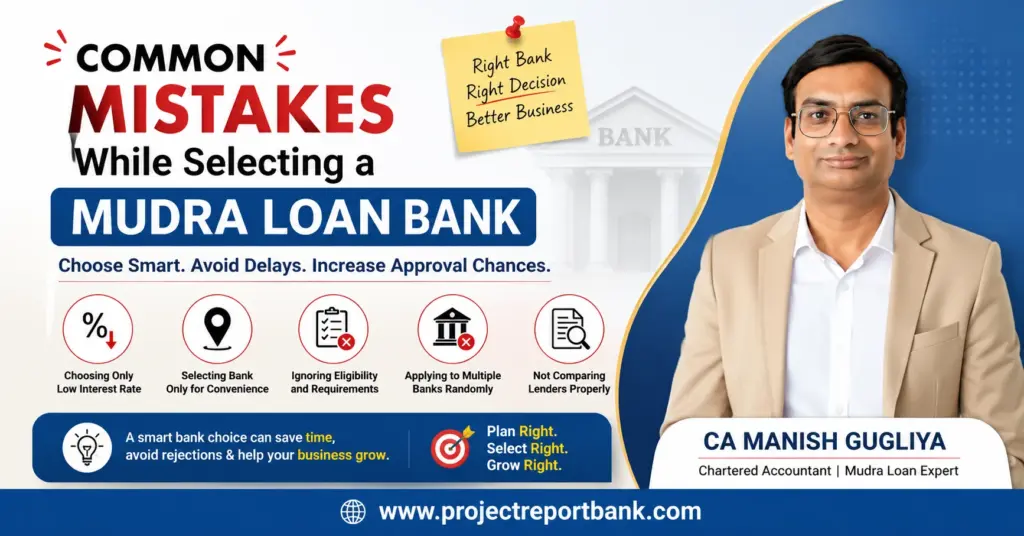
Common Mistakes While Choosing a Mudra Loan Lender
Avoid these errors:
- Assuming only government banks can sanction Mudra loans – ignoring private banks, SFBs, RRBs, NBFCs or MFIs that might be more suitable
- Assuming every bank or NBFC will provide Mudra loans – just because they fall under an eligible category in PMMY notifications
- Randomly applying to several institutions – without understanding each one’s documentation norms, risk appetite, ticket size preference or business focus
- Ignoring existing banking relationships – bypassing your own bank and going to a distant branch on someone’s advice, missing the benefit of known transaction history
- Comparing only interest rates – while ignoring processing fees, penal charges, repayment frequency and service quality
- Giving different financial figures to different lenders – inconsistency in turnover, profit or capital figures is easily detected and damages credibility
- Trusting agents who promise guaranteed Mudra loans – in return for hefty upfront fees; deal directly with the institution or through trusted professionals
- Applying without a clear business plan – or without understanding prior rejection reasons – wastes time across multiple institutions
Frequently Asked Questions
Which banks can sanction Mudra loans?
Mudra loans under PMMY can be sanctioned by participating scheduled commercial banks – both public sector and private sector – as well as Regional Rural Banks and small finance banks that have adopted Mudra loan products as per current government and RBI guidelines. There is no single fixed list because participation can change over time. Borrowers should verify with individual banks or official PMMY resources to confirm current availability.
Can cooperative banks and MFIs provide Mudra loans?
Certain eligible cooperative banks and Microfinance Institutions are part of the Mudra ecosystem and may provide Mudra-linked loans, especially for very small and local enterprises. However, not every cooperative bank or MFI automatically participates. Borrowers must confirm the current PMMY tie-up and product availability with the specific institution in their area.
Is MUDRA responsible if a bank rejects my Mudra loan application?
MUDRA is not the sanctioning authority for individual loans. It provides refinance and guidelines to lenders, but each bank, NBFC or MFI independently appraises and decides on applications. Any grievance about processing delays or unfair treatment should first be raised with the concerned bank’s branch, then escalated within that bank’s grievance redressal system, and only then – if needed – to higher regulatory or ombudsman channels.
Does every branch of a participating bank handle Mudra loans?
Even when a bank is part of PMMY, some branches may focus more on retail banking, others on MSME credit, and not all may actively source or process Mudra loans at all times. Applicants should confirm at the branch whether Mudra applications are accepted there, and if not, request guidance on the nearest branch or MSME cell authorised to handle such cases.
Which financial institution is “best” for a Mudra loan?
There is no universally best lender. The ideal institution depends on the borrower’s business profile, loan size, documentation strength, existing relationship, location and comfort with the lender’s processes and terms. Shortlist and compare a few suitable institutions – for example, your existing bank, a nearby RRB or SFB, and possibly an NBFC or MFI – instead of relying on generic recommendations or hearsay. The credit availed must be suited to your development and funding needs, and the lender must understand your stage of growth.
Conclusion
Mudra loans under Pradhan Mantri Mudra Yojana are not restricted to a single type of bank. They can be sanctioned by various eligible financial institutions – including public and private sector banks, Regional Rural Banks, small finance banks, participating cooperative banks, NBFCs and MFIs – subject to current PMMY and regulatory guidelines.
The key distinction remains: an institution being eligible to participate in PMMY is not the same as an individual applicant actually obtaining a sanctioned Mudra loan. Sanction depends on business viability, repayment capacity, documentation and the lender’s internal credit norms. MUDRA itself does not directly lend to retail borrowers – it supports and refinances the network of participating institutions that actually process and sanction the loan extended to the borrower.
Instead of chasing “guaranteed Mudra loans,” entrepreneurs in India should prepare a realistic business proposal, maintain good financial discipline and approach a suitable eligible lender where their business profile and banking relationship are properly understood. That remains the most reliable path to obtaining the funding and financial assistance your enterprise needs.
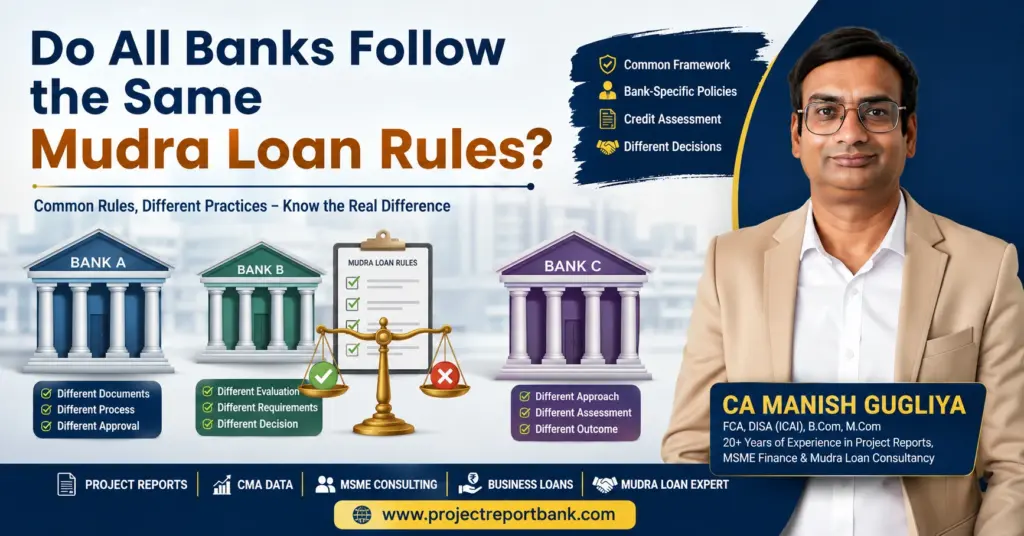
- Do All Banks Follow the Same Mudra Loan Rules?

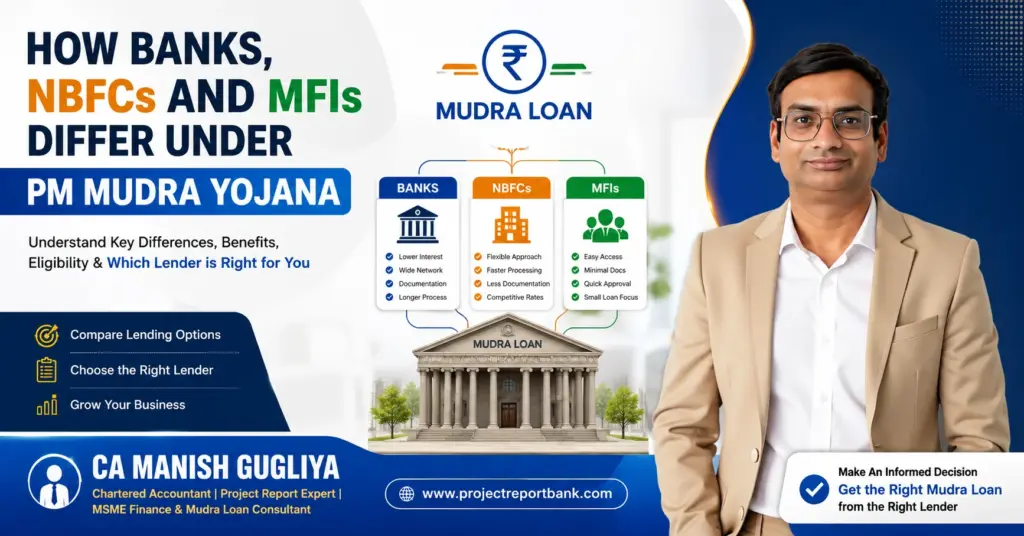
- Banks vs NBFCs vs MFIs for Mudra Loan: Which is Best for Your Business in 2026?
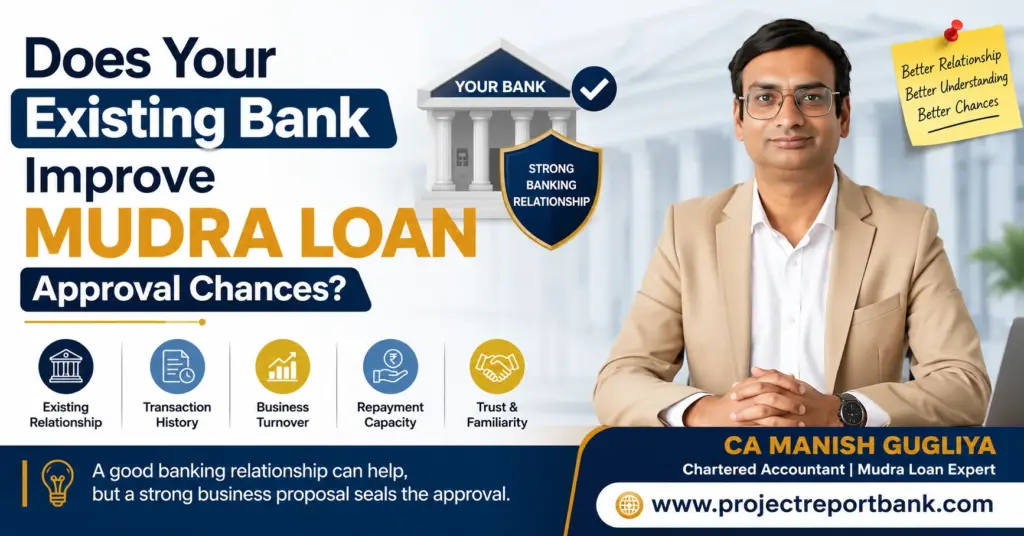
- Does Your Existing Bank Improve Mudra Loan Approval Chances?
- Common Mistakes While Selecting a Mudra Loan Bank – Practical Guide by CA Manish Gugliya
- What to Check Before Choosing a Mudra Loan Lender

- How to Find Participating Mudra Loan Banks in India
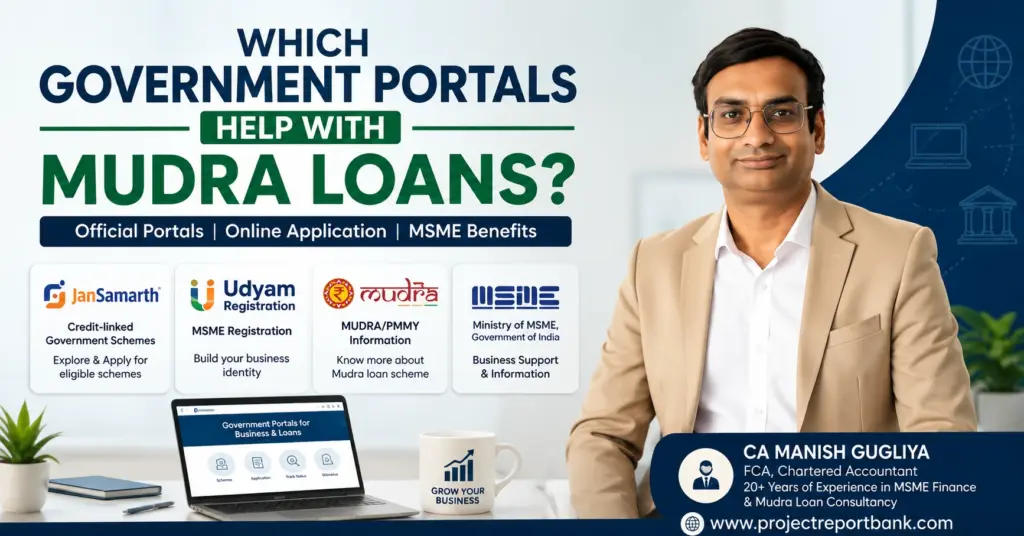
- Which Government Portals Help with Mudra Loans?
- Which Financial Institutions Can Sanction Mudra Loans?
- Bank vs NBFC for Mudra Loan: Which Is Better for Small Business Owners?