Key Takeaways
- Mudra loans under Pradhan Mantri Mudra Yojana share a common government scheme framework, but each bank or financial institution applies its own internal credit policy, risk assessment and documentation standards.
- Satisfying basic eligibility criteria gives you the right to apply – not a guaranteed sanction from every lender.
- Loan amount, documents demanded, interest rates and final approval can differ from one bank to another based on business viability, cash flow and repayment capacity.
- Different decisions by different banks do not automatically mean someone is violating mudra loan rules; it is often normal credit judgement.
- This article is written from the professional experience of CA Manish Gugliya for Indian micro and small business owners.
Introduction: Why Two Banks Treat the Same Mudra Loan Application Differently
A small trader in Jaipur approaches Bank A for a mudra loan and is asked for GST returns, a project report and other documents. His friend with a similar business goes to Bank B and is asked mainly for a bank statement and Aadhaar-PAN. Both banks officially offer loans under Pradhan Mantri Mudra Yojana, launched in April 2015 by the government of India to provide financial support to non corporate micro enterprises engaged in income-generating activities.
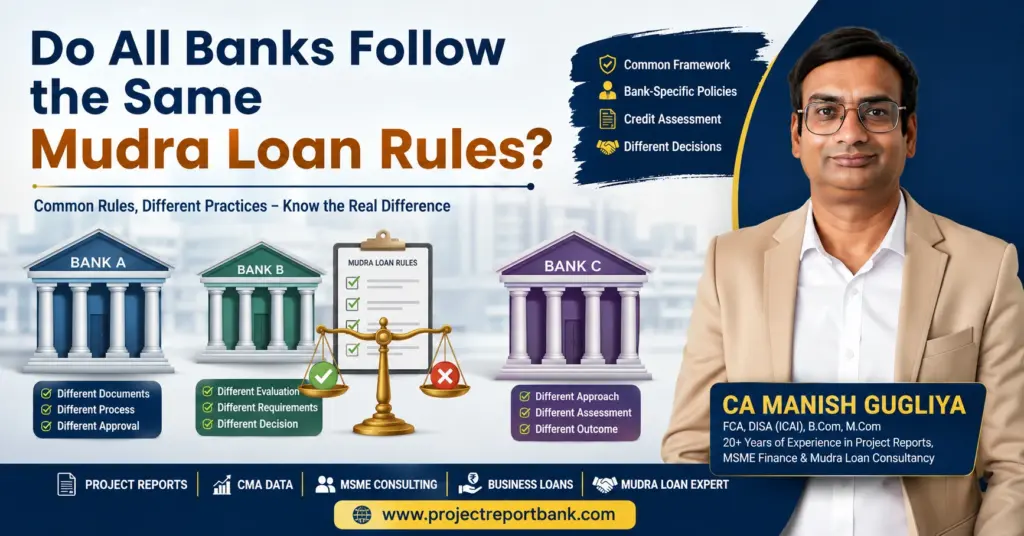
So do all banks follow the same mudra loan rules, or can they do whatever they want? The answer is nuanced. There is a common PMMY framework, but each bank’s internal credit policy, risk appetite and documentation approach can create very different borrower experiences.
Are Mudra Loan Rules the Same for Every Bank?
No. Mudra loan rules in India share a common scheme framework, but individual lenders maintain their own mudra loan bank policy and appraisal methods:
- Scheme-level rules – loan categories, maximum loan amount, collateral norms – are common.
- Regulatory requirements under RBI and government guidelines must be followed by all.
- But mudra loan approval rules such as how risk is measured or how much loan is actually sanctioned are part of each bank’s credit process.
Example: Two banks may agree a kirana shop is eligible under PMMY, but one may approve ₹3 lakh and another only ₹2 lakh based on their own view of sales and repayment capacity. Eligibility to apply is different from the right to get the loan.
In my 20+ years of MSME finance practice, I regularly see different decisions from different banks on the same applicant – without any rule being broken.
Table of Contents
What Mudra Loan Rules Are Generally Common Across Banks?
The PMMY framework for loan categories and collateral-free nature is uniform nationwide. Here is what all participating lenders share:
- Eligible borrowers: Individual borrowers running or starting non corporate micro enterprises – proprietorships, partnerships, small manufacturers, traders, services sectors providers, and those in allied agricultural activities. The applicant must not be in default to any bank or financial institution.
- Eligible purposes: Business loan for working capital, purchase of capital assets like machinery or equipment, vehicles for commercial use, shop renovation – all must be income-generating. Employment creation is a core scheme objective. Purely personal consumption is not permitted.
- Loan categories: Mudra Yojana classifies loans into three categories plus a newer fourth – Shishu (up to ₹50,000), Kishor (₹50,001 to ₹5,00,000), Tarun (₹5,00,001 to ₹10,00,000), and Tarun Plus (₹10,00,001 to ₹20,00,000) for borrowers who have successfully repaid previous loans under Tarun. Loans up to ₹10,00,000 are available under PMMY, and Mudra Yojana provides loans up to ₹20 lakh through Tarun Plus. Shishu loans are sanctioned up to ₹50,000, Kishore loans range from ₹50,001 to ₹5,00,000, and Tarun loans range from ₹5,00,001 to ₹10,00,000.
- Collateral: No collateral is required for loans up to ₹10 lakh. Banks may still require primary security such as hypothecation of assets created from the loan.
- Regulatory obligations: Basic KYC requirements are universal for PMMY loans. Fair lending practices, transparent communication, proper documentation and record-keeping are common regulatory expectations from RBI – not preferences of an individual branch.
These common elements define the broad mudra loan lending guidelines, but leave space for each bank to decide how to appraise individual cases.
What Can Differ From One Bank to Another?
This is where most confusion arises. Borrowers see different mudra loan bank requirements and assume one bank must be wrong. Often, both are operating within their own credit policy.
- Internal credit policy: Every bank has its own policy defining preferred sectors, exposure limits and risk parameters. For instance, IDBI Bank requires nil margin for loans up to ₹50,000 but 25% margin beyond that.
- Risk appetite: Some lenders are comfortable financing transport or trading businesses; others are conservative. This is legitimate risk management, not a change in scheme rules.
- Credit assessment: Lenders check existing loans, CIBIL score, banking habits, GST returns, turnover, profit margins and cash flow. Different lenders may interpret the same data differently. An applicant’s credit needs are assessed based on the lender’s own models.
- Documentation: Mudra loan documents required by banks can vary. One may insist on ITR for 2–3 years; another may accept CA-certified income or bank statements. Banks have discretion over lending terms such as interest rates and documentation requirements.
- Interest rates and fees: Interest rates for mudra loans are deregulated and not fixed – they vary by lender. Processing fees may vary based on the lending institution’s policies. Bank of Baroda, for example, offers different fee structures and moratorium periods by loan bracket.
- Loan amount assessment: Asking for ₹8 lakh does not mean every bank must sanction ₹8 lakh. Lenders rework project cost, margin money and working capital requirement at their sole discretion based on current income and cash flow.
- Processing: Some banks sanction Shishu Kishor loans at branch level; others route even small cases to regional offices. This affects speed and questions asked.
These bank-specific variations explain why borrowers experience different mudra loan approval rules under one national scheme.
Why Can Two Banks Give Different Decisions on the Same Mudra Loan Application?
A micro manufacturing unit needs ₹9 lakh under Tarun for machinery and working capital:
- Bank A accepts projections, sees similar units performing well, sanctions ₹8.5 lakh.
- Bank B considers projected sales optimistic, notes irregular banking transactions, sanctions only ₹5 lakh.
- Bank C declines, citing high existing liabilities and low credit score.
All three can still be following mudra loan guidelines for banks. The framework allows each to take its own risk call. A rejection is not proof that the bank is ignoring PMMY guidelines – it may indicate genuine concerns about repayment capacity. Always ask for the specific reason so you can improve before approaching another lender.
Government Scheme Rules vs Bank Credit Policy
| Area | Common Scheme/Regulatory Framework | Bank-Specific Assessment |
|---|---|---|
| Basic eligibility | Who can apply under PMMY | Who the bank prefers to finance based on internal filters |
| Business activity | Permitted activities (manufacturing, trading, services) | Sectors the bank is cautious about |
| Loan purpose | Scheme-allowed purposes for proposed activity | How strictly proof of purpose is verified |
| Documentation | Mandatory KYC, application form, identity and address proof | Extra financials, quotations, utility bills, licences |
| Credit score | No fixed PMMY score requirement | Each bank’s minimum CIBIL or internal rating |
| Business viability | Scheme goal of supporting micro units | Bank’s own analysis of turnover, profit and cash flow |
| Repayment capacity | General principle | Bank-specific EMI-to-income limits |
| Loan amount | Overall ceiling (₹10 lakh / ₹20 lakh for Tarun Plus) | Bank’s comfort on ticket size based on financials |
| Security | No collateral requirement up to ₹10 lakh | Primary security details and guarantee coverage |
| Approval process | Regulatory guidelines on fair practices | Bank’s own delegation and workflow |
| Risk assessment | Broad prudential norms | Detailed internal risk models |
| Final sanction | No guarantee in scheme | Bank’s independent decision |
Can Banks Set Their Own Mudra Loan Rules?
Banks cannot override statutory or regulatory mudra loan lending guidelines. But they can and must frame internal credit policies within that framework:
- Mandatory requirements: Following KYC norms, not insisting on collateral for eligible loans up to ₹10 lakh, applying fair lending practices.
- Reasonable internal credit requirement: Asking for 15–25% promoter contribution for machinery loans, requiring 6–12 months bank statements, insisting on a project report. These are not violations – they are responsible credit appraisal.
- Potentially questionable practices: Insisting on buying unrelated products as a condition for sanction, demanding collateral contrary to applicable PMMY norms, or charging unauthorized fees. Document such conduct and seek clarification.
Distinguish between tough but genuine appraisal and an actual deviation from rules.
Can Different Banks Ask for Different Documents?
Yes. Documentation varies by business type (a new manufacturing unit needs quotations and licences; a trader mainly needs GST returns and bank statements), by loan amount (Shishu requires lighter documentation than Tarun), by constitution (proprietorship vs partnership deed vs board resolution), and by existing relationship (your bank already has KYC on record).
Keep standard items ready – KYC, address proof, financials, quotations, application form, educational qualification certificates if applicable, and relevant proof of business. This minimises back-and-forth regardless of which lender you approach.
Do Public Sector and Private Banks Follow Different Mudra Rules?
Scheme-level rules are the same. But public sector banks may have wider branch networks and larger Mudra targets, while private banks may use centralised processing and stricter screening. Internal credit policy, risk appetite and documentation styles differ, leading to different borrower experiences under the same mudra yojana. Some public sector banks may be more open to first-time tiny borrowers for Shishu loans; some private banks focus on existing account holders.
What About Banks, NBFCs and MFIs Under Mudra?
Mudra refinancing covers scheduled commercial banks, regional rural banks, small finance banks, NBFCs and MFIs. MUDRA acts as a refinance agency through SIDBI. The core scheme guidelines are aligned, but on-ground models differ – banks prefer term loan and working capital limits; NBFCs may use field-based models; MFIs focus on very small ticket loans. Same scheme does not mean identical interest rates, processing fees or collection methods. Each financial institution operates within broad regulatory limits. Eligible borrowers should verify the lender type before assuming identical terms.
How Do You Know Which Institutions Can Provide Mudra Loans?
Not every finance company automatically provides mudra loans. Verify that the institution is a recognised PMMY participating lender – scheduled commercial banks, eligible NBFCs, small finance banks, MFIs. Confirm at the branch whether the loan extended is actually under Pradhan Mantri Mudra Yojana or a generic business loan with different rules.
Does Your Existing Bank Treat Your Application Differently?
An existing account gives the bank transaction history, deposit patterns and cheque return data – an information advantage. This can reduce initial document requests and speed up verification. But it does not create a right to automatic approval. A trader with a satisfactory credit track record and regular GST payments may get smoother processing, while another applicant with poor account conduct at the same bank may still face rejection.
How Should You Choose a Bank for Mudra Loan?
Selecting a lender only because “someone got easy approval there” is risky. Consider:
- Whether the institution is a recognised PMMY-participating lender
- Your existing relationship and transaction history
- Branch accessibility and typical processing speed
- Match between your business profile and the bank’s comfort with your sector
- Your documentation readiness and funding needs
A well-prepared, realistic application matters more than the name of the bank.
What If a Bank Appears to Ignore Applicable Mudra Loan Guidelines?
Not every unfavourable decision is a violation. Distinguish between a genuine negative credit decision, a request for clarification, and a serious compliance issue.
Normal situations: Requesting more proof of turnover, suggesting a lower loan amount, asking for a revised project report.
Red flags: Staff claiming Mudra cannot cover any service business, demanding collateral for eligible loans without explanation, insisting on unrelated product purchases.
If concerned, ask for written reasons, escalate to regional office, and consider formal complaint channels if clear deviations exist.
Common Misunderstandings About Mudra Loan Bank Rules
- Myth: Every bank must approve my loan if I am eligible. Reality: Approval depends on each bank’s credit appraisal and repayment capacity assessment.
- Myth: All banks must ask for the same following documents. Reality: Documents vary by lender, borrower profile and loan category.
- Myth: If one bank rejects, all others will reject. Reality: Rejection is a signal to improve your case, not the final word.
- Myth: If Bank A sanctions ₹10 lakh, Bank B must sanction the same. Reality: Sanction amount depends on justified project cost and income.
- Myth: Any extra document requested violates Mudra rules. Reality: Banks can seek relevant additional documents for proper assessment.
- Myth: Mudra loan means free money with no appraisal. Reality: These are normal bank loans – not subsidies or grants – availed under a government scheme. Financial assistance requires proper credit evaluation.
Practical Example – Same Applicant, Three Different Banks
A small plastic components manufacturer in Indore needs ₹7.5 lakh for machinery plus working capital:
- Bank A: Satisfied with promoter experience and order book. Asks for quotations and a project report. Sanctions nearly the full amount.
- Bank B: Finds projected turnover high compared to past ITRs. Suggests lowering the loan amount to ₹5 lakh with higher promoter contribution. Covers the loan under Kishor category.
- Bank C: Identifies past delays in previous loans and multiple cheque bounces. Declines despite receiving the same documents.
All three decisions remain within mudra loan bank rules. The PMMY framework allows each lender to interpret risk based on its own policy and experience. The stage of growth and financial history of the beneficiary micro unit matter more than which bank you walk into.
What Should You Do If One Bank Rejects Your Mudra Loan?
- Get the real reason – ask clearly and obtain written reasons if possible.
- Review documentation – check whether KYC, financials, quotations and proof of business were complete.
- Recheck project cost – compare requested amount with realistic funding and working capital need.
- Analyse income and liabilities – look at existing EMIs, monthly cash surplus and whether your repayment capacity supports the EMI.
- Strengthen your project report – use professional help for realistic projections. Ensure turnover assumptions match your business model.
- Then approach another suitable lender – with improved documents, targeting a participating bank or NBFC where your profile fits. The next phase of your application should address weaknesses from the first attempt.
Role of Business Viability and Financial Discipline
Irrespective of which lender you approach, strong business viability and financial discipline determine mudra loan outcomes. Lenders check turnover and margin trends, net profit, seasonality of sales, and reasonableness of projections. They want to see regular EMI payments on existing loans, minimal cheque bounces, timely GST and income tax filing, and business cash flowing through banking channels. A financially sound case with necessary skills documented clearly succeeds across most banks. Small businesses with weak proposals struggle everywhere.
Expert Guidance by CA Manish Gugliya
Many entrepreneurs spend months searching for the “easiest” bank instead of strengthening their project. In my experience, a strong application withstands different credit appraisals. A common lending framework does not mean an identical lending decision – each bank’s credit committee uses judgement based on its reference point for risk.
Focus on correctly estimating project cost, preparing realistic projections, keeping finances disciplined, and organising all documents clearly. Treat a bank’s questions as an opportunity to improve, not as personal rejection. I never guarantee approval or a specific loan amount – my role is helping borrowers present transparent, realistic and policy-compliant cases. Understanding the difference between scheme rules and bank-specific credit judgment is essential for navigating mudra loan application rules successfully.
Frequently Asked Questions
Do all banks follow the same Mudra Loan rules?
Scheme and regulatory rules are broadly common – loan categories, collateral norms, eligible purposes. But internal policies, documentation requirements, credit score thresholds and sanction decisions differ from one lender to another. Lenders apply their own internal credit evaluation methods for PMMY loans.
Can one bank reject a Mudra Loan that another bank approves?
Yes. Different banks can reasonably assess risk differently based on their own analysis of your business viability, cash flow and existing liabilities. Rejection by one bank does not mean all will reject, nor does it prove any rule was violated.
Does every bank charge the same interest rate on Mudra Loans?
No. Interest rates for PMMY loans are not fixed and vary by lender. They depend on the bank’s lending rate, your risk profile, loan category and amount. Always compare terms before finalising.
Can I apply at multiple banks simultaneously?
You can approach different financial institutions, but submitting the same weak application repeatedly wastes time. First understand why an earlier application was rejected, correct the weaknesses, and then approach a suitable participating lender with an improved proposal.
Is Mudra Loan only for new businesses?
No. Both new and existing micro enterprises can apply. PMMY loans are available for eligible non-farm micro enterprises and allied agricultural activities at any stage – whether starting, expanding or managing working capital needs of an existing business.
- Do All Banks Follow the Same Mudra Loan Rules?

- Banks vs NBFCs vs MFIs for Mudra Loan: Which is Best for Your Business in 2026?

- Does Your Existing Bank Improve Mudra Loan Approval Chances?

- Common Mistakes While Selecting a Mudra Loan Bank – Practical Guide by CA Manish Gugliya

- What to Check Before Choosing a Mudra Loan Lender

- How to Find Participating Mudra Loan Banks in India

- Which Government Portals Help with Mudra Loans?

- Which Financial Institutions Can Sanction Mudra Loans?

- Bank vs NBFC for Mudra Loan: Which Is Better for Small Business Owners?