Key Takeaways
- Wrong bank selection for a Mudra Loan can delay or derail sanction even if your business idea and project report are otherwise workable.
- Applicants frequently choose a lender based only on distance, brand name, or a friend’s opinion, ignoring their own business profile, documentation readiness, and banking conduct.
- Factors like existing banking relationship, required loan amount, nature of business activity, and working capital needs must be evaluated before selecting a Mudra Loan bank.
- Interest rates matter, but total terms, processing approach, charges, and communication quality are equally important in choosing the right bank for a Mudra Loan.
- There is no single “best” Mudra Loan bank for everyone. Selection should be based on fit between your proposal and the lender’s way of working.
Introduction: Why Bank Selection for Mudra Loan Is Often an Afterthought
In my 20+ years of working with MSME finance, project reports, and CMA data preparation, I have observed a recurring pattern. Mudra Loan applicants spend weeks collecting quotations, arranging KYC documents, and preparing their project report-but give almost no thought to which bank or financial institution they should actually approach.
Pradhan Mantri Mudra Yojana (PMMY) provides collateral-free loans up to ₹10 lakh for non corporate micro enterprises engaged in the non farm sector, covering loans for manufacturing, trading and services activities. Mudra loans support micro enterprises in the non-farm sector and are available through various financial institutions. Yet, selecting the right lender remains one of the most overlooked steps.
Consider these real scenarios:
- A trader picks the nearest branch simply because it is at the corner of the market-even though that branch rarely handles PMMY proposals.
- A service provider approaches a bank because a neighbour said “loan mil gaya yahan se,” without checking if the same branch is comfortable with a different business type.
- A small manufacturer chases the lowest advertised interest rate without understanding repayment terms, processing charges, or tenure flexibility.
Bank selection should be based on your own profile: business activity, turnover, banking behaviour, loan amount required, and readiness of documentation. No bank can guarantee approval. Sanction always depends on eligibility criteria, credit assessment, and the strength of your proposal.

Table of Contents
Why Bank Selection Matters in a Mudra Loan Application
Under Pradhan Mantri Mudra Yojana, many types of institutions participate as lenders. Authorized lending institutions include public banks, private banks, and NBFCs, along with Regional Rural Banks (RRBs), small finance banks, and MFIs. But not all are equally suitable for every borrower or every business type.
Here is why your choice of lender matters:
- Business activity fit: How the bank views your line of business-whether trading, manufacturing, or services-affects how smoothly your application is assessed.
- Transaction history: A bank where you already maintain your current account can see your cash flow patterns and turnover directly.
- Loan structure comfort: Whether the lender is comfortable structuring your requirement as a term loan, working capital finance, or a combination under the Mudra cap of ₹10 lakh.
- Branch-level experience: Internal processes, staff familiarity with MSME proposals, and workload vary from branch to branch-even within the same bank.
It is important to understand that MUDRA is a refinancing agency, not a direct lender. The actual loan is extended by participating financial institutions. This means each lender applies its own credit assessment norms.
Choosing a reasonably suitable bank does not ensure sanction. But choosing a clearly unsuitable bank or branch can easily cause delays, repeated queries, or rejection of an otherwise viable proposal.
Common Mistakes While Selecting a Mudra Loan Bank
This is the core section of this article. Each sub-section below covers one specific mistake in detail, drawn from real-life observations in Mudra Loan consultancy, project report preparation, and MSME finance work.
Before diving in, a quick context: Mudra loans are available for non-corporate micro enterprises in three main categories-Shishu loans are for amounts up to ₹50,000, Kishore loans range from ₹50,001 to ₹5,00,000, and Tarun loans range from ₹5,00,001 to ₹10,00,000. A Tarun Plus category (Tarun+ loans range from ₹10,00,001 to ₹20,00,000) was introduced in October 2024 for eligible borrowers at the next phase of their stage of growth development. Not understanding loan categories can lead to wrong choices during bank selection.
The focus here is on how applicants choose the bank or lender-not on general scheme features-except where they directly affect bank selection.
Mistake 1: Choosing a Bank Only Because It Is Nearby
Convenience of location helps with regular visits and document submission, but should never be the sole deciding factor.
A small workshop owner picking the nearest branch-even though that branch rarely handles MSME or PMMY proposals-often faces repeated delays, incomplete guidance, and frustration. The branch staff may not be familiar with Mudra Loan documentation requirements for your proposed activity.
Before treating location as an advantage, first check whether that nearby branch actively processes Mudra Loans, understands PMMY documentation, and is comfortable with your type of business.
Mistake 2: Selecting a Bank Only on the Basis of Interest Rate
Many applicants ask only one question: “What is the Mudra Loan interest rate here?” Interest rates for Mudra loans range from approximately 9.05% to 21% depending on lender type and borrower profile. Interest rates are deregulated for Mudra loans, meaning each lender sets its own rate.
But interest alone does not determine the true cost. Failing to compare interest rates may result in higher costs, and not checking for hidden fees can increase overall loan expenses. Although MUDRA loans have no processing fees as per official guidelines, some lenders may apply other charges.
Other elements to compare:
- Prepayment or foreclosure conditions
- Repayment tenure flexibility (3 years vs 5 years vs 7 years)
- Insurance or account maintenance fees
- Requirement of guarantor
A slightly higher interest rate with better tenure and fewer hidden charges can sometimes be more suitable than the “cheapest” looking offer. Ignoring the repayment terms can cause financial strain later.
Mistake 3: Ignoring Your Existing Banking Relationship
Many proprietors walk into a completely new bank for a Mudra Loan without even discussing with their primary banker-where they maintain their current account and route their main transactions.
Your existing bank already has 6–12 months of bank statements. They can see turnover, cash flow patterns, and your adherence to minimum balance and cheque handling norms. This supports their credit assessment significantly.
An existing account does not mean automatic sanction. The business must still meet eligibility criteria, demonstrate repayment capacity, and submit complete documentation. But starting with your current bank, especially for moderate amounts like ₹2–5 lakh, is often a practical first step.
Mistake 4: Assuming Every Bank or Branch Handles Mudra Loans the Same Way
While broad PMMY guidelines are common, branch-level experience varies greatly. One branch regularly processes Shishu and Kishor loans for traders and service providers, while another branch mostly handles retail products and seldom touches Mudra Loans.
Choosing a bank familiar with one’s business type can improve application chances. Observe how clearly staff explain documentation requirements, how they respond to questions, and whether they seem familiar with Pradhan Mantri Mudra Yojana processes. These differences reflect experience and workload-not rule-bending-and should factor into your selection.
Mistake 5: Applying Without Checking Whether the Lender Participates in Mudra Loans
Some applicants approach any nearby institution or NBFC assuming it must offer Mudra Loans. Only notified participating banks, NBFCs, MFIs, RRBs, and small finance banks are authorised to extend Mudra Loans under PMMY guidelines. You can check the list of participating Mudra Loan banks and lenders to understand which institutions are generally eligible.
Verifying lender eligibility before preparing and submitting a detailed file saves significant time and avoids confusion.
Mistake 6: Applying to Multiple Banks Randomly
Some applicants submit applications to several banks at once without tracking which bank asked for what documents or where follow-up is pending.
Multiple applications are not automatically prohibited. But random submissions create confusion, inconsistent information, and a poor impression if different data is given to each lender.
Maintain a simple record: date of application, bank/branch, loan amount requested, and current status. Focus on 2–3 well-chosen lenders instead of approaching every bank in the market. Quality and consistency of information matter more than sheer volume.
Mistake 7: Ignoring the Difference Between Banks and NBFCs
Commercial banks (public sector, private, RRBs, small finance banks) and NBFCs differ in how they process Mudra Loans. Interest rates, processing approach, repayment terms, and customer support can vary significantly.
Applicants should understand who they are borrowing from and compare suitability, terms, and product offerings. A detailed comparison is available in the guide on Bank vs NBFC for Mudra Loan. Neither type is universally better-suitability depends on your business profile and expectations.
Mistake 8: Assuming Public Sector Banks Are Always Better
Many applicants believe only public sector banks give “genuine” Mudra Loans because PMMY is a government scheme launched for financial assistance to small and micro enterprises. Both public and private banks follow RBI and government guidelines. Actual experience depends on specific branch, staff, and internal processes.
Public sector banks often have wide rural reach and long MSME history. Private banks may offer more digital processes and quicker communication. Read more about public sector bank vs private bank for Mudra Loan before deciding.
Mistake 9: Not Comparing Lenders Before Applying
Many applicants walk into the first bank they find without basic comparison. Candidates should compare interest rates across various lenders before applying.
A simple pre-comparison approach:
- Confirm whether the bank actively lends under PMMY
- Check the indicative interest band for your category
- Ask about documentation for your specific business type
- Understand typical processing time
For a more structured approach, refer to the guide on how to choose a Mudra Loan lender. Call or visit 2–3 shortlisted lenders, make brief notes, then take an informed decision.
Mistake 10: Believing a Famous Bank Means Easier Approval
Large or nationally famous banks are often assumed to be more likely to approve any loan. This is not accurate.
Such banks still evaluate proposals strictly on business viability, credit history, existing obligations, and compliance with PMMY guidelines. A small trader expecting easy approval at a well-known private bank but getting queried heavily because transaction records and GST filings are weak is a common scenario. Brand size does not replace proper documentation and a sensible business plan.
Mistake 11: Ignoring Business Stability
From a banker’s perspective, stability of business operations-how long the firm has been running, continuity of location, and consistency of sales-gives comfort on repayment. Lenders assess credit history and repayment capacity for MUDRA loans as part of standard appraisal.
Applicants sometimes shift addresses frequently or operate informally without basic registrations, then expect the bank to overlook this. Read more about business stability and Mudra Loan approval to understand what lenders typically look for. Regularise your business status before or alongside bank selection.
Mistake 12: Ignoring Financial Discipline
Many borrowers overlook their credit score before applying. Banks place significant weight on banking conduct: cheque returns, minimum balance adherence, EMI payments on existing loans, and overall cleanliness of bank statements. A satisfactory credit track record strengthens your case regardless of which lender you approach.
Changing banks will not hide recent financial indiscipline; most lenders use bureau reports and may request statements from other banks. Learn more about how financial discipline improves Mudra Loan approval. Improving financial discipline must go hand-in-hand with lender selection.
Mistake 13: Selecting a Bank Before Understanding the Required Loan Amount
Some applicants choose the bank first and then ask the banker: “Kitna loan mil sakta hai?” instead of calculating the realistic requirement based on project cost and working capital needs.
You should estimate how much is needed for machinery, equipment, furniture, initial stock, and minimum working capital before visiting banks. A maximum loan of upto Rs 10 lakh is available under Mudra, and Mudra loans up to ₹10 lakh require no collateral security.
Refer to proper project costing for Mudra Loan approval to understand how to arrive at a logical loan amount. Once the requirement is clear-say, ₹4.80 lakh term loan plus ₹1.20 lakh working capital-bank comparison becomes more meaningful.
Mistake 14: Assuming a Bank Will Decide the Entire Project Cost for You
Many entrepreneurs expect the bank to tell them the exact machinery cost, renovation budget, and working capital requirement. Banks expect the applicant to bring a reasonably worked-out project cost supported by supplier quotations, rental estimates, and realistic working capital calculations.
A CA-prepared project report or a well-structured internal estimate helps you confidently discuss project cost with any lender. Relying fully on the bank to size your project makes it harder to compare lenders, because you have no fixed reference point for what you actually need. This also affects how the loan extended to your beneficiary micro unit is structured.
Mistake 15: Ignoring the Quality of the Business Proposal
Some applicants believe bank selection alone will solve everything, even if their business model is unclear, sales assumptions are unrealistic, or profitability is poorly calculated.
A good bank cannot convert a vague proposal into a strong one. Key components that must be clear include:
- Description of business activity and target market
- Projected monthly and annual sales
- Expected gross margin and fixed expenses
- Working capital cycle and cash flow projections
- EMIs under the requested loan amount
Prepare at least 1–3 years of basic projections so that whichever bank you approach can understand the proposal clearly. Your income generation assumptions and capital assets requirements should be realistic.
Mistake 16: Choosing a Bank Based Only on Another Borrower’s Experience
A friend’s approval at a particular branch does not mean the same outcome for you if you have a different business type, turnover, or credit history.
A long-standing customer with clean statements and GST returns may get smooth sanction. A new startup with no track record may require more scrutiny at the same branch. Use others’ experiences as a reference point, not as the sole basis for your decision. Every individual borrowers situation is assessed based on their own merits.
Mistake 17: Believing a Bank Recommendation Guarantees Approval
Recommendations from friends, relatives, agents, or even existing staff cannot replace formal credit appraisal. The bank’s sanctioning authority makes the final decision at its sole discretion based on credit policy.
Some applicants treat an introduction to a branch manager as a guarantee, leading to disappointment when the file is later declined on genuine policy or credit grounds. Complete documentation is essential to avoid delays in loan processing-recommendations cannot substitute for it.
Mistake 18: Ignoring Communication and Accessibility
Smooth communication with the chosen bank or branch is critical during Mudra Loan processing, especially when clarifications or additional documents are requested.
Notice how the branch responds to early queries: whether staff explain requirements in simple terms, whether they share a clear list of documents, and whether follow-ups are handled politely. Where possible, choose a bank where you can easily visit, call, or receive email updates rather than only chasing a slightly lower rate with poor communication.
Mistake 19: Not Asking Questions Before Submitting the Application
Key questions applicants should ask before submitting:
- What KYC and business documents are required for my business type?
- Are GST returns or ITRs needed for the requested loan amount?
- What is the typical processing time at this branch?
- Can working capital plus term loan be combined under Mudra?
- Are there any applicable charges beyond the standard guidelines?
- Is there any educational qualification or necessary skills requirement?
Many applicants feel hesitant to ask and submit incomplete files, leading to repeated visits and frustration. A short, structured pre-application discussion clears expectations on both sides.
Mistake 20: Selecting the Bank Before Making the Application Bank-Ready
Some entrepreneurs spend weeks asking “Which bank is best for Mudra Loan?” while their own documentation is not ready.
Key items to prepare before finalising the bank:
- Identity and address proof (KYC)
- Business registrations (Udyam, GST where applicable)
- Last 6–12 months’ bank statements
- Income tax returns where applicable
- Vendor quotations for machinery or stock
- Simple project report with financial projections
- Details of previous loans (especially if you have successfully repaid previous loans)
A bank-ready file receives more structured and faster attention from lenders. Read the guide on how to improve your chances of Mudra Loan approval for a comprehensive preparation checklist.

Existing Bank vs New Bank: Which Should You Approach?
A common question from Mudra applicants is whether to approach their existing bank or look for a new one.
Existing bank advantages:
- Already has your account history, turnover, and cash flow data
- Communication may be simpler if branch staff know you
- Verification of banking conduct is straightforward
Existing bank limitations:
- Relationship alone does not guarantee approval
- If account conduct is weak, it may actually work against you
- Internal policy may not support your specific Mudra Loan structure
When a new bank may be suitable:
- Your existing bank does not actively lend under Mudra
- They are not comfortable with your line of business
- Processing is significantly slower compared to alternatives
Evaluate both options objectively. Start with your existing bank for clarity, but keep the option of approaching another appropriate participating lender if needed.
Public Sector Bank vs Private Bank vs Other Eligible Lender
Mudra Loans are availed through public sector banks, private banks, RRBs, small finance banks, and eligible NBFCs/MFIs. Each has its own strengths.
Practical comparison points:
- Branch network: Public sector banks typically have wider rural and semi-urban reach
- Digital processing: Some private and small finance banks offer better online tracking
- MSME familiarity: Certain public sector branches have decades of experience with micro units and credit needs of small borrowers
- Communication: Private banks may respond faster in urban centres
- Documentation practices: Can vary significantly by lender type
Avoid blanket statements like “only PSU bank is good” or “only private bank is fast.” Compare at the local level. See which lender suits your business profile, whether your proposed activity involves manufacturing trading or services, and your overall comfort level.
Actual terms-interest rates, charges, tenure-are governed by lender policy and RBI guidelines, and can differ across institutions even under the same PMMY framework. The scheme provides a structure, but the borrower must still be eligible under each lender’s assessment.
What Should You Check Before Selecting a Mudra Loan Bank?
Use this as a practical pre-selection checklist:
- ☐ Is the institution a participating PMMY lender?
- ☐ Does the lender handle my type of business activity?
- ☐ Is my required loan amount (within ₹10 lakh) within their comfort zone?
- ☐ Can they provide working capital support along with term loan if needed?
- ☐ Do I already have a useful banking relationship there?
- ☐ Have I compared applicable interest rates and charges?
- ☐ Do I understand the repayment structure and tenure?
- ☐ Is the branch accessible for regular communication?
- ☐ Is my project cost realistic and well-documented?
- ☐ Are my KYC, bank statements, and registrations complete?
- ☐ Do I have a simple project report or business plan ready?
- ☐ Can I explain my business, funding needs, and repayment plan confidently?
Review your answers before deciding the final bank or NBFC for your Mudra application.
A Practical Bank Selection Framework for Mudra Loans
Based on my practical experience, here is a step-by-step framework to guide applicants through Mudra Loan bank selection:
Step 1 – Determine your actual funding requirement. Calculate project cost, promoter contribution, and working capital need before approaching any lender.
Step 2 – Understand your business and borrower profile. Clarify your business type, stage of growth development and funding needs, turnover, and existing obligations.
Step 3 – Identify suitable participating lenders. Shortlist banks, NBFCs, or other eligible institutions active in your area under PMMY.
Step 4 – Check your existing banking relationship. Evaluate whether your current bank is a practical first option.
Step 5 – Compare relevant lender options. Look at interest rates, tenure, charges, documentation requirements, and processing approach.
Step 6 – Understand documentation and applicable terms. Clarify what each shortlisted lender requires for your specific business and loan category.
Step 7 – Prepare a strong project proposal. Get your project report, CMA data (where relevant), and financial projections ready. This helps for income generation planning and demonstrating repayment capacity.
Step 8 – Select the appropriate lender/branch. Based on Steps 1–7, make a considered choice.
Step 9 – Submit a complete application. Ensure all documents, quotations, and supporting papers are attached.
Step 10 – Maintain proper follow-up and records. Note date of application, reference number, contact person, and track every communication.
Wrong Approach vs Better Approach
| Wrong Approach | Better Approach |
|---|---|
| Choose the nearest bank without checking suitability | Evaluate whether the branch handles Mudra Loans and understands your business |
| Choose only the lowest advertised interest rate | Compare total lending terms including charges, tenure, and conditions |
| Follow a friend’s bank recommendation blindly | Evaluate your own profile, turnover, and documentation |
| Apply to many banks randomly | Follow a planned, documented lender-selection approach |
| Ignore your existing banking relationship | Consider your existing bank first where appropriate |
| Choose only by bank brand or size | Evaluate actual suitability for your business type and loan size |
| Prepare documents after applying | Prepare a complete, bank-ready file before approaching the lender |
| Depend only on verbal promises | Verify terms and charges through official channels |
| Estimate loan requirement roughly | Prepare realistic project costing with clear working capital calculations |
| Expect the bank to prepare your business case | Submit a well-supported proposal with quotations and projections |

How a Project Report Helps Before Choosing a Bank
A properly prepared project report gives clarity on project cost, means of finance, expected sales, expenses, and repayment capacity-even before the first bank visit.
Key components for a Mudra Loan project report:
- Total project cost and breakdown (machinery, furniture, assets created, renovation)
- Term loan vs working capital requirement
- Expected turnover and gross margins
- Operating expenses and overheads
- Projected EMI schedule and Debt Service Coverage Ratio (DSCR)
- Break-even analysis
The purpose is not to impress the bank with glossy documents. It is to ensure you have thought through your business model and can explain it confidently to any lender. The same project report can be discussed with multiple banks to see which is more comfortable with your proposal.
Many Mudra applications get delayed not because the bank is wrong, but because the proposal is unclear or unsupported by reasonable financial projections. A lender typically looks for a DSCR of about 1.25 or more, meaning your projected cash flow should comfortably cover EMIs.
Warning Signs When Selecting a Lender
Be cautious about:
- Unofficial “guarantees” of sanction from agents or intermediaries
- Demands for cash or commission outside normal bank charges
- Claims of “100% guaranteed Mudra Loan approval”
- Pressure to inflate or manipulate financial figures
- Requests to sign blank or incomplete forms
- Unclear or unexplained security demands
Genuine banks issue proper sanction letters, receipts, and acknowledgement of documents. Any insistence on only verbal communication or avoidance of written terms should raise concern. Verify information directly through the bank’s official channels before trusting third-party promises.
Walk away from arrangements involving misrepresentation or false documents-these can lead to serious legal and financial problems.
What If You Selected the Wrong Bank?
Sometimes, despite careful selection, you realise the chosen bank or branch is not handling your proposal effectively.
Steps to consider:
- Review current status calmly. What documents are pending? What queries have been raised? Are delays from the bank’s side or yours?
- Ask for clear feedback. Is the proposal fundamentally acceptable but stuck due to workload, or are there specific policy or credit reasons making sanction unlikely?
- Maintain written records. Keep emails, application numbers, and meeting notes before deciding your next step.
- Consider alternatives carefully. If feedback confirms the branch is not suitable, approach another participating lender with a refined proposal.
Delays do not always mean rejection. Read more about Mudra Loan delay in processing if you are facing extended waiting periods.
Expert Guidance from CA Manish Gugliya
In my experience working with MSME finance and Mudra Loan applications, I have seen a consistent pattern. Entrepreneurs spend considerable energy asking, “Which bank gives Mudra Loan easily?” while their own business plan, documents, and financial discipline are not yet in order.
The better questions to ask yourself are:
- Which lender fits my line of business and turnover level?
- Is my funding requirement (within the Mudra cap) realistic and well-calculated?
- Does my business stability and cash flow support the repayment I am proposing?
- Is my project report credible enough for any reasonable lender to understand?
- Have I selected the lender after comparison rather than assumption?
A suitable bank cannot convert a weak, confused proposal into a strong one. Bank selection and application preparation must work together. Employment creation potential and income generation capacity of your proposed activity matter to every lender.
I encourage borrowers to invest time in understanding their own numbers and documentation first. Then apply the bank selection principles discussed in this article. Searching endlessly for a universally “best” Mudra Loan bank is far less productive than preparing a bank-ready, honest application.
Frequently Asked Questions (FAQs)
Which bank is best for Mudra Loan under PMMY?
There is no single best bank for all applicants. Suitability depends on your business type, turnover, credit profile, location, and documentation level. Applicants should consider public sector banks, private banks, RRBs, small finance banks, and eligible NBFCs, then shortlist those that actively lend to businesses similar to theirs. Over 57 crore loan accounts have been sanctioned under PMMY across nearly 194 participating institutions of various types. Follow the bank selection framework discussed in this article rather than relying on generic recommendations.
Does having a low CIBIL score mean I should search for a “lenient” bank?
Most regulated lenders refer to credit history as part of Mudra Loan assessment, especially for higher ticket sizes like Kishor and Tarun category loans. Instead of hunting for a lenient bank, focus on understanding and improving your credit behaviour, clearing overdues where possible, and presenting complete and honest information. Shishu loans up to ₹50,000 may have lighter scrutiny in some cases, but no responsible institution can guarantee approval where credit issues are serious. Your eligibility is assessed based on multiple factors, not just one.
Can I change the bank after my Mudra Loan application is rejected?
Yes. If one bank formally declines your application, you can approach another participating lender. However, first understand the reasons for rejection. According to available data, over 30% of Mudra applications are rejected, with common causes including weak income relative to requested amount, inconsistent bank statements, and prior defaults. Address genuine issues before applying elsewhere-otherwise the same problems may repeat. Keeping a copy of the earlier application and noting the rejection reasons helps refine your proposal.
Does the size of my business turnover affect which Mudra bank I should choose?
Very small, early-stage units seeking Shishu loans may find certain branches or micro-focused institutions more comfortable, while slightly larger units seeking Kishor or Tarun amounts may benefit from banks experienced with MSME working capital and term loans. Allied agricultural activities and non farm activities may require different lender specialisations. Match your approximate turnover and loan amount with banks that commonly handle similar ticket sizes in your area.
Should a startup choose a different lender than an established business?
Not necessarily a “different” lender, but a startup should be realistic about what lenders expect. An established business with a track record, stable address, and previous loans that were successfully repaid has a stronger profile at most branches. A startup with no track record may need to present a more detailed business plan, stronger projections, and possibly choose a lender that is specifically comfortable with newer businesses. There is no blanket rule-it depends on the stage of the business, the loan category, and the lender’s internal comfort with newer enterprises.
Conclusion
Common Mudra Loan bank selection mistakes-choosing solely by distance, brand, lowest interest rate, or others’ experiences-can lead to delays and frustration even when the business idea is viable and the applicant is otherwise eligible.
There is no universal “best” Mudra Loan bank. The right choice depends on your business profile, existing banking relationship, loan amount, working capital needs of the beneficiary micro unit entrepreneur, and documentation readiness. The growth development and funding needs of each borrower are unique.
As a Chartered Accountant, my practical advice is this: first strengthen your own proposal-project costing, financial discipline, and clear documentation. Then apply the structured comparison and framework provided in this article to select a suitable Mudra lender.
Thoughtful bank selection combined with a well-prepared, honest application gives a far better chance of a smooth Mudra Loan process than any shortcut or promise of “easy approval.”
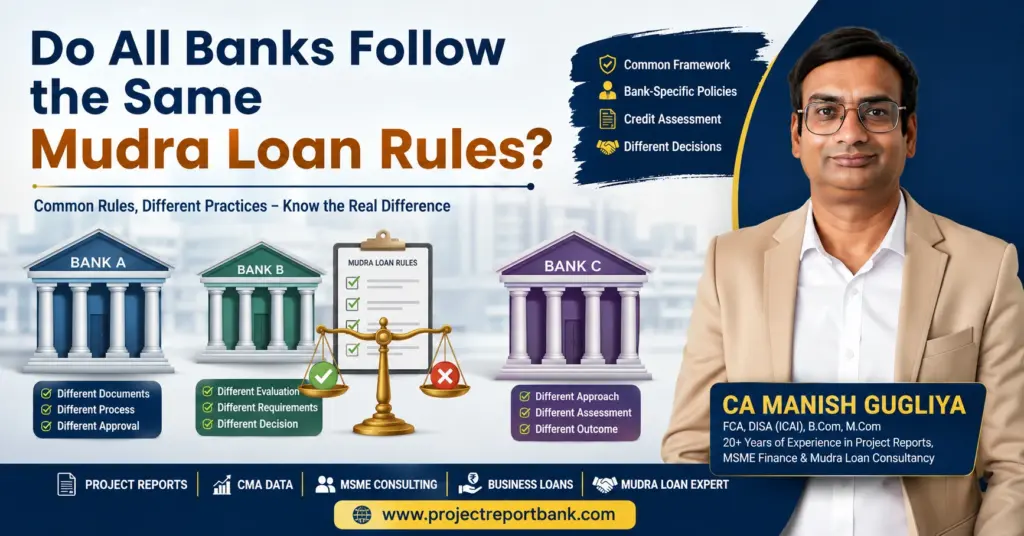
- Do All Banks Follow the Same Mudra Loan Rules?

- Banks vs NBFCs vs MFIs for Mudra Loan: Which is Best for Your Business in 2026?

- Does Your Existing Bank Improve Mudra Loan Approval Chances?

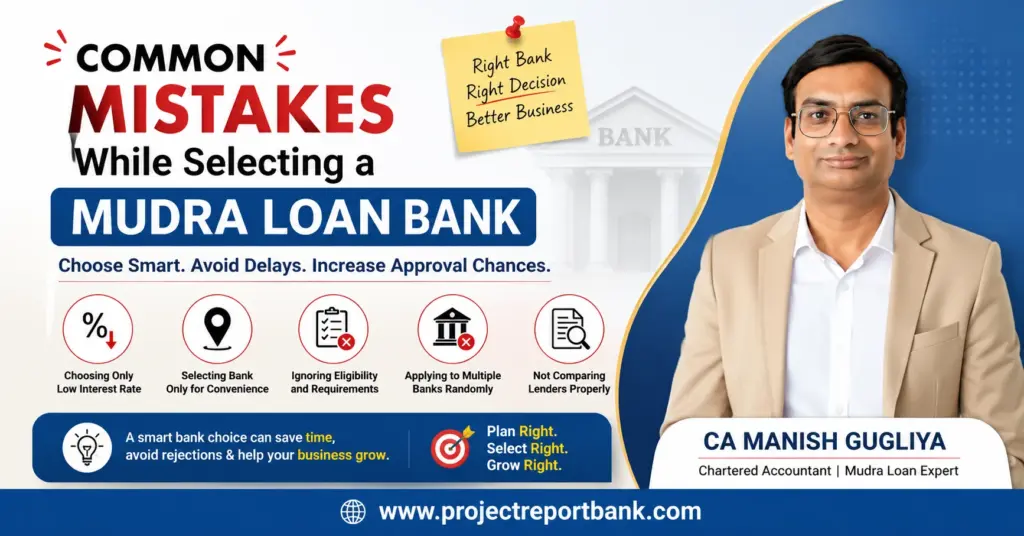
- Common Mistakes While Selecting a Mudra Loan Bank – Practical Guide by CA Manish Gugliya
- What to Check Before Choosing a Mudra Loan Lender

- How to Find Participating Mudra Loan Banks in India

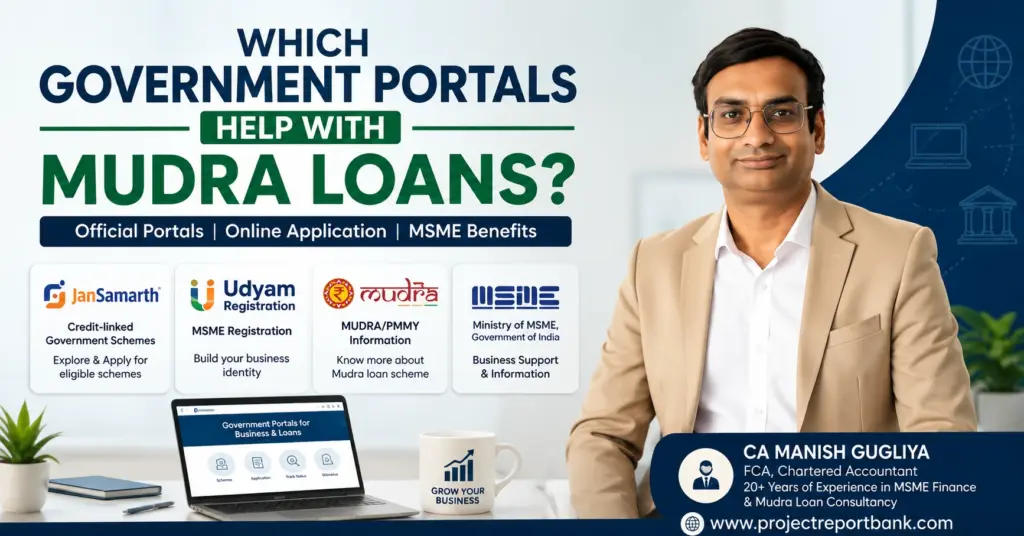
- Which Government Portals Help with Mudra Loans?
- Which Financial Institutions Can Sanction Mudra Loans?

- Bank vs NBFC for Mudra Loan: Which Is Better for Small Business Owners?