Key Takeaways
- Mudra loan approval factors depend mainly on business viability, proper documentation, realistic loan amount, and demonstrated repayment capacity – not luck or connections.
- Banks under Pradhan Mantri Mudra Yojana (PMMY) closely examine your project report, credit behaviour, and how clearly you define the loan purpose before sanctioning any amount.
- A complete, error-free application with strong business details and supporting documents dramatically improves your Mudra loan approval chances.
- Even new businesses can get mudra loans if they present a practical Mudra loan business plan, possess the necessary skills, and maintain good banking habits.
- This guide also includes an approval checklist, common rejection reasons, expert tips from CA Manish Gugliya (FCA), and a dedicated FAQ section covering real borrower doubts.
Introduction: Why Some Mudra Loans Are Approved and Others Are Not
Many Mudra loan applications get delayed or rejected – not because the scheme is tough, but because applicants walk into the bank underprepared. The difference between a smooth sanction and a frustrating rejection almost always comes down to how well you present your case.
Pradhan Mantri Mudra Yojana (PMMY), launched on April 8, 2015, provides collateral-free financial assistance upto rs 10 lakh for non corporate, non-farm micro enterprises engaged in manufacturing, trading, and services, as well as allied agricultural activities like poultry, dairy, and beekeeping. The scheme was designed to support income generation and employment creation across India. Mudra loans cater to non-corporate small businesses and are provided by commercial banks, small finance banks, NBFCs, and other eligible lending institutions.
Before sanctioning any loan, a bank or financial institution evaluates five core areas: the applicant (character and banking habits), business viability, repayment capacity, documentation quality, and overall financial planning. The approval process for a Mudra loan depends on several key evaluations – and understanding these is where most borrowers gain a real edge.
This guide focuses on practical mudra loan approval factors and step-by-step tips that actually work in real bank branches. I am CA Manish Gugliya (FCA), and over 20+ years of preparing project reports, CMA data, and Mudra loan consultancy for MSME borrowers, I have seen exactly what separates approved files from rejected ones. Everything shared here is based on real bank processes and actual case outcomes.
Table of Contents
How Banks Evaluate a Mudra Loan Application
When you submit a Mudra loan application at any public sector bank, small finance banks branch, or NBFC, the file moves through a structured evaluation. Understanding this process helps you prepare each element the bank will scrutinise.
Eligibility check: The first step verifies whether your enterprise meets the eligibility criteria. Eligibility requires the enterprise to be a non-corporate non-farm small or micro-enterprise. Candidates must be Indian citizens aged 18 to 65 years. The bank confirms your business type, loan category (Shishu, Kishor, Tarun), constitution (proprietorship, partnership, individual), and whether your proposed activity falls within permissible sectors.
Documentation review: The branch checks your KYC documents (Aadhaar, PAN, address proof), business proof (shop act license, trade license, Udyam Registration), GST registration if applicable, and last 6–12 months of bank statements. Proper documentation is crucial for loan approval and includes identity proof and business registration. Any mismatch across documents – different spellings, outdated addresses – triggers doubt.
Business feasibility: Lenders evaluate business viability and require a well-defined project report for higher loan categories. They check your quotations for machinery, expected sales, local market demand, and whether you possess the necessary skills for the proposed business activity. A sound business plan with realistic revenue projections is essential for approval.
Credit assessment: A clean credit history is essential for Mudra loan approval. Banks review your CIBIL score, existing loan obligations, bounced cheques, and overdrawn accounts. Lenders also review past bank statements to verify cash flow and operational revenue. However, a moderate score does not automatically mean rejection if other factors are strong.
Repayment capacity: The bank calculates whether your projected business surplus, minus existing EMIs and household expenses, can comfortably cover loan repayments. DSCR (Debt Service Coverage Ratio) of at least 1.25 is generally expected for trading and service businesses.
Bank verification and field inspection: An officer may visit your shop, workshop, or unit to confirm the business address, check stock or machinery, verify licenses, and make informal enquiries about your reputation. Mudra loans are generally collateral-free but are subject to the lender’s assessment – and this verification is part of that assessment. Loans up to ₹10 lakh require no collateral security, but the bank still needs confidence in your operations.
Approval flow:
Application Submitted → Eligibility Check → Document Verification → Business Evaluation → Credit Assessment → Bank Verification / Field Inspection → Approval Decision → Loan Disbursement
If you are new to this process, reading a detailed step-by-step Mudra loan application guide before approaching the bank can save you multiple branch visits.
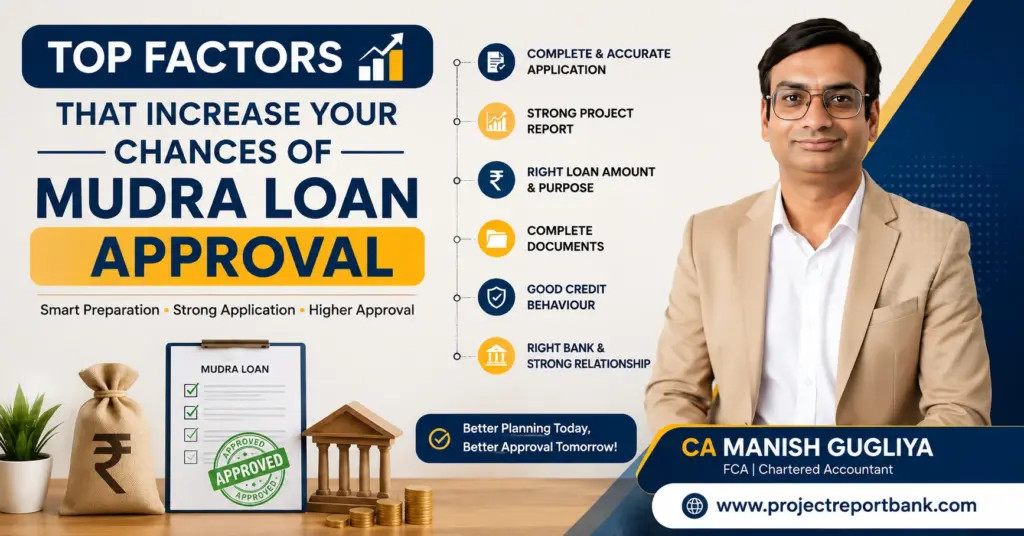
Top Factors That Increase Your Chances of Mudra Loan Approval
These are the most important mudra loan approval factors I have observed across hundreds of real cases. Implementing even 3–4 of these properly can sharply increase your chances – whether you run an existing enterprise or plan to start a new business.
Submit a Complete and Error-Free Application
Many Mudra loan application approvals get delayed simply because the form is incomplete or wrongly filled, even when the business itself is perfectly viable.
- Fill personal details (name, date of birth, Aadhaar number, PAN, address) exactly as they appear on your KYC documents. Even a minor spelling difference between your Aadhaar and bank records creates a red flag.
- Enter accurate business details: firm name, constitution (proprietorship or partnership), business address, nature of activity, and registration numbers.
- Ensure signatures match your bank records. Sign in all required places, including photograph attestations.
- Never leave fields blank. If something does not apply, write “Not Applicable” instead of leaving it empty.
- All information must be consistent across the form, Aadhaar, PAN, Udyam, GST certificate, bank statement, and project report.
For a detailed walkthrough, refer to How to Fill the Mudra Loan Application Form Correctly.
Prepare a Professional Project Report
For mudra loans above ₹1–2 lakh, most banks insist on a Mudra loan project report and rely heavily on it for their decision. In my experience, this single document influences approval more than almost any other factor.
A project report is simply a written summary of your business model, total investment, expected income, expenses, and how you plan to repay the loan. Key components include:
- Business overview and promoter profile (your educational qualification, experience, training)
- Market analysis and customer segment
- Cost of project and means of finance (own contribution + loan)
- Working capital needs
- Profit and loss projections for 3–5 years
- Cash flow statement and repayment schedule
The most important thing: use realistic assumptions. Conservative first-year sales projections and prudent cost estimates increase banker confidence far more than inflated numbers. For example, a tailoring unit projecting 15 customers per day from month one in a small town will raise eyebrows – projecting 6–8 customers initially, growing to 15 by year two, is far more credible.
Check Is a Project Report Mandatory for Mudra Loan? to understand when and why banks require it.
Choose the Right Loan Amount
Asking for a sensible loan amount is one of the most underrated mudra loan approval factors. Over-asking without justification is a frequent cause of rejection.
Calculate your requirement honestly: total fixed investment (machinery, furniture, equipment, renovations) plus initial working capital (stock, rent, salaries, utilities) minus your own contribution. Loan categories under PMMY help you align:
| Category | Loan Amount Range | Typical Stage |
|---|---|---|
| Shishu | Up to ₹50,000 | Starting micro activity |
| Kishore | ₹50,001 to ₹5,00,000 | Early stage of growth development |
| Tarun | ₹5,00,001 to ₹10,00,000 | Expansion / next phase |
| Tarun Plus | ₹10,00,001 to ₹20,00,000 | For those who have successfully repaid previous loans (Tarun) |
The maximum loan amount under PMMY is ₹10 lakh (₹20 lakh for Tarun Plus, for eligible borrowers). Shishu loans are designed for the smallest micro units, while Kishore and Tarun cover the growth development and funding needs of the beneficiary micro unit.
Applying for a lower but justifiable amount often leads to faster sanction. Read more on How Much Mudra Loan Should You Apply and Minimum Mudra Loan Amount.
Clearly Mention the Loan Purpose
Banks must record the exact end-use of funds. A clear loan purpose is compulsory – vague descriptions like “for business” or “for personal use” significantly reduce trust.
Good examples of acceptable purposes:
- Purchase of a specific sewing machine (₹45,000 quotation attached)
- Buying initial inventory for a mobile accessories shop (₹1,20,000)
- Setting up salon interiors and purchasing equipment (₹3,50,000 with itemised quotation)
- Working capital for a photocopy and printing centre
Your stated purpose should match the quotations attached with the application and align with your project report. This consistency tells the bank exactly how the loan extended will generate income and enable EMI repayment.
See How to Mention Loan Purpose Correctly for detailed guidelines.
Write Strong Business Details
The business details section of your Mudra loan form and project report is where you convince the lender that your proposed activity and market are real and workable.
Cover these points:
- Nature of business, products or services offered
- Customer segment and location advantage
- Suppliers, competitors, and pricing strategy
- How revenue will be generated (e.g., 20 customers/day × ₹200 average billing = ₹4,000/day)
Even for a new business, mentioning prior work experience, family background in the same trade, or training attended improves confidence. The bank wants to know you can undertake this activity successfully.
Follow the guide on How to Write Business Details Section to strengthen this part of your application.
Submit Complete Supporting Documents
Incomplete documentation is among the most common reasons for delay or rejection. According to a KPMG/NITI Aayog assessment, most rejection of loan applicants happens at the CIBIL check level and as a failure to submit required documents.
Here is a checklist of essential documents:
| Document | Purpose |
|---|---|
| Aadhaar Card | Identity and address verification |
| PAN Card | Tax identity |
| Passport-size photographs (2) | Application form requirement |
| Address proof (utility bill, rent agreement) | Residence confirmation |
| Bank statements (last 6–12 months) | Cash flow and transaction verification |
| Business proof (shop license, trade license) | Business existence |
| Udyam Registration | MSME identity |
| GST Registration (if applicable) | Tax compliance |
| Quotations for machinery/equipment | Validates loan purpose and cost |
| Income proof / ITR (if available) | Repayment capacity evidence |
All documents must carry consistent name, address, and business details. Self-attested photocopies plus originals for verification usually speed up processing and reduce repeat visits.
Maintain Good Credit Behaviour
Credit behaviour means paying EMIs and credit card dues on time, avoiding cheque bounces, not frequently overdrawing your account, and maintaining some savings balance. A satisfactory credit track record is one of the strongest signals a bank looks for.
Your CIBIL score does affect Mudra loan approval chances, especially for higher-ticket Kishor and Tarun categories. But a low score alone does not automatically mean rejection – individual borrowers with moderate scores still get approval if their project report is strong and the requested amount is reasonable.
Before applying:
- Check your CIBIL report and correct any errors
- Clear small overdue amounts
- Avoid taking new unnecessary credit
- Maintain consistent bank account activity (no frequent zero-balance episodes)
Build a Healthy Banking Relationship
Having a current or savings account with regular transactions at the same bank where you apply often improves comfort level and can speed up processing. The branch already has visibility into your business turnover and banking habits.
Route your business receipts and payments through bank accounts for at least a few months before applying. Deposit cash regularly instead of only withdrawing, avoid long periods of inactivity, and have transparent discussions with the branch manager about your business model. These habits signify genuine business activity and reduce the bank’s perceived risk.
Apply Through the Right Bank
While all eligible banks and NBFCs can grant mudra loans, choosing the right bank or branch significantly affects approval time and comfort. Applying with your existing banker – who already knows your track record – gives you an advantage over approaching a new financial institution where you have no history.
Consider factors like branch experience with MSME loans, staff familiarity with your industry, and overall processing efficiency. Some branches are simply more active in Mudra lending and have better turnaround times. Compare options using Best Bank for Mudra Loan Application.
Avoid Common Application Mistakes
Avoiding a few common mistakes can instantly improve approval chances:
- Missing signatures or incomplete form fields
- Wrong loan amount category selection
- Unrealistic financial projections that don’t match ground reality
- Mismatched KYC details across documents
- Pasting wrong photographs or signature mismatch vs. bank records
- Copying project reports from someone else without understanding the numbers – bankers spot this quickly
For detailed error-avoidance strategies, see Mudra Loan Application Form Mistakes and What to Do Before Applying for a Mudra Loan.
Choose the Right Application Method
Three common methods exist: direct offline application at the branch, online application through portals like JanSamarth or the bank’s website, and assisted application via consultants or common service centres.
Online applications are convenient and faster for initial submission, but still require branch-level verification and physical document checks. Offline applications allow direct interaction with loan officers, which helps clarify doubts on the spot. Assisted applications work best for first-time borrowers who want to avoid mistakes in the form or project report.
New entrepreneurs uncomfortable with forms should consider assisted application, while experienced business owners with clear documents may prefer online channels to save time. You can also explore whether it’s possible to apply without visiting the bank.
Factors Banks Consider Before Approving a Mudra Loan
Every bank has its own internal guidelines, but the major mudra loan eligibility factors are broadly similar. Here is a reference point for understanding what matters and how to improve each area:
| Approval Factor | Why It Matters | How to Improve It |
|---|---|---|
| Business viability | Banks need confidence that demand and profit potential are real | Conduct a basic market study; include it in your project report |
| Project report | Clear numbers reduce uncertainty for the lender | Get it professionally prepared with realistic CMA data |
| Loan purpose | Defined end-use ensures the loan will generate income | Align purpose with quotations and your business plan |
| Documentation | Complete, consistent documents reduce processing time | Use a checklist; pre-verify all KYC details |
| Repayment capacity | Banks check surplus income vs. EMI burden | Project realistic cash flows; choose the right loan amount |
| Credit behaviour | Timely payments and clean CIBIL build trust | Settle overdues; avoid new unnecessary borrowings |
| Business experience | Prior knowledge reduces execution risk | Highlight work history, training, or family background |
| Banking relationship | Familiar customers are assessed based on visible track record | Route transactions through the same bank regularly |
| Financial estimates | Conservative, data-backed estimates look credible | Work with a CA or finance professional |
| Loan amount | Must be proportional to scale and capacity | Justify each rupee through detailed cost breakdowns |
Mudra Loan Approval Checklist
Use this checklist before visiting the bank or applying online:
Personal Eligibility:
- [ ] Age between 18 and 65 years
- [ ] Indian resident
- [ ] Non-farm micro enterprise (non corporate)
- [ ] Business stage matches Shishu / Kishor / Tarun category
Documentation:
- [ ] Aadhaar card (updated address)
- [ ] PAN card
- [ ] Passport-size photographs
- [ ] Current address proof
- [ ] Last 6–12 months bank statements
- [ ] Business registration proof (shop act / trade license)
- [ ] Udyam Registration certificate
- [ ] GST Registration (if applicable)
- [ ] Quotations for machinery / equipment
- [ ] ITR or income proof (if available)
Business Planning:
- [ ] Project report prepared with realistic projections
- [ ] Clear loan purpose note written
- [ ] Basic market study completed
- [ ] EMI calculation understood
Banking & Credit:
- [ ] CIBIL report reviewed and errors corrected
- [ ] Existing EMIs listed
- [ ] Regular account operations for last few months
- [ ] Bank record mismatches corrected
Procedural:
- [ ] Form filled completely with no blank fields
- [ ] Signatures in all required places
- [ ] Document photocopies self-attested
- [ ] Originals kept ready for verification
- [ ] Application method (online / offline) decided
If every item is ticked, your chances of a smooth Mudra loan sanction increase substantially.
Common Reasons Mudra Loan Applications Get Rejected
Understanding why banks reject applications helps you avoid those mistakes before they happen.
- Weak or generic project reports: Copy-paste numbers with no clear market logic, especially in Kishor and Tarun segments, are a top rejection cause. Banks operating at sole discretion expect you to demonstrate knowledge of your own business.
- Incomplete or mismatched documents: Different names or addresses across Aadhaar, PAN, and bank statements; missing Udyam Registration; unverified quotations.
- Poor financial planning: Very high expenses vs. projected income, or no clear EMI repayment path. The bank sees no guarantee that capital assets created from the loan will generate sufficient returns.
- Unrealistic income projections: Projections that don’t match local demand, experience level, or industry norms raise doubts about seriousness.
- Excessive loan amount: Requesting far more than what turnover or experience justifies, especially with zero own contribution.
- Weak business justification: Vague or confused description of activities; poor answers during bank interviews.
- Poor banking history: Repeated cheque bounces, unpaid EMIs, high credit card overdues, or frequently overdrawn accounts send strong negative signals.
- Verification failures: Non-functional business address, shop found closed, neighbours unaware of business, or conflicting information during field visits.
For a deeper understanding, read Why Banks Approve Some Mudra Loan Applications Faster Than Others.
Practical Tips to Improve Your Mudra Loan Approval Chances
These tips summarise what has consistently worked in real Mudra loan cases I have handled over two decades:
- Maintain accurate financial records – even simple notebooks or spreadsheets. Gradually move to formal accounting to support your application.
- Prepare realistic projections – conservative sales estimates with clear EMI calculations. Mudra loans support micro enterprises in various sectors, but each sector has different margins and seasonality.
- Keep documents updated – address changes on Aadhaar, renewed licenses, latest bank statements, fresh quotations. Stale documents slow everything down.
- Apply only for what you need – demonstrate some personal contribution, even if small, to show seriousness. A borrower who has skin in the game earns more trust.
- Respond quickly to bank queries – provide additional documents or clarifications within a day or two. Delays from your side get interpreted as disinterest.
- Know your numbers – total investment, gross margin, net profit, EMI burden. Walk into the bank prepared, not hoping to figure it out there.
- Maintain clean banking history in the months leading up to application. Avoid unnecessary cash withdrawals and cheque bounces.
- Be honest during verification – avoid memorised scripts. Bankers value ground reality over rehearsed answers. Interest rates for mudra loans are deregulated by banks, so understand your specific interest cost and factor it into your planning.

Expert Guidance from CA Manish Gugliya
I am CA Manish Gugliya (FCA), a Chartered Accountant with over 20 years of hands-on experience in MSME finance, project report preparation, CMA data, and Mudra loan consultancy across different states and bank types.
In my practice, I have seen that professionally prepared project reports and CMA data – aligned with actual bank formats – significantly increase approval speed and sanction amounts. Banks process these files faster because the numbers are already in the form they need.
Typical support I provide includes:
- Business feasibility study for the beneficiary micro unit entrepreneur
- Funding structure (own contribution vs. Mudra loan as term loan or working capital)
- Cost of project calculation covering all capital assets and working capital
- Cash flow-based repayment planning matching EMI to seasonal revenue patterns
Common mistakes I see applicants make: undervaluing working capital needs, ignoring seasonal variations in revenue, overestimating profit margins, and submitting project reports without understanding the numbers inside them.
My documentation strategy focuses on choosing the right bank, preparing complete file sets covering loans across all categories, and anticipating bank queries in advance – reducing branch visits from five or six down to two or three. I also help in selecting the correct Mudra category, structuring the loan amount slab-wise, and documenting sources of margin money.
If you want customised Mudra loan project reports, financial projections, and end-to-end application support, feel free to reach out for professional guidance that is assessed based on your specific business and stage of growth.
Frequently Asked Questions
These FAQs cover practical doubts that bank brochures usually leave unanswered but matter deeply for real-world Mudra loan approval.
Does CIBIL score completely decide Mudra loan approval?
No. CIBIL score is an important mudra loan approval factor, especially for Kishor and Tarun categories, but banks also consider current income, business viability, the collateral-free nature of PMMY, and overall repayment track. Many borrowers with moderate scores still get approval when their project report is strong, documents are clean, and the requested amount is reasonable. However, very poor scores with recent defaults or write-offs are serious concerns – these should be addressed before applying. The loan is availed based on multiple parameters, not CIBIL alone.
Can a completely new business get a Mudra loan?
Yes. Mudra loans are available even for new businesses, especially in the Shishu and lower Kishor ranges. The scheme is specifically designed to provide funding for micro units at every stage of growth development and funding needs. New entrepreneurs must rely more on a well-prepared project report, clear loan purpose, strong personal banking habits, and – where possible – some own contribution. Mentioning past informal work experience, family background in the same trade, or certified training can improve approval chances. The lender wants assurance that the applicant can undertake the proposed activity competently.
Is GST registration compulsory for getting a Mudra loan?
GST registration is not compulsory for all Mudra loans. It depends on your business turnover and the nature of activity as per GST law. For small micro enterprises below the GST threshold, loans may be sanctioned without GST – but banks may still ask for Udyam Registration and basic local licenses as business proof. If your enterprise is clearly above threshold, having proper GST registration and filed returns actually improves credibility and supports higher loan amount requests. These are part of the broader guidelines that banks follow.
Can I apply for Mudra loan with more than one bank simultaneously?
Technically, a borrower can approach multiple banks. However, submitting duplicate applications without disclosure is discouraged – it creates confusion and generates multiple CIBIL enquiries that banks can see. Focus on 1–2 suitable banks where you have a relationship, and withdraw other applications once one bank shows serious processing. Multiple simultaneous applications for the same loan amount may appear as desperation and do not really increase approval chances. Each bank has links to credit bureau data and can see your enquiry history.
What should I do if my Mudra loan application is rejected?
First, get a clear reason from the bank – whether it was due to documents, credit history, business model, or the loan amount requested. Then correct the specific issue: improve your project report, settle small overdues, adjust the loan amount, or update registrations. You can re-apply at the same bank after rectification or approach another bank with improved documentation and professional guidance. A rejected application does not permanently disqualify you – it simply means the bank needs more confidence in your file. Many borrowers who were initially rejected have gone on to get sanction after proper preparation.
Mudra loan approval is not about luck – it is about preparation, documentation, business viability, and financial planning. Applicants who present a realistic business proposal with complete, consistent documentation have significantly better approval chances than those who walk in hoping for the best.
If you want to approach your bank with a professionally prepared file – project report, CMA data, financial projections, and complete documentation – reach out to CA Manish Gugliya for end-to-end Mudra loan application support tailored to your specific business and needs of the beneficiary.
- Can a Startup Get Easy Mudra Loan Approval? (Expert Guide by CA Manish Gugliya)

- How Financial Discipline Improves Mudra Loan Approval

- Why Proper Project Costing Helps Mudra Loan Approval
- Turnover vs Profit for Mudra Loan: What Really Matters for Approval?
- Income Assessment in Mudra Loan Approval Explained
- How Banks Judge Business Stability Before Mudra Loan Approval
- Business Profile vs Documents: Which Matters More for Mudra Loan Approval?

- Common Reasons Banks Hesitate to Approve Mudra Loans

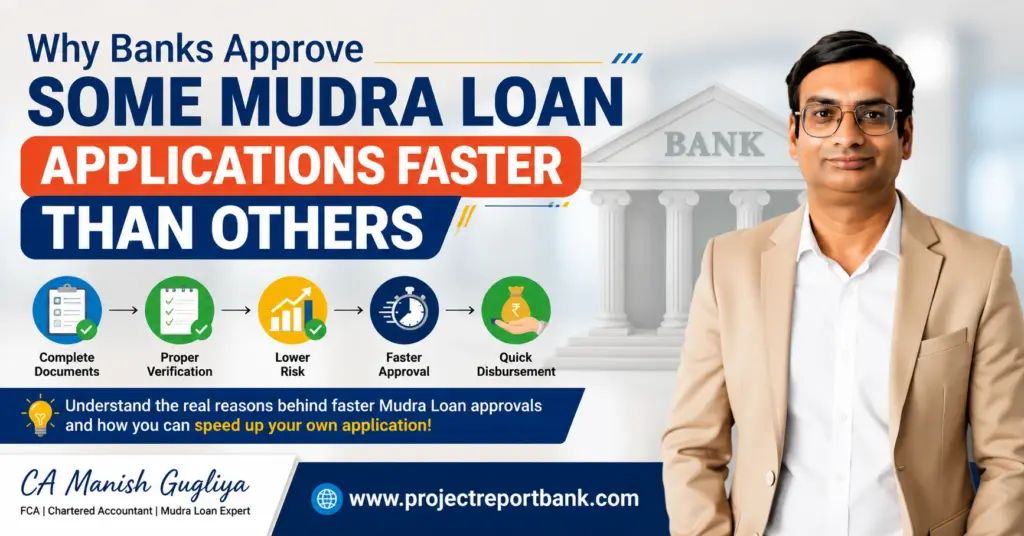
- Why Banks Approve Some Mudra Loan Applications Faster Than Others