Key Takeaways
Many mudra loan applications face delays or rejection despite the applicant meeting basic eligibility criteria. Here is what you need to know before approaching any bank branch:
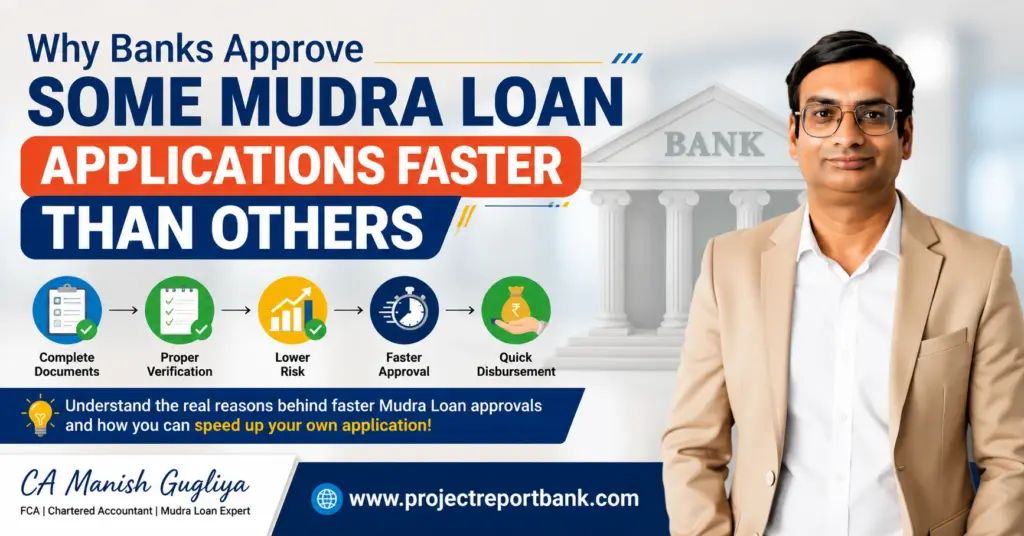
- Banks hesitate mainly due to risk assessment concerns: weak project reports, poor repayment capacity, incomplete documentation, and inconsistent information across documents.
- Eligibility under mudra yojana does not guarantee final loan approval. Branch-level credit appraisal, reserve bank guidelines, and PMMY norms still apply.
- A realistic business plan, proper income proof, clear loan purpose, and organised bank statements significantly improve chances of approval.
- Poor credit history, high existing EMI burden, and negative field verification are among the most common silent deal-breakers.
- As CA Manish Gugliya (FCA) with 20+ years of MSME finance experience, I will walk you through the practical, bank-side reasons for hesitation and what small business owners can do to fix them.
Introduction: Why Do Banks Hesitate Even Under Mudra Yojana?
Pradhan Mantri MUDRA Yojana promotes micro-entrepreneurship through collateral-free loans up to ₹10 lakh. The scheme covers micro units development and finance for income generating activities across trading, manufacturing, and services. Indian citizens with viable business plans can apply for Mudra loans through commercial banks, private sector banks, small finance banks, regional rural banks, and NBFCs.
Yet every week, I see applicants walk into my office frustrated. They met the eligibility criteria. They filled the form. And the bank still said no – or worse, said nothing at all. Many applicants lack awareness of eligibility criteria beyond the basic brochure, which creates confusion when their loan application stalls.
Here is the reality: Mudra is a refinance scheme. The government of india launched it in April 2015 to push funding to micro enterprises, but each lender still has to protect its depositors’ money. High historical non-performing assets lead banks to exercise caution in unsecured lending. In Gujarat alone, over 96,000 Mudra accounts became NPAs by March 2021.
This article shares the practical, branch-level reasons for hesitation that we see daily at ProjectReportBank.com – and what you can do to prepare better.
Table of Contents

How Banks Evaluate a Mudra Loan Application
Meeting eligibility – business type, non corporate non-farm sector, loan amount within limits, Indian citizen – is only the first step. Banks evaluate mudra loan applications based on strict internal credit policies and risk assessment guidelines that go far beyond the scheme brochure.
Banks may reject applications if the proposed activity does not fall within the scheme’s eligibility categories. But even eligible borrowers face a multi-step appraisal: receiving the mudra loan application and documents, pulling CIBIL reports, analysing the project report, assessing cash flow and repayment capacity, and finally making a sanction decision.
Branch-level discretion affects mudra loan approval based on tracking of non-performing assets. Smaller Shishu loans are often approved at the branch manager level, while higher Kishore and Tarun loans may need approval from higher authorities at a regional office. Mudra loans are available for amounts up to ₹20 lakh under some banks’ Tarun Plus category, which demands even stricter appraisal.
Banks also verify whether projected revenue, costs, and margins are realistic for the local market. Your repayment capacity – whether monthly income safely covers EMI plus household expenses – matters more than the attractiveness of your idea.
| Eligibility (Scheme Level) | Final Approval (Bank Level) |
|---|---|
| Activity allowed under Mudra Yojana | Cash flow strong enough to repay EMI |
| Loan amount within ₹10 lakh limit | CIBIL and credit history acceptable |
| Applicant is an Indian citizen | Business viability confirmed through field visit |
| Non-farm or agri-allied business | Project report with realistic projections |
| Not in default with any financial institution | Documentation complete, consistent, and verified |
No consultant or banker can guarantee approval. It depends on the bank’s credit assessment and applicable RBI/PMMY guidelines.
Common Reasons Banks Hesitate to Approve Mudra Loans
Most rejections happen due to a combination of factors, not just one issue. In practice, banks hesitate when they cannot clearly see how the loan will be safely repaid from business income within the chosen tenure.
The following subsections break down the most frequent reasons seen in actual cases handled through 2023–2026. Fixing even two or three of these – say documentation and project report – can dramatically improve the impression your application makes.
Poor or Vague Business Plan
Many applicants arrive with only a rough idea: “I will start a shop.” No details on products, target customers, pricing, or monthly sales expectations. Lack of a clear business plan can cause loan application rejection outright.
Consider this: someone wants to open a mobile accessories shop in a locality already saturated with similar stores, projecting ₹3 lakh monthly sales from day one without any basis. The bank officer, who walks past those shops daily, knows this is unrealistic.
Banks want to see viability – profit after all expenses, not just turnover. Create a solid business plan for Tarun category loans especially, covering costs, competition, and growth realistically. A well-prepared Mudra Loan project report converts a rough idea into a structured, bank-friendly plan.
Weak Project Report and Financial Projections
Larger loans like Kishore and Tarun require structured business plans and financial projections. Yet many project reports I see are copy-paste templates unrelated to the applicant’s city, scale, or trade – with sales rising in a perfect straight line every year and zero seasonality.
Banks need projected profit and loss, simple cash flow, breakup of loan utilisation (machinery, stock, working capital), and achievable growth. Underestimating rent by ₹5,000 per month can turn a seemingly profitable tailoring unit into a loss-maker on realistic numbers. Experienced officers recognise weak reports instantly and hesitate.
Incomplete Documentation and KYC Issues
Incomplete documentation can lead to immediate rejection. Incomplete or mismatched documentation can lead to automated or manual rejections of loan applications. Common problems: Aadhaar-PAN name mismatch, different addresses on KYC documents, expired shop licence, unsigned forms.
Key documents banks expect: identity and address proof (including utility bills and rental agreement where applicable), business registration (Udyam, GST, shop establishment licence), latest bank statements (6–12 months), quotations for machinery, and income proof. Applicants must register their business on the Udyam portal to improve credibility. Applying as an individual instead of a business entity can confuse banks – always apply under your business name with proper registration.
Rural applicants often face digital access challenges in gathering and uploading these documents, adding further delay. Refer to our complete list of Mudra Loan documents to prepare beforehand.
Poor Repayment Capacity and EMI Stress
Repayment capacity is often more important than the business idea itself. Banks calculate average monthly credits in your bank statements, estimate net profit margin, deduct household expenses and existing EMIs, and check what surplus remains.
Example: an applicant wants a ₹5 lakh Kishore loan with EMI of around ₹11,000 but bank statements show only ₹25,000–₹30,000 monthly family income. If the net surplus after EMI is only ₹3,000–₹4,000, the bank will hesitate or ask to reduce the loan amount.
Showing other verifiable incomes – spouse’s salary, rental income – and reducing unnecessary liabilities strengthens your repayment picture.
Low or Weak Credit History
A CIBIL score above 700 is preferred for Mudra loans. Low CIBIL scores below 650 may result in outright declines. Poor credit history significantly affects the approval chances for Mudra loans. Banks may also reject applications due to low or no credit history.
Weak or negative banking behavior – frequent bounces, delayed EMIs, multiple settled credit cards – can lead to loan denial due to perceived repayment risks. Borrowers with “thin file” (no credit history at all) can still explore a Mudra Loan without a high CIBIL score by strengthening other parts of their application.
Business Viability and Local Market Concerns
Even when project report numbers look fine on paper, branch officers compare them with their knowledge of local market conditions. A fourth garment showroom in a small lane of a tier-3 town, or a highly seasonal ice-cream cart asking for Tarun-level funding without an off-season plan – these raise doubts.
Including area-specific evidence – footfall data, local competition count, confirmed orders, or tie-ups – in the project report helps counter these concerns.
Insufficient Business or Industry Experience
First-time entrepreneurs or applicants shifting to a completely new line (say, from driving to running a restaurant) face more questions. Banks prefer at least 2–3 years of experience in the same trade, either through employment or family business.
Practical ways to compensate: relevant training certificates, partnership with an experienced person, or a stronger and more detailed project report. I have seen a well-prepared plan combined with a food-handling certificate help a first-time entrepreneur secure a Kishore loan at Canara Bank.
Unclear or Mixed Loan Purpose
Mudra loans are strictly for business purposes. Banks hesitate when they suspect money will go towards personal expenses, old dues, or property. Red flags include very round figures without breakup (“Need ₹5,00,000 for business”), refusal to provide quotations, or frequent mention of clearing credit card dues.
Clear utilisation – “₹2.5 lakh machinery, ₹1.5 lakh stock, ₹50,000 renovation, ₹50,000 working capital” – builds credibility. Unlike home loans, Mudra loans have strict end-use monitoring.
Existing Loan Burden and Multiple EMIs
Banks cross-check all existing loans through CIBIL and bank statements – personal, gold, vehicle, and credit card EMIs. A high debt-to-income ratio can lead banks to view applicants as over-leveraged. Even small EMIs from multiple NBFC apps suggest over-borrowing behaviour.
Steps that help: consolidating high-cost small loans, closing unnecessary credit cards, and reducing the planned mudra loan amount to a comfortable level.
Inconsistent Information and Mismatches
Inconsistencies across documents immediately create doubt. Different signatures on Aadhaar and bank records, varying dates of birth, mismatched turnover between GST returns and project report – all of these can trigger extra verification or outright rejection on “KYC mismatch” grounds.
Correct all details in Aadhaar, PAN, bank account, and GST before applying. Every number in your project report, ITR, and bank statements should tell a consistent story.
Negative Field Verification
For most loans above ₹1–2 lakh, banks conduct field visits to verify business and residence. Officers check whether the business actually exists, stock levels, machinery presence, and neighbourhood conditions.
Negative findings – shop closed for days, neighbours saying no business activity, phone switched off repeatedly – make sanction very difficult, even if documents and CIBIL look fine.
Missing Quotations or Cost Estimates
For machinery, vehicle, or equipment finance, banks want recent quotations from GST-registered suppliers on letterhead with GSTIN and contact details, dated within 30–60 days. Missing quotations make it hard to judge whether the loan amount is genuine or inflated.
Weak Financial Records and Cash-Only Business
Many micro enterprises operate mostly in cash with no books, invoices, or proper bank deposits. From the bank’s angle, this makes it nearly impossible to verify actual turnover and profit. If you claim ₹60,000 monthly profit but bank credits show only ₹15,000, the file will struggle.
Simple improvements: route daily sales through your bank account, maintain a basic cash book, and file ITR even for modest incomes to create a verifiable track record.
Applying in a Hurry Without Proper Preparation
Many applications are filed in a rush – half-filled forms, missing signatures, no project report. Such files move to the bottom of the bank’s priority. Officers prefer well-prepared cases that can be quickly processed. Study things to do before applying for a Mudra Loan so you approach the bank with a complete proposal.

Mistakes That Increase Bank Hesitation
Many applicants unintentionally create red flags through avoidable mistakes. Here is a quick reference:
| Mistake | Bank’s Concern | Better Approach |
|---|---|---|
| Asking for maximum loan amount without breakup | Inflated or unrealistic requirement | Calculate actual need with itemised cost list |
| Not disclosing existing loans | Dishonesty, hidden default risk | Declare all liabilities upfront with context |
| Contradictory figures in project report vs ITR | Data manipulation or ignorance | Align all financial documents before submission |
| Submitting expired shop licence | Business may not be operational | Renew all licences before applying |
| No Udyam or GST registration | Informal, unverifiable business | Register your business on the Udyam portal |
| Vague loan purpose (“for business needs”) | Possible personal misuse of funds | Provide detailed, itemised utilisation plan |
| Multiple recent loan enquiries in CIBIL | Desperate borrowing behaviour | Space out applications; apply to one bank at a time |
Eliminating these mistakes does not guarantee approval but can significantly reduce hesitation from the banker.
How to Increase Your Chances of Mudra Loan Approval
Most genuine micro-entrepreneurs can substantially improve chances of approval with proper preparation.
- Choose a realistic loan amount based on actual need and repayment capacity – not always the highest slab.
- Prepare a clear, customised project report with realistic sales projections and proper cost breakup.
- Submit complete and correct documentation to avoid rejection: KYC, business registration, bank statements, valid quotations, and income proof.
- Check your CIBIL score before applying for a Mudra loan. Correct errors and close small overdue accounts.
- Be honest about existing loans and bounces. Explain context and show improvement.
- Submit an organised file with labelled sections and an index page – it saves the banker’s time and builds trust.
Professional help from an experienced Chartered Accountant familiar with MSME finance can make the proposal far more bankable. See our step-by-step guide on how to improve your chances of Mudra Loan approval.
What If the Bank Keeps Asking for More Documents?
It is normal for banks to ask for additional documents during appraisal – updated bank statements, Udyam registration, GST returns summary, income proof of spouse, or photographs of the business place. Banks may also delay processing due to high workloads, which stretches timelines.
Request a clear, written list of all pending documents so you can submit everything at once. If the list keeps changing without justification, escalate politely to the branch manager or nodal officer. Read more about your rights when a bank keeps asking for new Mudra Loan documents.
Can a Bank Reject a Mudra Loan Without Proper Reasons?
While mudra yojana encourages lending to micro enterprises, loan approval is always at the bank’s sole discretion based on its credit norms and risk assessment. Banks are expected to record rejection reasons internally and communicate them when asked in writing.
Acceptable reasons include weak repayment capacity, adverse CIBIL with recent write-off, non-viable project, or serious KYC mismatch. Vague replies like “policy issue” can be challenged politely. Learn more about whether a bank can reject a Mudra Loan without reason and maintain all acknowledgement receipts and emails as evidence.
What to Do If Your Mudra Loan Is Rejected
A rejection from one bank does not permanently disqualify you from the scheme or other business loans. Follow these steps:
- Identify the actual reason – obtain verbal explanation, request written feedback, compare with your CIBIL report and documents.
- Correct common issues: update KYC, clear small overdue loans, revise the project report with realistic numbers.
- Improve financial behaviour for 3–6 months – no cheque bounces, regular deposits, timely EMIs on existing loans.
- Follow up weekly after submitting your loan application at the new bank or branch.
- Avoid filing multiple simultaneous applications – each shows as an enquiry in CIBIL.
You can understand the common reasons for Mudra Loan rejection and learn how to appeal a rejected Mudra Loan application when justified. Improving the substance of your proposal is always more effective than simply moving to another bank with the same weak file.
Frequently Asked Questions
These FAQs address practical doubts based on queries commonly received on ProjectReportBank.com. Answers reflect typical banking practice up to 2025–26. Mudra loan approval always remains subject to bank’s credit assessment and prevailing guidelines.
Is meeting PM Mudra Loan eligibility enough to get my loan sanctioned?
No. Fulfilling PM Mudra Loan eligibility – business type, non-farm sector, loan amount within ₹10 lakh, age criteria – only allows the bank to consider your application. After that, credit history, income, business viability, and field verification still determine the outcome. Two applicants both eligible for Kishore: one with strong bank statements gets approved, the other with weak financials gets declined.
Can startups and first-time entrepreneurs really get Mudra Loans?
Yes. Mudra loans under the scheme’s four categories (Shishu, Kishore, Tarun, Tarun Plus) are meant largely for micro units and startups. But banks still need comfort on skill, viability, and repayment. A strong project report, training certificates, and a smaller initial loan amount help. See our guide on Mudra Loan for startups.
Does a low CIBIL score always mean Mudra Loan rejection?
Not always. A CIBIL score below 650 may result in outright rejection at many banks, but officers also look at the reason behind the score. One old settled card is different from multiple recent defaults. Borrowers who now show 12–18 months of clean behaviour sometimes still get approved with tighter conditions. Always obtain your own CIBIL report and correct errors first.
Can banks reject my Mudra Loan without even visiting my shop or house?
In some cases, if the proposal is clearly non-viable or documents are seriously deficient, rejection can occur before field verification. However, banks are expected to follow a process. You can read more about whether banks can reject Mudra Loans without verification. Always ask politely whether field visit was done and request basic feedback.
Can I get a top up or enhancement on my existing Mudra Loan?
Some banks allow enhancement within the overall Mudra limit if the existing loan has been availed and is running smoothly for at least 12 months with timely EMIs. The bank will again check repayment track record, updated financials, and whether the combined loan amount fits within scheme limits and interest rates norms. Carry your last 12 months’ EMI track, updated project report showing business growth, and clear utilisation plan.
Conclusion
Banks hesitate on mudra loans due to genuine risk concerns – weak repayment capacity, unclear business plans, poor documentation, or inconsistent information – not because they are against small borrowers. The scheme exists to support micro enterprises and entrepreneurs, but each bank branch must still protect its assets and depositors.
Eligibility under the scheme is only the first filter. Final approval depends on the bank’s credit assessment, internal policy, and compliance with RBI and PMMY guidelines. No amount of “connections” or shortcuts replaces a solid application.
You can significantly improve your chances by preparing a realistic project report, organising complete documents, demonstrating stable cash flows, and choosing a sensible loan amount and tenure.
If you need expert help with your Mudra Loan project report, CMA data, financial projections, or end-to-end application guidance, feel free to reach out to CA Manish Gugliya (FCA) through www.projectreportbank.com. We have helped thousands of small business owners across India submit bankable proposals – and we can help you too.
- Can a Startup Get Easy Mudra Loan Approval? (Expert Guide by CA Manish Gugliya)

- How Financial Discipline Improves Mudra Loan Approval

- Why Proper Project Costing Helps Mudra Loan Approval

- Turnover vs Profit for Mudra Loan: What Really Matters for Approval?
- Income Assessment in Mudra Loan Approval Explained
- How Banks Judge Business Stability Before Mudra Loan Approval
- Business Profile vs Documents: Which Matters More for Mudra Loan Approval?

- Common Reasons Banks Hesitate to Approve Mudra Loans

- Why Banks Approve Some Mudra Loan Applications Faster Than Others