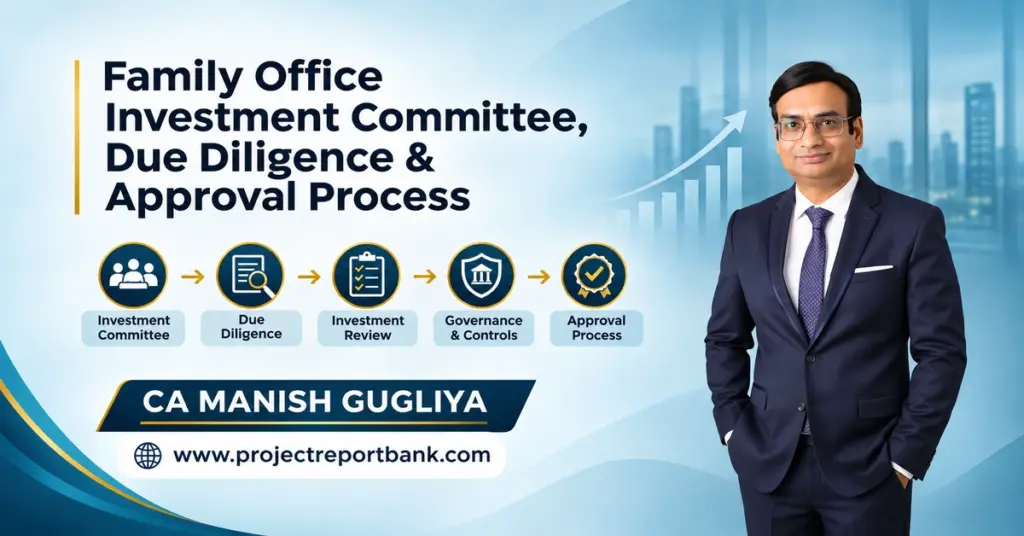
Key Takeaways
- The family office investment approval process in India typically follows a structured lifecycle-from deal sourcing and initial screening through detailed due diligence, investment memorandum preparation, committee or principal review, term sheet negotiation, and final fund disbursement.
- Many family offices, whether operating as a single family office or multi family office, now apply PE-style evaluation frameworks for direct investments, but retain flexible, family-driven decision rights shaped by family dynamics and investment philosophy.
- Investor-ready documentation-including a professionally prepared DPR, integrated financial model, business valuation, and data room-significantly improves approval odds, though no document can guarantee funding.
- Promoter quality, governance standards, realistic valuation, exit visibility, and alignment with family values matter as much as growth potential or the asset classes on offer.
- Project Report Bank, led by CA Manish Gugliya (FCA, DISA-ICAI), helps Indian businesses prepare credible, investor-grade documentation for family office and equity investor evaluation.
Introduction – Why Family Office Investment Approval Matters
Family offices managed a combined $3.1 trillion in assets globally in 2024, and Indian family offices have grown from roughly 45 in 2018 to an estimated 300 by 2024. This expansion means more capital is available for direct deals in private companies, manufacturing expansion, and growth-stage businesses. Alternative investments-including private equity, venture capital, and real estate-now account for approximately 45% of family office portfolios globally, reflecting a decisive shift away from traditional wealth management approaches.
Yet many financially sound proposals never receive approval. The reasons are rarely about project quality alone. Proposals fail because of weak documentation, promoter governance gaps, misaligned risk-return expectations, or insufficient clarity on exit strategy. Family offices operate under internal mandates shaped by family objectives, risk tolerance, and capital allocation priorities. Understanding how investment committees, family principals, and the chief investment officer evaluate proposals is therefore essential for any promoter seeking ₹10–100 crore in equity.
The family office investment approval process blends institutional due diligence with personalised governance. This article explains each stage of that process, the evaluation criteria applied, common rejection triggers, and how promoters can prepare effectively. Project Report Bank and CA Manish Gugliya work with Indian businesses to produce the investor-ready DPRs and financial projections that support rigorous family office review.
Understanding the Family Office Investment Approval Process in India
Investment decision making in Indian family offices follows a lifecycle that can be mapped broadly, even though actual sequencing varies by office and transaction size.
Typical stages:
- Deal Sourcing – Opportunities arrive through networks of CAs, investment bankers, PE and venture capital fund managers, AIFs, industry peers, and direct inbound approaches.
- Initial Screening – Does the opportunity match the family’s investment strategy? Sector, ticket size, geography, and stage are checked against the investment policy statement.
- Mandate Fit & Asset Class Mapping – The opportunity is assessed for fit within existing asset allocation across public markets, private markets, private credit, fixed income, hedge funds, and real estate.
- Preliminary Financial Review – Historical financials (3–5 years), basic profitability, revenue growth, and leverage are reviewed.
- Detailed Due Diligence – Multi-domain investigation covering financial, commercial, legal, tax, promoter, operational, and ESG dimensions.
- Investment Memorandum – Internal preparation summarising opportunity, risks, valuation, and exit.
- Committee / Principal Review – Formal or informal approval by investment committees or family principals.
- Term Sheet & Documentation – Non-binding term sheet followed by definitive agreements.
- Pre-Closing Conditions – Regulatory, compliance, or operational milestones to be met.
- Fund Disbursement – Capital transfer and commencement of post-investment monitoring.
Smaller, entrepreneurial single family offices may compress stages and move faster, while institutionalised multi family offices serving multiple families typically follow a more documented, process-driven workflow. Many family offices also maintain a centralised investment approval database to track proposals, approvals, and outcomes across their portfolio. At each stage, promoters are expected to provide progressively detailed documentation-from a teaser note to a full data room.

Family Office Investment Committee – Structure, Roles and Responsibilities
Not all family offices in India have formal investment committees. Some rely on a single family principal, others on a chief investment officer supported by an in house team, and some use a virtual family office model that assembles external advisors as needed. However, all have some governance structure through which investment decisions are made.
Typical roles in an Investment Committee:
- Family principal(s) – Ultimate decision-makers, especially on larger or strategic investments
- Next generation leaders and family members involved in legacy planning and succession
- Chief Investment Officer – Frames recommendations, oversees investment management, manages the portfolio
- Investment directors and analysts – Family office staff who prepare evaluation notes, run financial models, coordinate diligence
- External legal advisors, tax advisors, and independent industry experts – Brought in for specialised sectors such as manufacturing or infrastructure
- Non family members serving as independent committee members in larger family offices
The delegation of authority should specify investment approval limits based on size. For example, a CIO might approve deals up to ₹10 crore independently, while anything larger requires full committee or principal sign-off. Governance structures influence decision-making speed in family offices-a single family office dedicated to one family allows direct decision making by family principals, while a multi family office standardises processes for efficiency across clients managing the financial and personal affairs of many families.
Family offices often use investment policy statements to guide decisions, and effective approval processes require clear accountability and independent oversight. Achieving intergenerational alignment in values is challenging, but formal family governance frameworks help bridge differences between generations in investment approach and risk appetite. Automated systems streamline compliance and reporting for family offices, and technology enhances family office efficiency through portfolio management software.
Family Office Investment Evaluation Criteria
This is the core lens through which family offices assess prospective direct investments. Seventy percent of family offices prioritise aligning investments with family values, which means evaluation extends well beyond financial returns.
| Evaluation Parameter | What Family Office Examines | What Promoters Should Prepare |
|---|---|---|
| Business model & competitive advantages | Sector growth, defensibility, recurring revenue | Market research, industry report, peer comparables |
| Promoter track record & integrity | Past execution, defaults, governance history | Clean promoter profile, audited ROC filings, references |
| Historical financial performance | Revenue growth (3–5 years), margins, cash flows | Audited statements, reconciliations, cost breakdowns |
| EBITDA quality & cash conversion | Adjustments for one-offs, free cash flow | Capex schedule, cash flow statements, maintenance capex |
| Leverage & working capital cycle | Debt, off-balance exposures, receivables, inventory | Working capital schedules, debt schedule, repayment plan |
| Scalability & capex plan | Capacity to scale, infrastructure, supply chain | Detailed capex plan, site readiness, sensitivity analysis |
| Valuation & deal structure | Pre-money valuation vs comparables, dilution | Professional valuation report, comparables, term structure |
| Governance & compliance | Related-party transactions, board structure, licences | Entity paperwork, compliance procedures, licence certificates |
| Exit options & liquidity | Exit route clarity, time horizon, acquirer pipeline | Exit scenario modelling, IPO readiness assessment |
| Alignment with family objectives | Portfolio concentration, family values, ESG, impact | Pitch showing strategic fit, ESG disclosures |
Family offices often deal with unique assets alongside traditional portfolios, and asset allocation frameworks must adapt as family offices grow. Public markets serve as liquidity anchors in family office portfolios, while direct investments in private companies provide growth. Typical red flags include aggressive revenue assumptions, poor compliance history, related-party transactions not at arm’s length, heavy customer concentration, or misaligned valuation expectations.
Family office portfolios typically focus on long-term objectives, and family offices increasingly look at past performance relative to market benchmarks when assessing promoter credibility. Diversified allocations across asset classes and complex assets help manage concentration, while 65% of family offices plan to maintain portfolio risk levels in 2025.
Family Office Due Diligence Process
Once a proposal crosses initial screening, most serious family offices adopt a structured due diligence process. Investment candidates should undergo due diligence including financial and legal checks before any capital commitment. The diligence process typically covers seven sub-domains:
Financial Due Diligence: Verification of audited financials, quality of earnings analysis, normalised EBITDA, debt and off-balance sheet exposures, working capital metrics, DSCR, and cash flow patterns. AI tools help family offices analyse vast data for investment decisions, and family offices increasingly use data-driven metrics for investment performance evaluation.
Commercial Due Diligence: Market size and growth, customer concentration, competitive landscape, pricing power, supplier risks, and cyclicality. This helps the office make informed decisions about revenue sustainability.
Legal & Regulatory Due Diligence: Shareholding structure, ROC filings, contracts, environmental clearances, litigation, FEMA/FDI aspects. Legal advisors verify licences, permits, and statutory compliance procedures.
Tax Due Diligence: Income tax, GST compliance, TDS, transfer pricing. Tax considerations and tax planning exposures are examined alongside tax advice from specialists.
Promoter & Management Due Diligence: Background checks, reference calls, site visits, interviews. Execution capability, governance culture, and personal affairs relevant to business management are assessed. Note that 70% of family office LPs are unincorporated individuals or families, making promoter trust especially critical.
Technical/Operational Due Diligence: For manufacturing-plant capacity, machinery condition, capacity utilisation, maintenance practices, raw material security, labour, utilities, and expansion timelines. Cash flow planning and operational efficiency are examined on-site.
ESG & Reputation Review: Environmental permits, sustainability risks, and social obligations. Family offices integrate social responsibility into investment strategies. The impact investing market exceeds $1.164 trillion globally, and measuring impact requires frameworks beyond traditional metrics. Technology aids family offices in monitoring ESG performance, and family offices are increasingly using technology for impact investing. Family offices often develop frameworks to measure impact investments, though many family offices struggle to find mission-aligned investment opportunities.
Practical due diligence checklist for Indian manufacturing promoters:
- Audited financials (3–5 years) and recent management accounts
- CMA data and capex estimates
- Key customer and supplier contracts
- Licences, environmental clearances, pollution control certificates
- Land/factory ownership or lease documents
- Board minutes, share register, ownership structure
- GST returns, income tax returns, TDS certificates
- Employee contracts, union/labour status
- Insurance and safety certificates
Investment Memorandum and Investment Committee Presentation
After diligence, the internal team prepares an Investment Memorandum (IM) summarising the opportunity for the family principal or Investment Committee. The Investment Committee reviews proposals and challenges assumptions before approval.
Key IM components include executive summary, promoter background, transaction rationale, use of funds (capex, working capital, debt reduction), historical and projected financials, valuation and capital structure, risk analysis with downside scenarios, proposed terms (board seats, veto rights, reporting), exit thesis, and final recommendation.
The IM is supported by documents from the company: an investor-ready DPR, integrated financial model, feasibility analysis, and business valuation note. High-quality documentation makes it easier for the investment team to argue for approval, even if it does not guarantee a positive decision. In committee meetings, the opportunity is typically presented through a slide deck with Q&A, covering alignment with existing capital allocation priorities, risk management frameworks, and concentration within the portfolio.
Financial Modelling, Business Valuation and Return Assessment
This section represents the analytical heart of family office investment decision making, separate from relationship dynamics or gut feel. Family offices review integrated financial projections and financial models covering revenue build-up, unit economics, EBITDA margins, capex phasing, working capital, term loan schedules, DSCR, and free cash flows.
Common valuation approaches include discounted cash flow (DCF), comparable company multiples, and precedent transactions. Return metrics examined include IRR, MOIC, payback period, and scenario analysis across base, downside, and upside cases. Indian family offices commonly target gross IRRs of 20–25% for direct deals, though this varies by risk profile and stage.
Illustrative example: A ₹15 crore equity investment at a pre-money valuation of ₹60 crore results in a post-money valuation of ₹75 crore, giving the investor a 20% equity stake. If the company exits at 2.5× post-money value (₹187.5 crore) in six years, the investor’s share is ₹37.5 crore-a MOIC of 2.5× and an approximate IRR of ~16–17%. Higher exit multiples or faster growth would improve returns.
Family offices evaluate concentration risk, exposure within their overall portfolio across private equity, private credit, venture capital, real estate, and fixed income, and consider market volatility and market stress scenarios. Investment advice from internal expertise and external advisors shapes the final assessment. Leveraging technology and portfolio management tools, family offices track performance against market benchmarks and internal return thresholds.
Family Office Investment Decision Making – Approval, Rejection and Conditional Approval
After IM review and discussion, the family office arrives at one of several outcomes:
- Approval – Internal minutes confirm ticket size, valuation, rights, and conditions. Term sheet authorisation follows, sometimes with staggered or tranched capital.
- Conditional approval – Promoter must resolve specific issues: clean up litigations, improve debt-equity ratio, complete licences, bring additional promoter equity, or meet certain KPIs before first disbursement.
- Request for more information – Promoters should organise the data room, provide professional clarifications, and respond promptly.
- Revised terms – Valuation renegotiation, structural changes such as partly convertible instruments, or adjusted governance rights.
- Deferral – Committee may defer if the family is managing liquidity across commitments or reassessing sector exposure.
- Rejection – Promoters should seek feedback and address the funding gaps identified before re-approaching.
Post-investment monitoring includes tracking performance against initial expectations. Family office approvals also factor in qualitative elements such as legacy and impact, efficient wealth transfer planning, estate planning, and wealth preservation for future generations. Ongoing monitoring and regular reporting are standard requirements.
Common Reasons Family Offices Reject Investment Proposals
Many proposals are declined after initial interest. Here are the most frequent reasons and corrective actions:
- Unrealistic valuation – Expectations far above comparable listed peers or precedent deals. Corrective: Commission a professional business valuation with market comparables.
- Weak financial documentation – Unaudited accounts, inconsistent management accounts. Corrective: Audit past accounts, reconcile all financial statements.
- Questionable projections – Overly optimistic margins or capacity utilisation without sensitivity analysis. Corrective: Build multiple scenarios with realistic assumptions.
- Promoter credibility issues – Past legal cases, defaults, ownership disputes. Corrective: Disclose proactively, resolve outstanding matters.
- Governance weaknesses – No formal board structure, undisclosed related-party transactions. Corrective: Establish a formal governance structure, document policies.
- High leverage and working capital stress – Excessive debt or stretched receivables. Corrective: Restructure debt, improve working capital cycle.
- Regulatory or environmental risk – Missing clearances, pending litigation. Corrective: Obtain all licences and environmental permits before approaching investors.
- Unclear exit strategy – No credible pathway for investor liquidity. Corrective: Prepare exit scenario modelling with realistic timelines.
- Mandate misalignment – Sector, stage, or size outside the family office’s investment strategy. Corrective: Research the office’s mandate before approaching.
- Poor diligence preparation – Missing data room documents, sloppy pitch materials. Corrective: Prepare a complete, consistent investor-ready DPR with professional advisory support.
Professional advisory support in preparing DPRs, financial models, and documentation can pre-empt many of these rejection triggers before the decision making processes even begin.
Family Office Investment Approval Timeline
There is no fixed timeline, but promoters should plan conservatively.
| Phase | Illustrative Duration |
|---|---|
| Initial screening and mandate fit | 1–3 weeks |
| Preliminary review and meetings | 2–6 weeks |
| Detailed due diligence and valuation | 6–12 weeks |
| Committee/principal decision and term sheet | 2–4 weeks |
| Documentation and closing | 4–8 weeks |
These are examples, not guaranteed timeframes. Factors influencing timing include deal size, sector complexity (manufacturing projects involve site visits, environmental checks), quality of promoter documentation, speed of responses, internal liquidity constraints, and whether co-investors or lenders are involved.
Promoters should distinguish between soft interest (positive discussions), internal approval (go-ahead to issue term sheet), binding documentation (signed SHA/SSA), and actual fund disbursement. Always plan project timelines assuming a conservative approval window.

Practical Case Study – Indian Manufacturing Expansion Seeking Family Office Capital
This is a hypothetical, clearly labelled illustration.
Background: Vishwa Auto Components Pvt Ltd, an established Pune-based manufacturer of precision auto parts, has been operating for 12 years with ₹85 crore annual revenue. The promoter plans a ₹40 crore expansion to add a new product line and increase capacity by 60%.
Funding sought: ₹15 crore equity from a family office, with the balance from term loan (₹18 crore) and promoter contribution (₹7 crore).
Preparation: The company engages a professional advisor to prepare an Investor-Ready DPR with 7-year financial projections, capex breakdown, DSCR analysis, sensitivity analysis, and a business valuation based on EBITDA comparables from listed auto-component companies.
Approach: The promoter approaches a Mumbai-based single family office with a manufacturing-focused investment mandate. The teaser note passes initial screening-sector fit, ticket size within ₹10–25 crore range, and promoter reputation confirmed through industry references.
Due diligence findings: Financial DD confirms 18% EBITDA margin, healthy working capital cycle (55-day operating cycle), and clean audit history. Commercial DD validates demand growth in the target segment. Legal DD identifies one minor pending labour matter (low risk). Tax DD finds no material exposures.
Investment Committee discussion: The CIO presents the IM. The committee questions sensitivity to raw material price shocks (+20% cost scenario). The DPR’s sensitivity analysis shows the project remains viable with DSCR above 1.3× even in the downside case. The committee grants conditional approval-subject to resolution of the labour matter and promoter bringing ₹2 crore additional equity.
Deal structure: Pre-money valuation: ₹60 crore. New money: ₹15 crore. Post-money: ₹75 crore. Family office stake: 20%. Promoter retains 80%.
Assumed exit (Year 6): If the company reaches ₹180 crore revenue at exit and a comparable EBITDA multiple applies, the investor’s 20% stake could be worth ₹30–38 crore-a MOIC of 2.0–2.5× and an indicative IRR of 12–17%.
Lessons: Start documentation early, be transparent about risks, remain flexible on structure, and align with the family office’s expectations on governance and reporting.
How Indian Businesses Can Improve Their Chances of Family Office Investment Approval
Promoter-readiness checklist:
- Audited financial statements (at least 3–5 years)
- Investor-Ready Detailed Project Report with realistic assumptions
- Integrated financial projections (5–7 years minimum)
- Professional business valuation with comparables
- Well-structured pitch deck and investment memorandum
- Data room with legal, tax, and operational documents
- Promoter background documentation and reference contacts
- Clear proposal on equity amount, pricing, use of funds, and governance
- Advance answers for due diligence questions on working capital, customer concentration, licences, and succession
Governance upgrades before approaching investors:
- Formal board meetings with documented minutes
- Clarified roles among family members and professional managers
- Documented related-party transaction policies
- Improved internal MIS and reporting systems
Realistic expectations on valuation, openness to minority protection rights, and readiness for periodic reporting and site visits make a positive impression in internal family office discussions. Investment advisory services from qualified professionals help promoters navigate these requirements effectively.
How Project Report Bank Supports Family Office Investment Readiness
Project Report Bank, led by CA Manish Gugliya (FCA, DISA-ICAI), provides professional project finance and equity-investor readiness advisory for Indian businesses. Services relevant to family office funding include customised Investor-Ready DPRs, detailed financial projections and financial modelling, manufacturing project feasibility studies, business valuation, capital structure planning, and investment-focused pitch decks.
These services help by aligning projections with actual plant capacity and project cost, analysing DSCR and cash flows, stress-testing assumptions through sensitivity analysis, and ensuring consistent numbers across the DPR, CMA data, and financial model. This is the kind of preparation that helps promoters navigate the investor selection and funding challenges they face in India.
Project Report Bank does not promise funding or direct introductions to family offices but strengthens the quality and credibility of documentation used throughout the family office investment approval process.
Frequently Asked Questions on Family Office Investment Approval
What is the typical family office investment approval process in India?
The process generally follows a sequence: deal sourcing, initial screening against the family’s mandate, preliminary financial review, detailed multi-domain due diligence, preparation of an internal investment memorandum, review by the Investment Committee or family principal, term sheet negotiation, definitive documentation, satisfaction of closing conditions, and fund disbursement. The exact stages and formality vary by office.
Do all family offices have a formal Investment Committee?
No. Larger family offices and multi family offices are more likely to have formal investment committees with defined charters, quorum requirements, and delegated authority. Smaller or single family offices may rely on the family principal and a chief investment officer for investment decisions, sometimes supported by external advisors on a deal-by-deal basis.
How long can family office due diligence and approval take for a ₹10–30 crore deal?
Illustrative timelines suggest 10–20 weeks from initial screening to fund disbursement, though this varies significantly. Manufacturing deals involving site visits, environmental clearances, or complex regulatory matters may take longer. The quality and completeness of promoter documentation is often the single biggest factor in reducing timelines.
Why do family offices reject investment proposals?
Common reasons include unrealistic valuations, weak or unaudited financial documentation, questionable growth projections, promoter credibility concerns, governance weaknesses, regulatory risks, unclear exit strategy, and misalignment with the office’s investment mandate and risk tolerance. Many of these issues can be addressed with proper preparation before approaching investors.
How does an Investor-Ready DPR help inside the family office decision process?
A professionally prepared DPR provides the investment team with structured, consistent financial data-project cost, means of finance, projected profitability, DSCR, IRR, sensitivity analysis, and use-of-funds detail. This makes it significantly easier for the internal team to prepare their investment memorandum and argue for approval. It does not guarantee a positive decision, but its absence frequently weakens the case.
Conclusion – Preparing Seriously for Family Office Investment Approval
A disciplined internal approval process helps family offices protect capital and ensure alignment with long-term family objectives across wealth preservation, estate planning, and legacy planning. Promoters who respect this structure-and prepare accordingly-position themselves far better than those who treat it as a formality.
The message is straightforward: governance readiness, due diligence preparation, realistic valuation, and clear exit thinking are prerequisites for successful family office investment approval in India. Professional documentation does not guarantee funding, but its absence frequently causes rejection.
Indian promoters planning manufacturing expansion, diversification, or growth projects are welcome to consult CA Manish Gugliya (FCA, DISA-ICAI) at ProjectReportBank.com for Investor-Ready DPRs, financial modelling, feasibility analysis, and equity-investor documentation. Enquiries can be made through the official website or WhatsApp channel.
This article is for informational and educational purposes only. It does not constitute investment, tax, or legal advice. Each transaction requires customised professional evaluation based on specific facts and circumstances.