Key Takeaways
- Industrial cattle feed manufacturing in India is a scale-driven, margin-sensitive business where raw materials form 75–85% of production cost, making procurement strategy and feed formulation the biggest profitability levers.
- A modern cattle feed plant (5–20 TPH) typically requires multi-crore investment across land, building, machinery, utilities and working capital, backed by a bankable Detailed Project Report (DPR) and CMA Data.
- Profitability depends on capacity utilisation, stable demand from dairy and beef cattle segments, production efficiency, quality control, and well-designed dealer and institutional sales channels.
- Bank term loans, working capital limits and a robust DSCR-based financial structure are essential for viability – promoters should not rely on generic project cost estimates.
- Project Report Bank, led by CA Manish Gugliya, FCA, DISA (ICAI), provides customised DPRs, financial modelling, feasibility assessment and project finance advisory for medium and large cattle feed plants across India.
1. Introduction: Industrial Cattle Feed Manufacturing Opportunities in India
India is the world’s largest milk producer, with a massive bovine population sustained largely by smallholder dairy farmers. Yet milk yields per animal remain well below global benchmarks, primarily because a significant proportion of livestock is fed unbalanced rations – crop residues, loose home-mixed feed and inadequate minerals. This gap between nutritional requirements and actual feeding practice creates a structural demand for scientifically formulated compound cattle feed and dairy nutrition products.
The demand for cattle feed is directly affected by local dairy farming activities and livestock population. Globally, cattle feed production surpassed 310 million tons in 2024, and the global cattle feed market was valued at USD 548.1 billion in 2025, expected to reach USD 702.75 billion by 2034. Within India, the animal feed market was valued near ₹1,110 billion in 2024, growing at approximately 6.9% CAGR.
Industry trends are clear: rising milk demand, growth of commercial dairy farms near urban centres, increasing acceptance of branded cattle feed in states like Gujarat, Maharashtra, Karnataka, Punjab and Uttar Pradesh, and demand for cattle feed pellets rising rapidly in South America, Africa and Asia. For serious promoters, this means an industrial cattle feed manufacturing plant project report covering technical, commercial and financial feasibility is essential before committing land or machinery orders.
2. Types of Cattle Feed and Dairy Nutrition Products
Product mix design is central to project feasibility because it determines the raw material basket, formulation cost, branding approach and target customer segments.
Key product categories include:
- Compound cattle feed – for dairy and beef cattle, available as mash, pellets or crumbles
- Pelletised cattle feed – higher digestibility, reduced wastage, premium positioning
- Mash cattle feed – lower processing cost, simpler machinery, but higher feeding losses
- Crumbled feed – pellets broken into smaller particles, suitable for calves and young stock
Feeds are further tailored by physiological stage: lactating cow feed, high-yield dairy cow feed, dry cow and transition-period feed, heifer feed, and calf starter feed. A typical feed formula for 4–6 month old beef cattle includes vitamins and minerals alongside energy and protein sources. Roughage feed should account for 40–50% of daily dry matter for fattening cattle.
Dairy cattle feed accounts for about 35% of the market share globally, while beef cattle feed accounts for nearly 65% of global ruminant feed production. Cattle feed formulations must meet specific nutritional requirements tailored to breed, yield level and fodder base.
| Parameter | Mash Feed | Pellet Feed | Crumbled Feed |
|---|---|---|---|
| Processing complexity | Low | High | Medium-High |
| Wastage during feeding | Higher | Lower | Lower |
| Typical users | Small farms | Commercial dairies | Calf rearing |
| Capital requirement | Lower | Higher | Higher |
3. Industrial Plant Capacity Planning for Cattle Feed Production
Capacity planning must align with target markets, raw material access, distribution radius and financing capability. Standard industrial capacities range from 5 TPH to 20 TPH (rated capacity), though actual commercial output is typically lower due to maintenance, product changeovers and shift changes.
Cattle feed plants can produce 20,000 to 100,000 MT annually depending on capacity and utilisation. Converting TPH to annual capacity: a 10 TPH plant operating 16 hours/day for 300 days yields an installed capacity of 48,000 MT/year. Realistic utilisation ramps from approximately 55–60% in Year 1 to 80–85% by Year 3–4.
Larger plants benefit from economies of scale – lower fixed cost per tonne, better bargaining power in bulk raw material procurement, and improved power and fuel efficiency per tonne. However, they require proportionately higher working capital, stronger distribution networks and larger warehousing to avoid underutilisation.
4. Raw Materials and Feed Formulation for Balanced Nutrition
Raw materials account for around 75–85% of production cost in cattle feed manufacturing, making procurement strategy the single biggest profitability lever. Common raw materials for cattle feed include maize, soybean meal, wheat bran and minerals, alongside mustard meal, cottonseed cake, groundnut cake, rice bran and molasses. Maize accounts for a dominant share of total operating expenses in energy-dense formulations.
Local availability of raw materials directly impacts production cost and profitability in cattle feed manufacturing. A project’s success depends on securing reliable raw material sources and ensuring quality consistency. Procurement should address seasonal price trends, supplier concentration risk, moisture content limits and aflatoxin risk in oil cakes – IS 2052:2023 caps aflatoxin B1 at 20 ppb for plant-based ingredients.
Practical storage norms include separate godowns for grains and protein meals, FIFO stock rotation, ventilation, fumigation and moisture control. Feed formulation involves balancing energy, protein, fibre, minerals and vitamins using formulation software or qualified nutritionists. This article does not provide fixed universally applicable recipes – formulations must be customised for breed, yield level, fodder base and regional raw material availability.
5. Industrial Cattle Feed Manufacturing Process and Main Stages
The main stages in an industrial cattle feed plant differ for mash, pellet and crumble production. Cattle feed manufacturing involves grinding, blending and pelleting processes in a continuous flow.
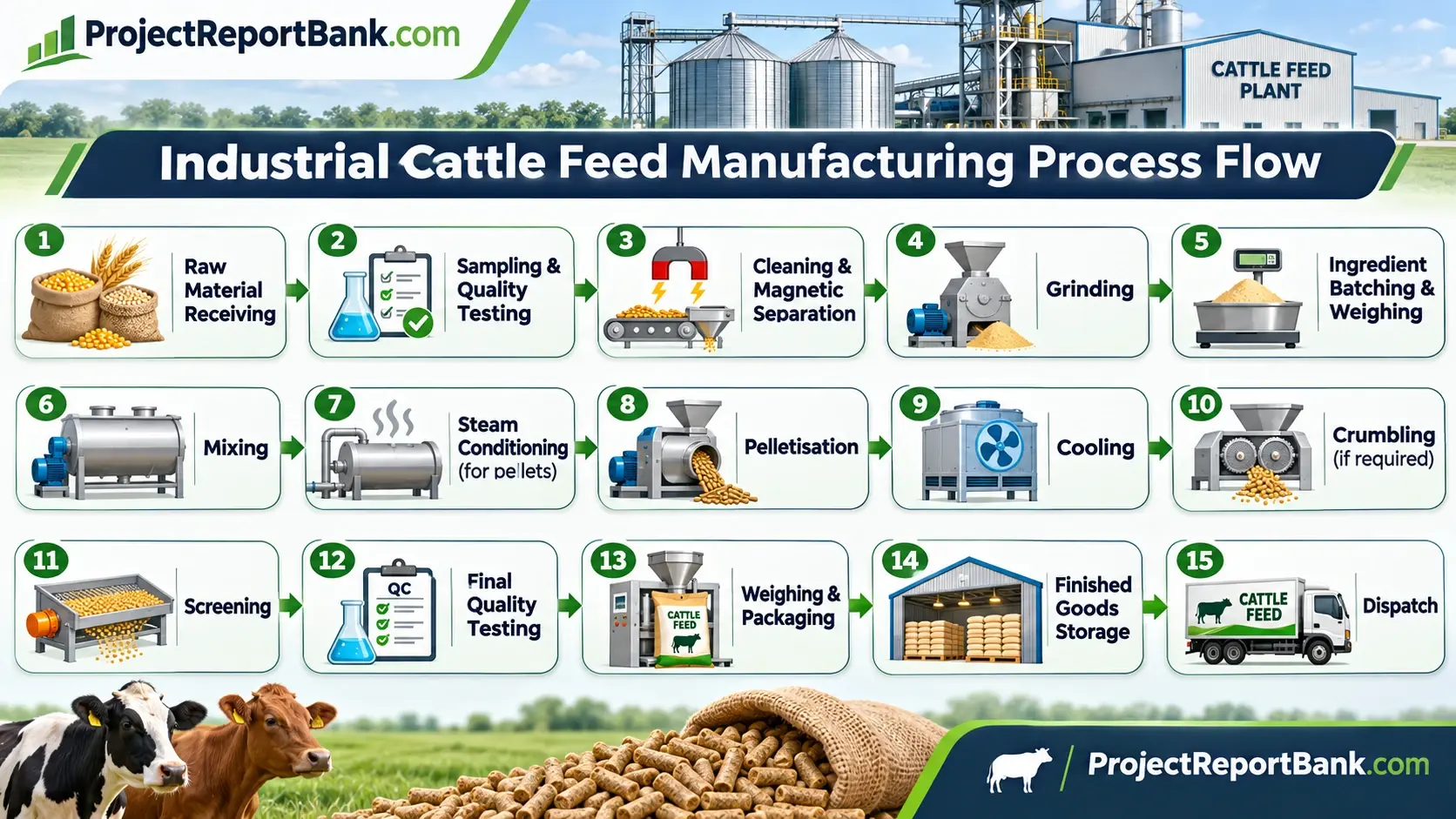
Process Flow: Raw Material Receiving → Sampling & Quality Testing → Cleaning & Magnetic Separation → Grinding → Ingredient Batching & Weighing → Mixing → Steam Conditioning (for pellets) → Pelletisation → Cooling → Crumbling (if required) → Screening → Final Quality Testing → Weighing & Packaging → Finished Goods Storage → Dispatch
Key process considerations:
- Grinding: Hammer mills reduce grain to target particle sizes. Cattle feed grinder particle size should be 0.5–0.8 mm for optimal digestibility while maintaining rumen health.
- Batching and weighing: Automated batching via PLC/SCADA ensures recipe accuracy for both balanced nutrition and cost control.
- Mixing: Ribbon or paddle mixers target a Coefficient of Variation (CV) ≤5% for homogeneity.
- Steam conditioning and pelletisation: Conditioning mash with steam before passing through ring-die pellet mills produces durable feed pellets with improved digestibility. Energy consumption benchmarks are approximately 9–11 kWh per tonne.
- Cooling and screening: Counter-flow coolers bring pellets to ambient temperature and safe moisture; crumblers produce smaller particles for calf feeds; fines are screened and recycled.
- Packing: 50 kg bags with batch coding for traceability. Finished goods warehousing requires clear segregation by batch and product line.
6. Plant Machinery and Equipment for a Modern Cattle Feed Plant
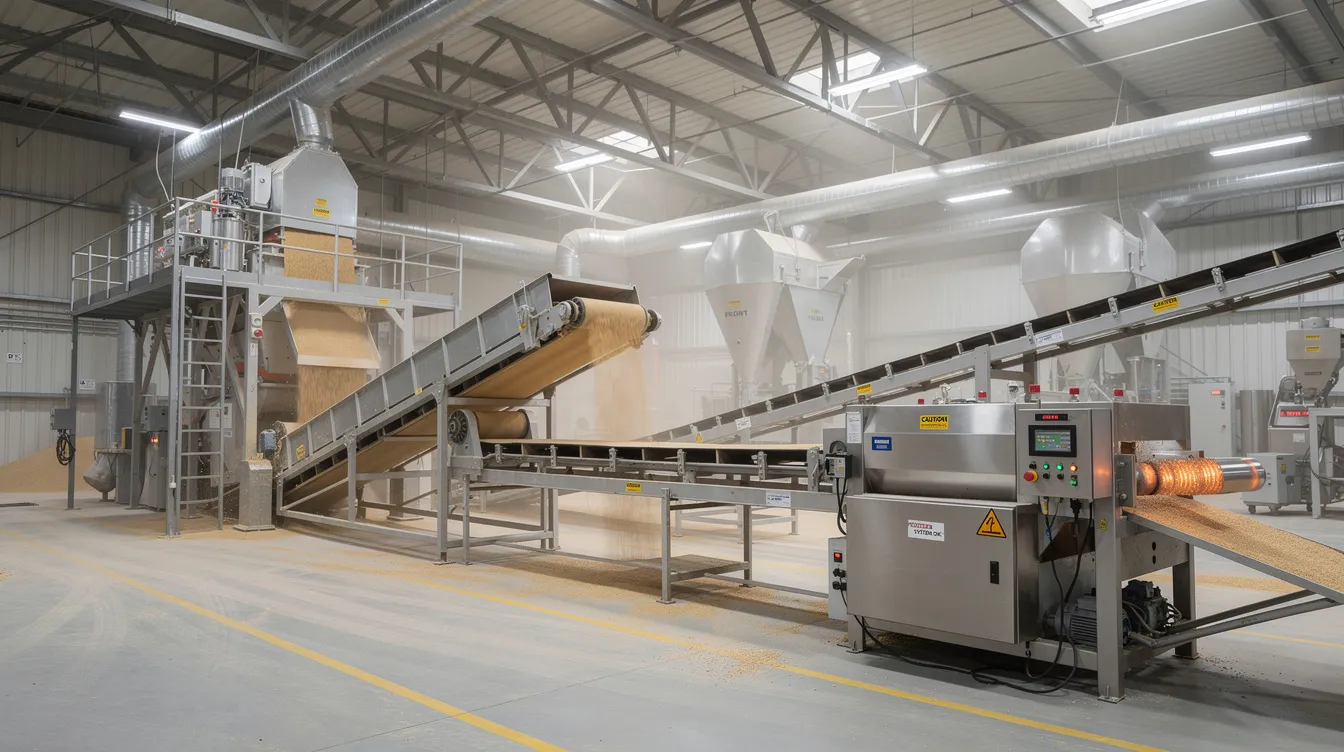
A complete feed plant is a system of interconnected machines – mechanical, pneumatic and electrical – combined with automation and quality-control facilities. Cattle feed pellet machines can process various raw materials, and automatic cattle feed machines enhance efficiency by approximately 30% compared to manual operations.
Core machinery includes intake hoppers, conveyors, bucket elevators, raw material silos, grain cleaners, magnetic separators, hammer mills, automated batching systems, feed mixers, steam conditioners, pellet mills (with dies sized for cattle feed – larger than poultry feed pellets), pellet coolers, crumblers, and grading screens. Supporting systems include boilers, dust collection (cyclones and bag filters), PLC/SCADA automation and automated bagging machines.
Installation and commissioning of machinery are key aspects of plant setup and operational readiness. Promoters should distinguish between ex-factory machinery price and total installed cost – which includes erection, commissioning, electrical cabling, foundations, freight and taxes. Vendor selection should prioritise proven suppliers with Indian service backup, spare parts availability and performance guarantees.
7. Land, Building and Infrastructure Requirements
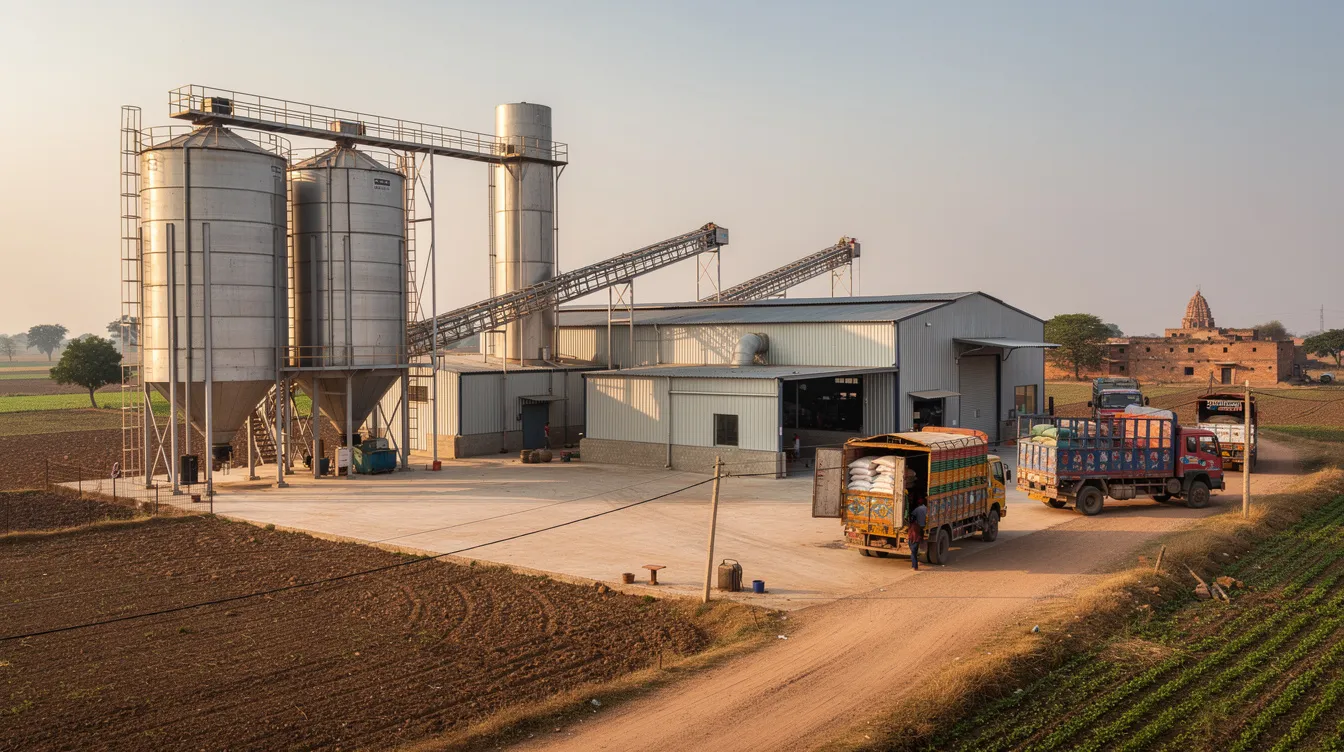
Cattle feed plants require careful site evaluation for operational efficiency. For a 5–10 TPH plant, typically 1–2 acres may be needed, with more for larger capacities.
Built-up components include: production building, raw material godowns for raw material storage, finished goods warehouse, utility block (boiler, compressor, DG set), laboratory, administrative office, weighbridge and security. Internal logistics must accommodate truck turning radius, docking bays, covered platforms for monsoon protection, and expansion space.
Infrastructure needs: reliable 3-phase power supply with backup DG, water for boiler and cleaning, road access for transportation, drainage, and fire-fighting systems. Location proximity to grain belts, dairy belts and highways significantly influences supply chain cost and distribution reach. Statutory approvals are necessary for establishing a cattle feed manufacturing plant – including zoning permissions, pollution control board consents and factory licence.
8. Cattle Feed Manufacturing Plant Setup Cost in India (Illustrative Framework)
Disclaimer: Actual project cost must be determined through quotations and project-specific DPR. Figures below are illustrative using 2026 price-level assumptions.
The majority of project costs come from raw materials, machinery, installation and civil works. Major capital cost heads include land and site development, civil construction, plant and machinery, electrical installation, boiler and utilities, storage systems, laboratory equipment, pre-operative expenses, contingency and margin for working capital.
| Component | Approximate Share of Total Cost |
|---|---|
| Plant & Machinery (installed) | 45–55% |
| Building & Civil Works | 25–35% |
| Utilities, Electrical, Lab | 8–12% |
| Pre-operative & Contingency | 5–10% |
As a broad reference, a 5 TPH pellet plant may fall in the mid-single-digit crore range, while 10–20 TPH plants typically require high single- to low double-digit crore total capital investment. A sample 32 MT/day plant referenced in NPCS project data indicated total project cost of approximately ₹3.80 crore including land, machinery and working capital margin. Investment in cattle feed production at appropriate scale is critical for profitability.
Project Report Bank prepares cost estimates based on plant capacity, automation level, location, vendor quotations and promoter preferences.
9. Working Capital Requirements for a Cattle Feed Plant
Working capital assessment is essential for financing raw material inventory and day-to-day operations. Even profitable plants can face cash-flow stress if working capital is underestimated.
Key components: raw material inventory (15–30 days of major materials), finished goods (7–15 days), trade receivables (dealers typically receive 15–30 days credit), and operating expenses. Inventory norms may expand during harvest seasons when locking in lower grain prices is commercially attractive.
Banks typically finance working capital through cash credit limits assessed on drawing power against stock and book debts, or through projected turnover methods for MSMEs. A detailed financial analysis considers working capital, cost of production and profitability estimates in an integrated manner.
10. Production Cost and Operating Economics of Cattle Feed Manufacturing
Operating economics revolve around cost per tonne and contribution margin. Cattle feed production costs are primarily driven by raw materials – typically 75–85% of total cost. Other cost heads include packing materials, power and fuel, direct labor, repairs and maintenance (including pellet die replacements at roughly 20,000-tonne intervals), factory overheads, selling and distribution expenses, and administrative costs.
Gross profit margins for cattle feed typically range from 15–25%, with average market price gross margin often at 15–20%. EBITDA per tonne in efficient mid-to-large plants may range ₹1,100–₹2,300 – sensitive to maize, soybean meal and oil cake price movements. Lower capacity utilisation increases fixed cost per tonne and compresses margins.
11. Revenue, Profitability and Financial Projections
Financial projections in a project report typically estimate profitability and cash flow for 5 to 7 years. Key assumptions must be transparently defined: installed capacity, phased utilisation (Year 1 at 55–60%, stabilising at 80–85% by Year 3–4), product mix, average selling prices (typically ₹25,000–₹32,000 per tonne ex-factory), and raw material escalation trends.
The projected P&L structure flows from revenue through cost of goods sold, gross profit, overheads and selling expenses to EBITDA, then subtracts depreciation and finance costs to arrive at PBT and PAT. Promoters should evaluate multiple scenarios – base, conservative and optimistic – rather than relying on a single projection. Similar principles apply to financial projections across dairy value chain projects, as discussed in our Dairy Processing Plant Financial Projections guide.
12. Bank Loan and Project Finance Structure for Cattle Feed Plants
Medium and large cattle feed plants are typically financed through promoter equity plus bank term loans and working capital limits. Typical debt–equity ratios range from 1.5:1 to 2:1, depending on bank policy and project risk.
Under the Animal Husbandry Infrastructure Development Fund (AHIDF), eligible entities can access term loans with repayment tenure up to 8 years (including moratorium up to 2 years) and interest subvention of 3% per annum. Security typically includes primary charge on fixed assets, hypothecation of stocks and receivables, and promoter guarantees. Banks evaluate DSCR, profitability, net worth support and industry risks through the DPR and CMA Data before sanctioning loans. No interest rate or approval can be guaranteed.
13. Financial Feasibility and Bankability Assessment
Financial feasibility goes beyond simple profit estimation. Project reports must include financial viability indicators such as ROI, IRR and payback period. DSCR – cash accruals divided by annual debt service – is the primary bankability metric; lenders typically expect minimum annual DSCR above 1.25–1.30 over the repayment period. Sample projects indicate average DSCR around 1.75 at stabilised operations, with break-even utilisation at approximately 40–45% of capacity.
Understanding local market demands and existing competition is critical for financial feasibility in project planning. Even projects with good projected profitability can face cash-flow stress due to aggressive repayment schedules or working capital shortages – underscoring the need for integrated cash-flow modelling.
14. Market Opportunities and Distribution Strategy
Distribution networks play a key role in reaching target customers in the cattle feed market. Primary segments include dairy cooperatives, private dairies, organised dairy farms, small farmers via rural dealer networks, and institutional buyers. Many promoters also consider diversification into other animal feed segments such as poultry feed manufacturing once they stabilise cattle feed operations.
Competitive differentiation comes through consistent quality, science-backed formulations, transparent labelling, technical advisory to farmers and reliable delivery. New plants should phase distribution – launching in 3–5 districts in Year 1, expanding regionally in Year 2, and exploring institutional contracts by Year 3.
15. Quality Control, Standards and Regulatory Compliance
The cattle feed manufacturing sector requires compliance with regulatory standards such as Bureau of Indian Standards (BIS) codes. IS 2052:2023 specifies nutrient requirements for compounded cattle feed, and the Animal Feeds and Feed Ingredients Quality Control Order 2026 will mandate BIS certification from April 2027. Quality control measures in cattle feed production include regular testing for moisture, nutrient levels and contaminants.
Legally compliant operations require necessary registrations, licenses and environmental clearances – including factory licence, State Pollution Control Board consents, GST registration and labour compliances. Optional certifications like ISO 9001 provide commercial advantage with large institutional buyers.
16. Key Industrial Project Risks in Cattle Feed Manufacturing
While cattle feed is a demand-stable business, key risks include:
- Raw material price volatility – mitigate through staggered procurement, diversified suppliers
- Feed formulation errors – engage qualified nutritionists, maintain lab testing
- Capacity underutilisation – build distribution gradually, avoid overbuilding
- Dealer credit risk – enforce credit discipline, maintain adequate provisions
- Machinery breakdowns – schedule preventive maintenance, stock critical spares
- Regulatory changes – monitor BIS and state feed control developments proactively
Comprehensive risk analysis is a core component of a professional DPR.
17. Sensitivity Analysis for Investors
Sensitivity analysis helps promoters and lenders understand how changes in key variables affect profitability, DSCR and IRR – forming an essential part of industrial cattle feed plant financial feasibility assessment.
Key variables to stress-test: raw material prices increasing by 5%, 10% and 15%; selling prices declining by 5%; capacity utilisation falling 10–20 percentage points below projection; working capital cycle extension; and interest rate increases of 1–2 percentage points. Prudent promoters and serious lenders prefer conservative assumptions and robust DSCR under stressed scenarios.
18. Importance of a Professional Detailed Project Report (DPR)
For projects exceeding ₹5 crore investment, a professionally prepared bankable DPR is indispensable. A cattle feed manufacturing project report must cover technical, financial and operational dimensions. A proper project report outlines the manufacturing process including steps like cleaning, grinding, batching and mixing, alongside capital cost estimates, market analysis and demand-supply assessment, revenue projections, working capital assessment, DSCR analysis, IRR calculations and sensitivity testing.
The difference between a generic online report and a customised DPR is fundamental: generic reports use broad assumptions and cannot support bank finance applications, whereas a professional DPR incorporates actual quotations, location-specific costs and promoter-specific financial structuring.
19. Professional DPR and Financial Feasibility Services by Project Report Bank
CA Manish Gugliya, FCA, DISA (ICAI), leads Project Report Bank with over 20 years of professional experience in DPRs, project finance, financial projections and feasibility studies for industrial projects across India.
Services relevant to cattle feed and dairy nutrition projects include:
- Customised industrial cattle feed manufacturing plant project report and dairy cattle feed manufacturing plant project report
- Bank finance DPRs, CMA Data preparation and loan proposal support
- Financial modelling, DSCR analysis and sensitivity testing
- Working capital assessment, loan structuring and means-of-finance planning
- Investor-ready DPRs for equity fundraising
Promoters planning capacities of 5 TPH and above, or investments upwards of ₹5 crore, are invited to share project details through the Project Report Bank website or WhatsApp facility for an initial scope discussion.
20. Frequently Asked Questions
What is the typical investment range for an industrial cattle feed manufacturing plant in India?
Investment depends significantly on capacity, automation level and location. A 5 TPH pellet plant may require mid-single-digit crore investment, while 10–20 TPH plants typically fall in the high single- to low double-digit crore range including land, building, machinery, utilities and working capital margin. A customised DPR based on actual quotations is necessary for precise estimation.
Is cattle feed manufacturing profitable at industrial scale?
Cattle feed manufacturing can be commercially viable when operated at adequate scale with efficient procurement, competitive formulations and strong distribution. However, margins are thin – gross profit margins typically range from 15–25% – and highly sensitive to raw material prices. Profitability is not guaranteed and depends on capacity utilisation, cost management and market conditions.
What is the difference between mash cattle feed and pellet cattle feed from a commercial perspective?
Mash feed requires simpler machinery and lower capital investment but results in higher feeding wastage and lower market acceptance at premium price points. Pellet feed requires additional equipment (conditioner, pellet mill, cooler, boiler) and higher energy consumption but commands better pricing, reduced wastage and improved animal digestibility. Most industrial projects targeting organised dairy farms prefer pellet feed production.
How long does it usually take to implement a cattle feed manufacturing project from concept to commissioning?
Implementation timelines typically range from 12 to 18 months for medium-scale plants, covering site acquisition, statutory approvals, civil construction, machinery procurement, installation and commissioning, and trial production. Delays in land approvals, building construction or imported machinery can extend timelines. A well-prepared project plan with realistic milestones helps manage implementation risk.
Why is a Detailed Project Report necessary before approaching banks for a cattle feed plant loan?
Banks require a technically grounded and financially structured DPR to evaluate project viability, repayment capacity, security adequacy and promoter credibility. The DPR must present realistic financial projections, DSCR analysis, working capital assessment and sensitivity testing. Without a bankable DPR and supporting CMA Data, loan processing cannot proceed effectively. Generic documents downloaded from the internet do not meet banking appraisal standards for projects of this scale.
21. Conclusion and Professional Call to Action
The market opportunity for organised compound cattle feed and dairy nutrition in India is substantial and growing. However, this is a margin-sensitive business where success depends on correct capacity selection, efficient plant layout, reliable raw material procurement, rigorous quality assurance and well-designed distribution – not just on demand alone.
Financial feasibility hinges on realistic projections, adequate working capital provisioning, conservative DSCR under stressed scenarios, and disciplined sensitivity analysis on raw material and selling price assumptions. Before committing to land purchases or placing machinery orders, promoters should invest in a professional industrial cattle feed manufacturing plant project report and financial model to develop defensible assumptions and strengthen bankability.
Planning an Industrial Cattle Feed or Dairy Nutrition Manufacturing Plant in India? Contact CA Manish Gugliya, FCA, DISA (ICAI), through www.projectreportbank.com for a customised Detailed Project Report, financial feasibility assessment, CMA Data and project finance advisory. Connect through the website’s WhatsApp facility for an initial discussion on your proposed capacity, location, product mix and investment range.