Soy lecithin is a phospholipid-rich natural emulsifier recovered during soybean oil refining – specifically during the degumming stage, where hydrated gums are separated from crude soybean oil. For soybean processors and independent entrepreneurs in India, converting these wet gums into saleable lecithin represents a commercially significant value-addition opportunity. This article examines the manufacturing process, machinery requirements, capital investment, production economics, risk factors and financial viability considerations relevant to a soy lecithin extraction plant project report prepared for Indian conditions.
Key Takeaways
- Soya lecithin is extracted during soybean oil refining – it is recovered from wet gums separated during degumming, not from soybean meal.
- Key applications of soy lecithin include food processing, confectionery, bakery, animal feed, dietary supplements and the pharmaceutical industry. Liquid lecithin represented 86.2% of global lecithin revenue in 2024.
- A soy lecithin extraction plant project report must cover plant setup, manufacturing process design, machinery and technology requirements, capital expenditure, operating costs, working capital assessment and market-linked selling prices.
- Project viability depends on reliable crude soybean oil or wet gum supply, lecithin quality specifications, capacity utilisation and realistic financial projections including DSCR, IRR and net present value.
- All investment figures in this article are indicative. Final project cost, production economics and DSCR must be validated through a customised, project-specific feasibility study and detailed project report prepared by a qualified professional.
Executive Overview and Purpose of the Soy Lecithin Extraction Plant Project Report
Soy lecithin occupies an important position in the food industry, nutraceutical formulations, animal feed and selected industrial applications as a versatile emulsifying agent, wetting agent and release agent. It functions at the molecular level by stabilising oil-water interfaces – its constituent phospholipids, including phosphatidyl choline and phosphatidylethanolamine, are structurally similar to components of cell membranes, which accounts for its functional and health benefits in dietary supplements and functional foods.
Commercially, soya lecithin production is tied directly to crude soybean oil degumming. The wet gums separated during this process contain phospholipids, residual oil, moisture and minor components. Drying and refining these gums produces liquid or de-oiled lecithin – a final product commanding substantially higher per-kilogram value than the crude oil from which it originates.
Two principal project models exist:
- Integrated lecithin recovery within an existing edible oil refinery, where wet gums are piped directly from the degumming section – an approach detailed in the Integrated Soybean Crushing, Oil Extraction & Refining Plant DPR.
- Standalone soy lecithin processing plant that purchases wet gums or crude oil from third-party refineries.
This article covers the manufacturing process, plant setup, machinery, capital expenditure, operating cost structure, project economics, risk factors and financial viability to help promoters in India make informed investment decisions.
Introduction – Soy Lecithin Manufacturing Opportunities in India
Soy lecithin is classified as food additive E322 in Europe and must meet FDA regulations in the United States, reflecting its widespread acceptance as a generally recognized safe ingredient. In India, it is regulated by FSSAI as a permitted food additive used across chocolate and confectionery, bakery, margarine and spreads, instant drink mixes, dairy alternatives and animal feed formulations.
Within the soybean value chain, lecithin sits downstream of soybean crushing and oil extraction. India’s soybean oil production is projected at approximately 1.80 million metric tons for marketing year 2026/27, with Madhya Pradesh, Maharashtra, Rajasthan and Gujarat serving as principal crushing hubs. This significant crude oil volume generates a substantial quantity of wet gums – the primary raw material for lecithin production.
It is important to distinguish lecithin recovery (which comes from the oil stream during degumming) from soybean meal processing (which involves the protein-rich residue after oil extraction).
This soy lecithin extraction plant project report is intended as a practical advisory guide for Indian entrepreneurs, existing refinery operators and investors evaluating diversification and value-addition opportunities.
Understanding Soy Lecithin: Product Types, Grades and Applications
Not all lecithin is commercially equivalent. Product form, purity, phospholipid content and end-use determine the required technology, investment level and achievable selling price.
- Standard liquid soy lecithin (food-grade): A viscous, brown liquid with standard viscosity, recovered after drying wet gums and standardisation. Used widely in chocolate, bakery, margarine, instant powders and as an emulsifying agent in processed foods. This is the most common commercial form.
- Feed-grade lecithin: Produced to looser specifications – typically higher moisture, lower phospholipid concentration. Used in poultry, cattle and aquaculture feed to improve fat digestibility and palatability. Margins are lower but quality control requirements are simpler.
- De-oiled soy lecithin powder/granules: De-oiled soy lecithin is powdery and free-flowing, produced through acetone extraction of crude lecithin followed by drying and milling. Preferred in nutraceutical capsules, instant drink mixes and some pharmaceutical formulations. Commands a significant price premium.
- Specialty and fractionated lecithin: Includes hydrolysed, enzyme-modified or fractionated grades with enhanced hydrophilicity or specific phospholipid ratios. Requires additional process steps, higher capital cost, more stringent quality control and access to premium buyers.
Soya lecithin is also used as an emulsifier in industrial coatings and selected cosmetic formulations, though these remain secondary markets for most Indian producers.
| Product Type | Phospholipid Content | Moisture | Key Applications | Price Level | Manufacturing Complexity |
|---|---|---|---|---|---|
| Liquid lecithin (food-grade) | 62–70% AI | < 1% | Chocolate, bakery, margarine | Medium | Moderate |
| Feed-grade lecithin | 50–62% AI | 1–3% | Animal feed, aquaculture | Low | Low |
| De-oiled lecithin powder | > 95% AI | < 2% | Nutraceuticals, pharma, instant foods | High | High (solvent handling) |
| Fractionated / modified | Variable | Variable | Specialty food, pharma, cosmetics | Very high | Very high |
Note: AI refers to acetone-insoluble matter, a standard measure of phospholipid concentration. Soya lecithin accounted for 78.3% of the global lecithin market in 2024, confirming its dominant position across all these product categories.
Raw Material Requirements and Lecithin Recovery from Degummed Soybean Oil
Commercial lecithin production relies on wet gums obtained during crude soybean oil degumming – not from soybean meal or whole beans directly.
- Upstream crude soybean oil typically contains 1.3% to 3.0% phospholipids on a crude oil weight basis. The actual percentage depends on seed quality, crushing method and pre-treatment conditions. Solvent extraction using hexane generally yields higher lecithin content compared to mechanical extraction, which yields lower lecithin but is chemical-free.
- Degumming is the process where phospholipids are hydrated by adding approximately 2% water (by weight of oil) at 70–80°C. Hydration of crude soybean oil precipitates phospholipids as gums, which are then separated by centrifugation. The USDA technical report on lecithin provides detailed parameters for this process.
- Wet gum properties vary considerably: moisture content often ranges 40–50%, with substantial trapped oil. Storage requirements for raw materials include temperature-controlled tanks with agitation to prevent settling and oxidation.
- In integrated plants, wet gums are piped directly from the refinery degumming section. In standalone soya lecithin plants, gums are received via road tankers or ISO tanks and stored in heated tanks.
- Raw material testing – phosphatide content, free fatty acids, moisture, heavy metals and peroxide value – is essential before processing, as these parameters directly affect yield, lecithin quality and the financial model assumptions in any project report.
According to the US Soy Fact Sheet, recovered lecithin yields approximately 2.5% of crude oil weight. For India’s annual soybean oil production of approximately 1.80 million metric tons, this implies a theoretical lecithin potential of around 45,000 metric tons per annum.
Soy Lecithin Extraction and Manufacturing Process
The manufacturing process for soy lecithin involves several distinct unit operations, each affecting yield, colour, shelf life and overall product quality. Below is a simplified process flow covering the main production processes:
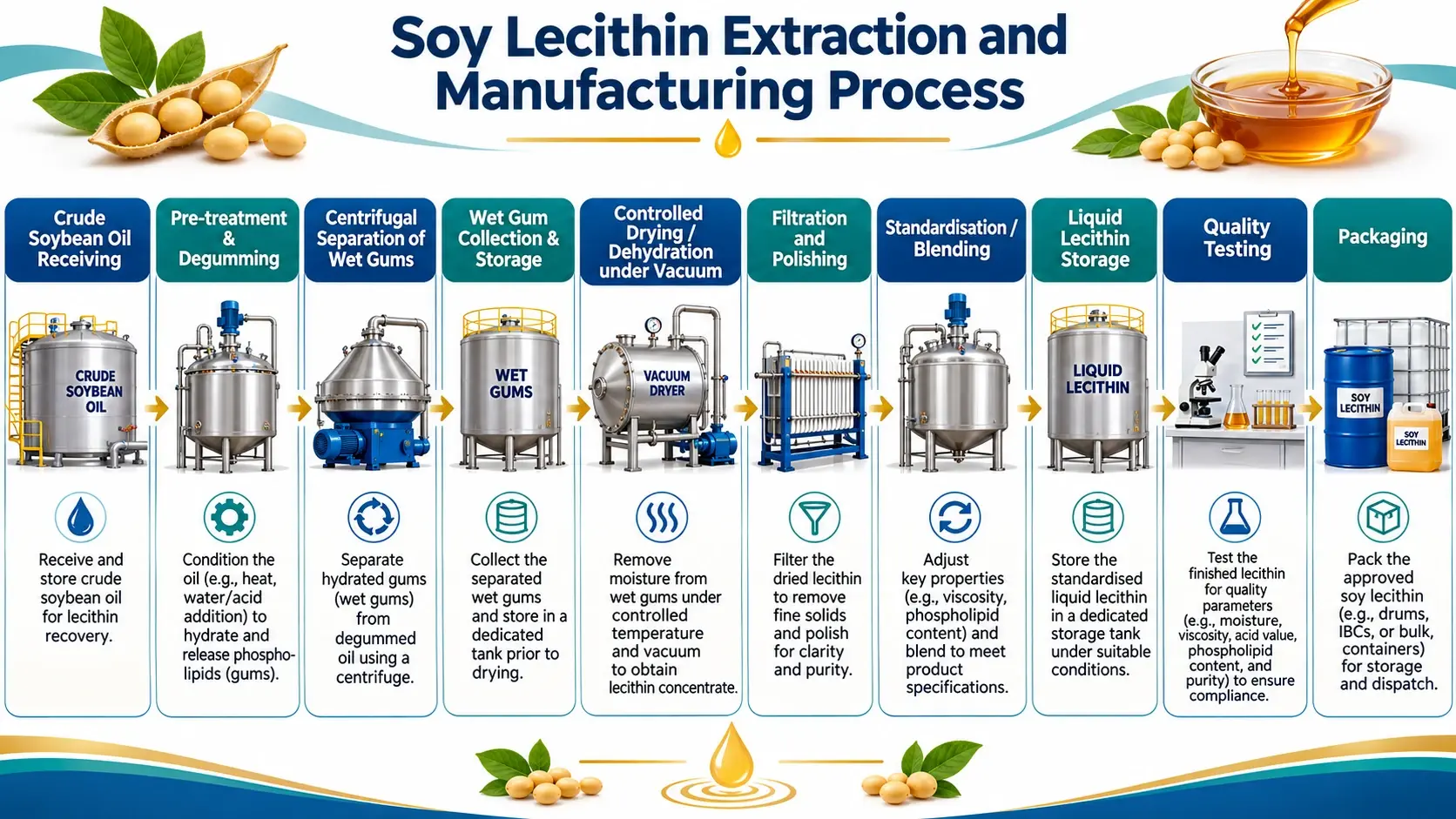
Crude Soybean Oil Receiving → Pre-treatment & Degumming → Centrifugal Separation of Wet Gums → Wet Gum Collection & Storage → Controlled Drying / Dehydration under Vacuum → Filtration and Polishing → Standardisation / Blending → Liquid Lecithin Storage → Quality Testing → Packaging
Key aspects of each stage:
- Degumming: Degumming separates gums from oil using water in lecithin production. Temperature control, correct water dosage and residence time (typically 15–30 minutes) are critical. Acid degumming and enzymatic hydrolysis represent alternative approaches – enzymatic hydrolysis is an eco-friendly lecithin extraction method gaining attention for improved yield and reduced chemical use.
- Centrifugal separation is used to separate wet lecithin from degummed oil. Self-cleaning disc centrifuges achieve the required separation efficiency while minimising oil losses.
- Vacuum drying removes moisture from wet gums under reduced pressure, preventing colour darkening and thermal degradation. Target moisture for food-grade liquid lecithin is below 1%.
- Oxidative stability requires nitrogen blanketing throughout the process, low oxygen exposure and clean-in-place systems to prevent contamination and extend shelf life of the final product.
For de-oiled lecithin powder, an additional downstream route is required: acetone extraction is needed for producing deoiled lecithin powder, where dried crude lecithin is washed with acetone to remove neutral oil, filtered, dried and milled. This adds significant capital cost and requires explosion-proof installations and solvent recovery systems.
Understanding the Edible Oil Refinery Process Flow and Degumming is essential for promoters planning integrated lecithin recovery.
Soy Lecithin Extraction Plant Machinery and Equipment
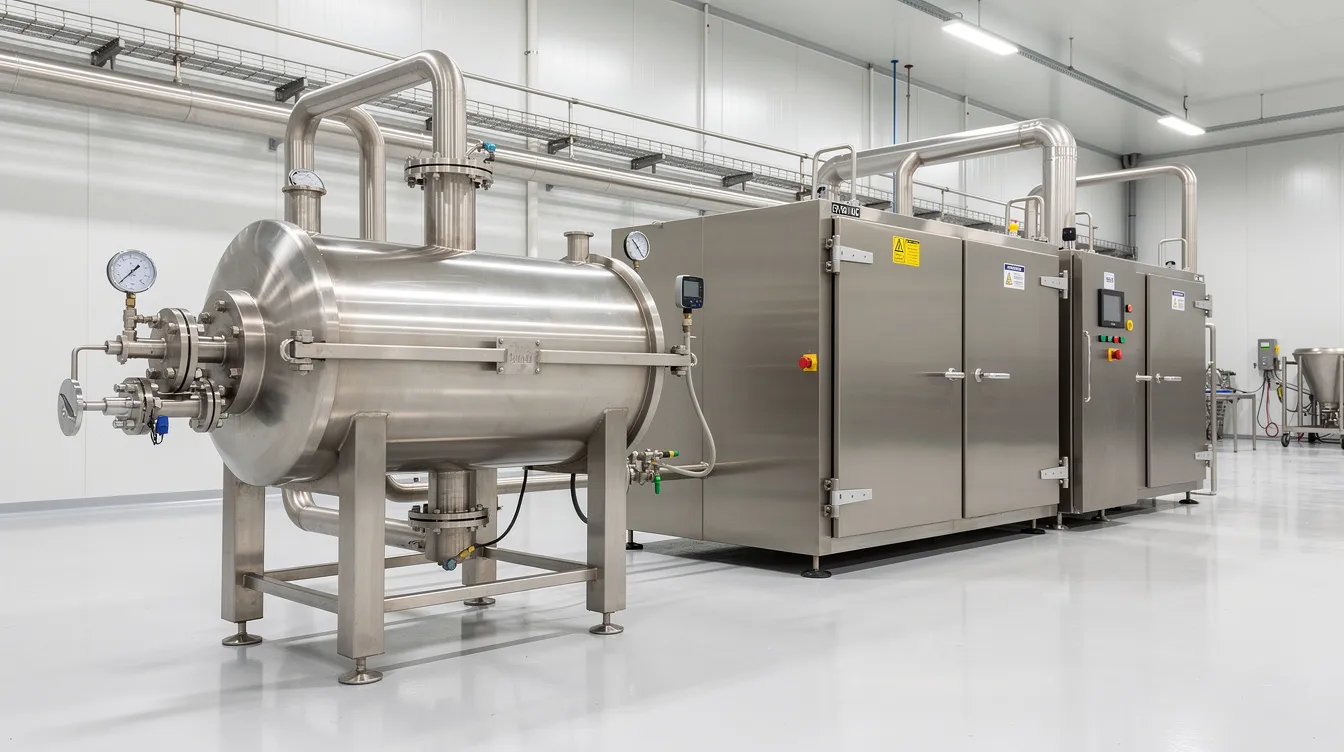
Selection of lecithin plant machinery depends on desired capacity, automation level, product grade and whether de-oiled products are planned. The various unit operations involved require specific equipment designed for food-contact compatibility.
Core process equipment includes:
- Soy lecithin plants need crude oil heaters for processing – typically shell-and-tube or plate-type heat exchangers
- Degumming reactors with agitation and in-line mixers for water or acid dosing
- Soya lecithin production requires a self-cleaning disc centrifuge for gum-oil separation
- Mixers and holding tanks are crucial for lecithin production – heated wet gum storage tanks with agitators prevent solidification
- Vacuum dryers are essential for removing moisture from lecithin – thin-film evaporators or agitated vacuum dryers with associated vacuum systems and condensers
- Polishing filters, safety heat exchangers and nitrogen blanketing systems
For de-oiled lecithin, additional equipment includes acetone extraction vessels, filter presses, solvent recovery distillation columns, explosion-proof electrical systems and solvent storage tanks with proper safety dykes.
Soy lecithin can be packaged in drums or intermediate bulk containers (IBCs), requiring appropriate filling and sealing equipment.
| Equipment Group | Process Function | Key Selection Criteria | Major Cost Drivers |
|---|---|---|---|
| Crude oil heaters | Temperature conditioning | Heat transfer area, MOC (SS316) | Capacity, material grade |
| Degumming reactor | Phospholipid hydration | Residence time, agitation | Volume, automation |
| Disc-stack centrifuge | Gum-oil separation | Throughput, separation efficiency | Capacity, self-cleaning mechanism |
| Vacuum dryer / thin-film evaporator | Moisture removal | Evaporation rate, temperature control | Surface area, vacuum system |
| Solvent extraction system (optional) | De-oiling via acetone | Explosion-proof design, recovery efficiency | Safety systems, automation |
| Boiler / thermic fluid heater | Steam and heat supply | Fuel type, steam capacity | Capacity, fuel |
| PLC/SCADA | Process automation | Integration, redundancy | Sophistication level |
| QC laboratory | Product testing | Analytical capability | Equipment range |
Equipment material of construction is typically SS304 or SS316 for food-contact surfaces, with appropriate surface finish and CIP compatibility. Promoters evaluating machinery should also review Edible Oil Refinery Machinery and Technology Selection for alignment with broader refinery EPC decisions.
Plant Capacity Planning and Production Configuration
Capacity planning should start from available crude soybean oil or wet gum volume, not from arbitrary lecithin tonnage targets. The projected annual production capacity for commercially viable lecithin plants ranges from 2,000 to 10,000 MT, depending on scale and integration.
- Integrated configuration: Refinery fresh gums are sent directly to the lecithin plant. A refinery processing 200 tonnes per day of crude oil may generate roughly 1,500 MT per year of crude lecithin potential (illustrative estimate based on ~2.5% yield).
- Standalone lecithin plants purchase wet gums from multiple refineries. This model requires strong long-term supply contracts but offers location flexibility.
- Hybrid plants produce both liquid and de-oiled lecithin, diverting part of the liquid stream for acetone extraction based on market demand for powder grades.
Promoters should evaluate production capacity based on 300–330 operating days per year, with realistic capacity utilisation during ramp-up (50–60% in Year 1, scaling to 80–90% in stable years).
Land, Building and Utility Requirements for a Lecithin Plant
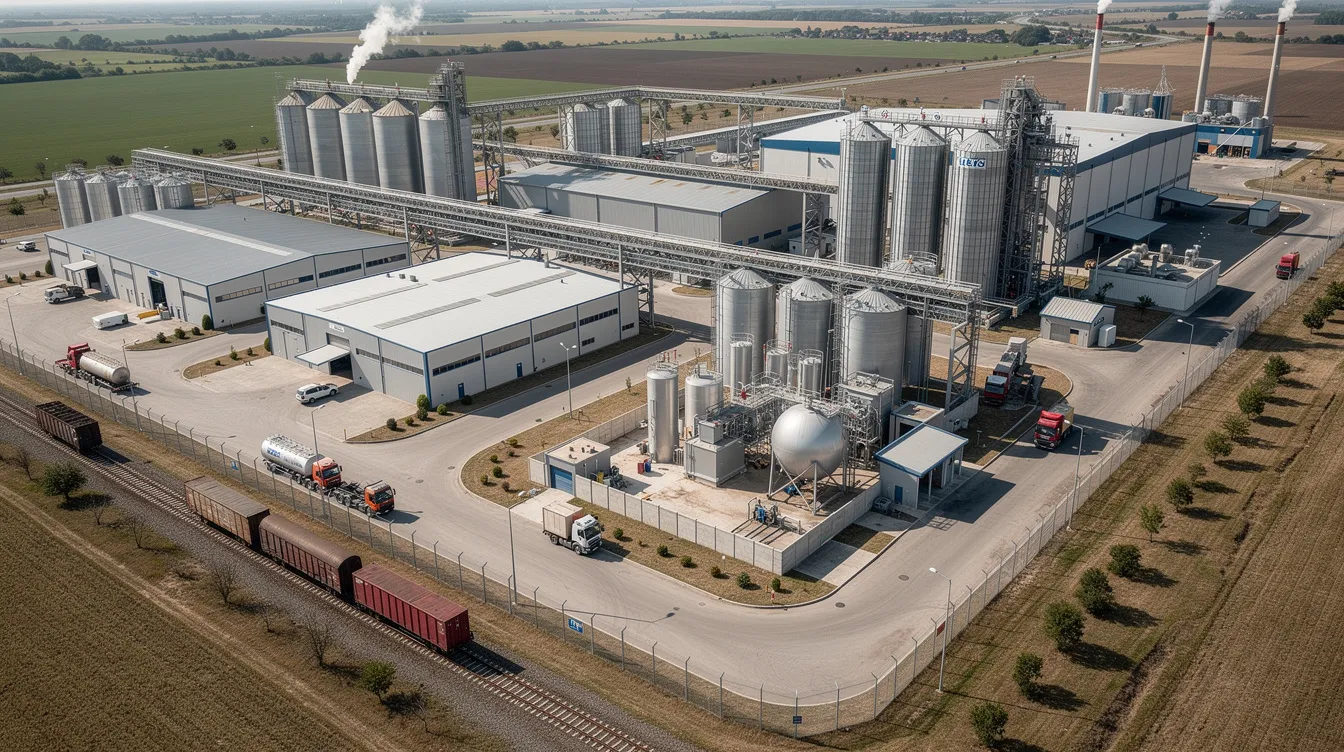
A mid-scale soya lecithin manufacturing plant typically requires 0.5–1.5 acres depending on integration level, including process buildings, storage tanks, utility block, laboratory and administrative area.
Building layout should provide separate zones for degumming/drying, solvent handling (where applicable), packaging, finished-goods storage and quality control, designed to comply with food-safety zoning principles. Utility requirements include steam or thermic fluid heating for degumming and drying, electrical connected load for centrifuges, pumps and automation, cooling water circuits, compressed air distribution and effluent treatment for oily wastewater.
Plants using solvents such as acetone for de-oiling require explosion-proof electrical zones, flame-proof fittings, solvent storage dykes and adequate ventilation – adding both to construction cost and regulatory compliance requirements.
Soy Lecithin Processing Plant Project Cost and Capital Expenditure Structure
Capital expenditure for a soy lecithin plant varies widely with capacity, integration level, technology choice and automation. Initial setup costs include land, machinery and infrastructure. The project implementation schedule typically spans land acquisition and construction timelines of 9–15 months for most mid-scale projects.
| Capital Cost Component | Key Considerations |
|---|---|
| Land and site development | Location, industrial zoning, access roads |
| Civil construction | Process building, storage, lab, offices |
| Main process machinery | Centrifuges, dryers, reactors, tanks |
| Utilities | Boiler, cooling, vacuum systems, compressed air |
| Electrical systems | Panels, cabling, explosion-proof fittings (if applicable) |
| Storage and packaging | Finished product tanks, drum/IBC filling |
| Laboratory and quality systems | Analytical instruments, testing protocols |
| Installation and commissioning | Engineering, piping, erection |
| Pre-operative expenses | Project development, interest during construction |
| Contingency (5–10%) | Cost escalation, foreign exchange variation |
| Working capital margin | Operational liquidity for initial months |
Greenfield standalone lecithin projects must invest in complete utilities, while incremental investment inside an existing refinery benefits from shared infrastructure. For context on integrated plant investment, promoters may review the Edible Oil Refinery Project Cost and Investment analysis.
Capital investment estimates should be supported by vendor quotations, engineering drawings and clearly stated assumptions – not by generic figures.
Raw Material Consumption, Processing Yield and Production Economics
This section is where mass balance and yield assumptions feed directly into contribution margins and financial projections in the project report.
Illustrative mass balance (per tonne of crude soybean oil processed):
| Stage | Approximate Quantity | Notes |
|---|---|---|
| Crude soybean oil input | 1,000 kg | Starting material |
| Wet gums separated | 50–80 kg (wet basis) | 40–50% moisture, trapped oil |
| After drying | 30–35 kg crude lecithin | Moisture reduced to < 1% |
| De-oiled lecithin (if applicable) | 20–25 kg | After acetone extraction |
These are illustrative estimates based on typical global practice (verified yield of ~2.5% on crude oil weight from USSEC data).
Operating cost drivers:
Operating costs are primarily driven by raw material consumption. Crude soybean oil accounts for 70–80% of operating expenses when degumming is performed in-house. Additional variable costs include steam and power, labour, maintenance, packaging requirements, quality control testing and internal transport.
Production economics differ materially between liquid and de-oiled lecithin. De-oiled powder requires additional acetone, higher energy for solvent recovery, nitrogen consumption and milling – but may command 2–3× the selling price of commodity liquid grades.
All numerical examples here are indicative estimates for educational purposes, not market quotations or guaranteed returns.
Soy Lecithin Market Demand, Customers and Sales Strategy
The global soya lecithin market was valued at USD 645.1 million in 2024, with soya lecithin revenues surpassing USD 469 million in 2023. The soya lecithin market is expected to reach USD 1,068.8 million by 2030, with the global soya lecithin industry projected to grow at a CAGR of 9.1% from 2025 to 2030. The global demand for soya lecithin is around 225,000 tonnes per annum.
Primary customer segments include:
- Chocolate and confectionery manufacturers
- Industrial bakeries and processed food companies
- Margarine and spread producers
- Instant beverage premix companies and dairy alternatives brands
- Integrated feed mills requiring animal feed ingredients
- Nutraceutical formulators and capsule manufacturers producing dietary supplements
The soya lecithin market is fundamentally B2B, where stable long-term customer relationships, sample approvals, application trials and quality certifications matter far more than spot sales. Commercial terms typically involve price indexation with soybean oil markets and credit periods of 30–60 days.
Promoters should distinguish between confirmed demand (contracts or letters of intent) and general market interest when building revenue projections in their business plan. Industry trends favour non-GMO, identity-preserved and organic lecithin, which command premium prices but require additional certification costs and supply-chain controls.
Soy Lecithin Plant Financial Projections and Viability Analysis
Financial viability of a soy lecithin extraction project includes assessing capital expenditure, operating expenditure, revenue realisation and debt-servicing capacity through a structured 7–10-year financial model.
Key components of income and expenditure projections:
- Revenue projections should be linked to installed capacity, phased capacity utilisation (e.g., 55% in Year 1 scaling to 85% by Year 3), product mix and realistic average selling prices
- Operating expenses include raw materials (wet gums or crude oil), utilities, salaries, repairs and maintenance, selling and distribution and administrative overheads
- EBITDA and operating margins derived from projected P&L, with gross profit margins typically ranging between 35–45% for well-managed operations
- Key financial indicators for project viability include IRR, NPV and DSCR – banks focus on DSCR profile (generally requiring > 1.3–1.4 on average) and sensitivity results rather than headline profit alone
- The break-even point usually ranges between 35% to 45% capacity utilisation for lecithin plants with moderate leverage
Effective project reporting should include detailed financial projections and sensitivity analysis. Promoters preparing financial models for lecithin projects may find relevant methodology in the Edible Oil Refinery Financial Projections, CMA Data and DSCR article.
Working Capital Assessment and CMA Data for Lecithin Projects
Soy lecithin units are working-capital intensive because wet gums, finished goods and receivables tie up significant funds – particularly when selling to large B2B customers on 30–60 day credit terms.
Key current assets include raw material inventory (wet gums or crude oil), consumables and chemicals, packaging material, finished lecithin stock, trade receivables and minimum cash balances. Current liabilities include supplier credit, wages payable, statutory dues and short-term borrowings.
Working capital cycle calculations – material holding days, WIP days, finished-goods days, debtor days and creditor days – feed directly into bank assessment of fund-based credit limits. CMA Data for bank loans should be prepared per RBI and Indian banking formats, containing projected balance sheets, P&L, fund-flow statements, ratio analysis and maximum permissible bank finance for at least 5–7 years.
Bank Finance, Term Loan and Means of Finance Planning
A soya lecithin plant typically requires a well-structured mix of promoter equity and term loan, with separate limits for working capital.
- Means of finance: Promoter contribution (typically 25–35% of project cost), term loan from bank or financial institution (65–75%), and separate working capital limits (cash credit, WCDL, LC/BG)
- Loan structuring should align repayment tenure and moratorium with project cash flows and stabilisation timeline – a steady supply of lecithin revenue takes 12–18 months to establish
- Banks scrutinise the soy lecithin extraction plant project report, promoter background, market assumptions, DSCR, collateral and statutory compliance during due diligence
- Promoters should avoid over-leverage and maintain comfortable DSCR under base-case assumptions – projects with marginal DSCR under optimistic conditions face serious appraisal risk
Integrated Soybean Processing vs Standalone Soy Lecithin Manufacturing
| Factor | Integrated with Refinery | Standalone Lecithin Plant |
|---|---|---|
| Feedstock security | High – direct wet gum supply | Moderate – depends on contracts |
| Capital costs | Lower incremental investment | Full standalone investment required |
| Operating costs | Lower – shared utilities | Higher – independent utilities |
| Quality consistency | Better – controlled degumming | Variable – multi-source gums |
| Working capital | Lower – integrated procurement | Higher – separate inventory cycle |
| Scalability | Linked to refinery capacity | Flexible sourcing, independent scaling |
| Implementation risk | Higher complexity | Simpler, focused scope |
Existing soybean refineries enjoy clear commercial advantages for lecithin recovery through shared infrastructure and feedstock security. However, standalone plants may suit entrepreneurs with strong gum sourcing relationships or those targeting specific regional markets.
For promoters evaluating broader integration, the Industrial Oilseed Processing Plant Project Report provides relevant context on multi-product oilseed complexes.
Licences, Regulatory Compliance and Quality Standards in India
The exact regulatory requirements depend on plant location, product grade, process technology and whether solvents are used.
- Company and factory compliance: Company registration, industrial land allotment, factory licence under Factories Act, local construction permits and power connection approvals
- FSSAI licensing is mandatory for food-grade soy lecithin as a permitted food additive. Quality control processes must comply with ISO and FDA standards, and regular testing for contaminants is required for food safety compliance
- Environmental approvals: State Pollution Control Board consents (Consent to Establish/Operate), effluent treatment requirements, air emissions norms and solid-waste handling protocols. Environmental management systems are common at export-focused lecithin sites
- Safety compliance: Fire and safety clearances, boiler and pressure vessel registration, PESO permissions for solvent storage. Respiratory and safety compliance regulations are crucial during solvent handling in de-oiling operations
- Quality certifications: ISO 9001, ISO 22000/FSSC 22000, HACCP, Halal/Kosher as per market requirements. Quality control requires testing for microbial, heavy metal and solvent residues to maintain product integrity and reduce cholesterol levels-related claims only where scientifically supported
- Export markets may require adherence to Food Chemicals Codex, EU E-number standards or specific country import certifications
Promoters should verify up-to-date regulatory requirements using official FSSAI, SPCB and labour department notifications. Factors influencing regulatory burden include plant scale, product specifications and target markets.
Risk Assessment, Project Sensitivities and Mitigation Strategies
Soy lecithin projects face multiple operational, market and financial risks requiring systematic detailed analysis in any bankable DPR.
Technical and supply risks: Variable gum quality from different refineries, degumming inefficiencies, drying issues leading to dark colour or high peroxide value, equipment breakdowns and skilled manpower shortages. The environmental impact of solvent handling and waste disposal must also be managed.
Market and price risks: Fluctuation in soybean and crude oil prices, shifts in demand from food processing sectors, competition from sunflower lecithin or synthetic emulsifiers, and buyer concentration risk where a small number of large customers dominate offtake.
Financial risks: Lower-than-planned capacity utilisation, delayed ramp-up, higher raw material costs, increased interest rates and tightening credit terms. These potential challenges must be quantified through sensitivity analysis.
Recommended sensitivity scenarios:
- Raw material cost increase of 10–20%
- Selling price reduction of 10–15%
- Recovery yield decline of 5–10 percentage points
- Delayed capacity ramp-up (50% utilisation in Year 1 vs planned 65%)
Each scenario should show its impact on EBITDA, cash flow and DSCR. Practical mitigation strategies include long-term supply and offtake contracts, diversification across product grades and customers, preventive maintenance programmes and conservative leverage levels.
Promoters may reference the approach to sensitivity analysis described in Edible Oil Refinery Feasibility, ROI and Profitability for the wider edible oil value chain.
Preparing a Bankable Soy Lecithin Extraction Plant DPR
A Detailed Project Report must integrate technical design, market assessment and financial modelling into a coherent document suitable for bank appraisal and investor review. Key success in DPR preparation lies in internal consistency between technical and financial assumptions.
Essential DPR chapters include:
- Executive summary and promoter profile
- Product description, grades and market analysis
- Technology selection and process description
- Plant capacity justification and raw material requirements assessment
- Site selection, layout and civil drawings
- Plant and machinery specifications with vendor shortlisting
- Project cost estimates with implementation schedule
- Means of finance and loan structuring
- Financial projections (P&L, balance sheet, cash flow) for 7–10 years
- Working capital assessment and CMA Data
- DSCR, break-even, IRR, net present value and payback period analysis
- Sensitivity analysis and risk assessment
- Statutory approvals and compliance requirements
Assumptions on yields, prices, operating days and finance costs should be transparently documented so bankers can evaluate the rationale behind each projection. The report should provide valuable insights for investment opportunities while maintaining defensible assumptions rather than optimistic projections.
Why Work with Project Report Bank & CA Manish Gugliya for a Soy Lecithin Project?
CA Manish Gugliya, FCA, DISA (ICAI) is a practising Chartered Accountant with over 20 years of professional experience in project finance, DPR preparation, CMA Data and financial modelling for industrial and agro-processing projects.
Project Report Bank focuses on customised, analysis-driven soy lecithin extraction plant project reports – not generic templates. Each DPR is tailored to the specific capacity, technology, integration level and market context of the promoter’s project.
Capabilities include project cost estimation, realistic financial projections, DSCR and sensitivity analysis, working-capital planning, CMA Data for bank loans and investor-ready documentation. Technical equipment details are prepared in collaboration with experienced process engineers and reputed machinery suppliers to ensure practical, bank-acceptable assumptions.
Serious promoters may share basic project details – location, capacity, integration level – via WhatsApp or email for a structured professional consultation. No automatic loan sanction or subsidy is promised.
Frequently Asked Questions (FAQ)
What is the minimum practical capacity for a soy lecithin extraction plant in India?
While very small plants of 1–2 TPD lecithin output exist, bankable industrial projects typically start at capacities aligned with a medium edible oil refinery processing several hundred tonnes per day of soybeans. The minimum viable scale depends on feedstock availability, integration with existing refinery infrastructure and target market specifications. A standalone lecithin plant purchasing wet gums may require a minimum throughput of 5–10 TPD of wet gums to achieve reasonable unit economics.
How long does it typically take to set up and commission a soy lecithin plant?
Typical timelines include 2–3 months for the feasibility study and DPR preparation, 3–4 months for detailed engineering and machinery ordering, and 4–6 months for installation and commissioning. The total project implementation schedule usually spans 10–15 months from decision to commercial production. Integrated projects may take longer due to coordination with refinery operations and shared utility commissioning.
Can I upgrade an existing edible oil refinery to add soy lecithin production?
Many refineries can retrofit lecithin recovery by modifying the degumming section and adding gum handling, drying and finishing equipment. However, a technical audit is necessary to confirm that the existing degumming system generates adequate quality wet gums, and a financial analysis should establish whether the incremental capital investment delivers acceptable returns on the lecithin stream. Liver function and other health-related claims for lecithin products require separate scientific validation and regulatory clearance.
Is it feasible to focus only on de-oiled soy lecithin powder from day one?
While possible, this requires higher capital investment, advanced solvent-handling systems compliant with PESO requirements, explosion-proof infrastructure and access to premium buyers willing to commit volumes. For many first-time promoters, starting with liquid lecithin production and planning later de-oiling expansion is more prudent from both a financial and operational standpoint.
Why is a professionally prepared soy lecithin extraction plant project report essential for bank finance?
Banks rely on DPRs and CMA Data to assess project cost, means of finance, DSCR and risk. A professionally prepared report ensures that capacity assumptions, yield estimates, selling prices and operating costs are internally consistent, supported by verifiable data and presented in formats familiar to bank appraisal teams. Promoters with professionally documented projects typically receive more constructive engagement from lenders during due diligence.
Conclusion and Professional Call to Action
Soy lecithin manufacturing offers meaningful value-addition for soybean processors and independent entrepreneurs in India, provided they secure reliable wet gum supply, invest in appropriate processing technology and maintain strict lecithin quality standards across their chosen product grades.
Project success depends on accurate capacity planning, prudent capital expenditure, efficient operations, disciplined working-capital management and verified customer demand supported by contracts or strong commercial relationships. All technical parameters should be validated with competent process engineers and technology suppliers, and investment decisions should be grounded in a robust financial feasibility study with multiple sensitivity scenarios.
Serious project promoters and investors considering soy lecithin manufacturing may contact Project Report Bank for customised DPR preparation, financial projections, CMA Data and project finance advisory. Please initiate the discussion via WhatsApp or email with basic project details – location, proposed capacity, integration level and target product grades – for a structured, professional consultation.
CA Manish Gugliya FCA, DISA (ICAI) www.projectreportbank.com