Key Takeaways
- Total ethanol plant project cost includes land, civil construction, plant and machinery, utilities, environmental systems (ETP and ZLD), pre-operative expenses, interest during construction (IDC), contingency and working capital margin – not just machinery quotations.
- For grain-based ethanol plants in India, indicative total project cost ranges from approximately ₹50–60 crore for 30 KLPD to ₹360–480 crore for 200 KLPD, depending on scope, location, feedstock technology, DDGS, CO₂ recovery and environmental compliance.
- Debt-equity planning, promoter contribution and term-loan structuring directly affect DSCR, project IRR and overall bankability – a professional detailed project report and financial model are essential before approaching lenders.
- Means of finance must reconcile exactly with total project cost, supported by actual funding commitments rather than assumed availability of loans, subsidies or investor capital.
- Project Report Bank, led by CA Manish Gugliya (FCA, DISA, ICAI), specialises in customised ethanol production plant DPRs, CMA Data preparation and project finance advisory – not generic templates or machinery-vendor reports.
Introduction – What “Ethanol Plant Project Cost” Really Means
When entrepreneurs and industrial promoters ask about ethanol plant project cost, they usually have a specific number in mind – the amount required to set up and commission a grain-based ethanol distillery. However, what most promoters initially estimate based on machinery vendor quotations is quite different from the actual total investment required to make the plant operational, bankable and financially sustainable.
Starting an ethanol plant requires substantial capital and operational expenses. A grain-based ethanol production plant’s total project cost covers land acquisition, building and civil works, plant and machinery, boiler and utility infrastructure, environmental compliance systems, pre-operative expenses, IDC and working capital margin. The investment varies significantly by installed capacity – whether 30, 60, 100 or 200 KLPD – by feedstock choice, level of automation, inclusion of DDGS and CO₂ recovery systems, and state-specific approvals.
India aims for 20% ethanol blending with petrol by 2030, and the Indian government supports ethanol production through the EBP Programme. This policy environment has created significant opportunities for new ethanol distillery projects. Ethanol production supports energy security and reduces fossil fuel dependence, making this sector strategically important. Each 100 KLPD ethanol plant creates 200–300 jobs, adding to the economic case for such projects.
A bankable ethanol production plant requires a detailed project report, structured financial projections and a well-planned means of finance – not just vendor quotations. At Project Report Bank, CA Manish Gugliya provides Chartered Accountant-led advisory focused on ethanol project reports, CMA Data and project finance. Promoters planning ethanol distillery projects can connect via WhatsApp for customised DPR and loan documentation support.
Understanding Total Project Cost of an Ethanol Production Plant
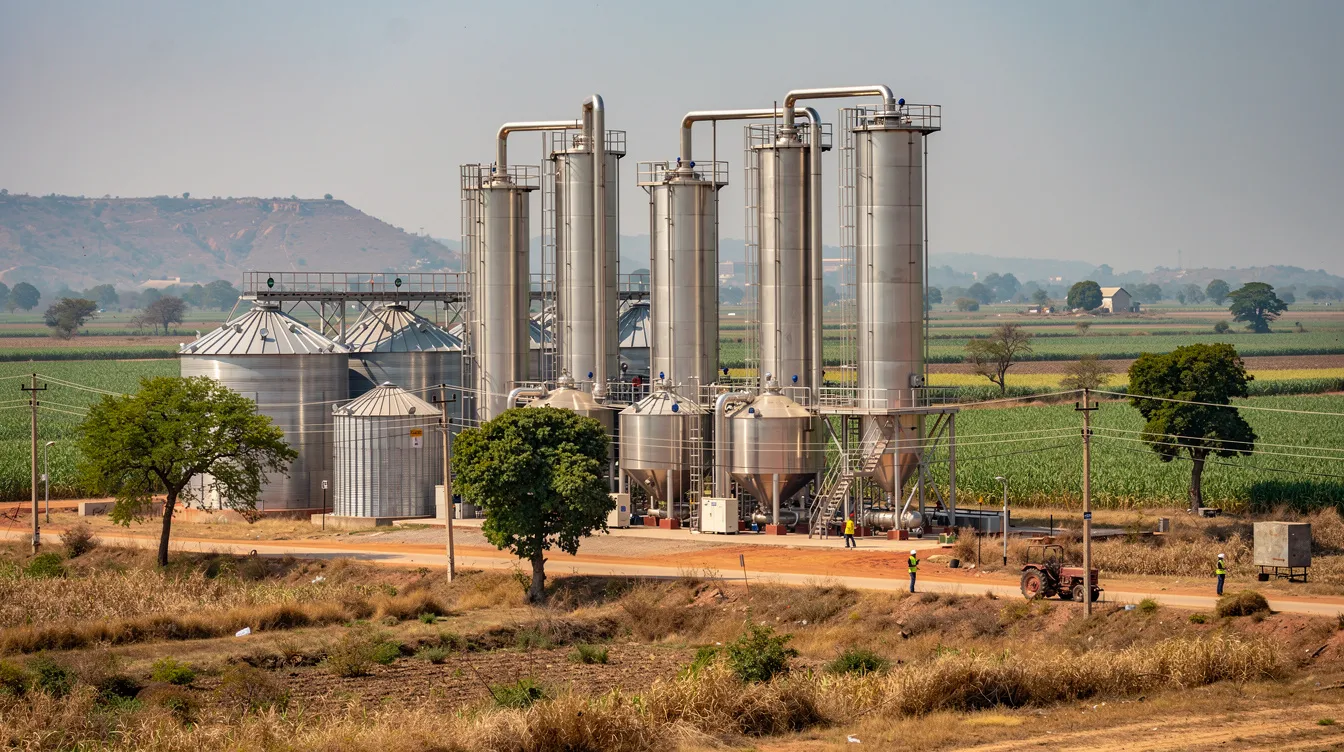
Total project cost is the complete capital outlay required to establish, finance and commission an ethanol plant up to the point of commercial production. It is not the same as the ex-works machinery price or the setup cost quoted by equipment suppliers. Understanding this distinction is important for accurate budgeting, realistic bank-loan proposals and sound investment decisions.
A comprehensive ethanol plant project cost typically includes:
- Land purchase or lease and site development – capital costs include land acquisition and civil construction, with pricing varying sharply by state and proximity to industrial zones
- Factory building and civil structures – plant sheds, fermenter foundations, boiler house, tank farm, admin blocks, internal roads and drainage
- Main grain-based ethanol plant and machinery – grain handling and milling, liquefaction, saccharification, fermentation vessels, distillation columns, dehydration (molecular sieve) units
- DDGS processing and drying equipment – dryers, conveyors, storage and handling systems for by-product feed
- CO₂ recovery unit – where commercially justified, adds capital but also a revenue stream
- Boiler, turbine-generator and utility systems – high-pressure steam, captive or co-generation power, cooling towers, compressed air
- Water treatment, ETP and ZLD infrastructure – ethanol plants may require significant investments in wastewater treatment systems, especially in environmentally sensitive zones
- Electrical installations, storage tanks and instrumentation
- Preliminary and pre-operative expenses – consultancy, design, legal, trial-run and pre-commissioning costs
- Interest during construction (IDC) – interest on term loan disbursed during the construction and moratorium period
- Contingency provision – typically 5–10% on specific heads to cover cost escalation
- Working capital margin – promoter-funded portion of working capital required at the time of commissioning
Technological choices impact both capital and operational costs in ethanol production. The choice between grain-based and molasses-based feedstocks affects the cost structure of the facility. Different feedstocks have unique processing and infrastructure requirements – grain-based ethanol production uses starch-containing grains as feedstock, requiring milling, liquefaction and saccharification equipment that molasses plants do not need. Ethanol can be produced from sugarcane juice and molasses, while maize and broken rice are available year-round for ethanol production. Agricultural residues like rice straw and bagasse are low-cost feedstocks for second-generation ethanol. Damaged food grains can also be used to prevent wastage in ethanol production.
Environmental compliance costs must be included in project budgets – according to GreenPermits, environmental compliance can represent 15–25% of total investment depending on location and regulatory requirements. For a detailed understanding of how setup cost differs from total project cost, refer to our guide on grain-based ethanol plant setup cost in India. Land and infrastructure requirements are discussed separately in our article on ethanol plant land, building and layout requirements.
Operating expenditure – grain procurement, power, labour, maintenance and consumables – is separate from capital cost but must be modelled in the DPR for DSCR and viability analysis. Operational costs include expenses for labour, maintenance and consumables, and feedstock represents the largest operational expense for ethanol plants.
Ethanol Plant Project Cost by Capacity – 30, 60, 100 and 200 KLPD
Promoters frequently ask for specific project cost figures for 30, 60, 100 or 200 KLPD ethanol plants. While capacity-wise benchmarks are useful for initial planning, they are not sufficient for final investment decisions. Actual project cost depends on location, land price, scope of by-product systems, ZLD requirements, technology selection, utility configuration and regulatory environment.
The following indicative ranges are based on publicly disclosed project data and industry estimates. These are illustrative and should not be treated as universal budgets.
| Capacity (KLPD) | Indicative Total Project Cost (₹ Crore) | Indicative Fixed Capital (₹ Crore) | Key Assumptions |
|---|---|---|---|
| 30 | 50–80 | 40–65 | Basic grain-based, limited co-gen, standard ETP |
| 60 | 130–175 | 110–145 | Full grain process, DDGS, boiler, partial ZLD |
| 100 | 230–310 | 180–250 | Full scope including ZLD, co-gen, DDGS, CO₂ |
| 200 | 360–480 | 300–400 | Large-scale, full compliance, all by-products |
A 30 KLPD ethanol plant costs ₹50–60 crore for a basic scope. Higher production capacity typically benefits from economies of scale – the per-KLPD cost tends to decline as fixed portions like civil works, utilities and administration spread over more production. However, larger capacity also means larger absolute equity requirement, more complex project execution and higher raw-material aggregation risk.
For detailed guidance on how to decide optimal capacity rather than only chasing size, refer to our article on ethanol plant capacity planning – 30 to 200 KLPD. Banks look for capacity justified by feedstock availability, product offtake and realistic utilisation, not just higher KLPD numbers.
Proximity to raw materials significantly affects logistics costs, and promoters should evaluate feedstock sourcing before finalising capacity. Operational expenses are heavily influenced by feedstock and energy costs – a plant located far from grain-surplus regions will face higher working capital and transport burden.
Detailed Ethanol Plant Project Cost Breakup – Illustrative 100 KLPD Model
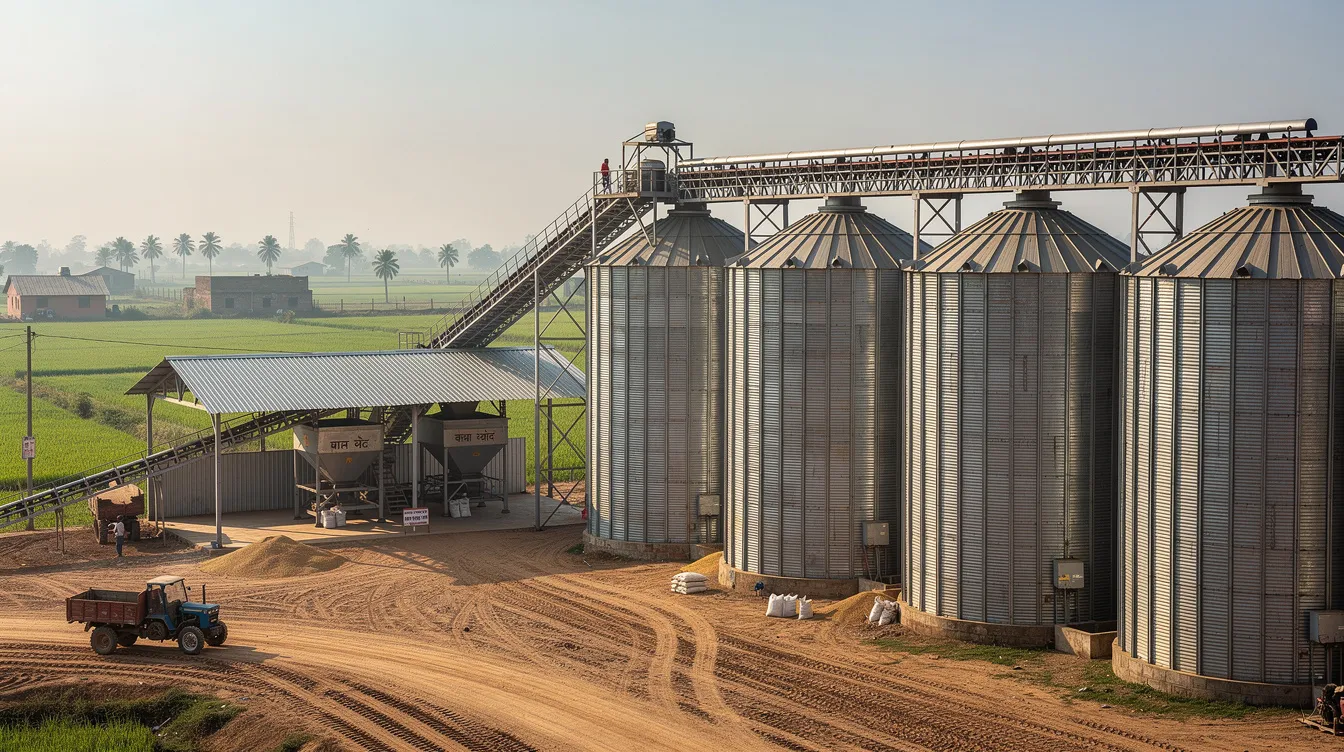
This section uses an illustrative 100 KLPD grain-based ethanol production plant to show how a detailed project report structures project cost heads. These are not vendor quotations or bank-approved estimates – they are illustrative assumptions based on 2024–25 market conditions.
| Cost Head | Illustrative Amount (₹ Crore) |
|---|---|
| Land and site development (20 acres) | 8.00 |
| Buildings and civil construction | 32.00 |
| Plant and machinery (ethanol process) | 120.00 |
| Boiler, TG and steam systems | 22.00 |
| Water treatment, ETP and ZLD | 18.00 |
| DDGS dryer and handling | 10.00 |
| CO₂ recovery unit (optional) | 5.00 |
| Electricals, instrumentation, storage tanks | 12.00 |
| Miscellaneous fixed assets | 3.00 |
| Sub-total: Fixed Capital | 230.00 |
| Preliminary and pre-operative expenses | 8.00 |
| Interest during construction (18 months) | 15.00 |
| Contingency (5% on fixed capital) | 11.50 |
| Margin for working capital | 10.50 |
| Total Project Cost | 275.00 |
Plant and equipment costs represent a significant portion of capital expenditure – in this illustration, plant and machinery alone accounts for approximately 52% of fixed capital, consistent with industry benchmarks where machinery represents 71–76% of fixed capital when all process equipment is included. Details on boiler, steam, power and utility requirements and water consumption, ETP and ZLD systems explain how these cost heads are determined through engineering design and regulatory requirements.
The final cost model is built by translating quotations from multiple machinery vendors, civil cost estimates, utility design specifications and environmental engineering requirements into a structured DPR. This cost breakup is critical for bank appraisal, sensitivity analysis and project monitoring during construction.
Means of Finance for an Ethanol Plant Project
Means of finance shows how the total project cost will be funded. It must reconcile exactly with the project cost – every rupee of investment must have an identified source. Effective project financing includes accounting for working capital and contingencies alongside term debt and equity.
Common funding sources include:
- Promoter equity capital – cash contribution from promoters proportionate to their stake
- Unsecured loans from promoters or group – treated as quasi-equity by some lenders, subject to specific conditions
- Bank term loan – primary debt component, secured against project assets
- Institutional financing – from entities like IREDA, SIDBI or state financial corporations
- Strategic equity partners – where applicable, co-investors bringing capital and expertise
- Working capital facilities – separately sanctioned by banks, distinct from term loan
| Source of Finance | Illustrative Amount (₹ Crore) | % of Total |
|---|---|---|
| Promoter equity | 55.00 | 20% |
| Promoter unsecured loans (quasi-equity) | 27.50 | 10% |
| Bank term loan | 192.50 | 70% |
| Total | 275.00 | 100% |
The Indian government provides several support mechanisms. Interest Subvention Scheme is available for ethanol projects meeting eligibility criteria. Viability Gap Funding is provided for ethanol production initiatives in some cases. Guaranteed procurement from Oil Marketing Companies under the EBP Programme reduces market uncertainty for producers. However, subsidies and interest subvention should be treated conservatively and not booked as committed means of finance until actually sanctioned. Policy details should be verified independently before relying on them in a DPR.
For assistance in optimising debt-equity structure, loan tenure and repayment schedule, refer to our project finance advisory and loan structuring services.
Debt-Equity Ratio and Promoter Contribution Planning
Typical ethanol plant debt-equity expectations range from 1.5:1 to 2.5:1, but each lender has its own norms based on project risk, collateral value and promoter profile. IREDA financing norms, for instance, may allow up to 90% loan (with 10% promoter contribution) for projects eligible for interest subvention, while standard norms may require 30% promoter contribution.
Consider two illustrative scenarios for a ₹275 crore ethanol distillery project:
| Structure | Debt (₹ Crore) | Equity (₹ Crore) | Debt-Equity Ratio |
|---|---|---|---|
| 70:30 | 192.50 | 82.50 | 2.33:1 |
| 60:40 | 165.00 | 110.00 | 1.50:1 |
The term “debt-equity ratio” differs from “loan to project cost.” Banks test tangible net worth, existing leverage of the promoter group and genuine sources of funds – not just the ratio on paper. Over-stretching leverage can weaken DSCR and make the ethanol plant bank loan difficult to service. Conversely, very high equity may depress equity IRR, making the project less attractive to the promoter.
A professional ethanol plant DPR and financial model should explicitly show promoter fund infusion schedule, sources of equity and impact on both DSCR and IRR under different financing structures.
Bank Term Loan for Ethanol Plant – DPR, CMA Data and Appraisal
Indian banks evaluate ethanol plant term-loan proposals through a structured appraisal covering technical feasibility, project cost reasonableness, promoter background, market risk and collateral security. The process is neither automatic nor guaranteed – it requires thorough documentation and defensible projections.
Key documents and analyses typically required:
- Detailed project report with item-wise cost breakup and implementation schedule
- CMA Data covering 7–8 years of projected financial statements
- Projected balance sheet, profit and loss, and cash flow statements
- DSCR and break-even analysis under realistic assumptions
- Vendor quotations and cost estimates
- Land records and statutory approvals
- Offtake assumptions under the Ethanol Blended Petrol programme
- Environmental clearances and compliance documentation
DSCR – the ratio of cash available for debt service to annual debt obligations – is a critical metric. Lenders typically require an average DSCR above 1.20 and minimum annual DSCR above 1.10, based on realistic utilisation assumptions rather than ideal-case projections.
For professional support in preparing bank-ready DPRs and loan proposals or CMA Data for bank loans, Project Report Bank under CA Manish Gugliya assists ethanol plant promoters with services starting from around ₹25,000, subject to project scope and complexity. No guarantee of loan sanction is implied.
Working Capital Requirements and Margin for Ethanol Production
Even a fully commissioned ethanol plant requires substantial working capital for day-to-day operations. Estimating annual operational costs requires calculating feedstock consumption and other expenses carefully – this is not a one-time exercise but an ongoing financial management requirement.
Principal working capital components include:
- Raw material inventory – grains (broken rice, maize, wheat), enzymes, chemicals
- Work-in-process and finished ethanol stock
- DDGS and other by-products awaiting sale
- Receivables from OMCs or industrial buyers
- Minimum cash and bank balance
- Trade creditors (partial offset)
For a 100 KLPD ethanol plant, a simplified working capital assessment might look like this: one month’s grain inventory at approximately ₹15–18 crore annual consumption, 15 days of finished ethanol stock, plus receivables of 30–45 days – resulting in gross working capital requirement of approximately ₹12–15 crore, partially offset by trade creditors.
The difference between sanctioned working capital limits (cash credit, WCTL) and “margin money for working capital” that forms part of project cost is important. Margin money – typically 25% of working capital limits – is funded by the promoter and appears in the means of finance. Feedstock pricing volatility directly impacts profit margins in ethanol production, making working capital planning especially sensitive to grain price fluctuations. For details on grain consumption and yield, refer to our article on ethanol plant raw material requirements and yield.
Interest During Construction, Pre-Operative Expenses and Contingency
Many ethanol project promoters underestimate pre-operative expenses, IDC and contingency, leading to cost overruns and funding gaps during construction. These items can add 15–25% beyond fixed capital expenditure.
Common pre-operative cost items include project consultancy, design and engineering fees, legal and approvals costs, travel, salaries during project phase, trial-run expenses and initial marketing costs. For a 100 KLPD grain-based ethanol plant with an 18-month construction period, pre-operative expenses may range from ₹5–10 crore.
IDC is calculated based on the term-loan drawdown pattern during construction, the applicable interest rate and the moratorium period granted by the lender. If the project is delayed by even six months, IDC can increase materially – sometimes by ₹3–5 crore or more for a 100 KLPD project.
A contingency provision of 5–10% on specific heads protects against cost escalation, minor scope changes and delays, especially in civil works and imported equipment. A robust DPR and financial model should run alternative scenarios – on-time versus delayed commissioning – to show the impact on total ethanol plant investment cost and required means of finance.
Ethanol Plant Project Finance – Viability, DSCR and Risk Analysis
Even if a grain-based ethanol production plant is technically feasible, banks will only finance if long-term cash flows show adequate DSCR, IRR and resilience under stress scenarios. Ethanol production can reduce operational costs by up to 15% through process optimisation and by-product monetisation, but this must be demonstrated through credible financial modelling.
Key financial metrics evaluated by lenders and investors:
- Project IRR vs equity IRR – project IRR reflects returns on total investment; equity IRR reflects returns on promoter capital
- Average and minimum DSCR – must remain above lender thresholds across the projection period
- Payback period – time to recover the initial investment from net cash flows
- Break-even capacity utilisation – the minimum production level at which the plant covers all costs
- EBITDA margins – operating profitability before depreciation and financing costs
DSCR is derived from cash accruals (net profit plus depreciation plus interest on term loan) divided by annual debt servicing (principal repayment plus interest on term loan). A minor change in ethanol price or grain cost can sharply affect this ratio.
Sensitivity scenarios that every ethanol plant DPR should include:
- Grain prices increasing by 15–20% above base case
- Capacity utilisation at 70–75% instead of projected 85–90%
- OMC payment delays stretching receivables beyond 60 days
- Interest rates increasing by 100–150 basis points
- DDGS realisations falling by 20% – refer to our analysis of DDGS production, revenue and profitability
Project feasibility studies help assess the viability of new ethanol plants before committing capital. For professional financial modelling and sensitivity analysis, our financial projections and modelling services and project feasibility study services are designed for exactly these requirements.
Common Mistakes in Estimating Ethanol Plant Project Cost and Finance
Based on practical experience with ethanol plant DPRs, these are frequent errors promoters make:
Cost estimation mistakes:
- Ignoring full civil and utility scope – underestimating building costs relative to machinery
- Under-budgeting for ZLD, ETP and environmental compliance, which can be 15–25% of total investment
- Excluding IDC or using unrealistically short construction timelines
- Keeping inadequate contingency (less than 5% on major heads)
- Underestimating working capital requirement, especially for grain procurement cycles
Revenue and utilisation mistakes:
- Assuming 90–95% capacity utilisation from year one without established supply chains or customer base
- Over-optimistic ethanol prices without considering procurement price variations
- Treating DDGS and CO₂ revenue as guaranteed without market validation
Financing mistakes:
- Counting expected subsidies and unapproved soft loans as firm means of finance
- Using very aggressive debt-equity ratios without adequate promoter net worth
- Preparing projections with artificially high DSCR to impress lenders, which unravels during detailed appraisal
- Copy-pasting project costs from other plants without adjusting for location, capacity, technology and current market conditions
Early engagement with a CA-led advisory practice helps identify these pitfalls and improve project bankability before approaching lenders.
Role of a Detailed Project Report (DPR) in Ethanol Plant Financing
A professional detailed project report for an ethanol production plant is not a narrative document or a feasibility report alone – it is an integrated financial model and evidence-backed document aligned with bank appraisal needs and investor expectations. It should contain technical description, capacity and process flow, item-wise project cost, implementation schedule, means of finance, projected financial statements, DSCR analysis, sensitivity analysis and risk-mitigation measures.
CMA Data, projected balance sheet, profit and loss, and fund-flow statements must be consistent with the DPR’s project cost, means of finance and term-loan repayment schedule. Any inconsistency between the project report and CMA Data can delay or derail loan appraisal.
The versatility of a well-prepared DPR lies in its ability to serve multiple purposes – bank financing, investor discussions and internal decision-making. The details in a DPR allow promoters to understand the time required for project execution, the views of lenders on risk, and whether the project is ready for financing.
Serious ethanol project promoters planning to approach banks or investors should connect with CA Manish Gugliya on WhatsApp or phone for customised DPR, CMA Data and feasibility study services. Services start around ₹25,000 depending on project size and complexity. No guarantee of funding or loan sanction is implied – the objective is to prepare a defensible, bankable proposal based on realistic assumptions.
Frequently Asked Questions on Ethanol Plant Project Cost and Finance
How should a promoter start estimating ethanol plant project cost before a DPR?
Start with capacity selection – for example, 60 versus 100 KLPD – based on available land, feedstock supply and capital budget. Identify tentative land requirements, technology choice (grain-based with DDGS or without), and then collect broad budgetary quotations for major machinery and civil works from at least two or three vendors. These initial estimates are later refined, verified and structured in a formal DPR with proper financial modelling. The important thing is to understand at an early stage in September or October of your planning cycle whether the total investment – not just machinery – fits within your financial capacity.
When should promoter equity be brought into the project – before or after sanction?
Typically, some initial equity is deployed for land acquisition, preliminary approvals and DPR preparation before approaching banks. After loan sanction, the remaining promoter contribution is infused in phases during project execution as per the bank-approved financing plan. Banks generally expect promoters to bring in equity proportionately with or ahead of loan disbursements – not entirely after the loan is released.
Is it possible to reduce ethanol plant project cost by using second-hand equipment?
In practice, used machinery raises concerns around warranty, efficiency, residual useful life, maintenance costs and – critically – valuation and acceptability as collateral security by banks. Some lenders may not accept second-hand equipment for loan security or may apply steep haircuts on valuation. This should be evaluated case by case in the DPR and discussed with the lender before procurement.
What happens if actual project cost exceeds the estimate in the DPR?
Cost overruns create a funding gap that must be covered by additional promoter equity, cost-overrun loans (if available from the lender) or scope reduction. This is precisely why adequate contingency provision and realistic cost estimation at the DPR stage are important. A funding gap during construction can delay commissioning, increase IDC and weaken the overall financial structure of the project.
How is per-litre cost of ethanol production different from project cost?
Project cost is the one-time capital investment required to establish the plant. Per-litre production cost is an ongoing operating metric that includes grain consumption, utilities, labour, maintenance, consumables and finance costs (interest plus depreciation). Both interact – depreciation and interest from project cost flow into per-litre cost – but they are analysed separately in the DPR and financial model. A project may have a reasonable capital cost but still be unviable if per-litre operating costs exceed realisable ethanol prices.
CA Manish Gugliya FCA, DISA (ICAI) More than 20 years of professional experience in project reports, financial projections, CMA Data, project finance and business advisory.
Project Report Bank provides customised ethanol plant DPRs, CMA Data preparation and project finance advisory for serious promoters across India. For a professional assessment of your ethanol project’s investment requirement and financing structure, reach out via WhatsApp or phone.