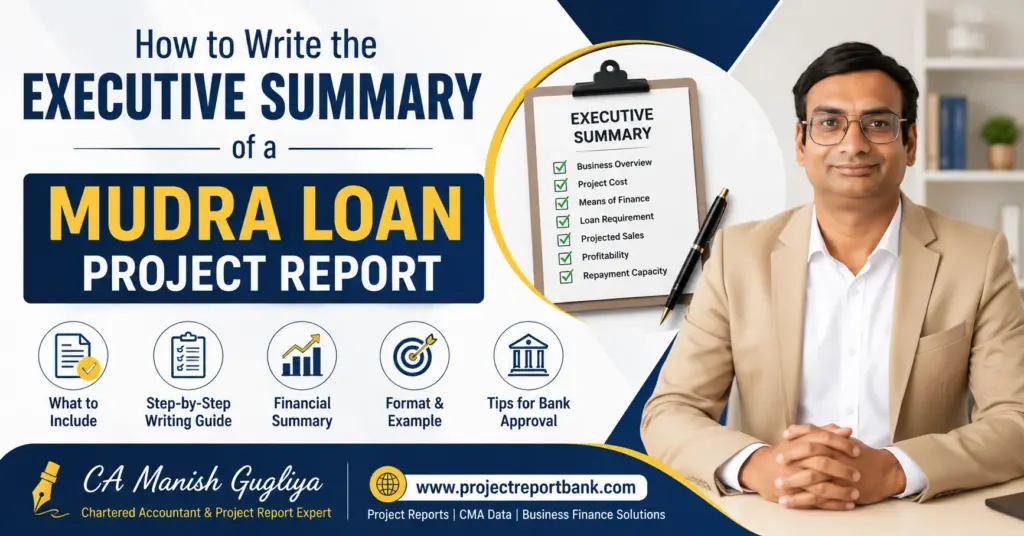
Key Takeaways
- The executive summary is a 1–2 page snapshot of your mudra loan project report that concisely covers business overview, project cost, means of finance, loan requirement, and repayment capacity – it is not a copy of the full report.
- Every figure in the executive summary (project cost, mudra loan amount, sales, profit) must exactly match the detailed financial projections inside the report; even small mismatches raise questions.
- A clear, realistic and internally consistent executive summary helps bank officers understand the proposal quickly, but it does not guarantee loan approval under the Pradhan Mantri Mudra Yojana (PMMY).
- Follow a structured approach: introduce the business and promoter, describe the activity, summarize project cost and means of finance, state the loan requirement, and briefly present projected sales, profit and EMI repayment ability.
- This article is written from the perspective of CA Manish Gugliya (ProjectReportBank.com), with practical tips, an example format, a complete illustrative executive summary, and a checklist you can use before submitting to the bank.
Introduction – Why Focus on the Mudra Loan Project Report Executive Summary?
For many applicants, the executive summary is the first page a bank officer reads – often within 30 to 60 seconds. A project report is essential for mudra loan approval, and the executive summary is the most critical part of that project report. As of 27 March 2026, the pmmy scheme had disbursed about ₹40.07 lakh crore through more than 57 crore loan accounts, which means branches handle enormous volumes of applications daily.
I am CA Manish Gugliya, a Chartered Accountant and project report specialist at ProjectReportBank.com. Based on years of real experience with MSME and mudra loan proposals, this article focuses only on how to write the executive summary section of a report for mudra loan – not the entire loan project report format.
An executive summary is a concise overview of your business idea, promoter profile, project cost, means of finance, mudra loan requirement, projected sales, expected profitability, and repayment capacity. Although it appears in the first pages of the report, it is usually written last – after financial projections and assumptions are finalized. This article gives you a clear structure, a step-by-step guide, a reusable format, a realistic example, common mistakes to avoid, and an end-of-report checklist.

What Is an Executive Summary in a Mudra Loan Project Report?
An executive summary is a 1–2 page written section that condenses the key areas of your full mudra loan project report so that bank officials can quickly understand what you are proposing. It differs from the detailed sections – such as market analysis, technical details, financial statements, and risk assessment – by offering only highlights rather than complete data tables.
The critical rule: every number in the executive summary must tally with the detailed schedules and CMA data in the report. If your detailed project report shows a total cost of ₹7,00,000 but the summary says ₹6,50,000, that inconsistency alone can slow down or derail your application. If you are unsure about what a Mudra Loan project report is, start with the beginner guide before working on your summary.
Why Is the Executive Summary Important for a Mudra Loan Project Report?
Bank managers and credit officers scan the executive summary first to decide whether the proposal is worth deeper appraisal. Research shows that 45% of mudra loans are rejected due to weak project reports – and the summary is where weaknesses become visible fastest. A good executive summary presents at a glance: business description, promoter background, proposed activity, total project cost, borrower’s own contribution, loan amount, expected revenue, profitability, and repayment capacity.
Banks require a project report for Kishore and Tarun loans. Shishu loans do not require a project report in most cases. For applicants in the Kishore and Tarun categories – where a project report is required – the executive summary becomes the entry point for the banker’s assessment. Under the Pradhan Mantri Mudra Yojana, branches at public sector banks like State Bank of India, Canara Bank, Axis Bank, and other financial institutions receive thousands of proposals. A clear summary saves time and reduces back-and-forth queries.
However, banks use the summary only as a starting point. They still perform their own appraisal, assess risk through credit history and financial viability checks, and may ask for more documents. To understand why banks may require a project report for a Mudra Loan, refer to that separate discussion.
Table of Contents
Where Should the Executive Summary Appear in the Project Report?
In a typical project report format, you should include an executive summary as the first page of your report – right after the cover page and index. Some banks title it “Executive Summary,” others prefer “Project at a Glance” or “Brief Project Profile.” The purpose is identical.
The practical point: although it is placed at the beginning, finalize it only after completing your project cost, means of finance, loan amount, and financial projections. Keep a placeholder during drafting and fill it in once all financial tables are settled. For the complete Mudra Loan project report format, see the separate guide.
What Should Be Included in a Mudra Loan Project Report Executive Summary?
A project report must include financial projections and market analysis – and the executive summary should reflect these key elements along with business identification and promoter background. Financial highlights such as expected turnover, profitability, and repayment assurance belong here too. The structure below is flexible; different banks may expect slightly different formats, but covering these items usually creates a complete picture.
Name and Nature of the Business
Business identification includes the enterprise name, legal constitution, location, and registration details. Mention your business name exactly as it appears in your application – for example, “M/s Shree Ganesh Mobile Repair & Accessories, Proprietorship, Jaipur, Rajasthan.” State whether it is a new business or an existing unit, and specify whether the activity is manufacturing, trading, or services.
Promoter or Applicant Profile
Promoter background should highlight the entrepreneur’s relevant skills and experience. Cover the promoter’s full name, education qualification where relevant, and specific business or job experience linked to the project work – for example, “5 years as a pharmacy sales executive.” Avoid long biographies. Bankers read this portion to judge managerial capability. If the mudra loan is for expansion, mention years in operation and a basic turnover trend.
Business Activity and Project Description
Nature of activity describes the business model as manufacturing, trading, or services. Explain what the business does, who the target customers are, and where it is located – briefly enough that someone who has never visited the area can understand the business plan. For a flour mill near residential colonies, you might write: “Daily grinding capacity 1,000 kg, serving households and local retailers in XYZ Colony.” For beauty parlors, mention the number of chairs and services offered.
Project Cost
Show only the main cost heads with rounded amounts. For example:
| Particulars | Amount (₹) |
|---|---|
| Machinery & Equipment | 3,20,000 |
| Furniture & Fixtures | 80,000 |
| Initial Stock | 2,00,000 |
| Working Capital Margin | 1,00,000 |
| Total Project Cost | 7,00,000 |
The total cost here must equal the figure in your detailed project cost table.
Means of Finance
Show how the total project cost will be funded:
| Source | Amount (₹) |
|---|---|
| Promoter Contribution (30%) | 2,10,000 |
| Proposed Mudra Loan | 4,90,000 |
| Total Means of Finance | 7,00,000 |
Total means of finance must equal total project cost. Mismatches here are a common red flag that makes bankers question data reliability.
Mudra Loan Requirement
State the exact loan amount, category, and type of facility. MUDRA loans are categorized into four tiers: Shishu (up to ₹50,000), Kishor (₹50,000–₹5,00,000), Tarun (₹5,00,000–₹10,00,000), and Tarun Plus (₹10,00,000–₹20,00,000). Loan classification specifies the mudra category clearly. Fund utilization outlines how the capital will be used – for machinery, initial stock, or working capital. A vague loan purpose can result in application denial, so connect the loan request to specific project elements.
Expected Sales and Revenue
Present projected sales as annual figures for at least Year 1. Annual sales are calculated as monthly sales multiplied by 12. For example, a pharmacy with 40 customers per day and an average bill of ₹300 generates approximate monthly sales of ₹3,60,000 and annual sales of ₹43,20,000. Base projections on capacity utilization, pricing, and realistic assumptions – not arbitrary high numbers.
Expected Profitability
Mention Year 1 net profit and approximate margin. For example: “Net profit in Year 1 expected around ₹3,60,000, approximately 10% of projected sales.” A complete P&L statement should project profits for 5 years inside the detailed report, but the summary needs only the headline numbers that demonstrate financial viability.
Repayment Capacity
Net profit must exceed the EMI to ensure loan safety. Banks require a Debt Service Coverage Ratio (DSCR) above 1.25 for loan approval – SBI, for instance, requires a DSCR above 1.25 for approval. Present this simply: “Proposed EMI of approximately ₹11,200 per month is expected to be serviced from average monthly net cash surplus of about ₹32,000, giving a DSCR of approximately 2.8 times.”
Employment Generation and Business Impact
MUDRA loans have been found to help borrowers start businesses and generate employment. Add 1–2 lines about jobs created – for example, “The unit will employ 3 persons including the promoter.” The mudra scheme aims to improve access to institutional credit for micro enterprises, supporting financial inclusion, so realistic employment data adds value. Keep this factual, not emotional.
Information You Should Collect Before Writing the Executive Summary
A correct executive summary depends on accurate base data. Finalize the following before drafting:
- Business name, constitution, and udyam registration (if applicable)
- Promoter details including Aadhaar and PAN (banks need these for loan applications)
- Nature of activity, project location, and shop or plant details
- List of machinery/equipment with approximate costs
- Detailed project cost breakup and confirmed promoter contribution
- Exact mudra loan requirement and intended category
- Working capital needs
- Sales assumptions: customer numbers, pricing, capacity utilization, seasonal variations
- Repayment plan assumptions: interest rate, tenure, EMI
A separate guide on information required before preparing a Mudra Loan project report provides a fuller checklist.
Step-by-Step: How to Write a Mudra Loan Project Report Executive Summary
Keep your detailed project report and financial projections open while drafting so you can cross-check figures immediately.
Step 1: Identify the Business and Promoter
Start with business name, constitution, city, and promoter name(s). Example: “M/s Ananya Beauty Studio is a proposed proprietorship salon to be set up by Ms. Ananya Sharma in Kota, Rajasthan.”
Step 2: Describe the Proposed Activity
Write 4–6 lines covering the business model, products or services, target customers, and why demand exists. Detailed market analysis belongs elsewhere; here, provide only a crisp business overview.
Step 3: State the Project Objective
Clearly state the purpose: starting a new unit, expanding capacity, or modernising machinery. Example: “The objective is to establish a two-chair ladies’ beauty parlour with modern equipment to serve the growing residential population in XYZ Colony.”
Step 4: Summarize the Project Cost
Total all capital and working capital expenses. Present them as a brief list, rounding to the nearest thousand. Verify the total matches your detailed cost sheets.
Step 5: Present the Means of Finance
Show promoter contribution in rupees and percentage, the mudra loan amount, and any other confirmed sources. The totals must reconcile with project cost.
Step 6: State the Mudra Loan Requirement
Mention the exact amount, category (Shishu, Kishore, or Tarun – the three categories most commonly used), and type of facility (term loan, working capital, or both). This figure must match the application form and all financial schedules.
Step 7: Summarize Expected Sales
Pull sales totals from your financial projections. Connect numbers to assumptions: daily customers, capacity utilization, average bill value. Overestimating sales projections leads to loan rejections.
Step 8: Mention Expected Profitability
Quote Year 1 net profit and margin percentage. Cross-check that these numbers are exactly the same as those in the projected profit and loss account.
Step 9: Explain Repayment Capacity Briefly
Link monthly net cash surplus with approximate EMI. Mention DSCR if calculated. Banks require a DSCR above 1.25 for loan approval across most lender norms.
Step 10: Review All Figures Against the Detailed Project Report
Re-check every number. Even small discrepancies – like ₹5,00,000 in the summary and ₹5,50,000 in financial tables – create doubts and slow the appraisal. Name mismatches across documents also cause application rejections.
Mudra Loan Executive Summary Format
This is an illustrative format – not a mandatory standard prescribed universally for every bank. The exact fields may vary depending on lender norms and the nature of business.
| Field | Content |
|---|---|
| Business Name | M/s Riddhi Siddhi Flour Mill |
| Promoter Name | Mr. Ramesh Kumar |
| Business Constitution | Proprietorship |
| Project Location | Industrial Area, Alwar, Rajasthan |
| Nature of Business | Manufacturing – Wheat & Grain Grinding |
| Project Objective | To set up a flour mill with 500 kg/day capacity |
| Total Project Cost | ₹6,50,000 |
| Promoter Contribution | ₹1,62,500 (25%) |
| Proposed Bank Finance | ₹4,87,500 (Kishore category) |
| Working Capital Requirement | ₹1,00,000 |
| Expected Annual Sales (Year 1) | ₹18,00,000 |
| Expected Net Profit (Year 1) | ₹1,80,000 (10% margin) |
| Proposed Loan Tenure & EMI | 60 months; ~₹10,600/month at 11% p.a. |
| Employment Generation | 3 persons (including promoter) |
| Viability Statement | Adequate cash flow to service EMI with DSCR of ~1.7 |
Example of a Mudra Loan Project Report Executive Summary
Business: M/s Riddhi Siddhi Flour Mill, a proposed proprietorship unit to be established by Mr. Ramesh Kumar at Industrial Area, Alwar, Rajasthan.
Promoter: Mr. Ramesh Kumar, age 34, holds a diploma in business administration and has 4 years of experience working in a grain processing unit. He has firsthand knowledge of flour milling operations, equipment maintenance, and local grain sourcing.
Activity: The unit will process wheat and mixed grains for households, retailers, and small enterprises in the Alwar district. Proposed daily grinding capacity: 500 kg. Key machinery includes a flour grinding machine (₹2,50,000), sieving equipment (₹50,000), and weighing/packing setup (₹20,000).
Project Cost: Machinery & Equipment – ₹3,20,000 | Furniture & Fixtures – ₹30,000 | Initial Stock – ₹1,00,000 | Shop Renovation – ₹50,000 | Working Capital Margin – ₹1,00,000 | Preliminary Expenses – ₹50,000 | Total: ₹6,50,000
Means of Finance: Promoter Contribution – ₹1,62,500 (25%) | Mudra Loan (Kishore) – ₹4,87,500 (75%) | Total: ₹6,50,000
Loan Requirement: ₹4,87,500 under the Kishore category as a term loan for machinery purchase, shop renovation, initial stock, and working capital. The loan is collateral free under PMMY guidelines.
Sales Projection: Expected Year 1 annual sales of ₹18,00,000 based on average daily processing of 400 kg at ₹150 per kg service/selling rate, operating 300 days per year.
Profitability: Expected net profit in Year 1: ₹1,80,000 (approximately 10% net margin). Business performance is expected to improve gradually with increasing capacity utilization.
Repayment Capacity: At 11% p.a. interest over 60 months, EMI works out to approximately ₹10,600 per month. Projected monthly cash surplus after all expenses: ~₹15,000. DSCR is approximately 1.7 times, indicating comfortable repayment capacity.
Employment: The unit will create 3 direct jobs including the promoter and 2 workers.
Why this example works: The figures reconcile – project cost equals means of finance. The promoter has relevant experience. Sales are based on stated capacity and utilization (not inflated). Profit and EMI numbers are internally consistent. The business description is specific to a real locality.
Note: All figures are purely illustrative. Your executive summary must reflect your own business assumptions and actual project data.

How to Present Project Cost and Means of Finance in the Executive Summary
Project cost is the total amount needed to set up and start the project. Means of finance are the sources from which those funds will come. In the executive summary, a simple reconciliation reassures bankers that you understand your own project finances. The two tables should always have matching totals.
For more detailed cost breakups and calculations, a structured Mudra Loan project report format in Excel can help – but only summarized totals belong in the executive summary.
How to Summarize Financial Projections Without Overloading the Executive Summary
The executive summary should not reproduce every line of the projected profit and loss account, balance sheets, or cash flow statement. Focus on: total sales, net profit, average annual cash surplus, and DSCR. Financial projections include estimated monthly sales and expenses – but in the summary, present only 3–5 key figures for Year 1 in 1–2 short paragraphs. If your projections show a gradual ramp-up for a new business, acknowledge lower first-year performance and explain expected growth simply.
Common Mistakes While Writing a Mudra Loan Executive Summary
Based on real project report reviews, these are the most frequent errors many applicants make:
- Summary too long – stretching to 4–5 pages instead of 1–2. Fix: remove duplicated tables and paragraphs.
- Vague language – phrases like “good market potential” without context. Fix: use specific locality and customer references.
- Inflated sales – 45% of Mudra loans get rejected due to weak reports, and overestimating sales projections leads to loan rejections. Fix: use conservative, defensible assumptions.
- Inconsistent numbers – project cost in summary not matching detailed schedules, or different loan amounts in different sections. Fix: reconcile against your Excel sheets line by line.
- Ignoring working capital – even for trading businesses, working capital is material. Fix: include working capital margin in the cost table.
- Copying another business’s summary – banks can spot generic templates instantly. Fix: customize every detail for your actual business profile.
- Old figures after revision – failing to update the summary after changing projections. Fix: finalize the summary only after the last revision.
Treat constructive criticism from a CA or advisor as an opportunity to strengthen your report, not as a setback.
Should You Write the Executive Summary Before or After Preparing Financial Projections?
From my professional experience: prepare a rough outline early, but finalize the executive summary only after completing your project cost, means of finance, and financial projections. Writing it too early leads to inconsistencies when assumptions change. Draft the business description and promoter profile first, complete all financial tables, then return to fill in totals and DSCR-based comments. This approach prevents mismatched figures across your comprehensive project report.
Can You Prepare the Executive Summary Yourself?
Many small businesses and proprietors can draft their own executive summary if they understand their cost structure and basic financial assumptions. Challenges in obtaining MUDRA loans include documentation requirements and limited financial literacy, so professional help from a CA or project report expert is advisable when you have complex machinery costs, need detailed working capital assessment, or face repeated inconsistencies. Some applicants use tools – a project report typically takes 30 minutes to create using MudraReady, for example – but professional review adds credibility, especially when a ca signature or certification is expected by the branch. For a deeper discussion, see whether you can prepare your own Mudra Loan project report.
Does a Good Executive Summary Improve Mudra Loan Approval Chances?
A strong project report improves loan approval chances significantly. A well-written executive summary makes it easier for a banker to see key numbers quickly and feel confident that the applicant knows their business. However, even the best summary does not guarantee loan approval. Sanction depends on the lender’s independent appraisal, credit history, scheme eligibility, KYC, and internal bank policies – which vary across different banks. If the rest of the detailed project report or documents are weak, a strong summary alone cannot secure approval. Read more about whether a project report guarantees Mudra Loan approval in the dedicated article.
CA Manish Gugliya’s Practical View – Expert Tips for a Strong Executive Summary
In my experience as a Chartered Accountant handling mudra loan project reports and professionally prepared reports for small enterprises:
- Keep the summary concise – 1–2 pages maximum. Bank officers at public sector banks and other financial institutions do not have time to read partial fulfilment of a novel.
- Never put a number in the executive summary that cannot be traced back to a detailed schedule. Every figure – project cost, loan amount, sales, profit – must reconcile.
- Avoid aggressive projections just to make EMI look comfortable. Modest, defensible sales growth and realistic profit margins always hold up better during appraisal, even if a break even analysis takes slightly longer to reach.
- Make the nature of business understandable to someone who has never visited the locality. Avoid local slang or overly technical jargon without explanation.
- Finalize the executive summary only after one last review of financial schedules. Consistency is more valuable than decorative language.
Executive Summary Checklist Before Submitting the Project Report
Before you walk into the branch, tick off each item:
- ☐ Business name and promoter details exactly correct
- ☐ Business activity clearly explained in simple terms
- ☐ Project cost total equals the same figure in detailed tables
- ☐ Means of finance total equals project cost
- ☐ Mudra loan amount consistent across summary, application form, and all financial schedules
- ☐ Sales and profit figures match projections
- ☐ Working capital needs considered where relevant
- ☐ Repayment assumptions reasonable and EMI in line with repayment plan
- ☐ No unsupported or exaggerated claims
- ☐ No leftover old numbers after last revision
- ☐ Summary length within 1–2 pages
- ☐ Language clear enough for a non-technical reader
Print the summary, read it once as if you were the banker, and correct anything that looks confusing before visiting the branch.

Frequently Asked Questions on Mudra Loan Project Report Executive Summary
How long should the executive summary of a Mudra Loan project report be?
For most micro enterprises and small businesses, 1–2 pages are sufficient. Going beyond 2 pages usually means you are repeating full report sections instead of summarizing them. Focus on key facts, figures, and the business profile.
Do banks have a fixed executive summary format for Mudra Loan?
Formats can vary. Some banks provide their own templates, while others accept any clear, structured executive summary following standard project report practice. Follow any bank-specific instructions you receive, but the elements described in this article will fit well within most formats used by different banks.
Can I submit my Mudra Loan project report without an executive summary?
Where a full project report is required – as it is for Kishore and Tarun loan limits – an executive summary or “project at a glance” is strongly recommended and often expected. Skipping it makes the banker’s job harder, which can delay processing or lead to more articles of correspondence requesting clarification.
What should I do if my executive summary numbers do not match the detailed projections?
Revisit your detailed Excel or working notes first to confirm the correct figures. Then update the executive summary line by line to match the final version. Save and print only after a final reconciliation check – inconsistent numbers are a common and avoidable reason for additional bank queries.
Should sales and profit projections appear in the executive summary?
Yes. Include at least Year 1 projected annual sales and net profit with approximate margins. These figures help the banker quickly assess financial viability and repayment capacity without reading the entire comprehensive project report. Just ensure the numbers match your detailed financial statements exactly.
Final Takeaway
A strong mudra loan project report executive summary gives a clear snapshot following one logical chain: Business → Promoter → Project → Project Cost → Means of Finance → Mudra Loan Requirement → Sales → Profitability → Repayment Capacity – all in 1–2 pages.
Clarity, realistic assumptions, and perfect consistency with the detailed project report matter far more than fancy language or over-optimistic numbers. Invest the time to draft, review, and revise your executive summary carefully. It is often the first and most closely read page by bank officers handling mudra loans under the Mantri Mudra Yojana PMMY. While a good executive summary cannot guarantee loan approval, it significantly improves how well and how quickly a banker can understand and appraise your loan project.
- How to Present Sales & Revenue Projections in a Mudra Loan Project Report


- How to Present Working Capital Requirement in a Mudra Loan Project Report
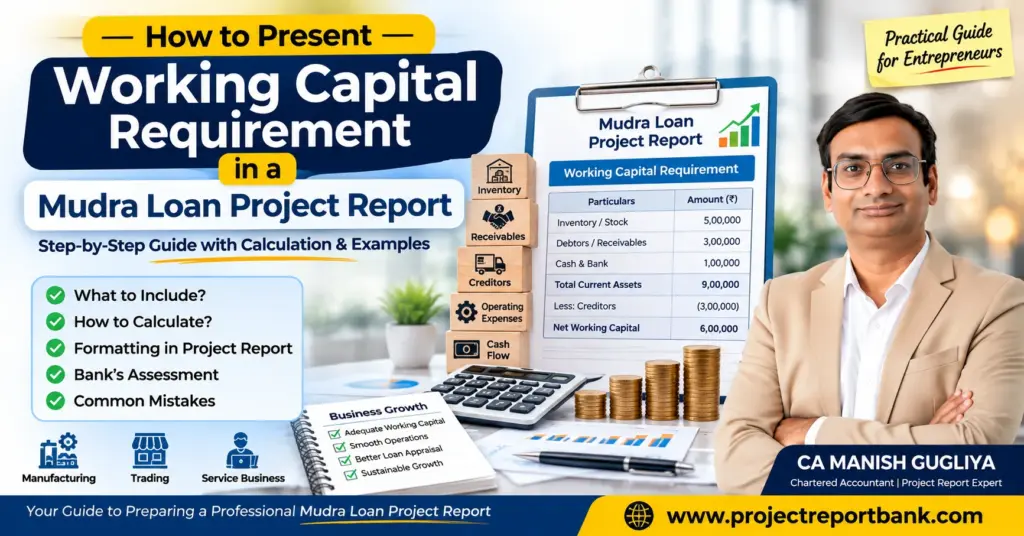
- How to Present Machinery Details in Mudra Loan Project Report
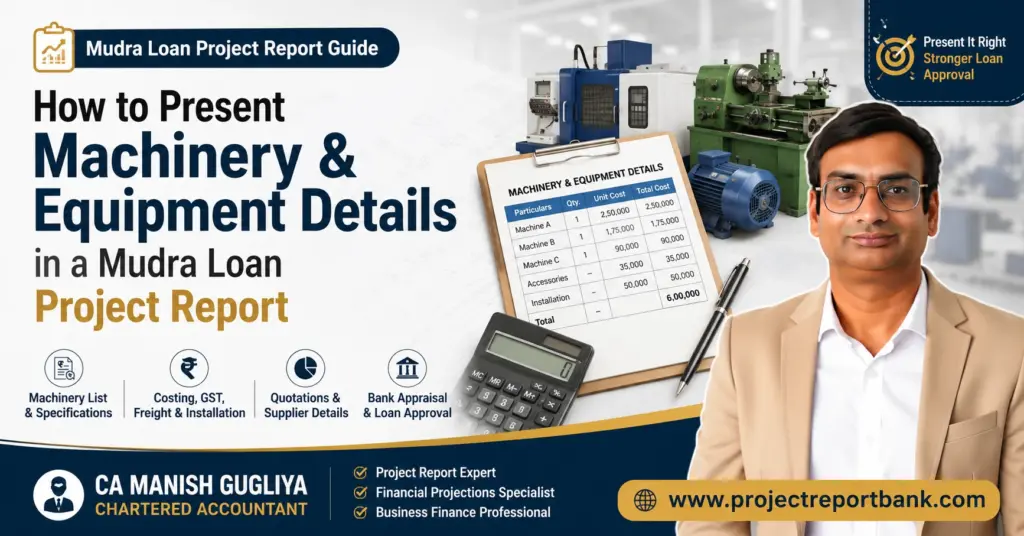
- How to Show Means of Finance in a Mudra Loan Project Report
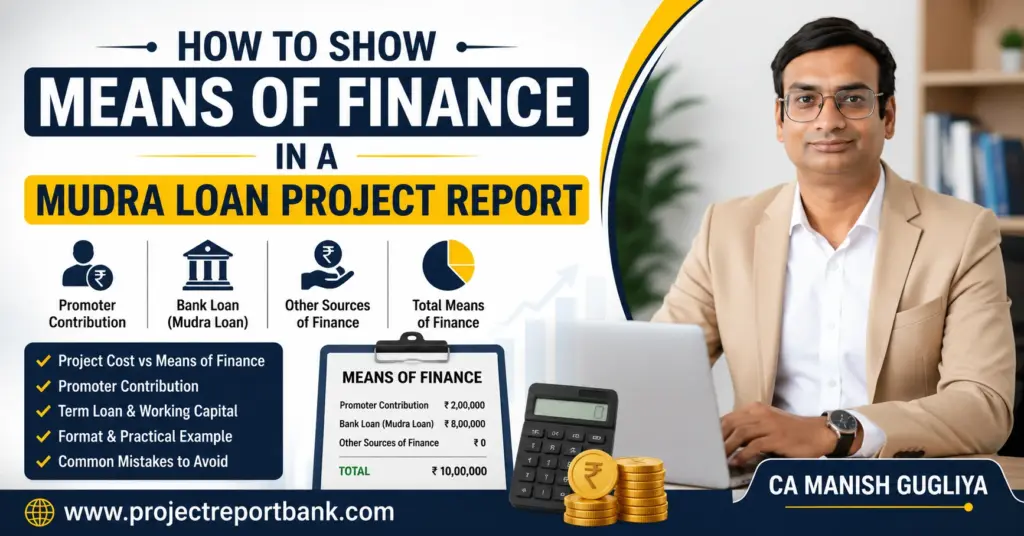
- How to Present Project Cost in a Mudra Loan Project Report
- How to Write Business Activity & Project Description in a Mudra Loan Project Report
- How to Write Promoter Profile in a Mudra Loan Project Report

- How to Write Business Profile in a Mudra Loan Project Report

- Mudra Loan Project Report Executive Summary – How to Write It Right