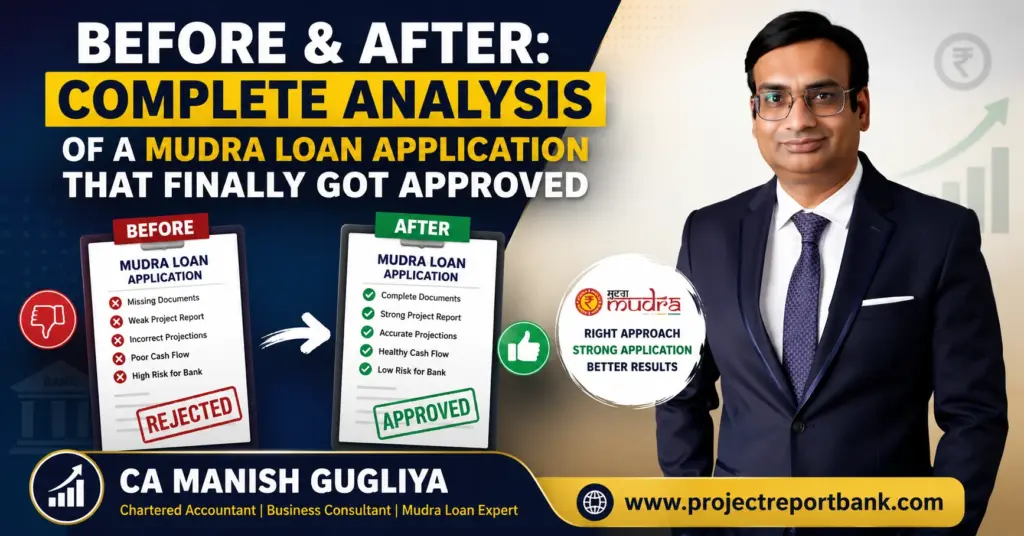
Key Takeaways
- This mudra loan application analysis is based on 20+ years of practical experience by CA Manish Gugliya, with all applicant details anonymised for confidentiality.
- The same business idea was first rejected and later approved after improving the project report, financial projections, documentation, and loan amount justification.
- You will see a before vs after mudra loan approval case study, common mudra loan application mistakes, and a practical checklist you can follow immediately.
- The lessons apply to all four categories of mudra loans – Shishu, Kishore, Tarun, and Tarun+ – under Pradhan Mantri Mudra Yojana (PMMY), and every bank or financial institution follows its own internal credit policies.
- No consultant can guarantee approval, but a professionally prepared file significantly reduces your chances of rejection.
Introduction: Why Mudra Loan Application Analysis Matters
Every week, thousands of Pradhan Mantri Mudra Yojana applications land on bank desks across India. Many are returned or rejected – not because the business idea is weak, but because the application file is poorly prepared.
Mudra loans cater to small business owners and micro-units in India. Under this flagship scheme for non corporate, non farm sector micro enterprises, individual borrowers, partnerships, and companies can access financial assistance without collateral security for loans up to ₹10 lakhs. The applicant age for mudra loans typically ranges from 18 to 65 years. Mudra loans are classified into four categories: Shishu loans are up to ₹50,000, Kishore loans range from ₹50,001 to ₹5 lakhs, Tarun loans range from ₹5,00,001 to ₹10 lakhs, and Tarun+ loans are available up to ₹20 lakhs. Mudra Yojana offers loans upto rs 20 lakhs in total, and loans under PMMY must be for income generation activities in specified sectors, including manufacturing, trading, services, and allied agricultural activities. The collateral-free status aims to support micro-enterprises in accessing credit. Mudra loans can also be applied online through the JanSamarth portal.
The Pradhan Mantri Mudra Yojana (PMMY) evaluates micro-enterprises’ viability before sanctioning any facility. As CA Manish Gugliya, I have personally analysed and corrected hundreds of mudra loan project reports, and this case study draws on those practical observations.

Table of Contents
Why Banks Reject Otherwise Good Mudra Loan Applications
Under pradhan mantri mudra yojana pmmy, commercial banks, small finance banks, RRBs, and NBFCs evaluate risk, repayment capacity, and documentation quality – not just the business idea. PMMY loan applications are assessed based on creditworthiness and income potential. Factors such as business viability, repayment capacity, and credit history are critical in loan assessments.
Here are the most common reasons applications fail:
- Incomplete KYC documents: Required documents include ID proof and address proof. Missing or mismatched Aadhaar, PAN, passport size photos, or unsigned form pages trigger immediate returns. Name mismatches between PAN and Aadhaar are especially common.
- No Udyam Registration or GST details: Where applicable, absence of these registrations lowers credibility even if not always legally mandatory at every stage of growth development and funding.
- Weak or copy-paste project reports: No local market study, no explanation of competition or pricing, no clear business model, and unrealistic sales numbers.
- Poor financial projections: Same monthly sales in all 12 months, ignoring seasonal demand, skipping expenses like rent, electricity, GST, and bank charges, and not showing DSCR or cash flow.
- Wrong loan amount: Borrowers asking for the maximum loan limit without linking to actual project cost or working capital needs.
- Poor banking habits: Frequent cheque bounces, heavy cash withdrawals, and existing EMIs visible in bank statements.
A satisfactory credit track record and a minimum CIBIL score of 730 are often preferred by lenders. Lenders assess repayment capacity based on projected cash flow and existing obligations. Lenders may also conduct site visits to verify business operations and activities. Business activity must align with the eligibility criteria set for PMMY loans – the proposed activity must fall within eligible sectors, and the nature of the business must be clearly established.
According to the NITI Aayog Assessment of PMMY, lack of documents and low credit bureau scores remain primary rejection reasons across the scheme.
Applicant Background and the “Before” Mudra Loan Application
Let me walk you through a realistic case. A 34-year-old proprietor in Jaipur – let’s call him Mr. R – planned to start a small garment stitching and alteration unit in 2025. His business type was micro manufacturing and services. The expected total investment was around ₹8 lakh, and the sought mudra loan amount was ₹7 lakh under the Kishore category.
Mr. R had 7 years of experience as a master tailor in a branded showroom. He had the necessary skills and knowledge of the trade, though his educational qualification was Class 10. The business would operate from a rented shop in a residential-commercial area.
Developing a clear business plan is essential for presenting loan applications. However, Mr. R’s original “before” application file was bare:
- Simple bank Mudra form with basic details
- Aadhaar and PAN copies, residence proof
- Rent agreement for shop
- Basic quotations for sewing machines (handwritten, without GST)
- Last six months savings account bank statements showing modest balances
The first project report was a downloaded template with generic language. It had no local market data, no clear costing, no break-up of machinery versus working capital, and no proper profitability or cash-flow statement. There was no reference point for how sales numbers were estimated.
The bank returned the proposal, citing unclear financial viability, insufficient clarity on working capital, and doubts about repayment capacity despite decent experience. Loan repayment tenures under PMMY can extend up to 5-7 years, but the borrower’s file gave the lender no confidence that even modest EMIs could be sustained.
Major Problems Found During Mudra Loan Document Analysis
I performed a detailed mudra loan application analysis, reviewing every document, figure, and assumption used in Mr. R’s original file. Documentation accuracy and consistency are vital for successful loan applications, and this file had neither.
Ineligibility may arise due to weak credit history or unclear business viability – and while Mr. R’s credit history was not terrible, his application made it look far worse than reality.
Here is a summary of the key problems:
| Problem | Why Bank Was Concerned | Risk Level |
|---|---|---|
| Bank statements outdated by 2 months | Could not verify current income or account conduct | High |
| Inconsistent signatures across documents | Identity and ownership verification failed | High |
| No business proof (no Udyam Registration) | Could not confirm business enterprises existence as a beneficiary micro unit | Medium |
| Machinery quotations without GST, from unknown suppliers | Suspected inflated or fake cost estimates | High |
| No working capital break-up in project report | Bank could not assess if the loan covered real needs | High |
| Sales projection: flat ₹1.2 lakh/month from month 1 | Unrealistic for a new unit; no seasonal adjustment for garment business | High |
| No DSCR or cash flow statement | No proof of repayment capacity vs EMI | High |
| Margin money source unclear | No documented own funds; promoter’s contribution not visible in accounts | Medium |
| No mention of household expenses or existing EMIs | Bank could not judge net surplus after personal obligations | Medium |
| Generic project report language | Appeared copied; no local demand or competitor analysis | Medium |
Each of these gaps feeds directly into how a credit officer at any bank perceives risk. When the application is for a collateral-free scheme extended to a beneficiary micro unit entrepreneur, the processing officer has no security to fall back on – so every detail in your file matters.
How the Mudra Loan Application Was Improved and Finally Approved
The entire proposal was rebuilt – project report, financial projections, documentation, and loan requirement – without changing the core business idea. The business remained the same; only the presentation and planning changed.
Project Report Improvements
The project report was rewritten with a clear business profile, a brief industry and local market analysis, an explanation of customer segments (nearby colonies, small boutiques, and working professionals needing alterations), competitor mapping within a 2-km radius, and a concrete business model covering job work, bulk orders, and alteration services. The statement of purpose clearly explained how this undertake would generate income.
Financial Projection Improvements
Comprehensive financial records strengthen loan applications by demonstrating repayment capacity. Here is what was fixed:
- Sales ramp-up: Month 1–2 at 20% capacity, months 3–5 at 40–50%, months 6–12 at steady volumes. No more flat projections.
- Item-wise expenses: Rent, electricity, thread and fabric, salary for one helper, GST, and bank charges – all listed separately.
- Gross and net profit: Calculated month by month.
- DSCR: Brought from 0.85 (before) to 1.35 (after), well above the 1.2 threshold most commercial banks and small finance banks require.
- Break-even: Clearly shown at month 7.
- Cash flow: Matched with proposed EMI at prevailing interest rates (approximately 11–12% for Kishore term loan). Interest rates are determined by lending institutions based on their own policies and the reserve bank guidelines.
Owner drawings were kept realistic – not zero, and not inflated.
Documentation Corrections
- Updated six-month bank statements (covering the last six months with consistent deposits)
- Clean KYC with matching identity and address proof across all other documents
- Udyam Registration obtained for micro enterprise status
- GST registration decision explained (turnover below threshold, so not required yet)
- Valid machinery quotations from recognized dealers with GST-inclusive values
- Proper rent agreement with notarization and business address proof
Loan Amount Recalculation
The loan amount was recalculated based on correct project cost. Margin money from documented own funds (₹1.6 lakh visible in savings) was shown as promoter’s contribution. Realistic working capital for at least 3 months was included. The revised Kishore-category mudra loan amount came to ₹6.2 lakh – slightly lower than the original ₹7 lakh, but now fully justified.
After these changes, the bank officer found the proposal complete, risks explained, and repayment capacity visible. The mudra loan was approved under PMMY within a reasonable processing time. PMMY loans are generally collateral-free and backed by the Credit Guarantee Fund, which also gave the bank confidence in covering loans of this nature.
Before vs After Comparison and Key Lessons for Mudra Loan Applicants
The difference between rejection and approval often lies in presentation quality, data consistency, and clarity – not in changing the entire business idea.
Comparison Table
| Section | Before | After |
|---|---|---|
| Project Report | Generic template, no local data | Customised with market study, competitor map |
| Financial Projections | Flat ₹1.2L/month, no expenses listed | Realistic ramp-up, itemised costs, DSCR 1.35 |
| Cash Flow | Not prepared | 12-month forecast with seasonal dips shown |
| Loan Amount | ₹7 lakh (unjustified) | ₹6.2 lakh (linked to project cost + working capital) |
| Documentation | Outdated statements, unsigned forms, no Udyam | Current statements, complete KYC, Udyam registered |
| Business Plan | 2-line description | Detailed model: job work + bulk + alterations |
| Profitability | Not shown | Gross margin 42%, net profit from month 4 |
| Repayment Capacity | No DSCR, no EMI matching | DSCR 1.35, EMI comfortably within surplus |
| Bank Confidence | Low – returned application | High – sanctioned within 3 weeks |
Mudra Yojana supports income-generating activities in various sectors, and the scheme is designed to help business enterprises at every stage – from Shishu for the next phase of a home-based startup, through Kishore and Tarun for growth development and funding needs.
Key Lessons
- Never guess the loan amount – calculate it from actual project cost and working capital.
- Avoid generic, copy-paste project reports. Banks spot them immediately.
- Match your sales projections with bank statement trends and local demand reality.
- Explain every major assumption inside the project report.
- Organise a clean document file with an index page, labelled sections, and signed/dated pages.
- Ensure all legal forms of the business (proprietorship, partnership, or other legal forms) are properly documented.
- Show margin money source clearly in your accounts.
- If you have availed any previous loans or have existing EMIs, disclose them upfront and show that surplus still covers the new EMI.
Applicants whose mudra loan was earlier rejected should perform their own “before-and-after” review – or seek professional help – before reapplying.

FAQs on Mudra Loan Application Analysis and Approval
These FAQs cover doubts not fully addressed in the main case study, written in plain language that any applicant can understand.
Can a rejected Mudra loan application be corrected and used again?
Yes. You can revise your project report, correct documents, and reapply at the same bank or a different financial institution. However, the bank will reassess your file as per current policies, and you may need to submit updated bank statements, fresh quotations, and revised financial projections. If you have successfully repaid previous loans under any scheme, mention that – it builds credibility. Applications for loans up to ₹5 lakh must be processed within 2 weeks once complete, so do not delay resubmission. Processing fees for shishu loans are often waived by banks, and even for Kishore and Tarun categories, charges are minimal.
Should I always change my loan amount after a Mudra loan rejection?
Not blindly. The loan amount should match your realistic project cost and working capital needs. Changing the amount without recalculating based on proper planning achieves nothing. If your original amount was over-ambitious or under-justified, then adjusting it based on an honest cost assessment makes the proposal stronger. The maximum loan under each category is a ceiling, not a target.
Do I really need detailed financial projections for a small Shishu or Kishore Mudra loan?
Yes. Even for smaller amounts, simple but logical sales, expense, and cash-flow estimates improve bank confidence. Banks assess every loan – regardless of category – based on whether the borrower can repay. A one-page projection showing monthly income, expenses, and surplus is assessed based on the same principles whether the loan is ₹40,000 or ₹4 lakh.
How can a Chartered Accountant help in Mudra loan approval?
A CA can prepare customised project reports with proper industry analysis, realistic financial projections with DSCR and break-even calculations, and organised documentation files that reduce the chances of rejection. Professional review catches mismatches, arithmetic errors, and weak assumptions that applicants often miss. It is a useful reference point for any applicant, especially those applying for Kishore or Tarun categories where scrutiny is higher. The funding request becomes far more credible when backed by professional finance knowledge.
Does a better presentation guarantee Mudra loan approval?
No. No consultant or advisor can guarantee government scheme approval. Each bank decides as per its own eligibility criteria, credit policy, risk assessment, and RBI/PMMY guidelines. But a strong, well-documented application – with realistic projections, proper proof of ownership, clean accounts, and clear fund utilization – significantly improves your chances. Banks approve applications that reduce lending risk. That is the simple truth behind every mudra loan success story.
- Integrated Value-Added Rice Products Processing Plant Project Report & DPR
- Integrated Rice Plant Bank Loan, Feasibility, ROI, IRR, Payback & Sensitivity Analysis


- Integrated Rice Processing Plant Financial Projections, Working Capital & DSCR

- Integrated Rice Products Revenue Model, Market Strategy & Profitability

- Integrated Value-Added Rice Plant Project Cost & Means of Finance

- Raw Material Procurement & Inventory Planning for Integrated Value-Added Rice Plant

- Common Utilities, Warehousing, Packaging & Material Handling for Integrated Rice Plant

- Integrated Rice Processing Plant Land, Building & Multi-Line Plant Layout – A Practical Guide for DPR & Bank Finance

- Integrated Rice Processing Plant Capacity Planning & Product Mix