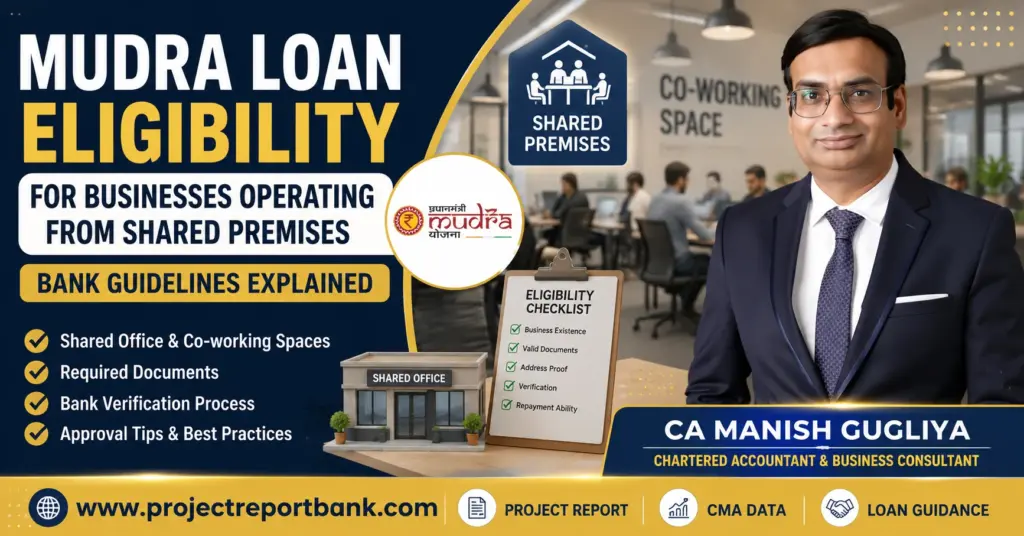
Key Takeaways
- Operating from shared premises, co-working spaces, or family-owned shops does not automatically make you ineligible for a Mudra Loan under Pradhan Mantri Mudra Yojana (PMMY).
- Banks focus on genuine business activity, proper documentation, consistent address proof, and successful site verification – not on exclusive premises ownership.
- Applicants should prepare rent or co-working agreements, NOC from property owner, business registrations (GST, Udyam), a visible nameboard, and active bank statements to strengthen approval chances.
- MUDRA loans are collateral-free for amounts up to ₹10 lakh, and loans under MUDRA Yojana are collateral-free up to ₹10 lakh across Shishu, Kishor, and Tarun categories.
- As a practicing CA (CA Manish Gugliya), this guidance draws from real Mudra loan cases handled across traders, service providers, freelancers, and startups using shared spaces.
Introduction: Shared Premises and Mudra Loan – What Entrepreneurs Must Know
A digital marketing freelancer in Indore recently asked me whether his co-working desk would disqualify him from getting a Mudra Loan. His co-working agreement was valid, his clients paid him regularly, and his bank account showed steady inflows. His only worry was the shared address.
This fear is extremely common. Many Indian businesses – from garment traders in market complexes to consultants in business centres – operate from shared commercial premises. Under Pradhan Mantri Mudra Yojana, banks regularly finance such businesses. MUDRA stands for Micro Units Development and Refinance Agency, functioning as a refinance agency under the Government of India. MUDRA Yojana was launched on April 8, 2015 to support micro and small businesses in India, and MUDRA Yojana supports micro and small businesses’ growth across manufacturing, trading, and services. Loans under MUDRA can reach up to ₹20 lakh, and MUDRA loans can be applied online or offline through participating banks’ websites.
This article covers how banks view mudra loan shared premises applications, the eligibility criteria, required documents, the verification process, common rejection reasons, and practical steps to improve your approval chances.
Table of Contents
What Do Banks Treat as Shared Business Premises Under Mudra Loan?
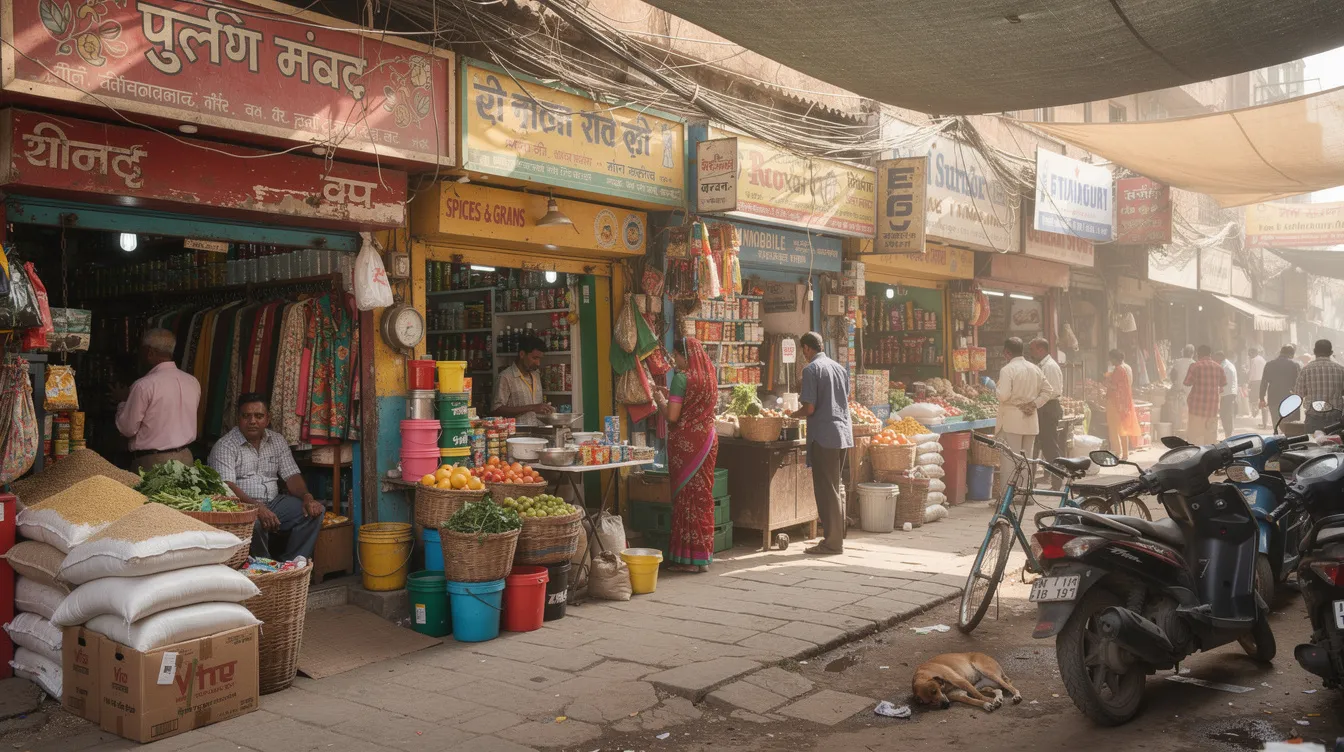
“Shared premises” simply means more than one business or individual uses the same commercial or mixed-use space. This is the reality for a large majority of Indian micro enterprises.
Common scenarios include:
- Two brothers operating separate businesses from one 200 sq. ft. shop
- Multiple traders in a market complex sharing common corridors
- Small units in an industrial estate sharing a shed or warehouse
- Freelancers or startups in co-working floors in Bengaluru or Gurugram
- Clinics, coaching centres, or consultancies housed inside business centres
- Home-cum-office arrangements where residential and business addresses overlap
Banks generally accept registered co-working contracts, clear rent or leave & license agreements, documented allotments in industrial estates, and family shops where multiple activities run from adjoining areas. Mudra loans can be used for shared premises such as co-working spaces without any policy restriction.
Borderline situations – purely virtual offices with zero physical activity, temporary stalls without written permission, or addresses flagged for multiple suspicious loan applications – attract extra scrutiny. But banks do not reject simply because another business shares the same address. They become more careful about verification.
Can Shared-Premises Businesses Get Mudra Loan? How Banks Actually Decide
Yes, you can get a Mudra Loan from shared premises, provided your business is genuine and you satisfy the bank’s eligibility criteria under PMMY.
Eligibility criteria include being an Indian citizen with no defaults on previous loans. Applicants must be aged between 18 to 65 years. Businesses must be non-farm income-generating units to qualify for Mudra loans – agricultural businesses are not eligible for MUDRA loans. Eligible businesses include shop owners, vendors, and service providers, along with any other legal entity or non corporate enterprise engaged in a proposed activity in manufacturing, trading, services, or food processing.
Loan categories include Shishu, Kishore, Tarun, and Tarun Plus. Shishu loans offer up to ₹50,000 for startups. Kishore loans range from ₹50,000 to ₹5 lakh for growth. Tarun loans provide ₹5 lakh to ₹10 lakh for established businesses. Tarun Plus loans range from ₹10 lakh to ₹20 lakh for expanded businesses. MUDRA Yojana offers collateral-free loans up to ₹20 lakh, and no collateral is required for loans up to ₹10 lakh. MUDRA loans are provided by banks, NBFCs, and MFIs, including commercial banks and small finance banks. Interest rates for MUDRA loans are generally lower than traditional loans, often ranging 9–14% p.a. depending on the bank or financial institution.
Banks assess risk based on cash flow, bank statement patterns, past credit behaviour, and business sustainability – not just the address. If you have a satisfactory credit track record and have successfully repaid previous loans, your file gets stronger. MUDRA loans can be used for purchasing machinery and hiring employees, or as working capital for day-to-day operations.
If you run multiple businesses at one address, banks become more cautious but approval is very much possible when documentation is strong.
Why Banks Verify Shared Premises and What Officers Look For
Public money is being lent under the mudra scheme. Bank officers must ensure every beneficiary micro unit is real, stable, and not part of any fraud or multiple-loan misuse.
Their main concerns with shared premises:
- Fake businesses created solely to raise funding
- One person taking several mudra loans using different names at the same address
- Temporary setups that disappear after the loan extended
- Misuse of loans for personal rather than business purposes
During a site visit for rented or shared premises, officers check for a signboard, separate working area, and actual business activity. They observe whether customers visit, whether inventory or raw material exists, and whether employees are present. For service-based or home-based micro units, they adjust expectations – looking for laptops, tools, files, or equipment matching the declared activity.
Documentation must prove that the business is operational and legitimate. Officers compare field investigation reports with details in the loan application and project report. Contradictions between what the form says and what the officer sees can delay or reduce your sanction.
Documents and Proofs Banks Expect for Mudra Loan from Shared Premises
Most documents are standard for all mudra loans, but shared-premises applicants must pay extra attention to occupancy proof and address consistency.
Occupancy and Premises Proof:
- A valid rental agreement is required for businesses in shared premises (registered or unregistered, depending on bank)
- Co-working agreement or membership letter
- Allotment letter for industrial estate units
- A no-objection certificate may be required from the owner of shared premises
- Latest electricity, water, or property tax bill for the premises
Business Identity:
- GST registration showing the same address
- Udyam Registration as a legal entity
- Shop & Establishment certificate or trade licence
- Partnership deed, company incorporation, or other documents as applicable
Personal KYC and Financials:
- PAN, Aadhaar, photographs
- Financial documentation must include bank statements and a viable business plan covering at least 6–12 months
- ITRs if available, and CMA data aligned to the requested loan amount
Photographic Evidence:
- Exterior with nameboard visible, interior with inventory or equipment, and the applicant present
Avoid common errors: mismatched spellings across documents, address proof inconsistencies between Aadhaar and GST, outdated rent agreements, and unsigned contracts. Under GST Instruction No. 03/2025, shared or co-working premises require a consent letter from the owner, ownership proof, and a declaration – and banks use the same reference point when validating your business registration address.

Verification, Common Rejection Reasons, and How to Improve Your Approval Chances
The standard Mudra Loan verification process involves initial branch scrutiny, telephonic verification, a field or site visit, and final credit approval assessed based on all findings combined. Loans under MUDRA Yojana are approved quickly without collateral when everything checks out.
During a site visit to shared premises, the officer identifies the unit by nameboard or shop number, interacts with the applicant or staff, takes photographs, checks stock or capital assets, and sometimes speaks with neighbouring shopkeepers. Individual borrowers and eligible borrowers are expected to cooperate fully.
Common rejection triggers:
- Office closed repeatedly during visits or business not operational during mudra loan verification
- No visible business signboard or separate working area
- Address on documents not matching actual location
- No rent agreement or NOC; utility bill entirely in someone else’s name without written permission
- Same set of other documents being used by multiple applicants for covering loans at one address
Practical steps to improve chances:
- Install a clear nameboard before you submit your application
- Keep the business operational during expected inspection windows
- Maintain basic records – sales bills, purchase bills, appointment books, online orders
- Align all key documents (GST, Udyam, Aadhaar, rent agreement) to one standard business address
- Build at least a few months of active transactions in your bank statement so the borrower’s EMI capacity looks realistic against the requested loan amount
- Have necessary skills and knowledge of your trade clearly demonstrable during interaction
As CA Manish Gugliya, I strongly advise that a bank-ready project report, realistic financial projections, and a properly organised document file significantly improve outcomes – especially when premises are shared or rented. Applicants with no educational qualification barriers and clear business plans rarely face trouble, even from shared spaces. Whether you apply online through a bank or financial institution’s website or walk into a branch, preparation is what separates approval from rejection. The credit guarantee under PMMY and the subsidy support through government channels are designed to help small enterprises and entrepreneurs access financial assistance – not to penalise them for operating from affordable, shared spaces. The next phase of your business growth depends on how well you present your case today.
Frequently Asked Questions on Mudra Loan for Shared Premises
Here are answers to the most common questions I receive from applicants operating from shared premises.
Can I get a Mudra Loan if I work only from a co-working space?
Yes. Co-working spaces are acceptable to most lenders if you hold a valid agreement, your business activity actually runs from that location, and you can demonstrate independent identity through invoices, bank transactions, and traceable clients. Many micro enterprises engaged in services and trading successfully obtain business loans from co-working setups.
Is a registered rent agreement compulsory for Mudra Loan on shared premises?
While some public sector commercial banks insist on a registered agreement, many lenders accept an unregistered rent deed plus the owner’s NOC and a utility bill for small-ticket shishu loans or Kishor cases. However, a registered document always strengthens your file and reduces processing delays.
What if the electricity bill is in my landlord’s or relative’s name?
This is common across India. Banks usually accept the bill in the owner’s name alongside your rent or co-working agreement and NOC, provided the full address matches and your business nameboard is visible during site inspection. The interest rate or loan terms are not affected by whose name appears on the utility bill.
Can two different businesses use the same address for separate Mudra Loans?
Yes, when both units are genuinely different – each with its own business registration, PAN, bank account, and clearly separate activity. Officers will cross-check both files carefully and may conduct joint verification. Assets created by each enterprise should be independently identifiable.
Does PMMY require that I own the premises where my business runs?
Ownership of property is not a condition under Pradhan Mantri Mudra Yojana. Rented, leased, co-working, or family-owned spaces are all acceptable. MUDRA loans are available for non-farm small businesses only, regardless of whether premises are owned or shared – as long as occupation is legal, documented, and the enterprise is actually operating from there. You can apply for MUDRA loans through participating banks’ websites or visit any branch of a bank that extends the mudra scheme. The loan can fund working capital needs or help acquire capital assets upto rs 10 lakh without collateral.
- Can Bank Reduce Mudra Loan Amount Without Your Consent? Complete Practical Guide (2026)


- What to Do If You Cannot Pay Your Mudra Loan EMI (2026 Guide)

- Can a Bank Refuse a Mudra Loan Because the Target Is Completed? Complete Guide (2026)

- Bank Refused My Mudra Loan Application – What Are My Rights?

- Mudra Loan for Used Vehicles (2026): Eligibility, Documents, Bank Rules & Complete Guide

- Rejected Mudra Loan – What to Do Next? Appeal Process Explained (2026)

- Mudra Loan Project Report Madhya Pradesh – Bank-Ready DPR & CMA Guide

- Project Report for Mudra Loan Maharashtra: Complete Guide for MSMEs, Startups and Small Businesses (2026)

- Mudra Loan Uttar Pradesh: Complete Guide for MSMEs, Startups and Small Businesses (2026)

- Mudra Loan Bihar 2026: Eligibility, Documents, Online Application Process & Project Report Guide

- Jan Samarth Mudra Loan 2026: Complete Guide to Online Application, Eligibility, Documents & Approval Process

- MSME Mudra Loan: Complete Guide for Small Businesses, Startups & Manufacturing Units in India (2026)

- Is the Mudra Loan Subsidy Real or Fake? Get the Facts Here

- Mudra Loan Without CIBIL Score: How to Qualify and Apply

- Mudra Loan for Used Machine (2026 Guide) – Eligibility, Documents, Valuation & Approval Tips