A Mudra Loan rejection may feel discouraging, but it does not mean your business financing journey has come to an end. Many Mudra Loan applications are rejected because of issues that can be corrected, such as an outdated Project Report, weak financial records, poor bank statements, incomplete documentation, unrealistic loan requirements, or business verification concerns. Once these shortcomings are identified and addressed, applicants often have a much better chance of securing approval through a fresh application.
Banks do not automatically reject repeat applicants. In fact, they regularly approve second Mudra Loan applications when they see genuine improvements since the previous submission. Updating your Project Report, strengthening your business profile, improving banking transactions, maintaining accurate financial records, and correcting the reasons for the earlier rejection demonstrate that your business has become more viable and capable of repaying the loan. These positive changes can significantly improve the bank’s confidence in your application.
This comprehensive Mudra Loan Reapplication Strategy Guide walks you through every stage of the reapplication process. From understanding why your previous application was rejected and preparing a pre-reapplication checklist to updating your Project Report, improving bank statements, choosing the right bank, revising the loan amount, and deciding the best time to apply again, this guide covers everything you need to know. It also serves as a central resource, providing links to detailed guides for every reapplication scenario so you can prepare a stronger application and maximise your chances of Mudra Loan approval.
What You'll Learn in This Guide
Use the quick navigation below to explore every important aspect of a successful Mudra Loan reapplication.
- 📌 Understanding the Mudra Loan Reapplication Success Formula – Learn the complete strategy for improving your approval chances after rejection.
- ✅ Pre-Reapplication Checklist – Review everything you should prepare before submitting another Mudra Loan application.
- 🤝 Reapplying with a New Business Partner – Understand how ownership changes affect your loan application.
- 🏦 Improving Bank Statements – Learn why banking transactions play a major role during reapplication.
- 📄 Updating Your Project Report – Find out when revising your Project Report becomes essential.
- 📈 Reapplying After Business Expansion – Learn how business growth can strengthen your second application.
- 💼 Building a Strong Business Profile – Discover practical ways to improve business credibility before reapplying.
- 💰 Changing the Loan Amount – Decide whether increasing or reducing your requested loan amount is the right strategy.
- 🏛️ Same Bank vs Another Bank – Compare both options before submitting your next application.
- ⏳ Should You Wait Six Months? – Learn whether waiting before reapplying improves your approval chances.
Quick Navigation
Browse the complete Mudra Loan Reapplication Strategy library below. Click any guide to learn more about that specific topic and prepare a stronger Mudra Loan application.
Success Formula
Learn the complete strategy to improve your approval chances after a Mudra Loan rejection.
Read Guide →Pre-Reapplication Checklist
Review every document, financial record, and preparation before applying again.
Read Guide →New Business Partner
Understand how adding a new partner affects your Mudra Loan reapplication.
Read Guide →Bank Statements
Discover how better banking habits can significantly improve loan approval chances.
Read Guide →Update Project Report
Know when and why your Project Report should be revised before reapplying.
Read Guide →Business Expansion
Learn how business growth can strengthen your next Mudra Loan application.
Read Guide →Strong Business Profile
Build a stronger business profile to increase your credibility before reapplying.
Read Guide →Change Loan Amount
Find out whether changing your requested loan amount is the right decision.
Read Guide →Same Bank vs Another Bank
Compare the advantages of reapplying through the same bank or a different lender.
Read Guide →Reapply After Six Months
Understand whether waiting six months can improve your approval prospects.
Read Guide →Understanding Mudra Loan Reapplication Strategy
A Mudra Loan reapplication is an opportunity to submit a stronger application after correcting the issues that led to the previous rejection. Instead of repeating the same mistakes, applicants should improve their financial records, update important documents, and strengthen their overall business profile. A well-planned reapplication demonstrates that the business is now better prepared to meet the bank’s lending requirements.
What Is a Mudra Loan Reapplication?
Reapplication means submitting a fresh Mudra Loan application after addressing the shortcomings identified in the previous one. Before applying again, review your earlier application, update your Project Report if necessary, improve your financial records, and ensure all supporting documents are accurate and up to date.
Fresh Application vs Reapplication
A first-time application is evaluated solely on the information submitted by the applicant. In contrast, a reapplication is compared with the earlier application. Banks expect to see genuine improvements rather than the same documents and financial information submitted again.
Why Do Banks Review Second Applications More Carefully?
Banks already have records of the previous application and want to verify whether the reasons for rejection have been addressed. They may review updated financial records, business performance, documentation, Project Report, bank statements, and any significant changes in the business before making a fresh lending decision.
Does a Previous Rejection Permanently Affect Approval?
No. A previous rejection does not permanently prevent you from obtaining a Mudra Loan. What matters most is whether you have corrected the earlier deficiencies and submitted a stronger, more complete application. Applicants who demonstrate measurable improvements often have better approval prospects.
Common Myths About Mudra Loan Reapplication
Many applicants believe they must wait exactly six months before reapplying, that changing the bank guarantees approval, or that submitting the same documents again is sufficient. In reality, successful reapplication depends on addressing the actual reasons for rejection, updating relevant documents, and presenting a stronger business case.
Want to explore each topic in detail? Browse the guides in this cluster to learn about pre-reapplication preparation, Project Report updates, bank statements, business profile improvement, loan amount revision, choosing the right bank, and the complete reapplication strategy.
Which Guide Should You Read?
Not sure where to start? Use the table below to identify your current situation and jump directly to the most relevant guide for your Mudra Loan reapplication.
| If Your Situation Is... | Read This Guide |
|---|---|
| ❌ Recently rejected | Mudra Loan Reapplication Success Formula → |
| 📋 Preparing to apply again | Pre-Reapplication Checklist for Mudra Loan Approval → |
| 🤝 Added a new business partner | Mudra Loan Reapplication with a New Partner → |
| 🏦 Weak banking transactions or poor bank statements | Bank Statements for Mudra Loan Reapplication → |
| 📄 Your Project Report has changed | Should You Update Your Project Report? → |
| 📈 Your business has expanded | Mudra Loan Reapplication After Business Expansion → |
| 💼 Your business profile needs improvement | Build a Strong Business Profile Before Reapplying → |
| 💰 You want to change the loan amount | Change Loan Amount for Mudra Loan Reapplication → |
| 🏛️ Confused whether to apply to the same bank or another bank | Same Bank vs Another Bank → |
| ⏳ Unsure about the waiting period before reapplying | Mudra Loan Reapplication After 6 Months → |
Why Do Banks Examine Reapplications More Carefully?
When a borrower submits a Mudra Loan application for the second time, the bank does not treat it as a completely new case. Instead, it compares the new application with the previous one to determine whether the applicant has addressed the earlier shortcomings. The objective is not to reject the application simply because it was rejected before, but to evaluate whether the business has become a stronger and lower-risk lending opportunity.
Previous Rejection History
Banks maintain records of earlier loan applications and the reasons for rejection. During reapplication, loan officers review the previous observations and compare them with the new application. This helps them determine whether the applicant has resolved the issues that led to the earlier rejection.
Corrective Action Taken
One of the first things banks look for is whether the applicant has taken meaningful corrective action. For example, if the earlier application was rejected due to incomplete documents, weak financials, or an unrealistic Project Report, the bank expects these issues to have been properly resolved before considering the new application.
Updated Documents
Reapplications should always include the latest business and financial documents. Updated KYC documents, bank statements, GST returns, Income Tax Returns, licences, quotations, and Project Reports help the bank evaluate the current status of the business instead of relying on outdated information.
Financial Improvement
Banks carefully assess whether the financial position of the business has improved since the previous application. Better turnover, improved profitability, healthier cash flow, stronger banking transactions, and reduced existing liabilities indicate that the business is now better prepared to repay the loan.
Business Growth
Positive business developments strengthen a reapplication. Expansion of operations, addition of new products or services, increased customer base, improved infrastructure, or higher sales demonstrate that the business has progressed since the earlier application and may now justify fresh financial support.
Credit Behaviour
The bank also reviews the applicant’s recent credit behaviour. Timely repayment of existing loans, responsible use of credit facilities, and a stable banking relationship reflect financial discipline and improve the lender’s confidence in the applicant.
Repayment Capacity
Every loan decision ultimately depends on repayment capacity. Banks evaluate whether the business generates sufficient income and cash flow to comfortably repay the proposed EMI while continuing normal business operations. A stronger repayment profile significantly improves the chances of approval.
Overall Risk Assessment
Finally, the bank performs a fresh risk assessment by considering all the updated information together. Rather than focusing on a single factor, it evaluates the business’s financial strength, operational stability, documentation, credit behaviour, and future repayment ability. If the overall risk has reduced compared to the previous application, the chances of Mudra Loan approval increase considerably.
First Mudra Loan Application vs Reapplication
| First Application | Reapplication |
|---|---|
| Initial review | Comparative review |
| Limited application history | Previous rejection history available |
| Standard verification | Enhanced verification |
| New financial projections | Updated financial projections |
| General business assessment | Assessment of business improvements |
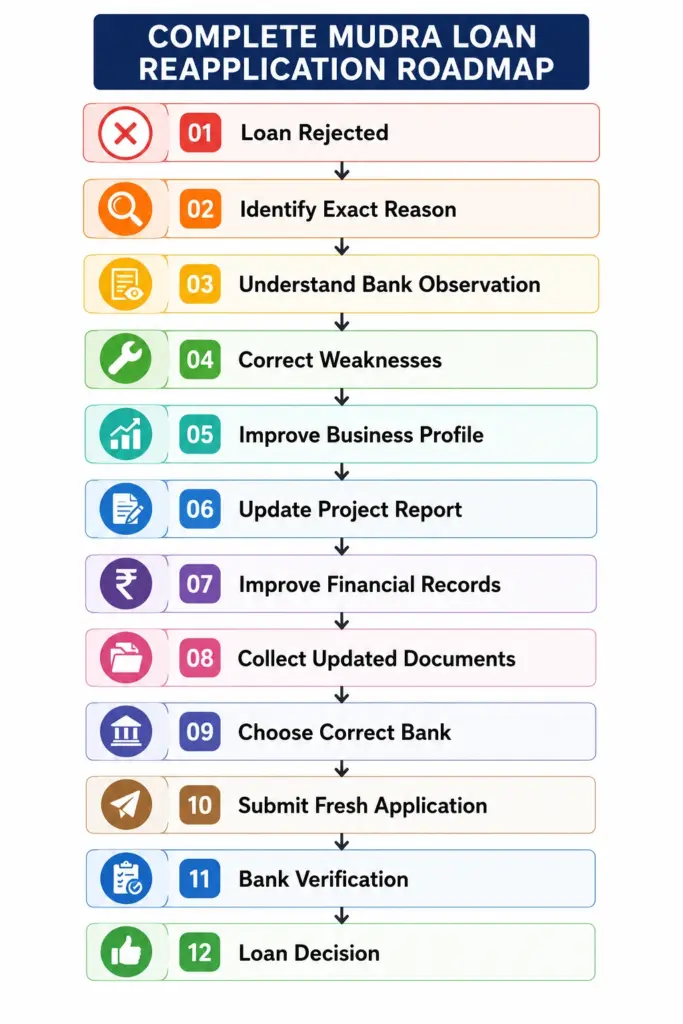
Complete Mudra Loan Reapplication Roadmap
The following roadmap illustrates the complete Mudra Loan reapplication process—from identifying the reason for rejection to submitting a stronger application and receiving the bank’s final decision. Following these steps systematically can significantly improve your chances of loan approval.
Common Reasons Why Reapplications Fail Again
Many Mudra Loan reapplications are rejected because applicants repeat the same mistakes that caused the earlier rejection. Simply submitting another application without addressing the bank’s observations rarely improves the outcome. Before reapplying, ensure that your documents, financial records, Project Report, and business profile reflect genuine improvements. The following are some of the most common reasons why a second application may also fail.
Using the Same Project Report
Submitting the same Project Report without making any revisions is one of the most common mistakes. If your business has changed, the Project Report should also be updated to reflect the latest business activities, financial projections, and funding requirements. Learn when and why you should update your Project Report before reapplying.
Submitting Old Documents
Banks expect applicants to provide the latest documents during a reapplication. Outdated bank statements, GST returns, Income Tax Returns, quotations, licences, or KYC documents may create doubts about the current status of your business and delay the approval process.
Poor Bank Statements
Bank statements are an important indicator of business performance and financial discipline. Frequent cheque returns, irregular transactions, low balances, or inactive business accounts can negatively affect the bank’s assessment. Before reapplying, review your bank statements for Mudra Loan reapplication and improve your banking habits wherever possible.
Weak Business Growth
If your business has shown little or no improvement since the previous application, the bank may question its future viability. Demonstrating higher sales, increased customer demand, new products, or business expansion can strengthen your loan proposal. If your business has expanded, understand how business expansion affects Mudra Loan reapplication.
No Improvement in Financials
Banks expect to see stronger financial performance during a second application. Improved turnover, profitability, cash flow, and lower debt levels increase confidence in your repayment ability. Reapplying without any financial improvement reduces the likelihood of approval.
Ignoring Previous Rejection
Many applicants simply apply again without understanding why the earlier application was rejected. This often results in another rejection for the same reasons. Carefully review the bank’s observations and follow a structured Mudra Loan Reapplication Success Formula before submitting a fresh application.
Incorrect Loan Amount
Requesting a loan amount that is either too high or too low compared to your business requirements can weaken your application. The requested amount should be supported by realistic project costs, working capital requirements, and repayment capacity. If necessary, consider changing your loan amount before reapplying.
Applying Too Early
Submitting another application immediately after rejection, without making any meaningful improvements, rarely changes the outcome. Instead of focusing only on timing, use the waiting period to strengthen your business, improve financial records, and prepare a better application. If you’re unsure about the ideal timing, read when to reapply for a Mudra Loan after rejection.
Incomplete Documentation
Missing or inconsistent documents continue to be one of the leading causes of Mudra Loan rejection. Before submitting a fresh application, verify that all mandatory documents are complete, accurate, and up to date. A Pre-Reapplication Checklist can help ensure that nothing important is overlooked.
Weak Repayment Capacity
Ultimately, banks approve loans only when they are confident that the borrower can repay them. If your income, cash flow, or business profitability is insufficient to support the proposed EMI, the application may be rejected again. Strengthening your financial position and demonstrating sustainable repayment capacity significantly improves the chances of Mudra Loan approval.
Mistakes to Avoid Before Reapplying
A successful Mudra Loan reapplication requires visible improvement in the areas that caused the earlier rejection. The comparison below highlights common mistakes and the better strategy applicants should follow before submitting a fresh application.
| Mistake | Better Strategy |
|---|---|
| Submitting the same application | Follow an updated reapplication strategy after correcting previous weaknesses. |
| Submitting the same financial information | Show improved turnover, profitability, cash flow, and financial stability. |
| Weak bank statements | Improve banking transactions and prepare stronger bank statements for Mudra Loan reapplication . |
| Using the same Project Report | Revise financial projections and update the Project Report before reapplying . |
| Reapplying immediately | Allow sufficient time to correct deficiencies and understand when to reapply after rejection . |
| Requesting an excessively high loan amount | Calculate the practical business requirement and revise the requested loan amount where necessary. |
| Ignoring the previous rejection reason | Understand the bank's observations and correct every identified deficiency. |
| Submitting incomplete or outdated documents | Use a Pre-Reapplication Checklist and submit complete, accurate, and updated documents. |
Decision Matrix: Choose the Right Improvement Before Reapplying
Not every Mudra Loan rejection has the same solution. Use the decision matrix below to identify the improvement that best matches your situation before submitting a fresh application.
| Your Problem | Recommended Solution |
|---|---|
| Weak Project Report | Revise and update your Project Report |
| Poor Banking Transactions | Improve bank statements and banking discipline |
| Added a New Business Partner | Update ownership details and supporting documents |
| Business Expanded | Update financial projections and business information |
| Loan Amount Changed | Revise project cost and funding requirement |
| Purchased New Machinery | Update machinery quotations, project cost, and supporting documents. |
| Business Address Changed | Update KYC, business address proof, registrations, and licences before reapplying. |
| Weak Business Turnover | Improve business performance before submitting a fresh application |
Complete Guide Library
This library brings together every detailed guide in the Mudra Loan Reapplication Strategy cluster. If your previous Mudra Loan application was rejected, use the guides below to identify the exact issue, understand the bank’s expectations, and prepare a stronger application before reapplying.
Mudra Loan Reapplication Success Formula
A successful Mudra Loan reapplication is based on correcting previous mistakes rather than simply applying again. This guide explains a practical success formula that covers rejection analysis, corrective actions, documentation, financial improvements, and business preparation. It helps applicants understand what banks expect before approving a second application.
👉 Read More: https://projectreportbank.com/mudra-loan-reapplication-success-formula/
Pre-Reapplication Checklist for Mudra Loan Approval
Before submitting another Mudra Loan application, verify that every important requirement has been completed. This comprehensive checklist covers Project Reports, bank statements, financial records, KYC documents, GST returns, business information, and verification readiness. Following this checklist helps reduce avoidable mistakes during the reapplication process.
👉 Read More: https://projectreportbank.com/pre-reapplication-checklist-for-mudra-loan-approval/
Mudra Loan Reapplication with a New Partner
Has your business added a new partner after the previous rejection? This guide explains how ownership changes affect Mudra Loan eligibility, what documents should be updated, and how banks verify revised partnership details. It also covers practical tips for submitting a stronger application after changes in business ownership.
👉 Read More: https://projectreportbank.com/mudra-loan-reapplication-with-new-partner/
Bank Statements for Mudra Loan Reapplication
Bank statements play an important role in demonstrating business performance and financial discipline. This guide explains how banks analyse banking transactions, common mistakes that weaken an application, and practical steps to improve your banking profile before submitting a fresh Mudra Loan application.
👉 Read More: https://projectreportbank.com/bank-statements-mudra-loan-reapplication/
Should You Update Your Project Report Before Reapplying?
Your Project Report should reflect the current status of your business rather than outdated assumptions. This guide explains when a Project Report must be revised, how updated financial projections improve loan approval chances, and the common mistakes applicants make while reusing an old report.
👉 Read More: https://projectreportbank.com/should-you-update-project-report-before-reapplying-mudra-loan/
Mudra Loan Reapplication After Business Expansion
Business expansion often changes your investment requirements, working capital needs, and financial projections. This guide explains how to update business information, revise financial estimates, and present expansion plans effectively while submitting a fresh Mudra Loan application.
👉 Read More: https://projectreportbank.com/mudra-loan-reapplication-after-business-expansion/
Build a Strong Business Profile Before Reapplying
A stronger business profile increases the bank’s confidence in your repayment ability. This guide explains how to improve turnover, customer base, financial management, business stability, and overall credibility before approaching the bank with a new Mudra Loan application.
👉 Read More: https://projectreportbank.com/build-strong-business-profile-before-reapplying-mudra-loan/
Should You Change the Loan Amount?
Many applicants request an unrealistic loan amount that does not match their actual business requirements. This guide explains when you should revise the loan amount, how to calculate a practical funding requirement, and how an appropriate loan request improves approval prospects.
👉 Read More: https://projectreportbank.com/change-loan-amount-mudra-loan-reapplication/
Same Bank vs Another Bank
Should you submit your next application to the same bank or choose another lender? This guide compares both options, explains the advantages and disadvantages of each approach, and helps you decide which option is more suitable based on your previous rejection and current business position.
👉 Read More: https://projectreportbank.com/mudra-loan-reapplication-same-bank-vs-another-bank/
Mudra Loan Reapplication After 6 Months
Many entrepreneurs believe they must always wait six months before reapplying. This guide explains whether there is a mandatory waiting period, when it is appropriate to submit another application, and what improvements should be completed before approaching the bank again.
👉 Read More: https://projectreportbank.com/mudra-loan-reapplication-after-6-months/
Expert Advice by CA Manish Gugliya
A successful Mudra Loan reapplication is not about trying again—it is about applying smarter. Based on practical experience in preparing Project Reports, CMA Data, and business loan documentation, here are some recommendations that can significantly improve your chances of approval.
✓ Don't Submit the Same Application Again
Always improve your application before reapplying. Banks expect to see meaningful changes, not the same documents submitted twice.
✓ Find the Real Reason for Rejection
Understand why your previous application was rejected and correct every deficiency before submitting a fresh application.
✓ Update Your Project Report
Whenever your business expands, costs change, or loan requirements are revised, prepare an updated Project Report with realistic financial projections.
✓ Improve Banking Habits
Maintain healthy banking transactions, avoid cheque returns, and keep regular business activity in your account for a few months before reapplying.
✓ Keep Financial Records Updated
Ensure your GST returns, Income Tax Returns, bank statements, and other financial records accurately reflect your current business position.
✓ Request the Right Loan Amount
Apply only for the amount genuinely required by your business and support it with proper cost estimates and financial projections.
✓ Prepare for Bank Verification
Keep your business premises, documents, and business information ready for field verification and discussions with the bank.
✓ Strengthen Your Business Profile
Demonstrate business growth, improved turnover, and better financial management before approaching the same or another bank.
✓ Maintain Document Consistency
Business name, address, ownership details, financial figures, and supporting documents should remain consistent across every record submitted.
✓ Seek Professional Guidance
If your application involves complex financial projections, Project Reports, or CMA Data, professional assistance can help you prepare a stronger proposal.
Frequently Asked Questions
Can I reapply for a Mudra Loan after rejection?
Yes. A Mudra Loan rejection does not permanently prevent you from applying again. However, before submitting a fresh application, you should identify the actual reason for rejection, correct the deficiencies, and ensure your new application is stronger than the previous one.
How soon can I submit another Mudra Loan application?
There is no universal waiting period for every applicant. You should reapply only after resolving the issues that caused the earlier rejection. If your documents, financial position, or business profile have improved, you can consider submitting a fresh application.
Should I update my Project Report before reapplying?
Yes. If there have been changes in your business, project cost, machinery, financial projections, or funding requirements, you should prepare an updated Project Report. A revised report gives the bank a more accurate picture of your current business.
Can I change the loan amount during reapplication?
Yes. If your business requirements have changed since the previous application, you can revise the requested loan amount. Ensure that the revised amount is supported by realistic project costs and repayment capacity.
Should I use the same bank again?
It depends on the reason for the previous rejection. If the rejection resulted from correctable issues that have now been resolved, reapplying to the same bank may be appropriate. In other situations, approaching another bank may be a better option after strengthening your application.
Will my previous rejection affect future approval?
A previous rejection does not automatically result in another rejection. Banks primarily assess the quality of your current application, financial position, documentation, and repayment capacity before making a lending decision.
Can I add a new business partner before reapplying?
Yes. If your business structure has changed, you can add a new partner before reapplying. However, you should update all ownership documents, registrations, financial records, and the Project Report to reflect the revised business structure.
How important are bank statements?
Bank statements are one of the most important documents reviewed by lenders. They help banks assess business transactions, cash flow, financial discipline, and repayment capacity. Healthy banking habits significantly improve your chances of approval.
Is waiting six months compulsory?
No. There is no fixed rule requiring every applicant to wait six months before reapplying. The right time depends on how quickly you can correct the reasons for rejection and strengthen your application.
What documents should I update before reapplying?
You should update all documents that no longer reflect the current status of your business. These may include your Project Report, bank statements, GST returns, Income Tax Returns, quotations, licences, KYC documents, and any business registration records that have changed.
How do banks assess repeat applicants?
Banks compare the new application with the previous one to determine whether meaningful improvements have been made. They review updated documents, financial performance, business growth, credit behaviour, repayment capacity, and the corrective actions taken after the earlier rejection.
How can I maximise approval chances?
The best way to improve your approval prospects is to understand the previous rejection, correct every identified weakness, update your documents and financial records, prepare a realistic Project Report, maintain healthy banking transactions, and submit a complete, well-prepared application that demonstrates genuine business improvement.
Conclusion
A Mudra Loan rejection should not be viewed as the end of your financing journey. In many cases, it is an opportunity to identify weaknesses in your application, strengthen your business, and return with a proposal that better meets the bank’s lending requirements. Applicants who take corrective action before reapplying are often in a much stronger position than those who simply submit the same application again.
A successful reapplication is built on careful preparation. Understanding the actual reason for rejection, correcting deficiencies, updating financial records, revising the Project Report, and presenting accurate business information can significantly improve your chances of approval. Banks look for evidence that your business has progressed and that the risks identified during the previous application have been addressed.
Simple but meaningful improvements—such as preparing an updated Project Report, strengthening your business profile, maintaining healthier bank statements, requesting a realistic loan amount, and submitting complete documentation—can make a substantial difference during the bank’s assessment.
Use the detailed guides in this Mudra Loan Reapplication Strategy cluster to resolve specific issues, prepare your application with confidence, and submit a stronger Mudra Loan proposal with a better chance of approval. Each guide focuses on a key aspect of the reapplication process, helping you move one step closer to a successful Mudra Loan approval.
-
Mudra Loan Reapplication Strategy: Complete Guide to Reapply Successfully After Rejection
-
Mudra Loan Reapplication Success Formula – 25 Checks to Complete Before Submitting a Fresh Application
-
Mudra Loan Self Assessment Checklist: How to Prepare Before Reapplying After Rejection
-
Mudra Loan Reapplication with New Partner or Co‑Applicant – Does It Really Increase Approval Chances?
-
How Bank Statements Can Improve or Damage Your Mudra Loan Reapplication
-
Should You Update Your Project Report Before Reapplying for a Mudra Loan?
-
Mudra Loan Reapplication After Business Expansion – Will Banks Consider the New Business Scale?
-
How to Build a Strong Business Profile for Mudra Loan Reapplication 2026
-
Can You Change Your Loan Amount While Reapplying for a Mudra Loan? (Practical Guide by CA Manish Gugliya)
-
Mudra Loan Reapplication with the Same Bank vs Another Bank – Which Option Is Better?