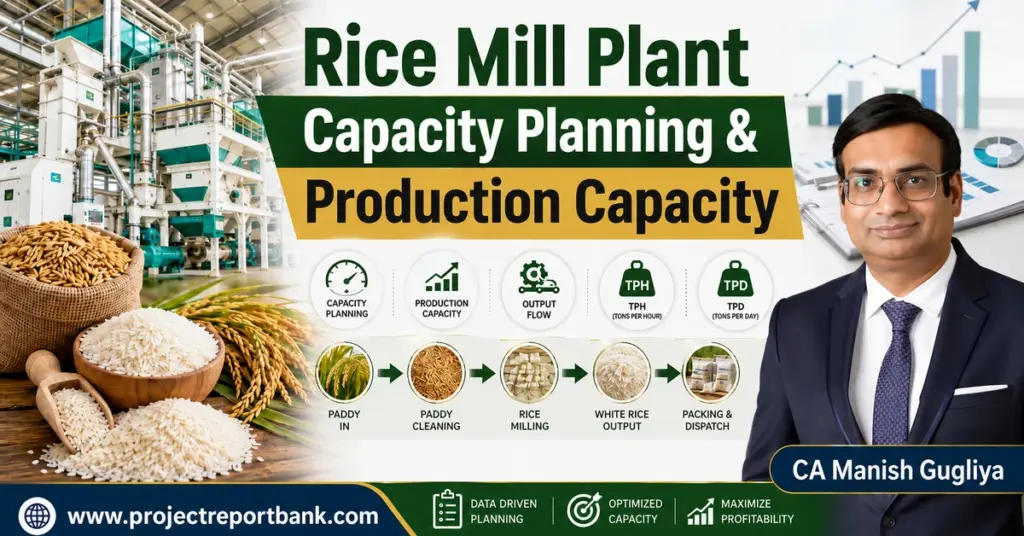
Key Takeaways
- Rice mill plant capacity planning directly determines project cost, working capital, operational costs, and long-term profitability. Selecting wrong capacity can cost lakhs or crores over the life of a project and is extremely difficult to correct later.
- Rice mill production capacity must be calculated step by step: from paddy input in TPH (tonnes per hour) to daily TPD (tonnes per day), then to annual TPA (tonnes per annum), and finally to realistic saleable rice output after applying rice recovery percentages and capacity utilisation assumptions.
- In India, optimum capacity depends on paddy availability in the catchment area, market demand, number of shifts, storage infrastructure, reliable power supply, and the promoter’s capital and bank-finance eligibility – not just on supplier quotations.
- A bankable rice mill DPR and rice mill project report must justify the selected capacity to bankers with transparent assumptions on working days, shifts, paddy requirement, rice recovery, by-products, and DSCR (debt service coverage ratio).
- CA Manish Gugliya and ProjectReportBank.com specialise in rice mill plant capacity planning, financial projections, and DPR preparation for MSMEs, entrepreneurs, and investors across India.
Introduction: Why Rice Mill Plant Capacity Planning Matters
Correct rice mill plant capacity planning is one of the most critical decisions while setting up or expanding a rice mill business in India. It directly impacts rice mill project cost, working capital, operational costs, and the mill’s ability to service bank loans over time. Capacity planning for a rice mill requires balancing raw material supply and market demand from the very first stage of project conceptualisation.
Oversizing – for example, jumping straight to a 20 TPH or 200 TPD industrial rice mill plant without paddy security – leads to low utilisation, high fixed expenses, idle machinery, and stressed repayments. Conversely, under-sizing (say, installing only a 1 TPH or 50 TPD mill in a strong paddy belt) restricts growth, prevents economies of scale, and wastes available raw materials and market opportunity, even if the initial investment feels safer.
Rice mill plant capacity planning is a balance of several factors: local paddy availability, market demand (retail, wholesale, export, institutional), machinery configuration, working hours and shifts, capital and bank finance, infrastructure, power requirements, storage for both raw paddy and finished products, and overall financial viability. This article, written by CA Manish Gugliya, Chartered Accountant and project finance consultant at ProjectReportBank.com, focuses on how to reflect capacity decisions correctly in a rice mill DPR, project report, and bank loan proposal.
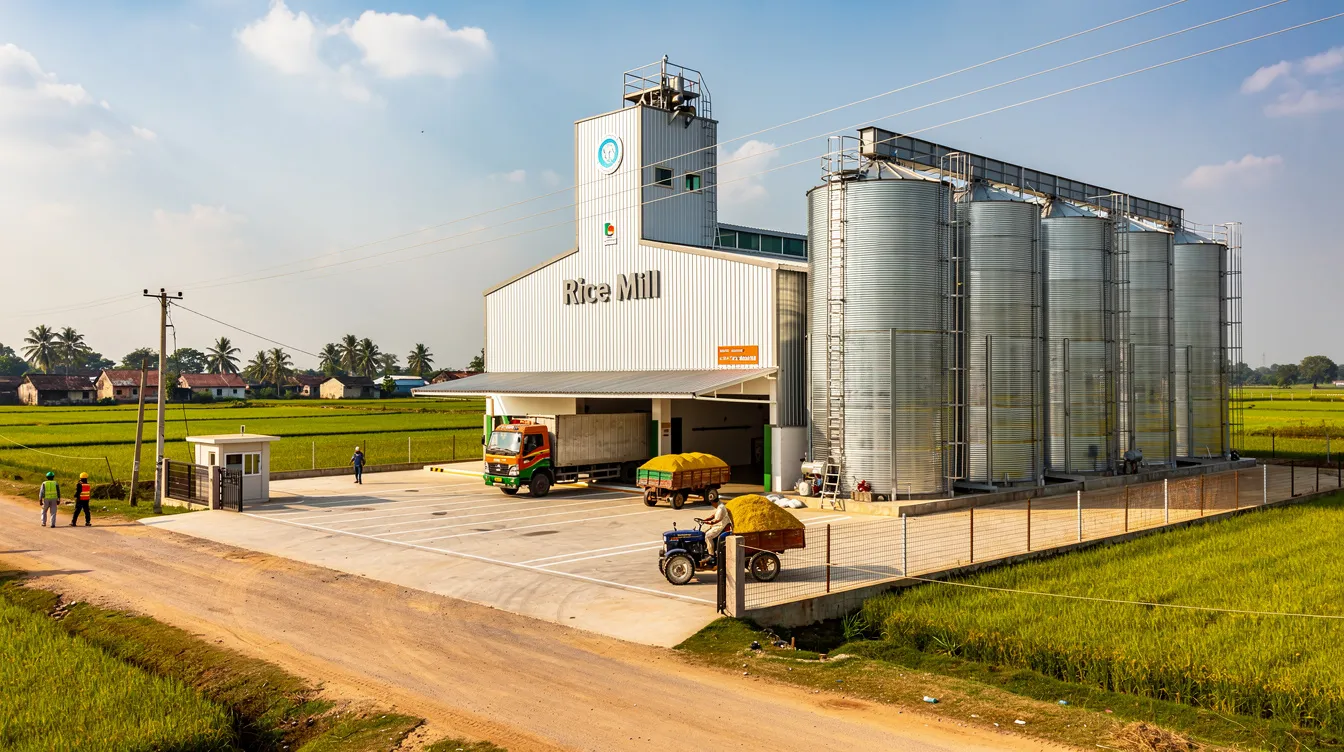
What Is Rice Mill Plant Capacity?
Rice mill plant capacity generally means the maximum paddy processing rate that the mill can handle under standard conditions. It forms the foundation for all production, revenue, and cost projections in any rice mill project.
For a commercial rice mill in India, capacity is normally expressed as:
- Tonnes per hour (TPH) – for example, 1 TPH, 3 TPH, 5 TPH, 10 TPH, or 20 TPH lines.
- Tonnes per day (TPD) – for example, 50 TPD, 100 TPD, or 200 TPD plants.
- Tonnes per annum (TPA) – annual paddy processing capacity used in rice mill DPRs.
Rice mill capacity in TPH or TPD generally refers to paddy input, not finished rice output, unless the supplier or DPR explicitly mentions otherwise. The installed capacity of a rice mill used in a rice mill plant DPR should clearly state the rated TPH of the line, planned operating hours per day, working days per year, and the resulting rice mill daily production capacity and annual production capacity. For bank appraisal and DSCR analysis, installed capacity is converted to realistic production by applying capacity utilisation assumptions – for example, 60% in Year 1, 70–75% in Year 2, stabilising at 80–85% thereafter.
Difference Between Paddy Input Capacity and Rice Output Capacity
In rice milling, paddy input does not equal finished rice output. This distinction must be crystal clear in any rice mill production capacity calculation.
From a given paddy input, the typical output streams are:
- Head rice (full-grain polished rice)
- Broken rice
- Rice bran
- Husk
- Moisture and other process losses
For the same paddy input capacity (say 5 TPH), finished rice output varies depending on paddy variety, moisture percentage, parboiling (if any), pre cleaning efficiency, milling technology, and operator skill. Grain characteristics such as moisture content directly affect machine throughput and recovery rates. Modern multistage mills can achieve 65% to 70% milling recovery rates under ideal conditions. Proper calibration keeps broken rice below 3 to 5 percent in well-maintained plants.
For DPR purposes, realistic ranges are more appropriate than one universal figure – for instance, head rice recovery can illustratively range from 62% to 68%, with broken rice at 2–5%, bran at 4–6%, and husk at 18–22%. A bankable rice mill plant feasibility study should show paddy processing capacity, rice production capacity per day and per year, and expected by-product quantities with their contribution to revenue.
Rice Mill Capacity in TPH: Practical Meaning with Examples
Rice mill capacity in TPH means how many tonnes of paddy the mill can process in one effective operating hour under rated conditions. Commonly used commercial capacities in India include:
- 1 TPH rice mill plant – suitable for small commercial or custom milling units, processing roughly 8–12 TPD. Mini rice mills at this scale may cost around ₹2–3 lakhs for basic setups.
- 2 TPH or 3 TPH rice mill plant – often used by medium scale mills targeting local mandis and traders.
- 5 TPH rice mill plant – widely used as a standard commercial rice mill capacity for state procurement, bulk buyers, and regional brands.
- 8 TPH rice mill – increasingly becoming the industry standard for serious commercial processing.
- 10 TPH and 20 TPH large scale mills – used by industrial processors, integrated plants, and export-oriented units requiring strong paddy availability.
For example, a 5 TPH line running 16 effective hours per day can theoretically process 80 tonnes of paddy per day; however, with realistic downtime and capacity utilisation, actual rice mill daily production capacity will be lower. Machinery brochures often quote ideal TPH at optimal conditions; a prudent rice mill DPR must adjust this for effective throughput (typically 80–90% of rated TPH) when performing rice mill capacity calculation.
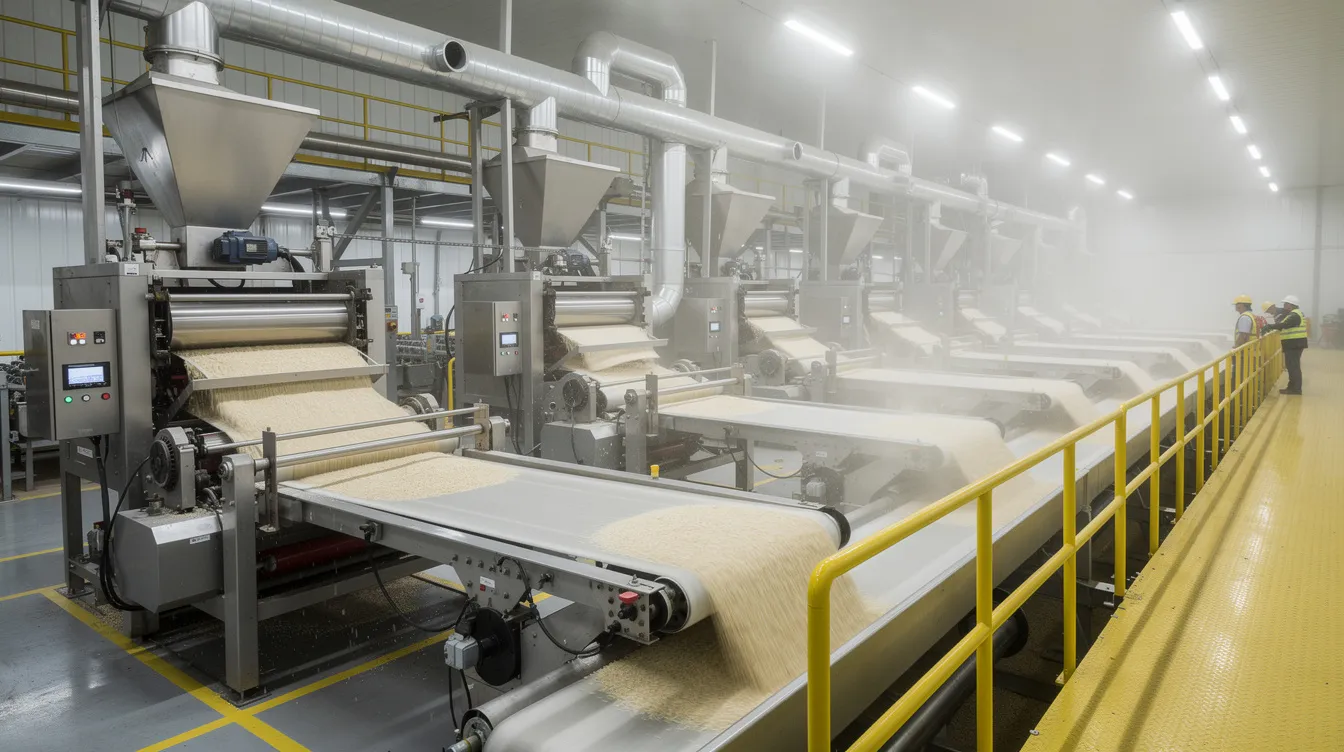
Rice Mill Capacity in TPD and Conversion from TPH
Bankers and investors in India typically evaluate rice mill capacity in TPD and TPA, while machinery vendors quote in TPH. The DPR must clearly bridge this gap. Estimating daily processing volume is key for effective capacity planning in rice mills.
The conversion formula is straightforward:
Daily Paddy Processing Capacity (TPD) = Rated TPH × Effective Operating Hours per Day
Illustrative examples:
- A 3 TPH mill operating 12 effective hours/day = 36 TPD paddy capacity.
- A 5 TPH mill operating 16 effective hours/day = 80 TPD paddy capacity.
- A 20 TPD rice milling plant processes about 20 metric tons daily under its designed parameters.
Note that “effective hours” must exclude start-up, shutdown, daily cleaning, grade changes, and routine checks. A plant advertised as running 24 hours may effectively produce for only 20–21 hours. When stating rice mill daily production capacity in a DPR, the report should show both paddy processing capacity and estimated finished rice output using stated recovery assumptions.
How to Calculate Annual Rice Mill Production Capacity
Annual capacity is essential for revenue projections, raw-material planning, and working-capital assessment in any rice mill DPR.
The step-wise method:
- Step 1: Installed Annual Paddy Processing Capacity (TPA) = Rated TPH × Effective Hours per Day × Working Days per Year.
- Step 2: Effective Annual Paddy Processing = Installed Capacity × Planned Capacity Utilisation (%).
- Step 3: Finished Rice Production Capacity (TPA) = Effective Paddy Processed × Rice Recovery (%).
Illustrative example: A 4 TPH plant, 16 effective hours/day, 300 working days/year yields an installed capacity of 19,200 TPA paddy. At 75% utilisation, 14,400 TPA paddy is actually milled. At an illustrative 65% overall rice recovery, the mill produces about 9,360 TPA finished rice, plus by-products (bran, husk, broken rice).
For a rice mill DPR, it is better to assume conservative utilisation in initial years (60%, 70%, 80%) rather than flat 100%, because bankers examine these assumptions to assess DSCR and risk. Annual capacity should connect coherently with rice mill monthly production capacity and daily capacity.
Installed Capacity vs Actual Capacity Utilisation
Installed capacity is the theoretical maximum based on machinery rating and designed working hours. Capacity utilisation is the percentage of that maximum actually achieved.
Key distinctions:
- Installed Capacity – based on rated TPH, operating hours, and working days as per design.
- Practical Capacity – installed minus unavoidable maintenance, cleaning, and process constraints.
- Capacity Utilisation – (Actual Production ÷ Installed Capacity) × 100.
Typical utilisation patterns in Indian conditions, based on field surveys of modern mills:
- Year 1: 50–65% during trial and market development.
- Year 2: 65–75% as systems stabilise.
- Steady-state: 75–85% for well-run commercial mills.
Presuming 100% utilisation from the first year in a rice mill DPR raises credibility issues with bankers and overstates revenue and DSCR. Rice mill capacity utilisation calculation forms the backbone of financial projections and break-even analysis.
Capacity Planning Based on Paddy Availability
For any rice processing plant capacity planning in India, local paddy availability is often the primary limiting factor. Raw paddy availability ensures a consistent supply for milling operations, and a rice mill’s total capacity should be determined based on achievable paddy procurement, not merely projected sales.
Key considerations include:
- Assessment of district-level paddy production using agriculture department data.
- Definition of a procurement radius (typically 50–100 km) based on transport cost, road quality, and competition from existing mills.
- Role of mandis, direct farmer procurement, FCI or state procurement patterns, and prevailing MSP.
- Realistic estimation of “capturable share” considering seasonal supply peaks (e.g., October–December in kharif belts).
A guiding concept: Sustainable Plant Capacity (TPA) ≈ Realistic Annual Paddy Availability to the mill × Security Factor (70–80%). This must be refined in each rice mill plant feasibility study.
Rice Mill Capacity Planning Based on Number of Shifts
The same installed TPH yields very different annual capacity depending on whether the plant runs one, two, or three shifts.
Common Indian patterns:
- Single-shift operation: 8–10 effective hours per day, suitable for smaller or newly established mills.
- Two-shift operation: 14–18 effective hours per day, typical for growing commercial mills.
- Three-shift or near-continuous operation: 20–22 hours per day, reserved for large scale mills with strong demand and robust maintenance.
Capacity planning must evaluate labour availability and cost across shifts, reliability of grid power and backup systems, maintenance scheduling, and the effect on working capital – higher daily throughput requires faster paddy procurement and larger stocks. For example, a 3 TPH mill at 10 hours/day behaves as a 30 TPD plant, while the same machinery at 20 hours/day becomes a 60 TPD plant, significantly influencing initial investment decisions.
Rice Mill Machinery Capacity Balancing and Bottleneck Analysis
For an industrial rice mill plant, it is not enough that each machine is labelled “5 TPH.” The entire rice mill production line must be balanced so that no section becomes a bottleneck. A well-engineered line keeps broken rice below 4 percent and rice milling production lines reduce manual handling and grain breakage.
Key stages whose capacities must match:
- Raw paddy intake and pre cleaning
- Destoner
- Dehusker/husker and paddy separator
- Whitening and polishing machines
- Graders, sifters, and colour sorter
- Weighing and packing section
- Conveyors, bucket elevators, and intermediate bins
If pre cleaning and husking are rated 10 TPH but the colour sorter or packaging line handles only 6 TPH, the real rice mill output capacity drops to approximately 6 TPH, creating queues and inefficiencies. Rice mill machinery sizing and capacity balancing should be explicitly documented in a rice mill plant DPR.
Capacity Planning and Rice Milling Process Flow
Accurate rice mill capacity planning must follow the actual rice milling process flow chart and production process, from raw paddy reception to finished rice packing and by-product handling. The rice milling process includes intake and pre cleaning, drying (if applicable), storage, husking, separation, whitening, polishing, grading, colour sorting, and final packing.
Each stage has its own rice mill machinery capacity, and the slowest stage practically defines the production line capacity. Proper drying procedures are required to bring wet paddy moisture levels down to 13% to 14% before milling. Drying infrastructure is essential for managing moisture in wet paddy to prevent spoilage. For integrated plants, the process flow also covers parboiling, drying systems, and husk-fired boilers.
Capacity Planning and Machinery Selection
Selected rice mill plant capacity directly determines the specification, number, and automation level of machines, and hence the overall project cost. Efficiency of rice milling machinery impacts processing speed and recovery rate across the entire operation.
Key distinctions include basic conventional rice mills (lower automation, suitable for smaller capacities), modern automated rice mills (mechanised handling, grading, colour sorting; suitable from 3–5 TPH upward), and large scale integrated mills where material handling, PLC controls, and redundancy become critical. Fully automatic rice mills require higher investment than semi-automatic ones, but integrated lines reduce labor costs and grain damage significantly.
Promoters should study typical rice mill machinery and equipment cost for different companies and capacities in India. Correct rice mill machinery selection should match line capacity to planned shifts, provide safety margin without gross oversizing, and consider power consumption, maintenance needs, and after sales service support.
Capacity Planning for an Integrated Rice Mill
Integrated rice mill plants combine paddy cleaning, drying, parboiling, milling, polishing, grading, colour sorting, bran and husk utilisation, and storage. Capacity planning becomes more complex than for a simple milling unit. Waste management plans are crucial for handling by-products generated in rice milling at this scale.
Capacities must align across parboiling units (batch sizes per day), dryers (TPH or TPD and cycles per day), milling lines, husk-fired boilers, and bran handling systems. Very high parboiling capacity with insufficient drying or milling capacity creates bottlenecks and working-capital blockages in semi-finished stock.
Capacity selection is closely tied to the overall integrated rice mill plant setup cost in India, because additional parboiling and drying capacity can significantly increase project size. In a rice mill plant DPR for integrated projects, capacity tables should be presented separately for parboiling and drying, milling and polishing, storage silos, and husk and bran handling systems.
Illustrative Rice Mill Capacity Comparison (1–20 TPH)
Promoters often compare different TPH ranges. The following table illustrates scale differences at 16 effective operating hours per day:
| Rated Capacity (TPH) | Paddy Processing per Hour | Example Daily Processing (16 hrs) | Typical Application |
|---|---|---|---|
| 1 TPH | 1 tonne | ~16 TPD | Small commercial unit |
| 2 TPH | 2 tonnes | ~32 TPD | Small/medium plant |
| 5 TPH | 5 tonnes | ~80 TPD | Commercial plant |
| 10 TPH | 10 tonnes | ~160 TPD | Medium/large plant |
| 20 TPH | 20 tonnes | ~320 TPD | Large industrial plant |
These are illustrative. Real throughput depends on effective hours, downtime, and capacity utilisation. A 20 TPD rice milling plant costs between USD 120,000 and USD 200,000, while a 50 TPD rice mill plant can reach USD 400,000 to USD 600,000. Project cost per TPH generally reduces at higher scale because of shared infrastructure, but absolute investment is significantly higher for larger plants.
How Capacity Affects Rice Mill Project Cost
Rice mill capacity and investment are closely linked: higher capacity almost always means higher project cost, but not in direct proportion. Rice mill machinery costs range from a few lakhs to crores depending on technology and scale. Small-scale rice mills cost ₹10 to ₹25 lakhs to set up, while larger automated rice mills can exceed ₹5 crores in setup costs. Rice mill installation costs vary based on civil construction and machinery specifications.
Project components that scale with capacity include rice mill machines and equipment, land and factory building, electrical installation and transformers, boilers and dryers (for integrated plants), silos and warehouses, material handling systems, and laboratory and quality-control equipment.
Capacity doubling from 5 TPH to 10 TPH does not mean exactly double project cost – some infrastructure (administration, compound walls, roads) increases marginally, while process equipment scales nearly proportionately. Medium scale mills (3–5 TPH or 100 TPD) often strike a better balance between initial investment and economies of scale for many Indian districts.
Capacity and Working Capital Requirement
Working capital grows with capacity because larger plants must carry more paddy stock, more finished goods inventory, and larger receivables, especially during peak procurement seasons.
Key considerations:
- Paddy stock: higher capacity mills buy large volumes during harvest months, tying up significant funds.
- Finished rice and by-product inventory: buffer stock to serve orders and maintain quality.
- Packaging materials, spares, and consumables (rubber rollers, polishing stones).
Rice mill capacity and working capital are directly linked in CMA data and financial projections. Seasonal working-capital pressure in India, where paddy procurement concentrates in 3–4 months while sales spread across the year, must be considered during the feasibility study. A bankable rice mill DPR must ensure working-capital assessment is consistent with daily and monthly production capacity.
Capacity and Power Requirement
Power requirements increase with rice mill output capacity but depend strongly on machinery type, automation level, dryers, parboiling, and auxiliary equipment. Rice mills require stable energy supplies and backup generators due to high energy consumption. Power consumption typically runs between 25 and 40 kilowatt-hours per ton for medium-capacity mills.
Approximate ranges:
- 1–2 TPH plants may run on lower connected loads with simple LT connections.
- 3–5 TPH plants often need dedicated transformers.
- A 50 TPD rice mill requires 160 to 220 kilowatts at peak operation.
- 10–20 TPH plants or integrated mills require high connected loads, sometimes captive husk-based cogeneration.
No single universal “kW per TPH” figure is valid. The rice mill plant DPR must estimate motor ratings section-wise, add allowances for lighting and utilities, and consider electricity demand charges and tariffs while computing operational costs. Inadequate power planning can lead to derated production capacity and high diesel generator costs, affecting profitability and DSCR.
Capacity and Manpower Requirement
Higher capacity and automation can both increase and decrease manpower needs: more tonnage demands more supervision, but automated systems reduce manual handling per tonne. The availability of skilled labor versus automation affects operational efficiency in rice mills.
Typical functional categories include plant operators and shift in-charges, helpers and loaders, quality-control and laboratory staff, mechanical and electrical maintenance technicians, storekeepers and warehouse personnel, and procurement, sales, and administration teams. For a 1–2 TPH unit, many roles are combined, while a 10 TPH or 200 TPD industrial rice mill will usually have specialised teams across shifts. Manpower cost is a significant part of operational costs and must align with capacity utilisation assumptions in the DPR.
Capacity and Storage Requirement
Storage is often underestimated in rice mill capacity planning. Storage capacity planning must account for wet paddy, dry paddy, and finished rice separately.
Key requirements:
- Raw paddy storage – often several weeks to months of daily capacity, especially where procurement is seasonal.
- Finished rice storage – sufficient for order processing cycles and quality maintenance.
- By-product storage – bran, broken rice, and husk, which may be sold or used internally.
A 5 TPH or 10 TPH plant running in double shift can process hundreds of tonnes per week; without adequate silos or godowns, logistics choke and force sub-optimal utilisation. Land and building sizing in a rice mill project report should derive from both process capacity and storage requirements so that future expansion is not blocked by space constraints.
Rice Mill Capacity and Financial Viability
Selecting rice mill production capacity is fundamentally a financial decision. It affects revenue, gross contribution, fixed-cost absorption, break-even output, DSCR, IRR, and payback period. A well-engineered line returns capital within 24 to 36 months when capacity is well-matched to market and raw materials.
Larger capacity can reduce cost per tonne by spreading fixed costs but demands higher capital, working capital, and consistent paddy and market access. Smaller capacity reduces financial risk but keeps unit costs higher and caps revenue potential. Rice mill capacity should align with market demand to avoid overproduction and excess inventory.
The key insight is that bigger is not automatically better. The optimum rice mill capacity is the one that can be kept reasonably utilised (70–85%), financed comfortably, and supplied with adequate paddy year after year. CA Manish Gugliya typically performs capacity-linked financial modelling, testing alternative capacities (for example, 3 TPH vs 5 TPH vs 8 TPH) to show promoters and bankers how each scenario affects profitability and repayment capacity.
How to Select the Optimum Rice Mill Capacity
Selecting the right rice mill capacity is a structured decision, not a gut call. Market demand analysis helps define the required product quality and volume for rice milling.
Promoters should assess:
- Annual paddy availability within feasible procurement radius.
- Market demand for different product lines (raw rice, parboiled, branded packs, institutional).
- Planned working days, number of shifts, and escalation over 3–5 years.
- Expected capacity utilisation ramp-up over Year 1 through Year 4.
- Rice recovery and by-product pricing assumptions.
- Availability of land, power, and water for the proposed capacity.
- Working-capital feasibility at higher capacity.
- Promoter’s own capital contribution versus bank finance.
- Scope for future modular expansion.
If realistic annual paddy availability supports 30,000 TPA and bankable finance supports a 5 TPH plant, then the optimum may be a 3–5 TPH commercial rice mill rather than jumping to 10 TPH. The right capacity should be technically, operationally, and financially sustainable. Rice mill capacity planning for project report should transparently capture this reasoning.
Planning Capacity for Future Expansion
Even when a promoter starts with moderate capacity (say 3 TPH or 4 TPH), the project should be designed with clear provisions for future expansion. A rice mill’s capacity should be designed with scalability for future expansion in mind.
Practical expansion strategies include procuring a slightly larger land parcel than initially required, designing factory layout to allow a second milling line or additional dryers later, and oversizing certain utilities (transformer, boiler, compressed-air system) within reason. Modular design – planning for additional colour sorters, packaging lines, or extra pre cleaning capacity – enables upgrades without major disruption.
From a financial-planning perspective, the main DPR’s financials and DSCR should be based on Phase-I capacity actually being installed. CA Manish Gugliya often advises promoters to start at a capacity they can comfortably finance and utilise, while ensuring that moving from 4 TPH to 8 TPH or from 100 TPD to 200 TPD is structurally feasible later.
Rice Mill Capacity Planning in a Detailed Project Report (DPR)
A professional rice mill DPR must present capacity planning assumptions clearly because bankers evaluate whether those assumptions are consistent and realistic. Compliance with local regulations is also necessary for efficient rice milling operations and must be reflected in the project documentation.
Key items to document:
- Installed capacity in TPH, TPD, and TPA.
- Machinery-wise rated capacity matching the process flow.
- Planned shift pattern and effective operating hours per day.
- Working days per year and phased capacity utilisation.
- Paddy requirement per day, month, and year.
- Rice production capacity including by-products.
- Storage requirements and inventory norms.
- Power, water, and manpower aligned with capacity.
Lenders examine whether proposed capacity matches documented paddy availability, market study supports projected sales volume, and project cost and working capital are adequate for the planned production level. Rice mill capacity planning for project report is central to the credibility of financial projections and CMA data.
Example of Rice Mill Capacity Calculation (Illustrative)
All numbers below are purely illustrative. Each real project must have its own customised rice mill production capacity calculation.
- Rated plant capacity: 5 TPH paddy processing.
- Effective operating hours: 16 hours per day (two shifts).
- Working days: 300 days per year.
- Installed annual paddy-processing capacity = 5 × 16 × 300 = 24,000 TPA.
At different utilisation levels:
| Utilisation | Paddy Processed (TPA) | Finished Rice at 65% Recovery (TPA) |
|---|---|---|
| 60% | 14,400 | ~9,360 |
| 75% | 18,000 | ~11,700 |
| 90% | 21,600 | ~14,040 |
Actual rice recovery and production depend on paddy quality, moisture, technology, and operations. This calculation illustrates how rice mill annual capacity calculation is structured in a DPR.
Common Capacity Planning Mistakes to Avoid
Many underperforming rice mills in India suffer not from lack of machinery but from incorrect capacity planning at project stage.
Key mistakes include:
- Choosing capacity purely on a supplier’s persuasive quotation without a proper feasibility study.
- Ignoring realistic paddy availability and assuming full capture of district production.
- Assuming 100% capacity utilisation across all years, leading to inflated revenue projections.
- Not aligning dryer, parboiling, and milling capacity in integrated plants, creating bottlenecks.
- Underestimating storage, power, and manpower required for higher capacities.
- Using over-optimistic paddy-to-rice conversion assumptions.
- Undersizing packaging and dispatch sections, causing end-of-line congestion.
- Not planning for routine maintenance downtime while calculating daily throughput.
Engaging an experienced DPR and project-finance consultant like CA Manish Gugliya helps align capacity decisions with both technical realities and banker expectations, significantly reducing these risks.
Frequently Asked Questions
The following FAQs address additional queries that promoters and bankers commonly raise about rice mill plant capacity planning.
What minimum capacity is generally viable for term-loan based rice mill projects?
Banks in India do finance small capacity plants (for example, 1–2 TPH or 30–60 TPD), especially in rural or semi-urban areas. The minimum viable capacity depends on local paddy availability, ability to maintain sufficient throughput to cover fixed costs and loan instalments, and the promoter’s equity and collateral position. Rather than chasing a specific minimum TPH, the DPR should demonstrate that projected cash flows at the chosen capacity can comfortably service term loans under reasonable utilisation and price assumptions.
How does processing multiple paddy varieties affect capacity planning?
When a rice mill handles different varieties (parboiled vs raw, long-grain vs medium), practical capacity reduces because of changeover time, separate storage, and different machine settings. Different rice varieties require distinct milling techniques affecting throughput and processing time. The rice mill production planning in the DPR should use slightly lower effective operating hours, consider separate batch schedules, and avoid assuming full rated capacity for all varieties simultaneously.
Can a rice mill temporarily operate below its designed capacity without financial stress?
Many mills operate below designed capacity in initial years. What matters is whether projected utilisation is sufficient to cover fixed costs and loan servicing. The DPR should include sensitivity analysis showing DSCR under lower utilisation scenarios (60–70%), so promoters understand the minimum utilisation needed for comfortable operations.
How does pre-cleaning and drying capacity influence the main milling capacity?
If pre cleaning or drying sections are undersized compared to the main mill (e.g., pre cleaner at 3 TPH with a 5 TPH mill), they limit overall throughput, especially during peak procurement seasons when moisture levels in raw paddy are high. Pre cleaning and drying should generally match or slightly exceed milling capacity to avoid queues and quality issues.
Is it possible to upgrade an existing 3–4 TPH rice mill to 5–8 TPH later?
Capacity upgradation is often feasible by adding or replacing critical machines with higher-capacity models, installing additional colour sorters or packers, and enhancing material-handling and power infrastructure. Such expansion is significantly easier if the original project was designed with future capacity in mind – adequate land, building height, transformer size – which is why modular, future-ready design is recommended at the planning stage.
Conclusion
Successful rice mill plant capacity planning requires integrating technical, commercial, and financial perspectives – paddy availability, realistic market potential, machinery capacity, operating hours, rice recovery, storage, working capital, and bankability. Neither the smallest nor the largest possible plant is automatically optimal. The right rice mill production capacity is the one that can be sustainably utilised at 70–85% over time, with manageable project cost and comfortable DSCR. The long term success of any rice mill business in India depends on this foundational decision.
Promoters should rely on a properly prepared rice mill plant feasibility study and rice mill DPR rather than solely on vendor quotations or rule-of-thumb capacities. A target market assessment, paddy procurement analysis, and rigorous financial modelling are essential.
CA Manish Gugliya and ProjectReportBank.com assist entrepreneurs, MSMEs, and investors across India with rice mill detailed project reports and bank-finance DPRs, capacity assessment and rice mill capacity planning for project report, financial projections, CMA data, and DSCR/repayment analysis, as well as project cost estimation, working-capital assessment, and overall project feasibility analysis. No guarantee of loan approval or profitability is implied – the objective is to provide robust, data-backed documentation that supports informed investment decisions.