
Key Takeaways
- A bank loan for value-added dairy products plant typically combines a term loan for fixed assets (building, machinery, cold storage, utilities) with working capital limits for daily milk procurement and operations, backed by adequate promoter contribution.
- A bankable DPR, realistic financial projections covering at least a 5-year period, DSCR computation and cash flow analysis are critical for dairy plant project finance in India, especially for products like paneer, curd, yogurt, lassi and probiotic items.
- Banks assess promoter profile, technical feasibility, market viability, project cost, means of finance, security and repayment capacity before sanctioning a dairy processing plant bank loan.
- CA Manish Gugliya assists promoters with dairy plant loan project report, CMA Data, financial projections, DSCR and working capital assessment – but loan approval remains the bank’s independent decision.
- Proper planning of cold chain infrastructure, working capital cycle and realistic capacity utilisation assumptions can significantly improve the chances of securing a project loan for dairy processing plant.
Financing Challenges & Opportunities for Value-Added Dairy Plants
Establishing a value-added dairy products plant – manufacturing paneer, curd, yogurt, Greek yogurt, lassi or probiotic products – is a capital-intensive undertaking. A medium-scale plant processing 10,000 litres per day with multiple value-added lines can require total project investment of ₹6.5–10 crore or more, depending on product mix, automation level and cold chain infrastructure. For larger integrated dairy processing facilities, the figure can run into ₹35–100 crore. This scale of investment almost always requires structured bank finance.
The capital expenditure spans land and site development, factory building, processing machinery (pasteurisers, homogenisers, fermentation tanks, paneer presses), refrigeration systems, cold storage, milk reception and handling systems, packaging lines, QC laboratory, utilities (boiler, chiller, ETP, water treatment), vehicles, and pre-operative expenses.
The basic funding identity is straightforward: Project Cost = Promoter Contribution + Term Loan + Other Eligible Sources of Finance. The financial structure for a dairy processing project often combines term loans with working capital. This article covers project cost compilation, means of finance, bank appraisal criteria, DSCR, working capital assessment and the documentation needed to secure a bank loan for value-added dairy products plant.
CA Manish Gugliya’s Practical Insight: In my experience, technically sound dairy plants often face loan delays mainly due to weak documentation, unrealistic projections and under-estimated working capital – not because the project itself lacks merit.
Understanding Bank Loan Structure for Value-Added Dairy Products Plant
Project finance for value-added dairy plants typically combines three components: a term loan for fixed assets, working capital finance for operations, and promoter contribution as equity or margin money. Commercial banks and development banks commonly provide financing for dairy processing projects of this nature.
This structure applies to medium-to-large units processing 10,000 to 3,00,000 litres of milk per day into paneer, curd, yogurt or lassi – not small dairy units or village-level milk collection centres. The rest of the article breaks down how to get bank loan for value-added dairy products plant into clear, bank-friendly steps covering term loan assessment, working capital limits, promoter contribution and government scheme eligibility.
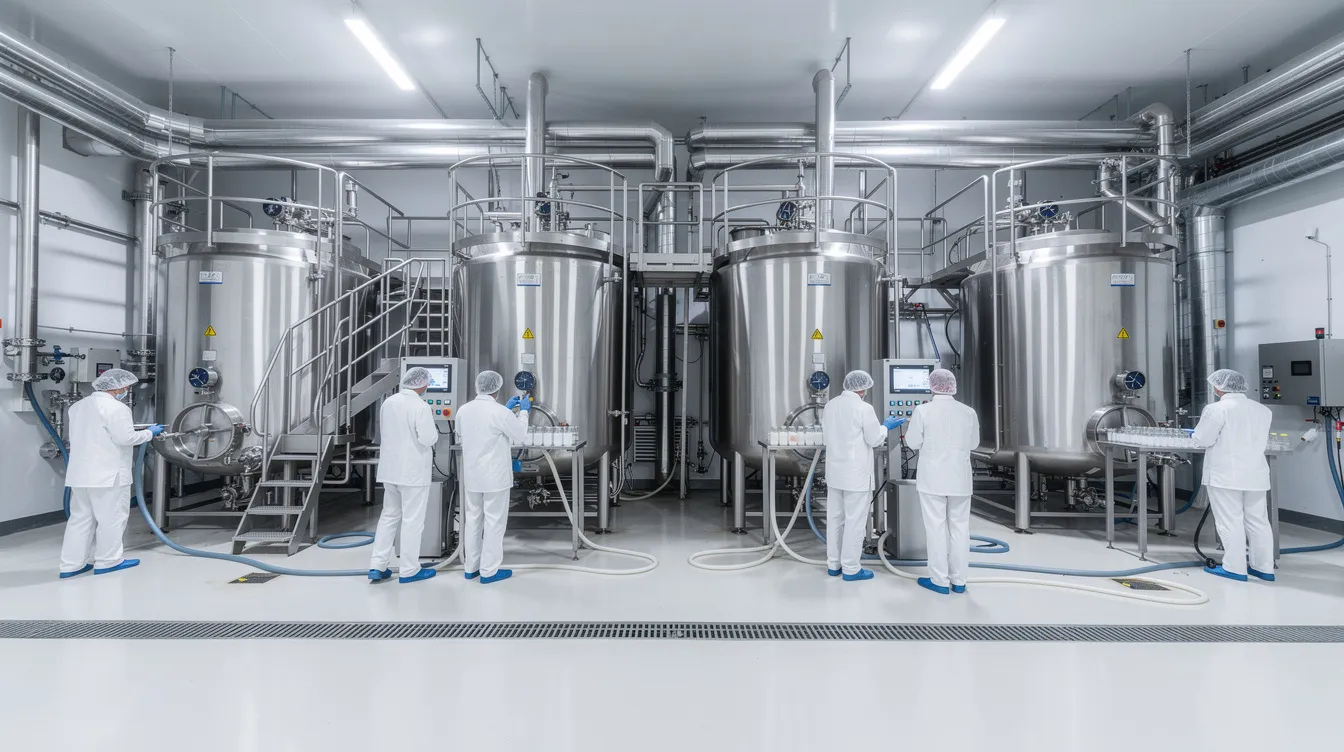
Term Loan for Fixed Assets – What Banks Usually Finance
A dairy processing plant term loan typically finances the following eligible fixed assets:
- Land development and factory building (RCC structures, insulated rooms, cold rooms)
- Plant and machinery – pasteuriser, cream separator, paneer press, curd incubation tanks, fermentation vessels, homogeniser
- Refrigeration systems and cold storage chambers
- Milk silos and reception equipment
- Utility systems – boiler, chiller, compressor, water treatment, ETP
- Packaging machinery and material handling equipment
- Laboratory and QC equipment
- Vehicles (where applicable under the scheme)
Banks assess the term loan amount based on eligible project cost, promoter margin, acceptable dairy plant debt equity ratio and the project’s repayment capacity – not merely on machinery quotations. Typical repayment structures for loans span from 5 to 10 years, often with a moratorium period during construction and trial production. Under NABARD-linked schemes, repayment periods for loans range from 3 to 7 years. The Animal Husbandry Infrastructure Development Fund (AHIDF) offers up to 90% financing with a moratorium of up to 2 years.
CA Manish Gugliya’s Practical Insight: Reverse-engineering a very high term loan with a low equity margin often weakens the DSCR and triggers bank queries or downsizing of the sanctioned loan amount. Balance your debt-equity structure carefully.
Working Capital Finance for Value-Added Dairy Products Plant
Value-added dairy businesses need substantial working capital because milk procurement happens daily, finished goods are perishable, cold storage inventory ties up funds, and distributors and modern trade customers often demand 15–30 days credit.
Main current assets requiring finance include:
- Raw milk stock and cultures/ingredients
- Packaging materials (cups, pouches, cartons)
- Finished goods held in cold rooms
- Trade receivables from distributors, institutional buyers and HoReCa customers
- Minimum cash and bank balances
Current liabilities – creditors for milk, packaging suppliers, utility payables – partially offset this requirement. The gap between current assets and current liabilities is what working capital limits aim to fund, typically through cash credit, working capital demand loan or bill discounting facilities.
A realistic working capital requirement for value-added dairy products plant assessment is mandatory in the dairy plant CMA Data for bank loan. For reference, a 5,000 LPD plant may need approximately ₹73 lakh per month as working capital. The Kisan Credit Card offers interest rates as low as 4% for dairy farmers, though eligibility requires land ownership or lease agreement.
Project Cost Assessment & Means of Finance for Dairy Plant Bank Loan
A comprehensive project cost for dairy plant project finance India must cover every capital component:
- Land, land development, internal roads and drainage
- Civil construction, plant and machinery, installation and commissioning
- Electrical systems, refrigeration, cold storage, boiler and steam systems
- Water treatment, ETP, laboratory, material handling
- Furniture, office equipment, vehicles
- Preliminary and pre-operative expenses, interest during construction
- Contingency provision and margin for working capital
Banks expect project cost figures supported by quotations, estimates and realistic implementation timelines. Over-inflated or under-stated figures damage the credibility of a dairy plant detailed project report for bank finance.
The means of finance typically includes promoter capital or equity, unsecured loans from promoters or directors (where appropriately structured), bank term loan, working capital limits, and eligible subsidy or incentive receivables. Banks typically require 10% to 25% of the total project cost as promoter margin – micro and small enterprises may qualify at the lower end under AHIDF.
Government schemes can provide subsidized loans and interest rates for dairy processing. The Dairy Entrepreneurship Development Scheme (DEDS), implemented in September 2010 by the government, provides a 25% capital subsidy for dairy projects. Eligible borrowers include farmers, NGOs, and cooperatives, with repayment tenures under DEDS ranging from 3 to 7 years. The scheme aims to enhance rural entrepreneurship in dairy and rural development. NABARD offers a 25% back-end capital subsidy for dairy projects and coordinates structured refinancing for rural processing units. The PMFME scheme provides a 35% credit-linked capital subsidy up to ₹10 lakh. AHIDF provides a 3% interest subvention on eligible dairy processing projects.
Subsidies should not be treated as upfront cash unless timing and conditions are clearly established. For a detailed breakdown, see the guide on value-added dairy plant project cost and means of finance.
How Banks Assess a Value-Added Dairy Products Plant Proposal
Banks evaluate dairy manufacturing project finance proposals through a multi-layered appraisal covering promoter credentials, technical viability, market potential, financial strength, security structure and statutory compliance. Banks evaluate technical feasibility and financial viability for loan approval before committing funds.
Promoter Background & Management Evaluation
- Experience in dairy processing, FMCG or related business activity
- Educational qualifications and management capability
- Existing business performance and net worth
- Banking track record and credit history (CIBIL score)
- Team strength, technical personnel and governance structure
Banks assess collateral and eligibility based on borrower category and project viability.
Technical Feasibility & Plant Configuration
- Installed capacity in litres per day and capacity utilisation ramp-up plan
- Choice of process lines – paneer, dahi, yogurt, lassi, probiotic products
- Plant layout and hygienic design
- Milk procurement strategy – tie-ups with milk unions, milk producer companies, dairy cooperatives and individual milk collection centres
- Utilities sizing, cold chain adequacy, machinery and equipment cost and food safety compliance
- Manufacturing process and production line configuration
Market Viability & Revenue Model
- Product mix and target segments (retail, modern trade, HoReCa, institutional bulk buyers)
- Pricing strategy, distribution network, dealer margins
- Competition analysis and product differentiation
- Milk sales channels and revenue model and market strategy
Product Mix Economics and Impact on Loan Appraisal
Different value-added dairy products have distinct economics that directly affect DSCR and dairy project loan repayment capacity:
- Paneer locks more fat and SNF per litre of milk, offering higher realisation (often ₹240/kg or more) but requiring heavy drainage and pressing equipment
- Set curd or dahi has different milk yield ratios and pricing dynamics; it serves as a high-volume base product stabilising cash flow
- Greek yogurt involves higher milk solids and premium pricing but shorter shelf life and stronger cold chain needs
- Probiotic dairy products may command higher margins but require stricter GMP, specialised cultures and greater marketing spend
- Lassi and flavoured milk have relatively simpler processing but face competitive pricing pressure
For product-specific financial analysis, see project reports on industrial paneer manufacturing, curd/dahi manufacturing, industrial yogurt, Greek yogurt, lassi and probiotic dairy products.
Banks prefer product-mix level analysis in dairy plant financial projections for bank loan rather than a single blended average realisation, because risk and margins differ between SKUs.
CA Manish Gugliya’s Practical Insight: In several cases I have reviewed, over-reliance on ultra-premium products without a stable base of mass products like curd or paneer made cash flows volatile and raised lender concerns about repayment capacity.
Financial Projections, Capacity Utilisation & Revenue Estimation
Financial projections typically cover a 5-year period (many lenders prefer 7–10 years for larger projects). The main schedules required include projected profit and loss, balance sheet, cash flow, fund flow, term loan amortisation, working capital assessment, break-even analysis and DSCR computation.
Capacity utilisation should follow a realistic ramp-up. An illustrative pattern:
| Year | Capacity Utilisation |
|---|---|
| Year 1 | 50% |
| Year 2 | 65% |
| Year 3 | 75% |
| Year 4 | 85% |
| Year 5+ | 90% |
Illustrative example only; actual figures will depend on the project and lender appraisal.
Revenue is estimated as Revenue = Sales Volume × Average Realisation, calculated product-wise and then consolidated:
| Product | Installed Capacity (MT/Year) | Utilisation (Year 3) | Production (MT) | Selling Price (₹/kg) | Revenue (₹ Lakhs) |
|---|---|---|---|---|---|
| Paneer | 600 | 75% | 450 | 260 | 1,170 |
| Curd | 1,200 | 75% | 900 | 60 | 540 |
| Yogurt | 400 | 75% | 300 | 140 | 420 |
Illustrative example only; these are not industry benchmarks.
CA Manish Gugliya prepares integrated financial models based on information and assumptions shared by the promoters. For detailed methodology, see value-added dairy plant financial projections for DPR.

Profitability, Break-Even, Working Capital Cycle & DSCR
Lenders closely examine profitability, break-even point, working capital cycle and DSCR before finalising dairy plant term loan assessment.
The break-even formula is: Break-Even Sales = Fixed Cost ÷ Contribution Margin Ratio. Real projects require detailed product-wise cost sheets covering contribution margin, EBITDA, PAT and cash accrual.
The working capital operating cycle for value-added dairy plants runs: Raw Milk → Processing → Cold Storage → Dispatch → Credit Sales → Collection → Cash. Each stage adds days to the cycle, directly increasing working capital needs. Bulk milk coolers and cold chain equipment affect both capital cost and operating cycle duration.
DSCR = Cash Available for Debt Service ÷ Total Debt Service (principal plus interest). A Debt Service Coverage Ratio of 1.25 or above is required by banks as a minimum average, while many lenders prefer the DSCR must exceed 1.5 for comfortable loan approval. Interest rates vary depending on the lender, loan amount, and credit profile.
| Year | Cash Accrual (₹ Lakhs) | Principal (₹ Lakhs) | Interest (₹ Lakhs) | DSCR |
|---|---|---|---|---|
| 1 | 95 | 50 | 38 | 1.08 |
| 2 | 140 | 65 | 34 | 1.41 |
| 3 | 185 | 75 | 28 | 1.80 |
| 4 | 210 | 85 | 22 | 1.96 |
| 5 | 225 | 90 | 16 | 2.12 |
Illustrative example only; actual figures will depend on the project and lender appraisal.
For deeper analysis, refer to resources on value-added dairy plant profitability and break-even analysis and DSCR and loan repayment capacity for value-added dairy project.
Security, Collateral, Documentation & CMA Data
Beyond project viability, banks examine the security structure, collateral comfort and documentation completeness.
Primary security typically includes first charge on all assets created from the term loan (plant, machinery, building, cold storage) and first charge on current assets for working capital limits. Collateral requirements for bank loans may include primary security over machinery and land, mortgage of additional immovable property, and personal or corporate guarantees. Collateral norms differ across lenders and must be confirmed with the respective bank. MUDRA loans require no collateral for Shishu and Kishore tiers. The maximum loan under MUDRA’s Tarun tier is ₹20 lakh, while MUDRA loans for dairy farms range from ₹50,001 to ₹5 lakh under lower tiers.
Key documents usually required:
- KYC documents – PAN, Aadhaar (applicants need Aadhaar and PAN for identity verification), voter ID, address proof
- Constitution documents – partnership deed, MOA/AOA, LLP agreement
- GST registration, Udyam registration
- Promoter net worth statement, income-tax returns, bank statements (KYC documents and bank statements are required for NBFC loans as well)
- Land documents and land records (land ownership is not required for all dairy farm loans – a lease agreement may suffice)
- Building estimates, machinery quotations, technical specifications
- Project implementation schedule, statutory approvals roadmap including FSSAI licensing and local authority approvals
- A Detailed Project Report is mandatory for loan applications
- CMA Data, financial projections, projected balance sheet, P&L, cash flow, fund flow, DSCR calculation, break-even analysis and working capital assessment
CMA Data covers existing and projected financials, working capital analysis and ratio analysis. CA Manish Gugliya assists in preparing CMA Data and projections based on promoter-provided information and assumptions – he does not certify the data or guarantee loan sanction.
Bank Loan Application Process & Role of a Professional DPR
The bank loan application process typically begins with defining the project components. A practical sequence:
- Finalise business activity, product mix and capacity planning
- Freeze project location and arrange land or lease agreement
- Obtain machinery quotations from equipment suppliers
- Estimate civil construction, utilities and cold storage and cold chain costs
- Compile project cost and determine means of finance
- Assess promoter contribution and required documents
- Prepare the bankable project report (DPR)
- Build financial projections, working capital assessment and DSCR
- Prepare CMA Data aligned with bank formats
- Compile all supporting documents
- Submit proposal to the lender
- Respond to appraisal queries
- Fulfil pre-disbursement and sanction conditions
A professionally structured value-added dairy plant DPR for bank loan integrates promoter profile, industry outlook, product mix, manufacturing process, layout, project cost, means of finance, market strategy, risk mitigation, financial projections, sensitivity analysis and DSCR – all in one document.
CA Manish Gugliya’s Practical Insight: Banks are far more comfortable when DPR numbers, quotations and assumptions reconcile perfectly with CMA Data and projected financial statements. Inconsistencies between the narrative report and Excel projections often trigger avoidable queries or delays.
Loan sanction remains the independent decision of the concerned bank or financial institution, based on its credit policy, risk appetite, security comfort and assessment of the borrower and project.
Common Issues in Dairy Plant Project Finance & How to Address Them
Common problems in dairy plant project report for term loan submissions:
- Unrealistic milk sales volumes: Revise based on achievable market demand and distribution capacity
- Over-optimistic selling prices: Support with market data and dealer price surveys
- Under-estimated milk procurement and cattle feed costs: Factor in seasonal price fluctuations and veterinary expenses
- Ignoring refrigerated logistics cost: Build cold chain operating costs into recurring expense projections
- Insufficient promoter contribution: Rebalance debt-equity to improve the dairy plant debt equity ratio
- Weak milk procurement plan: Establish tie-ups with dairy cooperatives, milk unions or farmer producer companies
- Under-stated working capital: Reassess receivable days, inventory holding and purchasing cows or cattle purchase credit needs
- Low DSCR: Revisit revenue assumptions and phase capacity addition instead of building excess capacity in Year 1
Conduct structured sensitivity analysis testing lower selling prices, higher milk procurement costs, reduced capacity utilisation, higher power tariffs and longer collection periods. CA Manish Gugliya routinely performs such sensitivity checks while preparing dairy plant financial projections for bank loan, helping dairy entrepreneurs pre-empt lender questions.
How CA Manish Gugliya & ProjectReportBank.com Support Dairy Plant Promoters
CA Manish Gugliya is a practising Chartered Accountant with extensive experience in preparing detailed project reports, CMA Data, financial projections and bank finance documentation for value-added dairy processing projects. His services cover:
- Preparation of dairy plant loan project report and bankable DPR
- Assessment of project cost and means of finance
- Integrated financial models covering profitability, break-even, cash flow and fund flow
- Working capital assessment and DSCR calculation
- Illustrative term loan repayment schedules and sensitivity analysis
- Structuring dairy plant CMA Data for bank loan aligned with lender formats
ProjectReportBank.com provides structured, lender-oriented DPRs specifically tailored for value-added dairy products manufacturing plants. If you are planning a dairy unit – whether a paneer plant, curd manufacturing facility, yogurt line or multi-product dairy farm expansion – and need assistance with bank finance DPR, projections, CMA Data or DSCR analysis, reach out through ProjectReportBank.com.
Final loan approval depends solely on the concerned bank or financial institution.
Frequently Asked Questions
Below are answers to common questions from promoters exploring dairy plant project finance.
Can I get a bank loan for a value-added dairy products plant if I am a first-time entrepreneur?
Banks do finance first-time dairy entrepreneurs if the project is viable, promoter contribution is adequate and a strong DPR with realistic projections is submitted. Lack of prior experience can be mitigated by engaging an experienced technical team, establishing milk procurement tie-ups or partnering with professionals who understand dairy processing. Individuals and farmers can apply for mini dairy loans under various schemes.
Is working capital financed separately from the term loan for a dairy processing plant?
In most cases, term loan and working capital are sanctioned as separate facilities under the same proposal – term loan for fixed assets and cash credit or similar limits for day-to-day operations. Sanction of each facility depends on bank appraisal, projected working capital cycle and security, and may be phased with project implementation.
What level of promoter contribution do banks usually expect in a value-added dairy project?
Banks generally expect 10% to 25% equity or margin contribution so that the dairy plant debt equity ratio stays within acceptable levels. Exact percentages vary across institutions and schemes. Under AHIDF, micro and small enterprises may qualify at approximately 10%, while larger enterprises may need 25% or more. Promoters should be prepared with documented own funds aligned with the bank’s credit policy.
Do I need a Detailed Project Report for a medium-scale paneer and curd plant loan?
For medium-to-large value-added dairy plants, banks almost always insist on a bankable DPR covering technical, commercial and financial aspects, along with CMA Data and projections. A well-prepared DPR reduces back-and-forth queries and helps the credit team evaluate viability, repayment capacity and risk. Under MSME loan frameworks and NABARD-linked agriculture schemes, the project report requirement applies across borrower categories.
Does CA Manish Gugliya guarantee bank loan approval for my dairy processing project?
CA Manish Gugliya does not and cannot guarantee bank loan approval. Sanction remains entirely the decision of the respective bank or financial institution based on its own appraisal, credit guarantee framework and policies. His role is to assist promoters in preparing robust DPRs, financial projections, CMA Data and documentation so the proposal is professionally presented and aligned with banking expectations.