Key Takeaways
- CMA Data for a Mudra Loan needs clear business details, project cost, means of finance, sales and expense assumptions, working capital cycle information and existing loan details. CMA data includes historical and projected financial performance, and CMA data helps lenders evaluate financial health and risk.
- The information required for cma data preparation is not the same as the full bank loan documentation checklist. Some inputs overlap, but each serves a different purpose.
- Requirements differ significantly for new and existing businesses. Preparing credit monitoring arrangement data requires historical performance and future projections – a new unit may lack the former entirely.
- Organized records such as past financial statements, bank statements, GST returns and income tax returns (where available) make cma data preparation faster and more accurate.
- A chartered accountant typically prepares or assists in preparing CMA Data based on information and assumptions provided by the entrepreneur. Projected figures represent estimates, not guaranteed outcomes.
Quick Checklist: Information Required for CMA Data for Mudra Loan
Before cma data preparation begins, it helps to organize your inputs into clear categories. CMA data includes financial statements and projected financials, but the raw inputs come from you – the business owner. Here is a practical, at-a-glance checklist.
| Information Category | Examples / What to Keep Ready |
|---|---|
| Business details | Business name, legal constitution, address, nature of activity (manufacturing/trading/service) |
| Promoter details | Background, industry experience, proposed role, capital contribution |
| Loan requirement | Loan amount, purpose (term loan vs working capital), proposed tenure |
| Project cost | Machinery, furniture, setup costs, renovation, deposits |
| Means of finance | Own funds, proposed bank loan, other sources (subsidy, family funds) |
| Historical financials | Past balance sheet and profit & loss accounts (last 2–3 years if available) |
| Sales information | Current turnover or realistic sales projections with calculation basis |
| Expense information | Raw materials, salaries, rent, utilities, overheads, margins |
| Working capital | Inventory holding, debtor days, creditor days, operating cycle |
| Existing borrowings | Current bank loans, EMIs, outstanding balances, existing credit limits |
| Supporting records | Bank statements, GST returns, ITRs, quotations where applicable |
Not every business will have every item. A new startup will not have audited financial statements or GST returns, and that is perfectly normal.
Basic Business Information Required
In my experience, the first thing I need before opening any CMA Excel sheet is a clear understanding of what the business actually does. Without that, financial projections become guesswork.
Here is the business information generally required:
- Legal constitution – proprietorship, partnership, LLP or private limited company
- Business name as per registration documents
- Full business address and city
- Nature of activity – manufacturing, trading or service
- Detailed product or service description (for example, “readymade garments retail” is far more useful than just “business”)
- Whether the proposal is for a new unit or an existing one
- Date of commencement or expected start date
- Installed or proposed capacity (for manufacturing units, this might be units per month or per day)
- Key customer or market segment details where they materially influence sales projections
A clear business description prevents unrealistic assumptions. For instance, a service business typically has much lower inventory than a trading business – and their working capital structures differ accordingly. For a deeper discussion, see how to prepare a business profile for a Mudra Loan project report.
Table of Contents
Promoter Information Required
Banks and financial institutions assess both the project and the person behind it. Promoter details help contextualize the financial data in a credit proposal.
- Full name of each promoter
- Age and educational background
- Relevant technical or professional qualifications
- Prior experience in the same or a related industry
- Existing businesses, if any, with basic turnover indication
- Proposed role and time commitment in the enterprise
- Proposed capital contribution or margin money
This information supports the business proposal but does not replace proper financial projections. For guidance on structuring this section, refer to the guide on promoter profile in a Mudra Loan project report.
Loan Requirement and Purpose of Finance
CMA Data cannot be built around a single round number. Simply saying “I need ₹10 lakh” tells me nothing about what will be done with the money. CMA data is essential for working capital and term loans, and the break-up matters.
- Total finance required from the bank
- Separate indication of term loan requirement (machinery, furniture, renovation, vehicles)
- Separate indication of working capital requirement – cash credit or overdraft for day-to-day operations
- Whether the loan is for new setup, expansion, modernization or working capital enhancement
- Expected tenure and basic repayment structure for any term loan
- Applicable Mudra category – Shishu, Kishore or Tarun – where relevant
CMA data is essential for loan application approval because the requested loan amount should logically align with project cost, promoter margin and projected cash flows. Lenders use CMA data to assess repayment capability, so everything must connect.
Project Cost Information Required
Project cost in CMA Data means total investment in the business up to the point it is ready to operate. Typical cost heads include:
- Plant and machinery (item-wise approximate totals)
- Tools and equipment
- Furniture and fixtures
- Computers and office equipment
- Vehicles used primarily for business
- Electrical installation and wiring
- Civil work, interiors or renovation
- Pre-operative expenses (registration, consultancy, trial runs, initial deposits)
- Initial margin for working capital if included in the project cost format
Only genuine, business-related components should be included. Avoid double-counting – for example, taking full annual rent as both project cost and operating expense inflates the proposal without substance. For detailed guidance, see how to present project cost in a Mudra Loan project report.

Machinery and Equipment Details
For manufacturing or processing units, machinery details directly influence both project cost and achievable sales. They are indispensable inputs for preparing CMA Data.
- Item-wise description of each major machine
- Quantity required
- Basic technical specifications affecting capacity (for example, “20 kg/hr pulveriser”)
- Unit price and total price
- Applicable GST and other taxes
- Packing, transport, installation and commissioning charges
- Expected production capacity at full load
- Annual maintenance cost if significant
CMA reports require quotations for machinery or capital assets being purchased. While formal quotations are not always mandatory for CMA preparation, they are very helpful as supporting evidence. See the detailed guide on machinery and equipment details for a Mudra Loan project report.
Means of Finance and Promoter Contribution
A fundamental rule: total project cost must equal total means of finance. If these do not balance, CMA Data will not stand.
- Promoter’s own capital or contribution (cash, capital introduced, or unsecured loans from promoters treated as quasi-equity)
- Term loan requested from the bank
- Working capital limits requested (cash credit, overdraft)
- Other sources such as subsidies, soft loans or contributions from family where actually proposed
- Existing assets being brought into the business, with their values
Promoter contribution percentage must be clearly decided before projections are finalized – many small business loans expect 20–25% of project cost as margin, subject to bank policy. For more, see means of finance in a Mudra Loan project report.
Historical Financial Information for an Existing Business
For an existing unit seeking expansion or additional working capital, past financial performance provides the base for realistic future projections. CMA structures typically include historical profit and loss, balance sheets, and working capital details.
- Last available balance sheets and profit & loss accounts – CMA reports typically require financial statements for the past 2 to 3 years
- Turnover, gross profit and net profit for each year
- Major expense heads: purchases, salaries, rent, power, administrative costs
- Depreciation and interest as per audited financial statements
- Year-end balances of trade receivables, trade payables and inventories
- Capital and drawings or current account adjustments
- Existing term loans and working capital limits as reflected in the balance sheet
- Any major one-time items that should be adjusted while projecting future years
CMA reports require performance estimates for the current financial year up to the application date. CMA data includes analysis of a balance sheet including assets and liabilities breakdown for each historical year.
Not every Mudra applicant will have audited financial statements. Very small or recently started businesses may use internally prepared statements or provisional figures with proper clarity.
Bank Statements, GST Returns and Income Tax Information
There is an important distinction between financial figures used in CMA Data and supporting records that help cross-check or derive those figures. Bank statements, GST data and income tax returns fall primarily in the second category – they are source evidence, not CMA statements themselves. That said, actual document requirements depend on each lender’s credit analysis process.
Bank Statements
- Six to twelve months of statements for the main business current account help analyse monthly turnover, cash deposits, cheque receipts and regular expenses
- These statements assist in estimating realistic cash flows and spotting seasonal patterns
- Existing loan EMI payments visible in bank statements help reconcile debt obligations
- Statements should ideally be downloaded directly from the bank (PDF or passbook printouts) to avoid transcription errors
GST Information
- Where GST-registered, GSTR-1 and GSTR-3B summaries for the last 4–8 quarters help reconcile turnover and purchase figures used in CMA Data
- GST data also indicates whether the business is primarily B2B or B2C and shows monthly or quarterly sales trends
- If the business is below the GST threshold or deals in fully exempt supplies, GST returns will naturally not be available
Income Tax Information
- For proprietors and partnership firms, recent income tax returns (ITR-3, ITR-4) and computation statements support declared profits and drawings used in CMA Data
- Company ITRs with audited financials provide a ready base for historical data and help resolve differences between books and CMA figures
- Absence of ITRs for a brand-new business is expected, but for an existing business, non-filing may affect how lenders view the borrower’s financial stability
Sales and Revenue Information Required
Most Mudra Loan CMA discussions come down to one question: “How will sales grow, and how have you calculated these numbers?” The operating statement projects sales and profits for 3-5 years, and every projection needs a calculation basis.
- Manufacturing: production quantity × average selling price = sales. Capacity utilisation assumptions matter – for example, 50% in Year 1, 70% in Year 2
- Trading: expected purchase volume, selling price, gross profit margin and stock turnover frequency
- Services: expected number of clients or assignments per month × average billing rate
Cover both existing turnover (supported by past accounts, GST and bank data) and projected turnover for each year. Capture seasonality where it exists. Explain growth through planned marketing or customer acquisition, not just an arbitrary figure that supports a desired EMI.
Projections should never be reverse-calculated to match a loan amount. They should flow from business capacity and realistic assumptions. For structuring guidance, see sales and revenue projections for a Mudra Loan project report.
Expense and Profitability Information Required
Profit projections depend on both sales and carefully estimated operating costs. Ignoring expenses to show inflated net profit margin weakens the proposal. Key cost groups include:
- Raw materials and purchase cost (with typical gross profit assumptions)
- Direct labour and wages
- Salaries of administrative and sales staff
- Rent and lease charges
- Electricity and fuel
- Repairs, maintenance, transport and delivery
- Marketing and selling expenses
- Insurance, telephone, office expenses and professional fees
- Statutory levies directly impacting cost
Non-cash expenses like depreciation (linked to project cost and asset life) and finance cost (interest on term loan and working capital) should be separate line items. Variable expenses must rise with increased turnover – a bank reviewing credit proposals will immediately notice if net operating income grows by 40% while raw material cost stays flat without explanation.
Working Capital Information Required
Working capital is the funds locked in stock, receivables and daily operating expenses, minus credit available from suppliers. CMA reports assess working capital needs using detailed analysis of assets and liabilities, and the inputs must come from the business owner.
- Typical stock holding period for raw materials, work-in-progress and finished goods (in days)
- Credit period allowed to customers (average debtor days)
- Credit period received from suppliers (creditor days)
- Expected level of cash and bank balance for smooth operations
- Monthly fixed expenses to keep the business running
- Seasonal bulges requiring additional borrower’s working capital
CMA reports require details of current assets and current liabilities for working capital assessment. CMA reports include calculations of maximum permissible bank finance (MPBF), and MPBF calculation determines maximum bank finance for borrowers. The maximum permissible bank finance is crucial for loan approval as it sets the ceiling for working capital limits from the bank.
These assumptions feed into year-wise current assets and current liabilities computation. For detailed treatment, see working capital requirement in a Mudra Loan project report.
Existing Loan and Liability Details
Banks look at total repayment obligations – not just the new Mudra Loan EMI. CMA reports require a summary of existing debt and credit facilities, and the CMA report must include current and proposed credit limits.
- Existing term loans from any bank or NBFC: sanction amount, present outstanding, EMI, rate of interest, tenure remaining
- Existing working capital facilities: sanctioned and utilized limits for cash credit or overdraft
- Other business loans: machinery finance, vehicle loans used for deliveries
- Personal loans of promoters where EMI is being serviced from business income
Credit card dues or informal borrowings that materially affect cash flow should also be disclosed. The debt service coverage ratio is essential for assessing repayment capacity in CMA Data, and accurate existing loan data is necessary for proper total debt service and overall cash-flow analysis.
Information Required for a New Business vs Existing Business
First-time applicants often feel stuck because they lack past financial statements. The information expectations genuinely differ:
| Information | New/Proposed Business | Existing Business |
|---|---|---|
| Historical financial statements | Usually not available | Normally required if available |
| Past turnover | Not available | Important base for projections |
| GST and ITR data | May not exist initially | Usually available and useful |
| Project cost | Central to the proposal | Important for expansion |
| Machinery quotations | Important where applicable | Important where applicable |
| Working capital assumptions | Based on operating model estimates | Can be supported by historical cycles |
| Existing loans | Include if any exist | Must be detailed accurately |
For a new business, CMA Data relies more on quotations, expected capacity, market understanding and realistic cost estimates. For an existing business, future projections must be consistent with past financial performance unless there is a documented reason for change.
Information Needed to Prepare Projected Financial Statements
All earlier inputs ultimately flow into structured projected financial statements in CMA Data. A CMA report includes seven key financial statements, covering historical and projected years. The logical flow is:
Business assumptions → sales projections → cost and expense estimates → gross profit → operating profit → interest and depreciation → net profit → working capital requirement → fund flow → projected balance sheet
For each projection year, the following need to be computed: projected turnover, gross profit, net profit, capital balance, term loan outstanding, current assets and current liabilities, and key financial ratios. CMA data preparation includes a fund flow statement and ratio analysis. The fund flow statement tracks money inflows and outflows across years. Ratio analysis includes liquidity ratios, profitability ratios, leverage ratios, solvency ratios, interest coverage ratio and debt equity ratio. CMA reports include key financial metrics and ratios for assessment, and CMA reports require calculation of key financial ratios for evaluating repayment capability.
A comprehensive CMA offers a clear view of historical financial performance and future viability. These statements must be internally consistent – closing term loan balance in one year must match opening balance of the next. Balance sheet analysis, capital employed figures and cash flow statement projections cannot be prepared independently without underlying assumptions.
Difference Between CMA Data Information and Project Report Information
Many entrepreneurs treat CMA Data and a project report as the same document. In practice, a detailed project report typically covers business description, market overview, technical details, promoter background and risk analysis – broader narrative sections. A cma report concentrates on structured financial data: historical results, projected financials, working capital assessment and financial analysis.
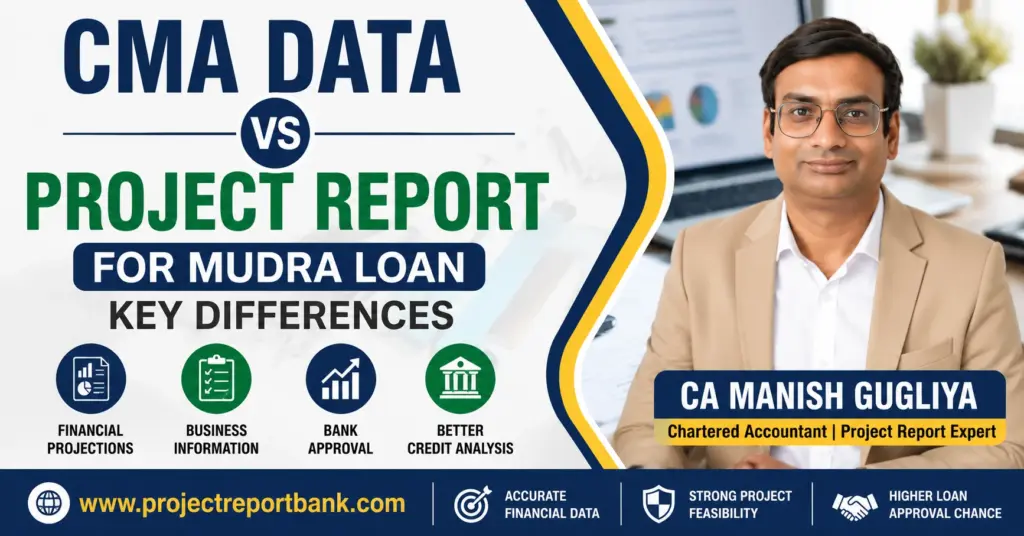
Much of the underlying information – sales assumptions, cost estimates, project cost, means of finance – overlaps between both documents, but the presentation format and level of financial detail differ. For a detailed comparison, see CMA Data vs project report for a Mudra Loan.
Is CMA Data Always Required for a Mudra Loan?
While many banks prefer structured financial information for approving loans – especially as the loan amount increases – some lenders may not demand full-format CMA Data for every small ticket. Banks require CMA data for loans above ₹5 crore as a general norm, but many lenders apply similar expectations to smaller business loans under their internal credit policy. CMA data must be submitted annually during loan renewals as well.
Requirements vary by lender, branch, loan category and the nature of the business. Even if formal CMA is not insisted upon, the underlying information discussed in this article remains useful for any structured loan application. For a detailed discussion, see whether CMA Data is required for a Mudra Loan.
Who Can Prepare CMA Data?
While entrepreneurs can organise their basic financial data themselves, converting it into a bank-compliant CMA format requires understanding of accounting, financial projections and banking norms. Chartered accountants or finance professionals can assist in preparing CMA Data and projections based on information and assumptions provided by management.
Projected CMA Data is not “certified” the way audited historical accounts are. It represents estimates and future projections – not guaranteed outcomes. The professional’s role is to ensure structure, internal consistency and reasonable linkage between assumptions and projected numbers. For more, see who can prepare CMA Data for a Mudra Loan.
Common Information Gaps That Delay CMA Data Preparation
In my practice, delays rarely happen because of the CMA format itself. They happen because of missing or unclear inputs. Preparation of CMA data typically takes 5-8 working days when information is organized; it takes much longer when it isn’t.
Common gaps I encounter:
- Borrower knows the loan amount but not the detailed project cost
- Machinery list or quotations are missing entirely
- Promoter contribution percentage is undecided
- Sales projections are given as lump sums without any capacity or pricing basis
- Major expense heads are missing or unrealistically low
- Existing loans and EMIs are not fully disclosed
- Debtor and creditor days are unknown
- Past financial statements do not reconcile with GST or ITR figures
- Bank statement turnover is very different from claimed sales without explanation
Resolution is usually straightforward: obtain quotations, prepare a simple monthly sales and expense working, list all existing borrowings with EMIs, and reconcile any discrepancies before sending information to your CA.
Practical Checklist Before Sending Information to Your CA or CMA Preparer
Use this as a ready-reference checklist before you approach a professional to prepare cma data for your Mudra Loan.
- Business: profile write-up, nature of activity, products or services, business address, basic market description
- Investment: item-wise project cost list, machinery and equipment details, quotations where available, renovation or interior cost, security deposits
- Finance: required bank loan (term and working capital split), promoter’s own contribution, any other funding sources, existing loans list with EMIs and outstanding balances
- Historical Financial Information: last 2–3 years’ financial statements (if available), latest provisional accounts, 6–12 months’ bank statements, recent GST returns, recent income tax returns
- Projections: expected monthly or yearly sales, selling prices, capacity utilisation, purchase or raw material cost percentage, salary structure, rent and utilities, marketing and other overheads
- Working Capital: expected stock holding period, customer credit period, supplier credit period, minimum cash balance requirement, seasonal variation details
Providing information in an organized manner reduces back-and-forth queries and significantly speeds up finalization. An accurate cma report starts with accurate inputs.

Frequently Asked Questions
These FAQs address common doubts that remain after reading the main article, focusing on practical information-related queries. Answers reflect general practice – specific bank requirements may vary.
What minimum information do I need if I am starting a brand-new business with no past financials?
For a new unit, the key inputs are: a detailed business profile, project cost with machinery quotation details, means of finance including promoter contribution, realistic sales and expense assumptions based on capacity, working capital cycle assumptions, and any existing personal loans that will affect cash flow. Audited past financial statements, GST returns and ITRs are naturally not available for a new business. Banks typically rely more on project viability, the borrower’s ability to execute and promoter profile in such cases.
Can CMA Data be prepared if my last year financial statements are not audited yet?
CMA Data can often be prepared using provisional accounts for the recent year, supported by internal records, bank statements and GST filings. However, if there are significant differences once audit is completed, updated figures should be provided. Acceptance of provisional data depends on the lender’s internal policy and the loan amount involved. CMA reports require audited financial statements for the last two years as a general norm, but practical flexibility exists for smaller proposals.
Do I need to give personal household expenses or only business expenses for CMA Data?
CMA Data focuses on business financials. However, for proprietors and partners, approximate drawings or household requirements are relevant because they directly impact available surplus for loan repayment and affect the company’s ability to service debt obligations. A detailed personal expense breakup is usually not needed, but realistic drawings figures should be included in future financials.
Are quotations for every item mandatory, or can I use approximate costs in project cost?
Formal quotations are especially useful for major machinery and significant fixed assets – they strengthen your credit proposals and support project cost estimates during the loan evaluation process. Smaller items like furniture or minor fittings may be reasonably estimated. Some banks may insist on quotations above a threshold amount, so it is safer to collect key quotations before finalizing. Accurate CMA data improves chances of loan approval.
Can I change my assumptions after CMA Data has been prepared once?
Assumptions can be revised if there is a genuine change – a different machine, updated selling price, revised rent. But frequent ad-hoc changes just to fit a particular EMI or to improve loan approval chances without business justification can reduce credibility. Any revision should keep all projected financial statements internally consistent and be clearly communicated to the CA or preparer. Seek professional advice before making material changes to financial projections.
About CA Manish Gugliya
CA Manish Gugliya is a practising Chartered Accountant with hands-on experience in preparing project reports, CMA Data, financial projections and MSME finance documentation for small and medium businesses. Through ProjectReportBank.com, the objective is to help entrepreneurs understand the financial data, assumptions and documentation involved in preparing business project reports and CMA Data – so that discussions with bankers become more structured and transparent.
The guidance in this article is general in nature. Specific bank requirements or formats may vary. Borrowers should confirm exact documentation needs with their lending institution before finalizing loan applications.
Conclusion
Quality CMA Data for a Mudra Loan starts with accurate, complete and consistent information about the business, project cost, means of finance, sales and expense assumptions, working capital and existing borrowings. Preparing CMA data requires historical records, current estimates, and future projections – and the quality of output depends directly on the quality of inputs.
- The information required for CMA Data preparation is wider than just past financial statements – it spans business details, investment plans, revenue assumptions and the full working capital cycle
- New and existing businesses face different information challenges, but both need internally consistent financial projections
- Projections must be grounded in realistic assumptions about capacity, pricing and costs rather than being reverse-designed to support a fixed loan amount
- Organized documentation significantly reduces delays during the company’s financial health assessment and credit analysis by the bank
If you are exploring this topic for the first time, start with the beginner guide to CMA Data for Mudra Loan for foundational concepts.
CMA Data should present a financially coherent, explainable story of how the business will use funds and repay the bank – not just numbers inserted to satisfy a format.
- CMA Data for Mudra Loan: Complete Guide


- CMA Data for Mudra Loan Online – Can It Really Be Prepared from Anywhere?

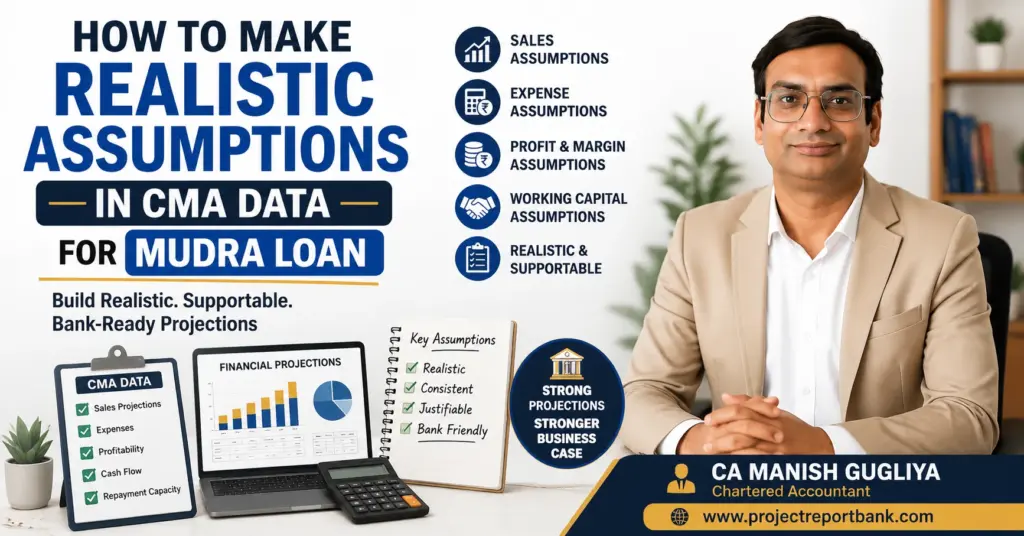
- How to Make Realistic Assumptions in CMA Data for Mudra Loan
- How Banks Analyse CMA Data for Mudra Loan Applications

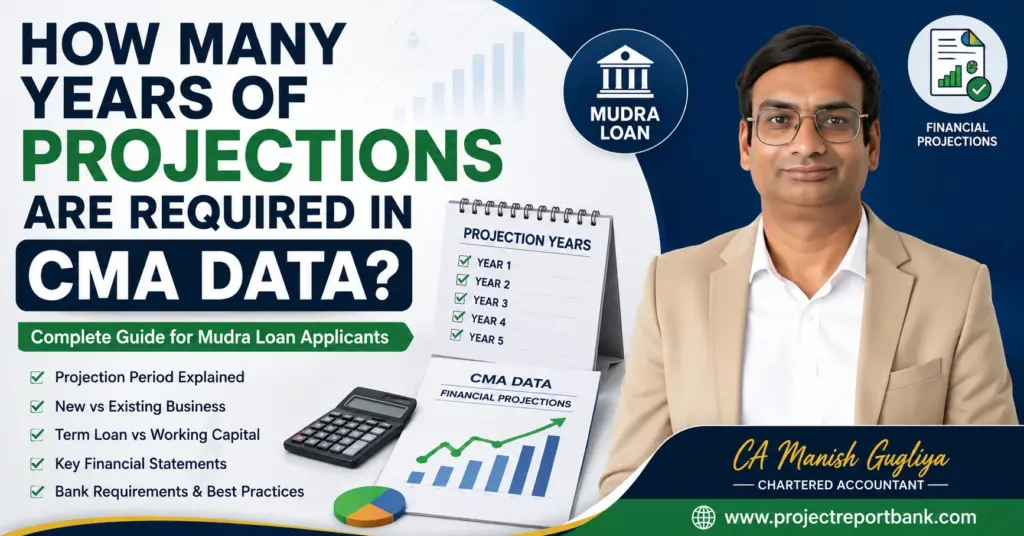
- How Many Years of Projections Are Required in CMA Data?
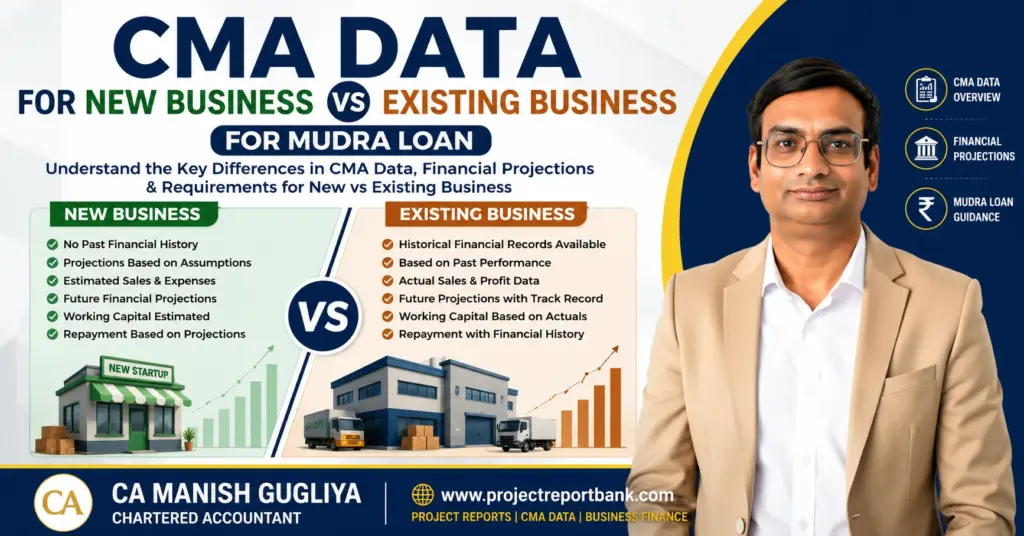
- CMA Data for New Business vs Existing Business for Mudra Loan
- Information Required for CMA Data for Mudra Loan – Practical Guide by CA Manish Gugliya

- Who Can Prepare CMA Data for Mudra Loan? Is a CA Required?

- CMA Data vs Project Report for Mudra Loan: Key Differences