When you search online for a Mudra Loan, you will find Government websites, bank websites, loan marketplaces, private financial portals, agents, and MSME registration sites – all claiming to help. This confusion is real, and I see it every day in my practice. Most applicants waste time on the wrong website, or worse, share personal data with an unofficial portal that has nothing to do with the Government.
The truth is straightforward. Several government portals for mudra loan applicants exist, but each one performs a different function. One gives scheme information. Another handles MSME registration. A third facilitates online loan applications. And the final credit decision always rests with the concerned bank or financial institution – not the portal.
Let me walk you through every genuine portal, what it actually does, and what it cannot do.
Key Takeaways
- There is no single Mudra Loan Government Portal that handles everything from registration to disbursement. Different official portals cover information, MSME registration, and loan application separately.
- The jansamarth portal is the primary Government platform where eligible borrowers can check schemes, compare lenders, and in many cases apply online for Mudra or PMMY-related credit – but final approval rests with the bank or financial institution.
- Udyam Registration gives your enterprise a formal MSME identity. It does not itself sanction or guarantee a Mudra Loan.
- Official MUDRA/PMMY pages and other MSME portals are genuine sources for scheme details and participating lender lists – they are mainly information portals.
- Successful Mudra Loan approval still depends on eligibility criteria, proper documents, realistic project details, and the lending institution’s own credit appraisal, even if the application is started online.
Table of Contents
Quick Answer: Which Government Portals Help with Mudra Loans?
Below is a fast summary of the genuine government portals for mudra loan applicants. Bookmark these and ignore look-alike sites.
| Portal | Main Purpose | How It Helps Mudra Applicants |
|---|---|---|
| JanSamarth (jansamarth.in) | Credit-linked Government schemes | Applicants can check eligibility and apply online for PMMY and other supported credit schemes |
| Udyam Registration (udyamregistration.gov.in) | MSME registration | Provides formal MSME identity that supports documentation for bank finance |
| Udyamimitra Portal | Connects entrepreneurs with lenders | Connects micro-entrepreneurs with lenders for PMMY loans |
| PMMY/MUDRA Official Resources (financialservices.gov.in) | Scheme information | Explains PMMY categories, loan limits, and lists participating lenders |
| MyScheme Platform | Government scheme discovery | Helps check eligibility for MUDRA loans and other schemes |
| Other MSME portals | Business support services | Supporting registrations and information, not direct Mudra sanction |
The official portals for PMMY application include Udyamimitra and JanSamarth.
Applying through any Government portal never guarantees loan approval. The bank or financial institution makes the final decision after its own credit assessment.
What Is a Government Mudra Loan Portal?
When people search for “Mudra Loan Government Portal” or “Mudra Loan Official Website,” they usually expect one website where they can register, apply, get approved, and receive money – all in one place. That single portal does not exist.
Instead, the process works through a chain of separate platforms:
- Information portal – gives scheme details only (e.g., PMMY page on financialservices.gov.in)
- MSME registration portal – gives your business an MSME identity (Udyam Registration)
- Loan application portal – captures your application and routes it to a lender (JanSamarth)
- Bank or financial institution website – where the lender processes, appraises, and decides on your loan
Here is a simple example. A shopkeeper reads about PMMY on the official Government website, completes MSME registration on Udyam, then fills an online application through JanSamarth selecting a preferred bank. The bank branch calls him for document verification and a site visit. Only after internal assessment does the bank sanction and disburse the loan.
The Pradhan Mantri Mudra Yojana (PMMY) is not a direct lending program. MUDRA connects applicants with hundreds of lenders through government-backed portals. Government portals guide, collect data, and route – but only the concerned lending institution can sanction and disburse.

JanSamarth Portal and Mudra Loan
JanSamarth is the Government of India’s National Portal for Credit-Linked Government Schemes, launched in June 2022 by the Department of Financial Services. It brings multiple subsidy- and credit-linked central schemes under one digital front-end, including PMMY (Mudra Loans).
Key features relevant to Mudra applicants:
- Around 15 credit-linked central schemes available, including PMMY and Weaver Mudra
- Approximately 250+ partner lenders across public sector banks, private banks, NBFCs, RRBs, and small finance banks
- Digital integrations with UIDAI (Aadhaar), CBDT (Income Tax), NSDL (PAN), credit bureaus, Udyam, and GST – enabling automatic data verification
- Available in 8+ languages
Applicants can apply online through the JanSamarth portal. The JanSamarth portal allows users to check eligibility for PMMY loans using basic inputs like Aadhaar, PAN, and business activity.
Basic applicant journey:
- Sign up and login using Aadhaar OTP
- Choose business or MSME loan category
- Answer eligibility questions – system suggests matching schemes
- Fill the application form (much data is pre-populated from linked databases)
- Upload KYC and business documents
- Select your preferred bank or financial institution from the partner list
- Submit application
What happens after submission: The application is routed to the chosen lender. The bank branch may contact the applicant. Documents, business details, and credit history are verified. Then the lender takes a decision based on its own internal guidelines and risk norms.
Online application or “in-principle digital approval” on the portal does not automatically mean final sanction. The bank may still decline, modify the offer, or request additional documents after detailed assessment.
Udyam Registration Portal and Mudra Loan
The Udyam Portal is the official Government website for MSME registration. It is free, paperless, and based on Aadhaar and PAN. No documents need to be uploaded initially – details are pulled from linked Government databases.
Who should consider Udyam Registration?
Micro and small businesses in manufacturing, trading, and services – including shopkeepers, small manufacturers, repair services, food businesses, and similar micro enterprises engaged in non-farm activities.
Udyam Registration provides a formal MSME identity and a certificate with a dynamic QR code. This can support applications for Government schemes, bank finance, and other benefits.
Udyam Registration is not a Mudra Loan approval. It establishes your enterprise classification. The loan decision is made separately by the lending institution after testing repayment capacity, business viability, and credit history.
Many banks prefer or sometimes require Udyam details while assessing MSME finance. So completing Udyam can make your documentation stronger when applying directly at a bank or through JanSamarth.
Official MUDRA and PMMY Information Sources
The PMMY scheme page on financialservices.gov.in is the authoritative Government source for scheme details. Here you can find:
- Overview of PMMY and its purpose – financial assistance for non corporate small/micro enterprises
- Loan categories: Shishu loans (upto rs 50,000), Kishore (Rs 50,001 to Rs 5 lakhs), Tarun (Rs 5,00,001 to Rs 10 lakhs), and Tarun Plus (Rs 10,00,001 to Rs 20,00,000 for those who have successfully repaid previous loans)
- The scheme was launched on April 8, 2015
- Mudra loans are available for non-corporate small businesses, and MUDRA loans support non-corporate small/micro enterprises
- PMMY is intended for Indian citizens wanting loans for eligible non-farm micro-enterprises
- No collateral is required for loans up to Rs 10 lakh
- Broad list of participating banks and financial institutions (commercial banks, NBFCs, MFIs, RRBs, SFBs)
- PMMY loans are distributed through various financial institutions including banks and NBFCs
- As of February 2025: over 52.07 crore accounts sanctioned and approximately ₹32.40 lakh crore disbursed
MUDRA itself acts as a development and refinancing institution. It does not directly sanction individual loans in most cases. The actual loan extended to the borrower comes from the Member Lending Institution – the bank, NBFC, or MFI.
These official pages usually do not accept direct individual Mudra Loan applications. They direct applicants to banks, NBFCs, MFIs, or recognised channels like JanSamarth. Checking scheme details from these pages helps avoid confusion created by unofficial or commercial websites claiming fake “Mudra Loan registration online.”
Other MSME Government Portals That May Indirectly Help
Several other Government websites indirectly support a Mudra Loan application:
- Udyamimitra Portal – The Udyamimitra Portal connects micro-entrepreneurs with lenders for PMMY loans. It serves as a reference point for finding nearby lending institutions and handshake services.
- MyScheme Platform – The MyScheme platform helps to check eligibility for MUDRA loans and other central Government schemes based on your profile. Useful for scheme discovery.
- MSME Ministry Information Sites – Provide updated guidelines, scheme booklets, grievance portals, and entrepreneurship support resources.
- State Single-Window Systems – Help with state-level business registrations and licences that some banks may ask for during documentation.
These portals are not Mudra Loan online portals. They do not provide a guarantee of finance merely because your business is registered or listed there.
Government Portal vs Bank Website – What Is the Difference?
Many applicants confuse Government portals with the actual lender’s website. This leads to wrong expectations about approval and timelines.
| Point | Government Portal | Bank/Lender Website |
|---|---|---|
| Main purpose | Scheme/registration/application support | Lending and banking services |
| Business registration | Available on relevant portals (Udyam) | Generally no |
| Scheme information | Yes, official and updated | May provide lender-specific information |
| Loan application | Depends on portal (JanSamarth: yes) | Often available |
| Credit appraisal | No – facilitation only | Yes – full assessment |
| Final sanction | Generally no | Concerned lender decides |
| Disbursement | No | Concerned lender transfers funds |
Whether you apply through JanSamarth to a public sector bank or apply directly on the same bank’s website, the final approval steps remain within the bank. The portal simply makes the entry easier.
Can You Apply for Mudra Loan Completely Online?
The application process for PMMY can be initiated online or through lending institutions. Many steps – eligibility check, application form, document upload – can happen online through JanSamarth or a bank’s own digital platform. For example, Bank of Baroda offers a Digital Mudra Loan with online sanction for amounts upto rs 50,000.
However, in most cases some offline interaction is still needed:
- Physical verification of original documents
- Signing of loan agreement
- Possible visit to business premises
- Completion of KYC norms as per bank rules
The exact mix of online and offline steps varies across banks and financial institutions. Rules may differ for small ticket shishu loans (where digital-only processing is more common) versus larger Tarun category loans where branch-level involvement is typical.

What Happens After You Apply Through a Government Portal?
Do not assume that portal submission equals sanction. Here is the typical journey:
- Portal application submitted – You receive a reference number
- Mapping to chosen bank – Application routed to the selected lender
- Preliminary screening – Bank checks basic eligibility and data consistency
- Document request – Lender asks for additional papers or clarifications; keep your phone active
- Credit assessment – Bank reviews CIBIL, business viability, turnover, existing liabilities
- Decision – Sanction, rejection, or modified offer communicated
- Documentation – Loan agreement, terms acceptance
- Disbursement – Funds transferred to borrower account
Timelines vary based on bank workload, completeness of documents, loan amount, and internal approval levels. Follow up politely instead of re-applying on multiple portals simultaneously.
Does Applying Through a Government Portal Guarantee Mudra Loan Approval?
No. Applying through any Government portal gives you a formal and often easier way to submit your case. It does not guarantee approval.
A bank still checks:
- Nature and viability of the proposed activity
- Realistic project cost and funding requirement
- Repayment capacity and satisfactory credit track record
- Existing liabilities and whether the applicant is a defaulter
- Whether the applicant has successfully repaid previous loans
- Consistency of documents and declarations
Even if the portal shows you as “eligible” based on basic data, the bank’s credit team can decline if detailed assessment reveals problems.
For deeper guidance, read our article on how to improve your chances of Mudra Loan approval.
Why Your Business Details Still Matter
Portals only capture what you enter. Unclear or inconsistent business details reduce approval chances even when the online eligibility check passes.
Banks look at:
- Nature of business – trading, services, or manufacturing
- Location and years of experience
- Customer profile and expected sales
- How the Mudra Loan will support growth of the beneficiary micro unit
Describe your business in simple, factual language. Match details with your registration documents and GST or Udyam data where applicable. Avoid copying generic descriptions.
For templates and examples, see our guide on how to write the business details section of a Mudra Loan application.
Mention Your Loan Purpose Correctly
In online forms and bank applications, “loan purpose” is a critical field that lenders examine closely to judge whether the proposal is genuine and eligible under PMMY.
Common valid Mudra Loan purposes include:
- Purchase of machinery, tools, or capital assets for the business
- Setting up or renovating a shop or workspace
- Buying inventory and raw material
- Working capital for day-to-day operations
- Commercial vehicle for business use
- Small equipment for service providers
Avoid vague entries like “personal use” or artificial purposes suggested by agents. Always match loan purpose with quotations, bills, or project details. Detailed guidance is available in our article on how to mention loan purpose correctly in a Mudra Loan application.
Project Costing Still Matters in an Online Application
Even when you apply online, the bank expects a realistic project cost – not a random loan amount typed into the form.
Break your project cost into:
- Equipment or machinery
- Shop setup or renovation
- Initial stock or inventory
- Working capital
- Other genuine business needs
Unrealistic costing – too high or too low for the type of business – can make lenders doubt your seriousness. The loan amount should be assessed based on actual need, not a wish list. For exact examples and templates, refer to our guide on proper project costing for Mudra Loan approval.
How Banks Assess Income and Repayment Capacity
Every bank or financial institution must be satisfied that the borrower can repay EMIs from business income. This is true regardless of whether the loan is covering loans under PMMY or routed through any portal.
Banks look at:
- Expected sales and profit margin
- Monthly expenses and household obligations
- Existing loans and od (overdraft) facilities
- For existing businesses: past bank statements, GST data, and ITR show turnover and profit
- For startups: projections and promoter’s experience become the primary basis
Avoid overstating income just to qualify for a higher loan. Inconsistencies between documents and declarations lead to rejection.
Read more in our guides on income assessment in Mudra Loan approval and turnover vs profit in Mudra Loan approval.
Which Type of Lender Should You Choose?
Mudra Loans under PMMY can be availed through several types of financial institutions that sanction Mudra Loans. Government portals may list or connect you to many of them.
- Public sector commercial banks – Largest network, well-known branches across India
- Private sector banks – Often faster digital processes
- Regional Rural Banks (RRBs) – Strong in rural and semi-urban areas
- Small finance banks – Focus on underserved micro units and individual borrowers
- NBFCs and MFIs – Active in groups and communities where traditional banks have limited reach
Eligible borrowers include proprietorship and partnership firms, as well as individuals. Each lender category may differ in documentation style, processing time, and comfort with certain business types.
Choosing a lender where you already have a savings or current account can make communication easier. For detailed comparisons, read public sector bank vs private bank for Mudra Loan and bank vs NBFC for Mudra Loan.
Government Portal Application vs Direct Bank Application
Both routes eventually lead to the same destination – a decision by a specific bank or financial institution. The starting path differs.
| Factor | Government Portal Route | Direct Bank Route |
|---|---|---|
| Starting point | Government platform (e.g., JanSamarth) | Bank branch or bank website |
| Scheme discovery | Easier – multiple schemes visible | Limited to that lender’s products |
| Online eligibility check | Often available | Depends on the specific lender |
| Application method | Portal-dependent | Lender-dependent |
| Final credit appraisal | Done by lender | Done by lender |
| Approval authority | Lender | Lender |
| Follow-up | Portal + lender depending on stage | Bank/lender directly |
Government portals work well when you want to compare multiple schemes or lenders. A direct approach works if you already know your preferred bank. Neither method assures faster sanction – speed depends on document readiness, clarity of proposal, and lender workload.
Can a Startup Use Government Portals for Mudra Loan?
Yes. Many startup or first-time entrepreneurs can use Government portals to explore schemes and apply for mudra loans, even without past turnover. But startups face extra challenges:
- No historical income proof
- Heavy reliance on projected sales and profitability
- Need to clearly explain the business idea and the promoter’s necessary skills and knowledge
- No educational qualification is specifically mandated, but banks do check whether you possess relevant experience to undertake the proposed activity
Banks closely examine project reports, market understanding, and realistic cash flow estimates. A separate internal guide on Mudra Loan approval for a startup provides detailed preparation tips.
Can You Apply to More Than One Bank?
While technically possible, applying to multiple banks without planning can create confusion:
- Multiple credit enquiries appearing on your report
- Different loan amounts or business descriptions across applications signify poor planning to lenders
- Difficulty managing follow-up with many institutions at once
Focus on a small number of carefully chosen banks. Maintain consistent information everywhere. Withdraw unnecessary applications rather than “trying everywhere.” Read our detailed guide on applying at more than one bank for Mudra Loan.
Why a Portal Application May Still Get Delayed
Using a Government portal simplifies data entry and routing. It cannot eliminate all reasons for delay within the bank or financial institution.
Common causes of delay:
- Incomplete or blurred documents uploaded
- Mismatch between online data and physical papers
- Bank branch workload and internal approval hierarchies
- Need for a field visit to the business location
- Festival or quarter-end rush periods
Practical advice: Keep scanned documents clear and legible. Respond quickly to branch calls. Follow up politely on status. Do not repeatedly resubmit applications. For a detailed breakdown, see Mudra Loan processing stages and timeline and Mudra Loan delay in processing.
Why Banks May Still Hesitate After an Online Application
Even a well-filled portal application may face hesitation if the underlying business or financial profile is weak:
- Inconsistent information about turnover or profit
- Unclear loan purpose or vague proposed activity
- Requested amount far exceeding current scale of business
- Poor financial discipline – irregular bank statements, bounced cheques
- Negative credit history or being a defaulter on previous loans
Lenders prefer stable and transparent operations, even for small loans. Improvement in record-keeping, banking habits, and financial discipline over time can significantly strengthen future applications. Also read about why banks hesitate to approve Mudra Loans and business stability and Mudra Loan approval.
Beware of Fake Mudra Loan Websites and Agents
Many fake websites and unauthorised agents misuse terms like “Mudra Loan,” “PMMY,” “Government Loan,” and even Government logos to cheat applicants. MUDRA does not employ agents for processing loans under PMMY.
Warning signs:
- Portals asking for large upfront fees to private accounts
- Promises of “100% guaranteed Mudra Loan approval”
- Requests for ATM PIN, OTP, or net banking passwords
- Fake sanction letters sent over WhatsApp
- Suspicious APK downloads or app links
- Agents claiming to provide “fast-track approval” for a fee
Always verify the website domain. Check that it is an official Government or bank website. Never rely solely on sponsored ads or forwarded links.
Genuine banks and Government portals may levy official charges only as per rules, issue proper receipts, and never guarantee sanctions without assessment.
How to Identify an Official Government Portal
Use this practical checklist whenever you encounter a new “Mudra Loan portal” online:
- Domain: Look for .gov.in or recognised bank domains
- Ministry details: The portal should clearly mention the relevant Ministry or Department
- Contact information: Official email IDs and phone numbers should be listed
- Secure connection: HTTPS with a valid certificate
- Privacy policy: Clearly stated data handling practices
- Cross-links: The portal should be linked from other known Government websites
Using words like “PM,” “Pradhan Mantri,” “Mudra,” “PMMY,” or “MSME” in the URL or logo does not automatically make a private website official. Search for the portal name on official Government pages or PIB releases before trusting it with personal or banking information.

Documents to Keep Ready Before Using a Mudra Loan Portal
Having documents ready before starting an online application reduces errors and delays.
Personal KYC documents:
- Aadhaar card
- PAN card
- Recent passport-size photograph
- Address proof
Business-related documents:
- Udyam Registration certificate (if applicable)
- Business registration or licence
- GST registration and returns (where applicable)
- Last 6–12 months bank statements
- Quotations for machinery or equipment
- Basic financial statements for existing businesses
For startups:
- Projected income and expense statements
- Simple project report explaining expected sales, costs, and profit
The final document checklist depends on loan category, amount, type of business, and the specific bank or financial institution’s internal rules.
Government Portal Does Not Replace a Good Project Report
An online form, even when detailed, cannot fully explain the business model, assumptions, and risk analysis the way a structured project report can.
A good project report covers:
- Business profile and market overview
- Detailed project cost and means of finance
- Revenue and cost projections
- Profit and loss estimates
- Cash flow and repayment schedule
- Break-even analysis
Many bank officers processing Mudra Loans, especially for the next phase (Kishore or Tarun categories), appreciate a concise, well-prepared project report. It helps them understand the proposal quickly and justify their recommendation internally.
Through ProjectReportBank.com, CA Manish Gugliya prepares such practical project reports and CMA data for MSME finance. The assets created through proper documentation can make a real difference in how your case is perceived.
Common Mistakes While Applying Through Government Portals
Here is a quick checklist of avoidable errors:
- Using an unofficial look-alike website – Always verify the domain
- Entering wrong Aadhaar or PAN – Double-check every digit
- Choosing the wrong business activity category – Match with your actual registration
- Entering a random high loan amount – Base it on realistic project cost
- Giving unrealistic turnover figures – Banks will cross-check with GST/bank statements
- Writing a vague loan purpose – Be specific about what the funds will be used for
- Uploading blurred or incomplete documents – Use clear scans
- Providing inconsistent information across applications – Keep one master set of business facts
- Assuming “application submitted” equals guaranteed sanction – It does not
- Ignoring calls or emails from the bank – Respond promptly
- Paying money to unknown agents for “fast-track approval” – This is likely a scam
- Creating multiple inconsistent applications – Focus on quality, not quantity
Step-by-Step Government Portal Strategy for Mudra Applicants
Follow this roadmap from planning to disbursement:
Step 1 – Clarify your genuine funding requirement and rough project cost
Step 2 – Complete relevant registrations (Udyam, business licence)
Step 3 – Collect all personal and business documents
Step 4 – Visit genuine Government portals (PMMY info page, Udyam, JanSamarth) to understand available schemes and categories
Step 5 – Use portal tools to check eligibility criteria for your business and loan requirement
Step 6 – Fill the online Mudra or business loan application carefully and accurately
Step 7 – Upload required documents in clear, legible format
Step 8 – Submit and note your application or reference number
Step 9 – Respond promptly to bank queries, verification visits, and document requests
Step 10 – Review sanction terms, EMI, interest rate, and conditions before signing and accepting funds

Government Portals vs Private Loan Websites
Both Government portals and private loan websites appear when searching for Mudra Loans. They play different roles.
| Point | Government Portal | Private Loan Website |
|---|---|---|
| Ownership | Government or public authority | Private company |
| Main purpose | Government scheme services | Commercial lead generation or lending |
| Mudra information | Official and updated where applicable | Secondary or aggregated information |
| Application facility | Depends on portal (JanSamarth: yes) | Depends on the company |
| Service charges | As per official rules (often free) | May include commercial charges |
| Final approval | Lender decides | Lender decides |
| Verification needed by applicant | Yes – always verify domain | Yes – read terms and privacy policy carefully |
Many private portals act as aggregators or DSAs (direct selling agents) who forward applications to banks or NBFCs. They are not the lender or Government authority. Not all private sites are fraudulent, but applicants must verify carefully and avoid sharing sensitive data on unknown platforms.
Expert Guidance from CA Manish Gugliya
In my 20+ years of working with entrepreneurs on project reports, CMA data, and MSME finance, I have noticed a common pattern.
Applicants spend hours – sometimes days – hunting for a “special secret portal” that will magically provide a Mudra Loan. They try one website after another, enter their data on multiple platforms, and then wonder why nothing moves forward.
The reality is simpler than people think. The correct Government portal is only the entry gate. Real success depends on:
- A genuine business requirement with clarity of the proposed activity
- Correct loan amount matched to realistic project cost
- Repayment capacity supported by actual or projected income
- Clean, consistent documentation
- Disciplined follow-up with the bank or financial institution
I have seen many cases at ProjectReportBank.com where a well-prepared project report and clean documentation made it significantly easier for banks to process Mudra Loans. The portal captured the application. The project report convinced the lending officer.
Do not underestimate the stage between “application submitted” and “loan sanctioned.” That is where preparation matters most. No portal – Government or private – can compensate for weak business information or inconsistent data.
Frequently Asked Questions (FAQ)
These FAQs address common doubts about government portals for mudra loan applications that may not be fully covered above.
What is the official Government portal for Mudra Loan?
- There is no single exclusive “Mudra Loan Government Portal” that handles every step. Instead, PMMY information pages (financialservices.gov.in), JanSamarth (for online application), and Udyam (for MSME registration) together form the ecosystem.
- JanSamarth currently acts as the main national portal for credit-linked Government schemes, including PMMY-related options. But final processing happens at the selected bank or financial institution.
- Always cross-check the portal address from official Government sources before entering personal details.
Is Udyam Registration compulsory to get a Mudra Loan?
- Udyam Registration is not legally compulsory for every Mudra Loan, especially for very small ticket loans. However, many banks encourage or prefer MSME registration for better documentation and faster verification.
- Requirements can vary between lenders and over time. Ask your chosen bank or check the latest instructions on official portals.
- Serious micro and small businesses should consider obtaining Udyam Registration because it strengthens their MSME identity and can help when approaching any lender for financial assistance in the sector.
Does online eligibility on a portal mean my Mudra Loan is sanctioned?
- No. Online eligibility is only a preliminary filter based on limited inputs like Aadhaar, PAN, and business type. It does not mean the loan has been approved.
- The bank will still verify documents, check credit history where applicable, examine business viability, and then decide the final sanction amount and terms – or even reject.
- Treat portal eligibility as a positive starting point, not as a guarantee of funding.
Is it safe to share my Aadhaar and PAN details on Government loan portals?
- Recognised Government portals use secure connections and official data integrations. However, always verify you are on the authentic website – correct domain (.gov.in), HTTPS connection, and official ministry details.
- Never share OTP, PIN, or banking passwords, even on genuine sites. No official portal or bank should ask for these during loan processing.
- Use personal devices and secure internet connections when filling online loan applications.
Can I track my Mudra Loan status online after applying through a portal?
- Many portals, including JanSamarth and several bank websites, provide dashboards or status pages where applicants can see basic progress on their applications.
- Detailed reasons for delay or rejection may not always be visible online. You might need to contact the bank branch or customer care directly for clarification.
- Tracking facilities vary by lender. Always note your application reference number and follow instructions given by the specific bank or financial institution you applied through.
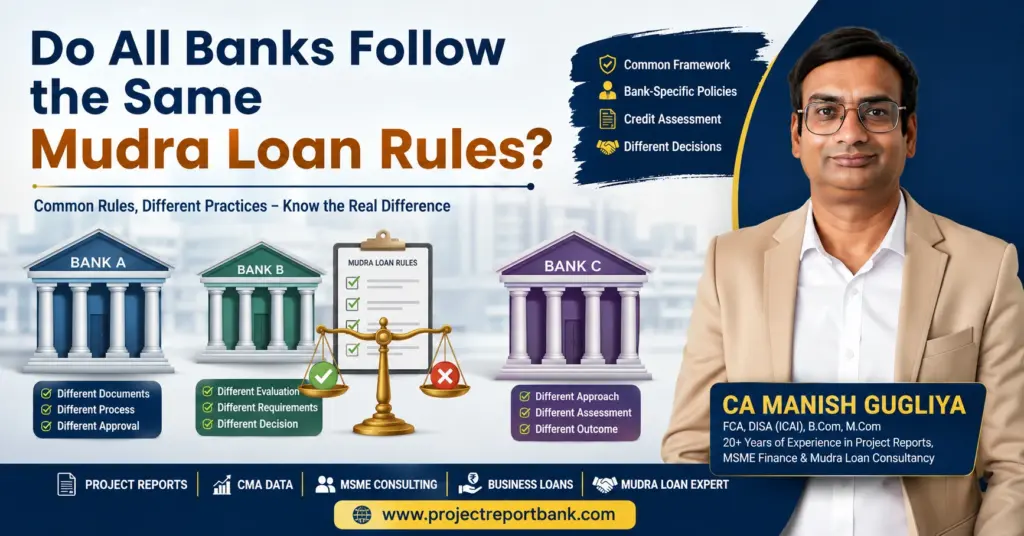
- Do All Banks Follow the Same Mudra Loan Rules?

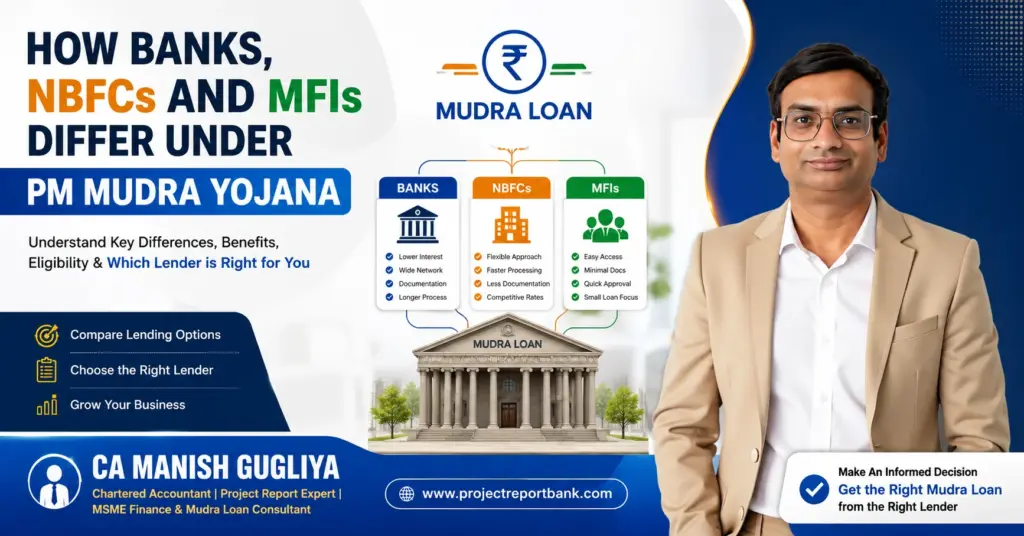
- Banks vs NBFCs vs MFIs for Mudra Loan: Which is Best for Your Business in 2026?
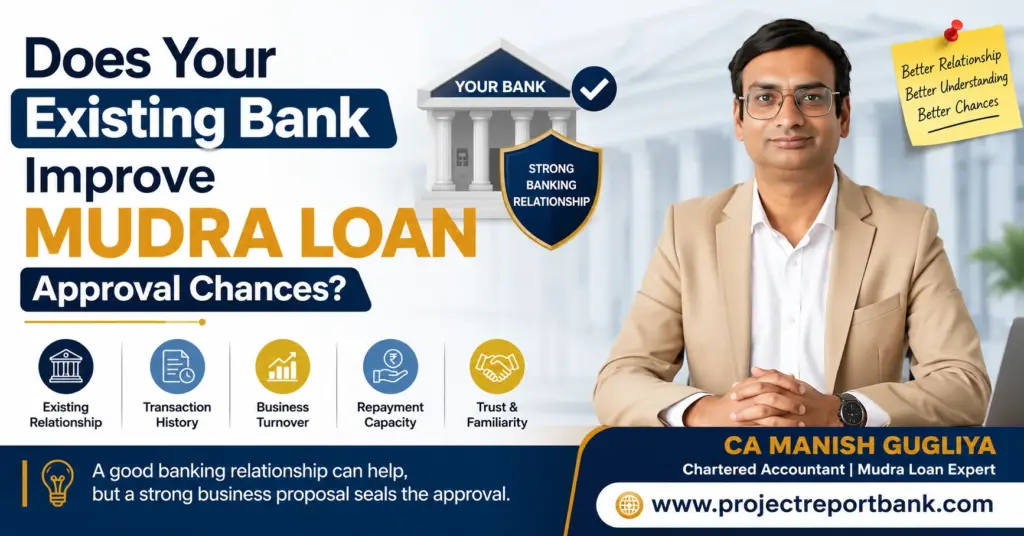
- Does Your Existing Bank Improve Mudra Loan Approval Chances?
- Common Mistakes While Selecting a Mudra Loan Bank – Practical Guide by CA Manish Gugliya
- What to Check Before Choosing a Mudra Loan Lender
- How to Find Participating Mudra Loan Banks in India
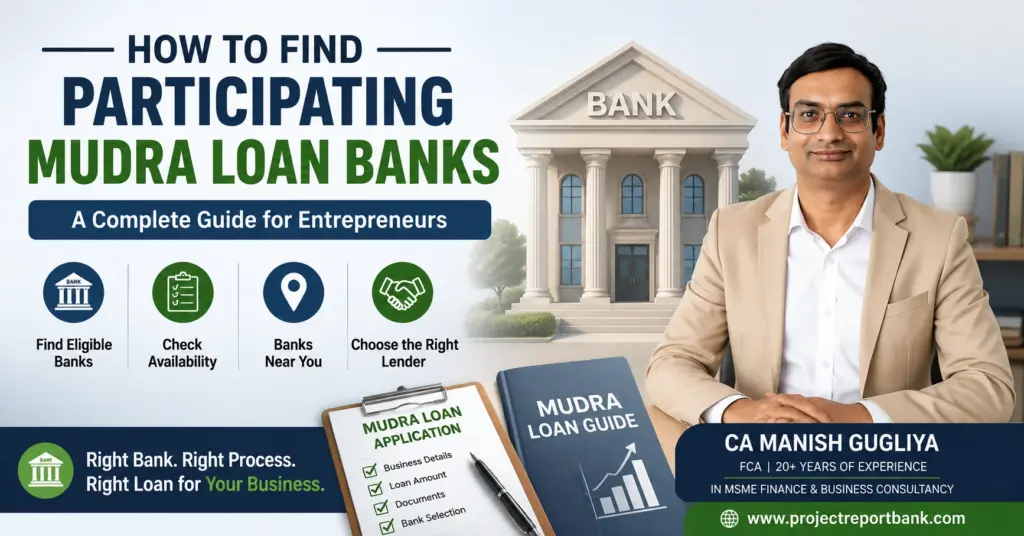
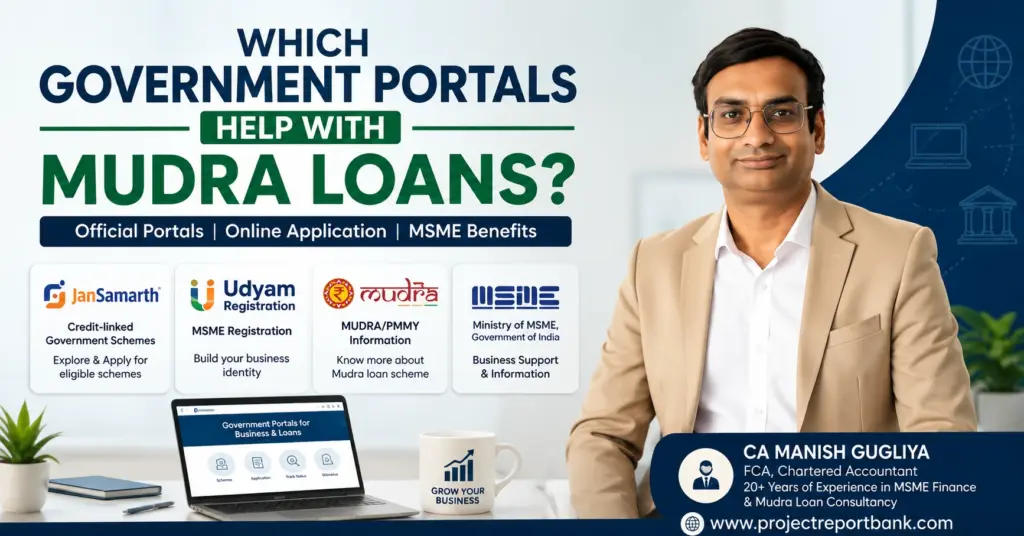
- Which Government Portals Help with Mudra Loans?
- Which Financial Institutions Can Sanction Mudra Loans?
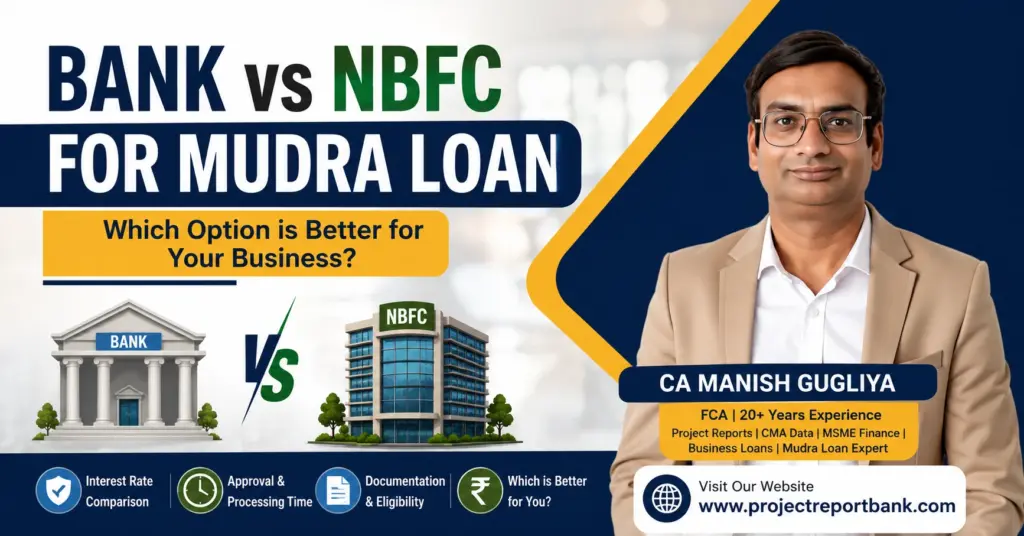
- Bank vs NBFC for Mudra Loan: Which Is Better for Small Business Owners?