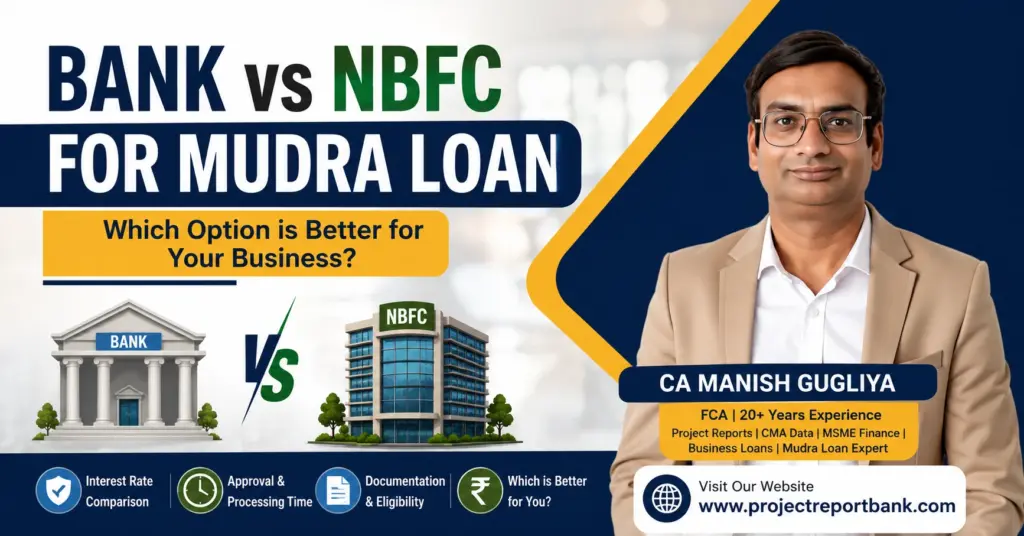
Most first-time Mudra Loan applicants face the same confusion: should I walk into a State Bank of India branch or try HDFC Bank? Will a government bank approve faster? Does a private bank even offer Mudra Loans? Will the interest rate differ?
These questions matter because choosing the wrong bank can mean weeks of unnecessary delay, higher interest costs, or outright rejection due to documentation mismatches.
After helping hundreds of MSME borrowers prepare project reports and loan applications across both bank types, I can tell you this: the bank type matters less than your preparation, but it still matters enough to get wrong.
The short answer: For most Mudra Loan applicants, especially first-time entrepreneurs, small shopkeepers, women entrepreneurs, and rural businesses, a Public Sector Bank is the stronger starting point. PSBs handle roughly 93% of all Mudra loan accounts and 96% of disbursed amounts, charge lower interest rates (9% to 13% vs 11% to 18% at private banks), and maintain branches in areas where private banks have no presence. However, if you are an urban borrower with strong financial records, an existing private bank relationship, and an urgent funding need, a private bank can process your application faster and with a better digital experience.
What Are Public Sector Banks for Mudra Loans?
Public sector banks (PSBs) like SBI, Bank of Baroda, Punjab National Bank, and Canara Bank are government-owned commercial banks that act as authorized Member Lending Institutions under the Pradhan Mantri Mudra Yojana (PMMY). They are the backbone of the Mudra Loan ecosystem.
Their defining strengths for Mudra Loan applicants:
- Volume and experience: PSBs process the vast majority of Mudra loans across all categories. Their branch staff handle Shishu, Kishore, and Tarun applications daily, which means familiarity with informal business documentation and first-time borrowers.
- Extensive branch network: PSBs operate in rural, semi-urban, and urban areas, reaching micro enterprises that private banks cannot serve physically.
- Lower interest rates: PSBs consistently offer rates in the 9% to 13% range, depending on the loan category and borrower profile.
- Minimal processing fees: Many PSBs charge zero processing fees for Shishu Loans, and nominal fees for higher categories.
Table of Contents
What Are Private Banks for Mudra Loans?
Private sector banks such as HDFC Bank, ICICI Bank, Axis Bank, and Kotak Mahindra Bank also participate in the Mudra scheme as lending institutions. Public sector banks provide loans under the same government scheme as private banks; the eligibility criteria and loan categories remain identical.
Their defining strengths:
- Faster turnaround: Private banks often process Mudra loan applications in 7 to 15 days for smaller tickets, compared to 2 to 4 weeks at many PSBs.
- Digital infrastructure: Online application tracking, document uploads, and mobile banking integration are more mature at private banks.
- Customer service: Dedicated relationship managers, quicker query resolution, and proactive follow-ups are standard at most private bank branches.
- Lower NPA rates: Private banks maintain lower non-performing asset levels in micro-loan segments compared to PSBs, partly because they apply stricter credit screening upfront.
Public Sector Bank vs Private Bank: Mudra Loan Comparison at a Glance
| Factor | Public Sector Banks | Private Banks |
|---|---|---|
| Best for | Rural/semi-urban borrowers, first-time entrepreneurs, informal businesses | Urban borrowers, tech-savvy applicants, businesses with formal records |
| Share of Mudra accounts | ~93% of all accounts, ~96% of disbursed amount | ~1% of disbursed amount |
| Interest rates (Shishu) | ~8.85% to 10% | ~10% to 13% |
| Interest rates (Tarun) | ~11% to 14% | ~13% to 18% |
| Processing time | 7 to 15 days (small tickets); 2 to 4 weeks (Kishore/Tarun) | 7 to 15 days; faster for existing customers |
| Branch presence | Strong rural and semi-urban coverage | Concentrated in urban and semi-urban areas |
| Processing fees | Often nil for Shishu; nominal for higher tiers | May charge nominal fees across categories |
| Digital facilities | Improving; many steps still require branch visits | Online application, digital tracking, mobile access |
| Documentation approach | Standardized checklists; more flexible for informal businesses | Stricter early-stage screening; may require audited financials sooner |
The headline takeaway: PSBs offer lower cost and wider access, while private banks offer speed and digital convenience. Your profile determines which trade-off matters more.
Processing Speed and Approval Timeline
Processing speed is not a luxury for most Mudra Loan applicants. A street vendor restocking inventory or a manufacturer purchasing capital assets cannot afford to wait six weeks for a decision. The difference between a 10-day and a 30-day approval cycle can mean lost business.
Here is how the timeline typically breaks down:
At a Public Sector Bank (Kishore/Tarun category): Application acceptance takes 1 to 3 days. Document verification and site inspection can take another 5 to 10 days. Internal credit appraisal and approval routing through branch manager, regional credit office, and sometimes zonal office adds another 5 to 10 days. Disbursement after sanction takes 2 to 5 days. Total: roughly 2 to 4 weeks for a complete application. Loan processing times may be slower in public sector banks due to formal procedures and multiple approval layers.
At a Private Bank (same category): Private banks generally provide a faster turnaround time for Mudra loans. Application acceptance and initial screening happen within 1 to 2 days. Document verification is often digitized, cutting 3 to 5 days from the process. Approval authority is typically more centralized, reducing the chain. Total: 7 to 15 days for borrowers with complete documentation. Private banks often focus on borrowers with clearer documentation and higher digital adoption, which explains the speed advantage.
One important caveat: a private bank that requires additional financial disclosures (ITR, audited turnover, detailed project reports) may end up taking just as long if the borrower scrambles to arrange those documents. Speed means nothing if you are not ready.
Winner: Private Banks for applicants with complete documentation and an existing banking relationship. PSBs are catching up through digital portals like Jan Samarth, but their internal approval chain remains longer for Kishore and Tarun categories. If you want to understand how long a bank can keep a Mudra Loan application pending, that is a separate question worth reading about.
Customer Service and Support Experience
For a first-time beneficiary micro unit entrepreneur applying for a Mudra Loan, the quality of branch-level support can determine whether the application even gets submitted correctly. I have seen borrowers abandon applications because nobody at the branch explained what a project report should contain.
PSBs: Branch staff at public sector banks, especially in smaller towns, tend to have more hands-on experience with Mudra applicants who lack formal business records. They are accustomed to guiding borrowers through the process. The trade-off: PSB branches handle high foot traffic, and staff are often stretched across multiple loan products. Follow-up on pending applications can require multiple visits. Query resolution through call centers is slow.
Private Banks: Dedicated relationship managers are common. You get a single point of contact who tracks your application, communicates updates, and escalates delays. Online application tracking through mobile apps works well. Response times for queries are shorter. The trade-off: private bank staff may be less patient with borrowers who need hand-holding on basic documentation or who operate informal businesses without clear financial records. Some branches may also attempt cross-selling insurance or other products during Mudra Loan processing, which adds friction.
Winner: Private Banks for urban, digitally comfortable borrowers who value responsiveness. PSBs win for borrowers who need patient, in-person guidance and operate in locations where private banks have no presence.
Documentation Requirements and Verification Process
The core documentation for any Mudra Loan application is the same regardless of bank type. Identity proof is required for Mudra loan applications (PAN, Aadhaar). Address proof is necessary for applying for a Mudra loan. Proof of income must be submitted for Mudra loan applications. Beyond these basics, you will need bank statements (last 6 months), proof of business existence, and Udyam Registration.
Where the two diverge:
PSBs for Shishu Loans (upto Rs 50,000): Documentation requirements are relaxed. Many PSB branches accept informal proof of business, a simple one-page application, Aadhaar, and PAN. No project report is typically demanded. This matters for micro units like street vendors, home-based food businesses, or small repair shops that lack formal financial statements.
Private Banks for Kishore and Tarun categories: Private banks tend to ask for detailed project reports, quotations for assets to be purchased, GST registration (if applicable), audited financials, and a clear business plan earlier in the process. For a Tarun loan of ₹5 lakh to ₹10 lakh, a private bank may request a full usage-of-funds statement before even starting the credit appraisal. If you are unsure about what documents you need, this guide on Mudra Loan documents required breaks it down category-wise.
PSBs for Kishore and Tarun: PSBs follow standardized checklists but are more accommodating of informal documentation for small and micro enterprises. Site verification is common for larger amounts; an officer will visit your business location. This adds time but can actually work in your favor if your physical setup demonstrates viability even when paperwork is thin.
Loans up to ₹10 lakh do not require collateral security, as mandated by the Reserve Bank of India. Neither PSBs nor private banks can legally demand collateral for standard Mudra loans. If a bank asks for security, you should know whether a bank can ask for security in a Mudra Loan.
Winner: PSBs for borrowers with informal businesses, limited financial records, or those applying under Shishu. Private banks are better suited if you already maintain audited financials and a satisfactory credit track record.
Branch Accessibility and Physical Presence
This factor is straightforward but consequential. Public sector banks have a wider branch network that supports rural outreach for Mudra loans. Public sector banks have a stronger presence in rural areas compared to private banks. If you run a micro enterprise in a district headquarter town, a taluka, or a village, your nearest bank branch is almost certainly a PSB or a Regional Rural Bank.
Private banks concentrate in metros, tier-1, and tier-2 cities. Walk into a village in Madhya Pradesh, Bihar, or Rajasthan, and you will not find an ICICI or HDFC branch. For borrowers in these areas, the “private bank advantage” in speed or digital tools is irrelevant because the option does not physically exist.
Even where private bank branches exist, the staff may not have extensive experience processing Mudra applications. A PSB branch in a semi-urban area may process 50 to 100 Mudra applications a month; a private bank branch in the same town may process 5.
Winner: Public Sector Banks. No contest on geographic reach. For rural borrowers, this factor alone can settle the decision.
Digital Banking and Online Facilities
Private banks often use more digitized and streamlined processes for consultations and application management. HDFC Bank, ICICI Bank, and Axis Bank offer online Mudra Loan pre-qualification, document upload portals, real-time application tracking, and digital disbursement notifications.
PSBs are improving. The Jan Samarth portal integrates multiple PSBs for online Mudra Loan applications. SBI’s YONO app and Bank of Baroda’s digital lending platform support basic application submission. Still, most PSBs require at least one or two physical branch visits for document verification, signatures, or site inspection scheduling.
For tech-savvy individual borrowers running service businesses or trading operations in urban areas, private banks’ digital infrastructure reduces trips to the branch and speeds up the process. For borrowers without reliable internet access or smartphone comfort, PSBs’ branch-first approach is more practical.
Private banks tend to adopt an agile, performance-driven approach for Mudra loan targeting, using data analytics to pre-approve existing customers and route applications faster through automated credit scoring.
Winner: Private Banks for digital capability. PSBs are narrowing the gap through government portal integration, but the day-to-day digital experience at private banks remains superior.
Public Sector vs Private Bank: Which Should You Choose for Mudra Loan?
There is no universal “best bank” for Mudra Loans. The right choice depends on your specific situation. Here is a practical decision framework:
Choose a Public Sector Bank if:
- You are a first-time entrepreneur with no prior banking relationship at a private bank
- Your business is in a rural or semi-urban area where PSBs are the only option
- You operate an informal business (street vending, home-based manufacturing trading and services) without audited financials
- You are applying for Shishu Loans (upto Rs 50,000) where PSBs charge minimal fees and lower interest
- You need the lowest possible interest rate and can wait 2 to 4 weeks for processing
- You are a woman entrepreneur applying under a government scheme with priority sector lending benefits
- You prefer face-to-face guidance through every step of the application
Choose a Private Bank if:
- You need urgent funding and can provide complete documentation from day one
- You are an existing customer of a private bank with a satisfactory credit track record
- Your business maintains formal financial records (ITR, GST, audited statements)
- You operate in an urban area where private bank branches are accessible
- You value digital tracking and minimal branch visits
- You have successfully repaid previous loans and have a strong CIBIL score
- You are applying under Kishore or Tarun categories with a well-prepared business plan
Decision matrix by borrower type:
| Borrower Profile | Recommended Bank Type | Primary Reason |
|---|---|---|
| Street vendor (Shishu) | Public Sector Bank | Low documentation, zero processing fees, local branch |
| Retail shopkeeper expanding (Kishore) | Public Sector Bank | Lower interest, MSME experience at branch level |
| Urban service provider (Tarun) | Private Bank | Speed, digital process, relationship manager support |
| Rural manufacturer | Public Sector Bank | Branch access, understanding of informal records |
| Trader with strong financials | Private Bank | Faster approval, existing relationship leverage |
| Woman entrepreneur (first-time) | Public Sector Bank | Priority sector focus, hand-holding support |
| Existing MSME scaling up (Tarun Plus) | Either | Depends on which bank handled previous loans |
Overall: For the majority of Mudra Loan applicants in India, who are small business owners, first-time entrepreneurs, or micro enterprises engaged in manufacturing, trading, or services, Public Sector Banks remain the practical choice. PSBs command a larger share of Mudra loan disbursements by absolute value and volume for a reason: they serve the borrowers this scheme was designed for.
If you fall into the urban, documented, time-sensitive category, do not avoid private banks. They participate in the same scheme, follow the same eligibility criteria, and can deliver faster results when the fit is right.
Expert Advice from CA Manish Gugliya
After two decades of helping MSMEs secure funding, here is what I tell every borrower before they choose a bank:
1. Prepare your project report before choosing the bank. Most rejections happen because the borrower walks in with incomplete information. A properly prepared project report shows income generation potential, repayment capacity, and how the loan extended will be used. Whether you approach a PSB or private bank, a strong project report is your single biggest advantage. Learn more about how banks decide the Mudra Loan amount based on your project report.
2. Choose the branch, not just the bank. A well-run PSB branch with experienced staff will outperform a poorly managed private bank branch every time. Visit the branch, speak to the manager, and gauge their familiarity with Mudra Loans before applying.
3. Get your documentation right the first time. Incomplete applications sit in queues for weeks. Verify the complete list of Mudra Loan documents required for your specific category before submission.
4. Check your eligibility honestly. Mudra loans are available for non-corporate small enterprises in the non farm sector, including manufacturing, trading, and services. Allied agricultural activities also qualify. If your proposed activity does not fit, no bank, public or private, will approve your application. Review the PM Mudra Loan eligibility criteria before applying.
5. Do not apply to multiple banks simultaneously. Each application generates a credit inquiry. Multiple inquiries in a short period can lower your credit score and signal desperation to lenders. Pick one bank, prepare thoroughly, and apply once.
6. Respond to bank queries within 48 hours. Banks assess your seriousness based on how quickly you provide requested information. Delays from your side give the bank a reason to deprioritize your file.
Frequently Asked Questions
Can private banks give Mudra Loans?
Yes. Pradhan Mantri Mudra Yojana was launched on April 8, 2015, and loans are available through various financial institutions including public sector banks, private banks, Regional Rural Banks, small finance banks, NBFCs, and MFIs. Private banks act as authorized Member Lending Institutions under the scheme. MUDRA stands for Micro Units Development & Refinance Agency.
Are government banks safer for Mudra Loans?
The loan terms are governed by RBI and PMMY guidelines regardless of bank type. Loans up to ₹10 lakh do not require collateral security at any bank. Your rights as a borrower are the same whether you apply at SBI or HDFC Bank.
Which bank processes Mudra Loans faster?
Private banks typically process applications in 7 to 15 days when documentation is complete. PSBs take 2 to 4 weeks for Kishore and Tarun categories due to multi-layer approval processes. For Shishu loans, the difference narrows.
Do all banks charge the same interest rate on Mudra Loans?
No. Interest rates for Mudra loans are deregulated by banks. Each bank or financial institution sets its own rate. PSBs generally offer 9% to 13%, while private banks charge 11% to 18% depending on the category and borrower profile. To compare rates across lenders, check which bank offers the lowest interest rate for Mudra Loan.
Can I apply to multiple banks at the same time?
You can, but I advise against it. Multiple credit inquiries hurt your score. Focus on one well-prepared application rather than scattering weak applications across several banks.
Can a bank reject my Mudra Loan even if I meet all eligibility criteria?
Yes. Approval is assessed based on business viability, repayment capacity, documentation quality, existing liabilities, and credit history. Meeting the basic eligibility criteria does not guarantee approval. Banks have internal risk assessment frameworks that may differ.
Does branch experience with Mudra Loans matter?
A branch that processes Mudra applications regularly understands the documentation requirements, common issues, and approval pathways. An inexperienced branch may create unnecessary delays or request documents that are not required under PMMY guidelines.
Which bank is better for startups with no credit history?
PSBs tend to be more accommodating for eligible borrowers without formal credit history, especially for Shishu Loans. Private banks prefer borrowers with an existing credit track record and banking relationship.
Is a project report compulsory for Mudra Loans?
For Shishu Loans (upto Rs 50,000), many banks do not require a formal project report. For Kishore Loans (₹50,001 to ₹5 lakh) and Tarun Loans (₹5 lakh to ₹10 lakh), a project report demonstrating the proposed activity, capital assets needed, and repayment plan is expected at most banks.
What is the Tarun Plus category?
Tarun+ Loans can be up to ₹20 lakh. This category was introduced in October 2024 for borrowers who have availed and successfully repaid previous loans under the Tarun category. It represents the next phase of growth development and funding needs for established micro units.
Can a bank reduce my sanctioned loan amount?
Yes. Banks can sanction a lower amount than applied for based on their assessment of your repayment capacity and business needs. Read more about whether a bank can reduce the sanctioned Mudra Loan amount.
Does educational qualification matter for Mudra Loan eligibility?
No. There is no educational qualification requirement for Mudra Loans. What matters is the necessary skills to run the proposed business, a viable business plan, and the credit needs of the beneficiary micro unit. The scheme targets individual borrowers from all backgrounds, including those without formal education.
Are processing fees different at public and private banks?
Public sector banks may charge minimal or zero processing fees for Mudra loans, especially for the Shishu category. Private banks may charge nominal processing fees for Kishore and Tarun categories. Foreclosure charges are generally nil across both bank types.
Is Udyam Registration mandatory?
It is not always mandatory, but having Udyam Registration strengthens your application at both public and private banks. It confirms your status as a non-corporate micro or small enterprise in the non farm sector and simplifies the bank’s verification process.
Conclusion
The choice between a public sector bank and a private bank for your Mudra Loan comes down to your specific situation: where you live, how formal your business records are, how urgently you need the funds, and which bank you already have a relationship with.
Public sector banks serve the widest range of Mudra Loan borrowers. They offer lower interest rates, broader branch access, and more comfort with informal micro enterprises. Their share of the Mudra lending market (93% of accounts, 96% of amounts) reflects this. Private banks serve a narrower but well-defined segment: urban, documented, time-sensitive borrowers who value digital convenience and speed.
Neither bank type guarantees approval. What guarantees a strong application is a well-prepared project report, complete documentation, a viable business model, and honest communication with your lender.
Stop worrying about which bank is “better.” Start preparing an application that no bank can easily refuse.
This article is written by CA Manish Gugliya (FCA), a Chartered Accountant with over 20 years of experience in Project Reports, CMA Data, MSME Finance, Business Loans, and Mudra Loan consultancy. If you need professional assistance preparing a bank-ready project report or loan documentation for your Mudra Loan application, reach out for expert guidance tailored to your specific business and bank requirements.
- Do All Banks Follow the Same Mudra Loan Rules?


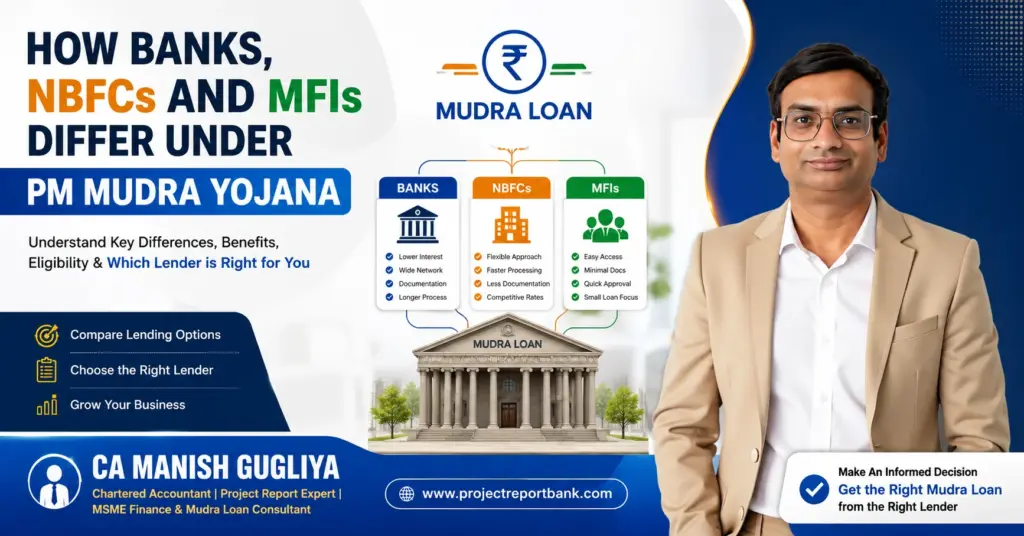
- Banks vs NBFCs vs MFIs for Mudra Loan: Which is Best for Your Business in 2026?
- Does Your Existing Bank Improve Mudra Loan Approval Chances?

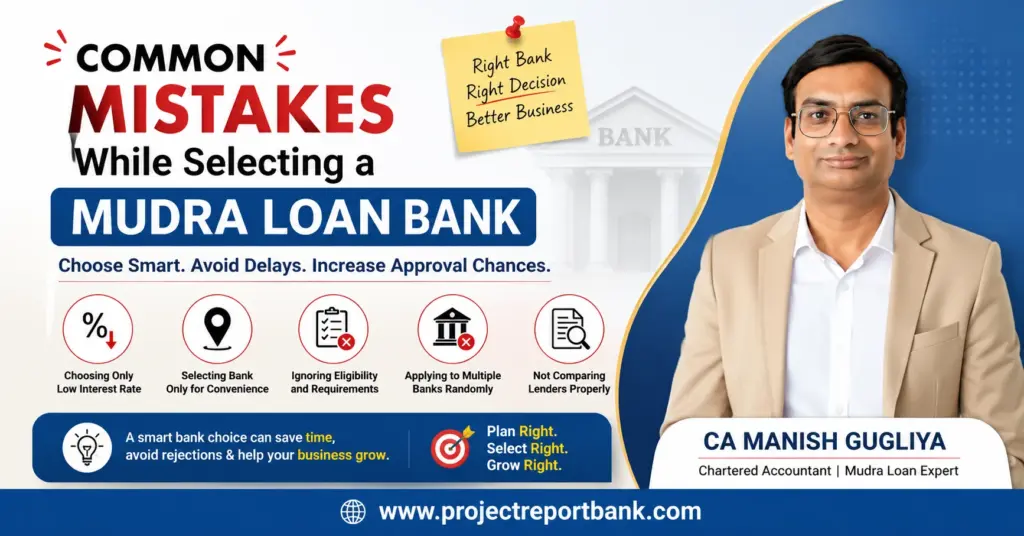
- Common Mistakes While Selecting a Mudra Loan Bank – Practical Guide by CA Manish Gugliya
- What to Check Before Choosing a Mudra Loan Lender

- How to Find Participating Mudra Loan Banks in India
- Which Government Portals Help with Mudra Loans?
- Which Financial Institutions Can Sanction Mudra Loans?
- Bank vs NBFC for Mudra Loan: Which Is Better for Small Business Owners?