Key Takeaways
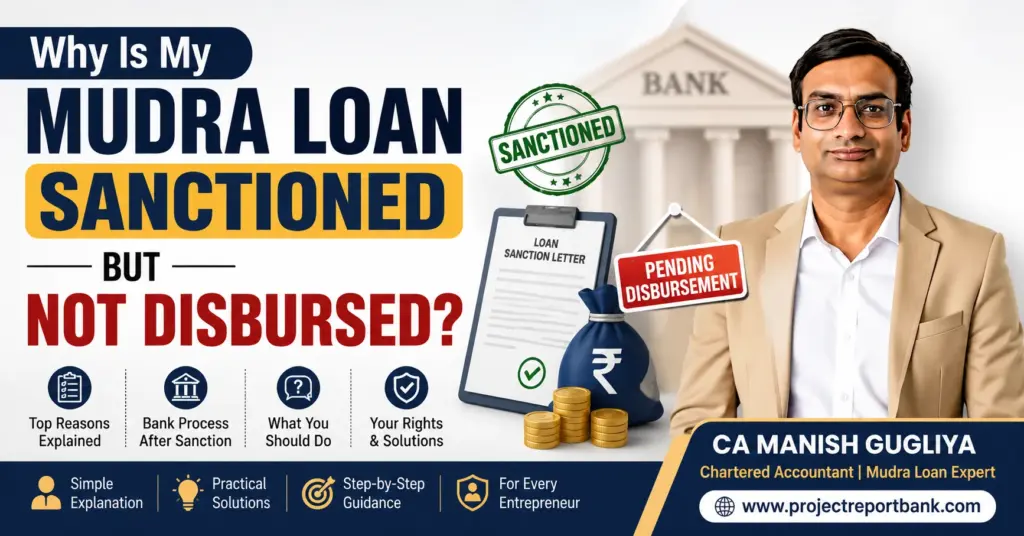
- “Mudra loan sanctioned but not disbursed” is extremely common. Sanction is not the final step – the bank must still complete several formalities before releasing your money.
- Normal delay between sanction and disbursement is usually 2 to 7 working days if all documents and conditions are complete. Delays beyond 30 days are abnormal and need escalation.
- Common reasons include pending documents, unsigned sanction acceptance, ECS/NACH mandate not done, current account not opened, margin money not deposited, or vendor invoice not submitted.
- This article covers every possible reason for delay, the internal bank process after sanction, your step-by-step action plan, your legal rights as a borrower, and how to escalate if the bank is delaying without reason.
Introduction: Sanction Letter Milestone, But Money Still Not Credited
Imagine this: Ramesh, a small shopkeeper in Varanasi, receives an SMS on 15 June 2026 saying his mudra loan of ₹3,00,000 has been sanctioned. He is excited. He starts calling his machine vendor. But one week passes – the loan amount is not credited in his account. He is confused and worried.
This situation is more common than you think.
“Sanctioned” does not mean “money is in your bank account.” It only means the bank or financial institution has agreed in writing to give you a loan under certain conditions. Under Pradhan Mantri Mudra Yojana (PMMY) – the flagship scheme launched on 8th April 2015 to provide collateral free loans to micro enterprises – banks must still complete documentation, compliance checks, and internal approvals before they disburse funds.
Mudra Yojana supports small businesses in manufacturing, trading, and services. The scheme aims to promote self-employment and entrepreneurship, supporting income generation and employment creation across rural and urban areas. But even with this strong financial support from the government, practical delays happen due to holidays, technical issues, or pending documents required under the mudra scheme.
In this article, you will learn exactly what “sanctioned” means, the difference between sanction and disbursement, all possible reasons for delay, normal timelines, post-sanction bank process, documents still needed, a day-wise follow-up plan, your borrower rights, common mistakes, and practical tips from a CA with over 20 years of MSME finance and business loans experience.

Table of Contents
What Does “Loan Sanctioned” Actually Mean in a Mudra Loan?
“Loan sanctioned” means the bank has checked your application and decided they will give you a mudra loan up to a fixed sanctioned limit – for example, ₹2,00,000 under Kishore category – on certain conditions. But the cash is not yet given.
There are three stages every borrower must understand:
- Approval / In-Principle Approval: The bank says “your application looks acceptable.” This is preliminary.
- Sanction: The bank formally commits in writing. You receive a sanction letter mentioning loan amount, interest rate, EMI, repayment period, and special conditions.
- Disbursement / Fund Release: The bank actually transfers money into your savings or current account, or pays the vendor directly. Only at this stage does the money become available.
Mudra loans are categorized into Shishu (up to ₹50,000), Kishore (₹50,001 to ₹5,00,000), and Tarun (₹5,00,001 to ₹10,00,000). Tarun Plus loans are also available for ₹10 lakh to ₹20 lakh for repeat borrowers. The maximum loan amount under the standard Mudra categories is ₹10 lakh, and no collateral is required for these loans.
Approval for mudra loans can take a few days, and mudra loans can be approved quickly, often within days. But sanction is still a conditional promise – if you don’t complete formalities, the bank can refuse to disburse.
| Feature | Sanction | Disbursement |
|---|---|---|
| What happens | Bank agrees to give loan in writing | Bank actually transfers money |
| Document issued | Sanction letter | Disbursement voucher / credit entry |
| Money in account? | No | Yes |
| Borrower action | Must sign acceptance, complete formalities | Can start using funds for business purposes |
| Can be reversed? | Yes, if conditions not met | Very rare once credited |
For a deeper comparison of all three stages, you can read Difference Between Mudra Loan Approval, Sanction & Disbursement.
Why Has My Mudra Loan Not Been Disbursed Yet? (All Possible Reasons)
This is the core section. Each subheading below covers one specific reason why a mudra loan is sanctioned but not disbursed.
In most PMMY mudra loans for small businesses, delay happens due to small but important formalities. For each reason, I’ll explain: what the problem is, why it happens, normal time taken, and what you should immediately do.
More than one reason can apply at the same time. Check all points against your own case. And remember – if the bank does not clearly explain the reason, you have the right to ask for a written explanation.
Pending Documentation
Even after sanction, the bank may still need updated KYC documents – Aadhaar, PAN copy, identity proof, GST registration, shop and establishment certificate, or partnership deed. Banks sometimes issue sanction letters quickly but keep a checklist of “pending documents” that must be received before disbursement.
Example: A small manufacturing unit in Jaipur receives sanction on 10 March 2026, but the latest electricity bill for the business address is not submitted. The branch keeps the case on hold.
Government audit findings confirm this is widespread. In one compliance audit by CAG, physical verification was not conducted in 19 cases, blocking disbursement.
What to do: Visit the branch, ask for the complete “pending document list” in writing, and submit everything at once with self-attestation. Keep photocopies. If documents required seem unreasonable, read Can Bank Keep Asking for New Documents?.
Acceptance of Sanction Letter Not Signed
In most banks, the borrower must sign and return one copy of the sanction letter as formal acceptance before any disbursement is allowed. Many borrowers assume disbursement will happen automatically after sanction – it will not.
An unsigned sanction letter means the bank cannot proceed. It is like an offer you haven’t formally accepted yet.
What to do: Visit the branch immediately. Read conditions carefully – interest rate, EMI start date, insurance requirements, any top up conditions. Sign the acceptance. Keep your own signed copy. If any condition looks confusing, read Hidden Terms and Conditions in a Mudra Loan Sanction Letter.
Borrower Has Not Completed Post-Sanction Formalities
After sanction, you may need to sign several legal papers:
- Loan agreement
- Demand promissory note (DP note)
- Hypothecation deed (charge on movable assets created with the loan)
- Standing instructions
- Guarantor signatures (if applicable)
Missing signatures on loan agreements can delay fund release. These are standard legal papers every bank must collect under RBI and internal policy before releasing mudra loan funds to small enterprises.
Example: A street vendor sanctioned a Shishu loan of ₹40,000 doesn’t visit for document execution for three weeks. The bank naturally keeps the loan undisbursed.
ECS / NACH / SI Mandate Not Completed
ECS or NACH is your permission to the bank to auto-debit monthly EMI from your account. Many banks will not allow mudra loan disbursement until a valid mandate form is signed, verified, and uploaded – which can take 1 to 3 working days.
Example: A woman running a beauty parlor in Bhopal signs the NACH form, but her signature mismatches with bank records. The mandate is rejected. Disbursement stays pending until she signs again correctly.
Errors in bank account details can also hold up fund transfers – check that the correct account number and IFSC code are written on the form.
Current Account for Business Not Yet Opened
For many mudra loans, banks insist that the borrower open a current account in the same branch for routing business transactions. If your sanction letter says “loan will be disbursed only after opening of current account,” and you have only a personal savings account, disbursement waits.
What to do: Carry PAN, Aadhaar, business registration, shop act licence, GST registration if any. Open the current account immediately and ask the branch to link it to your mudra loan.
Margin Money / Own Contribution Not Paid
Many mudra loans under Kishore and Tarun categories require you to contribute a small percentage of the project cost as margin money (for example 10–25%).
Example: Total project cost is ₹5,00,000. Bank sanctions ₹4,00,000 as term loan. You must deposit ₹1,00,000 from own sources first. Until this margin money is in your designated account, the file shows “disbursement pending.”
What to do: Deposit the required amount via NEFT/UPI, get stamped proof, and submit it to the loan officer.
Insurance Formalities (Life / Asset / Shop Insurance)
Some banks link mudra loans with insurance – shop insurance, machinery insurance, vehicle insurance, or credit life insurance. While RBI does not allow banks to force unwanted insurance, practically many branches delay disbursement until at least a basic insurance proposal is signed, especially where assets like transport vehicles or machines are financed.
Example: A tempo owner sanctioned a mudra loan for a commercial vehicle in April 2026 – disbursement waits until motor insurance policy and hypothecation endorsement are arranged.
Insurance formalities usually take 1 to 3 working days once documentation is complete.
Property / Asset Verification Still Pending
Physical verification of business premises forms part of the disbursement process. Even though mudra loans are collateral free, banks verify that your business actually exists, especially for higher amounts above ₹3 to 5 lakh.
Example: A small manufacturing unit in Indore sanctioned a Tarun loan of ₹7,50,000 – disbursement waits until the field officer visits and files an inspection report.
This normally takes 2 to 7 days after sanction depending on staff availability.
Vendor Invoice / Quotation Pending
In asset-based mudra loans – for buying a taxi, e-rickshaw, embroidery machine, or photocopy machine – the bank generally disburses the amount directly to the vendor after receiving a proper invoice. Missing asset quotations may prevent fund release for machinery purchases.
Real evidence from PNB bank branch minutes in South 24 Parganas shows that branches insisting upon invoices from borrowers resulted in large pendency of undisbursed sanctioned loans.
What to do: Select your vendor, collect a proper invoice with your name, address, machine details, price with GST, and supplier’s bank details. Submit to the bank with a written request for disbursement.
Internal Bank Approval / Regional Office Confirmation Pending
For higher mudra loan amounts or under products like Tarun Plus (above ₹10 lakh, upto rs 20 lakh, introduced October 2024), some banks require additional approval from the regional office or credit hub even after branch-level sanction.
Branch workload may add days to the processing time of sanctioned loans. A sanctioned mudra loan is delayed due to pending internal bank formalities in such cases.
What to do: Ask politely – “Has my loan gone to regional office? On which date?” Follow up through the branch. More details are available in Mudra Loan Pending After Internal Bank Approval.
Technical System Delay or Holiday / Year-End Closing
Delayed disbursement can occur due to operational or technical issues within banks – CBS server downtime, Mudra portal link failures, or month-end system freezes. On bank holidays or financial year closing (last week of March), branches may not post disbursement entries.
Example: A mudra loan sanctioned and documented on 30 March 2026 might only be disbursed on 2 April 2026 because 31 March is closing day.
Genuine technical delays usually resolve within 1 to 3 working days.
Bank Audit / Compliance Hold
Sometimes during internal audit, RBI inspection, or vigilance review, a branch temporarily stops disbursing fresh loans until checks are completed. Documentation mismatches can trigger compliance holds.
Such audit holds usually last 3 to 10 days. If your file is under such hold, ask for the expected clearance date.
Loan Conditions in Sanction Letter Not Yet Fulfilled
Sanction letters sometimes mention special pre-disbursement conditions: “close existing CC limit in another bank,” “submit NOC from present banker,” or “transfer all business transactions to this branch.” Conditions outlined in the sanction letter must be fulfilled before disbursement.
Example: A small trader is sanctioned ₹8,00,000 on condition he clears an old overdue of ₹50,000 first. Until that payment is made, disbursement stays pending.
What to do: Re-read your sanction letter line by line. Highlight each condition. Confirm with the bank whether each item is “complied” or “pending.” For deeper understanding, read Conditional Sanction in a Mudra Loan.

Normal Time Between Sanction and Disbursement in Mudra Loans
For most mudra loans under PMMY, the disbursement process can take 2 to 7 working days after sanction under ideal conditions. In very simple Shishu cases, it can even happen the same day.
The timeline for loan disbursement is not universally regulated by RBI – it depends on bank internal processes and borrower readiness.
| Time Gap | Typical Situation |
|---|---|
| Same Day | Very small Shishu working capital loans with complete KYC |
| 2–3 Working Days | All documents complete, only system entry and mandate pending |
| 4–7 Working Days | NACH registration, vendor invoice, or internal approval required |
| 8–15 Working Days | Asset verification, margin money arrangement, or insurance formalities |
| More than 30 Days | Abnormal delay – strong follow-up and escalation needed |
If more than 30 days pass, check your sanction validity period and begin escalation. For the full end-to-end timeline from application to disbursement, see Mudra Loan Processing Stage Timeline.
How Banks Process a Mudra Loan After Sanction (Step-by-Step Workflow)
Sanctioning and disbursement are separate stages in the loan process. Here is the typical flow that converts “sanction on paper” into “money in account”:
Sanction → Acceptance → Documentation → Compliance Check → Internal Verification → Disbursement Approval → Fund Release → Credit to Account
- Sanction: Branch creates sanction note in the system, prints sanction letter with conditions for the specific category (Shishu/Kishore/Tarun).
- Acceptance: You sign the sanction letter, giving consent to terms including interest rate, EMI schedule, and need for stock statement or insurance.
- Documentation: You sign the loan agreement, DP note, hypothecation deed, and guarantee forms. Check name spelling, loan amount, and EMI details carefully on each paper.
- Compliance Check: Bank verifies KYC, re-confirms credit profile through CIBIL, makes PMMY portal entries, and checks that the eligibility criteria under mudra yojana are met and documents required list is fully ticked.
- Internal Verification: Branch manager and credit officer confirm that all policy requirements are met. Final checks must be completed before a loan disbursement occurs.
- Disbursement Approval: System status changes from “sanctioned” to “ready for disbursement.” The final disbursement voucher must be authorized by the branch manager.
- Fund Release and Credit: Money is credited to your savings or current account, or paid to the vendor’s account. You see the entry in your passbook or bank statements.
What Documents May Still Be Required After Mudra Loan Sanction?
Many borrowers think “I already gave all papers with my application.” But some documents are collected only after sanction. Documents required include identity proof and business plan, along with:
- Signed sanction acceptance copy and fresh photographs
- Updated KYC if address changed, Udyam registration
- Business registration certificate, shop act licence, rent agreement, latest electricity bill
- Vendor quotations or proforma invoices for machines/vehicles with GST details
- Bank details of supplier for NEFT/RTGS disbursement
- Last 6 months bank statements as proof of running business
- ITR for 1–2 years, projected income statement, margin money deposit proof (for larger Kishore/Tarun loans)
- Filled ECS/NACH forms, cheque leaves, insurance proposal forms
Always ask for a complete checklist at one time so you don’t visit the bank repeatedly.
What Should You Do If Your Mudra Loan Is Still Not Disbursed? (Action Plan)
Here is a clear day-wise plan when your mudra loan is sanctioned but the amount is not credited:
Day 1–2: Visit the branch with your sanction letter. Ask for the exact status and a written list of pending formalities. Complete as many as possible the same day – sign acceptance, NACH forms, submit documents.
Day 3–5: Confirm that your documents have been entered into the system. Ask for the expected disbursement date and the name of the officer handling your file.
Day 7–10: If still not disbursed, write a short, polite letter to the branch manager: mention sanction date, list of documents submitted, and request for early fund release. Keep a photocopy.
Day 15: Meet the branch manager again. Request that they contact the regional office if needed. Note their response and the date they promise.
Day 30 and beyond: File a written complaint to the bank’s regional office or customer care. If no satisfactory response, approach the Banking Ombudsman through RBI’s Integrated Ombudsman Scheme.
Keep all communications in writing – letters, emails, SMS, WhatsApp chats. This protects you if you need to prove abnormal delay later.

Can the Bank Cancel a Sanctioned Mudra Loan Before Disbursement?
Yes, a bank can cancel or withdraw a sanctioned mudra loan before actual disbursement. Common reasons for delays after sanction include pending documentation and verification checks, but cancellation can happen when:
- Borrower provides wrong information or fake documents
- Borrower hides existing loan defaults or NPA status
- Formalities are not completed within the sanction validity period (usually 30, 60, or 90 days)
- Borrower’s cash flow or financial position worsens significantly
- Business activity is not eligible under mudra yojana (for example, purely agricultural farming instead of allied or income generating activities)
Example: A borrower sanctioned a Kishore loan in January 2026 but doesn’t arrange margin money for four months. By May, the bank cancels the sanction.
Keep your credit profile clean between sanction and disbursement – no cheque bounces, no fresh defaults. Banks sometimes re-check reports just before releasing funds. For detailed discussion, see Can a Sanctioned Mudra Loan Be Cancelled by the Bank?.
Your Rights After Mudra Loan Sanction
After sanction, you have clear rights as a borrower under RBI’s fair practices code:
- Right to know the reason: Ask the branch in writing to clearly mention which condition or document is pending and by which date they expect to release the loan.
- Right to copies: You can receive copies of the sanction letter, loan agreement, and any other document you sign.
- Right to fair treatment: The bank cannot delay because you are a woman entrepreneur, a street vendor, or from a particular community – if all eligibility criteria and documents are fulfilled.
- Right to complain: Write to the branch manager first, then regional office, and finally the Banking Ombudsman if the bank gives no proper answer.
Always keep your communication polite but firm. Focus on facts – dates, documents submitted, assurances given. Maintain a small file containing all papers related to your case.
Common Mistakes Borrowers Make After Mudra Loan Sanction
These mistakes often convert a simple 3–5 day gap into a 30–60 day delay:
- Assuming sanction means instant cash: It does not. Banks require final clearances before releasing funds after loan sanction.
- Not reading the sanction letter: Many borrowers skip the conditions printed on it.
- Delaying branch visits: Not signing documentation for weeks because “the bank will call me.”
- Submitting incomplete vendor invoices: Wrong name, missing GST, or no supplier bank details.
- Changing plans after sanction: Switching vendors or shop locations confuses the bank file.
- Changing EMI debit account: Without filling fresh NACH forms, leading to mandate rejections.
- Waiting silently at home: Instead of calling or visiting to check file status.
Using the action plan above can prevent most “mudra loan sanction but no disbursement” problems.
Practical Tips From CA Manish Gugliya for Faster Mudra Disbursement
From over 20 years of helping micro units, small enterprises, and beneficiary micro unit owners with funding under mantri mudra yojana pmmy, here are my practical tips:
- Keep all KYC and business documents updated before you even apply. Prepare a simple business plan even for a small ticket loan.
- Maintain a clean bank statement – avoid large unexplained cash deposits just before applying.
- Visit the branch in morning hours when staff is free. Carry a neatly organized file.
- Note down every discussion – date, officer name, what was promised.
- Ask for a written checklist instead of relying on verbal promises.
- If the officer says “come next week,” ask for a specific date.
- If they say “system problem,” request them to write a short remark or send an email confirmation.
- Do not make large advance payments to vendors based only on verbal assurance. Wait for clear indication of disbursement date.
- Keep your existing EMIs regular. Avoid cheque bounces between sanction and disbursement.
- Do not take multiple parallel business loans without informing the bank – it affects your credit profile.
- Route regular business transactions through your main bank account so future top up or working capital limit enhancement becomes easier.
- For working capital loans, keep a simple stock register ready if the bank asks for stock proof.
- Mudra loans can be applied online at udyamimitra.in – but even digital applications need physical document execution at the branch.
- For micro finance institutions or NBFCs, the process may be slightly different – always confirm with your specific financial institution.
- If your loan is for food processing, service sector, or trading, keep relevant licences (FSSAI, shop act) ready as the bank may ask post-sanction.
- Think of your bank relationship as long-term – good behaviour now means faster credit needs fulfillment later as a non corporate or other legal entity borrower.
- Mudra loans are available for various business activities – from small manufacturing units to street vending – but make sure your activity matches what you declared in the application.
- If you received a mudra card for working capital requirement, confirm with the branch when it will be activated after disbursement.
- Understand that loans upto rs 10 lakh are collateral free under PMMY – don’t let anyone at the branch demand property papers for this range.
- Mudra loans are available up to ₹10 lakh for micro enterprises and are designed as a reference point for financial assistance to the smallest businesses – treat the process with patience but also with awareness of your rights.
Frequently Asked Questions on Mudra Loan Sanctioned but Not Disbursed
Why is my Mudra loan sanctioned but amount not credited in my account?
Most often, some small formality is still pending – signing sanction acceptance, ECS/NACH form, current account opening, or vendor invoice. Visit the branch immediately, ask for a written list of pending items, and complete them quickly. The money will usually come within days after all formalities are done.
Does loan sanction guarantee that disbursement will surely happen?
Sanction is a strong step but still conditional. Disbursement normally happens if you complete all formalities honestly and within the validity period. But the bank can cancel sanction in cases of wrong information, serious default, or non-compliance with conditions mentioned in the sanction letter.
How many days after Mudra loan sanction does disbursement usually take?
Small Shishu loans may be disbursed same day or within 2–3 working days. Bigger Kishore and Tarun loans may take 4 to 15 working days depending on documentation, internal approvals, and verification. More than 30 days delay without clear reason is generally abnormal.
Can Mudra loan disbursement happen in instalments instead of full amount at once?
Yes. For some business loans, the bank may disburse the amount in parts – for example, part payment on booking a machine and balance on delivery. This is common in machinery and transport vehicles loans and will be mentioned in your sanction letter.
What if the bank keeps asking for new documents again and again even after sanction?
Politely request a single, complete list of documents on letterhead or email. Submit all at once with acknowledgement. If the bank still adds fresh demands without proper basis, read the detailed guide Can Bank Keep Asking for New Documents? and consider writing to higher authorities. As of March 2026, PMMY had covered over 57 crore accounts with ₹40.07 lakh crore disbursed – the system works, but sometimes you need to push.
Conclusion: Turning Your Mudra Sanction into Actual Money in Hand
Getting a sanction letter under Pradhan Mantri Mudra Yojana is an important achievement for any small business. Mudra loans are collateral-free for small businesses, available across rural and urban areas, and designed to provide financial assistance for income generating activities – from skill development to working capital for micro units development. But the real benefit comes only when the loan amount is actually disbursed and starts working for your enterprise.
The main message is simple: sanction and disbursement are two different stages. Most “sanctioned but not disbursed” problems are related to small formalities that can be solved by understanding the bank process, providing required documents, and following up properly. The maximum amount availed under standard Mudra is loans upto rs 10 lakh, and the refinance agency behind the scheme ensures that banks have the funding to disburse – so the delay is almost always procedural, not about money shortage.
Don’t panic if there is a short normal delay of a few days. But also don’t remain silent if there is unjustified delay beyond 30 days. Use your rights, the action plan, and the escalation steps explained in this article. Read your sanction letter carefully. Keep all communication and documents properly filed. Maintain a good relationship with your bank – this will also help for future working capital loans or term loan enhancements as your small enterprise grows.
Explore other detailed Mudra loan guides on ProjectReportBank – from what happens after sanction to understanding the full processing timeline – so you can handle your business finance confidently and make the most of every form of financial support available for your credit needs.
About the Author
CA Manish Gugliya (FCA) is a Chartered Accountant with over 20 years of practical experience in Project Reports, CMA Data, MSME Finance, business loans, and Mudra Loan consultancy. Through ProjectReportBank.com, he has helped many first-time entrepreneurs, street vendors, women entrepreneurs, and small businesses across India prepare proper project reports, understand mantri mudra yojana pmmy guidelines, and deal with banks confidently.
His focus is always on simple, real-life explanations rather than theory – so that even a reader with basic education can understand complex topics like mudra loan disbursement process and borrower rights. Connect with more guides, ready-made project reports, and practical tools on ProjectReportBank.com to secure your next bank loan or improve your existing mudra loan experience.
- Can You Delay Accepting Mudra Loan Disbursement? Everything Borrowers Should Know


- What Happens on Mudra Loan Disbursement Day? (Practical Guide by CA Manish Gugliya)

- Partial Mudra Loan Disbursement: Reasons and Next Steps
- Can Banks Release Mudra Loan in Installments? (Practical Guide by CA Manish Gugliya)
- Does the Bank Verify Documents Again Before Disbursement?
- Can a Sanctioned Mudra Loan Be Cancelled Before Disbursement? (Practical Guide by CA Manish Gugliya)
- How to Check Mudra Loan Disbursement Status Online
- Mudra Loan Amount Not Credited After Disbursement Approval: Reasons, Timeline & What You Should Do
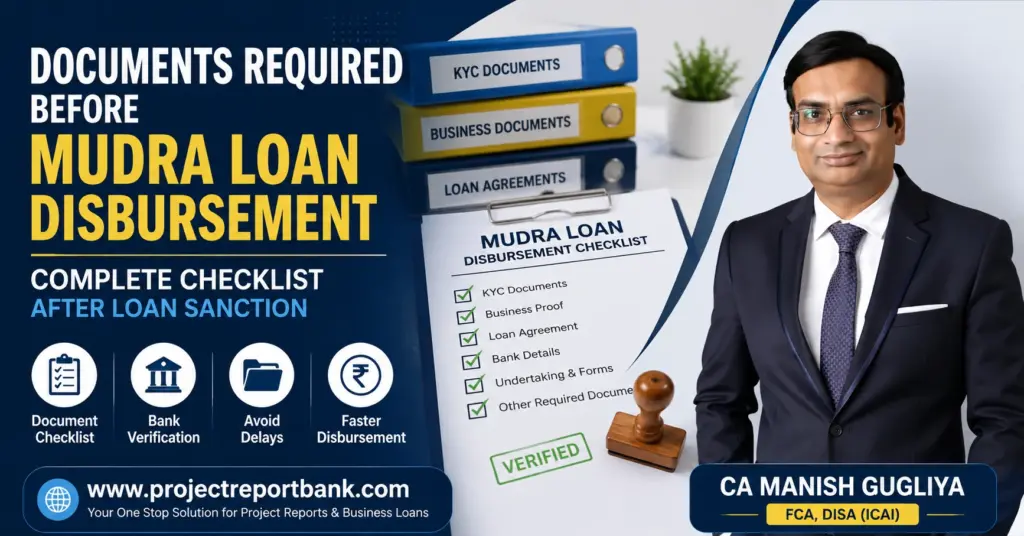
- Documents Required Before Mudra Loan Disbursement: Complete Post‑Sanction Checklist