Key Takeaways
This is a quick safety summary for every Mudra loan applicant. Read these points before you visit any branch.
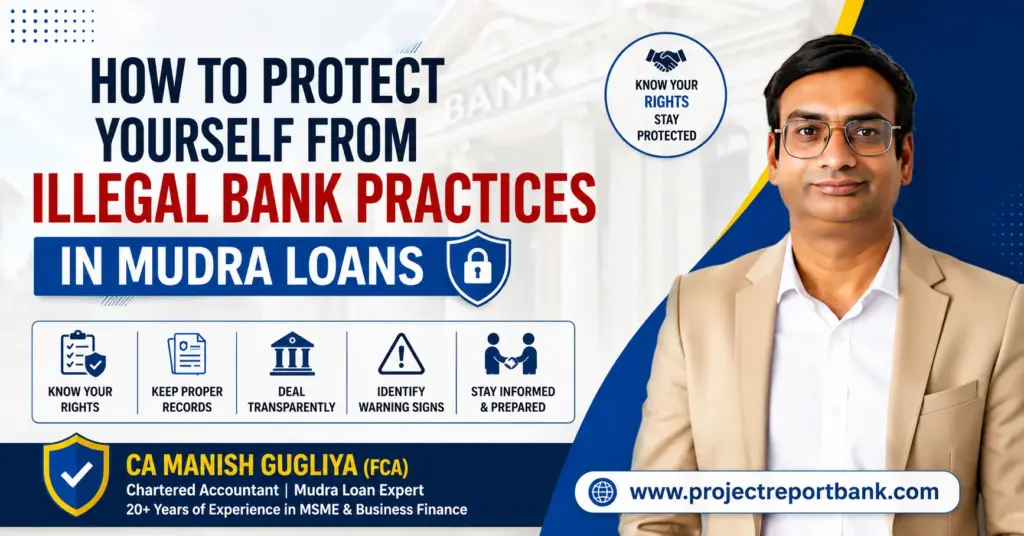
- Awareness and preparation before visiting any bank or financial institution is the strongest protection against illegal bank practices in Mudra loans.
- Never sign blank forms, never rely only on verbal promises, and always demand written communication and acknowledgements for your Mudra loan application.
- Safely preserve copies (physical and digital) of all key documents – application, project report, sanction letter, SMS/emails related to loan amount and terms.
- This article focuses on prevention, not complaint filing. For specific issues like unauthorized fees or collateral demand, linked guides provide detailed coverage.
- Written by CA Manish Gugliya (FCA) of ProjectReportBank.com, based on 20+ years of experience in project reports, CMA data, and MSME finance.
Introduction: Why Applicant Awareness Is Your First Protection
Most first-time entrepreneurs in India do not fully understand how to protect yourself from illegal bank practices in Mudra loans. They walk into branches without knowing what the bank is required to do – and what it is not allowed to do.
Under the Pradhan Mantri Mudra Yojana (PMMY), the government provides financial assistance to micro enterprises through categories like Shishu (up to ₹50,000), Kishore (₹50,001 to ₹5,00,000), Tarun (₹5,00,001 to ₹10,00,000), and Tarun+ loans that can go up to ₹20,00,000 for eligible borrowers. These are collateral-free loans extended through public and private banks across India.
Most bank officers are honest professionals. But sometimes, mistakes, non-compliance with guidelines, or fraudulent middlemen can cause real harm to applicants who have no written records. This guide will not discuss complaint procedures or the Ombudsman process in detail. Instead, it will teach you awareness, documentation, verification, and safe communication practices – the habits that prevent problems before they start.
At ProjectReportBank.com, we prepare project reports and CMA data for Mudra loan applicants regularly, and these recommendations come from real cases handled over 20+ years of MSME finance consultancy by CA Manish Gugliya (FCA).

Table of Contents
Why Prevention Is Better Than Fighting Illegal Bank Practices Later
Once a problem occurs – say, an extra charge deducted or an unfair delay – resolving it takes time, energy, and sometimes legal help. Prevention, on the other hand, is simple and almost free.
Maintaining clear written documentation from your first visit to the bank makes your position far stronger if any dispute about Mudra loan terms or loan amount arises later. For small entrepreneurs who already juggle business operations, suppliers, and customers, prolonged banking disputes create unnecessary mental stress.
Transparency – asking questions, requesting written confirmations, and reading forms before signing – helps both you and the banker avoid misunderstandings. RBI and PMMY guidelines expect banks to follow fair, transparent processing. Prepared applicants who keep acknowledgement slips, emails, and SMS records help ensure those rules are followed in daily practice.
When you understand whether RBI circulars are legally binding for Mudra loans, you approach the process with knowledge rather than guesswork. This is a reference point that keeps your interactions grounded in facts.
Common Warning Signs Every Mudra Loan Applicant Should Notice
Warning signs do not always mean fraud. But they should immediately make you more careful, more alert, and more focused on documentation.
Verbal-only promises. If a bank officer gives you verbal assurances about interest rate, processing time, or compulsory insurance but refuses to put anything in writing, treat this as a red flag. Always request email or SMS confirmation.
No written acknowledgement. Refusal to give a written acknowledgement for your Mudra loan application – or giving one without a date and reference number – is a major warning sign. Under RBI norms on application acknowledgement, banks must provide stamped receipts with serial numbers.
Repeated, unexplained document changes. If the branch keeps asking for different documents (PAN, Aadhaar, project report, quotations, bank statements) without a clear reason, note each request with the date. This could signify processing confusion or an attempt to delay.
Blank papers or incomplete forms. Never sign blank forms, blank sanction formats, or incomplete applications. Even if the officer is in a hurry, verify every detail – loan amount, tenure, purpose, and business name – before signing.
Refusal to communicate in writing. If staff will not respond via email, SMS, or written note about basic issues like receipt of your application or stage of processing, strengthen your own records immediately.
Other red flags to watch for:
- Any requests for cash payments without receipts should raise suspicion of scams. Fraudsters ask for upfront fees to release loans, which is illegal.
- Scammers send fake loan approval letters promising large sums through SMS or WhatsApp. Fraudsters also impersonate government officials or bank agents to steal money.
- If a bank requests collateral for a standard Mudra loan, this violates RBI norms, and a complaint can be filed.
- Fraudsters use fake documents to cheat Mudra loan applicants, as seen in recent CBI-investigated cases.
For detailed coverage of specific issues like unauthorized fees or processing delays, refer to our dedicated guides.
Practical Ways to Protect Yourself During Mudra Loan Processing
This is the main action section. These step-by-step practices apply whether you are applying for Shishu, Kishore, or Tarun categories – whether the loan amount is ₹50,000 or ₹10,00,000. Each sub-section below covers one practical habit you should build before and during your Mudra loan application at any bank or financial institution.
Always Keep Written Records
From your very first branch visit, write down the date, officer name, branch name, and a summary of the conversation in a notebook or phone note.
Even a small entry like “On 12-08-2026, submitted Mudra loan application for ₹3,00,000 at XYZ Bank, spoke to Mr. A about required documents” can later support your version of events. Keep screenshots of net-banking messages, online form submissions, and portal confirmations. These details become your evidence trail.
Request Written Communication
Politely ask the branch to send email or SMS updates at major steps – receipt of application, request for additional documents, sanction, or rejection. Written records protect both sides.
After each branch visit, consider drafting a short email summarizing what was discussed, and requesting the officer to confirm or correct. This creates a clear communication trail that links back to your timely communication rights as a borrower.
Keep Copies of Every Document
It is advised to keep copies of all loan-related documents submitted. This includes:
- Application form and KYC documents
- Project report, CMA data, and business plan
- Quotations, invoices, and bank statements
- Any extra declarations demanded by the bank
Keep both physical photocopies and scanned digital copies (Google Drive, email attachment, or pen drive), labeled with dates. This becomes crucial evidence if there is any dispute about what you actually submitted.
Submit Complete Documentation
Incomplete files lead to unnecessary delay and create room for confusion. Before visiting the branch, ask for a clear, written checklist of all required documents for your Mudra loan.
When you submit a batch of documents, attach a simple cover letter listing all enclosed papers. Ask the officer to stamp and return a copy of that list. This one step can prevent many future misunderstandings about paperwork.
Record Important Dates
Maintain a simple date-wise timeline: application submission date, additional document submission dates, site visit date, and sanction or rejection date.
If processing crosses a reasonable timeline, your date record allows you to politely request a status update. The RBI/PMMY expectations on fair processing set clear time norms that banks must follow, and your records help you hold them accountable.
Verify Information Before Signing
Before signing any Mudra loan document, carefully verify all filled-in data – your name, address, business details, loan amount, interest rate, tenure, and repayment mode.
A wrongly entered loan amount or tenure could create serious repayment burden. For example, if the form says 24 months instead of 36 months, your EMI jumps significantly. Corrections are easiest before signing – almost impossible after.
Never Pay Unofficial Charges
Any payment related to Mudra loans should be made only through official modes – cheque, bank transfer, or cash at the counter – with printed receipts mentioning the exact purpose. Loan processing fees must be officially disclosed by lenders according to RBI regulations.
Never pay any person – inside or outside the branch – without an official receipt. Verify loan offers to avoid paying fake processing fees. For detailed scenarios about unauthorized fees in Mudra loans, refer to our dedicated guide.
Understand the Loan Process Before Applying
Before submitting any documents, read the basic PMMY scheme details and the mandatory RBI/PMMY guidelines for banks. This way, you know what is standard and what is unusual.
No middlemen are authorized to process Mudra loans. Applicants should apply directly through official public or private banks. Scammers create fake websites to trick individuals into divulging personal information. Use reliable sources like ProjectReportBank.com’s guides rather than depending solely on agents or informal advice from unverified sources. Mudra Ltd does not directly sanction loans to individuals.
Read Every Form Carefully
No applicant should sign quickly just because the branch is crowded. Reading all pages calmly is a basic protection against hidden conditions.
Check for additional products (insurance, credit cards) or clauses that are not compulsory for PMMY loans. Check for official logos to identify legitimate Mudra loan documents. If unsure about any clause, ask the officer to explain in writing or refer you to official circulars about the scheme.
Stay Calm and Professional During Interactions
Polite, professional behaviour makes it easier to request acknowledgements, written clarifications, and corrections without conflict. An applicant who is calm and informed is taken more seriously.
Avoid arguments. Instead, calmly restate your requests and, if necessary, escalate through proper written channels with supporting records. If you face unprofessional bank behaviour, our separate guide explains how to handle it. This article focuses on prevention.

Documents Every Mudra Loan Applicant Should Preserve
Documentation is not just for audits or complaints. It is for self-protection and for proving your honest intention and cooperation with the lender.
Here is what you should preserve:
- Application form and acknowledgement slip – with tracking number, date, and branch seal
- Project report, CMA data, and business plan – ProjectReportBank.com specializes in preparing these, and a well-prepared report also reduces processing queries about your proposed activity, cash flow, and capital assets
- Quotations and invoices for machinery, stock, or equipment – these show how the loan amount was planned to cover funding for assets created in the enterprise
- Bank statements submitted to demonstrate your credit history and whether you have successfully repaid previous loans or have a satisfactory credit track record
- Email communication, SMS alerts, and official WhatsApp messages relating to application status, sanction, or conditions – take screenshots with visible dates
- Sanction letter or rejection letter – including interest rate, margin, repayment schedule, and any conditions; scan and back these up digitally
Keep all these records in a labeled physical file plus a cloud folder. This drastically improves your ability to answer any future queries from the bank or authorities about the loan extended to your beneficiary micro unit.
Applicant Protection Checklist (With Practical Tables)
Use this checklist every time you apply for a Mudra loan at any bank. You can print it and carry it to the nearest branch.
Protection Checklist Table
| Before Applying | During Processing | After Decision |
|---|---|---|
| Read PMMY scheme details and bank’s Mudra loan FAQ | Demand written acknowledgement with date and serial number | Verify sanction letter details (rate, tenure, amount) |
| Prepare complete documents per bank’s checklist | Keep copies of every document submitted | Preserve sanction or rejection letter (physical + digital) |
| Understand your acknowledgement rights | Record dates of every interaction | Check first EMI deduction against agreed terms |
| Confirm no collateral is required for loan up to ₹10 lakh | Request email/SMS updates at each stage | Back up all communication in cloud storage |
| Know that no unofficial charges are permitted | Never sign blank or incomplete forms | Report any mismatch immediately in writing |
Situation vs Safe Practice vs Why It Helps
| Situation | Safe Practice | Why It Helps |
|---|---|---|
| Officer asks you to sign blank form | Refuse politely; ask to fill all fields first | Prevents wrong terms being added later |
| Asked for cash payment without receipt | Decline; pay only through official modes with receipt | Protects against unofficial charges and fraud |
| No acknowledgement given | Request stamped receipt; cite RBI norms | Creates proof that bank received your application |
| Verbal promise about interest rate | Ask for written or email confirmation | Ensures the promised rate is legally recorded |
| Agent offers “fast approval” for a fee | Apply directly at the bank; avoid middlemen | No middlemen are authorized for Mudra loans |
Red Flag vs Safe Practice
| Red Flag | Safe Response |
|---|---|
| Blank forms handed for signature | Fill or verify every field before signing |
| Verbal-only promises on loan terms | Request email or written letter confirmation |
| No acknowledgement receipt provided | Ask for stamped copy; note officer name and date |
| Demand for upfront payment via personal account | Refuse; use only official payment channels |
| Agent claiming “direct approval from MUDRA” | Ignore; apply only through official banks |
| Unknown SMS/WhatsApp offering pre-approved loan | Do not click links; verify with branch directly |
Mistakes That Make Mudra Loan Applicants Vulnerable
Many problems with illegal bank practices become easier only because applicants unknowingly make avoidable mistakes.
- Trusting verbal promises about interest rate, loan amount, or guaranteed sanction. Always insist on written or email confirmation. A verbal assurance has no legal standing.
- Losing paperwork or submitting original documents without keeping any copy. This makes it nearly impossible to prove what you gave to the bank or financial institution.
- Paying agents in cash for “faster Mudra loan approval” without official receipt. Sensitive documents should not be shared in response to unsolicited requests. Cybercriminals can use downloaded apps from unverified sources to hijack data – so be careful about digital sharing too.
- Signing incomplete forms or allowing someone else to fill your form without checking every field, especially the loan amount, nature of business, and security details.
- Depending on informal agents or unverified online videos instead of checking official guidelines. No middlemen are authorized to process Mudra loans. Use reliable sites like ProjectReportBank.com that summarise RBI/PMMY rules in simple language.
- Not cross-verifying unusual demands. If something feels off, check with another branch, the bank’s website, or RBI circulars rather than blindly following instructions. Keep personal contact details, OTPs, and banking information private at all times.
Smart Habits That Reduce Future Problems in Mudra Loans
Safe banking is not a one-time activity. It is a set of habits that protect you across all loans – not just your current Mudra loan.
- Read financial documents regularly. Develop the habit of reading key parts of every form and letter. When checking your Mudra loan sanction letter feels natural rather than difficult, you are already safer than most borrowers.
- Re-check loan statements and EMI deductions regularly after disbursement. If any deduction does not match the agreed terms, you catch it early. Detailed fee issues are covered in a separate article, but the habit of checking starts here.
- Back up everything in two places. Keep a physical file and a cloud folder (Google Drive or email). Review them once in a while so you remember where everything is stored. This protects individual borrowers and micro enterprises engaged in trading, manufacturing, or services equally.
- Maintain a finance diary. A simple spreadsheet where you note all your loans – Mudra loan amount, interest, start date, and EMI – prevents confusion later. This is especially helpful if you have availed a term loan or any previous loans from other lenders.
Informed, organized applicants who undertake these habits are far less likely to be victims of illegal bank practices in Mudra loans. Understanding your rights through guides on RBI/PMMY guidelines and bank responsibilities makes this a continuous learning process, not a one-time effort.

FAQs: Preventive Protection for Mudra Loan Applicants
These FAQs answer additional preventive questions in simple Q&A style. For specific complaint procedures, refer to our linked detailed guides.
How can I protect myself during Mudra loan processing if I am a first-time borrower?
Carry photocopies of every document, demand a written acknowledgement with a date and serial number, and take notes of every discussion. Refuse to sign blank forms and read every page slowly before signing, even if the branch is crowded. Following the applicant protection checklist in this article gives first-time entrepreneurs a ready-made framework. If you possess the necessary skills for your proposed activity and submit a complete application assessed based on clear eligibility criteria, the process becomes smoother. You can call 1800 209 000 to report suspicious Mudra loan activities if anything feels wrong.
Why is written acknowledgement of my Mudra loan application so important?
An acknowledgement with a date and reference number proves that the bank officially received your application. It starts the timeline for fair processing under RBI/PMMY norms. If a branch hesitates, politely refer to the RBI’s Master Direction on Lending to the MSME Sector, which makes written acknowledgement mandatory. This small document can signify the difference between having evidence and having nothing if a dispute arises at the next phase of processing.
What documents should I preserve to stay safe if any problem arises later?
Preserve: filled application form, acknowledgement, KYC, project report, quotations, bank statements, sanction or rejection letters, and all SMS/emails related to the Mudra loan. Keep both physical and digital copies. These documents cover everything from your educational qualification declarations to the details of capital assets being funded. Refer to the “Documents Every Applicant Should Preserve” section above for the complete list.
Is it safe to rely only on verbal assurances given by bank staff about my Mudra loan?
No. Always seek written confirmation – email, SMS, or notes in the sanction letter – for important points like interest rate, tenure, security requirements, and any compulsory products. If the staff only spoke verbally, send a polite summary email after the meeting asking them to confirm or correct. This creates a written record that protects both the applicant and the bank. Complaints can be escalated to the RBI Ombudsman if a bank’s practices are unfair, but prevention through written records is always the better first step.
How does this guide on how to protect yourself from illegal bank practices in Mudra loans connect with other detailed articles?
This article is the main prevention and applicant-safety guide – the hub for the entire cluster. Separate linked articles on ProjectReportBank.com cover specific issues like unauthorized fees, collateral demand, processing delays, and unprofessional bank behaviour in much greater depth. Follow all preventive steps explained here first. Then explore the linked guides for topic-wise clarity whenever you notice a specific warning sign during your Mudra loan journey. The scheme is designed to support non corporate small enterprise owners and individuals seeking credit for employment creation and business growth – and these guides help you access that funding safely.
Conclusion, Key Takeaways, and Disclaimer
Informed, organized applicants who document everything, verify information, and communicate in writing are far less likely to suffer from illegal bank practices in Mudra loans. The central idea of how to protect yourself from illegal bank practices in Mudra loans comes down to preparation – not confrontation.
Key Takeaways:
- Never sign blank forms or incomplete applications, regardless of how rushed the branch feels.
- Always demand a written, stamped acknowledgement for every application and document submission.
- Preserve all documents – application, project report, sanction letter, SMS, emails – in both physical and digital form.
- Avoid all unofficial payments; if there is no printed receipt, do not pay.
A note from CA Manish Gugliya (FCA): With over 20 years of experience in project reports, CMA data, and MSME finance through ProjectReportBank.com, I can assure you that these recommendations come from real Mudra loan cases. An applicant who is aware of the process and maintains proper records rarely faces serious problems. Your knowledge and your records are your guarantee.
Disclaimer: This article is for educational and preventive guidance only. It is not legal advice. For specific disputes or legal situations, consult a qualified professional or approach the appropriate authorities directly.
Explore more Mudra loan guides on ProjectReportBank.com – from understanding your rights to preparing strong project reports that improve your eligibility and speed up processing.
- Mudra Loan Illegal Bank Practices: Complete Guide to Identify, Prevent & Report Unfair Banking Practices


- Can Banks Change Mudra Loan Terms Without Informing the Applicant?
- Red Flags That Indicate Unfair Bank Practices in Mudra Loans: Warning Signs Every Applicant Should Know

- What Evidence Should You Collect If a Bank Violates Mudra Loan Rules?
- How to Report Illegal Bank Practices in Mudra Loans
- How to Protect Yourself from Illegal Bank Practices in Mudra Loans
- How to Identify Illegal Bank Practices During the Mudra Loan Process
- Is It Legal for Banks to Delay Mudra Loan Processing Without Reason?
- Are Banks Allowed to Charge Unauthorized Fees for Mudra Loans? Complete Guide by CA Manish Gugliya