
Key Takeaways
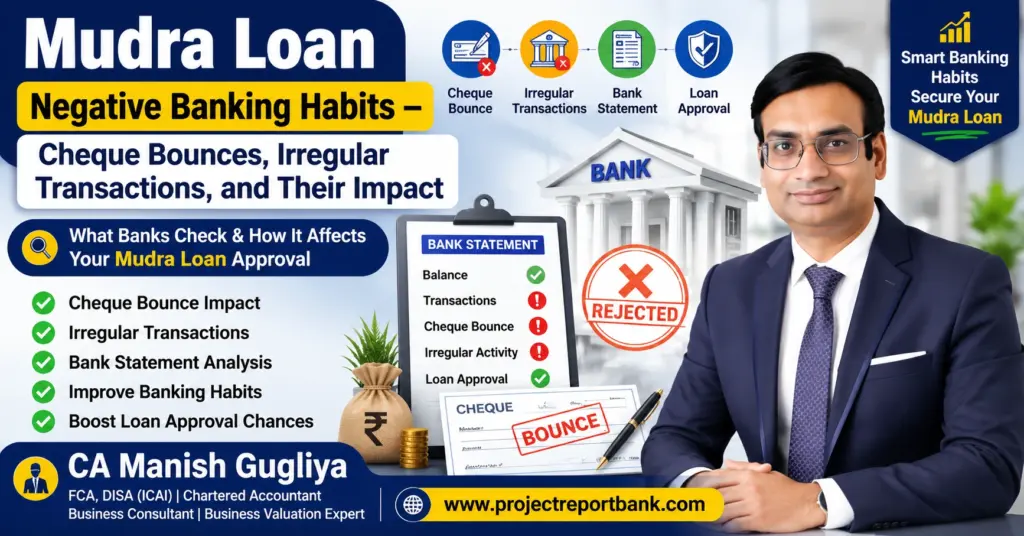
- Under Pradhan Mantri Mudra Yojana, banks evaluate not only your CIBIL score but also day-to-day banking behaviour visible in your last 6–12 months of bank statements.
- Negative banking habits can hinder the approval process for a Mudra loan – frequent cheque bounces, ECS/EMI returns, very low average balance, excessive cash deposits or withdrawals, and irregular business transactions commonly lead to rejection or a reduced loan amount.
- Mudra loans are categorized into Shishu (upto rs 50,000), Kishore (₹50,001 to ₹5,00,000), and Tarun (₹5,00,001 to ₹10,00,000), and scrutiny increases with the loan amount requested.
- Good habits like maintaining sufficient balance, regular business credits, digital payments, and clean statements for at least 3–6 months before application can significantly improve approval chances.
- This guidance is based on practical experience of CA Manish Gugliya in preparing Mudra loan project reports and handling real bank sanctions and rejections since 2015.
Introduction – Why Banking Habits Matter More Than You Think
Many entrepreneurs assume that a decent CIBIL score and complete documents are enough to get a Mudra loan approved. In reality, a large number of applications under PMMY get delayed or rejected because of what banks call “negative banking habits.”
For Mudra loans – which are collateral-free and unsecured, designed to support micro enterprises in various sectors – banks rely heavily on your recent bank statements. Your CIBIL score only shows how you handled past loans and credit cards. But banking behaviour – cheque bounces, average balance, cash handling, irregular transactions – tells the lender how you manage money daily. Banks look for steady income in bank statements when assessing loan applications, and that daily discipline matters more than most applicants realise.
The scheme was launched on April 8, 2015, and MUDRA Yojana aims to generate employment and income across india. As CA Manish Gugliya, with over 20 years of experience in MSME finance, project reports and bank appraisals, I have seen hundreds of cases where banking behaviour alone decided the fate of an otherwise strong application.
Table of Contents
What Do Banks Mean by “Banking Behaviour” in Mudra Loans?
Banking behaviour is the overall pattern of how you operate your current or savings account, especially during the last 6–12 months before your Mudra loan application. It covers daily account operation, account discipline, transaction consistency and cash flow management.
In practice, this means banks want to see regular deposits from sales, timely payments to suppliers, rent, salary and utility bills routed through your bank account – not handled entirely in cash. They check whether your monthly turnover is reasonably stable rather than showing big sudden spikes just before applying for a business loan.
Irregular cash flow in bank statements indicates financial instability, and using personal accounts for business transactions complicates loan approval because the lender cannot separate household spending from business credibility. A well-run statement convinces bank officials that the enterprise is genuine and can handle Mudra loan EMIs without default.

Why Banks Closely Examine Bank Statements for Mudra Loan
For Mudra loans – especially from ₹2 lakh to ₹10 lakh – most banks ask for 6 to 12 months of bank statements and study them closely. Lenders require bank statements to assess turnover for Mudra loans and judge how safely the sanctioned amount can be recovered from future business cash flows.
Repayment behaviour is judged from previous EMIs, ECS mandates, credit card payments and any existing business loans reflected in your accounts. Having too many active loans raises a borrower’s debt-to-income ratio, which directly impacts approval. Lenders check for high existing debt before extending new credit.
Bank officials typically observe average monthly balance, frequency of cheque or ECS returns, the mix of cash versus digital transactions, end-of-month balances, and whether deposits match declared turnover in ITR or GST returns. For example, if your GST shows ₹3 lakh monthly turnover but bank credits are only ₹80,000, that turnover mismatch will raise questions immediately.
Negative Banking Habits That Commonly Lead to Mudra Loan Rejection
Even one or two of these issues, if repeated, can cause the bank to reject, postpone or sharply reduce the requested loan amount.
- Frequent cheque bounces: Multiple bounced cheques indicate poor financial management. If you have 3–4 cheque returns within 6 months – especially for recurring payments like rent or supplier invoices – banks treat this as a strong negative signal.
- ECS or EMI bounce: Auto-debit failures on existing loans or credit cards create serious doubt about repayment capacity. Failure to repay previous loans is a red flag for lenders, and approval for Mudra loans may be denied if a borrower has defaults on previous loans.
- Very low average balance: Maintaining low or inconsistent banking activity affects loan eligibility. An average balance below ₹2,000 while requesting a ₹5 lakh Mudra loan signals extremely tight cash flow.
- Irregular business transactions: Two months of zero activity followed by sudden heavy deposits just before application is interpreted as “window dressing.” Banks see through this quickly.
- Excessive cash deposits and withdrawals: Large frequent cash deposits without supporting GST invoices, followed by immediate cash withdrawals, make the bank doubt whether declared turnover is genuine.
- Large unexplained credits: Third-party transfers, one-time lump sums from family or temporary funds parked for statement purposes – banks will ask for proof and explanation.
- Inactive or dormant account: If the business account shows almost no activity for 3–6 months, bankers assume the business is not running at the scale claimed in the project report.
- Frequent overdrafts and returned payments: Regular negative balances and failed supplier payments show stress. Inconsistencies in financial records can delay or result in rejection of loan applications.
Lenders may conduct additional verification if they find multiple risk factors in the same account, making the processing timeline even longer.

Positive Banking Habits That Improve Mudra Loan Approval Chances
Even if past behaviour was weak, 3–6 months of improved, disciplined banking before applying can change the bank’s decision. Regular banking transactions improve the chances of Mudra loan approval – here is what works:
- Adequate balance: Keep a cushion of at least 1–2 EMIs worth of amount so cheques and ECS mandates do not fail.
- Regular business transactions: Maintain steady monthly credits that match the scale of your business. Avoid long gaps. Route sales and expense payments through the account.
- Timely cheque and EMI clearance: Set reminders, use auto-debit with sufficient funds, and immediately clear any bounced transaction if it happens once.
- Business-only transactions: Do not mix heavy personal spends (festivals, jewellery, vacations) in your main business account – this confuses the underwriter.
- Digital payments and GST-linked banking: Use UPI, POS machines and bank transfers from regular customers. Reflect GST-paid invoices in the same bank account to strengthen your business trail.
- Monthly reconciliation: Review your statement every month. Keep narration clear. Preserve proofs for any large credit or debit so you can justify them when the banker asks.
Good banking behaviour leads to easier sanction, smoother documentation, and often the full requested loan amount instead of a reduced figure.
Practical Questions: Cheque Bounces, Statement Period & Genuine Difficulties
Entrepreneurs often worry that a single mistake will close the door. Banks look at patterns, not one-time human errors.
Does one cheque bounce mean automatic rejection? No. One isolated bounce in 6–12 months, quickly cleared with charges and a reasonable explanation, is usually ignored. But 3 or more cheque or ECS returns within a short period – especially for EMIs or rent – are treated as clear negative banking behaviour.
How many months of statement do banks check? Typically 6 months for smaller Shishu and Kishore loans, and 12 months for larger Kishore and Tarun category amounts. Low CIBIL scores below 650 can result in loan denial, and lack of awareness about eligibility criteria causes many rejections even before statement review begins. If you want to improve your CIBIL score before applying, start at least 6 months early.
How do banks handle seasonal businesses? If your business is genuinely seasonal (ice-cream, coaching centres, tourist shops), documents like ITR, GST returns and a realistic project report supporting seasonality can help. Open discussion with the banker, backed by evidence, helps differentiate genuine issues from careless account handling.
Common Banking Mistakes by Mudra Loan Applicants & How to Fix Them
Most problems in bank statements are avoidable if entrepreneurs address them at least 3–6 months before applying.
- Using personal savings account for business: Mixing household and business transactions confuses lenders. Shift regular business turnover to a dedicated current or business account.
- Irregular banking and heavy cash dealings: Depositing all sales once a month or keeping most collections in cash hides true turnover. Use more frequent smaller deposits and digital modes for regular customers.
- Unexplained credits: Maintain simple notes or confirmation letters for large support amounts from relatives or partners. Produce these if the bank asks during appraisal.
- Ignoring small bounce charges: Even ₹200–₹500 bounce entries appearing repeatedly tell the banker that you are careless with balance management.
- Not checking statements: Review your statement monthly to spot and correct errors, duplicate debits or wrong entries before the application is filed. Incomplete documentation leads to immediate rejection of Mudra loan applications.
Banks may discourage applicants due to processing small loans, and delays in processing can take weeks without updates – clean statements reduce these friction points significantly.
Actionable Checklist Before Applying for Mudra Loan
Follow this for at least 3 months before submitting your application:
- Maintain an adequate average balance throughout the month – not just on statement dates. Keep at least ₹10,000–₹25,000 depending on expected EMI.
- Eliminate cheque and ECS bounces completely by planning payment dates and monitoring SMS alerts.
- Route maximum business receipts through bank (UPI, NEFT, RTGS, POS) and match them with sales records or GST returns.
- Avoid sudden artificial “window dressing” deposits. Maintain consistent deposits that reflect real business scale.
- Keep supporting documents ready for unusual entries – one-time family support, machinery advance, security deposit – so banker queries are answered confidently.
- Get a realistic project report prepared by an experienced CA. CA Manish Gugliya through Project Report Bank can help align projections with actual banking patterns and improve eligibility.

Real-Life Style Case Study & Myths vs Reality
Rajesh runs a small mobile repair shop in Indore with monthly cash sales of around ₹1.5 lakh. He applied for a ₹3 lakh Mudra Kishore loan but was initially declined. His bank statement showed most income handled in cash, mixed in a personal savings account, frequent cash withdrawals, average balance below ₹3,000, and two cheque bounces for shop rent.
The banker advised him to open a proper current account, route at least 60–70% of sales through bank, and avoid cheque bounces for 3 months. After following this advice and getting a proper project report prepared, Rajesh received his ₹3 lakh Mudra loan. According to the MSME Know Your Lender handbook, lender risk models now heavily use objective transactional behaviour – and Rajesh’s case proves it.
Common myths corrected:
- “One cheque bounce always causes rejection” – Banks look at patterns, not isolated slips. One bounce with quick resolution is usually fine.
- “Only CIBIL score matters” – Banking behaviour, turnover verification and site inspection carry equal or greater weight in Mudra loan decisions.
- “Cash deposits are never allowed” – Cash is acceptable where the nature of business justifies it (street vendors, small traders), but documentation and consistency matter.
- “Personal and business accounts can be freely mixed” – Using personal accounts for business transactions complicates loan approval because lenders cannot separate personal from business spending.
Steady improvement in banking behaviour over months matters far more than trying to “fix” statements in the week of application. Mudra loans offer up to ₹20 lakh for micro enterprises under the extended facility, and the categories – Shishu loans up to ₹50,000, Kishore loans from ₹50,001 to ₹5,00,000, and Tarun loans from ₹5,00,001 to ₹10,00,000 – each signify a different stage of business growth and a different level of banking scrutiny.
Frequently Asked Questions on Banking Habits & Mudra Loans
Below are practical doubts not fully covered above, with brief and straightforward answers.
Does a cheque bounce in my salary or personal account affect Mudra loan?
Banks mainly focus on the account proposed for EMI repayment and your principal business account. However, serious or repeated bounces in any savings account with the same bank may also be considered, especially if EMIs or credit card dues are involved. The borrower should ensure all linked accounts show discipline.
Can I apply for Mudra loan if my account was inactive for a few months?
A recently activated account with only 1–2 months of activity makes lenders uncomfortable. Maintain at least 3–6 months of regular operations before applying. If your business is seasonal, provide supporting documents like GST returns and trade contracts to explain the gap, and submit a well-prepared business plan with your application.
Is it compulsory to have a current account for Mudra business loans?
Many banks prefer or insist on a current account for business transactions, especially for GST-registered micro and small enterprises. However, very small proprietors with business registration at the Shishu level may sometimes be considered with a well-operated savings account if transactions are clearly business-related and the applicant can provide adequate proof of trading activity.
How long should I maintain good banking behaviour before applying?
For very small Shishu loans, clean banking for at least 3 months may be sufficient. For higher Mudra loan amounts – Kishore and Tarun categories – maintain disciplined banking for 6–12 months. This is your reference point for when to start preparing.
Can professional guidance really change the bank’s decision?
In practice, a well-prepared project report, realistic maximum loan amount, and properly explained bank statement entries often convert borderline cases into approvals. Eligible borrowers who present professionally documented applications with accurate CMA data and aligned financial projections stand a significantly better chance. CA Manish Gugliya and Project Report Bank specialise in this type of support for entrepreneurs across manufacturing, trading and services sectors, helping them assess and fill gaps before the form reaches the bank.
- Can Bank Reduce Mudra Loan Amount Without Your Consent? Complete Practical Guide (2026)


- How Long Can a Bank Legally Keep a Mudra Loan Application Pending? (2026 Complete Guide)

- Mudra Loan Delayed for Months: Your Rights, Timelines & Complaint Options (2026 Guide)

- Can a Bank Force You to Open a Current Account for Mudra Loan? Complete Legal Guide (2026)

- Can a Bank Refuse to Accept a Mudra Loan Application? Complete Guide (2026)

- What to Do If You Cannot Pay Your Mudra Loan EMI (2026 Guide)

- Cross-selling by Banks During Mudra Loan – What Is Optional? Complete Practical Guide (2026)

- Is Insurance Compulsory with a Mudra Loan? Complete Guide (2026)

- Can a Bank Refuse a Mudra Loan Because the Target Is Completed? Complete Guide (2026)

- Mudra Loan Eligibility 2026: Complete Guide by CA Manish Gugliya

- Is Guarantor Mandatory for Mudra Loan? (2026 Complete Guide by CA Manish Gugliya)

- Can a Bank Legally Ask for Security in a Mudra Loan 2026 ?
- Bank Refused My Mudra Loan Application – What Are My Rights?

- Mudra Loan for Used Vehicles (2026): Eligibility, Documents, Bank Rules & Complete Guide

- Rejected Mudra Loan – What to Do Next? Appeal Process Explained (2026)
