Introduction – Mudra Loan, GST Turnover & Mismatch Problems
If you are applying for a Mudra loan today, understand one thing clearly: the bank officer sitting across the table is not just looking at your application form. Before sanctioning even a ₹2 lakh loan, that officer is comparing your GST returns, bank statements, ITR, financial statements, and project report side by side. GST mismatches occur when reported data does not align across these documents, and that single inconsistency can stall your entire loan application.
Between 2017 and 2026, this three-way matching – GST returns (GSTR-1, GSTR-3B), income declared in ITR, and 12-month bank account credits – has become standard practice at nearly every bank and NBFC processing Mudra loans. Many genuine business owners find their applications delayed or rejected simply because their turnover numbers do not agree across records. A mismatch between GST turnover and loan eligibility can lead to outright loan rejection, even when the business itself is perfectly legitimate.
A mismatch does not always mean fraud. But unexplained differences make any file “high risk” in the eyes of the credit department, leading to reduced loan amount or rejection. In this article, you will learn why mismatches happen, how banks verify GST turnover, what consequences follow when they find discrepancies, and exactly how to fix your records before applying.
I am CA Manish Gugliya (FCA, DISA, MSME finance consultant), and over two decades I have personally handled hundreds of Mudra and MSME loan files where GST turnover mismatch became the central issue. Let me walk you through everything you need to know.
Table of Contents
Understanding GST Turnover – Basic Concepts in Simple Language
When a bank officer says “GST turnover,” they mean the total value of outward supplies your business has reported in GST returns during a financial year. Banks treat this number as a government-verified proxy for business scale – it is harder to fabricate than a self-prepared P&L statement.
Here are the key terms you must understand. Sales means the invoice value of goods or services you sold. Turnover is the total of all such sales in one financial year. Taxable turnover is only that part of sales on which GST is actually payable. Exempt turnover covers items not liable to GST, such as certain health services or agricultural produce. Gross turnover is the total before adjusting discounts, returns, and credit notes. Net turnover is what remains after those adjustments. For example, if your FY 2024–25 gross sales are ₹100 lakh, but you issued credit notes of ₹5 lakh and gave discounts of ₹2 lakh, your net turnover is ₹93 lakh.
Why can these numbers differ from your books? Because GST figures are based on invoicing while ITRs account for actual cash realizations. Timing differences – like March invoices filed in April GSTR-3B – export or exempt supplies, and branch transfers all create legitimate gaps. Banks look at your annual GST turnover from GSTR-3B and compare it with P&L sales and credits in your bank statement. They also check whether input tax credit on purchases reconciles with your purchase register, which indirectly validates whether your sales volume is plausible.

Why Banks Compare GST Returns with Financial Statements for Mudra Loan
After GST launched in July 2017, banks and NBFCs gained access to a third, government-verified data source alongside ITR and bank statements. This changed how banks verify business turnover for Mudra loans fundamentally.
Lenders use GST filings to assess financial health and repayment capacity. An active GST registration with regular filing confirms the business is operational and compliant. The customer and invoice number patterns in GSTR-1 reveal the real scale and nature of operations – whether you serve 5 customers or 500. GST data is considered more reliable than bank statements in lending because it is cross-verified by GSTN against counterparty returns.
Credit risk teams estimate realistic loan amount eligibility using GST turnover, especially across Mudra categories – Shishu (up to ₹50,000), Kishore (₹50,001–₹5 lakh), and Tarun (₹5–10 lakh). Matching GST with P&L helps banks judge profitability and DSCR (debt service coverage ratio) by relating turnover and net profit to proposed EMIs.
Monthly GSTR-3B data shows whether your monthly turnover is stable or seasonal, directly affecting cash flow assessment and EMI viability. GST mismatches can compromise credit assessment for loans when banks see inflated turnover in project reports or “circular sales” between related entities. Discrepancies between GST and Income Tax Returns can signal financial inconsistencies that no bank will ignore. Credit history or existing debt further compounds concerns when turnover data is already inconsistent.
Documents Banks Cross-Check – GST, Financials, Bank Statements & More
Banks never rely on a single document. They build a complete picture using multiple records from the same financial year, typically looking at the last 2–3 years. Every document tells a different part of the story, and most lenders look for consistency across all of them before sanctioning any loan.
| Document | What It Verifies |
|---|---|
| GSTR-1 | Invoice-wise outward supplies, sales pattern, buyer details, trade references |
| GSTR-3B | Summarised monthly turnover and tax paid; main base for annual GST turnover |
| Annual GST Return (GSTR-9/9C) | Overall reconciliation, corrections, aggregate turnover |
| Profit & Loss Account | Total sales, gross profit margin, net profit; viability check |
| Balance Sheet | Capital, stock, debtors, creditors; business strength and existing liabilities |
| ITR | Income declared and tax compliance; cross-checked with P&L and GST |
| Bank Statements (12 months) | Actual inflows/outflows in the bank account; cash flow and turnover matching |
| Project Report & CMA Data | Projected turnover vs historical GST and bank data |
| Sales & Purchase Registers | Detailed invoice-level support for reconciling GST, inward supplies, and input tax credit claims |
Some banks now fetch data digitally via the Account Aggregator framework and Jan Samarth portal, but still insist on PDF statements for file records. Any serious mismatch across these documents leads to clarification letters or demand for a CA-certified reconciliation.
Common Reasons for GST Turnover Mismatch in Mudra Loan Cases
Most mismatches stem from weak bookkeeping, not intentional fraud. But the bank officer reviewing your file cannot assume that without a proper explanation. Common reasons for GST turnover mismatches include timing differences and filing errors – but the list goes much deeper.
Incorrect accounting entries are the most frequent culprit. Recording GST-inclusive invoice amounts as “sales” in your books inflates revenue compared to GST returns, which report net taxable value. Unrecorded cash transactions create opacity in revenue visibility – cash sales not deposited in the bank account or not recorded in books create gaps that no reconciliation can easily bridge. Manual errors can introduce a 1-4% error rate in GST filings, and over 12 months, even small mistakes widen the gap between GST and bank inflows by 1-4%.
Wrong GST filing – typing turnover incorrectly, selecting the wrong tax period, or applying wrong rates – creates immediate discrepancies. Delayed returns or filing NIL GSTR-3B for months when some cash sales actually happened is a common problem for small traders.
Amended returns, credit notes, debit notes, and cancelled invoices affecting one year’s GST but another year’s books create cross-year confusion. Accounting software mistakes such as duplicated invoices or misconfigured tax ledgers add further noise.
Structural issues matter too: March invoices reported in April GSTR-3B, misunderstanding which supplies are exempt versus taxable, and multiple GSTINs under one PAN causing confusion in total turnover. On the project report side, consultants or applicants often guess turnover figures or use copy-paste project reports not aligned with actual GST and bank data – a guaranteed way to trigger objections from the credit department.
How Banks Actually Verify GST Turnover for Mudra Loan
The typical Mudra loan workflow starts at the branch: the officer collects your documents, enters data into the banking software, does preliminary scrutiny, and then either processes or forwards the file to a centralized credit processing cell for verification.
The officer first reviews the loan application form and project report to note proposed turnover and requested loan amount. Financial statements show declared sales and profit. Then comes the critical step: computing annual GST turnover from GSTR-3B summaries for the last 12 months. GST filings must match bank statement deposits for accurate lending – so the officer compares monthly GST turnover with credits in your main business bank account, including cheque and UPI inflows from customers, and the pattern of cash deposits.
Beyond paperwork, banks conduct field investigations – site visits to verify stock, machinery, employees, and whether the business premises match the claimed scale. Basic sales verification involves checking a few invoices against the GST portal and bank entries. For higher-value or suspicious cases, vendor and customer verification through trade references is standard.
Many banks now use automated reconciliation tools that flag months where GSTR-1 and GSTR-3B differ abnormally, or where reported turnover is not supported by bank statements. Automated reconciliation reduces manual errors by up to 70%, and using intelligent matching algorithms minimizes discrepancies further. If GST turnover, books, and 12-month bank statements broadly tally within a small acceptable variance, the bank is comfortable sanctioning the requested loan.
Warning Signs That Make Banks Suspicious
Banks look for patterns, not just one number. Multiple red flags together usually cause either a reduced sanction or outright rejection. Here is what triggers concern.
GST turnover suddenly jumping 3–4 times in the year immediately before applying for a Mudra loan, without matching rise in bank credits or stock, is the classic red flag. Equally suspicious is a sudden sharp fall in sales after disbursement of a previous loan. Monthly GST sales fluctuating wildly without any seasonal logic raises questions about whether the business is real or paper-based.
GST showing steady high sales while bank statements reveal mostly low or NIL credits in the business account creates an obvious gap. Filing NIL returns for several months while claiming good turnover in the project report is contradictory. Large cash deposits appearing just before submitting bank statements, without corresponding GST invoices, suggest manipulation.
Round figure turnover – exactly ₹50.00 lakh every year with no variation – unsupported by detailed invoices looks fabricated. Input Tax Credit claims can be suspended due to mismatches between purchases declared in returns and actual payment evidence in bank statements, signalling possible fictitious invoicing. When these patterns appear alongside thin profits or inconsistent ITR income, banks treat the profile as high risk. For unsecured Mudra loans, this typically means drastic reduction in the sanctioned amount or rejection. A 30% divergence between GST and bank turnover triggers loan rejection at most branches.
Real-Life Style Case Studies of GST Turnover Mismatch
These anonymised examples reflect how banks actually think and what corrections helped in real Mudra applications.
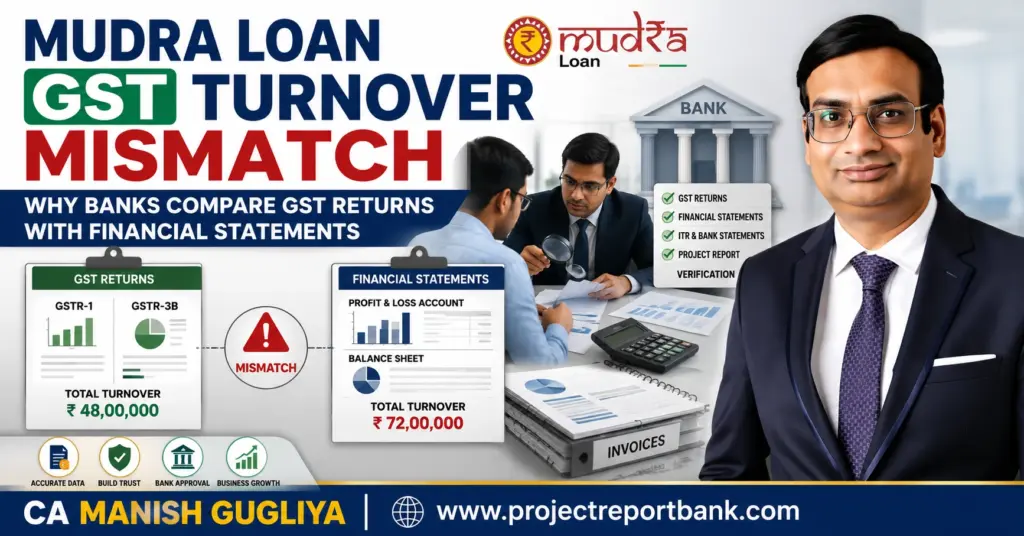
Example 1 – GST Lower Than Books: A small trader’s GSTR-3B showed annual taxable turnover of about ₹48 lakh for FY 2023–24. However, financial statements showed ₹72 lakh in sales. The gap existed because exempt supplies were not segregated in books, and March invoices were recorded in the books but filed in the April GST return. The bank put the loan on hold and asked for a reconciliation and CA certificate. After the applicant prepared a clear reconciliation statement explaining the timing differences and exempt supply breakup, the bank eventually sanctioned the loan – but reduced the loan amount by about 15%.
Example 2 – Perfect Match, Fast Approval: A proprietor had FY 2022–23 GST turnover of ₹32 lakh, P&L sales of ₹31.50 lakh, and bank credits of about ₹30 lakh. Minor differences were explained by small cash sales and collections from old debtors. The bank cleared verification quickly and approved a Mudra loan of ₹7.5 lakh with minimal delay. Consistent data across records made this possible.
Example 3 – Unrealistic Projections: A business with average GST turnover of ₹20 lakh over three years submitted a project report showing ₹80 lakh projected turnover in the first year. The bank asked for supporting orders, contracts, and trade references. Lacking them, the bank sanctioned a much lower amount aligned with plausible growth.
Example 4 – Multiple Bank Accounts: An applicant’s turnover was spread across two current accounts but only one bank statement was submitted. The bank found a mismatch between GST turnover and visible bank credits. After submitting all bank statements and a reconciliation note, the suspicion cleared and the loan moved ahead.

Consequences When GST Turnover and Records Don’t Match
Mismatch itself is not a crime. But not being able to explain it properly triggers adverse lending decisions that cost you time, money, and credibility.
The first consequence is delay. The bank sends a clarification letter or calls you and your CA for explanation, asking for detailed reconciliation of GST versus books versus bank statements. Lenders may require additional documentation to clarify discrepancies in GST returns – sales register, purchase register, stock statements, and sometimes a CA-certified turnover certificate.
Loan processing shifts to “pending for clarification,” easily delaying sanction by 2–6 weeks. For Mudra loans under schemes with strict timelines, such delays can push your case into the next quarter. Mismatches exceeding 5-10% can lead to reduced loan amounts, with banks computing income on a conservative basis – typically taking the lower of GST or bank credits. Mismatches can lead to compliance risks and financial penalties from tax authorities as well, compounding problems beyond the loan.
In serious cases, the application gets marked “high risk” and rejected, especially if GST registration is suspended or the ITC pattern appears fraudulent. You may need to re-apply after correcting returns and updating financial statements, often in the next financial year. Every avoidable mismatch costs both time and reputation, affecting future credit limits and enhancements with that bank. Understanding the full reasons for Mudra loan rejection helps you avoid these outcomes.
How to Correct GST Turnover Mismatch Before Applying for Mudra Loan
Treat this as a pre-application checklist. Ideally, start this process 4–8 weeks before submitting your Mudra loan application.
Step 1 – Download and summarise. Pull your last 12–24 months of GSTR-3B and GSTR-1 from the GST portal. Prepare a simple month-wise turnover summary. Compare this with monthly sales as per your books (sales register) and identify big gaps. Check if exempt or non-GST supplies are being handled consistently.
Step 2 – Match with bank statements. Download 12-month bank statements for all business-related bank accounts. Add up monthly credits related to sales and compare roughly with GST turnover. If there is a major unexplained variance, investigate before the bank does.
Step 3 – Correct errors. Fix wrong accounting entries – for example, splitting the GST portion and sales value correctly in your books. Where legally allowed, file amended GST returns or report corrections in subsequent periods. Tracking invoice amendments ensures accurate reporting in returns going forward.
Step 4 – Document everything. Borrowers can prepare a reconciliation statement to address discrepancies – a clear note explaining timing differences, cash sales, transfers between own bank accounts, and old debtor recoveries. Get a Chartered Accountant to verify and, where advisable, issue a CA certificate summarising turnover and reconciliation.
Step 5 – Align forward-looking documents. Update financial statements after adjustments. Prepare a realistic project report and CMA data using corrected turnover figures so the bank sees full consistency across all records.
GST Reconciliation Checklist for Mudra Loan Applicants
Print this checklist and tick off each item before visiting the bank:
- ☐ GSTR-1 and GSTR-3B filed for all months/quarters with no missing periods
- ☐ GSTR-1 vs GSTR-3B turnover tallied; reasons documented for any difference
- ☐ Sales register totals match GST output turnover
- ☐ Purchase register totals match GST input tax credit claimed; ineligible ITC reversed where required
- ☐ Financial statements (P&L and Balance Sheet) prepared up to 31 March of last financial year
- ☐ ITR filed for last 2 assessment years with income matching P&L
- ☐ 12-month bank statements for all business bank accounts collected and reviewed
- ☐ Major customer and supplier trade references cross-checked with GST numbers and invoices
- ☐ Invoice number sequences verified – no gaps or duplications
- ☐ Project report and CMA data prepared using actual historical figures, not estimates
- ☐ All reconciliation notes and explanations kept ready in a single file for bank queries
Best Practices to Avoid GST Turnover Mismatch & Improve Loan Approval Chances
Consistent discipline throughout the year is far better than last-minute patchwork when the loan application is due. Timely filing of GST and income tax returns is essential for loan approval – avoid NIL returns if actual sales exist.
Maintain updated books of accounts throughout the year using reliable accounting software. Integrating ERP with GST platforms ensures data consistency and eliminates the manual re-entry that causes most errors. Use one primary current account for all business transactions so that turnover assessment from bank statements becomes straightforward. Avoid mixing personal spending or unrelated transfers in your main business bank account.
Prepare realistic financial projections in your project report. Do not show 3–4 times turnover increase without strong justification like new machinery, confirmed contracts, or bigger premises. Ensure project report figures align with GST returns, ITR, and past bank statements.
Regular ITC audits help identify mismatches early – review your input tax credit claims and reversals quarterly so purchase-side problems do not surface during loan processing. Consult a Chartered Accountant or experienced MSME finance consultant before applying, especially if there have been past mismatches or delayed filing.
The benefit is clear: consistent records reduce questions, speed up sanction, and often support a higher, more appropriate loan amount under Mudra. With PMMY having disbursed over ₹40 lakh crore across 57 crore accounts, the opportunity is real – but only for those whose records are in order.

Frequently Asked Questions on Mudra Loan & GST Turnover Mismatch
Can GST mismatch alone cause Mudra loan rejection? Yes, if the mismatch is large and unexplained. However, with a proper reconciliation statement and supporting documents, many cases with moderate discrepancies still get approved at a slightly reduced loan amount.
Does every Mudra applicant need GST registration? Not necessarily. If your turnover is below the GST registration threshold, banks accept other income proof. However, GST-registered businesses generally have stronger loan applications. You can explore applying for a Mudra loan without GST registration as well.
Which GST returns do banks normally check? Banks primarily review GSTR-3B for monthly turnover summaries and tax paid. Some also check GSTR-1 for invoice-level details and GSTR-9 (annual return) where applicable.
Can banks directly access my GST data? Banks typically ask you to submit downloaded returns from the GST portal. Some banks access data via consent-based APIs through the GST system or Jan Samarth portal.
How much difference between GST and bank statements is acceptable? Small gaps of 5-10% due to timing differences or cash sales are generally tolerable if explained. Gaps exceeding 25-30% need strong, documented justification or the application faces rejection.
Will banks compare GST with ITR? Absolutely. Banks check whether income declared in ITR is consistent with turnover reported in GST returns. Any tax liability mismatch between the two raises immediate concerns.
What if my turnover has genuinely increased sharply? Show the latest GST returns, provisional financials, purchase orders, and rental agreement for any new premises. Documented proof of genuine growth is accepted by most banks.
Can corrected GST returns improve my case? Yes, provided corrections are genuine, legally valid, and done before final loan appraisal. Submit the corrected returns along with an explanation of what changed and why.
Common Mistakes & Expert Advice by CA Manish Gugliya
After two decades of working with MSME borrowers and bank credit officers, I see certain mistakes repeated in Mudra loan files again and again.
The most common: copying turnover figures from a sample project report found online without checking whether those numbers match your own GST returns and bank statements. Another frequent mistake is guessing sales figures or deliberately understating profit in ITR for tax saving while expecting a high loan amount – this creates an unsolvable mismatch that no reconciliation can fix. Using outdated financial statements from FY 2021–22 while applying in 2025 is another classic error that banks catch immediately. Ignoring reconciliation of GST versus books versus bank statements until the bank raises an objection leads to panic corrections – which often look worse than the original discrepancy.
My advice is straightforward. Always start from original documents – GST portal downloads, bank statements, and accounting books – and build your project report around real numbers. Maintain a single, organised file containing GST returns, ITR, financial statements, bank statements, and reconciliation notes. This practice of keeping everything in one place answers most bank queries before they are asked.
Transparency and accurate reporting build long-term creditworthiness. Your GST, ITR, and bank data are not three separate things – they are one integrated picture of your business. If you are unsure about reconciliation or preparing a bankable project report, take professional help. The cost of a consultation is far less than the cost of a rejected loan and months of wasted time. An audit of your records before submission is always cheaper than re-applying after rejection.
Conclusion – Treat GST Turnover as Your Partner, Not an Obstacle
GST turnover mismatch is usually a symptom of poor record-keeping rather than intentional wrongdoing. But banks cannot make that distinction unless your records are cleaned, reconciled, and presented clearly. Every unexplained gap becomes a risk in the eyes of the credit officer – and in unsecured Mudra lending, even small concerns can tip the decision.
Properly aligned GST returns, financial statements, ITR, and bank statements dramatically improve your chances of smooth approval and an appropriate loan amount. Reconcile your data every quarter, maintain neat bank statements without unnecessary cash movements, and keep a simple written explanation for any unavoidable differences.
Even if your earlier returns had issues, you can still regularise and apply with confidence after proper corrections and documentation. The rules are not designed to punish genuine businesses – they exist to protect both you and the government lending system.
Review your GST and bank data today – before filling your next Mudra loan application form. Consistency is your strongest proof of credibility.
- Can Bank Reduce Mudra Loan Amount Without Your Consent? Complete Practical Guide (2026)


- What to Do If You Cannot Pay Your Mudra Loan EMI (2026 Guide)

- Can a Bank Refuse a Mudra Loan Because the Target Is Completed? Complete Guide (2026)

- Bank Refused My Mudra Loan Application – What Are My Rights?

- Mudra Loan for Used Vehicles (2026): Eligibility, Documents, Bank Rules & Complete Guide

- Rejected Mudra Loan – What to Do Next? Appeal Process Explained (2026)

- Mudra Loan Project Report Madhya Pradesh – Bank-Ready DPR & CMA Guide

- Project Report for Mudra Loan Maharashtra: Complete Guide for MSMEs, Startups and Small Businesses (2026)

- Mudra Loan Uttar Pradesh: Complete Guide for MSMEs, Startups and Small Businesses (2026)

- Mudra Loan Bihar 2026: Eligibility, Documents, Online Application Process & Project Report Guide

- Jan Samarth Mudra Loan 2026: Complete Guide to Online Application, Eligibility, Documents & Approval Process

- MSME Mudra Loan: Complete Guide for Small Businesses, Startups & Manufacturing Units in India (2026)

- Is the Mudra Loan Subsidy Real or Fake? Get the Facts Here

- Mudra Loan Without CIBIL Score: How to Qualify and Apply

- Mudra Loan for Used Machine (2026 Guide) – Eligibility, Documents, Valuation & Approval Tips