Key Takeaways
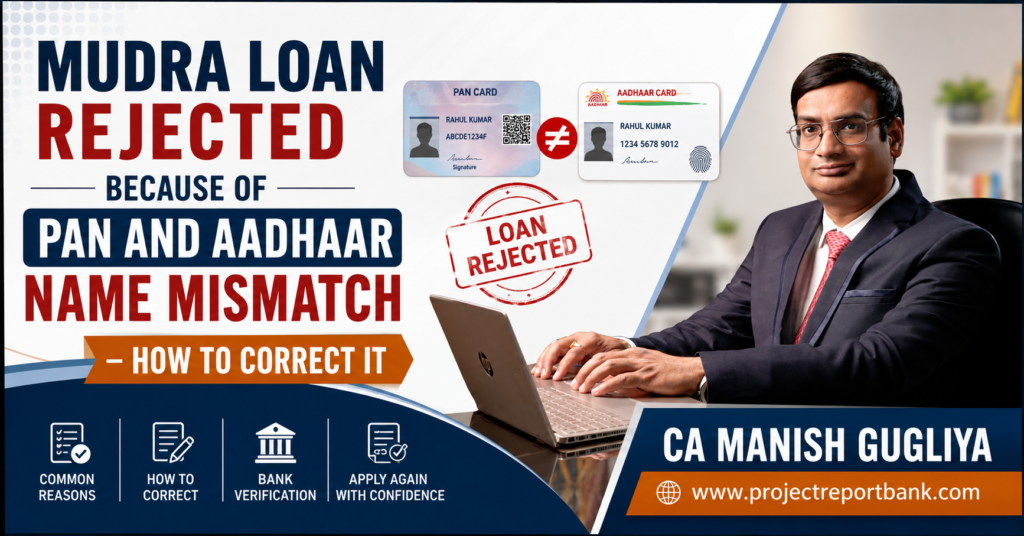
Many applicants discover that their mudra loan application was rejected not because of weak income or poor business viability, but simply because the name on their PAN card does not match their Aadhaar card. A name mismatch between PAN and Aadhaar can lead to loan application rejection even when the applicant has a strong cibil score, solid turnover, and a clear business plan.
- Even a minor difference – a missing middle name, initials instead of full name, a married surname, or a single spelling variation – can stop mudra loan processing during KYC verification.
- Incomplete or mismatched documents cause most Mudra loan rejections across banks, NBFCs, and MFIs in India.
- This is usually a fixable problem: correct PAN or Aadhaar, update bank KYC, then reapply for a mudra loan with consistent documents.
- I routinely handle such KYC mismatch cases in my practice, and timely correction can significantly improve loan approval chances while avoiding months of delay.
Introduction – Why PAN & Aadhaar Name Mismatch Stops Your Mudra Loan
If your mudra loan was rejected or kept pending, and nobody at the branch gave you a clear reason beyond “KYC issue,” there is a good chance the problem is a name mismatch between your PAN and Aadhaar.
Banks treat every mudra loan like any other unsecured business loan. The Pradhan Mantri Mudra Yojana, launched on 8 April 2015, offers collateral-free business loans up to ₹20 lakh for micro and small enterprises. Mudra loans have four categories: Shishu (up to ₹50,000 for new businesses), Kishore (up to ₹5 lakh for existing businesses), Tarun (up to ₹10 lakh for established businesses), and Tarun Plus (up to ₹20 lakh for repeat borrowers). Over ₹33 lakh crore has been disbursed in Mudra loans across the country. But if PAN and Aadhaar names do not match exactly, the system flags the file and the branch cannot move ahead.
Even if the business plan, loan amount, turnover, and cibil score are all acceptable, incomplete documents or a name mismatch alone can lead to immediate loan rejection. Do not panic – in most cases this is an administrative issue, not a reflection of your business. With proper corrections and documentation, you can typically reapply and get the loan approved.
This guide focuses specifically on PAN–Aadhaar name mismatch for Mudra loans, not on other rejection reasons like low CIBIL score or applying for an unjustified loan amount.

Table of Contents
What Is a PAN and Aadhaar Name Mismatch in Mudra Loan KYC?
A “name mismatch” means any difference between the name printed on your PAN card and your Aadhaar card, or how it is entered in the mudra loan application. You need to ensure identity documents including full name, date of birth, and gender match to prevent delays. Demographic details in both PAN and Aadhaar databases must match for successful linking.
Common examples I see regularly:
- “Rahul Kumar” on Aadhaar vs “Rahul K Kumar” on PAN
- “Mohan Lal Sharma” vs “Mohan Sharma” (missing surname)
- “Sita Devi” vs “Sita Kumari” (different suffix)
- A married woman who changed her surname in Aadhaar after 2018 but PAN still shows her maiden name
- “R. K. Verma” (initials) vs “Ramesh Kumar Verma” (full name)
- Regional spelling differences: “Chandrashekhar” vs “Chandra Shekhar”
- Extra spaces or reversed order: “Kumar Rahul” vs “Rahul Kumar”
For banks and for CKYC or credit bureau records, “almost same” is not acceptable – the name has to be identical enough for automated systems. Incorrect names on PAN or Aadhaar can cause KYC verification failures. Such a mismatch creates doubt about whether both documents belong to the same person, which is not allowed under RBI’s KYC directions.
Why Banks Strictly Check PAN & Aadhaar Matching Before Approving Mudra Loan
Though mudra loan is a government-backed scheme, Mudra loans are disbursed through banks, NBFCs, and MFIs, and these lender institutions are fully responsible for KYC compliance and recovery. The bank must verify every applicant’s identity precisely before any money is disbursed.
Key reasons for strict checking:
- RBI KYC norms: Banks must complete full KYC – name, business address proof, date of birth, photograph, ID proof – before sanctioning any loan.
- UIDAI & Income Tax linkage: PAN is linked to your income tax profile and cibil report. Aadhaar is often treated as the primary identity document in KYC processes and is linked to biometric identity and many government subsidies.
- Fraud prevention: Name mismatch can indicate impersonation, benami accounts, or attempts to hide previous defaults. Applicants must not have a history of loan defaults.
- Credit bureau checks: For category loans above a few lakh, banks pull the CIBIL or Experian score using PAN – a mismatch may show a different person’s report.
- CKYC: Central KYC records rely on consistent name across PAN, Aadhaar, and bank account.
In practice, most banks now use online APIs (NSDL for PAN, UIDAI for Aadhaar) integrated with their mudra loan systems, which automatically flag any difference. If the banker ignores a mismatch and an audit later detects it, the branch staff can face strict internal objections – so they refuse to proceed until it is corrected.
How Banks Detect PAN & Aadhaar Name Mismatch During Mudra Loan Processing
From the moment the mudra loan application is submitted, multiple systems cross-verify KYC details. Here is the typical sequence:
- Application submission: The applicant fills the mudra loan form (offline at the branch or apply online via Jan Samarth or the bank’s portal), entering their name exactly as per documents.
- PAN verification: The bank system validates PAN with the NSDL/Income Tax database. If spelling differs from the form, the system shows a discrepancy.
- Aadhaar e-KYC: The bank uses OTP or biometric e-KYC through UIDAI. Name, DOB, and gender must match what is entered in the loan system. Minor discrepancies between names can sometimes be verified with OTP if date of birth and gender match, but this is not guaranteed.
- CKYC check: If a CKYC ID already exists, the bank fetches the existing KYC record. Any difference between the stored CKYC name and new documents is flagged.
- Credit bureau pull: The cibil report is pulled using PAN. If the applicant name in CIBIL does not match Aadhaar or the application, the banker becomes cautious.
- Manual document verification: The branch compares printed PAN and Aadhaar copies with system data. A mismatch at this stage usually leads to a hold or rejection note.
In most cases, the system or cibil report is where the first alert appears. Sometimes, if mismatch is very minor, banks may ask for extra evidence or a declaration, but this depends heavily on the bank’s internal policy. Most banks will not process the file until mismatched documents are corrected.
Common Real-World Reasons for Name Mismatch in Mudra Loan Applications
In my practice as a Chartered Accountant, roughly 20–30% of rejected Mudra loan files have at least one KYC name mismatch as a primary or secondary rejection cause.
Here are the most common reasons I see:
- Different spellings used over the years (e.g., “Abdul Rahman” vs “Abdul Rehman”) due to school certificates vs later IDs
- Missing or extra surname (“Mohan Lal Sharma” vs “Mohan Lal”), common in North India
- Middle name omitted in Aadhaar but present in PAN
- Married women adopting husband’s surname in Aadhaar while PAN still shows maiden name
- PAN created long ago with a typing error that went unnoticed until the mudra loan application
- Aadhaar issued using local language spelling; English transliteration differs from PAN
- Use of initials instead of full name in one document, common in South India
- A different address or different name pattern in driving licence, passport, voter ID, or GST registration compared to PAN and Aadhaar
- Bank account KYC not updated after name change, creating a third variation
- Business registrations like the udyam registration certificate or Shop Act licence carrying slightly different proprietor name
When three or four documents all show slightly different names, banks treat the case as high-risk and either delay or decline the mudra loan until everything is aligned.
Which Documents Must Show the Same Name for Smooth Mudra Loan Sanction?
For a mudra loan, bankers look for consistency across identity proof, address proof, bank account, and business proof. It is important to ensure both documents reflect the same name before loan applications. You need PAN, Aadhaar, and business proof for Mudra loans – at minimum.
Critical documents and how names should align:
- PAN Card: Primary ID for income tax and CIBIL; treat the name here as the “master” for all financial documents.
- Aadhaar Card: Used for e-KYC and address proof; name and DOB should match PAN exactly.
- Bank account: Your current account or savings account in which the loan amount will be credited. The account title must reflect the PAN–Aadhaar name.
- GST registration (if applicable): Proprietor or entity name should match KYC name. Banks require proof of ongoing business operations for loan approval.
- Udyam Registration: Udyam Registration is recommended for Mudra loan applications and improves approval chances. Proprietor name should match PAN–Aadhaar.
- Voter ID, Passport, Driving Licence: Additional IDs that help but can also create confusion if names differ greatly.
- Local registrations: Shop & Establishment licence, municipal licences, rental agreement, utility bill if used as business address proof.
- Project report / business plan: A basic business plan is required for Kishore and Tarun loans. Use the same legal name here.
Before submitting a mudra loan application, place every document side by side and note any difference for correction.
How to Decide Whether to Correct PAN or Aadhaar First (Practical Scenarios)
Many entrepreneurs ask whether they should change PAN to match Aadhaar or vice versa. A wrong decision can force multiple corrections and add weeks of delay. Major discrepancies require updating either PAN or Aadhaar for matching names. The principle is simple: to correct a mismatch, update the document that contains the incorrect name.
Scenario-wise guidance:
- If PAN is already linked to Income Tax filing, credit history, and CIBIL with correct spelling as per school or degree certificates, and Aadhaar has a later or different spelling – correct Aadhaar to match PAN.
- If Aadhaar is used widely for bank statements, mobile SIMs, government benefits, and PAN was created with a clear typo – correcting PAN is more practical.
- If both documents have errors, decide on one “final correct format” (e.g., “RAHUL KUMAR SHARMA”). First correct Aadhaar, then PAN, so e-KYC becomes smoother.
- If GST, Udyam, and your business account are all aligned with Aadhaar but PAN is different, correct PAN to reduce disruption to existing business operations.
After correction, also update the name in your bank KYC, GST portal, Udyam registration, and CKYC (which gets automatically refreshed when the bank submits new KYC records). Where possible, consult a professional like a CA to freeze the “standard” full name format that will be used everywhere going forward. This avoids the loop of repeated corrections.
Step-by-Step: How to Correct Name in Aadhaar and PAN for Mudra Loan
Both UIDAI (for Aadhaar) and NSDL/UTIITSL (for PAN) have clear procedures, and most changes complete within 1–3 weeks if documents are ready.
Aadhaar name correction:
- Online: Visit the myAadhaar portal, login with OTP, select “Update Name,” upload supporting documents (PAN, passport, voter ID), and pay the nominal fee of approximately ₹50. Note the URN for tracking. Only limited changes are allowed online; bigger changes may need an enrolment centre visit.
- Offline: Visit the nearest Aadhaar Seva Kendra with original proofs, fill the update form, give biometrics, submit documents, and pay the fee. Updates typically reflect in 5–15 working days but can occasionally take up to 30 days.
- Common mistake: Using a nickname instead of official name, or not carrying a marriage certificate or gazette notification when required for a surname change.
PAN name correction:
- Online: Go to the official NSDL or UTIITSL portal, choose “Change/Correction in PAN Data,” fill the form with the correct name, attach scanned proof (Aadhaar, passport, marriage certificate if applicable), and pay around ₹107. Send the signed acknowledgement to the designated centre by courier if required.
- Offline: Fill the physical PAN correction form at an authorized centre, attach self-attested documents, photographs, and fees.
- Timeline: PAN correction usually takes 15–20 working days after documents are received.
After PAN and Aadhaar corrections, linking PAN with Aadhaar can be done through the Income Tax e-Filing Portal. During the correction process, do not submit new mudra loan applications. Wait until both updated documents are available and reflected in e-KYC checks.
After Name Correction – Updating Banks, Reapplying for Mudra Loan, and Expected Timelines
Correcting PAN and Aadhaar alone is not enough. Banks and other systems will still have old data until you proactively update them. After name updates are processed, the applicant should wait for changes to reflect in databases before reapplying.
What to do after receiving updated PAN/Aadhaar:
- Visit your home branch with original updated PAN and Aadhaar. Fill the KYC update form and request that both be linked and CKYC be updated. Ask for a stamped copy or SMS confirmation.
- If GST registration exists, login to the GST portal and file a non-core amendment to update your name, attaching supporting proof.
- Update your Udyam registration online. Download a fresh udyam registration certificate for attaching with your mudra loan application and project report.
- Verify that your bank passbook or bank statements now show the updated name for the account in which the mudra loan amount will be credited.
Typical timelines:
| Task | Expected Time |
|---|---|
| Aadhaar/PAN correction | 1–3 weeks |
| Bank KYC update and CKYC refresh | 2–7 working days |
| GST/Udyam updates | 1–3 days |
After all updates, prepare a fresh mudra loan application with updated KYC copies, a simple business plan or project report, and a covering letter explaining the earlier rejection and attaching proof of correction. You can apply again at the same bank or another branch. A clean, consistent KYC profile plus a justified loan amount greatly improves your chances of getting the mudra loan approved.
Practical Mistakes That Still Delay Mudra Loan Approval After KYC Correction
Many borrowers fix the PAN–Aadhaar mismatch but still face delay because other small but critical mistakes remain in the file. Lack of a clear business plan results in many loan denials. Existing loan defaults can immediately trigger loan rejection. Here are the mistakes I see most often:
- Submitting old photocopies of PAN/Aadhaar instead of freshly printed updated ones
- Not changing name in the bank account, so the account title still shows the old version
- Using a different spelling in the mudra loan application form than on corrected documents
- Mentioning the business name differently in the project report, bank KYC, and Udyam certificate
- Forgetting to sign some pages of the application or KYC forms
- Using an outdated mobile number, causing OTP failures during e-KYC
- Providing a rental agreement or utility bill with a slightly different name or incomplete address
- Not updating GST registration, leading to a mismatch between GST and PAN names
- Applying for a high loan amount with weak turnover or repayment capacity, making the loan appear like an unjustified loan
- Ignoring existing EMIs or previous loan defaults visible in CIBIL – a cibil score below 650 often leads to loan rejection regardless of KYC status
- Attaching unclear photocopies that make verification difficult
- Submitting a project report that uses a nickname instead of the full legal name
- Not informing the bank that PAN/Aadhaar have been corrected, expecting them to discover it automatically
- Relying on agents who promise “guaranteed” approval and give wrong advice
- Applying simultaneously in multiple banks with inconsistent details, which creates multiple loan enquiries in your CIBIL
Before reapplying, review the complete file – KYC, business plan, repayment plan, existing credit, and loan amount – so the second attempt is strong and consistent. Applying for an unjustified loan amount leads to rejections just as often as KYC problems.
Expert Tips from CA Manish Gugliya to Avoid PAN–Aadhaar Issues in Future Mudra Loans
Over 20 years of working with MSMEs, Mudra loan project reports, and resolving bank objections, I have handled thousands of KYC-related issues. Here are my key recommendations:
- Freeze one standard full name format (first name, middle name, surname) and use it consistently everywhere – PAN, Aadhaar, bank, GST, Udyam, every form you fill.
- Before applying for any business loan, keep all KYC documents in one folder and cross-check spellings line by line.
- Whenever you change name due to marriage or any other reason, update Aadhaar, PAN, bank account, GST, and Udyam within the same month.
- Ask the banker to show how your name appears in their core banking system and immediately correct any mistake.
- For new entrepreneurs, keep the loan amount modest and pair it with a simple business plan showing realistic repayment capacity and regular transactions.
- Ensure your project report uses exactly the same name as PAN and Aadhaar, and the same business registration name as GST/Udyam.
- Keep all acknowledgment receipts of PAN and Aadhaar corrections safely; attach them if there is any doubt at branch level.
- If one bank is reluctant, try Canara Bank, regional rural banks, or another branch after fully correcting your KYC. Many applicants find that a different lender is more receptive once documents are clean.
- A cibil score above 700 improves approval chances – maintain it by paying all EMIs on time and keeping transaction history clean in your business account.
- Avoid giving different signatures on different documents; maintain one consistent signature style.
- Re-check all spellings when filling online forms – one typing mistake can again show mismatch.
- Keep your contact details, office address, and mobile number current across all documents.
With proper KYC discipline and documentation, a mudra loan becomes much easier to obtain and renew in future. The scheme is designed to help customers like you – do not let an administrative error hold you back.
Frequently Asked Questions on Mudra Loan PAN–Aadhaar Name Mismatch
These FAQs address common doubts that small business owners ask me during consultations, beyond what is already covered above.
Can my Mudra loan be rejected only because of a small spelling mistake in my name?
Yes. Even a one-letter spelling difference can technically lead to rejection because bank systems, CKYC, and CIBIL rely on exact matches. Some bankers may assess it with extra proof or a declaration, but they are not obligated to do so. Incomplete or mismatched documents cause Mudra loan rejections more often than many applicants realize. It is always safer to correct the mismatch before you submit or reapply.
After correcting PAN and Aadhaar, do I need to inform the bank myself?
Banks do not automatically receive update alerts from UIDAI or NSDL. You must visit the branch, submit updated KYC with originals, sign the KYC update form, and request that CKYC and account records be refreshed. Only after the bank’s records are complete should you reapply. The security and accuracy of your file is your responsibility.
How soon after name correction can I reapply for a Mudra loan?
In practice, it is safer to wait until your updated PAN and Aadhaar are active, bank KYC is updated, and a recent CIBIL check (if applicable) shows the corrected name. This typically takes 2–4 weeks from when you start the correction process. Rushing back before systems are updated will only result in the same processing failure.
Will name mismatch affect my CIBIL score directly?
The mismatch itself does not reduce your CIBIL score. However, it can prevent the bank from correctly viewing your report or may link you to the wrong credit profile. The risk is in loan rejection or delay, not in score deduction. Maintain your credit history by ensuring all details are accurate.
Is an affidavit or notarised declaration enough to solve name mismatch for Mudra loan?
Most banks will not rely only on an affidavit for KYC. They typically require PAN and Aadhaar to be properly corrected in the official databases. An affidavit can support your case and serve as additional evidence, but it cannot replace official document updates. If you need help understanding the actual reason behind your Mudra loan rejection, get your eligibility criteria and all documents reviewed before reapplying. Banks assess every detail, and free from errors means free from unnecessary delays.
- Mudra Loan Rejection Reasons: Complete Guide to Why Banks Reject Applications


- Mudra Loan Documentation Issues: Complete Guide to Avoid Document-Related Loan Rejections

- Mudra Loan CIBIL Issues, Rejection Reasons & Solutions (2026) – Complete Guide
- How to Prepare a Perfect Mudra Loan Document File Before Visiting the Bank 2026

- Mudra Loan Rejected Due to Signature Mismatch – Practical Guide 2026 by CA Manish Gugliya

- Mudra Loan Rejected Due to Missing Udyam Registration – Complete 2026 Guide by CA Manish Gugliya
- Mudra Loan Rejected Due to Invalid or Old Bank Statements – What Banks Expect (Explained by CA Manish Gugliya) 2026
- Mudra Loan KYC Documents: Complete Checklist to Avoid Rejection 2026
- Mudra Loan Rejected Due to Address Proof Issues – Complete Guide 2026 by CA Manish Gugliya
- Mudra Loan Rejected Due to Incorrect Business Proof – What Documents Do Banks Accept? 2026
- Mudra Loan Rejected Due to PAN and Aadhaar Name Mismatch – Practical Fix by CA Manish Gugliya
- How to Improve Your CIBIL Score Before Reapplying for a Mudra Loan (2026 Complete Guide)

- Mudra Loan Rejected Due to Poor Credit History Despite No Current Defaults – Complete Guide 2026 by CA Manish Gugliya
- Mudra Loan Rejected Because of Multiple Loan Enquiries – Does It Really Matter? 2026
- Mudra Loan Rejected Due to CIBIL Report Errors – Detailed Correction Guide 2026 by CA Manish Gugliya