If your Mudra Loan is approaching renewal and you are worried whether the bank will say no, you are not alone. Many small business owners assume that because a mudra loan was sanctioned once under Pradhan Mantri Mudra Yojana, the bank must renew it every year without questions. That assumption is incorrect, and it can cost you valuable working capital when you need it most.
I am CA Manish Gugliya, and through my practice at ProjectReportBank.com, I regularly advise micro and small enterprises on Mudra Loan applications, renewals, and documentation. In this article, I will explain exactly when and why a bank or financial institution can refuse renewal, what triggers that decision, and what practical steps you can take next.
Key Takeaways
- A bank can legally refuse to renew a Mudra Loan. Mudra loans under PMMY are not guaranteed for renewal. Each renewal is a fresh credit assessment based on repayment track record, financial statements, credit report, and current business performance.
- Good EMI payment history helps significantly, but it does not automatically ensure renewal if business turnover has fallen, cash flow is weak, or total liabilities have increased beyond your repayment capacity.
- Banks may decline mudra loan renewal due to risk, compliance, and performance metrics. Common reasons include irregular repayment, incomplete or mismatched documents, declining turnover, poor credit history, and diversion of loan funds.
- Many renewal refusals can be improved by correcting documents, updating financials, clearing overdue payments, or discussing restructuring with the bank rather than assuming permanent ineligibility.
- Mudra loans aim to boost micro enterprises, and ProjectReportBank.com helps entrepreneurs prepare better financials, a clear business plan, and complete documents before approaching the bank again.

Direct Answer: Can a Bank Refuse to Renew a Mudra Loan?
Yes, a bank may refuse to renew a Mudra Loan if the borrower no longer meets the lender’s applicable eligibility criteria, credit requirements, repayment behaviour standards, documentation conditions, account conduct expectations, or business viability thresholds. I want to be direct about this: renewal is not an automatic right merely because the original mudra loan was approved earlier.
Mudra Loan renewal is always subject to reassessment. Whether you bank with public sector banks like Canara Bank, private sector banks like HDFC Bank, regional rural banks, small finance banks, non banking financial companies, or micro finance institutions, the lending institution evaluates your creditworthiness afresh. The earlier sanction under PMMY does not create a legal guarantee of renewal, even though the scheme is government backed and offers loans up to ₹20 lakh without collateral.
- Refusal today does not automatically mean you can never get finance again. The key is understanding the specific reason for mudra loan rejection and whether it is curable.
- A decision based purely on the bank’s internal risk policy is different from a case where missing documents or incorrect information can be corrected and represented to the same bank or a different lender.
Table of Contents
Is Mudra Loan Renewal Automatic or Guaranteed?
One of the most common myths I encounter is that once a mudra loan is sanctioned, renewal or continuation is guaranteed every year without fresh checks. This is not how it works. Banks often conduct annual reviews for working capital mudra loans, and each review is essentially a mini credit assessment.
It helps to understand the difference between these situations:
- Continuation or renewal of an existing working capital limit (CC/OD facility)
- Enhancement of the same Mudra facility to a higher loan amount
- Restructuring or rescheduling due to financial stress
- Fresh mudra loan application after closing the earlier one
Most banks treat renewal as a fresh credit review. They recheck business turnover, current account transactions, GST returns, income proof, and any change in liabilities or credit profile. Lending decisions for Mudra loans are based on the bank’s internal policies, and these can differ between, say, Canara Bank and HDFC Bank. Mudra Loan renewal rules are guided by the general PMMY framework plus each bank’s board-approved credit policy.
For a step-by-step overview of the general renewal procedure, see: Mudra Loan renewal.
Key Reasons Why a Bank May Refuse Mudra Loan Renewal
In practice, mudra loan renewal rejection is usually due to multiple small issues combined rather than one dramatic failure. Banks evaluate creditworthiness for mudra loan applications and renewals alike. A bank can refuse to renew a mudra loan based on performance criteria, documentation gaps, compliance concerns, or rising risk.
The following subsections cover the most common reasons for mudra loan renewal rejection. Not all reasons apply in every case, and different banks give differing weight to each factor. Understanding these patterns helps you prepare before meeting the branch manager.

Irregular Repayment History and EMI Delays
Poor repayment history can lead to mudra loan non-renewal. Repeated late EMIs, cheque or ECS bounces, and frequent overdue days-even if later regularised-signal higher risk at renewal time. Banks look at the conduct of the loan account over the last 12 months, and this feeds into internal scoring.
Even a single 30+ days past-due incident can trigger closer scrutiny, especially in unsecured category loans like small Shishu loans, Kishore and Tarun loans. For more on how tenure affects EMI size and stress, see Mudra Loan repayment period. If you have already missed some EMIs, read about late EMI payment and Mudra Loan eligibility for practical guidance.
Poor Conduct of the Loan and Current Account
Beyond EMIs, banks review overall account conduct-especially the current account linked to business activity. Patterns that worry bankers include frequent cash withdrawals without visible business expenses, regular transactions returning due to insufficient funds, and long dormancy periods.
If your Mudra limit is structured as an overdraft or cash-credit facility, frequent over-limit usage and non-servicing of interest can seriously affect renewal. Healthy conduct means steady credits matching declared turnover and adequate balance before EMI dates. Some banks formally record account-conduct scores that directly influence renewal decisions even where basic KYC is in order.
Decline in Business Turnover or Closure/Change of Activity
A bank initially sanctioned the loan based on a certain scale of operations. Banks require proof of ongoing business operations for loans, and a significant fall in turnover at renewal time raises concern about repayment capacity. Bankers compare current account statements, GST returns, or other sales records with the original business plan submitted in the mudra loan application.
For example, a trader who earlier showed ₹40 lakh annual turnover and now shows only ₹18 lakh may face refusal instead of like-for-like renewal. Loss of eligibility for business activity-such as closing operations or shifting to a completely different address and business type-can also trigger refusal. If business has genuinely changed, present a fresh basic business plan and updated project report rather than relying solely on old sanction details.
Continuous Losses, Weak Profitability and Poor Cash Flow
Banks do not look only at turnover. They examine basic profit and cash flow trends to judge whether EMIs can be comfortably paid going forward. Warning signs include repeated net losses, negative capital, very low gross margin, or high drawings by the proprietor despite low profits.
Inadequate cash flow may arise even in profitable businesses due to heavy credit sales, large inventory, or slow debtor collection. Before renewal, prepare a simple profit and loss account and cash flow summary to show how the facility will be serviced. Strong, realistic projections often help the bank consider renewal even if the last year was temporarily weak.
Existing Loan and EMI Burden Becoming Too High
Banks evaluate overall indebtedness: personal loans, vehicle loans, gold loans, home loans, credit card dues, consumer finance EMIs, and other business loans. Existing loan defaults are a direct cause of rejection. If total monthly EMIs consume a large share of proven income, the bank may reduce the Mudra limit or refuse renewal.
Most banks access credit-bureau data for this purpose. For details, see whether banks check existing loans for Mudra Loan. An additional personal loan or high credit card outstanding taken after the original sanction can tilt the renewal decision negatively. Related guides: Mudra Loan with an existing personal loan and Mudra Loan with credit card outstanding.
Deterioration in Credit Profile and CIBIL Score
There is no official universal minimum CIBIL score for mudra loan renewal, but a CIBIL score below 650 often leads to rejection. A significant drop in credit score can affect mudra loan renewal. Banks rely on credit reports to see overall repayment behaviour, including recent delinquencies, written-off or settled accounts, high credit card utilisation, and multiple enquiries.
For details on which bureau lenders check, see which credit report banks check for Mudra Loan. Review your own credit report before renewal, correct factual mistakes, and avoid fresh unnecessary credit immediately before approaching the bank. A CIBIL score above 700 improves approval chances, but a low score does not mean permanent rejection if you demonstrate strong current conduct.
Incomplete or Outdated Documents at Renewal Time
Incomplete or mismatched documents cause most mudra loan rejections-at initial application and at renewal alike. Failure to submit required documentation can prevent loan renewal. Missing ITRs, GST returns, bank statements, KYC updates, Udyam registration, shop licence, rental agreement, or partnership documents are common gaps.
Even long-standing customers of banks may face delays if compliance documents are not updated. Complete documentation is crucial for mudra loan approval and renewal. A clear business plan is required for loans above ₹50,000, and a business plan is required for Kishore and Tarun loans specifically. You need PAN, Aadhaar, and business proof to apply or renew. For a detailed document-by-document guide, see documents required for Mudra Loan renewal.
Diversion or Improper Use of Mudra Loan Funds
Although mudra loans are flexible for working capital and small asset purchases, banks expect funds to be used for the sanctioned business purpose only. Mudra loans are for non-farm, non-corporate activities only. Banks may consider the diversion of loan funds as a reason for non-renewal-for example, using a Kishore working capital limit to finance personal expenses or speculative trading instead of stocking goods.
Evidence of diversion, such as large transfers to unrelated personal accounts soon after disbursement, causes the bank to doubt the borrower’s intent. Borrowers should clearly explain any genuine but unusual business transactions to the bank during review.
Non-Compliance With Bank or Regulatory Requirements
Renewal can be withheld if basic compliance is not met: PAN-Aadhaar linking, updated mobile and email, periodic KYC, and where applicable, adherence to GST or local licence rules. Registering your business on the Udyam portal is recommended, and businesses not registered on the Udyam portal may face rejection, particularly for Kishore and Tarun categories.
Non-cooperation with stock statements, debtor lists, or site visits for higher-ticket Tarun loans can also result in non-renewal. This is procedural, not harassment-timely compliance keeps this risk minimal. Treat bank information requests professionally and seek help from a CA if forms or formats are confusing.
Does Low CIBIL or Poor Credit History Automatically Mean Renewal Rejection?
Low CIBIL or a weak credit report is important but not the sole factor. CIBIL score is crucial for mudra loan approval, yet banks examine not only the score number but also underlying behaviour: recent EMIs, presence of NPAs, write-offs, settlements, high utilisation, and trends over 12–24 months.
A previously low score improving due to recent disciplined repayments can support renewal, especially with stable turnover. Serious negative events-like a recent write-off or multiple ongoing overdue accounts-carry more weight than the exact CIBIL figure. Actionable steps: obtain your report, correct factual errors, close unused credit cards, reduce unsecured personal borrowing, and demonstrate 6–12 months of on-time payments before approaching for renewal.
Can a Bank Refuse Renewal Even If All EMIs Were Paid on Time?
Yes. Even perfect EMI repayment does not give a legal guarantee of mudra loan renewal, though it is a major positive factor. A bank might still refuse due to a sharp fall in turnover, closure or shift of business, very high new liabilities, or significantly negative financial statements despite timely EMIs.
In such cases, the bank is judging future repayment capacity and business viability, not punishing past repayment. If you have a clean repayment record and renewal is refused, politely ask the bank branch for specific written reasons and explore whether a reduced limit or alternate structure is possible.
Can a Bank Refuse Renewal Because Business Turnover Has Fallen?
A fall in turnover is one of the most common practical reasons for banks to either reduce or refuse renewal of working capital limits. Banks link the size of the loan amount to the scale of business operations.
Consider a small manufacturing unit with ₹60 lakh earlier turnover dropping to ₹30 lakh due to market slowdown. The banker might propose reducing a ₹10 lakh Tarun limit to ₹5–6 lakh instead of full non-renewal. A temporary fall, properly explained with documents like order books or seasonal patterns, may still allow renewal at a sensible level. Prepare a short updated business plan rather than ignoring the decline.
Documents Typically Checked Before Mudra Loan Renewal
Proper documentation is the area where borrowers have maximum control. Applicants must provide proof of business operations, and here is what most banks check:
- KYC: PAN, Aadhaar, business address proof, photographs, utility bill
- Business registration: Udyam Registration, GST registration, shop licence, rental agreement
- Financial documents: Latest ITRs (1–3 years), profit and loss account, balance sheet, bank statements (6–12 months)
- Operational details: Stock and debtor information, major customer/supplier list, business assets, any updated simple business plan
- Liability details: Existing loan statements, credit card balances, details of all EMIs
Exact requirements vary by loan category and lender type. For a more detailed explanation, see documents required for Mudra Loan renewal.
What Should You Do If Your Mudra Loan Renewal Is Refused?
Do not panic. Treat the refusal as a diagnostic signal, not a final verdict. Here is a practical step-by-step approach:
- Obtain the specific written reason for renewal refusal from the bank. Requesting a written explanation is a borrower’s right under RBI guidelines.
- Check whether any documents or KYC updates are pending.
- Verify the Mudra Loan outstanding balance to ensure records are correct.
- Review your repayment history and fetch your credit report.
- List all existing EMIs and liabilities.
- Update financial statements with help of a CA. Prepare income proof and a revised repayment plan.
- Prepare a short written representation addressing each issue the bank raised.
- Meet the branch manager or credit officer calmly with your updated documents.
- Follow up weekly after submitting your loan application or renewal request.
- Borrowers can approach a higher bank authority if renewal is denied at the branch level.
If the issue is service deficiency-refusal to accept papers, verbal rejection without assessment-borrowers can file grievances if they believe loan refusal was unfair. Escalation through the bank’s grievance portal and then RBI Ombudsman may be considered, but with realistic expectations.
Can You Apply to Another Bank After Renewal Refusal?
A borrower is generally free to approach another eligible lender-PSU bank, private sector bank, RRB, SFB, or NBFC under PMMY-after mudra loan renewal rejection. Applications can be submitted through banks or online portals like Jan Samarth. Mudra loans are offered by various types of financial institutions.
However, switching banks does not erase your repayment history, CIBIL record, or weak financial statements. All lenders see the same bureau data. Approaching another bank is sensible when the original bank has very tight risk policy or refuses despite strong financials. But hopping without resolving fundamental issues leads to multiple enquiries and further weakens your profile. Correct curable issues first and prepare a stronger application package, including an updated project report.
Renewal Rejection vs Restructuring or Repayment-Period Extension
A routine renewal request and a situation where the borrower is struggling with EMIs are not the same thing. Restructuring can involve changing EMI amount by extending tenure, temporarily reducing instalments, converting overdraft to term loan, or providing limited moratorium-subject to the financial institution’s evaluation. For details, see Mudra Loan repayment period extension.
Restructuring is never automatic and may have implications for your credit report. If you are facing genuine cash flow stress, proactively discuss with the bank before EMIs start bouncing-waiting until the account becomes irregular makes renewal significantly harder.
Practical Hypothetical Example of a Mudra Loan Renewal Refusal
This is a hypothetical example for illustration only.
Rajesh, a small retail trader, took a ₹5 lakh Kishore mudra loan in 2022 with a repayment period of 5 years. Initially, his turnover was steady at ₹30 lakh per year. By FY 2024–25, turnover dropped to ₹16 lakh. He also took a vehicle loan (₹8,000 monthly EMI) and accumulated ₹1.2 lakh in credit card outstanding. Two EMI payments were delayed by 15–20 days. His latest ITR was not filed.

At renewal, the bank manager observed reduced credits in the current account, rising unsecured EMIs, a slightly deteriorated CIBIL score, and absence of updated financial statements. The bank refused to renew at the same level.
On advice, Rajesh regularised his EMIs, prepared updated financials with help from a CA, cleared part of his credit card dues, filed his ITR, and resubmitted with a request for a lower ₹3 lakh limit with a clear business plan showing realistic projections. The bank reconsidered and approved the reduced facility.
How to Improve Your Chances of Mudra Loan Renewal
Start preparing at least 3–6 months before the review date, not in the final week. Borrowers can clear overdue payments to improve chances of renewal. Here are actionable steps:
- Maintain consistent on-time EMIs. Avoid unnecessary cheque bounces.
- Ensure major business receipts route through your main current account with regular transactions visible.
- Organise books of account-at least basic cash book, sales and purchase records, and stock list.
- File ITRs and GST returns on time. Lack of a clear business plan can result in loan denial, so prepare one.
- Check your credit report annually. A CIBIL score above 700 improves approval chances.
- Avoid frequent new unsecured borrowings in months before renewal.
- Prepare a short updated business plan or note covering market position, recent challenges, and conservative projections-especially for higher Tarun loans.
CA Manish Gugliya’s Practical View on Mudra Loan Renewal Refusals
In my experience advising MSME clients on mudra loans and working capital finance, I have seen many applicants who successfully repaid previous loans but still faced renewal problems. The common thread is almost always that borrowers focus only on “whether I paid EMIs” and ignore broader renewal criteria.
Here are three practical insights from my practice:
- Bankers are more comfortable renewing when they can clearly see business activity in the current account. If your transaction history shows healthy, regular business transactions, it speaks louder than verbal assurances.
- A simple but well-prepared financial statement-even if not audited-makes more difference than many applicants expect. Most banks have branch managers who need something concrete to present to their credit committee.
- Early, honest discussion with the bank works far better than last-minute pressure or arguments. If turnover has dropped, explain why and present a realistic repayment plan.
Treat renewal as a fresh mini-assessment of your business, not as a formality guaranteed by PMMY. At ProjectReportBank.com, we help entrepreneurs prepare practical project reports, cash flow projections, and documentation before they approach the bank-because many applicants lose renewal not on merit but on poor presentation.
Conclusion: When Can a Bank Refuse to Renew a Mudra Loan and What Should You Do?
A bank may refuse mudra loan renewal when reassessment reveals concerns about repayment history, account conduct, business turnover, profitability, cash flow, documents, credit profile, or overall exposure. Government backing under PMMY does not convert mudra loans into a guaranteed or compulsory facility. Renewal remains a commercial credit decision exercised at the sole discretion of each bank.
Many issues are fixable-missing documents, outdated financials, moderate EMI delays. Others, like continuous losses, past defaults, or major fund diversion, may require deeper restructuring before approaching any lender again. Eligible borrowers should review their financial position, correct remediable issues, and seek expert help where needed.
I recommend preparing for Mudra Loan renewal well in advance-reviewing repayment history, outstanding liabilities, credit profile, business performance, and financial documents-instead of assuming that earlier sanction guarantees continuation.
Frequently Asked Questions (FAQs)
These FAQs cover additional focused doubts that borrowers commonly have after a mudra loan renewal refusal. Answers are general guidance based on Indian banking practice as of 2026. Individual banks may follow their own detailed internal policies.
Is a bank legally obliged to give reasons for Mudra Loan renewal refusal?
While banks are not required to disclose every internal risk parameter, in practice they should provide at least a broad reason for refusal if the borrower asks in writing. This is part of fair-lending and transparency practice. However, receiving a reason does not mean the bank is obliged to change its decision-it simply helps you understand whether the issue relates to documents, account conduct, or overall creditworthiness so you can take corrective action.
Can I get fresh Mudra finance after closing my existing loan that was not renewed?
After fully repaying or settling the existing facility, a borrower may apply again for a fresh mudra loan, subject to normal eligibility and credit checks. The old account’s repayment track record-good or bad-will still be visible in credit reports and will influence the new decision. Ensure that the earlier closure is properly updated in the bank’s records and credit bureau before submitting a new mudra application form. Processing time for Shishu loans, for reference, is typically 7 to 10 working days once all documents are in order.
Does switching from savings to current account improve chances of renewal?
For Kishore and Tarun mudra loans, many banks prefer or require a current account to capture business transactions. However, the mere type of account does not guarantee renewal. What truly helps is routing genuine business receipts and payments through that account so turnover and cash flow are clearly visible. Discuss with the bank manager whether maintaining the principal business current account in that branch can support your renewal request.
Can I request a lower limit or different structure instead of full renewal at the old amount?
Borrowers can discuss options such as renewing at a reduced limit, converting part of the outstanding into a term loan, or adjusting tenure-subject to the bank’s assessment. This is not a legal right but a matter of negotiation and risk comfort. Banks are often more open to smaller, well-supported exposures than to unchanged or increased limits in a weak business scenario. Prepare basic projections showing the reduced limit is serviceable from realistic future cash flow.
Does approaching the RBI Ombudsman guarantee that my Mudra Loan renewal will be approved?
No. The RBI Ombudsman mechanism addresses service deficiencies and procedural lapses, not commercial credit decisions. Complaints may be appropriate if a bank is not accepting applications, not giving receipts, or not responding within reasonable time. But the Ombudsman cannot force the bank to approve a risky proposal or override its loan approval criteria. Resolve document and financial issues first, and use grievance channels as a last resort where genuine unfair treatment is involved.
- Mudra Loan Closure Process: How to Properly Close a Mudra Loan After Full Repayment

- Mudra Loan NOC After Closure: Step-by-Step Guide by CA Manish Gugliya

- Mudra Loan Closed but Still Showing Active in CIBIL: What to Do?
- Can a Bank Refuse to Renew a Mudra Loan? Reasons, Rules & Next Steps
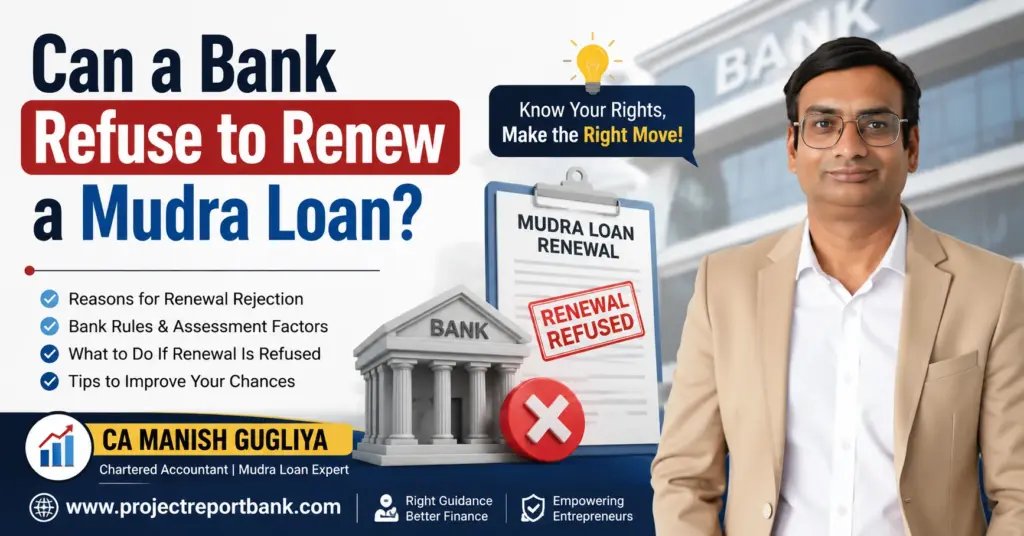
- What Documents Are Required for Mudra Loan Renewal? (Practical Guide by CA Manish Gugliya)
- Can a Mudra Loan Be Renewed? Eligibility, Process & Practical Guide (By CA Manish Gugliya)

- How to Check Mudra Loan Outstanding Balance? (Practical Guide for Borrowers)
- Can You Foreclose a Mudra Loan? Process, Charges & Rules (Expert Guide by CA Manish Gugliya)

- Can Mudra Loan Repayment Period Be Extended? (Practical Guide by CA Manish Gugliya)