Key Takeaways
- Having credit card outstanding does not automatically disqualify you from a Mudra Loan. The bank evaluates overall repayment behaviour, business capacity, and credit conduct before making a decision.
- There is a critical difference between normal card outstanding (amount due but not yet past due date) and serious overdue, settled, or written-off card accounts. Lenders treat these very differently during Mudra Loan assessment.
- Banks will typically examine your CIBIL report, credit utilisation, existing EMIs, business cash flow, and banking conduct before deciding on eligibility.
- A heavy credit card debt may compel lenders to offer lower loan amounts or stricter terms, even if they do not outright reject the application.
- Before applying under Mudra Yojana, regularise overdue dues, reduce high card utilisation, and prepare proper business projections and a realistic project report.
Can I Get Mudra Loan If I Have Credit Card Outstanding?
Yes, a Mudra Loan is still possible even if the applicant has credit card dues. The Pradhan Mantri Mudra Yojana (PMMY) scheme provides financial assistance to micro enterprises, small businesses, and entrepreneurs across India. Under this government scheme, mudra loans can be up to ₹10,00,000, and no collateral is required for loans up to ₹10,00,000. The scheme covers various categories: shishu loans are up to ₹50,000, Kishore loans range from ₹50,001 to ₹5,00,000, Tarun loans range from ₹5,00,001 to ₹10,00,000, and Tarun+ loans are from ₹10,00,001 to ₹20,00,000.
Lenders under PMMY focus on repayment capacity, business viability, and overall credit conduct rather than simply the presence of a card balance. Having debt is not automatically negative. The real concern is whether the borrower is servicing that debt on time and comfortably.
Banks generally check: total credit card outstanding, credit limit, utilisation percentage, recent payment track, any overdue amounts, other loans and EMIs, business income, banking behaviour, and the requested loan amount.
Consider this example. Applicant A has ₹50,000 outstanding against a ₹2,00,000 credit limit with all payments made on time every month. Applicant B also has ₹50,000 outstanding but against a ₹60,000 limit and has missed payment dates twice in the last six months. Although the outstanding amount is identical, the credit behaviour is entirely different, and banks will view these two applications very differently.
Table of Contents
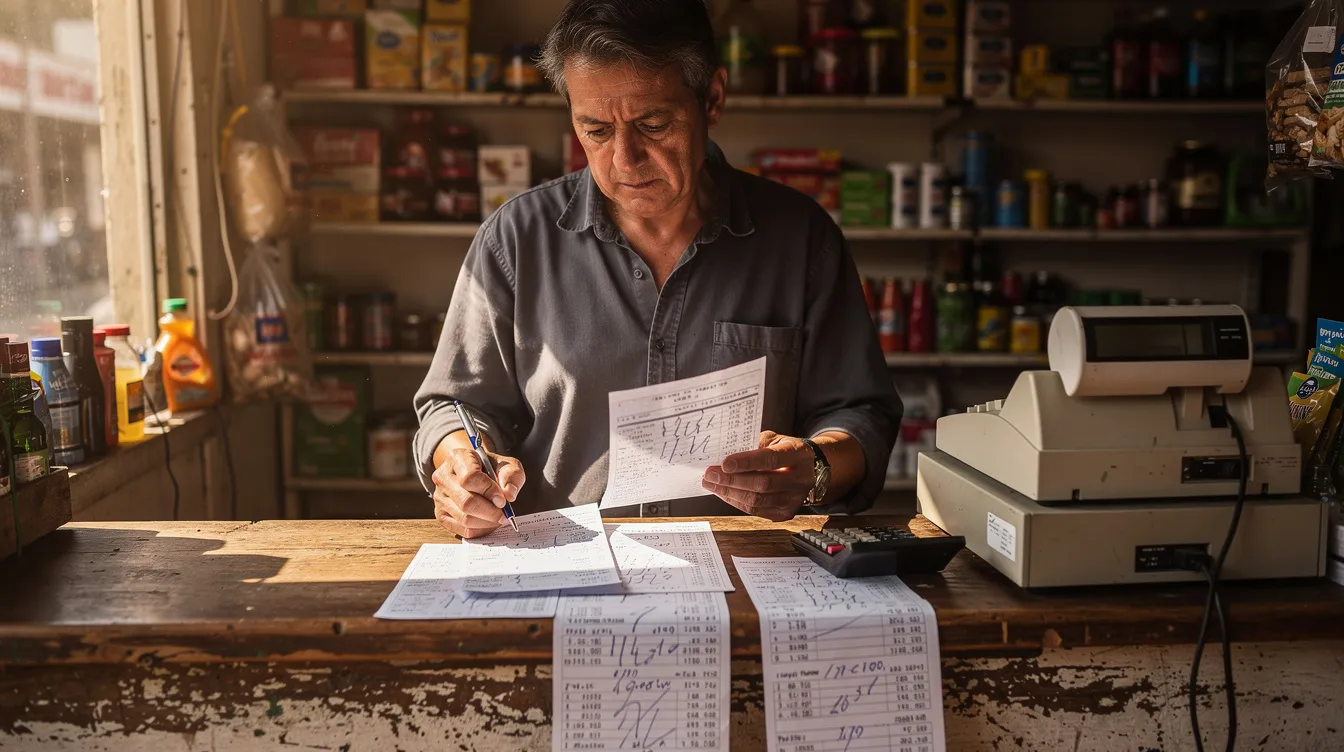
How Banks May View Credit Card Outstanding During Mudra Loan Assessment
When processing mudra loans, bank credit teams look at overall risk, not just one number on your credit report. The PMMY scheme provides a framework, but each bank or financial institution applies its own internal credit policy and risk norms in line with applicable guidelines. The same credit card data can be interpreted differently by different lenders. Readers may want to understand whether all banks follow the same Mudra Loan rules.
No single factor like “one late payment” or “60% utilisation” independently determines approval or rejection. Banks always look at the combined picture. Below are the key dimensions they examine.
Total Credit Card Outstanding
Lenders compare absolute outstanding with income level, business turnover, and card limit. A shop owner earning ₹60,000 per month with ₹25,000 card dues presents a very different picture from a professional earning ₹1,50,000 per month with ₹75,000 dues. High outstanding relative to income may signal financial pressure, especially when combined with other loans. Modest outstanding serviced on time is usually acceptable.
Banks often treat card outstanding as a revolving liability and may factor a notional EMI when computing your repayment capacity for the Mudra Loan.
Credit Utilisation Ratio
Credit utilisation ratio is the percentage of your credit limit that you are currently using. If your card has a ₹1,00,000 limit and you owe ₹80,000, your utilisation is 80%. If you owe only ₹15,000, it is 15%.
High credit card utilization signals high credit dependency to lenders. Consistently running at 75–90% utilisation can make it appear that the card functions like a permanent loan rather than short-term convenience. Holders of a credit card should aim for a utilization ratio below 30% for optimal financial health. However, there is no officially fixed Mudra rule saying “above 30% means rejection.” Utilisation is just one input into the bank’s risk view.
Payment History
Payment discipline on the credit card is often more important than the size of the outstanding. Timely payment of credit card dues is important for a positive credit assessment.
In simple terms:
- Full payment by due date – best possible behaviour.
- Partial payment – acceptable occasionally but raises questions if habitual.
- Minimum amount due – prevents immediate overdue flag but keeps balance high.
- Delayed payment – shows up on credit reports as DPD (days past due).
- Overdue – remains unpaid beyond due date; reported to bureaus.
A borrower who always pays the full due before the due date presents a much stronger case than someone who habitually pays only the minimum or pays late. To learn more, readers can explore how financial discipline can improve Mudra Loan approval readiness.
Existing EMIs and Liabilities
Banks add up all existing EMIs and obligations: personal loans, vehicle loans, home loans, education loans, business loans, and any converted credit card EMIs.
Simple illustration: if your current monthly EMIs total ₹14,000 and the expected Mudra EMI is ₹8,000, the lender checks whether ₹22,000 in total outgo is reasonable compared to your monthly surplus. Readers with other unsecured borrowing may also want to understand how lenders assess a Mudra Loan while having an existing personal loan. Similarly, those with secured long-term EMIs can refer to the guide on Mudra Loan with an existing home loan.
Business Cash Flow and Repayment Capacity
Banks look at actual cash generated by the business after expenses, not only at turnover or sales. Banks assess projected cash flows to ensure borrowers can handle new EMIs alongside existing obligations. A retailer with ₹3,00,000 monthly sales but ₹2,80,000 in costs has only ₹20,000 surplus, which is very different from a service provider with ₹1,50,000 sales and ₹80,000 costs leaving ₹70,000 surplus. To understand this better, readers can explore turnover vs profit in Mudra Loan assessment.
Strong, stable cash flows can sometimes compensate for moderate card outstanding. Weak or unstable income makes even small card dues more sensitive during Mudra Loan processing.
Credit Card Outstanding vs Credit Card Overdue – Understand the Difference
This distinction is critical and many applicants confuse the two.
Outstanding is the total amount on the card at a point in time. Your statement dated 5th of the month shows ₹35,000 outstanding with a due date of 25th. Until the 25th, this is simply outstanding – not overdue.
Overdue is the amount that should have been paid by the due date but remains unpaid. If ₹35,000 is still unpaid after the 25th, it becomes overdue. CIBIL and other credit bureaus report overdue status using days past due (DPD). Even one or two cycles of overdue can affect the credit profile more seriously than simple, not-yet-due outstanding.
Here is a simple comparison:
| Aspect | Outstanding | Overdue |
|---|---|---|
| Meaning | Total balance on card at statement date | Amount unpaid past due date |
| Payment due? | Due date has not yet passed | Due date has passed |
| Credit impact | Affects utilisation ratio | Affects payment history and DPD record |
| What lender focuses on | Size relative to limit and income | How long unpaid, frequency of delays |
| Concern level for Mudra Loan | Moderate (depends on utilisation) | High (especially if recent or repeated) |
Correcting overdue amounts is usually more urgent before applying for a Mudra Loan than trying to make the temporary outstanding figure exactly zero.
Does Credit Card Outstanding Affect CIBIL Score?
CIBIL score reflects overall credit behaviour, and credit cards are a key component. Outstanding credit card balances can lower your credit score and affect Mudra loan applications. A high credit card balance can increase your credit utilization and may reduce your credit score.
However, normal, regularly serviced outstanding by itself usually does not damage CIBIL. Issues arise when dues remain overdue or close to the limit for extended periods. Factors like repayment history, frequency of late payments, current overdues, settlements, and written-off accounts collectively influence the score.
While no credit score check is required for Mudra loans as a mandatory scheme-level rule, many individual lenders still conduct bureau score validation as part of their internal credit assessment. Do not believe blanket statements like “banks never check CIBIL for Mudra” or “good score guarantees approval.” The score is one of several inputs in the lender’s assessment.
What If I Pay Only Minimum Amount Due on My Credit Card?
The “minimum amount due” on a credit card statement is typically a small percentage of total dues plus applicable taxes and charges. Paying only this minimum by the due date may prevent immediate reporting as overdue, but the remaining balance continues and attracts interest. Credit cards carry high revolving interest rates often between 35% to 42% annually.
If a card shows ₹60,000 dues and the borrower pays just ₹3,000–₹4,000 as minimum for several months, the balance remains nearly unchanged. This pattern can signal cash-flow stress and may be viewed cautiously during Mudra Loan evaluation.
Occasional use of the minimum amount facility in a tight month is different from a consistent pattern. Applicants should try to reduce revolving balances before approaching banks for mudra loans.
Can High Credit Card Utilization Affect Mudra Loan Approval?
High utilisation means regularly using a large portion (70–90%) of your total card limit for months at a stretch. Consider two applicants, both with a ₹1,00,000 limit and on-time payments:
- Applicant X: Outstanding ₹90,000 (90% utilisation)
- Applicant Y: Outstanding ₹15,000 (15% utilisation)
Banks may perceive higher risk in Applicant X’s situation because it raises questions about whether the card is covering recurring deficits rather than occasional needs.
High utilisation does not mean guaranteed rejection. Where financially feasible, reducing very high utilisation a few months before applying can improve the presentation. But do not artificially borrow from informal sources just to show low utilisation if it will create hidden pressures elsewhere.
Can Overdue Credit Card Payment Cause Mudra Loan Rejection?
Overdue credit card dues can significantly hurt approval chances but do not lead to automatic rejection in every case. Missing payments can lead to accounts being classified as past due or non-performing assets. Being in default to a bank or financial institution disqualifies Mudra loan eligibility.
The escalation levels matter:
- Occasional short delay (3–5 days, once in a year) – minor concern
- Repeated late payments – raises a pattern of poor discipline
- Continuing overdue beyond one billing cycle (30+ DPD) – serious concern
- Serious delinquency (60–90+ DPD) – very negative
- Settlement – paid less than full dues; negative remark stays on report
- Written-off – lender wrote off the account; severely negative
Recent and repeated overdue entries are treated more seriously than an isolated old delay that has since been regularised. As far as possible, clear overdue amounts and maintain punctual payments for a few months before filing a Mudra loan application.
What If My Credit Card Account Is Settled?
There is an important difference between closing a card after paying all dues in full and “settling” by paying only part of the contractual amount under a negotiated deal. Settlements and “written-off” remarks remain visible on the credit report for several years and may negatively influence credit assessment.
For example, a card with ₹1,00,000 due is settled for ₹60,000. The credit report shows “settled” instead of “closed,” making future lenders more cautious. Readers should obtain their credit report, review how such accounts are reported, and work with the bank to rectify errors.
Even with a past settlement, a strong recent track record, healthy business cash flow, and sound documentation may still support a case, but probability of approval may be lower and conditions stricter.
How Existing Credit Card Debt Affects Repayment Capacity
Repayment capacity is the ability to comfortably pay all EMIs and dues from regular business surplus.
Example: A business owner has a net monthly surplus of ₹45,000. Existing obligations include a personal loan EMI of ₹10,000, a two-wheeler EMI of ₹3,500, and average credit card payment of ₹5,000. Total existing outgo: ₹18,500. Remaining surplus: ₹26,500. A Mudra EMI of ₹8,000–₹10,000 appears serviceable. But if the card payment alone were ₹20,000, the picture changes dramatically.
Lenders often calculate an overall debt service coverage ratio to see how much of income goes towards repayments. Very high ratios can make sanction difficult.
Hiding or under-reporting card dues and EMIs is counter-productive. Banks usually see these details in credit reports and bank statements.

Mudra Loan With Credit Card Outstanding – Practical Examples
The following four scenarios are illustrative. They help explain how different patterns of credit card usage may affect Mudra Loan assessment, without predicting any specific outcome.
Case 1: Low Outstanding + Regular Payments
A small tailoring unit owner (an enterprise in apparel design and services) has a ₹1.5 lakh card limit, ₹20,000 outstanding, and has never been late. She applies for a ₹3 lakh Kishore category Mudra Loan. The bank focuses on business viability, bank statements, and basic eligibility criteria. This is generally a comfortable scenario.
Case 2: High Utilisation but No Overdue
A mobile shop owner (trading in phone and vehicle accessories) has a ₹1 lakh limit and consistently carries ₹90,000 utilisation but always pays at least the due amount. The bank may probe cash flow more deeply and factor higher revolving liability while assessing the loan.
Case 3: Credit Card Overdue
A trader has ₹70,000 dues with two cycles unpaid (30+ DPD). The overdue status, recent delinquencies, and reasons for delays will be critical. This may materially reduce chances of sanction.
Case 4: Multiple Cards + Existing Loans
A service provider uses three cards plus a personal loan and a vehicle loan. The lender will add all EMIs and average card payments, look at combined liabilities, and assess whether surplus can absorb the new Mudra EMI. Readers in this situation may find the separate guide on Mudra Loan while having an existing personal loan helpful.
Should I Clear My Credit Card Outstanding Before Applying for Mudra Loan?
Clearing or meaningfully reducing card dues can strengthen the application, especially where utilisation is high or some amounts are overdue. However, for many micro units, completely exhausting savings or business working capital to show zero outstanding may not be practical and can itself create cash-flow strain.
Priority order:
- Clear overdue and penal charges as far as possible.
- Reduce very high utilisation to more reasonable levels (aim for below 50%, ideally below 30%).
- Avoid fresh large spends on credit card just before Mudra Loan application.
A borrower who reduces utilisation from 90% to 40% over 2–3 months through disciplined payments presents a more comfortable picture to lenders. The aim is not to appear “perfect” for one month but to build a genuinely sustainable financial position.
What Should I Do Before Applying for Mudra Loan?
Here is a practical checklist for 1–3 months before application:
- Check all credit card outstanding across all cards and identify which parts are overdue.
- Clear or regularise overdue dues where possible. Do not miss upcoming due dates.
- Obtain and review your credit report (CIBIL or other bureaus). Look for errors, and check how any settled or written-off accounts are shown.
- Reduce unusually high credit utilisation without harming essential business liquidity. Avoid unnecessary new credit enquiries or new cards just before applying.
- Calculate total existing monthly liabilities (all EMIs plus typical card payments) and prepare realistic business cash-flow projections.
- Prepare a proper project report with realistic loan amount, cost estimates, and expected income. Consider reading the guide on proper project costing for Mudra Loan approval.
- Keep last 6–12 months bank statements, GST filings (if applicable), and basic financial records ready.
- Consider applying through a bank where you already have a satisfactory account history. You can also explore whether an existing banking relationship can improve Mudra Loan approval chances.
Documents That Can Help Explain Your Financial Position
Document expectations vary by lender, loan amount (Shishu, Kishore, Tarun categories), and applicant profile. However, providing clear records usually supports faster and more accurate assessment.
Typical documents include:
- Savings/current account bank statements for last 6–12 months
- Latest credit card statements for all cards showing outstanding and payment history
- Statements of existing loans and EMIs
- GST registration and returns (where applicable)
- Udyam registration, trade licence, or other business proof
- Invoices, sales records, purchase bills, and basic profit/loss details or ITRs
- Projected profitability statements, projected cash-flow statements, and CMA data for higher-ticket mudra loans
- Project report covering the proposed activity, capital assets to be purchased, and assets created from the funding
Sharing credit card and loan statements transparently helps the credit officer see that dues are being serviced regularly, which may offset concerns from the mere fact that outstanding exists.
Credit Card Outstanding vs Personal Loan vs Home Loan – Does the Bank Treat Them the Same?
All three are liabilities, but their nature differs.
| Feature | Credit Card | Personal Loan | Home Loan |
|---|---|---|---|
| Type | Revolving credit | Fixed EMI, fixed tenure | Long-term secured, fixed EMI |
| Interest rate | High (often 35–42% p.a.) | Moderate | Lower |
| Security | Unsecured | Unsecured | Property-backed |
| EMI structure | Variable/minimum due | Predefined | Predefined |
Lenders add up all obligations when evaluating Mudra Loan eligibility. Existing unsecured personal loans and card dues together can increase overall unsecured exposure. A well-serviced home loan EMI may be viewed differently from irregular credit card dues.
The key is honest disclosure and demonstration of the ability to service all obligations from actual business surplus.
Common Mistakes Applicants Make When They Have Credit Card Outstanding
- Ignoring overdue credit card bills and hoping they will not appear on the credit report.
- Repeatedly paying late or only the minimum amount due for months.
- Using cash advances from cards to cover routine business expenses.
- Maxing out multiple cards simultaneously.
- Applying for several new cards or loans just before the Mudra application.
- Hiding existing liabilities from the bank despite them being visible on the credit report.
- Assuming high turnover means strong repayment capacity without showing actual profit or surplus.
- Requesting an unrealistic Mudra loan amount not backed by project costing.
- Closing or settling accounts hastily without understanding how “settled” or “written-off” remarks affect credit reports.
How to Improve Your Mudra Loan Application If You Have Credit Card Debt
- Regularise overdue card accounts as a first priority. Negotiate payment plans if needed and ensure consistent on-time payments for at least 3–6 cycles.
- Reduce excessive revolving balances (especially where utilisation exceeds 70–80%) in a planned way, while keeping sufficient working capital.
- Maintain clean banking conduct: avoid frequent cheque returns, maintain adequate average balances, and keep business and personal transactions reasonably well organised.
- Prepare realistic business projections and a clear project report showing how the Mudra Loan will be used and how cash flows will service EMIs.
- Discuss all existing liabilities transparently with the lending officer and select a realistic loan amount that aligns with both project needs and repayment capacity.
- For deeper preparation, explore how financial discipline can improve Mudra Loan approval readiness.
When Credit Card Outstanding May Not Be a Major Concern
Banks may be relatively comfortable when:
- Card outstanding is modest compared to income and credit limit.
- Repayment behaviour is consistently clean with no overdue amounts.
- Total monthly card payments form only a small portion of monthly surplus.
- Overall liabilities (including other loans) are within reasonable levels so that even after adding the proposed Mudra EMI, the borrower still has cushion.
- A satisfactory credit track record, stable banking transactions, and realistic loan amount all support the case.
Even in these comfortable situations, approval is never a guarantee. Internal bank policies and documentation can still affect the decision.
When Credit Card Debt Can Become a Serious Concern
Red-flag scenarios include:
- Repeated missed payments across several months.
- Substantial overdue amounts (two or more cycles unpaid).
- Multiple cards close to or at their limits.
- Card accounts settled for less than full dues or written-off accounts.
- Frequent use of cash advances to meet regular expenses.
- Heavy existing EMIs combined with limited business surplus and unstable bank statement flows.
In such cases, applicants may first need to stabilise their finances and rebuild their repayment track record before expecting a positive Mudra loan decision.
Expert Guidance by CA Manish Gugliya
CA Manish Gugliya (FCA), Chartered Accountant with 20+ years’ practical experience in Project Reports, CMA Data, MSME Finance, Business Loans, and Mudra Loan consultancy.
Many small-business owners in India panic the moment they see ₹40,000–₹1,00,000 outstanding on their credit card statement and fear automatic Mudra Loan rejection. In my experience, this fear is often misplaced.
The more relevant questions are: Is the amount overdue? Are payments being made on time? How much of the credit limit is being used? Are there other EMIs? What is the real business surplus after expenses? Is the requested Mudra loan amount reasonable for the proposed activity?
During advisory engagements, the focus is on presenting a transparent, realistic picture. This means reconciling bank statements with business turnover, preparing cash-flow estimates, and showing how existing credit obligations plus the proposed Mudra EMI can be serviced. Managing a Pradhan Mantri MUDRA Yojana loan requires careful balancing with credit card debt, and this balancing act is what lenders want to see demonstrated.
I have seen applicants with modest but well-managed card dues obtain mudra loans after proper documentation. A beauty parlours owner in a small town had ₹30,000 on her card, always paid on time, showed steady income, and obtained a Kishore category loan extended for equipment purchase. On the other hand, I have also seen traders with ₹80,000 overdue across two cards who were advised to first regularise before reapplying. Sweet shops owners, individuals in cotton ginning, livestock rearing, activities allied to agriculture, or any income generating enterprise – the principle remains the same.
Mudra loans are available for various business purposes across micro enterprises engaged in trading, manufacturing, and services. The scheme is designed for non corporate, non-farm small and micro units, individual borrowers, and entrepreneurs who possess the necessary skills and knowledge to undertake their proposed activity. Whether it is a term loan, an overdraft facility, or funding for capital assets, eligible borrowers across all categories can avail this scheme. Applicants must be between 18 and 65 years old, and no specific educational qualification is mandatory. The scheme supports employment creation and income generating activities – though it is worth noting that crop loans are not covered under this scheme.
Interest rates for Mudra loans are deregulated, meaning each lender sets its own rate. Repayment tenure for Mudra loans varies based on the loan amount and the nature of the enterprise. Mudra loans are available for various income-generating activities, and each beneficiary micro unit is assessed based on its specific merits.
Instead of trying to make the “CIBIL score look perfect” for one month, work on consistent financial discipline: timely payments, reasonable utilisation, and prudent borrowing. If you have successfully repaid previous loans or previous loans are being serviced well, that forms a strong reference point in your favour.
Lenders under Mudra Yojana are more confident when documentation, banking conduct, and project report all tell the same story about the business and its repayment capacity. The credit card outstanding is not, by itself, a barrier. What matters is behaviour, capacity, and honest presentation of facts.
At the next phase of your application, ensure all your links between financial documents are consistent, the details of assets created and assets to be purchased are clear, and your finance plan covering loans and equity contribution is realistic. A Mudra Loan is a form of security-free funding from the government-backed scheme, and when the applicant presents a credible case, the loan can certainly be availed.

Frequently Asked Questions
Can I get Mudra Loan if my credit card has outstanding balance?
Yes, having a credit card outstanding does not automatically disqualify you. The lender will evaluate your overall financial position including repayment history, credit utilisation, business cash flow, and existing liabilities. A well-managed outstanding with on-time payments is treated very differently from overdue or defaulted card accounts.
Is credit card outstanding the same as overdue?
No. Outstanding is the total balance on your card at a point in time, which may not yet be past its due date. Overdue means the amount has remained unpaid beyond the due date. Overdue amounts are reported to credit bureaus as days past due (DPD) and carry greater negative weight during loan assessment.
Does the bank check CIBIL for Mudra Loan?
While the PMMY scheme itself does not mandate a specific credit score, many lenders conduct their own bureau checks as part of internal risk policy. A good credit score supports your case but does not guarantee approval. Conversely, a poor score does not automatically mean rejection at every lender, but it does make approval more difficult.
What happens if my credit card account was settled?
A “settled” account means you paid less than the full contractual amount. This remark stays on your credit report for years and may make lenders more cautious. It is different from “closed,” which means you paid all dues in full. If you have a settled account, maintaining strong recent repayment behaviour and clean documentation can still support your Mudra Loan case, though approval chances may be lower.
Can I get Mudra Loan with a personal loan and credit card outstanding?
Yes, it is possible, but the lender will add up all your existing EMIs and card payments to assess whether sufficient surplus remains to service the new Mudra EMI. If combined liabilities are too high relative to your business surplus, the lender may offer a smaller loan amount or may not proceed. Keeping total fixed obligations at a reasonable proportion of your income is important.
Conclusion
A credit card outstanding balance is not an automatic barrier to Mudra Loan sanction. The lender looks at the bigger financial picture: whether dues are overdue, your repayment history, credit utilisation, other liabilities, business cash flow, repayment capacity, banking conduct, credit profile, and the proposed loan requirement. Eligible applicants from all stages of micro enterprise – whether in trading, services, manufacturing, or activities allied to agriculture – can approach their bank for a Mudra Loan even with existing card balances.
The critical distinction is between normal, well-managed outstanding and serious credit problems. Repeated overdue payments, settlements, and written-off accounts influence risk perception far more heavily than a modest, timely-serviced card balance. If your credit conduct shows discipline and your business generates adequate surplus, a card outstanding alone should not stop you from applying.
Practical steps that can genuinely help: clear or reduce overdue dues, bring utilisation to reasonable levels, avoid unnecessary new borrowing before application, and prepare a clear business plan with realistic cash-flow projections. Be transparent about all existing credit card and loan obligations. Use financial discipline as a long-term tool for strengthening eligibility – not just for one Mudra application.
No professional can guarantee loan approval. But understanding how credit card behaviour is viewed by lenders and taking corrective steps in advance can materially improve your Mudra Loan readiness. Focus on behaviour, capacity, and honest presentation of facts.
- Does Gold Loan Affect Mudra Loan Eligibility? (Expert Guidance by CA Manish Gugliya)

- Which Credit Report Do Banks Check for Mudra Loan?
- Do Banks Check All Existing Loans Before Approving Mudra Loan?
- Does Credit Card Limit Affect Mudra Loan Eligibility?

- Does Car Loan Affect Mudra Loan Eligibility?
- Does Late EMI Payment Affect Mudra Loan Eligibility?
- Does Credit Card EMI Affect Mudra Loan Eligibility?

- Mudra Loan with Credit Card Outstanding – Practical Guide by CA Manish Gugliya
- Mudra Loan With Existing Personal Loan: Can You Still Get Approval?