When you apply for a mudra loan, one of the first things the bank does is pull your credit report. But which credit report exactly? Most borrowers assume only a CIBIL report matters. The reality is more nuanced, and understanding it can help you prepare better.
As CA Manish Gugliya with over 20 years of experience in business loans, project reports, and MSME finance, I regularly guide small business owners through this process. This article gives you a clear, practical answer backed by regulatory facts and on-ground lending experience.
Key Takeaways
- Banks usually check at least one credit report – often from TransUnion CIBIL, but also from Experian, Equifax, or CRIF High Mark – when assessing a mudra loan application, based on their own credit policy.
- There is no single mandatory credit bureau fixed under Pradhan Mantri Mudra Yojana (PMMY). Lenders are free to use one or more RBI-approved Credit Information Companies (CICs). No credit score is required to apply for a mudra loan under the official scheme guidelines.
- The lender sees your existing loans, EMIs, credit card usage, and repayment track in the credit report, and combines this with business viability, financial documents, and repayment capacity to make a decision.
- There is no officially prescribed minimum cibil score for mudra loan eligibility. However, no past loan defaults are crucial, and a cleaner credit history with disciplined repayments improves approval chances.
- In my experience, applicants should focus on maintaining healthy credit behaviour and preparing a solid business proposal rather than worrying about which bureau the bank will check.
Which Credit Report Do Banks Check for Mudra Loan?
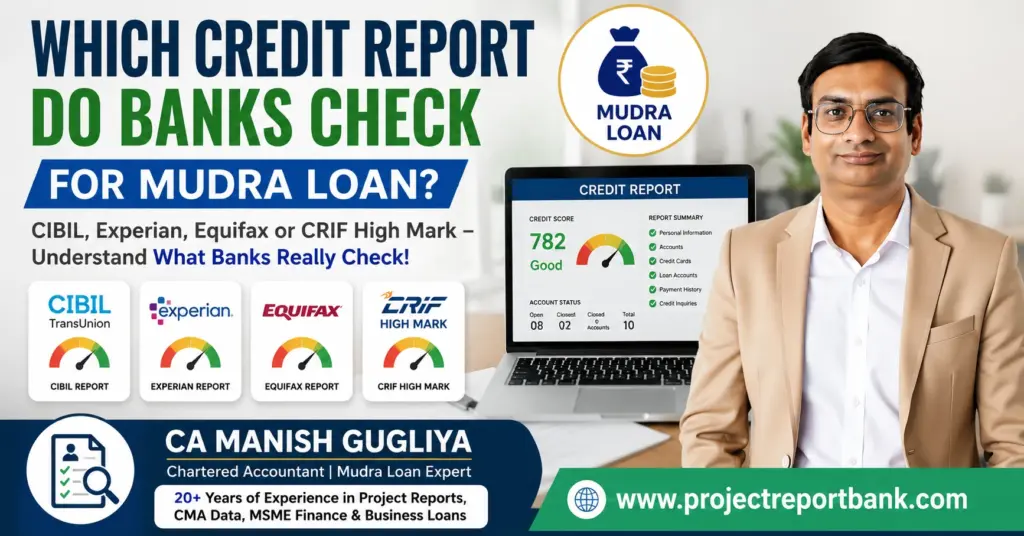
Banks typically check a credit report from at least one Indian credit bureau when you apply for a mudra loan. TransUnion CIBIL is the most commonly reviewed credit report by banks in India, but lenders also use Experian, Equifax, or CRIF High Mark depending on their internal systems and agreements.
To clarify key terms: a credit bureau (or Credit Information Company) collects your borrowing data from lenders. A credit report is the detailed document showing your loan and repayment history. A credit score is a numeric summary (typically 300–900) derived from that report. Mudra itself does not mandate a specific bureau or score.
Public sector banks, private banks, small finance banks, NBFCs, and MFIs participating in PMMY may use different bureaus or even pull multiple reports. Mudra loans are available for amounts up to rs 10 lakh and cover non farm income generating activities allied to agriculture and small businesses. Eligible applicants include self employed professionals, sole proprietorships, partnership firms, small manufacturers, and women entrepreneurs. Applicants must be Indian citizens aged 18 to 65, meeting the minimum age and maximum age limit criteria. PMMY loans support financial inclusion for new and micro enterprises, meaning the scheme is designed to encourage entrepreneurship even among first time entrepreneurs.
From the borrower’s perspective, the key is simple:
- Pay all EMIs and credit card bills on time
- Maintain clean credit behaviour across all loans and cards
- All major bureaus receive data from lenders, so good habits reflect everywhere
The credit report checked for a mudra loan is the same type used for other business loans and personal loans.

Table of Contents
Is CIBIL Report Checked for Mudra Loan?
Most banks commonly check a CIBIL TransUnion report for mudra loan assessment, but it is not legally compulsory that every lender must rely only on CIBIL. The CIBIL report is commonly used as a benchmark during credit assessments because CIBIL is India’s oldest bureau, which is why borrowers often equate “credit report” with “CIBIL report.”
A typical CIBIL report shows identity details, current and past loans, credit card limits and usage, enquiries, and repayment track including DPD (Days Past Due) status and any “settled” or “written-off” remarks. While there is no official minimum cibil score required under PMMY guidelines, individual banks may internally prefer scores of 700+ for larger Kishor or Tarun category loan amounts. For shishu loans, lenders prioritize basic identity verification like identity proof, address proof (voter i card, utility bill), and pan card, and may accept applicants with limited credit history.
Check your own CIBIL report before applying, correct genuine errors, and understand that even small loan amounts may trigger a credit check.
Which Credit Bureaus Can Banks Check in India?
Banks may choose from four RBI-approved credit information companies for mudra loan credit checks. Different banks have signed data-sharing arrangements with different bureaus, so the same applicant could be evaluated using CIBIL by one bank and Experian by another. While formats vary slightly, the broad information – loans, cards, EMI history, overdues, enquiries – is similar across all four.
TransUnion CIBIL
TransUnion CIBIL is India’s oldest and most widely used credit bureau, with scores ranging from 300 to 900. It is popular for general commercial and individual evaluations. Key report sections relevant for mudra loan appraisal include personal information, account summary, detailed account-wise history, and the enquiry section. Most banks first pull a CIBIL report, but the final mudra loan eligibility decision also depends on business viability and documentation.
Experian
Experian India is another RBI-approved credit bureau whose reports and scores are accepted by financial institutions processing mudra loans and other business loans. Some lenders rely primarily on Experian for retail and MSME loans. Experian scores also range roughly between 300 and 900 and evaluate similar parameters: past loans, card usage, overdue days, and settlements.
Equifax
Equifax Credit Information Services operates in India providing both consumer and commercial credit reports. Equifax India is frequently utilized for microfinance and small-ticket lending by certain private banks and NBFCs. Discrepancies between Equifax and CIBIL – for instance, one bureau showing a closed loan still as active – should be resolved through the respective bureau’s dispute mechanism.
CRIF High Mark
CRIF High Mark is used by microfinance institutions and regional rural banks for small-ticket loans, including some mudra loan segments. Their reports often include granular information on microfinance loans and joint-liability-group borrowing, relevant for borrowers under Shishu or Kishor categories. Good repayment behaviour will reflect across CRIF High Mark, CIBIL, Experian, and Equifax because most lenders report to more than one bureau.
Can Different Banks Check Different Credit Bureaus for Mudra Loan?
Yes. Different banks, small finance banks, NBFCs, and MFIs can and do use different credit bureaus for mudra loan credit checks. Some have a “primary” bureau (say CIBIL) and a “secondary” one for borderline cases. Cooperative banks and regional rural banks may rely on whichever bureau they are integrated with. Lenders assess overall financial position, not just cibil score from a single bureau.
Do not try to “shop” for a bank based only on which bureau it uses. Inconsistent behaviour across loans and cards will eventually surface. Consistent on-time EMIs and prudent credit-card usage is the best way to stay eligible across all lenders.
What Information Does a Bank See in Your Credit Report?
During mudra loan appraisal, the bank examines your credit report to understand existing debts and repayment habits. Lenders review credit reports to assess default history and repayment discipline. Multiple recent loan applications can indicate financial stress to lenders. Here is what a typical report shows:
- Existing loans and outstanding balances
- EMI repayment history (month-by-month for 24–36 months)
- Credit card limits, usage, and outstanding amounts
- Delayed or missed payments (DPD status)
- Active and closed credit accounts
- Defaults, write-offs, or settled accounts
- Recent enquiries from other lenders
The credit report reflects past behaviour. Banks combine this with your current income, projected business cash flow, required documents, and a viable project report to decide your loan eligibility.
Do Banks Check Existing Loans Before Approving Mudra Loan?
Banks do check existing loans and EMIs visible in your credit report before sanctioning a mudra loan to evaluate overall repayment capacity. Existing home loans, personal loans, or vehicle loans are not automatic grounds for rejection, but total monthly obligations should be reasonable compared to income. Improving income sources enhances mudra loan eligibility. Learn more about whether banks check existing loans before Mudra Loan approval.
If you already have multiple high EMIs, reassess the required loan amount and consider closing costlier loans first.
What If You Already Have a Personal Loan?
An existing personal loan will appear in your credit report with EMI amount and repayment track. Having one does not automatically disqualify you. Maintaining a good repayment history boosts loan approval chances, while frequent delays hurt eligibility. Borrowers close to finishing a personal loan may benefit from completing it first. Read more about getting a Mudra Loan with an existing personal loan.
Does an Existing Home Loan Affect the Credit Assessment?
A home loan involves a sizeable EMI that banks always consider. Credit history is especially scrutinized for larger loan amounts under PMMY. A long, clean repayment history on a home loan is a positive signal, but if the EMI consumes a major share of income, the bank may sanction a smaller mudra loan. Understand Mudra Loan eligibility with an existing home loan and prepare updated income statements showing adequate cash flow.
Does a Car Loan Affect Mudra Loan Eligibility?
A running car or commercial-vehicle loan appears in your credit report, and its EMI adds to your fixed obligations. Higher loan tiers require a formal track record of credit management. Consistent on-time car loan EMIs positively influence lender perception. Learn about how an existing car loan affects Mudra Loan eligibility.
Does Credit Card Outstanding Appear in Credit Assessment?
Your credit report shows each credit card with its sanctioned limit, current outstanding balance, and payment history. Credit reports are evaluated differently for collateral-free loans like PMMY loans, so banks pay close attention to utilization. High regular utilization (above 60–70% of the limit) may indicate riskier behaviour. Even with some card dues, approval is possible if your overall credit profile is strong – read about getting a Mudra Loan with credit card outstanding. Also understand whether your credit card limit affects Mudra Loan eligibility.
Does Credit Card EMI Affect Mudra Loan Eligibility?
Credit card EMIs – where purchases or outstanding are converted into fixed monthly instalments – appear as obligations in your bank statement and credit report. Even if you pay only the EMI, it reduces free monthly cash flow. Multiple ongoing card EMIs may signal over-leverage. Where feasible, close high-interest card EMIs before applying for a significant Kishor or Tarun mudra loan. More details on how credit card EMI affects Mudra Loan eligibility.
Do Late EMI Payments Show in the Credit Report?
Late EMIs are reported as Days Past Due (DPD) – status codes like 0, 30, 60, or 90 days overdue – in your month-by-month account history. A single old delay may be viewed more leniently than frequent recent 60–90 day delays. Applicants must not have any past loan defaults for the strongest eligibility. Read about whether late EMI payments affect Mudra Loan eligibility. Regularise any overdue EMIs and maintain a clean track for several months before approaching banks.
Do All Banks Follow the Same Credit Assessment Rules?
While PMMY lays down the broad framework and eligibility criteria, each participating lender has its own credit policy, internal rating models, and documentation norms. Two lenders can legitimately arrive at different decisions on the same applicant. The PMMY does not mandate a strict minimum credit score for eligibility – these thresholds vary by bank. If one bank rejects a reasonable proposal, improve documentation and try another. Learn whether all banks follow the same Mudra Loan rules.
Can Your Existing Bank Have an Advantage?
An existing relationship with a bank – current account, savings account, earlier loan – gives that bank more visibility into your business turnover and cash flow through your bank statement. This does not guarantee approval but may speed up the application process. Regular business credits, GST payments routed through the account, and low cheque bounces support a positive view. Read about whether an existing bank relationship improves Mudra Loan approval chances.
What If Different Credit Reports Show Different Information?
It is common for borrowers to see minor differences between CIBIL, Experian, Equifax, and CRIF High Mark reports due to different reporting dates. Typical causes include recent loan closures not yet reflected or limits updated only in some reports. Compare all reports carefully, identify genuine errors, and raise disputes with the relevant bureau. Allow a few weeks for corrections to reflect before submitting fresh mudra loan application form or related required details.
Is There a Minimum CIBIL Score Required for Mudra Loan?
No fixed cibil score is mandated under PMMY guidelines. The scheme defines eligibility by business type, loan amount (rs 5 lakh for Kishor, rs 10 lakh for Tarun), and non farm income generating activity – not by a specific score. However, cibil score is not required in the absolute sense, but maintaining a cibil score above 650 is advisable for higher loan categories. A good credit score helps but is not the sole factor. Banks look beyond the score number at recent defaults, written-off accounts, and overall leverage. Focus on timely repayments, reducing unnecessary borrowings, and demonstrating viable business cash flow in your project report.
Can You Get Mudra Loan With a Low Credit Score?
A low credit score makes approval more challenging but not automatically impossible. First-time borrowers are evaluated based on business viability and cash flow. Credit proposals rely on significant business revenue potential to offset low scores. Applicants without a credit history can still apply for mudra loans, especially under the Shishu category. New-to-credit applicants with no prior history can still qualify under certain categories where banks rely on business registration, banking transactions, and KYC rather than a score that does not yet exist. No consultant can legitimately guarantee approval at any score – be cautious of such cases.

How to Check Your Credit Report Before Applying for Mudra Loan
Reviewing your own credit report before applying is a practical first step. Correcting errors in credit reports improves loan application quality. Here is how:
- Obtain your report from CIBIL, Experian, Equifax, and CRIF High Mark through their official websites
- Verify name, PAN, date of birth, address proof details, and mobile numbers
- Confirm all active loans and cards listed are actually yours
- Scan for outstanding balances, EMI history (last 24–36 months), “written off” or “settled” remarks
- Check recent enquiries from lenders
- Raise disputes online for incorrect entries
- Avoid making multiple simultaneous loan applications just before your mudra loan process
Practical Example: How Banks Use Your Credit Report for Mudra Loan
Consider this illustrative scenario. A 32-year-old entrepreneur running a small trading firm applies for a Rs. 7 lakh Kishor mudra loan. She already has a car-loan EMI of Rs. 9,000, a home-loan EMI of Rs. 18,000, and a credit card with Rs. 1 lakh limit and Rs. 25,000 outstanding.
The bank reviews her credit report and checks: EMI track on home and car loans (all on time for 24 months), card dues paid before due date, total fixed obligations (Rs. 27,000) versus monthly business income (Rs. 70,000), and proposed mudra loan EMI (approximately Rs. 14,000). Lenders assess borrower’s business cash flow and viability during the application process. With clean repayment history and manageable obligations, the profile looks positive – though the bank may moderate the sanctioned maximum loan limit based on cash flow projections and interest rates.
This is only an illustrative example. Actual bank calculations vary by lender and by the applicant’s proposed business and business stage, along with financial assistance requirements and funding needs.
CA Manish Gugliya’s Practical View
In my 20+ years of preparing project reports, CMA data, and mudra loan files for micro enterprises and income generating businesses, I have seen borrowers over-focus on “which bureau will the bank check” instead of overall financial discipline. The most important factors have been: a realistic business proposal that strengthens the application, clear business purpose, a well-explained project report, and evidence of steady repayment behaviour.
Key habits every borrower should maintain:
- Pay EMIs and credit card bills on time
- Avoid unnecessary short-term loans
- Keep card utilisation moderate
- Regularise any past defaults
- Maintain clean bank statements with minimal cheque returns
I routinely help clients understand their credit profile and rectify genuine errors. But I never promise that a particular participating lender will definitely sanction a mudra loan purely based on a given lower score or any score. If your business is viable under mudra yojana, your financial documents are in order, and your credit history shows responsible behaviour, you stand a reasonable chance – whether the bank checks CIBIL, Experian, Equifax, or CRIF High Mark. That is the honest truth from someone who has helped eligible applicants across three categories of mudra loans navigate this process successfully.

Frequently Asked Questions
Can banks check more than one credit bureau for a single Mudra Loan application?
Yes. Banks can pull reports from more than one bureau if their internal policy requires it or if the first report is thin or inconsistent. Multiple enquiries by the same bank around the same time for the same loan generally have limited additional impact on your overall score.
Does checking my own credit report reduce my credit score before applying for Mudra Loan?
No. When you personally obtain your credit report, it is treated as a “soft enquiry” and does not reduce your credit score or hurt mudra loan eligibility. Regularly review your reports to check mudra loan eligibility readiness and identify errors before approaching most lenders.
If my spouse and I are co-borrowers for Mudra Loan, whose credit report is checked?
Banks typically check the credit reports of all co-borrowers and guarantors. Each person’s repayment history affects the combined risk assessment. Both partners should review and clean up their individual reports before submitting a joint application.
Will settling an old credit card help my chances for Mudra Loan immediately?
Settling an overdue card stops further deterioration, but the “settled” remark may be viewed cautiously and can remain visible for years. Paying dues in full is better than settlement. Even after settlement, maintain a clean track for some time before applying. Loan maturity and consistent behaviour matter more than a single corrective step.
Can I get a Mudra Loan if I have no credit history at all?
Applicants with no prior loans or cards may have a “no history” status. Lenders under mudra yojana, a refinance agency-backed scheme under micro units development framework, regularly deal with such first time entrepreneurs, especially under Shishu category. In such cases, banks rely on business viability, banking transactions, KYC (identity proof, address proof), and local knowledge rather than a credit score that does not yet exist. Small businesses and repair shops operated by applicants without formal credit history are not automatically excluded from the application process or from being able to get a mudra loan through pmmy guidelines.
- Does Gold Loan Affect Mudra Loan Eligibility? (Expert Guidance by CA Manish Gugliya)


- Which Credit Report Do Banks Check for Mudra Loan?
- Do Banks Check All Existing Loans Before Approving Mudra Loan?

- Does Credit Card Limit Affect Mudra Loan Eligibility?

- Does Car Loan Affect Mudra Loan Eligibility?

- Does Late EMI Payment Affect Mudra Loan Eligibility?
- Does Credit Card EMI Affect Mudra Loan Eligibility?

- Mudra Loan with Credit Card Outstanding – Practical Guide by CA Manish Gugliya

- Mudra Loan With Existing Personal Loan: Can You Still Get Approval?