If you have a Mudra Loan and want to know how much you still owe, the answer is straightforward: check the outstanding balance directly with the bank or financial institution that disbursed your loan. There is no single central Pradhan Mantri Mudra Yojana portal that shows every borrower’s balance. Your Mudra Loan outstanding balance is maintained in your loan account at the specific lender – whether it is a commercial bank, small finance bank, NBFC, or MFI. This article explains exactly how to check it, what the numbers mean, and how to verify that the figure shown is correct.
Key Takeaways
- Your Mudra Loan outstanding balance must be checked with the specific lender (bank, NBFC, or MFI) where the loan account is maintained – there is no single PMMY central portal for all lenders.
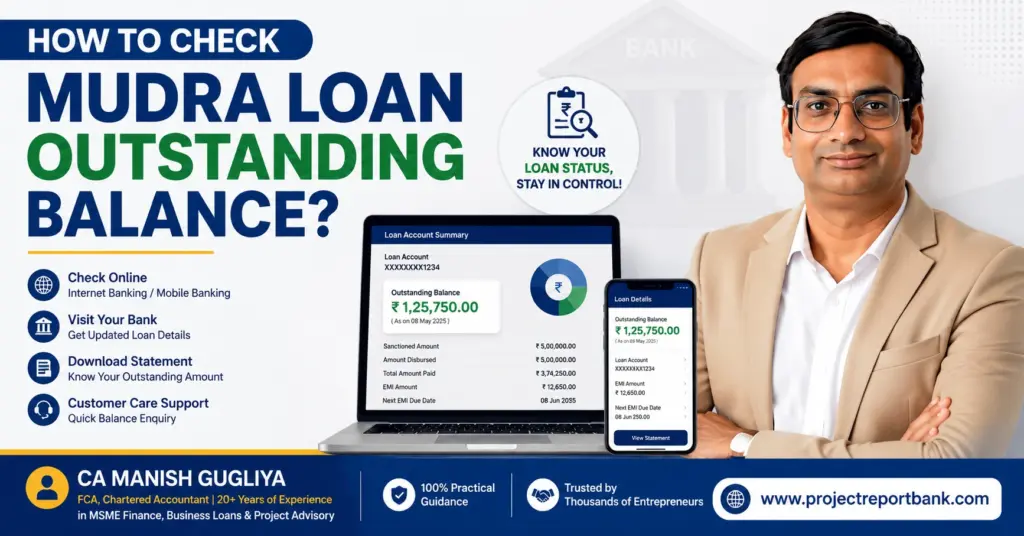
- You can check through internet banking, mobile banking app, branch visit, customer care, or by obtaining a Mudra Loan account statement.
- The outstanding balance usually includes principal outstanding, accrued interest, overdue EMIs, and any applicable charges – it is not the same as principal outstanding alone or the foreclosure amount.
- The safest and most reliable figure is always the latest lender-issued Mudra Loan account statement or a written foreclosure letter, especially before making a final repayment.
- This guide is written in the advisory style of CA Manish Gugliya (FCA) for MSME and PMMY borrowers who want to verify their remaining Mudra Loan amount accurately.
What Is Mudra Loan Outstanding Balance?
The Mudra Loan outstanding balance is the total amount you currently owe on your Mudra Loan account on a specific date. It is not necessarily the same as the original amount you borrowed. As you make EMI payments, the balance reduces. If you miss payments or incur charges, it may increase.
Mudra loans are for non-corporate, non-farm enterprises and are available through various financial institutions under the Pradhan Mantri Mudra Yojana (PMMY). Loans are categorized as Shishu, Kishore, and Tarun based on amount:
| Category | Loan Amount |
|---|---|
| Shishu | Up to ₹50,000 |
| Kishore | ₹50,001 to ₹5 lakh |
| Tarun | ₹5 lakh to ₹10 lakh |
| Tarun+ | ₹10 lakh to ₹20 lakh |
Loans up to ₹10 lakh are available under PMMY, and no collateral is required for loans up to ₹10 lakh. The Tarun+ category was introduced for eligible borrowers who have successfully repaid previous loans under the Tarun category.
There is a difference between the sanctioned limit (the maximum loan the lender approved) and the amount actually disbursed. Your outstanding balance relates to what has been disbursed, not what was merely sanctioned.
The total outstanding balance is calculated by adding accrued interest and unpaid charges to the outstanding principal. Accrued interest refers to interest accumulated on the unpaid principal balance. Key components that may appear in your Mudra Loan account include:
- Principal outstanding – the unpaid portion of the original disbursed amount
- Interest charged but not yet paid – interest accrued up to the statement date
- Overdue EMI – any EMI past its due date
- Penal interest or late charges – applicable if EMIs are delayed
- Other bank charges – processing or service charges, if any
The outstanding balance includes the original principal amount plus unpaid interest and late fees. Interest rates for Mudra loans are deregulated, which means they vary by lender. Current interest rates range from 19% to 21% fixed for some categories, while RLLR for Mudra loans is currently 9.05% per annum at certain banks. Banks are advised to charge reasonable interest rates.
Different labels may appear in statements – “Outstanding balance,” “Total dues,” “Principal outstanding,” and “Arrears” – and they should not be assumed to mean the same thing. Always read the label carefully before acting on any figure.
Table of Contents

How to Check Mudra Loan Outstanding Balance? (Overview)
The Mudra Loan outstanding balance is always checked through the specific lender’s systems. Since mudra loans are extended by different financial institutions – scheduled commercial banks, regional rural banks, small finance banks, NBFCs, and MFIs – there is no universal portal operated by PMMY where every borrower can log in and see their balance.
Common methods to check your Mudra Loan balance include:
- Internet banking portal of the lender
- Official mobile banking app
- Visiting the bank or NBFC branch in person
- Calling official customer care or phone banking
- Requesting a Mudra Loan account statement via email or physical copy
The availability of each method depends on whether the loan was taken from a commercial bank, cooperative bank, small finance bank, NBFC, or MFI, and on whether the lender has enabled digital access for loan accounts. Applicants can apply online through the JanSamarth portal, but balance checking is done through the lending institution’s own channels.
The sections below explain each method and then help you interpret and verify the Mudra Loan outstanding balance.
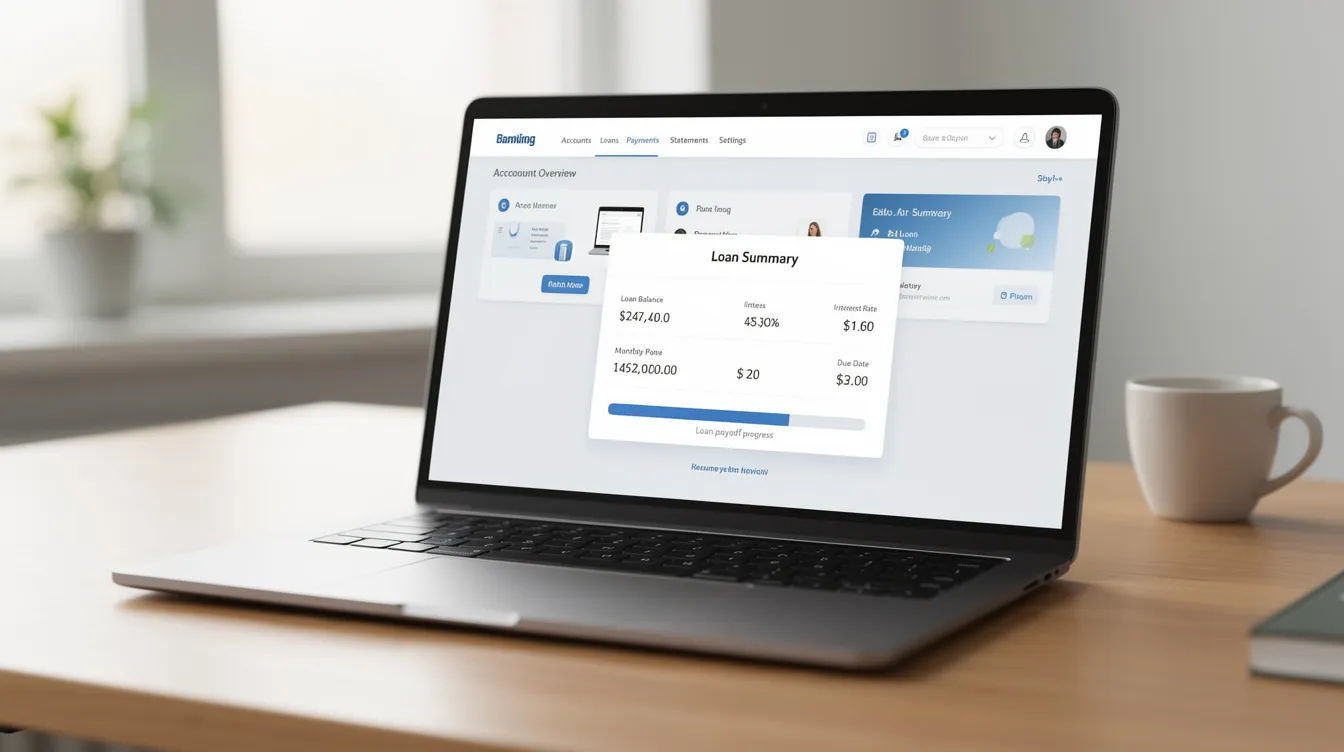
Check Mudra Loan Outstanding Balance Through Internet Banking
Most scheduled commercial banks and many small finance banks allow Mudra Loan balance enquiry through their internet banking portals, provided the loan account is linked to your customer ID.
Here is a typical step-by-step flow (menu names differ across banks):
- Log in to your lender’s internet banking portal with your user ID and password.
- Navigate to “Loans,” “Loan Accounts,” or a similarly named section.
- Select the Mudra Loan account number from the list.
- View the outstanding balance, principal outstanding, EMI amount, next EMI due date, and any overdue amount.
- Download or view the Mudra Loan statement if the option is available.
- Some banks display current dues, principal outstanding, and overdue amount on the same screen. Others may require you to click into a detailed view.
Illustration (for reference only, not an actual bank screen):
| Field | Value |
|---|---|
| Loan Account Number | 12345XXXX678 |
| Sanctioned Amount | ₹5,00,000 |
| Current Outstanding | ₹3,45,000 |
| EMI Amount | ₹11,500 |
| Next EMI Date | 05 Sep 2026 |
| Overdue Amount | Nil |
Always check the date up to which the online figure is updated (for example, “Position as on 31 Jul 2026”) before relying on it for any decision.
Check Mudra Loan Balance Through Mobile Banking
Many lenders display Mudra Loan account details in their official mobile banking apps, but exact features depend on the app and the lender’s policies.
A typical flow for Mudra Loan balance enquiry on mobile:
- Open the lender’s official app and log in with your registered mobile number and PIN/password.
- Tap “Loans” or “Accounts.”
- Select the Mudra Loan account.
- View current outstanding balance, EMI details, and repayment status.
Information that may be visible includes:
- Loan account number
- Sanctioned and disbursed amount
- Outstanding principal
- EMI amount and next EMI date
- Loan tenure
- Whether any EMI is overdue
- Never use third-party or unofficial apps for checking your Mudra Loan balance. Do not share your user ID, MPIN, passwords, or OTP with anyone.
- If the Mudra Loan account is not visible in the app, you may need to link the loan account with your customer ID or contact the branch for activation.
Check Outstanding Balance Through Bank Branch
For many Mudra Loan borrowers – especially those in rural or small-town areas, or where the lender is an NBFC or MFI – visiting the branch remains the most reliable method to check the Mudra Loan outstanding amount. Required documents include identity proof and proof of income or loan-related documents.
What to carry:
- Basic identity proof (Aadhaar, PAN, voter ID, or driving licence)
- Mudra Loan account number or sanction letter
- Linked savings/current account passbook (if any)
- Registered mobile number details
At the branch:
- Meet the loan officer or relationship manager.
- Request the Mudra Loan outstanding balance or the latest Mudra Loan account statement.
- Verify your identity as per the bank’s KYC norms.
- Obtain a printed statement or written outstanding balance slip.
If you are planning to close the Mudra Loan, specifically request a “foreclosure” or “pre-closure” amount letter rather than relying only on the regular outstanding figure.
For NBFCs and MFIs providing mudra loans, the branch or centre office may issue a passbook-style statement or a printed ledger for the loan account, which can be used to confirm the remaining balance.
Check Mudra Loan Outstanding Amount Through Customer Care
Some lenders allow Mudra Loan balance enquiry through official customer care numbers, phone banking, or email after proper identity verification.
You may need to provide:
- Loan account number
- Customer ID
- Registered mobile number
- Date of birth or other KYC details as requested
Customer care may share only a summary figure (such as total outstanding or next EMI due) and may direct you to collect a detailed Mudra Loan statement from the branch or through internet banking.
- Use only phone numbers and email IDs published on the lender’s official website or printed on your passbook. Never share OTP, full card details, CVV, net-banking password, or UPI PIN during any Mudra Loan balance enquiry.
- Some banks send mini-statements or loan account updates to the registered email on request, which you can use to reconcile the Mudra Loan remaining balance.
How to Get Mudra Loan Account Statement
A proper Mudra Loan account statement is the most dependable document to check outstanding balance, principal outstanding, interest debits, and EMI credits.
Common ways to obtain the statement:
- Download from internet banking (usually as PDF)
- Download from the mobile banking app
- Request by email if the lender provides e-statements
- Collect a printed statement from the branch
A typical Mudra Loan statement should show:
| Item | Description |
|---|---|
| Opening Balance | Balance at the start of the statement period |
| EMI Credits | Date and amount of each EMI received |
| Principal Component | Portion of EMI applied to principal |
| Interest Component | Portion of EMI applied to interest |
| Other Charges | Processing fees, late charges, etc. |
| Closing Balance | Outstanding balance at the end of the period |
Cross-check your bank account statement (from which EMIs are auto-debited) with the Mudra Loan account statement to ensure every EMI is correctly credited against the loan. Maintaining copies – soft or hard – of at least yearly statements can help later if there is any dispute about Mudra Loan repayment status or outstanding amount. As noted in a Livemint guide on loan statements, reviewing every entry in the statement is essential for accurate reconciliation.
Mudra Loan Outstanding Balance vs Principal Outstanding
Outstanding principal is the unpaid portion of the original loan amount – it excludes interest, charges, and penalties. The Mudra Loan outstanding balance, on the other hand, may include principal, interest due, overdue EMIs, and applicable charges.
Online and branch screens sometimes show both figures side by side. A borrower planning to close the loan must confirm which figure has been quoted.
Simple illustration:
| Component | Amount |
|---|---|
| Original Mudra Loan | ₹3,00,000 |
| Principal Outstanding (after EMIs) | ₹1,80,000 |
| Interest Due + Overdue Charges | ₹5,500 |
| Total Outstanding Balance | ₹1,85,500 |
Some borrowers search for “Mudra Loan remaining loan amount” when they actually mean principal outstanding, while others want the total dues. Always confirm the terminology with the lender.
For bookkeeping and income-tax purposes in small businesses, separating the interest component from principal outstanding is useful when preparing project reports, CMA data, or financial statements – a reference point that micro enterprises and small and micro enterprises should not ignore.
Is Mudra Loan Outstanding Balance the Same as Foreclosure Amount?
No. The Mudra Loan outstanding balance shown in a routine statement is usually not the final foreclosure amount payable on a future date.
The foreclosure or pre-closure amount is calculated as on a specific date and may include:
- Principal outstanding up to that date
- Interest accrued till that date
- Any overdue EMI
- Applicable foreclosure or prepayment charges as per the sanction terms
If you want to close your Mudra Loan early, obtain a written foreclosure quotation from the lender, valid up to a specified date, rather than relying only on the current online outstanding balance. For more detailed guidance on closure calculations and process, refer to the article on Mudra Loan foreclosure.
Policies on whether foreclosure charges are applied on Shishu loans, Kishore, or Tarun loans vary by lender and are governed by RBI and bank guidelines in force at the time. Always check your own sanction letter.
How EMI Payments Affect Mudra Loan Outstanding Balance
Each EMI has two parts: interest for the period and principal repayment. The entire EMI amount does not reduce the principal outstanding.
Example: For an EMI of ₹10,000 in the early months, perhaps ₹7,500 may go towards interest and only ₹2,500 towards principal. As the loan matures, the principal portion typically increases and the interest portion decreases. The repayment period typically ranges from one to five years, depending on the category and lender.
Mudra loans support micro enterprises in various sectors including manufacturing, trading, and services. Whether your beneficiary micro unit is engaged in manufacturing trading or in allied agricultural activities, the EMI structure follows the same amortisation logic.
The Mudra Loan EMI balance and outstanding balance reduce faster when all EMIs are paid on time without irregularities that lead to extra interest or penalty. Check your Mudra Loan statement periodically to see how much principal is actually reducing, instead of assuming a straight-line reduction.
For more details on tenure and schedule, see the dedicated article on Mudra Loan repayment period.
Can Mudra Loan Repayment Period Be Extended If Balance Is Difficult to Repay?
There is no automatic right to extend Mudra Loan tenure. Any extension or restructuring depends entirely on the lender’s policy, regulatory guidelines, and the specific case.
A borrower facing genuine repayment difficulty should approach the lending branch or loan officer early – before EMIs become overdue for long periods – and discuss options such as rescheduling or restructuring if the lender permits. Extension of tenure changes the EMI schedule and therefore affects how fast the outstanding balance reduces over time.
- For a detailed discussion, refer to the article on Mudra Loan repayment period extension.
- Restructuring or frequent delays may also impact the borrower’s credit report, which can affect future mudra loans or other business loans. Missing payments can severely impact credit scores and hinder future loan access.
Why Does My Mudra Loan Balance Look Higher Than Expected?
Small differences between expected and displayed Mudra Loan outstanding amount are common and often arise from timing or posting of entries rather than any error.
Typical reasons include:
- EMI for the current month not yet posted
- Interest applied at month-end not yet fully covered by payments
- An earlier EMI bounced and was later recovered with additional charges
- Interest and penalties may be charged for overdue payments as specified in the loan agreement
- A part-payment not yet adjusted in the core system
- Difference between principal outstanding and total dues
- Statement date or cut-off timing mismatch
Online balance is usually as of the last system update. If you have just made a payment through UPI, NEFT, or deposited cash or cheque, it may take some hours or days to reflect in the Mudra Loan account.
Compare the statement period and closing date with your own records. If the difference persists beyond a reasonable period, take printouts or screenshots of both your bank account statement and the Mudra Loan statement and discuss them with the branch for a clear reconciliation. If principal or interest remains overdue for more than 90 days, the account may be classified as an NPA (Non-Performing Asset). Lenders may initiate recovery proceedings if payments are overdue.
What If an EMI Payment Is Missing From the Loan Statement?
Sometimes an EMI may be debited from your savings or current account but not immediately reflected in the Mudra Loan account. This can happen due to inter-system delays, batch processing, or posting errors.
Steps to follow:
- Check your bank statement to confirm the debit – note the transaction reference or UTR number, date, and amount.
- Keep screenshots or printouts as proof.
- Download or request the latest Mudra Loan account statement for the same period.
- If the credit is still missing, raise a written complaint or service request with the branch or customer care, attaching proof of the debit and requesting correction in the Mudra Loan loan account details.
- Preserve acknowledgement of every complaint or request you submit.
Repeated EMI delays or bounce charges affect your credit behaviour record. Overdue loans may incur penalties and lead to their classification as Non-Performing Assets. For a deeper discussion, see the article on late EMI payment and Mudra Loan eligibility.
How Often Should You Check Your Mudra Loan Outstanding Balance?
Borrowers should regularly check their loan account statements to monitor the outstanding balance. You do not need to check daily, but periodic reviews at important points make a real difference.
Situations when checking makes practical sense:
- After every few EMIs (for example, once a quarter)
- After any part-prepayment
- If an EMI bounce or late payment has occurred
- Before applying for a new loan or seeking additional financial assistance
- Before planning early closure of the loan
Small businesses should align Mudra Loan balance enquiry with periodic business reviews, so the loan liability in their books tallies with the latest lender statement. Keeping track of the outstanding balance also helps in tax planning and in preparing project reports or CMA data for future finance proposals. Individual borrowers benefit from this discipline equally.
Documents/Details You May Need to Check Mudra Loan Balance
While a basic balance enquiry is simple, lenders follow security and KYC norms before sharing Mudra Loan account details.
Keep these details handy:
- Mudra Loan account number
- Customer ID or CIF number
- Registered mobile number
- Date of birth or PAN
- Any reference numbers from the sanction letter or repayment schedule
For branch visits, carry an original identity proof (Aadhaar, PAN, voter ID, or driving licence) and the Mudra Loan sanction letter or passbook. If you have multiple loans with the same bank, clearly mention that you are asking for the PMMY or Mudra Loan outstanding balance to avoid confusion with other term loan or working capital accounts.
NBFCs and MFIs may follow their own process – such as asking for a loan card number or group ID. Follow the instructions on your original documentation.
How to Verify Whether the Outstanding Balance Is Correct
Use this step-by-step checklist to validate your Mudra Loan outstanding balance rather than relying blindly on any single figure:
- Start with originals: Note the original sanction and disbursement amount, interest rate, and EMI schedule.
- Count EMIs due: Calculate the total number of EMIs due from the start date till today.
- Compare EMIs paid: Cross-check EMIs actually debited (as per your bank statement) with what the Mudra Loan statement shows.
- Check for discrepancies: Look for any bounced EMI, late charges, reversals, or unexplained debits.
- Use the amortisation schedule: If the lender provided a repayment chart at sanction, estimate what the principal outstanding should be after the number of EMIs paid. The final reference must still be the lender’s system-generated statement.
Do not simply multiply the number of remaining EMIs by the EMI amount to estimate the remaining balance. Due to the interest-principal structure and any additional charges, this calculation will almost certainly be wrong.
If you are still unsure after your own reconciliation, consult a qualified professional – such as a Chartered Accountant familiar with business loans and credit needs of micro units – or request a detailed break-up from the lender.
CA Manish Gugliya’s Practical Advice for Mudra Loan Borrowers
In my experience working with MSME finance, mudra loans, and project reports for over two decades, I have seen borrowers make avoidable errors simply because they relied on mental estimates instead of actual lender records.
My practical advice:
- Always rely on the latest lender-generated Mudra Loan account statement for the outstanding figure. Do not estimate based on remaining EMIs or rough calculations.
- Maintain a dedicated file – physical or digital – containing your sanction letter, disbursement advice, amortisation schedule (if provided), annual loan statements, proof of each EMI or major repayment, and any correspondence about rescheduling or part-prepayment.
- Before making a lump-sum final payment to close your Mudra Loan, obtain a written foreclosure or closure amount from the bank or NBFC. Pay exactly that amount through official channels.
- After full repayment, collect and safely preserve the final No Dues Certificate, closure letter, and updated Mudra Loan statement showing zero outstanding balance. These documents may be required later for future loans, audits, or to clear any accidental reporting in credit bureaus.
Whether your proposed activity is in manufacturing, trading and services, or income generation through allied agricultural activities, disciplined documentation is what separates a smooth loan closure from months of unnecessary follow-up.
Common Mistakes While Checking Mudra Loan Outstanding Balance
- Assuming sanctioned = disbursed = outstanding: The total amount sanctioned under the scheme is the maximum loan limit, not necessarily what was disbursed or what is currently owed.
- Multiplying remaining EMIs by EMI amount: This ignores the interest-principal split and any charges, producing an inaccurate estimate.
- Using an old Mudra Loan statement: A statement from six months ago does not reflect recent payments, charges, or adjustments.
- Overlooking small overdue interest or penalty entries: Even a few hundred rupees in penal interest can compound over time.
- Misreading principal outstanding as foreclosure amount: These are different figures. The foreclosure amount usually includes additional interest accrued up to the closure date.
- Confusing Mudra Loan with other working capital or cash-credit limits: Some borrowers with multiple accounts misread drawing power or overdraft balances as their Mudra Loan outstanding balance.
- Making large part-prepayments without confirmation: Always confirm in writing how any advance payment will be adjusted – towards principal reduction or future EMIs – and obtain a revised schedule.
- Not collecting closure documents: Failing to preserve the No Dues Certificate and final statement is a common mistake that creates difficulty later if any dispute arises about the loan account balance.
Frequently Asked Questions
The following FAQs address common practical questions about Mudra Loan outstanding balance and balance enquiry that are not fully covered in the sections above.
How can I check my Mudra Loan outstanding balance if I only have the loan account number?
Having the Mudra Loan account number is useful, but you must still use an official channel – internet banking, mobile app, branch visit, or customer care – where identity verification is completed before balance details are shared. A loan account number alone, without proper KYC verification, will not be sufficient. Visit your lending branch with identity proof and loan account number for the fastest resolution.
Does Pradhan Mantri Mudra Yojana have a single portal to check all Mudra Loan balances?
No. While the Pradhan Mantri Mudra Yojana PMMY is a government scheme launched to support the credit needs of micro enterprises engaged in the non farm sector, each Mudra Loan account is maintained by the respective bank, NBFC, or MFI. There is no single central portal where every PM Mudra Loan balance check can be done. You must use your own lender’s channels. The scheme covers eligible borrowers across the stage of growth development and funding needs of the beneficiary micro unit entrepreneur, but balance tracking is the lender’s responsibility.
Can I track my Mudra Loan remaining balance through SMS or email alerts?
Many lenders send SMS or email alerts for EMI debits, overdue reminders, or statement links. These can indirectly help you track repayment status. However, for the exact Mudra Loan outstanding balance online or offline, a full account statement or online view through internet or mobile banking is necessary. SMS alerts typically show only the EMI debited amount, not the detailed break-up of principal, interest, and any charges.
How does part-prepayment affect my Mudra Loan outstanding amount?
A part-prepayment usually reduces the outstanding principal directly, which then reduces the future interest burden. However, the impact on EMI amount or tenure depends on the bank’s policy – some lenders keep the EMI amount the same and reduce tenure, while others may reduce the EMI and keep tenure unchanged. Always request a revised repayment schedule or written confirmation from the lender after making any part-prepayment. The knowledge of how your payment was adjusted helps you track remaining balance accurately. Whether your beneficiary micro unit is assessed based on assets created, capital assets, or working capital needs, the adjustment logic remains the same.
What should I do if the bank’s online systems are down and I urgently need my Mudra Loan balance?
Visit the branch during working hours, call official customer care, or request a manual printout of the Mudra Loan outstanding balance. Do not rely on unofficial apps or third-party websites during outages. Your lender’s branch can always provide a written statement regardless of system availability, and this remains the most reliable method. The product offerings and digital services may vary across lenders, but branch-level access to your loan records is universally available. Whether your enterprise falls under the Shishu loans category or is at the next phase under Kishore or Tarun, the branch process for obtaining balance information remains the same. No educational qualification or security deposit is needed to simply request your own loan statement – it is your right as a borrower.
The safest way to know your correct Mudra Loan outstanding balance is to check the latest loan account information or statement through your lender’s official channels. If you are planning to fully repay the loan, obtain the exact closure or foreclosure figure from the lender instead of assuming that the displayed principal balance is the final amount payable. For professional guidance on project reports, CMA data, and MSME finance documentation, borrowers across India can reach out to CA Manish Gugliya at ProjectReportBank.com.
- Mudra Loan Closure Process: How to Properly Close a Mudra Loan After Full Repayment


- Mudra Loan NOC After Closure: Step-by-Step Guide by CA Manish Gugliya

- Mudra Loan Closed but Still Showing Active in CIBIL: What to Do?
- Can a Bank Refuse to Renew a Mudra Loan? Reasons, Rules & Next Steps

- What Documents Are Required for Mudra Loan Renewal? (Practical Guide by CA Manish Gugliya)

- Can a Mudra Loan Be Renewed? Eligibility, Process & Practical Guide (By CA Manish Gugliya)

- How to Check Mudra Loan Outstanding Balance? (Practical Guide for Borrowers)
- Can You Foreclose a Mudra Loan? Process, Charges & Rules (Expert Guide by CA Manish Gugliya)

- Can Mudra Loan Repayment Period Be Extended? (Practical Guide by CA Manish Gugliya)