Key Takeaways
- Paying the final EMI does not always mean your Mudra Loan account is formally closed in the bank’s system. Borrowers must verify zero outstanding balance, confirm the account status is marked “Closed,” and collect a NOC or No Dues Certificate.
- The complete mudra loan closure process includes: checking outstanding balance, making the final payment, obtaining the final loan statement, submitting a closure request if required, and confirming that the lender has updated the account status.
- After closure, borrowers should cancel or confirm deactivation of ECS, NACH, or standing instructions and then check their credit report to ensure the Mudra Loan shows as “Closed” with zero outstanding.
- This guide is written by CA Manish Gugliya, a Chartered Accountant specialising in project reports, CMA data, MSME finance, and Mudra Loan guidance, for small business owners, traders, and service providers who have fully repaid a Mudra Loan under Pradhan Mantri Mudra Yojana.
Introduction: After the Final EMI, Is Your Mudra Loan Really Closed?
Consider a shop owner in Jaipur who pays the last EMI of a ₹5 lakh Kishore category Mudra Loan in June 2026. The EMI gets debited, no further instalment appears due, and the borrower assumes the loan is done. Three months later, while applying for a new business loan, the bank tells him his previous Mudra Loan still shows “Active” in CIBIL.
Paying the final EMI or making full repayment is not always the same event as formal Mudra Loan account closure in the lender’s system. The payment clears your money obligations. The closure is an administrative step the lender must complete in their records and report to credit bureaus.
Proper closure means:
- Principal outstanding is zero
- Interest outstanding is zero
- No overdue charges or penalties remain
- The account status is changed from “Active” to “Closed”
- A NOC or No Dues Certificate has been issued
- Credit bureaus reflect the correct closed status
The rest of this article gives you a clear, step-by-step mudra loan closure process drawn from practical experience advising hundreds of MSME borrowers.

What Does Closing a Mudra Loan Mean?
Mudra Loan closure means the lender has recorded that the loan availed under Pradhan Mantri Mudra Yojana is fully settled, and the account is formally closed in their system. Loans under PMMY include micro, small, and medium-sized business loans classified into Shishu (upto rs 50,000), Kishore (above ₹50,000 to ₹5 lakh), Tarun (above ₹5 lakh to ₹10 lakh), and Tarun Plus (up to ₹20 lakh for borrowers who have successfully repaid under Tarun).
Understanding the difference between two events is essential:
- Final EMI paid: A payment event. Money leaves your account and reaches the lender.
- Loan account closed: An administrative and reporting event. The lender updates internal records, stops the loan from appearing under active facilities, and reports the closure to credit bureaus.
Specific closure conditions include:
- Principal outstanding is zero
- Interest outstanding is zero
- No pending penalties, late fees, or processing charges remain
- Any lien or hypothecation on assets (rare in mudra loans, which are collateral-free) is removed from records
- The loan no longer appears under “Active Loans” in the bank’s system
Closure should also lead to issuance of a No Objection Certificate or No Dues Certificate and the cessation of any auto-debit instructions. A properly closed Mudra Loan generally supports a stronger credit profile when applying for future business loans or MSME finance.
Table of Contents
Is a Mudra Loan Automatically Closed After the Last EMI?
In many banks and NBFCs, mudra loans may move towards closure automatically after the final EMI. But borrowers should never assume it is always automatic.
Loan closure procedures can vary depending on the lending institution. Public sector banks, private banks, RRBs, NBFCs, and MFIs each have different internal workflows. Delays in reconciliation or small residual interest can keep the account technically open.
Reasons a Mudra Loan might still appear active after the final EMI:
- Residual interest accrued for a few days between your last EMI date and actual credit date
- Unpaid late fees from earlier months that were never adjusted
- Rounding differences between the EMI schedule and actual interest calculation
- Pending internal approval for write-off of a minor amount
Every borrower should actively confirm closure status with the bank or NBFC instead of relying only on the fact that no further EMI appears due.
Step-by-Step Mudra Loan Closure Process After Full Repayment
This is the core section. Follow these 10 steps after full repayment of your Mudra Loan, whether it falls under Shishu, Kishore, Tarun, or Tarun Plus, and whether it was taken from a bank, NBFC, RRB, or MFI.
Throughout these steps, preserve practical records like statements, receipts, and NOC. Foreclosure (pre-closure before end of tenure) follows similar closure checks but is a separate topic.
Step 1: Check the Outstanding Balance
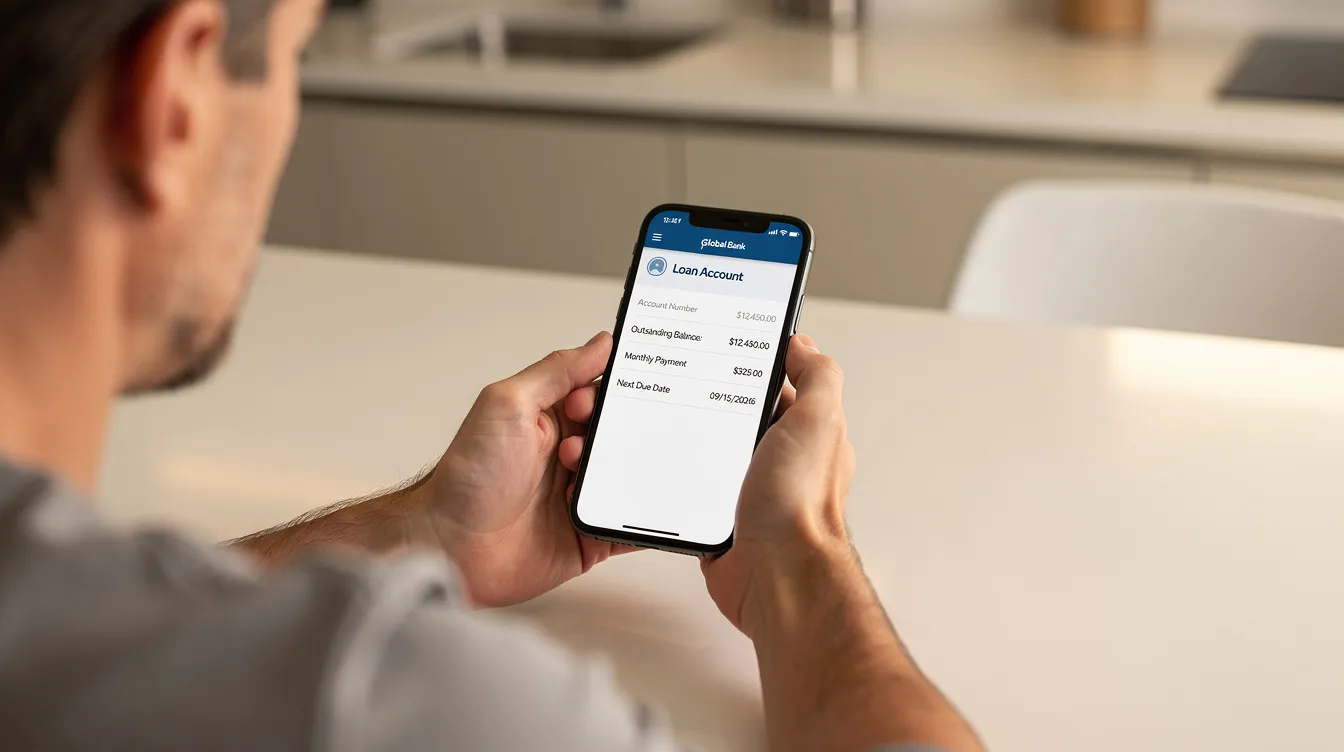
Near or after your last EMI date, review the Mudra Loan account using net banking, mobile banking, passbook update, or by visiting the branch. Verify:
- Principal outstanding
- Interest outstanding
- Overdue EMI (if any)
- Penal interest
- Any “other charges” shown by the lender
For detailed methods to verify your balance, you can check Mudra Loan outstanding balance in a separate guide.
Small residual balances of ₹150 to ₹500 should not be ignored. They can prevent formal closure and, over months, accumulate into a negative credit report entry.
Step 2: Pay the Final EMI or Remaining Verified Amount
Once you have verified the correct outstanding amount, ensure that the last EMI or remaining lump-sum (including accrued interest and legitimate charges) is paid. Paying all outstanding dues is necessary for loan closure.
Common payment modes include:
- Auto-debit through NACH
- Online transfer (NEFT, IMPS, RTGS, UPI)
- Cash deposit at the branch
- Cheque, as per bank policy
Preserve evidence of the final payment: transaction slip, UTR or reference number, or bank receipt. Paying exactly the amount appearing in the bank’s system helps avoid later disputes about underpayment.
Step 3: Allow the Final Payment to Be Reconciled
Even after you pay the last EMI or full outstanding, the bank’s core system may take time to update interest calculations and mark the account as clear. The exact processing time varies by lender. Check back after a few working days to see if the loan shows zero outstanding.
Do not assume closure failure because the status did not change on the same day. Track it until it reflects correctly.
Step 4: Obtain the Final Loan Account Statement
A final Mudra Loan account statement (covering up to the closure date) is your primary financial proof. Verify on this statement:
- Principal outstanding = 0
- Interest outstanding = 0
- Overdue = 0
- No unexplained fees or penalties
This statement may be needed later if there is any dispute with the bank, NBFC, or credit bureau about whether the account was actually cleared. Keep both printed and PDF copies.
Step 5: Submit a Mudra Loan Closure Request If Required
Some lenders automatically treat an account with zero outstanding as closed. Others expect a formal closure request or a branch visit. Closing a Mudra Loan requires processing through the original financial institution.
Documentation needed for loan closure includes an application request letter and identity proof. A simple closure letter or email can include:
- Borrower’s name and business name
- Loan account number (required for closure processing)
- Date and details of final payment
- Request for formal closure and NOC or No Dues Certificate
This written request creates a dated record. Obtain an acknowledgement slip or email confirmation and retain it with your documents. There are typically no processing costs associated with closing a Mudra Loan through regular closure; only instalments are paid.
Step 6: Confirm That the Loan Account Has Been Marked Closed
A loan showing “0 outstanding” is not the same as a loan with status “Closed.” For example, a trader’s Mudra Loan statement shows zero balance, but the product type still appears under “Active Loans” in net banking. The administrative closure may still be pending.
Ask the bank or NBFC to confirm that the account status has been changed from “Active/Running” to “Closed” and that no further debit can be raised.
A “Settled” remark is different from “Closed” and can have negative implications in credit reports. Per RBI’s Credit Information Reporting Directions 2025, “Settled” means the borrower paid less than the contractually due amount, while “Closed” means full repayment. Clarify this with your lender. The lender must provide written confirmation of the closure including a No Dues Certificate.
Step 7: Obtain NOC / No Dues Certificate
After internal closure, the lender should issue a Mudra Loan NOC or No Dues Certificate confirming no further dues under that account. Loan closure papers are sent after full payment is received.
What a NOC generally states:
- Full repayment has been received
- No charge on assets (if applicable under hypothecation)
- No objection to the borrower dealing with the financed assets or business freely
This document matters for future business loans, for addressing credit report discrepancies, and for proving that the Mudra Loan was closed properly. Detailed guidance on obtaining and using this certificate is available in a separate article on Mudra Loan NOC after closure.
Step 8: Check ECS, NACH or Standing Instructions
ECS (Electronic Clearing Service) and NACH (National Automated Clearing House) are automatic EMI debit arrangements from your bank account. Standing instructions work similarly.
After the Mudra Loan is confirmed closed, verify that the EMI mandate has been cancelled or deactivated so no further debits take place. Do not cancel these mandates before the final verified dues are cleared. Premature cancellation can cause dishonour of the last EMI, leading to penalties or negative credit reporting.
Obtain confirmation (SMS, email, or statement entry) that the NACH or ECS instruction for that specific Mudra Loan account is no longer active.
Step 9: Collect and Preserve All Closure Documents
Key Mudra Loan closure documents to preserve:
- Final payment receipt
- Final loan statement (zero balance)
- Loan closure confirmation (SMS, email, or letter)
- NOC or No Dues Certificate
- Closure request acknowledgement
- Relevant emails or SMS from the lender
Future lenders may ask for these records when assessing new business loans, overdrafts (od facilities), or MSME finance proposals. Keep one physical folder and one digital folder with scanned PDF copies, using clear file names showing the date, bank name, and loan account number.
Step 10: Check the Credit Report After Loan Closure
Even after the lender closes the Mudra Loan internally, there may be a lag before credit bureaus like CIBIL, Experian, Equifax, or CRIF High Mark update. From April 1, 2026, RBI mandated weekly loan data reporting to credit information companies, which should reduce this gap. Still, allow a few weeks.
Check your credit report to confirm the Mudra Loan account shows status as “Closed” with zero outstanding and a correct closure date. Ensure the lender updates the loan status to “Closed” with credit bureaus after repayment.
If a fully repaid Mudra Loan still appears active or with an incorrect balance, refer to the dedicated article on a Mudra Loan closed but still active in CIBIL scenario for dispute-handling steps. Accurate credit records help when you apply for future business loans or mudra loans under higher categories.
Mudra Loan Closure Checklist
Use this table to track every step of your Mudra Loan closure:
| Task | What to Verify |
|---|---|
| Final EMI / Payment | Successfully paid and reflected in statement |
| Outstanding Balance | No unexplained dues; zero balance confirmed |
| Final Loan Statement | Shows zero principal, zero interest, zero overdue |
| Closure Request | Submitted if required; acknowledgement retained |
| Loan Account Status | Marked “Closed” (not just zero balance) |
| NOC / No Dues Certificate | Collected from lender |
| ECS / NACH Mandate | Confirmed cancelled or deactivated after closure |
| Closure Records | All documents safely preserved (physical + digital) |
| Credit Report | Closure subsequently verified in CIBIL/other bureaus |
Tick off each item before you consider the Mudra Loan completely closed. In my practice, borrowers who skip even one of these steps often face avoidable complications months later.
Documents to Collect After Closing a Mudra Loan
Documentation is as important as repayment for a clean closure record of a Mudra Loan under the mudra scheme. These documents help resolve future disputes, credit report mismatches, or queries from new lenders when applying for business loans or term loans.
Final Loan Account Statement
This statement should show zero principal outstanding, zero interest, and no pending EMI, with a date covering up to the closure point. It serves as the primary financial proof that the borrower has completed repayment as per the bank’s record.
Final Payment Receipt
Acceptable forms include a bank-paid stamp on the deposit slip, NEFT/IMPS/RTGS reference number, UPI confirmation, or an official e-receipt from the lender’s portal. Cross-check that the receipt correctly mentions the Mudra Loan account number and amount paid.
Loan Closure Confirmation
Many banks send an SMS, email, or short letter confirming that the account has been closed. Save this confirmation along with the date, as it often includes the closure reference or request number.
NOC / No Dues Certificate
The NOC states that no further amount is payable to the lender for that specific Mudra Loan and that the lender has no objection regarding assets financed. A detailed guide on Mudra Loan NOC after closure is available separately.
Closure Request Acknowledgement
Where the borrower submitted a written or email closure request, the acknowledgement (with date, stamp, or auto-generated ID) should be kept safely. This helps if there is a delay in processing or if the status remains open longer than expected.
Relevant Bank Correspondence
Any emails, physical letters, or SMS messages concerning final dues, waiver of small charges, or confirmation of mandate cancellation should all be filed together. Organised correspondence helps prove you acted diligently in completing the closure process.
Difference Between Mudra Loan Closure and Foreclosure
Normal closure happens when you finish repayment as per the original schedule. Foreclosure (or pre-closure) means repaying the entire outstanding before the scheduled end date. You can request a foreclosure statement to determine the exact amount required for early closure.
| Aspect | Normal Closure | Foreclosure |
|---|---|---|
| Timing | At the end of loan tenure | Before scheduled end date |
| Stage of Repayment | All scheduled EMIs completed | Outstanding repaid in lump-sum mid-tenure |
| Charges | Regular closure incurs no fees; only instalments are paid | Pre-closure may involve charges depending on the bank, though most lenders do not charge pre-closure fees for Mudra Loans |
| Purpose | Natural completion of loan contract | Borrower wants to clear debt early |
| Procedure | Pay final EMI, verify, close | Request foreclosure statement, pay full outstanding, close |
Both end with the account being closed and NOC issued. For complete foreclosure details, refer to the dedicated guide on Mudra Loan foreclosure.
Does Mudra Loan Repayment Period Affect the Closure Process?
- Whether the tenure is 3 years, 5 years, or another period, the basic closure steps after full repayment remain the same: verify dues, pay the final amount, confirm closure, collect NOC, and check credit report. Repayment tenure for Mudra Loans varies based on loan category.
- A shorter or longer Mudra Loan repayment period affects when closure happens in calendar terms but does not change the required closure documentation.
- Interest rates for Mudra Loans start at 9.05% per annum, and total interest paid over the tenure depends on the period, but closure steps at the end are identical regardless of rate or tenure.
What If a Small Outstanding Amount Remains After the Last EMI?
Sometimes, even after paying the scheduled last EMI, the final statement may show a small due amount like ₹50, ₹200, or ₹750.
Possible reasons:
- Residual interest between EMI date and actual credit date
- Late payment charges from earlier months that were never adjusted
- Rounding differences between the EMI schedule and actual interest calculation
- Legitimate processing fees not included in the EMI
Do not ignore even small residual dues. They can prevent formal closure and lead to negative reporting to credit bureaus. Before paying any amount you do not understand, ask the lender for a break-up or explanation. Pay only the legitimate part.
For example, a food processing unit owner in Surat finds ₹300 residual interest on the final statement. She visits the branch, gets a written explanation, pays the amount, and receives an updated statement showing zero balance. The bank then processes closure and issues the NOC within a week.
What If the Bank Does Not Close the Mudra Loan After Full Repayment?
Operational delays, system issues, or unresolved small charges can keep a Mudra Loan account from closing even after repayment. According to government grievance reports under PMMY, “delay in account closure/settlement” is among the major issues cited by borrowers.
Escalation steps:
- Check the latest loan statement
- Verify whether any amount is still pending
- Contact the branch or customer care
- Submit a written closure request
- Keep acknowledgement of the request
- Ask specifically why the account is still open
- Clear any genuine dues
- If unresolved, use the lender’s formal grievance redressal channel
Written follow-up and proper records help the borrower if they need to escalate further within the bank’s system or to the Banking Ombudsman.
What If You Have Repaid the Mudra Loan but Have Not Received NOC?
- Sometimes NOC issuance is delayed even after the account is closed, especially where physical NOC letters are dispatched from central processing units.
- Check whether the loan status is actually closed in the system first, then send a request or reminder to the bank or NBFC for the NOC.
- Detailed stepwise guidance on how to get Mudra Loan NOC after closure is available in a dedicated article.
- Avoid losing the NOC envelope once received. Scan it for long-term digital storage alongside your other documents.
What If the Mudra Loan Still Shows Active in CIBIL After Closure?
A time gap can exist between four separate events: the borrower paying full dues, the bank marking the Mudra Loan as closed, the bank sending updated data to credit bureaus, and the bureau reflecting the closed status in reports. This gap can stretch to 30-45 days depending on the reporting cycle.
Confirm internal closure and possess your documents (final statement, closure confirmation, NOC) before raising any credit report complaint. If you see a closed Mudra Loan still showing active in CIBIL, the detailed article covers how to raise disputes or correction requests.
An incorrectly active Mudra Loan entry can affect eligibility criteria for future funding, working capital limits, or term loans and should not be ignored.
Common Mistakes After Repaying a Mudra Loan
- Assuming the last EMI automatically closes the account. The account may remain technically open for days or weeks.
- Not checking the latest outstanding balance. A small residual can snowball into an overdue entry.
- Ignoring a small residual amount. Even ₹50 can block formal closure.
- Not obtaining the final loan statement. Without it, you have no proof of zero balance.
- Not requesting or collecting the NOC. You lose the primary closure proof for future lenders.
- Relying only on verbal assurance from bank staff. Verbal confirmation has no evidentiary value.
- Misplacing payment receipts. Makes dispute resolution difficult if issues arise later.
- Cancelling NACH or ECS too early. Can cause dishonour of the last EMI and penalties.
- Never checking the credit report after closure. An “Active” entry can silently damage your credit score for months.
- Not keeping any paper or digital trail. When applying for the next phase of business finance, you may be asked for closure proof.

Practical Example of Mudra Loan Closure (Illustrative)
Priya runs a tailoring enterprise in Lucknow. In 2023, she took a ₹3 lakh Kishore Mudra Loan from a public sector bank to buy sewing machines and cover working capital needs. By May 2026, she completed all scheduled EMIs.
After the final EMI was debited, Priya logged into her net banking and noticed a ₹280 residual balance under “Interest Outstanding.” Instead of ignoring it, she visited the branch. The officer explained it was interest accrued for three days between her last EMI date and the actual credit posting date. Priya paid the ₹280 via cash and collected the receipt.
A week later, she checked again. The loan showed zero outstanding. She submitted a simple closure letter with her identity proof (aadhaar card and passport copy on file) and loan account number. The bank acknowledged her request and confirmed closure within five working days.
She received her NOC via registered post two weeks later, scanned it, and saved a digital copy. She also confirmed that her NACH mandate for the loan had been deactivated.
Six weeks after closure, Priya checked her CIBIL report. The Mudra Loan showed status “Closed” with zero balance. When she later applied for a Tarun category Mudra Loan to scale her business, the clean closure record and preserved documentation strengthened her case.
This case is illustrative and does not represent any specific bank’s exact process.
Expert Advice from CA Manish Gugliya
I am CA Manish Gugliya, a Chartered Accountant who works with entrepreneurs, traders, and service providers on project reports, CMA data, MSME finance, and Mudra Loan guidance. Over the years, I have seen dozens of borrowers face avoidable problems because they treated their final EMI as the end of the story.
Here are my practical recommendations:
- Always verify outstanding balance before assuming closure. Small amounts get reported as overdue if left uncleared.
- Never rely only on verbal statements from bank staff. Get everything in writing or email.
- Insist on clear written or email confirmation that the loan status is “Closed” in the bank’s core system.
- Preserve all closure documents. Future lenders often ask for proof of previous loan closure when assessing eligibility for new business loans.
- Question any unexplained charges on the final statement. You are not obligated to pay amounts the bank cannot explain.
- Keep digital copies of every closure record. Physical documents can be lost; a scanned PDF set is your safety net.
- Check your credit report 4-6 weeks after closure. If the loan still shows as active, raise the issue immediately using your NOC and final statement as proof.
- Remember that disciplined loan closure is a reference point that improves your credibility when you apply for larger funding, working capital limits, or term loans in the next phase of your business.
Mudra Loans offer financial assistance to micro units and small entrepreneurs across sectors like manufacturing, trading, services, and food processing. Treating the closure process with the same seriousness as the application process protects your credit history and your business.
FAQs About Mudra Loan Closure
How do I close a Mudra Loan after full repayment?
Check the latest outstanding balance, pay any remaining dues including the final EMI, obtain the final loan statement showing zero balance, submit a closure request if required (with your loan account number and identity proof), confirm account status as “Closed,” collect your NOC, and later check your credit report. You can apply for a Mudra Loan online through the JanSamarth portal, but closure generally requires processing through the original financial institution where the loan was availed.
Is a Mudra Loan automatically closed after the final EMI?
In some banks it may be automatic, but due to possible residual interest, late fees, or system delays, borrowers should always verify closure status. Do not depend only on the absence of further EMIs. Approval for Mudra Loans may take a few days at the sanction stage, and similarly, closure can take a few working days to complete in the system.
Can I close my Mudra Loan account online?
While EMIs and final dues may be paid online, and some banks allow online service requests, in many cases borrowers still need to contact the branch or customer care to get formal closure confirmation and NOC. Mudra Loans are available from banks and NBFCs online, and you can apply online for loans up to ₹20 lakh, but closure documentation often involves offline steps. MUDRA loans may not require traditional collateral but can involve hypothecation of assets, which may need to be cleared during closure.
Which documents should I keep after Mudra Loan closure?
Keep: final payment proof, final loan statement showing zero balance, written closure confirmation, NOC or No Dues Certificate, acknowledgement of closure request, and any related emails or SMS from the lender. Other documents such as your business registration certificate, business plan submitted at sanction, rent agreement, and form used during application should also be part of your complete loan file. These required documents can serve as proof and reference when applying for future loans.
Can an incorrectly active Mudra Loan in my credit report affect future business loans?
Yes. An active or overdue Mudra Loan shown in the credit report, even if actually repaid, can negatively affect eligibility and interest rates for new business loans. Applicants must be aged between 18 to 65 years and individuals must meet eligibility criteria specific to each lender. An incorrect credit entry can undermine an otherwise eligible applicant’s case. Mudra Loans are available for non-farm small businesses; eligible businesses include shop owners, vendors, and service providers. Agricultural activities are not covered under the mudra scheme. Loans up to ₹20 lakh are available under the Tarun Plus category, and a clean closure record as a beneficiary micro unit or legal entity (or other legal entity) is the foundation for accessing that next stage of funding. Borrowers should correct such entries promptly and submit proof of closure to the credit bureau through the lender.
Conclusion
The complete Mudra Loan closure sequence is: Check Outstanding Balance → Pay Final Amount → Obtain Final Statement → Confirm Account Closure → Collect NOC → Preserve Documents → Check Credit Report.
Responsible borrowers should treat Mudra Loan closure as a formal process. The final payment is one step; confirming that the lender’s records, your documentation, and the credit bureau data all correctly reflect the completed repayment is the complete process. Mudra Loans are collateral-free, ensuring faster approval at sanction, and a clean, verified closure ensures you carry that advantage into every future enterprise financing decision.
By following the structured mudra loan closure process in this article, micro and small entrepreneurs can avoid disputes, protect their credit history, and position themselves for the scale of money and financial assistance their business needs next.
- Mudra Loan Closure Process: How to Properly Close a Mudra Loan After Full Repayment
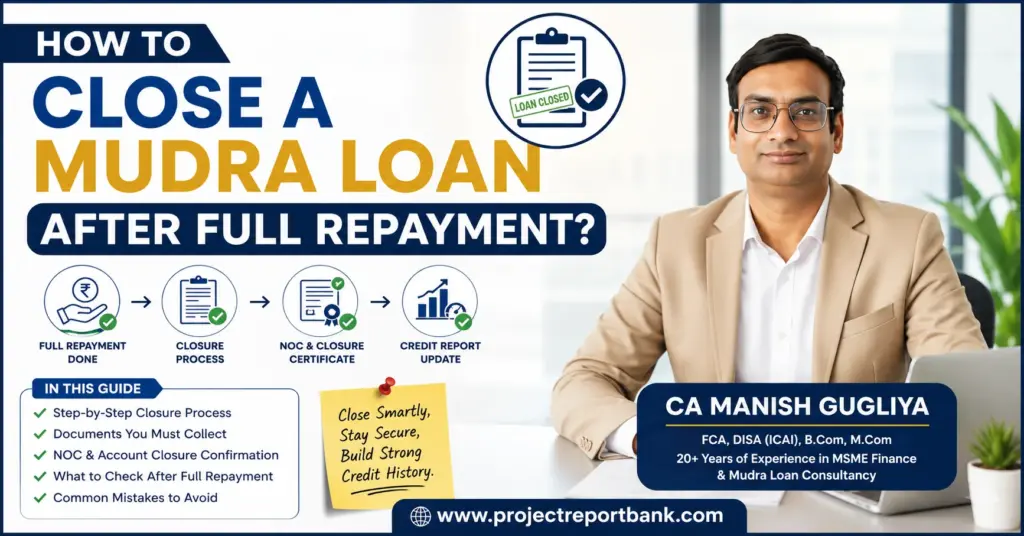

- Mudra Loan NOC After Closure: Step-by-Step Guide by CA Manish Gugliya

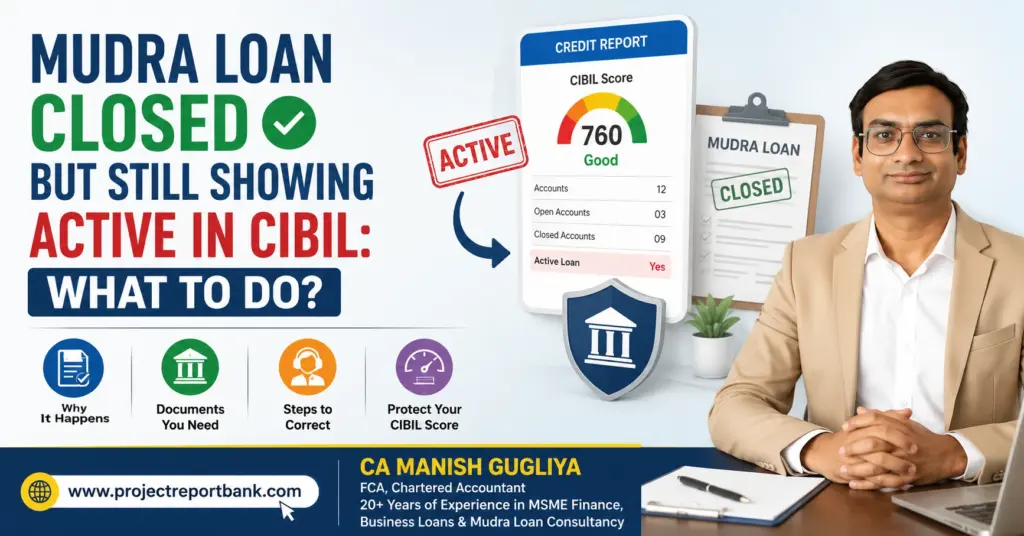
- Mudra Loan Closed but Still Showing Active in CIBIL: What to Do?
- Can a Bank Refuse to Renew a Mudra Loan? Reasons, Rules & Next Steps

- What Documents Are Required for Mudra Loan Renewal? (Practical Guide by CA Manish Gugliya)

- Can a Mudra Loan Be Renewed? Eligibility, Process & Practical Guide (By CA Manish Gugliya)

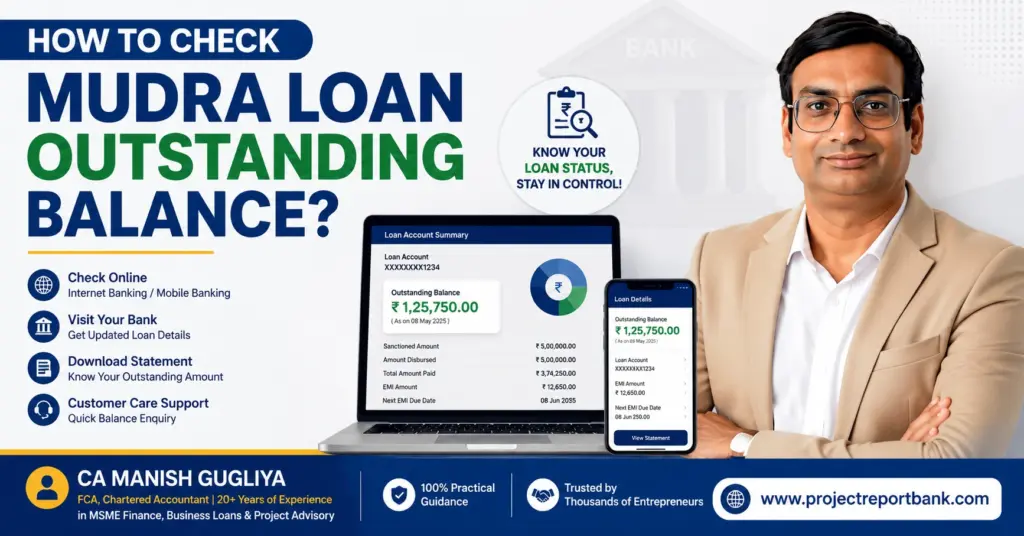
- How to Check Mudra Loan Outstanding Balance? (Practical Guide for Borrowers)
- Can You Foreclose a Mudra Loan? Process, Charges & Rules (Expert Guide by CA Manish Gugliya)

- Can Mudra Loan Repayment Period Be Extended? (Practical Guide by CA Manish Gugliya)