
Key Takeaways
- Branch managers can usually recommend and sometimes sanction mudra loans within a delegated loan amount limit set by the bank’s Head Office; larger or riskier cases must be approved by Regional or Zonal Office or a Credit Committee.
- Powers of branch manager in mudra loan approval differ from bank to bank as per internal credit policy, even though all banks follow RBI and Pradhan Mantri Mudra Yojana (PMMY) guidelines.
- For Shishu category loans (upto rs 50,000), many branch managers can sanction independently. For Kishore and Tarun categories, the branch manager’s role often stops at recommendation.
- Understanding these powers helps applicants prepare documents, communicate confidently with the bank, and avoid unrealistic expectations during the approval process.
- A branch manager cannot override bank policy, ignore CIBIL norms, or sanction loans beyond their delegated authority, regardless of personal relationship or pressure.
Table of Contents
Introduction: Why Branch Manager Powers Matter in Mudra Loans
Ramesh runs a small grocery shop in a semi-urban town. He walked into his nearest bank branch, handed over his application form, and told the branch manager, “Sir, please approve my ₹3 lakh Mudra loan today.” He assumed the branch manager alone would decide everything. Two weeks later, his file was still under processing at the regional office, and Ramesh had no idea why.
This story plays out every day across India. Most applicants believe the branch manager is the final authority on their Mudra loan. That belief leads to confusion, frustration, and sometimes unnecessary conflict.
Let me clarify what a Mudra loan actually is. The Pradhan Mantri Mudra Yojana is a flagship scheme that India launched on April 8, 2015, to provide financial support to micro entrepreneurs and small enterprises in the non farm sector. Any Indian citizen can apply for a Mudra loan. The scheme supports micro and small enterprises only, covering eligible activities like manufacturing, trading, and services, as well as allied agricultural activities such as dairy and poultry. Mudra acts as a refinancing agency and does not lend directly to micro-entrepreneurs; instead, banks, NBFCs, and MFIs disburse the loans.
Mudra loans are categorized into Shishu, Kishore, Tarun, and Tarun Plus:
- Shishu: upto rs 50,000, designed for startups and micro units in early stages
- Kishore: ₹50,001 to ₹5 lakh, for expanding businesses that need the next phase of funding
- Tarun: ₹5 lakh to ₹10 lakh, for established enterprises requiring larger working capital or term loan facility
- Tarun Plus: ₹10 lakh to ₹20 lakh, for growing businesses that have successfully repaid earlier Tarun loans
Mudra loans are available for amounts up to ₹20 lakh, and they are collateral free under the scheme. Since PMMY was launched, it has sanctioned over ₹33 lakh crore in loans, and 70% of PMMY beneficiaries are women entrepreneurs. The scheme promotes financial inclusion for underserved entrepreneurs, including shopkeepers, street vendors, artisans, and individuals setting up income generating activities.
Before going further, here are three terms you need to understand:
- Recommendation: The branch manager reviews your file and forwards it with a positive or negative note to the competent authority. This is not approval.
- Approval / Sanction: The competent authority (branch manager for small amounts, or regional/zonal office for larger amounts) formally records the decision to grant the loan in the bank’s system.
- Disbursement: The actual transfer of money to the borrower’s account after all conditions are met.
Common misconceptions that cause problems:
- “If I know the branch manager personally, my loan will be approved.”
- “Giving a gift or favour will speed things up.”
- “The branch manager can approve any amount on the spot.”
- “If the branch manager says yes verbally, the loan is confirmed.”
None of these are true. The branch manager works within a structured system with clear limits.
This guide will walk you through the exact role and powers of the branch manager, what decisions they can and cannot take, when your file moves to higher authorities, and how you should prepare to get the best possible outcome from your Mudra loan application.

Role of the Branch Manager in the Mudra Loan Process
In most PSU and private banks, the branch manager is the face of the bank for Mudra loans. But they work within a fixed “delegated authority” limit decided by the Head Office. Think of the branch manager as the first gatekeeper; they can open the gate for small cases and recommend opening it for larger ones, but the lock on bigger gates is held by someone higher.
Here is what the branch manager does in practice:
- Customer interaction: The manager meets the applicant, understands the business idea (whether it is a small manufacturing unit, a trading shop, or a service provider like a tailor or electrician), and explains basic eligibility criteria of Mudra loans. They also guide the applicant on which category (Shishu, Kishore, or Tarun) fits their requirement.
- Document scrutiny: The manager checks KYC documents (Aadhaar, PAN), business proof (GST registration, Udyam, Shop Act license), quotations for machinery or stock, project report, bank statements, and ITRs. Processing applications requires verifying identity, business activity, and supporting documents. Branch managers conduct KYC and field verification as part of the loan approval process.
- Initial assessment: The manager forms a first-level view on whether the business is feasible, whether the applicant can repay the loan, and whether the case should move forward for detailed credit appraisal. Branch managers hold the central position for evaluation and risk assessment at the branch level.
- Coordination: The branch manager guides loan officers, field staff, and business correspondents. They ensure the file moves through stages on time; delays at this stage can ripple through the entire process.
- Risk evaluation: The manager assesses obvious risks such as poor banking habits, very weak CIBIL scores, unverifiable business claims, or sector-specific concerns. Based on this, they decide whether to seek more information, ask for corrections, or decline at branch level.
- Responsibility and accountability: Branch managers are responsible for ensuring compliance with PMMY guidelines and bank credit policies. They are also answerable for the quality of Mudra loan proposals recommended from their branch. If a loan they recommended turns into an NPA (Non-Performing Asset), it reflects on their performance record. Branch managers must monitor loan utilization and repayment performance post-disbursement as well.
Where Does the Branch Manager Come in the Mudra Loan Approval Journey?
A Mudra loan usually passes through fixed stages. The branch manager’s powers operate mainly from the appraisal stage through to recommendation or sanction (for smaller amounts). Here is the typical flow:
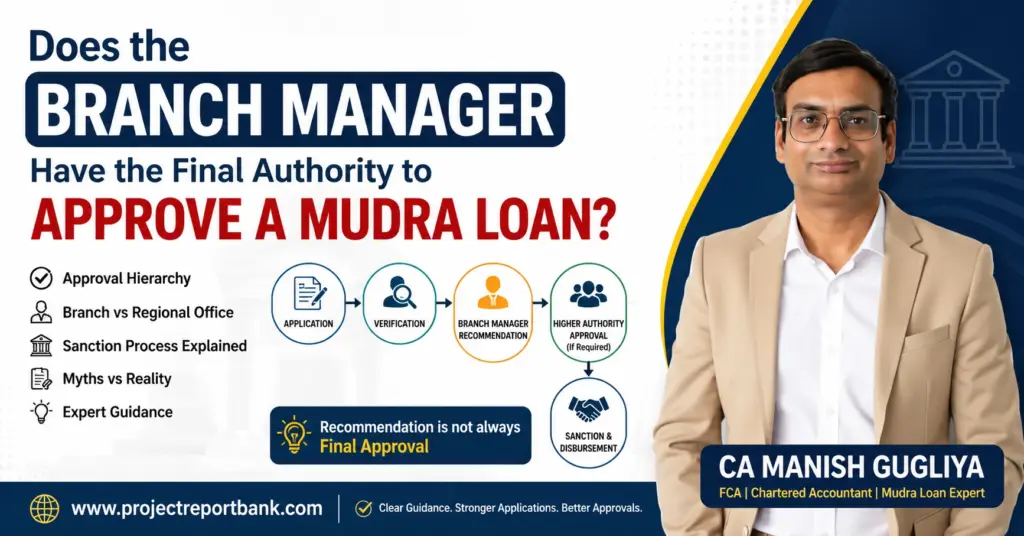
Application Submitted → Document Verification → Business Verification / Site Visit → CIBIL Verification → Credit Appraisal → Branch Manager Review → Internal / Regional Approval (if required) → Sanction → Disbursement
Let me explain each stage:
1. Application Submitted The applicant fills the Mudra loan application form at the branch counter or online portal. The loan officer checks if the form is complete, collects supporting documents, and issues an acknowledgement. The branch manager may or may not be involved at this point; often, the front-desk staff handles intake.
2. Document Verification The loan officer verifies KYC, business registration, bank statements, quotations, and other papers against the bank’s checklist. If anything is missing, the file goes back to the applicant. The branch manager oversees this to make sure nothing critical is skipped.
3. Business Verification / Site Visit For Kishore and Tarun categories, the bank typically sends a field officer to visit the applicant’s shop, factory, or workspace. They check if the business actually exists, if inventory or machinery matches the application, and if the location is as described. The branch manager orders this visit and reviews the verification report, especially for new businesses.
4. CIBIL Verification The bank pulls the applicant’s credit report. A low CIBIL score (below the bank’s threshold, often 650 or 700) can stall or end the application. The branch manager reviews CIBIL but cannot override the bank’s minimum score policy on their own. Files often get stuck at this stage, and understanding why Mudra loans remain pending at CIBIL verification can save applicants weeks of confusion.
5. Credit Appraisal This is where the bank digs deeper. The loan officer or credit officer prepares a detailed note covering business viability, repayment capacity, margins, and risk factors. The branch manager reviews this appraisal and adds their own observations. You can learn more about how Mudra loans move through credit appraisal and the typical processing stage timeline.
6. Branch Manager Review The branch manager studies the complete file: documents, site report, CIBIL, appraisal note. They form their recommendation. For small loans within their delegated limit, they may sanction here. For larger amounts, they forward the file with a recommendation to the regional or zonal office.
7. Internal / Regional Approval (if required) If the loan amount exceeds the branch manager’s sanction limit, or if the case has risk factors requiring policy deviation, it moves to the regional office, credit hub, or a credit committee. This step can take additional days or weeks depending on the bank’s internal queue. Understanding what happens when a Mudra loan is pending internal bank approval helps applicants stay patient during this phase.
8. Sanction The competent authority formally approves the loan. A sanction letter is generated in the bank’s core system with terms, interest rate, repayment schedule, and conditions.
9. Disbursement After the applicant signs loan documents and meets all pre-disbursement conditions (like opening a loan account, submitting a guarantee form if required), the loan amount is credited. Common reasons for Mudra loan disbursement delay include documentation gaps, pending insurance, or margin money shortfall. Loan disbursement timelines can be affected by the branch manager’s decision-making authority at the review stage.
Depending on the bank and the loan amount, the branch manager’s role is strongest at the appraisal and review stages and weakest at the final sanction stage for higher-ticket loans.

What Powers Does a Branch Manager Actually Have in Mudra Loan Approval?
Branch manager powers are defined in each bank’s internal “delegation of powers” document. These powers vary for Shishu, Kishore, and Tarun Mudra loans. The RBI’s master circulars require that banks’ Boards of Directors delegate specific sanctioning powers to branch managers and other functionaries, and these limits must be documented and monitored.
Here is what a branch manager can do at each step:
Receiving and Scrutinizing Applications
The branch manager can accept, return, or advise correction of Mudra loan applications. If the form is incomplete or the activity is not covered under PMMY (for example, someone applying for a personal expense rather than a beneficiary micro unit), the manager can return the application with reasons. They can also guide the applicant on which category to apply under, based on the quantum of funding required.
Asking for Missing Documents
The branch manager can insist on standard documents as per bank policy: KYC, business proof, bank statements, ITRs, quotations, and project report. If the manager asks for documents that seem beyond what the scheme requires, there should be a justified reason. If you feel the branch manager is asking for unnecessary documents, you can politely ask them to cite the specific policy requirement.
Conducting Preliminary Risk Assessment
Before sending the file forward, the manager judges risk based on the sector (for instance, a seasonal business vs. a year-round service), the applicant’s banking history, CIBIL score, and business model. A shopkeeper with three years of steady bank transactions presents lower risk than a brand-new enterprise with zero track record.
Reviewing Business Viability and Checking Applicant Eligibility
The manager cross-checks eligibility criteria under PMMY: the enterprise must be non corporate, non farm (or engaged in allied agricultural activities), and a micro or small enterprise. They verify the viability of proposed sales, margins, and expenses. If an applicant claims monthly revenue of ₹5 lakh from a small tea stall, the manager will flag that as unrealistic.
Branch managers must evaluate the viability of the business proposal and projected cash flows. Compliance with regulatory requirements is essential for sanctioning Mudra loans.
Quick example: A street vendor applies for ₹2 lakh (Kishore) to buy a push-cart and stock. The manager checks if the vendor has a trade license, reviews 6 months of bank statement credits (even if small), and verifies the quotation for the cart. If everything adds up, the manager can recommend this file with confidence.
Evaluating Repayment Capacity
The manager uses bank statements, income proof, and projected cash flow to check whether the EMI or instalment on the requested loan amount is realistic. If a borrower earns ₹20,000 per month net and the EMI would be ₹15,000, repayment capacity is clearly insufficient. Discretionary pricing and terms on loans include structuring repayment schedules based on cash flows. Branch managers have the power to apply interest rates within the specified bank range.
Recommending Approval
For loans within the branch manager’s delegated limit, the recommendation and sanction can happen simultaneously. For larger amounts, the manager writes a detailed recommendation note and forwards it. The recommendation carries weight because the manager has met the applicant, visited or received reports on the business, and reviewed numbers firsthand.
Example: A small manufacturer applies for ₹8 lakh (Tarun) to buy a CNC machine. The branch manager completes all checks, finds the business viable, and writes a strong recommendation. But ₹8 lakh is above the manager’s sanction limit (say ₹5 lakh in this bank). So the file goes to the regional office with the manager’s positive note. The regional office relies heavily on this note but makes the final call.
Recommending Rejection
The manager can also recommend rejection. In many banks, the final rejection is system-recorded after concurrence from a higher authority or credit hub. Rejection of a loan application must be communicated with clear reasons to the applicant. The manager cannot simply say “file rejected” without documentation.
Ordering Site Verification and Seeking Additional Clarifications
The branch manager can order field visits at any point, call the applicant for a face-to-face discussion, or independently verify claims by contacting suppliers, landlords, or customers. These checks happen at the manager’s discretion and form a critical part of the credit appraisal.
Escalating Cases to Regional Office and Monitoring Compliance Before Sanction
When a Mudra loan is borderline (weak CIBIL but strong business, or high amount with thin margins), the manager escalates to the regional office with a detailed note. Before recommending sanction, the manager also ensures all pre-sanction conditions are met: margin money (if required by bank policy), valid licenses, insurance on assets being purchased, and that the security of first charge on assets created from the loan is properly documented where applicable.
What Decisions Can a Branch Manager Take Independently, and What Is Beyond Their Powers?
For Mudra loans, independent decision-making powers depend mainly on the loan amount and risk rating. These limits differ between PSU banks, private banks, small finance banks, and RRBs. Lending institutions retain discretion to approve or reject PMMY applications based on creditworthiness.
Here is a reference point for understanding what falls within and outside the branch manager’s authority:
| Decision | Usually Branch Manager Can Decide? | May Require Higher Approval |
|---|---|---|
| Accepting or returning application | Yes | No |
| Checking document completeness | Yes | No |
| Ordering site inspection | Yes | No |
| Asking for additional verification | Yes | No |
| Clarifying credit or CIBIL issues with applicant | Yes | No |
| Sanctioning Shishu loans (up to ₹50,000) | Yes (in most banks) | Rarely |
| Sanctioning low-value Kishore loans (₹50,001 to ₹2 lakh) | Often yes, depends on bank | Sometimes |
| Sanctioning higher Kishore / Tarun loans (₹2 lakh to ₹10 lakh) | Sometimes, if within delegated limit | Usually yes |
| Sanctioning Tarun Plus loans (₹10 lakh to ₹20 lakh) | Rarely at branch level | Almost always |
| Policy deviation (e.g., relaxing CIBIL norm) | No | Yes |
| Final rejection without higher concurrence | Depends on bank policy | Often needs concurrence |
| Setting interest rate within bank’s range | Yes | No |
| Structuring repayment schedule | Yes (within policy) | No |
Branch managers can sanction micro-loans up to ₹50,000 without higher-level clearance in most banks. For Kishore and Tarun categories, the branch manager’s power depends on their grade and the bank’s internal policy. The approval limit for Tarun Plus loans (₹10 lakh to ₹20 lakh) almost always involves additional oversight from higher authorities.
Branch managers cannot approve loans beyond their delegated financial authority. No exceptions to this rule exist, regardless of how strong the applicant’s profile may be.
When a Mudra loan file is sent to regional office, it means the branch has recommended the case but final authority lies with the regional or zonal credit team. This is a normal part of the hierarchy, not a red flag.
One critical warning: even if the branch manager verbally assures you that “your file is okay,” the loan is not approved until the competent authority records a sanction in the bank’s core banking system. A verbal assurance is not a branch manager approval.
Can a Branch Manager Approve or Reject Every Mudra Loan?
A branch manager cannot approve or reject every Mudra loan based on personal choice. They must follow PMMY rules, RBI guidelines, and the bank’s internal credit policy.
Delegated Sanction Limits
Each bank sets maximum loan sanction powers for branch managers depending on their grade (Scale I, II, III officer), branch type (rural, semi-urban, urban, metro), and risk category of the loan. A Scale-II manager at an urban branch of a PSU bank might have sanction powers up to ₹5 lakh for Mudra loans, while a Scale-I manager at a rural branch might be limited to ₹1 lakh. These numbers are internal to each bank and are not published on websites for public access.
When Branch Manager Can Approve Alone
A ₹1.5 lakh Kishore loan for an existing customer with three years of steady banking, clean CIBIL, and a simple trading business can often be sanctioned entirely at the branch level. The branch manager reviews the file, records the sanction in the system, and processing moves to disbursement.
When Higher Authority Must Decide
For a ₹8 lakh to ₹10 lakh Tarun loan, or loans to new businesses with no repayment track record, or cases with borderline CIBIL scores (say 640 when bank policy requires 650), the branch manager cannot sanction alone. The file goes to the regional or zonal office, or to an internal credit committee. The manager’s recommendation carries weight, but the decision is not theirs to make.
Branch-Level Rejection
While the branch manager can record a recommendation to decline, in many banks the final rejection requires concurrence from a higher authority or credit hub. Common branch-level rejection reasons include:
- The applicant’s activity is not eligible under PMMY (for example, a purely speculative enterprise)
- Very poor repayment history on existing loans
- Projections in the project report are completely unviable
- Applicant refuses to provide required documents
In contrast, a case where the business is viable but CIBIL is slightly below threshold cannot be rejected by the branch manager alone; it must be escalated with a note explaining why the manager recommends decline or requests an exception.
Key Factors a Branch Manager Evaluates in a Mudra Loan Application
Even though Mudra loans are collateral free, they are still business loans and must pass a clear credit check. PMMY provides collateral free loans to micro and small enterprises, but the bank still needs to be satisfied that the money will be repaid.
| Factor | What the Branch Manager Checks |
|---|---|
| Business viability | Is there steady demand for the product or service? Is the market real? |
| Quality of project report | Does the report show realistic revenue, expenses, and profit projections? |
| Promoter’s experience | Has the applicant run this type of business before? How many years? |
| CIBIL score | Is the score above the bank’s minimum threshold? Any past defaults? |
| Existing loans and liabilities | Does the applicant already have OD, term loan, or credit card dues? |
| Banking habits | Does the bank statement show regular credits? Any cheque returns or overdrafts? |
| Cash flow | Is there enough monthly surplus after expenses to cover the EMI? |
| Repayment capacity | Can the applicant realistically pay instalments for the full loan tenure? |
| Own margin contribution | Is the applicant putting in their own money (10-25% depending on bank)? |
| Documentation quality | Are all papers genuine, consistent, and complete? |
| Business verification (on-ground) | Does the shop or unit actually exist? Does inventory match claims? |
| Business stability | Has the business been running for at least 6-12 months? |
Some factors, like a very low CIBIL score or serious past overdues, automatically restrict the branch manager’s powers. In such cases, the manager must either decline as per policy or seek regional approval for an exception.
A strong project report and clean banking record make it easier for the branch manager to support the file in front of higher authorities. These two factors alone can be the difference between a smooth approval and a prolonged delay.

Practical Real-Life Style Examples of Branch Manager Powers
Over 20 years of working in MSME finance, I have seen these powers play out in hundreds of Mudra loan cases. Here are five scenarios based on common patterns:
Example 1: Small Loan, Strong File
Sunita runs a tailoring unit from her home. She applies for ₹2 lakh (Kishore) to buy two industrial sewing machines. Her project report shows monthly income of ₹25,000 and expenses of ₹12,000. Her CIBIL is 720. Bank statements show regular deposits for 18 months. The branch manager reviews the file, orders a quick site visit (field officer confirms the unit exists), and sanctions the loan within his delegated authority. Total time: 9 working days.
Example 2: Weak Documents, Conditional Progress
Rajan applies for ₹5 lakh (Kishore) to expand his grocery store. He submits the form but his project report is a generic copy-paste template with no real numbers. His bank statement shows irregular deposits. The branch manager does not reject the file outright. Instead, the manager orders a site verification, asks Rajan to provide a revised project report with actual sales and expense numbers, and requests quotations for the refrigeration equipment he plans to buy. The file moves forward only after corrections. The branch manager uses their power to delay and conditionally recommend rather than reject.
Example 3: High Risk, Escalation Required
Prakash applies for ₹7 lakh (Tarun) to open a small food processing unit. His CIBIL is 590 (well below threshold). He has two old loans that went overdue for 90+ days before being repaid. The business idea is sound, but the risk profile is weak. The branch manager cannot override the CIBIL norm. He prepares a detailed note explaining the positives and negatives, and forwards the case to the regional office with a recommendation to decline. The regional office may agree or, in rare cases, approve with stricter conditions.
Example 4: Strong Business, Large Amount
Meera runs a well-established beauty salon chain (two locations) and applies for a maximum loan of ₹10 lakh (Tarun) as working capital to open a third branch. Her banking is excellent, CIBIL is 760, and she has successfully availed and repaid a Kishore Mudra loan two years ago. The branch manager completes all checks and writes a strong supporting note. But ₹10 lakh exceeds the branch manager’s sanction limit. The file goes to the zonal credit committee, which approves it in 12 working days with a condition that Meera maintains a minimum quarterly balance.
Example 5: Poor CIBIL, Strong Cash Business
Dinesh runs a busy street food stall with daily cash sales of ₹3,000 to ₹5,000. He applies for ₹3 lakh (Kishore). His CIBIL is 610, caused by a missed EMI on an old two-wheeler loan that has since been closed. His current banking shows healthy daily deposits. The branch manager cannot override the CIBIL minimum on his own authority. He has two options: reject as per policy, or prepare a special case note with full justification (strong cash flow, settled old dues) and send it to the credit committee as an exception. The decision is no longer in the branch manager’s hands.
Applicants should not assume their case is decided just because the branch manager has forwarded it. Higher authority decisions are still pending, and outcomes can go either way.
How Applicants Should Prepare Before Meeting the Branch Manager
A well-prepared applicant makes it easier for the branch manager to exercise their powers positively and recommend sanction. Here is a practical checklist:
- KYC documents: Aadhaar card, PAN card, passport-size photographs
- Business proof: Udyam registration, GST certificate, Shop and Establishment license, or trade license
- Bank statements: Last 12 months, from the account where business transactions are visible
- ITRs: Last 2-3 years (if filed; not mandatory for Shishu but helpful for Kishore/Tarun)
- Quotations: For machinery, equipment, or stock you plan to purchase with the loan
- Rent agreement or shop proof: Ownership documents or lease agreement for business premises
- Project report: A clear, realistic document showing your business plan, expected sales, expenses, profit, and how you will repay the loan
When you meet the branch manager, explain your business in simple language: what you sell, who your customers are, how much you earn in a typical month, your regular expenses, and how you plan to pay the EMI. Do not memorize a script; just be honest and clear.
Be upfront about existing loans and CIBIL issues. The branch manager will check CIBIL online regardless. Hiding information does not help; it destroys trust and reduces the manager’s willingness to recommend your file.
A professionally prepared project report, ideally from an experienced CA or Mudra consultant, can make a real difference. It gives the branch manager concrete numbers and a structured format to justify their favourable recommendation to the regional office.
Finally, ask the branch manager politely where your file stands in the process (at branch level, sent to regional office, or at credit hub). Do not assume delay means bad intention. If the branch manager is not responding or is delaying without explanation, there may be legitimate processing reasons or document gaps that need attention.

Mistakes and Misconceptions That Reduce Branch Manager Confidence
Even when the branch manager has technical power to recommend a Mudra loan, certain applicant behaviours make them reluctant to use those powers.
| Mistake | How It Reduces Confidence |
|---|---|
| Incomplete documents | Manager cannot process the file; it stays in queue |
| False or exaggerated information | Once caught (and it usually is), trust is permanently damaged |
| Inconsistent answers | Saying one thing in application and another during interview raises red flags |
| Weak or copy-paste project report | Manager has nothing concrete to justify recommendation to higher authority |
| Poor banking habits (frequent cheque returns, overdrafts) | Signals repayment risk; makes manager personally liable if loan goes bad |
| Ignoring phone calls or site visits | Manager marks the file as “non-cooperative applicant” |
| Pressuring manager to break rules | Reduces willingness to support even borderline-eligible cases |
Common Myths Debunked
“Branch manager can approve every loan.” No. Powers are limited by delegated authority, loan amount, and risk profile.
“Bribe or favour can force sanction.” Bank systems require formal sanction recording. A NITI Aayog impact assessment specifically flagged misuse of power by branch managers as a risk that banks must control through internal audit. Bribes may create liability for both parties without guaranteeing approval.
“Personal relationship guarantees Mudra loan.” The manager’s recommendation is documented and audited. Approving a weak file puts the manager’s career at risk.
“Site verification means loan is confirmed.” Verification is one step in a multi-stage process. It does not signify approval.
“Regional office is only a formality.” Regional offices reject or return files regularly. They apply independent judgment.
“Branch manager can ignore bank policy.” Every sanction is checked during internal audit. Unauthorized decisions result in disciplinary action.
If the branch manager gives a verbal rejection without written reasons, or refuses to accept your application, the real reason is often poor file quality or lack of delegated powers for that loan amount, not personal dislike.
Clear communication, patience, and document readiness encourage branch managers to use whatever powers they have in your favour.
Expert Guidance by CA Manish Gugliya on Using Branch Manager Powers to Your Advantage
I have spent over 20 years preparing project reports, CMA data, and Mudra loan files for entrepreneurs across India. Let me share how branch managers think and how you can work with that.
Branch managers care about three things: meeting their branch lending targets, maintaining loan quality (avoiding NPAs), and staying compliant with bank policy. Every file they recommend is a personal risk. If the loan goes bad, their appraisal suffers. So they naturally prefer simple, genuine cases with clear numbers and transparent behaviour.
Here is what works:
- Prepare a realistic project report. Do not inflate sales projections to show higher repayment capacity. If your tea stall earns ₹15,000 per month, write ₹15,000, not ₹40,000. The branch manager has seen hundreds of businesses in the area. They know what is realistic for your sector.
- Match your EMI with actual cash flow. If your net monthly surplus after expenses is ₹8,000, do not request a loan whose EMI is ₹10,000. The numbers must work.
- Maintain healthy banking habits for at least 6 months before applying. Regular deposits (even small amounts) in your bank account show discipline. Avoid cheque returns and overdrafts during this period.
- Be ready to answer basic questions. Who are your customers? Where do you buy raw material? What is your daily footfall? How do you handle seasonal dips? These are questions the branch manager will ask, and your answers build or break confidence.
- Be polite and concise in meetings. Carry all original documents. Do not pressure the manager to break rules. A manager who feels respected and sees a clean file is more likely to extend their support for borderline cases within their powers.
If your Mudra loan file has already been delayed, sent back, or verbally declined, consider seeking professional help. Sometimes a restructured proposal, a better project report, or applying to a different bank is more practical than arguing with one branch. The enterprise needs funding; the route to get it can be flexible.
Conclusion: Understanding Branch Manager Limits and the Full Mudra Loan Hierarchy
A branch manager in Mudra loans has real powers: assessment, recommendation, and for smaller tickets, outright sanction. But these powers are bounded by the bank’s internal approval matrix, PMMY guidelines, and RBI regulations. No branch manager operates in isolation.
Strong documentation, genuine business viability, and clear repayment capacity carry more weight than personal influence, pressure, or shortcuts. These are the factors that help a branch manager justify their recommendation to higher authorities.
When your file is sent to a regional office or credit committee, it does not mean the branch manager is against you. It means the system is working as designed, with multiple levels of review to protect both the bank and the borrower.
By understanding the full approval chain, from branch to regional or zonal office and credit committees, you can plan your application realistically, follow up at the right stages, and improve your chances of getting the Mudra loan amount your business needs. Employment creation and enterprise growth depend on applicants and banks working within this structure, not around it.

Frequently Asked Questions (FAQ)
Does every bank give the same Mudra loan sanction power to its branch managers?
No. Powers differ by bank, branch category (rural, semi-urban, urban, metro), and the grade of the officer. A branch manager at a large urban branch of State Bank of India may have a higher delegated sanction limit than a manager at a rural cooperative bank branch. The overall PMMY and RBI rules are common, but each bank’s Board of Directors sets its own internal delegation of financial powers. Applicants should politely ask the branch manager what the delegated limit is for their specific branch.
Can I shift my Mudra loan application to another branch if my current branch manager is not supportive?
In most cases, yes. You can withdraw your application and apply at another branch of the same bank or at a different bank entirely. There is no rule that ties you to one branch. The practical downside is that you lose the processing time already invested, and the new branch will start its own verification from scratch. If you have a legitimate reason (documented delay, unjustified refusal), shifting can be worthwhile. If the issue is a document gap, fix the gap first; a new branch will ask for the same things.
If my Mudra loan is rejected at branch level, can higher authorities still approve it?
This depends on how the rejection was processed. If the branch manager only recommended rejection and the file was not formally closed in the system, higher authorities can still review and approve it. If the rejection was formally recorded with concurrence from a credit committee, you would typically need to re-apply with improved documents or a revised proposal. You can also apply at a different bank. There is no PMMY rule that prevents re-application after rejection.
Is it useful to complain to higher officials if the branch manager delays my Mudra loan?
A balanced approach works best. First, check if there are genuine document gaps or pending requirements on your side. Ask the branch manager in writing (or through the bank’s customer service channel) for the status and reason for delay. If the delay persists beyond 30-45 days without explanation and all your documents are complete, you can write to the bank’s Regional Manager, Nodal Officer for PMMY, or use the bank’s online grievance portal. Escalation works when your own file is in order; it backfires when you escalate before fixing the basics.
Does Mudra loan approval depend only on the branch manager’s recommendation?
No. The branch manager’s recommendation is one stage in a multi-level process. For smaller loans within delegated limits, the branch manager’s recommendation and sanction may happen together. For larger amounts, the regional office, zonal office, or a credit committee reviews the file independently. Their decision can override the branch manager’s recommendation in either direction; they can approve a file the manager was hesitant about, or reject one the manager supported. The branch manager is the first filter, not the final authority.
- Mudra Loan Branch Manager Issues: Complete Guide to Manager’s Role, Powers & Common Problems


- How Branch Workload Affects Mudra Loan Processing


- Can a Branch Manager Return a Mudra Loan File for Corrections? Complete Practical Guide
- Why Is My Mudra Loan Waiting for the Branch Manager’s Signature?

- Why Does the Branch Manager Ask for Clarification Before Loan Approval?

- Branch Manager Recommendation in Mudra Loan: Full Meaning, Next Steps & Practical Guidance

- Can a Branch Manager Reduce the Requested Mudra Loan Amount?

- Does Branch Manager Have Final Authority to Approve Mudra Loan?
- What Happens If the Branch Manager Is Transferred During Mudra Loan Processing?