Key Takeaways
Before you dive into the full article, here are the most important points you should remember about how branch workload affects mudra loan processing.
- Heavy bank branch workload is one of the most common and genuine reasons for delay in Mudra loan processing, whether you have applied for a Shishu loan up to rs 50,000, a Kishore loan upto rs 5 lakh, a Tarun loan up to rs 10 lakh, or even the newer Tarun Plus category covering loans from ₹10 lakhs to ₹20 lakhs.
- Workload affects different processing stages differently. Document checking, business verification, credit appraisal, and Branch Manager review tend to slow down the most during busy periods. Sanction and disbursement also face delays when counters and documentation desks are overloaded.
- Delay due to workload does not automatically mean rejection. If your eligibility criteria, documents, and cibil score are in order, your file will usually move forward once the rush clears.
- Mudra loans are categorized into Shishu, Kishore, Tarun, and Tarun Plus, and the processing complexity increases with ticket size. Tarun Plus loans offer funding from ₹10 lakhs to ₹20 lakhs for growing micro enterprises.
- This article is written from the practical experience of CA Manish Gugliya (20+ years in MSME finance and Mudra loan consultancy) and will give you step-by-step guidance to reduce delays.
Introduction: Why Branch Workload Matters in Mudra Loan Processing
Imagine this. A shopkeeper in a small town applies for a ₹2 lakh Kishore Mudra loan in June 2025. He submits his documents, visits the bank branch twice a week, and after three weeks, still hears “your file is under process.” He starts thinking the bank is intentionally delaying his file or has already rejected it silently. This situation is more common than you think.
In reality, most public sector and private sector banks branches handle dozens of activities every single day. Cash deposits, withdrawals, government scheme enrolments, recovery follow-ups, internal reports, agriculture loans, and business loans all compete for the same limited staff time. Mudra loan processing can take several weeks simply because your file is one of many in the queue.
In my experience as CA Manish Gugliya, branch workload and staff shortage are among the biggest reasons for Mudra loan processing delay, especially for small ticket amounts like Shishu loans that provide up to ₹50,000 for micro enterprises, or Kishore loans that range from ₹50,001 to ₹5 lakhs. Tarun loans are available from ₹5 lakhs to ₹10 lakhs and naturally require more detailed appraisal.
Here is an important point: heavy workload increases processing time, but it does not change the scheme eligibility criteria, it does not directly change the interest rate, and it normally does not convert an eligible case into a rejection by itself.
Under the Pradhan Mantri Mudra Yojana (PMMY), also called the mudra scheme, loans are available to eligible borrowers including proprietorship and partnership firms, namely shishu, Kishore, Tarun, and Tarun Plus, covering four categories based on the stage of growth and needs of the beneficiary micro unit. Mudra loans are available up to ₹20 lakh, and no collateral is required for loans up to ₹10 lakh.
In this guide, you will learn how workload is created in a branch, which Mudra stages are most affected, how banks prioritise files, how to know if delay is due to workload or an actual problem, and what you can practically do to avoid extra delay.
Inside this guide you’ll learn
- Why branch workload affects Mudra loan processing time even when your documents are correct and your loan amount is eligible
- How banks practically prioritise Mudra files versus other business loans, working capital limits, and government work
- Which stages like verification, credit appraisal, and loan approval face maximum delay during heavy workload
- How seasonal factors like March year-end, festival season (Diwali, Navratri), or new government schemes increase branch pressure
- What an applicant can do to speed up Mudra loan processing without fighting with staff
- Practical advice from a Chartered Accountant with 20+ years in MSME finance
For deeper detail on specific sub-topics, you may also refer to the detailed Mudra loan processing stage timeline and the complete guide on Mudra loan delay in processing.
Table of Contents
Understanding Branch Workload in Banks
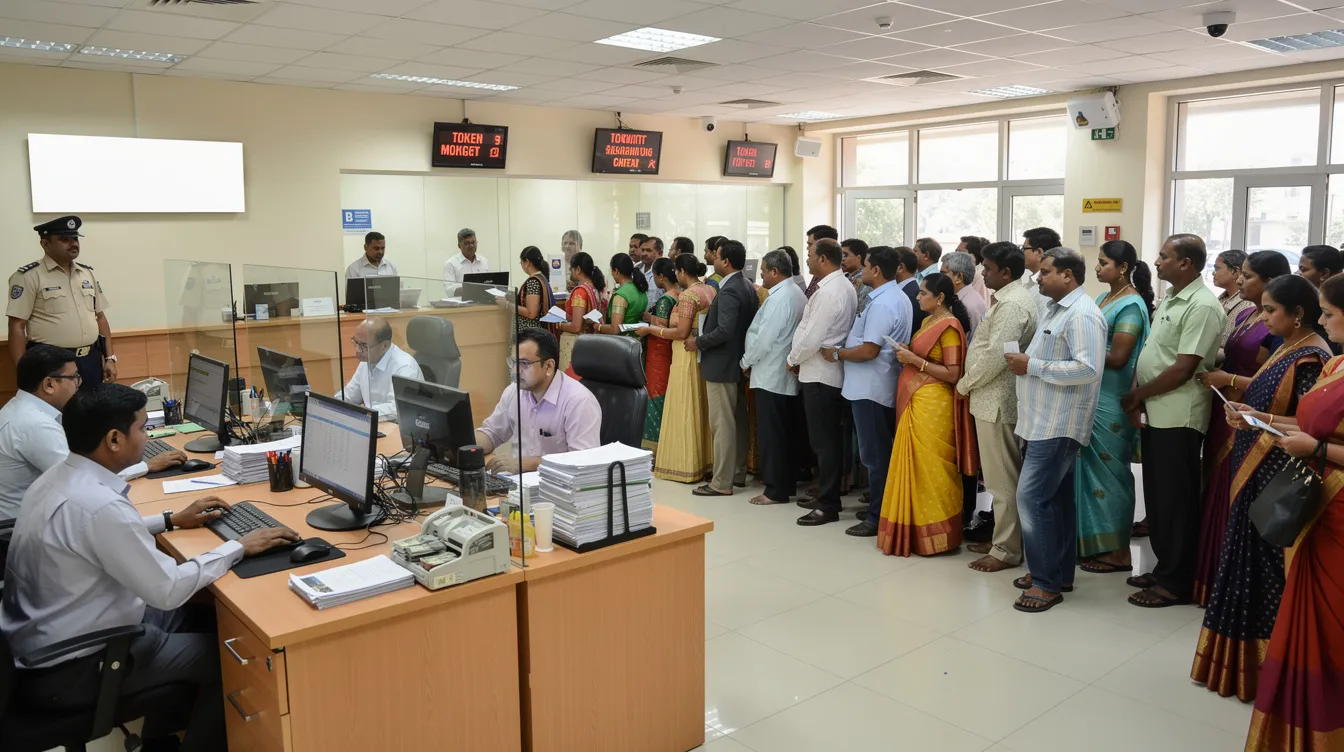
Walk into any Indian bank branch on a regular working day and you will see crowded counters, long token queues, and a small number of staff managing dozens of different tasks at the same time. Whether it is a large commercial banks branch in a metro city or a small regional rural banks office in a village, the workload picture is remarkably similar.
Here is what a typical branch handles daily:
- Cash operations: deposits, withdrawals, ATM loading, vault management
- Customer service: passbook updates, cheque book issue, KYC updates, current account and savings account opening
- Government schemes: PM Jan Dhan, PM Kisan, social security schemes, DBT (Direct Benefit Transfer) issues
- Agriculture loans: KCC renewal, crop loan sanction, gold loan for agriculture
- MSME and business loans: Mudra loans under PMMY, working capital limits, term loan processing for micro and small enterprises
- Recovery and NPA follow-up: phone calls, visits, legal notices, one-time settlement negotiations
- Internal reporting and RBI compliance: daily, weekly, and monthly reports, audits, returns, data uploads
- Miscellaneous: locker operations, standing instructions, system upgrades, digital onboarding
Each of these activities has fixed deadlines from head office or RBI, often with penalties if delayed. According to the NITI Aayog’s Impact Assessment of PMMY, many branches lack dedicated teams for handling Mudra or scheme-specific applications, meaning these files are processed along with all other credit and service tasks.
Rural and semi-urban branches often prioritize daily banking operations over credit appraisal due to high workloads. High application volumes in branches lead to longer processing times for Mudra loans. Even though PMMY is a priority government scheme, Mudra files still compete for time with cash management, customer service, and mandatory compliance work.
Why Branch Workload Delays Mudra Loan Processing
Branch workload is not one single thing. It is a combination of staff availability, month-end pressure, inspections, and seasonal peaks, each of which slows different parts of Mudra loan processing. Employee stress and fatigue from heavy workloads can reduce productivity in loan processing across the board. Branches using digital systems for loan processing can handle workloads more efficiently, but most public sector branches still rely heavily on manual steps.
Let me explain each major factor that causes delay.
Staff Shortage
Many branches operate with fewer officers and clerks than their sanctioned strength because of transfers, long leave, retirements, or simply vacant posts. Reports show that in some public sector banks, the employee-to-customer ratio is approximately 1 for every 1,000 customers, compared to private banks where ratios range between 1:100 and 1:600.
The staff-to-application ratio directly impacts backlog in processing mudra loans. When one loan officer is responsible for 40–50 Mudra files along with 20–30 other business loans, term loans, and cash credit accounts in a month, document checking and field visits naturally get delayed. In a Tamil Nadu case involving Indian Bank branches in Nagapattinam, staff reported doing the work of three people due to simultaneous campaign demands. Small businesses and their loan files simply had to wait.
Month-End Pressure
In the last week of every month (roughly 25th to 31st), branches must close monthly reports, reconcile accounts, send data to regional office, and chase short-term targets like CASA (current account and savings account balances) and recovery numbers.
During this time, non-urgent processes like fresh Mudra applications are often taken up slowly. Loan officers focus on completing disbursements that impact monthly figures rather than starting new appraisals. If you submit your application around month-end, expect slightly longer waiting times.
Quarter-End Targets
Every quarter end (June, September, December, March) brings additional pressure: target review by regional office, cross-selling campaigns, and special pushes for certain products. Banks sometimes focus more on achieving higher ticket business loans or recovering old NPAs in these periods. High-ticket loans often take precedence over Mudra loan applications during peak times.
This indirectly slows work on small ticket Mudra applications, especially Shishu loans. A Kishore Mudra file may wait 7–10 extra days because staff are busy closing other high-priority tasks at quarter close.
Financial Year Closing (February–March Rush)
The period from roughly 15 February to 31 March is historically the slowest for new Mudra loan processing. Balance confirmation, provisioning, audit preparation, year-end reporting, heavy target pressure, and clearing old pending entries consume most of the branch’s energy.
Approval timelines can extend due to peak workload periods like government campaigns or financial year-end targets. If possible, avoid filing fresh Mudra applications in the last 15–20 days of March, or at least keep your expectations realistic about timelines during this period.
Government Scheme Rush
Whenever a new government scheme or special campaign is launched, branches receive instructions to prioritise that activity for a limited time. For example, a drive for Jan Dhan enrolments or social security scheme sign-ups can temporarily divert loan officers from individual file examination.
PMMY itself sometimes runs special campaigns where staff collect applications or conduct camps. While these drives gather applications quickly, the detailed appraisal is often pushed to after the campaign, causing noticeable delays in individual Mudra loan processing.
Festival Season (Diwali, Navratri, Year-End Sales)
Festival periods like Navratri and Diwali see a sharp rise in customer footfall. Cash withdrawals, gold loans, festival offers, and increased Mudra demand from traders seeking stock finance all hit the branch at the same time. Seasonal surges in Mudra applications can overwhelm branch processing capabilities.
Delays often occur during festival seasons due to workload. Though banks may run “festival loan campaigns,” physical resources like counters, officers, and computers stay the same. In my experience, applications submitted 10–15 days before Diwali often take longer than normal simply because of the sheer number of visitors per day.

Multiple Inspections and Audits
Branches regularly face inspections from internal audit, concurrent audit, statutory audit, and RBI or head office teams. Sometimes these overlap in the same month. During such inspections, officers must provide files, prepare explanations, and correct observations, leaving less time for new credit proposals like fresh Mudra loans.
During a big audit, Branch Managers may instruct staff to postpone non-urgent customer meetings to focus on inspection compliance. This is a temporary but real cause of delay.
Credit Appraisal Backlog
Credit appraisal for Mudra loans still assesses borrower repayment likelihood despite official guidelines. The concept of a “backlog” means many Mudra and MSME loan proposals are waiting for detailed appraisal (financial analysis, viability, risk scoring) due to earlier workload peaks.
Even if an applicant submits documents today, the file enters this queue and will only move when earlier files are cleared. The delay is systemic, not personal. Some banks use centralised processing cells for higher-ticket Mudra loans (for example Tarun above ₹5 lakh), which can create another layer where backlog accumulates.
Documentation Verification Pressure
Officers must verify PAN, Aadhaar, current account statement, GST registration, Udyam, shop licence, rent agreement, quotations, and other documents for every Mudra loan application. Manual verification processes increase time required for Mudra loan applications under heavy workloads.
Heavy workloads can cause delays in documentation and verification for mudra loans. Verification sometimes involves calling landlords, checking electricity bills, or seeking clarification from the applicant. During heavy periods, officers may batch verification (checking 10–15 files together), causing each individual file to wait longer.
Branch Manager Availability
For Mudra loans, especially Kishore and Tarun up to ₹10 lakh, Branch Manager approval is usually compulsory. Branch Managers attend meetings at regional office, field visits, recovery camps, and audits, so they are not always at the desk to sign proposals.
This limited availability often becomes a bottleneck even when credit appraisal is complete, causing 2–5 days of additional delay at the final approval stage. If the Branch Manager is transferred during your processing, you can read about what happens when the Branch Manager is transferred during Mudra loan processing.
High Workload vs Normal Workload: Impact on Applicant Experience
Workload affects both the actual processing speed and the way applicants feel treated at the branch. During heavy periods, you will experience longer waiting, shorter discussion time, and more “come tomorrow” responses. Here is a comparison based on my practical experience:
| Situation | Processing Speed | Applicant Experience | Expected Timeline |
|---|---|---|---|
| Shishu (up to ₹50,000) – Normal Period | File picked within 1–2 days | Easily meets officer, gets clear updates | 7–10 working days |
| Shishu – Festival Rush | File picked after 4–6 days | Has to wait, officer appears rushed | 12–18 working days |
| Kishore (₹2–₹5 lakh) – Normal Period | File picked within 2–3 days | Officer schedules site visit promptly | 10–15 working days |
| Kishore – Quarter End | File picked after 5–8 days | Repeated “come next week” responses | 18–25 working days |
| Tarun (above ₹5 lakh) – Normal Period | File picked within 3–5 days | Detailed discussion, clear milestones | 15–20 working days |
| Tarun – Heavy Backlog/Year-End | File picked after 7–12 days | Minimal communication, delays without updates | 25–35 working days |
| Any category – Incomplete Documents | File not picked until complete | Officer asks applicant to return with missing papers | Indefinite until complete |
Extended turnaround times for Mudra loans can range from 15 to 30 working days during peak periods. Processing times for Mudra loans can vary based on branch workload and the complexity of loan requests. These are indicative timelines under Indian banking conditions in 2024–2026 and can vary by bank or financial institution, branch size, and city versus rural location.
Which Mudra Loan Stages Are Most Affected by Heavy Branch Workload?
Here is the typical flow of Mudra loan processing:
Application Received → Document Verification → Business Verification → CIBIL Check → Credit Appraisal → Branch Manager Review → Internal Approval → Sanction → Disbursement
While each stage can face some delay, heavy branch workload tends to hurt the verification, appraisal, and sanction review stages the most. For a detailed Mudra loan processing stage timeline, you can refer to our separate guide.
Application Received: During rush days, even receipt and initial data entry may be postponed or done hurriedly, risking missing documents. Staff may ask you to come back when it is less busy.
Document Verification: Checking KYC, business proof, bank statements, and quotations becomes a bottleneck when one officer handles dozens of proposals. Each file needs careful cross-checking of PAN, Aadhaar, and business registration. Incomplete documentation can lead to immediate rejection or delays.
Business Verification: Site visits, neighbour checks, and photographs depend on field staff availability. Travel time plus shortage of officers can delay this for 3–7 days during busy periods. For new businesses, you can read about Mudra loan verification for new businesses.
CIBIL Check: The actual cibil report fetching is quick, but analysis takes time. Officers must check other borrowings, repayment history, and overall repayment behaviour in detail. A cibil score above 700 is preferred for Mudra loans, while a CIBIL score below 650 may lead to outright application denial.
Credit Appraisal: This involves analysing the project report, checking sales, expenses, profit, and EMI capacity. It is a skilled task. The borrower’s repayment likelihood is assessed based on financial data and business viability. This step is often pushed to quieter days when workload is high.
Branch Manager Review: The Manager reads the proposal, asks questions, and records remarks. If travelling for meetings or busy with audit, files wait in their tray.
Internal Approval: Some banks require system-level or higher office approval for certain loan sizes, which slows down further when multiple branches send proposals at the same time.
Sanction and Disbursement: Preparation of sanction letter, signing of documents, account opening if needed, and credit of funds to the borrower’s current account or savings account. Heavy workload at counters and documentation desks can add a few extra days. Delays in processing can leave applicants without updates for weeks during this final stretch.

How Banks Prioritise Mudra Loan Files During Heavy Workload
Banks use practical prioritisation based on risk, completeness, and deadlines. This is not favouritism in most cases but workload management.
Complete Mudra loan files with all KYC, business proof, quotations, current account statements, and a proper business plan are often taken up earlier because they can be appraised and sanctioned faster, improving branch productivity. Applicants who have successfully repaid previous loans from the same bank or financial institution often find their files moving faster because the lender already has a satisfactory credit track record on record.
Incomplete files (missing PAN, Aadhaar mismatch, no rent agreement, weak project details) usually move to the bottom of the queue. Each missing item requires follow-up and extra work.
Higher-value cases like Tarun loans near ₹10 lakh may receive more detailed attention because they involve higher risk and contribute more to branch targets. This sometimes results in slightly different handling compared to very small Shishu loans.
When there are strict government deadlines (for example, PMMY targets to be achieved by 31 March), branches may temporarily give top priority to Mudra files to meet scheme numbers. Meanwhile, urgent compliance work like RBI or head-office reporting often overrides all loan processing for short periods, pushing pending Mudra loans backward. Staff availability on a given day directly affects which files move, and sometimes files simply wait for the responsible person to return from leave.
For more detailed reasons for Mudra loan processing delay, you can refer to our comprehensive guide.
Signs That Delay Is Due to Workload, Not Rejection
When your Mudra loan application appears stuck, anxiety is natural. But certain signs clearly show the delay is only due to workload and not a problem with your file:
- The bank has taken all your documents and given an acknowledgement or application number
- The officer has visited your business site or called neighbours, and verification is complete
- CIBIL enquiry has been done and no major adverse remark has been discussed with you
- Branch staff clearly state there is a backlog or inspection going on and ask you to wait 7–10 days
- Your file is physically moving between tables (for example from loan officer to Branch Manager) and staff can show it in the system as “under process”
In such cases, the probability of loan approval is generally good if you meet the eligibility criteria. Focus on maintaining communication rather than panicking or switching to another lender mid-way.
Politely ask for the approximate timeline and current processing stage, instead of only asking “when will my Mudra loan be approved?” If the delay is due to workload, reasons given by different staff members are usually consistent. Everyone will mention heavy rush, audit, or officer on leave. This is very different from problem-based delays where answers are vague or inconsistent.
Situations Where Delay Is NOT Caused by Workload
Sometimes applicants assume branch workload is the reason, but the file is actually stuck due to eligibility or risk issues. Understanding this difference helps you take the right corrective step.
Missing documents: The bank cannot move to sanction until gaps like missing business proof, incomplete KYC, or mismatched signatures are filled. Incomplete documentation can result in immediate rejection of applications, regardless of workload.
Poor CIBIL or serious overdues: If you have outstanding defaults in previous loans from any bank, small finance banks, or non-banking financial institution, these cases require deeper analysis or may lead to rejection. The delay here is due to risk, not workload. Individual borrowers should check their cibil report before applying.
Weak project report: When income projections do not support the EMI, or the purpose of loan is not clearly defined for the proposed activity, officers may ask for revision. Many applicants lack a clear business plan for loan applications, which causes repeat movement between applicant and branch. Lack of awareness about eligibility criteria leads to application confusion.
Business verification problems: Business not found at given address, neighbours denying knowledge, or business being different from what is declared. These issues lead to re-verification or decline. The Mudra loan verification process for new businesses covers this topic in detail.
Internal policy concerns: Cash-only businesses without current account history, firms with a very recent start date, or non corporate entities without proper registration may need extra checks. Bank bureaucracy can discourage applicants from pursuing loans, but these checks exist for good reason.
In these situations, daily visits or pressure will not solve the underlying problem. You may need to correct documents, improve your credit over time, or revise the loan amount.
How Applicants Can Reduce Delays Even When Branch Workload Is High
While you cannot control branch workload, you can control the completeness and clarity of your own Mudra loan application. This can significantly reduce extra delay.
Prepare a complete document set before your first visit:
- Aadhaar, PAN, photo, address proof
- Proof of business: Udyam Registration (business registration on the Udyam portal is recommended), GST, shop licence, rent agreement, electricity bill
- 6–12 months’ bank statements of the current account and savings account
- Simple project report or business plan with sales, expenses, and profit calculation
- Quotations for machinery, stock, capital assets, or transport vehicles if relevant
Whenever the bank asks for additional documents or clarification, respond within 1–2 days so your file does not get pushed to the end of the queue.
Keep your phone switched on and reachable. Many verification calls fail because the applicant’s phone is off, forcing staff to postpone verification to another day. Follow-up calls are recommended every week after application submission, but only if done politely.
Visit the branch only when there is a genuine update, for example once a week. This is more effective than daily visits that consume staff time without adding value.
A clear and realistic project report prepared with help from a professional like a Chartered Accountant makes a difference. Accurate numbers about turnover, margin, and EMI capacity build confidence and speed up credit appraisal. No educational qualification is needed to apply for Mudra loans, but having the necessary skills to run your business and present your finances clearly helps enormously.
Use official forms and follow the bank’s checklist from day one. This reduces to-and-fro movement and supports faster internal processing even during busy seasons. You can also apply online through the JanSamarth portal in some cases to reduce physical branch visits.
What Applicants Should Avoid During Mudra Loan Processing
Certain behaviours unintentionally increase Mudra loan processing time, especially when the branch is already under heavy workload.
- Avoid daily or twice-daily branch visits just to ask “any update?” This distracts officers and does not speed up credit appraisal.
- Avoid arguing, shouting, or threatening staff. Such behaviour can make officers extra cautious and less willing to take responsibility on borderline cases. A Branch Manager can even return a Mudra loan file for corrections if pressure creates doubt.
- Avoid submitting incomplete papers with the idea of “I will give remaining documents later.” Incomplete files are naturally pushed back in the queue.
- Avoid changing documents repeatedly (for example rent agreement, business address, mobile number, loan amount) after application. Each change triggers re-verification.
- Avoid ignoring bank calls or SMS. Missed communication leads to repeated visits or delayed clarifications.
- Never submit fake or manipulated information such as inflated turnover, false invoices, or borrowed current account statements. This not only delays processing but can lead to permanent rejection and even legal action.
Maintaining calm, polite, professional behaviour helps create trust. This indirectly supports smoother and faster decision-making by branch staff. Banks do not provide a central tracking ID for Mudra applications, so building a personal relationship with your loan officer is your best tracking system.
Does Visiting the Branch Every Day Help Speed Up Mudra Loan Processing?
In real banking practice, daily visits rarely speed up Mudra loan sanction. Sometimes they actually slow things down for both the applicant and the branch.
When occasional visits help:
- You can clarify doubts face-to-face
- Staff can quickly point out any missing papers
- Your relationship with the branch improves if interactions are respectful
When daily visits hurt (especially during heavy workload):
- Staff feel pressured and may give only very short, vague replies
- Officers lose workflow time when they have to repeatedly explain the same stage
- You may become more frustrated when no visible progress occurs daily
The best approach is to visit once a week or as advised by the officer, and in between use phone calls or SMS for small clarifications. If you are thinking of meeting the Branch Manager personally, read about whether meeting the Branch Manager can speed up your Mudra loan and when it actually makes sense to do so.
Can the Branch Manager Speed Up Processing During Heavy Workload?
The Branch Manager holds practical authority in Mudra loan approval. They can sanction Mudra loans within certain limits (for example up to ₹10 lakh for most branches), ensure credit policy and RBI norms are followed, and give final sign-off on appraisals done by officers.
While Branch Managers can prioritise urgent or time-sensitive cases and instruct staff to pick certain files first, they cannot ignore documentation, CIBIL checks, or verification rules just to reduce delay. Every sanction must be logged in the system with proper checks.
Internal limitations include dependence on the loan officer for detailed appraisal and field reports, requirement to record sanctions with proper documentation, and the reality that audits may question any shortcut taken under pressure. The micro units development and refinance agency (MUDRA) framework expects proper due diligence even for small ticket loans.
Respectful communication with the Manager, presenting complete documents, and clearly explaining your business requirement (for example, stock purchase before a seasonal sale, or equipment for employment creation in your micro enterprises engaged in manufacturing) can motivate them to give reasonable priority to your file within rules. Learn more about the powers of a Branch Manager in Mudra loan approval to set realistic expectations.
Practical Timeline During Heavy Workload (Stage-Wise Comparison)
Actual Mudra loan processing time depends on branch workload, file completeness, and ticket size. Here are approximate ranges to help set realistic expectations:
| Processing Stage | Normal Timeline (Working Days) | Heavy Workload Timeline (Working Days) |
|---|---|---|
| Application receipt and data entry | 1–2 | 3–5 |
| Document verification | 2–4 | 5–10 |
| Business/site verification | 3–5 | 7–15 |
| CIBIL check and analysis | 1–2 | 2–4 |
| Credit appraisal | 2–4 | 5–10 |
| Branch Manager review and approval | 1–3 | 3–7 |
| Internal/system approval (if needed) | 1–2 | 2–5 |
| Sanction, documentation, and disbursement | 1–3 | 3–7 |
| Total (approximate) | 12–25 | 28–63 |
Shishu loans usually move slightly faster because documentation and appraisal are simpler. Kishore loans need moderate detail. Tarun loans above ₹5 lakh naturally take more time due to bigger ticket size and more detailed appraisal, with physical inspection of capital assets and business site being almost mandatory.
According to LoanVittus, Mudra loan approval typically takes 7–15 working days when documentation is complete, but physical inspection cases can take 10–20 days just for the approval stage. In a legal case involving SBI, the bank committed to communicating sanction or rejection within 14 working days after completed documentation.
If processing time crosses even the heavy-workload range (for example more than 35 working days without clear reason), consider politely escalating or checking for underlying issues.

CA Manish Gugliya’s Practical Advice to Mudra Applicants
After helping hundreds of small business owners, micro enterprises, and individual borrowers with their Mudra loan applications, here is what I tell every client.
Set realistic expectations. Many Shishu and Kishore cases can be completed in 7–15 working days under normal workload. But always keep a mental buffer for busier months. Never plan a critical business event (like buying stock for a festival or signing a shop lease) on the assumption of instant sanction.
Your project report matters more than you think. Avoid copying unrealistic figures from someone else’s file. Base your numbers on your actual turnover, margins, and capacity. Whether you provide funding for a small enterprises in textiles or run a food stall, accurate finance figures about your business build lender confidence and speed up the next phase of appraisal. The loan extended to your business should match what your cash flow can support.
When visiting the branch, prepare a small checklist so all queries are discussed in one meeting. Keep a written record of dates and names of key interactions in a notebook. This serves as a useful reference point if you ever need to escalate.
Remain polite and cooperative. If the file is genuinely stuck without reason for more than a reasonable time, speak first to the loan officer, then to the Branch Manager. Only if that does not work should you consider taking up the matter with the regional office or banking ombudsman.
Treat bank staff as finance partners, not enemies. They handle hundreds of files from small businesses and micro units every month. A little patience and professionalism from your side goes a long way.
Common Myths About Branch Workload and Mudra Loan Delay
Many misconceptions circulate among small business owners about why their Mudra loan is delayed, leading to unnecessary stress and wrong decisions.
| Myth | Reality |
|---|---|
| Delay means my Mudra loan is rejected | Delay usually means the file is in queue. Rejection is communicated separately with reasons. |
| Branch Manager is ignoring my file | Managers handle dozens of proposals, meetings, audits, and recovery work simultaneously. Your file is in line. |
| Staff are intentionally delaying for bribe | While isolated cases exist, in the vast majority of Mudra applications the real issue is workload, documentation gaps, or risk assessment. |
| Daily visits will always speed approval | Daily visits often distract staff. Weekly follow-ups are more effective. |
| Festival delay means my file is lost | Festival rush creates temporary backlog. Files are not lost; they are simply queued. |
| Workload delay will change my interest or scheme benefits | Processing delay does not affect the interest rate, processing fee, or scheme benefits under Pradhan Mantri Mudra Yojana. The terms remain the same once sanctioned. |
| Only people with contacts get fast approval | Banks prioritise complete files, not connected people. Financial assistance under PMMY is assessed based on merit and documentation. |
Verify facts from official sources like the bank website, the PMMY portal, or your nearest Canara Bank, SBI, or any other commercial banks branch instead of believing rumours from social media.
Frequently Asked Questions (Focused on Workload-Related Issues)
These FAQs cover practical doubts specifically about branch workload and Mudra loan delays that may not be fully answered in the sections above.
How do I know if only my Mudra file is delayed or everyone’s file is moving slowly?
Ask the staff politely whether there is a general backlog or audit going on. Check with one or two other applicants waiting in the branch. If many people are facing similar delays, it is almost certainly a workload issue and not a personal problem with your file. You can also check whether a large government campaign or inspection is underway, which would explain the slowdown across all loan categories.
Can staff shortage or workload change my Mudra loan eligibility or sanctioned amount?
No. Eligibility criteria like business type, turnover, repayment capacity, and maximum loan amount (for example up to ₹10 lakh under standard PMMY or up to ₹20 lakh under Tarun Plus) are defined by the scheme and bank policy. Workload may delay the decision, but it does not change these rules. Whether you are a small business or a non corporate proprietorship, the scheme terms remain the same.
If my Mudra loan is urgent, can I apply in two different branches to avoid delay?
Applying simultaneously in multiple branches for the same Mudra loan is not advisable. It can create multiple CIBIL enquiries and confusion during verification, sometimes even leading to rejection. Focus on one branch and ensure your documents are complete. Banks cross-check enquiry records in the cibil report.
Does opening a current account in that branch help in faster Mudra loan approval?
Having a well-used current account with regular business transactions helps the bank understand your business better. It provides real data on your turnover, cash flow, and repayment history, which can support faster appraisal. But simply opening an empty account without activity does not guarantee faster approval. Banks look at transaction patterns, not just account existence.
Can I shift my Mudra application to another branch if workload is very high in the current branch?
Shifting mid-process is possible only at early stages and with the bank’s permission. It often causes re-processing and fresh verification, so it may not save time unless the original branch is genuinely unable to process the file. Some applicants consider approaching small finance banks or private sector banks as alternatives, which can work if you start fresh before the original bank has initiated deep processing.
Conclusion: Using Branch Workload Knowledge to Navigate Mudra Loan Processing
Heavy branch workload is a genuine and common reason for Mudra loan processing delay in India. Whether you are applying for a Shishu, Kishore, Tarun, or Tarun Plus loan, understanding that bank staff juggle cash operations, government schemes, recovery work, audits, and dozens of loan files every day helps you set realistic expectations. Delay due to workload does not automatically mean rejection or bias against you.
The key actions that help are simple. Submit complete and honest documents from day one. Keep communication channels open. Understand that certain months and seasons are slower due to structural banking pressures. Remain patient yet alert to unusual, unexplained delays that might signal a different problem.
As CA Manish Gugliya, my advice to every entrepreneur is this: treat the Mudra loan process as a professional partnership with your bank. Focus on building a long-term relationship. Once your loan is sanctioned and you run your business well, you become an eligible borrower with a satisfactory credit track record for future business loans, working capital, term loan facilities, and the next phase of growth. The financial assistance you receive today from this scheme is a stepping stone for bigger funding tomorrow, as your enterprise grows through its stage of growth from a micro unit to a thriving small enterprise.
For more detailed guidance on timelines, delay reasons, or verification processes, explore our guides on Mudra loan processing stages and complete Mudra loan delay analysis.
- Mudra Loan Branch Manager Issues: Complete Guide to Manager’s Role, Powers & Common Problems


- How Branch Workload Affects Mudra Loan Processing


- Can a Branch Manager Return a Mudra Loan File for Corrections? Complete Practical Guide

- Why Is My Mudra Loan Waiting for the Branch Manager’s Signature?

- Why Does the Branch Manager Ask for Clarification Before Loan Approval?

- Branch Manager Recommendation in Mudra Loan: Full Meaning, Next Steps & Practical Guidance

- Can a Branch Manager Reduce the Requested Mudra Loan Amount?

- Does Branch Manager Have Final Authority to Approve Mudra Loan?

- What Happens If the Branch Manager Is Transferred During Mudra Loan Processing?