Many applicants panic when their Mudra loan file comes back from the branch. They assume their application is finished. That is almost never true. Returning a file for corrections is a routine step in loan processing, not a rejection. This guide explains exactly why it happens, what to fix, and how to get back on track fast.
Key Takeaways
- Yes, a branch manager can return a Mudra loan file for corrections. Returning the application for rectification is a normal part of the loan appraisal process, not a punishment or final rejection.
- Mudra loans under Pradhan Mantri Mudra Yojana (PMMY) – including Shishu loan (upto rs 50,000), Kishore (₹50,000 to ₹5 lakh), and Tarun loan (₹5 lakh to ₹10 lakh) – go through standard scrutiny where document and form corrections are very common.
- Files are typically returned for missing KYC, incomplete mudra loan application form, weak business plan, mismatch in address proof or bank statements, or unrealistic financial projections.
- Quick and correct resubmission usually puts your file back in the active processing queue without starting over.
- This guide covers checklists, real examples, timelines, applicant rights, and FAQs so your corrected file moves smoothly toward sanction.
What You Will Learn in This Guide
Here is a quick roadmap of everything this article covers, written in very simple English.
- Whether a branch manager can legally return a mudra loan file for corrections
- The most common reasons a Mudra loan application file is returned
- The clear difference between “returned for correction” and “rejected”
- Typical corrections banks ask for – KYC, address proof, business registration, project report, quotations, income details
- What happens after you submit corrections and how much delay corrections usually cause for Shishu, Kishore, and Tarun loans
- Your rights as an applicant – asking for written reasons, escalation options
- How to prepare a clean application the first time
- All guidance comes from 20+ years of practical CA and banking documentation experience, not theory
Table of Contents
Understanding How a Mudra Loan File Is Processed in the Bank
To understand why a branch manager returns a file, you need to see the normal loan processing flow inside a bank or financial institution. The exact workflow depends on the lending bank’s internal credit policy and loan processing system. The process follows standard internal banking Standard Operating Procedures and credit hygiene guidelines.
Here are the stages:
- Application received at branch with mudra loan application form and documents
- An application number is generated after submission for tracking
- Initial scrutiny examines the application form, KYC documents, business proof, and other required documents
- A branch operations manager reviews the file for KYC alignment and business proof validation
- Project report and cash flow review for Kishore and Tarun categories
- Credit assessment – repayment capacity, CIBIL check, past defaults
- Correction stage – file may be returned to applicant
- Resubmission of corrected file
- Branch manager recommendation
- Final approval and disbursement
| Stage | Who Handles It | What They Check | Typical Issues Causing Return |
|---|---|---|---|
| Application receipt | Front desk / loan assistant | Form completeness, basic documents | Blank fields, missing photos |
| Document verification | Branch officer | KYC, identity, address proof | Expired ID, name mismatch |
| Business proof check | Branch officer | Udyam, GST, rent agreement | Missing registration, wrong address |
| Financial assessment | Credit officer / manager | Bank statements, ITR, projections | Inconsistent turnover, missing ITR |
| Manager review | Branch manager | Overall viability, compliance | Weak project report, unrealistic numbers |
Note: For online applications via portals like JanSamarth, the system may flag missing documents early. But corrections mostly happen at the physical file stage inside the branch.
Can a Branch Manager Return a Mudra Loan File for Corrections?
Yes, a branch manager can return a Mudra loan application file for corrections. This is completely normal under internal bank procedures and PMMY guidelines.
There is no single standard procedure governing how a branch manager should return a PM MUDRA loan file for corrections. Each bank follows its own internal process. But in practice, the bank notifies the applicant detailing the specific field or paper needs amendment. A deficiency memo or checklist clearly specifies each correction or additional document required.
Mudra loans are classified into Shishu, Kishore, and Tarun categories. Shishu loans cover amounts up to ₹50,000. Kishore loans range from ₹50,000 to ₹5 lakh. Tarun loans range from ₹5 lakh to ₹10 lakh. Tarun Plus loans can go up to ₹20 lakh for repeat borrowers who have successfully repaid previous loans. All these are still regular business loans – the branch must follow KYC, documentation, and credit norms before sanctioning.
Reasons a manager returns a file include:
- Administrative corrections – missing signatures, wrong date, incomplete form
- Documentation deficiencies – missing address proof, expired ID
- Clarification requests – doubt about business activity, turnover, or Udyam registration
- Compliance flags – internal audit observations
Returning a file for correction means the process continues after rectification. Rejection means the file is closed with a formal rejection recorded. These are very different outcomes.
Quick example: A tea-stall owner in Lucknow applied for a Shishu loan of ₹45,000. His PAN card had a spelling error versus his Aadhaar. The branch returned the file, he got PAN corrected, resubmitted, and the loan was approved in 5 days. To understand broader context, read about what powers a branch manager has in Mudra loan approval.
Common Reasons Why Branch Managers Return Mudra Loan Files
Most Mudra loan files are returned for similar, avoidable mistakes. Common reasons for returning a Mudra loan application include missing documents or KYC mismatches. High default rates lead banks to tighten approval criteria, so even small errors get flagged.
Missing KYC Documents
Aadhaar, PAN, voter’s id card, or driving licence missing or unclear. A photocopy too dark to read will come back.
Incorrect Aadhaar or PAN Details
Name spelled “R K Sharma” on PAN but “Ramesh Kumar Sharma” on Aadhaar creates CIBIL and e-KYC mismatch. Digit errors in Aadhaar number cause the same problem.
Signature Mismatch
If your signature on the application differs from your bank account specimen, most banks return the file. This is strict due to fraud risk.
Missing or Weak Business Proof
Banks require proof of business continuity for loan approval. This means business registration, GST, shop licence, Udyam registration, or rent agreement. A street vendor applying for a Shishu loan can provide a municipal vending certificate or local body ID as alternative proof.
Weak Project Report and Unrealistic Projections
Deficiencies may include missing KYC documents or incomplete financial projections. Claiming 80–90% profit margin in small retail trading, or doubling turnover without basis, will get your file sent back. If your Mudra loan project report was rejected, fix projections with realistic numbers.
Missing Quotations for Machinery or Vehicle
Old quotations (more than 3 months), missing supplier GST details, or informal WhatsApp quotes are not accepted. Get fresh proforma invoices on dealer letterhead.
Wrong Loan Amount Requested
Requesting a Tarun loan amount when your business size justifies only Kishore creates a mismatch. The loan required should match the proposed activity and business scale. A branch manager can also reduce the requested Mudra loan amount.
Incomplete Application Form
Blank fields, missing references, or skipping the educational qualification and liability statement sections. Fill every field. Use “NA” where something does not apply.
Inconsistent Bank Statements
If your bank statement from the last six months shows ₹2 lakh turnover but your project report claims ₹8 lakh annual sales, the file comes back. Applicants must not be defaulters to any bank for approval. Incomplete documentation can lead to Mudra loan rejection. Banks may reject applications without a current account for larger loans.
Documents Most Frequently Returned for Corrections in Mudra Loans
Most correction requests relate to a limited list of documents. You need seven documents to apply for a Mudra loan. A valid photo ID and address proof are required for application. You must submit a bank statement from the last six months. Preparing these correctly prevents 70–80% of file returns.
| Document | Common Problem | Correction Needed | Where to Fix |
|---|---|---|---|
| Aadhaar card | Old address, name mismatch | Update at UIDAI centre or online | UIDAI portal |
| PAN card | Wrong spelling, expired printout | Apply for PAN correction | NSDL/UTIITSL |
| Address proof (electricity bill, property tax receipt) | Older than 3 months | Get latest copy | Utility office / municipal body |
| Rent agreement | Not registered, expired | Get fresh registered agreement | Landlord + sub-registrar |
| Bank statements | Missing months, unstamped, name mismatch | Get full 6-month stamped statements | Your bank branch |
| Udyam registration | Wrong business name, wrong NIC code | Update on Udyam portal | udyamregistration.gov.in |
| Quotations / proforma invoice | Old date, missing GST, no letterhead | Fresh quote from supplier | Dealer / supplier |
| Project report (Kishore/Tarun) | Unrealistic margins, missing DSCR | Revise with CA help | CA / consultant |
| ITR copies (Kishore/Tarun) | Not filed, mismatched with bank turnover | File updated ITR | CA / Income Tax portal |
Keep self-attested photocopies and original documents together to reduce chances of repeat returns.
Does Returning a Mudra Loan File Mean Rejection?
No. A returned Mudra loan file normally does not mean rejection. It means the bank wants you to correct mistakes before they take a decision.
| Status | What It Means | What You Should Do | Risk Level |
|---|---|---|---|
| Returned for Correction | Bank found specific gaps; file is still live | Fix and resubmit promptly | Low |
| Kept Pending | Awaiting verification, manager review, or documents | Follow up politely | Low–Medium |
| Under Appraisal | Credit assessment in progress | Wait; respond to any queries | Medium |
| Formally Rejected | Application closed with recorded reasons | Understand reasons; apply fresh if eligible | High |
The corrected file is logged back into the active processing queue for appraisal and sanction. You can ask why the file was returned and request reasons in writing. If you face unfair refusal, you can escalate your Mudra loan issue beyond the branch manager.
A garment shop owner in Pune had his file returned twice – once for address proof, once for revised bank statements. After both corrections, the Kishore loan of ₹3 lakh was sanctioned within 12 working days.
What Happens After You Submit Corrections to the Branch?
After fixing the issues, applicants provide revised documents back to the branch during resubmission. Here is the typical flow:
Applicant with corrected file → Branch officer re-checks corrections → File moves to credit appraisal → Branch manager records recommendation → Sanctioning authority approves → Loan account opened → Disbursement
For larger Kishore and Tarun loans, the file may go to a higher sanctioning authority or regional office. Once sanction is issued, the branch prepares the sanction letter, loan documents, and mandate forms. The loan – whether term loan, working capital, or overdraft – is then disbursed.
Mudra loan disbursement should occur within 7–10 working days ideally. The realistic disbursement timeline is 15–30 working days depending on corrections and approvals. To understand what happens while waiting for manager signature, check our detailed guide.
Always take a receiving acknowledgement when resubmitting. Keep copies of corrected documents. Politely ask for the expected next review date.
How Long Can Corrections Delay Your Mudra Loan Processing?
Practical timelines depend on how quickly and accurately you provide corrections.
| Type of Correction | Examples | Extra Time Added |
|---|---|---|
| Minor | Missing signature, one extra photocopy | 1–3 working days |
| Medium | Updated Aadhaar address, fresh bank statements | 3–7 working days |
| Major | Revised project report, changed loan amount, adding guarantor | 1–3 weeks |
CIBIL report generation can take 3–5 days, adding to processing time. Internal credit committee approval may delay disbursement further. Account linking delays can extend the disbursement timeline too.
Delays increase near financial year-end (March) and festival seasons when branch workload peaks. Repeated incomplete corrections push a file into long pending status. Learn more about how long a bank can keep a Mudra loan application pending.
How to Avoid Your Mudra Loan File Being Returned: Practical Checklist
Prevention is easier than correction. A disciplined approach before first submission saves weeks. Eligible borrowers include individuals and partnership firms, proprietary concern owners, and any other legal entity running income generating micro enterprises. Applicants must be aged between 18 to 65 years. The applicant should have a satisfactory credit track record. Loans are available for amounts up to ₹20 lakh. Applicants must not be defaulters to any bank.
Personal KYC tips:
- Cross-check name and date of birth across Aadhaar, PAN, and bank passbook
- Ensure address proof is recent (not older than 3 months)
- Match signatures across all documents
- Carry original documents along with self-attested copies
Business proof tips:
- Complete Udyam registration before applying
- Arrange rent agreement or property tax receipt for business address
- Keep GST registration handy if your turnover requires it
Financial document tips:
- Ensure last six months bank statements support your claimed turnover
- Do not inflate sales figures to get a higher Tarun loan
- Prepare ITR if applying for Kishore or Tarun category
Project report tips:
- Prepare a simple, realistic project report with 12–24 month projections
- Include actual quotations on dealer letterheads with GST details
- Calculate repayment capacity honestly – include all existing liabilities
Fill every field in the mudra loan application form. Use “NA” where not applicable. If in doubt, ask branch staff before submission. A Chartered Accountant can help with project reports and CMA data, but no professional can guarantee approval – any such promise is a red flag. Also know that banks can keep asking for new documents during processing.
Real Practical Banking Examples of Mudra Loan Files Returned for Corrections
Real cases show that file returns are fixable situations, not disasters.
Case 1: A street food processing vendor in Bhopal applied for a Shishu loan of ₹40,000. His quotation for a food cart was missing. The branch returned the file. He got a fresh quotation from the supplier on letterhead, resubmitted, and the loan was approved in 4 days.
Case 2: A small garment shop in Jaipur applied for a Kishore loan of ₹3,50,000. Bank statements showed ₹1.5 lakh deposits but the project report claimed ₹6 lakh annual turnover. Branch manager returned the file for reconciliation. The borrower got a CA-prepared summary aligning cash flow with statements. File cleared in 10 working days.
Case 3: A taxi owner applied for a Tarun loan of ₹9,50,000 for vehicle upgrade. His project report assumed ₹3,000 daily income – unrealistic for that city. Branch returned the file. He revised projections to ₹1,800/day with three dealer quotations. Approved after two weeks.
Case 4: A beauty parlour owner’s Aadhaar address showed her previous city while the shop was in a different town. Simple address update on UIDAI portal fixed this in 3 days.
Case 5: A micro manufacturer submitted documents with wrong GST number. One digit was transposed. Corrected certificate resubmitted same day; file moved forward immediately.

Common Myths and Realities About Mudra Loan Files Returned for Corrections
Many individual borrowers panic or believe rumours when their file comes back. Here is what is actually true.
| Myth | Reality |
|---|---|
| Returned file means final rejection | It usually means only a correction is needed; your file stays live |
| The manager is personally against me | Managers follow compliance rules; it is not personal |
| I must start a completely new application | You resubmit corrections to the same file |
| Only highly educated people can get corrections right | Anyone can fix documents with simple guidance |
| Consultants can use contacts to prevent returns | No lenders bypass compliance for contacts |
| Banks cannot ask for more documents after accepting my file | Banks can and do ask during processing – this is normal |
| Raising a complaint will get my loan sanctioned automatically | Complaints ensure fairness but cannot force approval |
| Mudra scheme loans need collateral | Mudra loans are collateral free up to ₹10 lakh |
| Only a public company or legal entity can apply | Even street vendors as a proprietary concern qualify |
| Previous loans always block new Mudra funding | If you have availed and repaid previous loans properly, it actually helps |
Expert Advice from CA Manish Gugliya on Handling Corrections in Mudra Loans
With 20+ years handling project reports, CMA data, and MSME finance for small finance banks, non banking financial companies, and PSU banks, here is my practical advice:
- Maintain documentation discipline. Keep an organised file with an index page. This asset of preparation shows the branch you are serious.
- Always match financial data across ITR, bank statements, and projections. Inconsistency is the single biggest reason files come back.
- Disclose honestly. Do not hide existing money obligations, credit card dues, or past EMI delays. Banks check CIBIL – they will find out.
- When meeting the branch manager, politely ask for a complete list of corrections in one go. Repeat the list back to confirm. Take written notes.
- Consider professional help from a CA for project reports, but remember – no one can legally guarantee Mudra loan approval or fast-track the application process.
Golden rules before visiting the branch:
- Every document name must match exactly across all proof
- Every number must be consistent across all financial documents
- Every form field must be filled – never leave blanks
- Every quotation must be fresh, on letterhead, with GST details
The mudra yojana and the broader mudra scheme under government flagship scheme provide financial assistance and funding for income generating micro enterprises across activities allied to manufacturing, trading, food processing, khadi activity, and services. The scheme is managed by mudra ltd and covers pmmy loans through banks, small finance banks, and non banking financial companies acting as lenders. Whether you are assessed based on a business plan for a partnership firm or as an individual borrower with necessary skills running a proposed activity, the documentation standards remain the same. The money is meant as finance for genuine business activity – keep your application honest and complete.
Frequently Asked Questions (FAQs) About Branch Managers Returning Mudra Loan Files
How many times can a branch manager return my Mudra loan file for corrections?
There is no fixed limit. A branch manager can return your file as many times as needed until all deficiencies are resolved. However, repeated returns for the same issue may signal a deeper problem. Address every point in the deficiency memo in one go to avoid multiple rounds.
Can I submit corrections by email or WhatsApp, or must I visit the branch physically?
Most banks still require physical submission of corrected documents with original verification. Some private banks and financial institution branches accept scanned copies initially, but you will likely need to visit for original verification before final sanction.
Can I shift my Mudra loan application to another branch after a file return?
Technically, you can withdraw and apply at another branch. But this means starting fresh – new application number, new scrutiny. It is usually faster to correct and resubmit at the same branch where your file is already in the system.
What should I do if the branch manager refuses to give me a written list of corrections?
Politely request a deficiency memo or written checklist. If refused, note the verbal corrections carefully and follow up with a written letter to the branch acknowledging what was communicated. You can also approach the Regional Manager or use the bank’s grievance redressal process. Does the branch manager have final authority to approve a Mudra loan? Not always – escalation options exist.
Will corrections change my interest rate or Mudra loan category?
Corrections to documents do not change your interest rate or category (Shishu, Kishore, Tarun). However, if corrections reveal that your actual loan required is different from what you originally applied for – say your business justifies only Kishore instead of Tarun – the branch may recommend a different category or reduced loan amount.
- Mudra Loan Branch Manager Issues: Complete Guide to Manager’s Role, Powers & Common Problems

- How Branch Workload Affects Mudra Loan Processing

- Can a Branch Manager Return a Mudra Loan File for Corrections? Complete Practical Guide
- Why Is My Mudra Loan Waiting for the Branch Manager’s Signature?
- Why Does the Branch Manager Ask for Clarification Before Loan Approval?

- Branch Manager Recommendation in Mudra Loan: Full Meaning, Next Steps & Practical Guidance
- Can a Branch Manager Reduce the Requested Mudra Loan Amount?
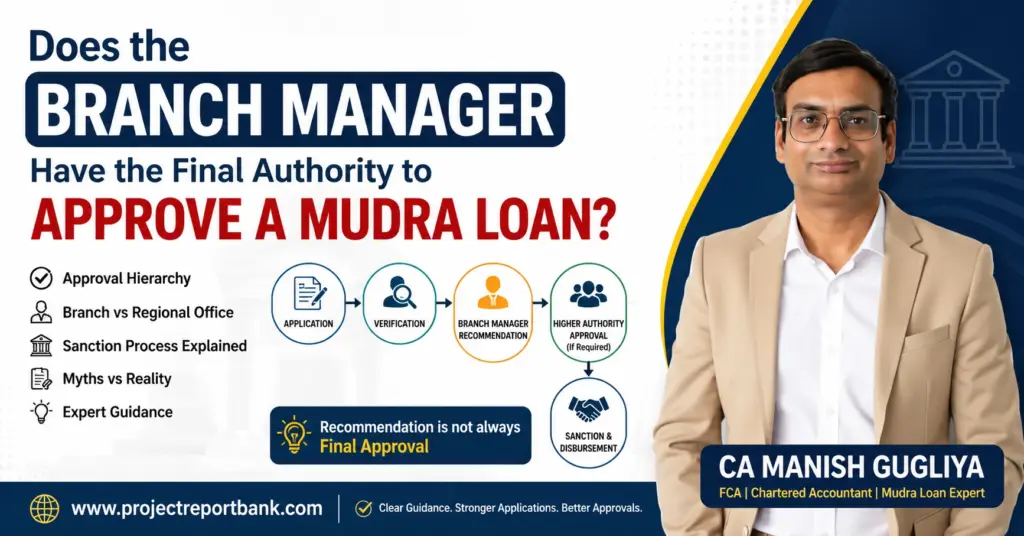
- Does Branch Manager Have Final Authority to Approve Mudra Loan?
- What Happens If the Branch Manager Is Transferred During Mudra Loan Processing?