
Key Takeaways
Meeting the branch manager for a Mudra loan can help clarify your application status and remove small hurdles, but it cannot force the bank to ignore credit norms or clear a weak file. Here is what you should know before visiting:
- The best time to meet the branch manager is after the bank’s normal processing time (7 to 21 working days, depending on the loan category and bank) has passed, or when your file is actually pending with the branch manager or credit officer.
- Carrying a proper project report, KYC documents, business proof, and an organised file creates a stronger impression than repeated emotional visits or political pressure.
- Polite, professional communication and asking the right questions during your meeting will speed up Mudra loan processing better than anger, threats, or daily visits.
- Approval depends on eligibility criteria, documentation, credit score, and bank policy. A meeting is a communication tool, not a guarantee.
- This article is written by an MSME finance professional with 20+ years of experience, and provides practical, real-life tips, example conversations, and scenarios on how to meet the branch manager for a Mudra loan.
Table of Contents
Introduction: Will Meeting the Branch Manager Approve Your Mudra Loan Faster?
Ramesh runs a small tailoring shop in Jaipur. He applied for a Mudra loan of ₹3 lakh at his local bank branch. After 20 days, he had received no SMS, no phone call, and no clear answer from the counter staff. Every time he visited, someone told him “your file is with the Branch Manager.” His neighbour suggested: “Just meet the manager directly. Your loan will be approved on the spot.” Ramesh believed it, walked into the cabin without an appointment, and demanded approval. The result? An irritated manager, an awkward conversation, and still no clarity.
This story is common across India. Thousands of applicants believe that a personal meeting with the branch manager will convert a pending Mudra loan into an approved one.
Let me explain the basics first. The Pradhan Mantri Mudra Yojana (PMMY), launched on April 8, 2015, provides mudra loans of upto rs 20 lakh to micro enterprises engaged in non-farm income-generating activities. These loans are available through commercial banks, small finance banks, regional rural banks, NBFCs, and MFIs. No collateral security is required for loans up to Rs. 10 lakh. Interest rates for Mudra loans are deregulated and reasonable, varying by bank and borrower profile.
Mudra loans are categorized as Shishu, Kishore, Tarun, and Tarun Plus. Shishu loans provide up to Rs. 50,000. Kishore loans range from Rs. 50,001 to Rs. 5 lakhs. Tarun loans range from Rs. 5 lakhs to Rs. 10 lakhs. Tarun Plus loans provide funding from Rs. 10 lakhs to Rs. 20 lakhs. These categories cover micro enterprises in various sectors including manufacturing, trading, and services.
Why do applicants get anxious? Because there is often no clear communication. Counter staff give different answers. SMS updates are vague. The applicant keeps hearing “under process” for weeks.
A branch manager is an important decision-maker. But he or she must follow bank policy, RBI guidelines, and internal credit norms. The manager cannot approve every loan application just because the borrower is insistent. Frequent, unplanned visits can disturb bank staff, slow their work, and create a negative impression when the customer becomes angry or emotional.
This article will teach you: when to meet the branch manager, how to request a meeting, what to carry, what to say and avoid saying, how to follow up, and when to escalate if needed.
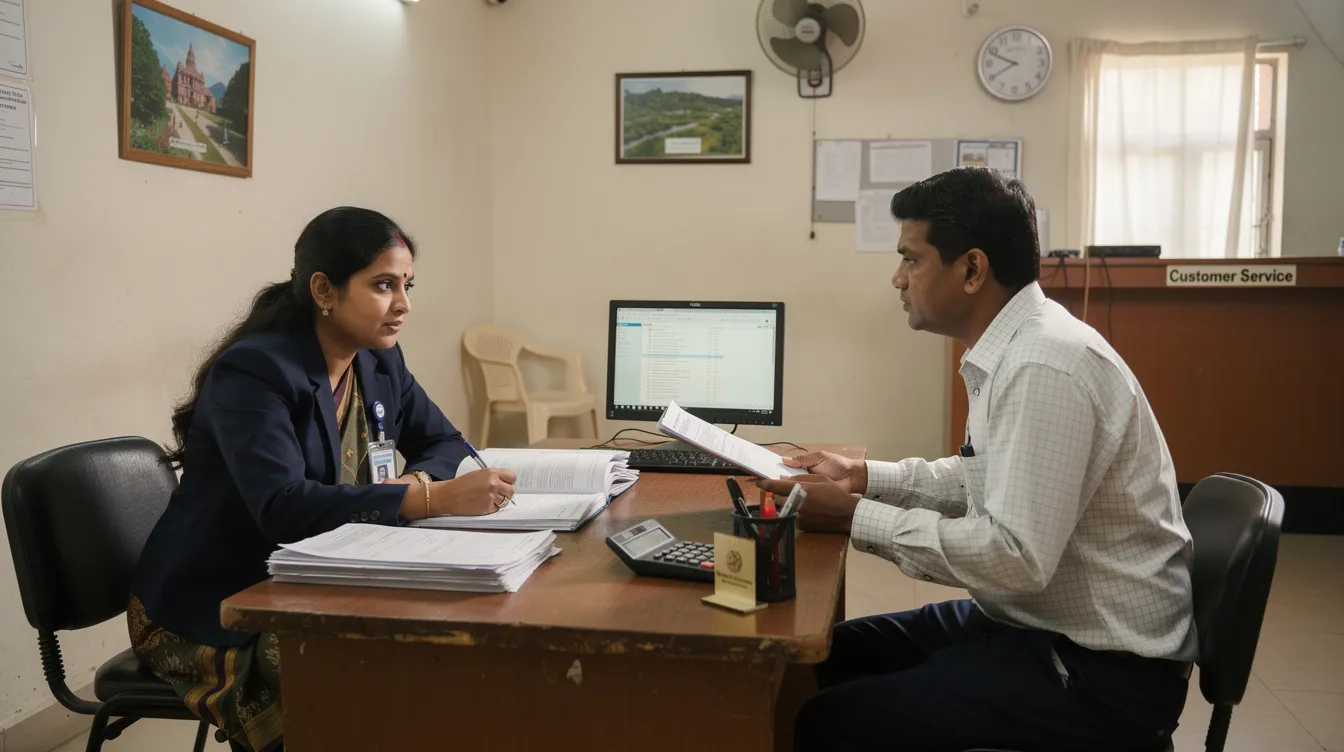
What You Will Learn in This Guide
Here is a quick overview of what this article covers:
- Whether meeting the branch manager can genuinely speed up Mudra loan approval or not, and in which types of cases it actually helps.
- The best time in the Mudra loan processing timeline to visit the bank and request a meeting with the branch manager.
- Important questions you should ask the branch manager about your Mudra loan file, and which questions you must avoid.
- Checklist of documents you should carry when you visit the bank so that the manager can take a clear decision.
- Professional behaviour tips: how to talk, how often to follow up, and how to avoid common mistakes that irritate bank staff.
- What to do if your Mudra loan remains pending at branch manager level, including escalation options within the bank.
- Real-life examples and practical tips from CA Manish Gugliya based on more than 20 years of experience with MSME and Mudra loans.
Does Meeting the Branch Manager Really Speed Up a Mudra Loan?
Many individual borrowers believe that one personal meeting will “magically” convert a pending Mudra loan into an approved one. This rarely works that way.
Here is what actually happens inside a bank when you submit a Mudra loan application:
- Your form is received and your data is entered into the bank’s loan processing system.
- Basic eligibility checks happen: KYC verification, credit bureau (CIBIL) score check, and review of your banking history.
- A field verification officer visits your business place to confirm that your business exists and is operational.
- A credit appraisal is done: the bank evaluates your cash flow, repayment capacity, margins, and the viability of your proposed activity.
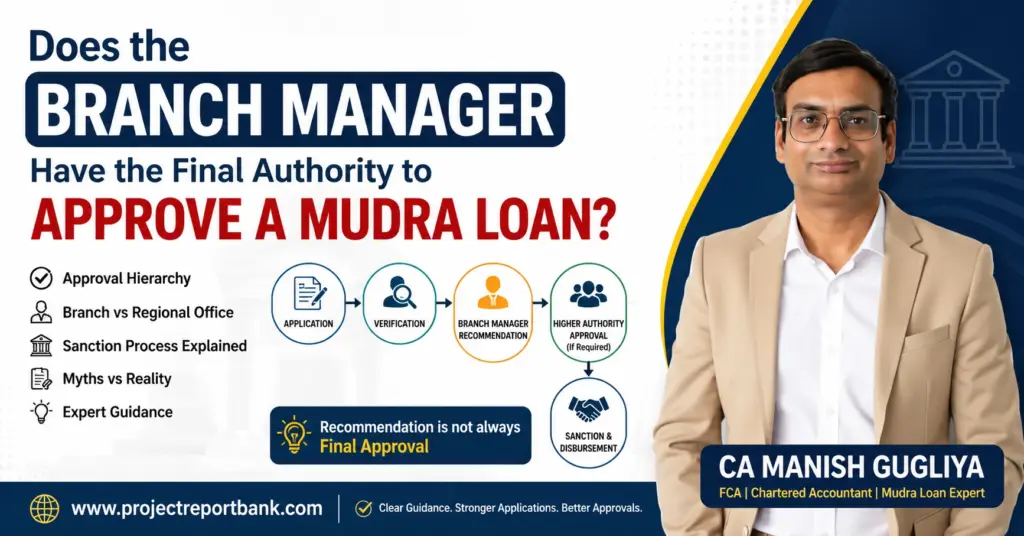
- The file reaches the branch manager or credit officer for review and decision.
- In some cases (larger amounts or higher risk), the file goes to a Regional Office or Credit Committee.
Meeting the branch manager can speed up files that are stuck due to small issues: a missing document, unclear business description, a staff member not putting up the file, or a communication gap between you and the loan officer.
But a meeting will not convert a fundamentally weak case into an approved one. If your CIBIL score is below the bank’s minimum threshold, if you have heavy existing loans, if your business is not eligible under the mudra scheme, or if you lack minimum margins per bank policy, no amount of personal meetings will change the outcome.
For a detailed understanding of how long each stage of Mudra loan processing takes, you can refer to our separate guide.
| Situation | Meeting Helpful? | Reason |
|---|---|---|
| File not yet entered in system (submitted 2 days ago) | No | Processing has not started; give it time. |
| KYC documents pending from your side | Partially | Submit documents; no meeting needed yet. |
| Verification complete but no decision for 15+ days | Yes | Manager can review and trigger a decision. |
| Low credit score or heavy existing borrowings | No | Policy hurdle; meeting cannot override internal norms. |
| Confusion about your business model or income | Yes | You can explain your business directly. |
| File at Regional Office for higher approval | Limited | Branch manager has limited control once file is escalated. |
Meeting the branch manager should be a planned, purposeful step based on a genuine reason, not a daily habit. It works best when your documentation and eligibility are already strong.
What Powers Does the Branch Manager Actually Have?
A branch manager’s daily Mudra loan work includes supervising staff, reviewing loan files, ensuring compliance with bank and government guidelines, and signing sanctions within delegated limits.
Here are the practical powers a branch manager usually holds:
- Preliminary scrutiny of the loan application and checking eligibility under Pradhan Mantri Mudra Yojana.
- Sending the file for field verification and calling the borrower for clarification.
- Returning incomplete files with a list of missing documents.
- Recommending approval or rejection after credit appraisal.
- In many banks, sanctioning Mudra loans within a particular sanctioned limit (for example, up to ₹5 to ₹10 lakh) without needing higher office permission.
Branch managers assess repayment capacity and project viability when reviewing loan applications. They check whether your income supports the EMI, whether your business can generate enough revenue, and whether your project report is realistic.
But here is what a branch manager cannot do:
- Waive basic eligibility criteria set by the bank or the government scheme.
- Ignore a negative CIBIL report or serious credit issues.
- Override system-based risk checks because you are insisting or using pressure.
- Approve a loan that falls outside delegated powers without sending it to a higher authority.
For a deeper explanation, you can read our article on branch manager powers in Mudra loan approval.
When a file is “stuck at branch manager approval,” it often means the manager is waiting for more comfort: a better project report, additional clarification on income, credit guarantee coverage under CGFMU, or completion of field verification. You can learn more about why your Mudra loan may be stuck at branch manager approval in our detailed guide.
Consider this boundary case: a shopkeeper applies for ₹9 lakh (within the branch manager’s power), but monthly income is borderline. The manager may still send the file to the Regional Office rather than take the full risk alone. Understanding this helps you speak in the correct language during the meeting and focus on decision-making points, not emotional appeals.
When Should You Meet the Branch Manager?
Timing matters. Meeting too early (before your file is even entered) or too late (after rejection) has limited benefit. Meeting at the right stage can unblock delays.
When a personal meeting is justified:
- No update even after 10 to 15 working days for Kishore or Tarun categories.
- Staff repeatedly telling you “file is with Branch Manager” without further explanation.
- SMS showing “under process” for weeks with no movement.
- You have submitted all requested documents but status has not changed.
- You need to correct a major mistake in your loan application.
- Your business model is slightly unusual and needs direct explanation.
- Verification has been completed but no decision has come for a long time.
When meeting is not yet needed:
- Application submitted just 2 to 3 days ago.
- Bank gave you a processing time (7 to 10 days) that has not passed.
- File is still under external verification like a site visit or KYC checks.
For Shishu category loans processed through STP (Straight Through Processing), decisions often happen within 1 to 2 working days digitally. Visiting the branch manager early in such cases adds no value.
For new businesses where verification takes longer, our guide on why Mudra loan verification takes longer for new businesses covers the reasons in detail.
| Days Since Application | Current Status | Action |
|---|---|---|
| 1 to 5 days | Just submitted | Wait patiently. |
| 5 to 10 days | Under KYC / verification | Call branch once for update. |
| 10 to 15 days | Verification done, no decision | Request polite meeting with BM. |
| 15 to 21 days | “Under process” with no clarity | Meet BM with full documents. |
| 21+ days | No response despite follow-up | Written complaint; consider escalation. |
The preferred sequence is: submit a complete file, wait normal time, make one polite follow-up with staff, and if still stuck, request a short appointment with the branch manager.
Best Way to Request a Meeting with the Branch Manager
How you request a meeting matters as much as the meeting itself. A polite, organised approach creates a positive first impression.
Most public sector and private banks allow walk-in requests for PMMY loans. Still, the ideal method is to visit during non-peak hours (between 11:00 a.m. and 1:00 p.m. on a normal working day; avoid salary days and month-end) and ask the counter staff politely if you can meet the branch manager for 5 to 10 minutes regarding your Mudra loan file.
Introduce yourself briefly: your name, type of business (mobile repair shop, tailoring unit, small manufacturing unit), location, Mudra loan amount applied for, date of application, and acknowledgement number.
Never walk directly into the manager’s cabin without consent, shout from the hall, or demand an immediate meeting. Request an appointment, even if it means waiting or coming the next day.
Sample Conversation
Good approach:
“Namaste Sir. My name is Priya Sharma. I run a small beauty parlour in Sector 14. I applied for ₹3 lakh Mudra Kishore loan on 5th June. My acknowledgement number is MUD-2026-4521. I have been waiting for 18 days and wanted to understand if any document or clarification is pending from my side. Can you spare five minutes?”
Bad approach:
“Sir, why is my loan not approved yet? I applied so many days back. Other banks give it in two days. Please approve it today itself.”
The first approach is fact-based and respectful. The second sounds demanding and creates defensiveness.
After the meeting, thank the manager, note down all instructions (documents requested, expected timeline), and avoid repeating the same discussion the next day.
Documents You Should Carry When You Meet the Branch Manager
A well-organised document file often impresses the branch manager more than long speeches. It shows the borrower is serious about the enterprise and the loan.
Detailed documentation enhances the likelihood of loan approval from banks. Here is what to carry:
KYC documents (original and photocopy): Identity and address proof can include Aadhaar card, PAN card, and voter ID. Carry recent passport-size photographs and keep your Aadhaar-linked mobile number active.
Business-related documents: Business proof can include GST registration, trade license, or MSME registration certificate. Udyam registration is useful to prove your status as a non corporate micro or small enterprise. For new units, carry quotations for machinery or a shop advance receipt.
Financial documents: Bank statements for the past 6 months may be required for loan applications. Carry existing loan statements if any, income proof, and a simple projected cash flow sheet.
A project report is essential for explaining the nature and cost of the business. A simple business plan should outline business nature, funding needs, and expected income. Include realistic revenue projections, expense estimates, and capital assets you plan to purchase.
Application-related: Bring a copy of your filled Mudra loan application form, acknowledgement slip with date and application number, any SMS or email from the bank, and any additional documents the bank asked for earlier.
| Document | Why It Is Needed | Tip |
|---|---|---|
| Project Report | Shows business viability and use of funds | Use realistic numbers; match with bank statements |
| Udyam Registration | Proves MSME/micro enterprise status | Free registration at udyamregistration.gov.in |
| Bank Statements (6 months) | Shows income pattern and cash flow | Highlight consistent deposits |
| GST Registration | Shows turnover trail and compliance | Carry even if turnover is below GST threshold |
| Existing Loan Statements | Proves you have successfully repaid previous loans | Shows satisfactory credit track record |
| Aadhaar + PAN | KYC compliance | Ensure name matches across all documents |
Carry two extra photocopy sets in a folder and a pen. This avoids running to the photocopy shop during the meeting.

Questions You Should Ask the Branch Manager
Asking clear, respectful questions shows the branch manager that you are serious, informed, and willing to cooperate. Be prepared to answer specific financial questions during meetings about the loan application as well.
Here are practical questions to ask:
- “Has my Mudra loan application been fully entered in the system?” (Tells you if processing has even started.)
- “At which stage is my file currently: verification, appraisal, or approval?” (Helps you understand the exact bottleneck.)
- “Is my file complete, or is any document or clarification still pending from my side?” (Identifies action items for you.)
- “Has the field visit report been received, and is it satisfactory?” (Tells you if your business location was verified.)
- “Has the credit appraisal started? Is there any concern about my income or repayment ability?” (Lets you address doubts directly.)
- “Is the decision fully at the branch level, or does the file need Regional Office approval?” (Sets realistic timeline expectations.)
- “What approximate time should I expect for the next step?” (Gives you a reference point for follow-up.)
You can also ask if minor improvements would strengthen your case: a revised project report, an additional guarantor under credit guarantee, or a slightly adjusted loan amount.
End with a summarising question: “Sir/Madam, please tell me clearly what I need to do now and by when I should follow up again.” Write the answer in a small notebook.
Questions You Should NOT Ask the Branch Manager
Certain questions and statements create a negative impression, make the manager defensive, and can harm your case, even if they do not officially affect the decision.
Avoid these:
- “Why have you not approved my loan yet; are you doing it on purpose?”
- “Can you please approve it today itself; I have urgent work.”
- “Other banks give Mudra loans in 2 days; why are you so slow?”
- “I know your higher officers / MLA / union leader.”
- “If my loan is not approved, I will complain on social media.”
- “Can you ignore this bounced cheque / old default?”
These statements sound disrespectful. They ignore the formal appraisal process. They assume the manager is personally against you, which is usually not true. Asking a manager to overlook negative credit history or hide undisclosed loans is not just unhelpful; it can be considered unethical and may close doors for future lending as well.
Instead, always focus on: “What is the status?” and “What can I do from my side to complete the process correctly?”
Common Mistakes Applicants Make During Meetings (and Better Alternatives)
In my experience as a Chartered Accountant handling many Mudra loan files, delays often happen not only because of weak business cases but also because of poor behaviour during branch visits.
Behaviour mistakes:
- Visiting the branch daily without new information.
- Calling the manager repeatedly on mobile.
- Raising voice in the banking hall.
- Arguing with junior staff.
- Bringing a large group of relatives or friends to “show strength.”
Content mistakes:
- Submitting incomplete documents every time.
- Not carrying originals for verification.
- Giving wrong or exaggerated sales and income figures.
- Changing the loan purpose in every visit (sometimes saying shop renovation, sometimes working capital).
Pressure mistakes:
- Using political or social pressure.
- Threatening negative social media posts.
- Comparing the branch manager unfavourably with other banks in front of staff.
| Mistake | Better Approach |
|---|---|
| Daily visits without purpose | Weekly, structured follow-up with a clear reason |
| Angry tone and shouting | Fact-based, polite discussion |
| Incomplete documents every time | Carry a complete, organised file from the start |
| Exaggerated income claims | Realistic figures matching bank statements |
| Bringing a crowd for pressure | Visit alone or with one partner/family member |
| Changing loan purpose repeatedly | Decide purpose upfront and stick with it |
| Political references | Let your documents and business merit speak |
Treat the Mudra loan meeting like a professional business meeting. Preparation and maturity matter more than emotions.
Can Frequent Meetings Actually Delay Your Mudra Loan?
Follow-up is necessary. Over-follow-up is harmful.
Each unplanned visit or phone call takes time away from staff who are processing loan files, including yours. Consider a real case: a small trader visited his branch almost every day for two weeks. Staff spent more time answering his questions than moving his file forward. His file moved slower than applications submitted after his.
Frequent interruptions also make staff and the branch manager cautious. They may take extra care to document everything and slow down decisions to avoid risk under perceived pressure.
Healthy follow-up means one visit or call after the promised time has passed, with a clear purpose and a specific question.
Unhealthy follow-up means daily visits, repeated calls in a single day, and emotional discussions that cover the same ground every time.
Excessive visits may also create a record in the branch that the customer is “difficult,” which might indirectly affect how comfortable staff feel about long-term dealings, including account operations after disbursement of the loan extended.
Agree on a clear next follow-up date with the branch manager. Respect that date. This shows patience and professionalism.
Signs the Meeting with the Branch Manager Was Productive
Many borrowers leave the bank confused because they do not know what a “good outcome” from a meeting looks like. Here are positive indicators:
- The manager clearly tells you the present stage of your Mudra loan file in language you understand.
- You receive a short checklist of specific actions: documents to submit, clarifications needed in the project report, or a site visit date.
- The manager gives a realistic timeline (for example, “we should be able to take a decision within one week after you provide these documents”) rather than vague statements like “we will see.”
- The manager or staff notes the discussion and deadlines on your covering letter or acknowledgement slip.
- You are given the name or phone extension of a specific loan officer for future status updates.
After the meeting, write a brief note at home: date, time, what was discussed, and deadlines promised. If you ever need to escalate, this record proves you have been cooperating properly.
What If the Branch Manager Is Not Helping?
In most branches, managers try to help within rules. But sometimes applicants feel their case is ignored, delayed without reason, or rejected without proper explanation.
Step 1: Written reminder to the branch. Mention your application details, dates of earlier visits, summary of discussions, and request a clear written status or reason for delay.
Step 2: Branch-level complaint. Use the complaint/suggestion register or box at the branch. You can also email the branch-in-charge. Keep complaints fact-based, not emotional.
Step 3: Regional or Zonal Office. Contact the bank’s Regional Office or Zonal Nodal Officer for grievances. Use the bank’s official grievance portal.
Step 4: Banking Ombudsman. If all bank-level options are exhausted and your case is strong, you can approach the Reserve Bank’s Banking Ombudsman scheme.
Our detailed guide on Mudra loan delay in processing covers these escalation steps with specific contact methods and timelines.
Escalation should be used only after giving the branch a fair chance. During escalation, attach copies of your acknowledgement, communications, and meeting notes. Avoid personal attacks.
Practical Tips from CA Manish Gugliya for Meeting the Branch Manager
These tips come from 20+ years of preparing project reports and handling MSME and Mudra loan files with public and private sector banks, including financial institution branches across India.
- Keep your project report updated with realistic sales and expense figures. Unrealistic projections raise red flags.
- Carry a neat file with labelled sections: KYC, business proof, financials, and application forms.
- Use simple language while explaining your business model. Avoid technical jargon.
- Arrive 10 to 15 minutes early for your meeting.
- Dress neatly but simply. First impressions matter.
- Switch your mobile to silent during the discussion.
- Do not bring small children or unnecessary companions into the manager’s cabin.
- Never hide existing loans or bounced cheques. Disclose and explain them honestly.
- If your CIBIL score is low, be ready with reasons and a plan for improvement. The applicant with a clear explanation gets more consideration than one who avoids the topic.
- If your business is new, highlight your necessary skills, relevant experience, training certificates, and any confirmed orders.
- Note every instruction from the manager in a diary.
- Send documents promptly when requested. Delay from your side gives the bank reason to delay from theirs.
- Avoid changing your loan amount or proposed activity frequently. It signals uncertainty.
- If you do not understand a banking term, politely ask for clarification instead of pretending.
- Match your sales and turnover figures in the application with what your bank statements show. Inconsistencies trigger queries.
- Maintain consistent deposits in your bank account. An account with frequent zero-balance days weakens your case.
- If your educational qualification is limited, do not worry. Many eligible borrowers succeed based on experience and knowledge of their business, not degrees.
- If you possess quotations or purchase orders from customers, carry them. They prove demand for your services or products.
Approval depends on eligibility and bank policy. Meeting the branch manager is a tool to present a strong, honest case; not a shortcut to bypass documentation and verification.
Real-Life Scenarios: How Meeting the Branch Manager Helped (or Did Not Help)
These case studies use changed names and locations but reflect real patterns from my consulting practice and documented success stories from the PMMY scheme.
Scenario 1: Manufacturing (Fabrication Unit) Suresh applied for ₹8 lakh under Mudra Tarun category to buy a cutting machine for his fabrication workshop. His file was stuck for 18 days after the site visit. He met the branch manager with a revised project report. The manager explained that a 10% margin money deposit was required. Suresh arranged it, and the loan was sanctioned within a week. Lesson: the meeting clarified a specific requirement the applicant did not know about.
Scenario 2: Retail Shop A kirana shopkeeper applied for ₹2 lakh under Mudra Kishore. He visited three times with incomplete documents each time. On the fourth visit, he carried everything in an organised file. The branch manager reviewed and sanctioned in 7 days. Lesson: preparation beats repetition.
Scenario 3: Service Business A beauty parlour owner needed ₹3 lakh for equipment. Verification was delayed because the field officer could not reach her shop during working hours. A meeting with the branch manager helped fix a visit date. The file moved forward within days. Lesson: polite follow-up solves scheduling issues.
Scenario 4: Startup A first-time entrepreneur wanted ₹45,000 under Shishu category to start a mobile repair shop. The branch manager was hesitant because the applicant had no prior business experience. During the meeting, the applicant showed a skills certificate from a training program and three customer quotations. The manager became comfortable and approved the loan. Lesson: evidence of necessary skills and demand matters for new businesses.
Scenario 5: Existing Business Expansion A garments trader seeking expansion finance faced questions about irregular bank statement patterns. During the meeting, he explained the seasonal nature of his trading business (high sales during festivals, low during off-season). The manager understood, and the file was approved with conditions on repayment schedule. Lesson: direct explanation of business nature resolves doubts.
Scenario 6: Woman Entrepreneur Sunita ran a home-based food processing unit. She was hesitant to visit the bank alone. After encouragement from a local business group, she met the branch manager and the Mahila Desk officer together. She presented her Udyam registration, photos of her products, and a simple income-expense sheet. The mudra loan was approved, and the assets created from the loan (grinder, packaging machine) helped her double her monthly output.
The government has also documented many success stories under PMMY. Raju Das Bairagi received ₹50,000 to start a fast food center. Budhram God was sanctioned ₹20,000 for a vegetable shop. Rohit Prasad Maravi earned ₹17,000 monthly after receiving a taxi loan of ₹8,20,000. Firozkhan Baghban established a computer institute with a ₹195,000 loan. Malsawm Handloom, a beneficiary micro unit, achieved an annual turnover of ₹1.2 crore in 2016-17. These cases show that with the right financial support and financial assistance, micro enterprises can undertake growth that transforms livelihoods.
In some cases, even after meeting, the loan may be declined for valid reasons (very low income, heavy existing borrowings, ineligible sector). Accepting such decisions and improving your profile for the next phase of application is better than forcing approval.

Myths vs Reality About Meeting the Branch Manager for Mudra Loan
Many misconceptions circulate in the market and on social media about Mudra loans and branch managers. Here is the ground reality:
| Myth | Reality |
|---|---|
| Meeting the branch manager guarantees Mudra loan approval. | Approval depends on eligibility, documentation, and bank policy, not one meeting. |
| Daily visits force the branch to clear your file faster. | Excessive visits can slow processing and irritate staff. |
| Using a political reference forces the manager to approve. | Banks must follow RBI and internal credit norms; pressure often delays matters. |
| Mudra is a government grant or subsidy. | Mudra loans are repayable loans with interest and EMI. |
| No documents or checks are required because it is a government scheme. | Banks perform full KYC, verification, credit appraisal, and sometimes audit. |
| Branch Manager can overlook negative CIBIL history. | Negative credit history is a strong rejection factor under internal credit policies. |
| The branch manager can approve any amount. | Managers have delegated limits; larger or riskier files go to Regional Office. |
| Only people with high educational qualification can get Mudra loans. | Any eligible borrower with a viable business and repayment ability can apply. |
| Online applications always get rejected. | The government has asked PSBs to reduce rejection rates on JanSamarth and speed up processing. |
| MUDRA itself gives loans directly. | MUDRA (now part of SIDBI) acts as a refinance agency; actual lending is done by banks and financial institutions. |
Rely on authentic sources and professional advice rather than rumours. Treat the branch manager as a partner in your business growth, not an obstacle.
Do’s and Don’ts Checklist for Meeting the Branch Manager
Review this checklist before visiting the bank:
| Do | Don’t |
|---|---|
| Carry all relevant documents in an organised file | Visit daily without a clear reason |
| Speak politely and briefly | Argue loudly in the banking hall |
| Note down what the branch manager says | Hide existing loans or financial problems |
| Clarify if you do not understand a banking term | Sign blank forms or documents you do not understand |
| Follow the agreed follow-up date | Call the manager’s personal mobile repeatedly |
| Introduce yourself with name, business type, and application number | Walk into the manager’s cabin without permission |
| Ask fact-based questions about status and pending items | Compare the manager unfavourably with other banks |
| Carry originals along with photocopies | Bring a large group of people to “show strength” |
| Dress neatly and arrive on time | Use emotional arguments or cry in the cabin |
| Submit requested documents promptly | Change your loan purpose or amount every visit |
| Thank the manager after the meeting | Make threats about social media or complaints |
| Keep your project report realistic and consistent | Give exaggerated income or turnover numbers |
| Be honest about your credit history | Expect the manager to “manage” your CIBIL score |
| Ask for a specific follow-up date | Demand same-day approval |
| Maintain a diary of all interactions | Ignore the manager’s advice or instructions |
Disciplined behaviour today builds a long-term healthy relationship with the bank. This helps for future loans, covering loans for expansion, working capital availed through cash credit, and other MSME facilities beyond the current Mudra loan.
Quick Action Plan: From Application to Meeting the Branch Manager
Follow this step-by-step roadmap:
- Prepare documents and project report. A simple business plan should outline your business nature, funding needs, and expected income. Gather KYC, business proof, and bank statements.
- Submit your Mudra loan application. You can apply at your chosen bank or financial institution branch. The application form is available on the bank’s website. You can also apply through the JanSamarth portal or submit through the Udyamimitra Portal, which connects you to your preferred bank. Collect acknowledgement with date and application number.
- Wait the normal processing time. For Shishu: 1 to 3 days. For Kishore and Tarun: 7 to 21 working days depending on the bank. SBI’s internal policy, for example, requires completed applications to be either sanctioned or rejected within 14 working days.
- Track status. Check via SMS, bank call, or counter visit.
- One polite follow-up. If no update after the promised time, make one visit or call.
- Request a meeting. If the file is with the branch manager or is delayed beyond normal time, request a 5 to 10 minute professional meeting.
- During the meeting: Ask the right questions, submit any pending documents, understand the timeline.
- Follow up as agreed. Respect the date the manager gives you.
- Written communication. If still unresolved and reasons are not clear, send a written reminder to the branch with all details.
- Escalate only if necessary. Use internal grievance channels first, then Banking Ombudsman if the bank does not respond.
For detailed stage-wise timelines, refer to our guide on Mudra loan processing stage timeline.
Conclusion: Use the Branch Manager Meeting as a Tool, Not a Shortcut
A personal meeting with the branch manager for a Mudra loan is useful to improve communication, clear misunderstandings, and push a genuine file that is stuck for small reasons. It is not a tool to bypass verification, ignore bank policy, or force a decision on a weak application.
Well-prepared documents, honest disclosure of your financial position, and a realistic project report assessed based on actual income and expenses are more powerful than emotional pressure, references, or arguments.
Treat the relationship with the branch manager and branch staff as a long-term partnership for your business journey. This includes future term loans, demand loans, and other MSME facilities, not just one Mudra loan transaction.
With correct guidance, patience, and professional behaviour, many micro and small businesses across India have used the Pradhan Mantri Mudra Yojana to grow their enterprise from a small idea to a sustainable business. You can do the same by following the steps in this guide.
Frequently Asked Questions
Can I meet the Branch Manager of a bank where I do not hold an account for a Mudra loan?
Yes, you can. Mudra loans are available at most commercial banks, small finance banks, and eligible NBFCs regardless of whether you hold an account there. However, many banks prefer existing account holders because they already have your banking history. If you visit a new bank, carry complete KYC documents, your project report, and business proof. The manager will guide you on account opening requirements alongside the loan application.
Is it possible to handle the entire Mudra loan process without any physical meeting?
For Shishu loans (up to ₹50,000), many banks use Straight Through Processing (STP) for existing customers. The entire process, from e-KYC to disbursement, happens digitally within 1 to 3 days. For Kishore and Tarun categories, a physical field visit is usually required, and most borrowers will need at least one interaction with bank staff. Fully online applications through the JanSamarth portal reduce physical visits, but branch-level verification and appraisal typically require some in-person contact.
How many times is it reasonable to meet the Branch Manager for one Mudra loan application?
One to two structured meetings during the entire processing period is usually sufficient. The first meeting clarifies status and pending items. A second meeting may be needed if new questions arise or if the manager requests additional documents. Beyond two meetings, your follow-up should shift to brief phone calls or written communication unless the manager specifically calls you in.
What if I shifted my business location after applying; should I meet the manager again?
Yes. A change in business address after application submission is a material change. The bank may need to redo field verification at your new location. Visit the branch promptly, inform the manager in writing, and provide updated address proof (new rent agreement, utility bill, or updated Udyam registration). Delays in reporting this change can lead to rejection if the verification officer finds a mismatch.
My Mudra loan was rejected after meeting the Branch Manager. Can I apply again?
You can reapply, but first understand the reason for rejection. If it was due to low credit score, work on improving your credit history over 3 to 6 months. If it was due to a weak project report, get professional help to prepare a realistic one. If your business sector was ineligible, check whether an alternative bank product exists. You can apply at the same bank or a different bank or financial institution after addressing the specific issues raised during rejection.
- Mudra Loan Branch Manager Issues: Complete Guide to Manager’s Role, Powers & Common Problems


- How Branch Workload Affects Mudra Loan Processing


- Can a Branch Manager Return a Mudra Loan File for Corrections? Complete Practical Guide
- Why Is My Mudra Loan Waiting for the Branch Manager’s Signature?
- Why Does the Branch Manager Ask for Clarification Before Loan Approval?

- Branch Manager Recommendation in Mudra Loan: Full Meaning, Next Steps & Practical Guidance
- Can a Branch Manager Reduce the Requested Mudra Loan Amount?

- Does Branch Manager Have Final Authority to Approve Mudra Loan?
- What Happens If the Branch Manager Is Transferred During Mudra Loan Processing?