
A Mudra Loan can help entrepreneurs start or expand their businesses, but many applications are delayed or rejected because banks carefully assess documents, eligibility, CIBIL, financial strength, business viability, Project Reports, and verification findings before granting approval.
A rejection does not always mean you are permanently ineligible. Most applications are rejected due to one or more specific issues that can often be identified and corrected before reapplying.
This Mudra Loan Rejection & Solutions guide explains the complete approval process, the most common rejection reasons, and practical ways to improve your approval chances. It also serves as a central hub, connecting you to detailed guides on every major rejection category, so you can quickly find the information relevant to your situation and prepare a stronger, bank-ready Mudra Loan application.
Why Read This Guide?
Understand how banks evaluate Mudra Loan applications.
Learn the most common rejection reasons.
Discover practical solutions to improve approval chances.
Access detailed guides covering all major rejection categories.
Prepare a stronger and more bank-ready Mudra Loan application.
What You’ll Learn in This Guide
Use this quick navigation to explore the key areas that influence Mudra Loan approval, rejection, and reapplication.
- How banks evaluate Mudra Loan applications
- Common Mudra Loan rejection reasons
- Documentation mistakes
- CIBIL issues and credit-related rejection
- Financial problems and repayment capacity
- Mudra Loan eligibility issues
- Project Report mistakes
- Bank verification process
- Mudra Loan reapplication strategy
- Appeals and complaints
- Real approval stories and case studies
- Expert tips by CA Manish Gugliya
Understanding the Complete Mudra Loan Approval Process
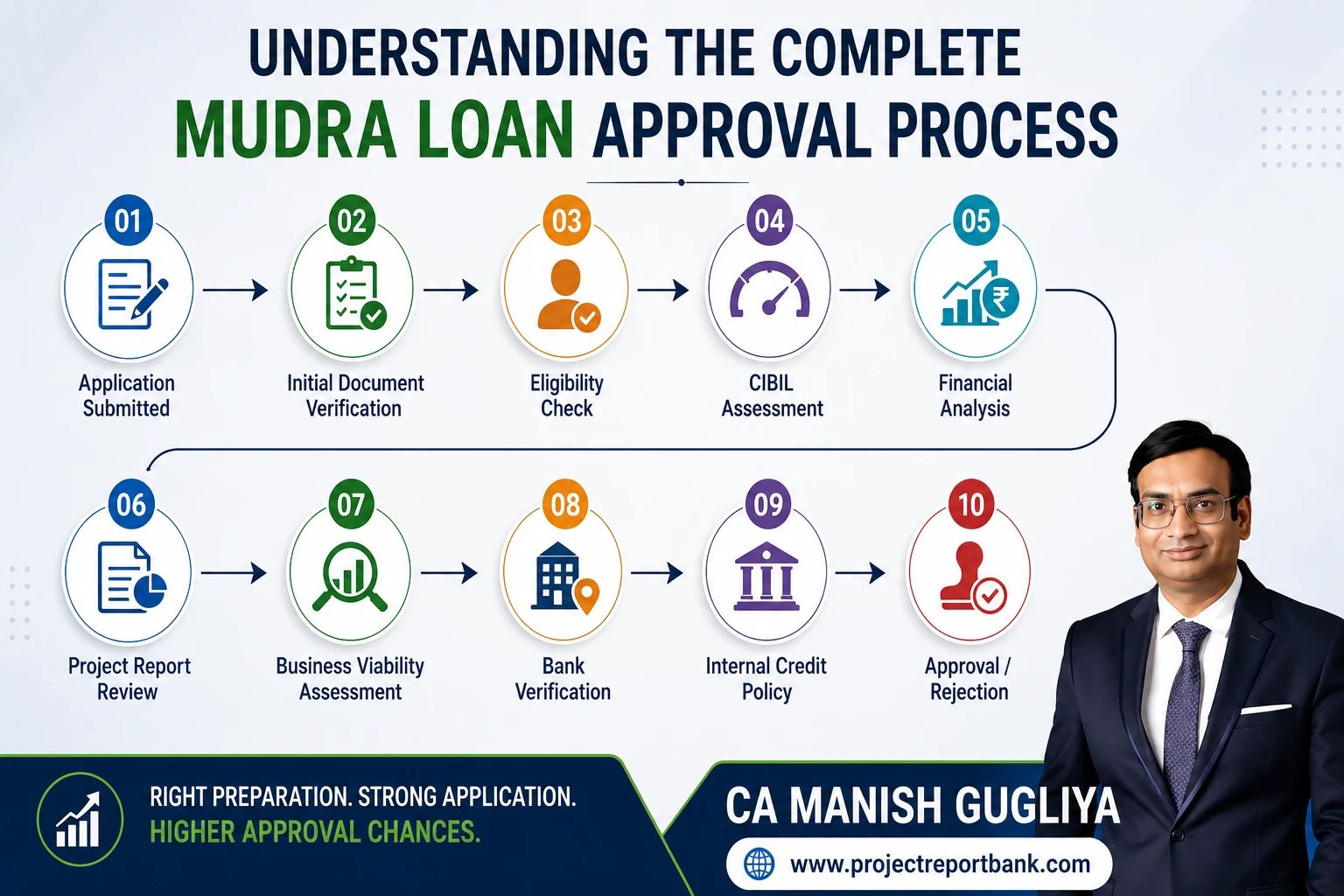
Banks follow a structured credit appraisal process before approving any Mudra Loan application. Instead of relying on a single factor, they evaluate your eligibility, documentation, credit history, financial strength, Project Report, business viability, and verification findings to assess the overall lending risk. Understanding each stage of this workflow helps applicants prepare a stronger application, avoid common mistakes, and improve their chances of approval. The flowchart below illustrates the complete Mudra Loan approval process from application submission to the final approval or rejection decision.
Why Do Mudra Loan Applications Get Rejected?
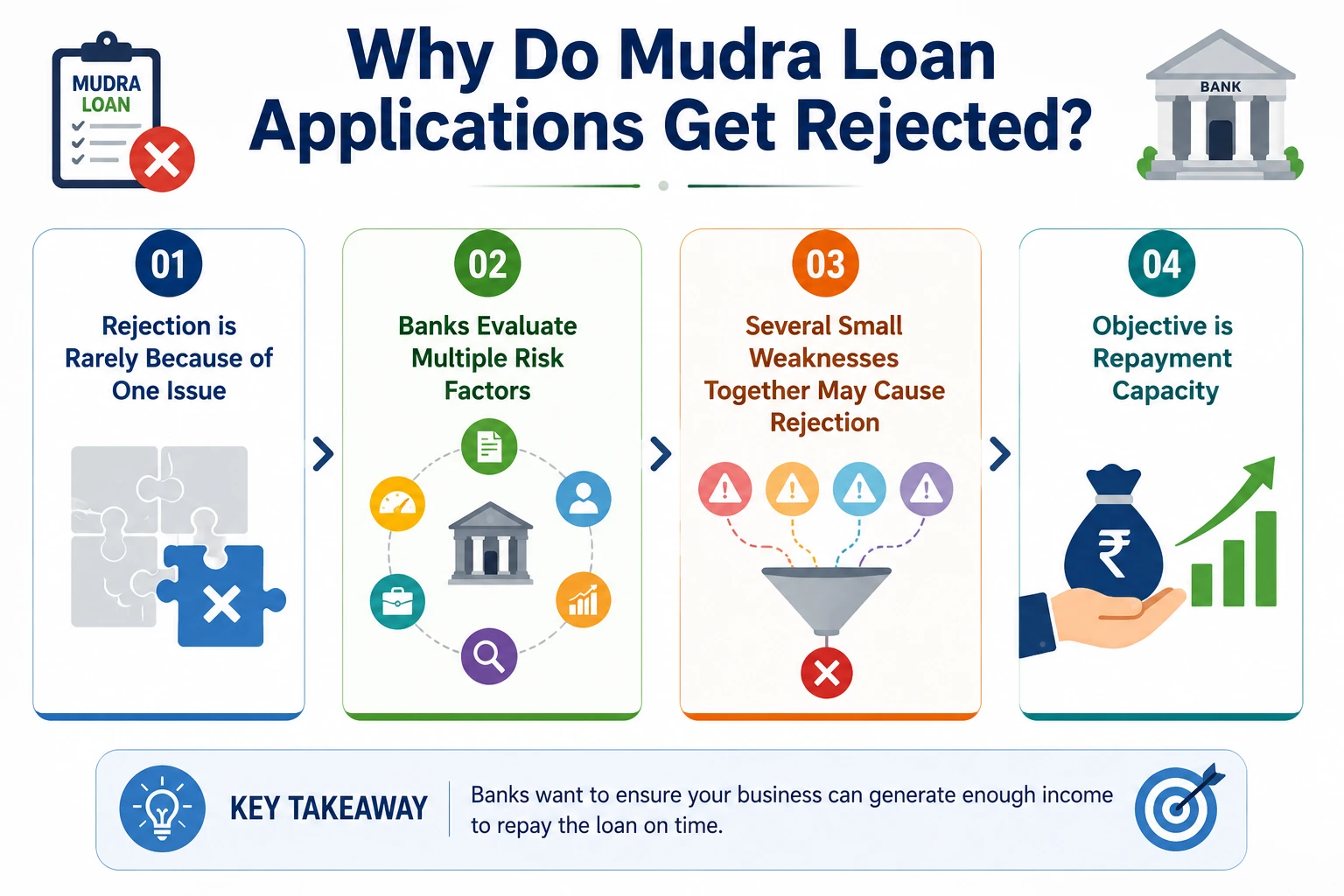
A Mudra Loan application is rarely rejected because of a single issue. Banks conduct a comprehensive credit appraisal to evaluate the applicant’s overall ability to utilise the loan effectively and repay it on time. During this process, they review multiple aspects of the business rather than focusing only on the CIBIL Score or submitted documents.
Every application is assessed against several risk factors, including documentation, business eligibility, financial strength, credit history, Project Report quality, cash flow, repayment capacity, business viability, and verification findings. If one or more of these areas do not meet the bank’s lending standards, the application may be delayed, returned for clarification, or rejected.
In many cases, several small weaknesses together become the actual reason for rejection. For example, an applicant may have a satisfactory CIBIL Score but also submit an incomplete Project Report, inconsistent financial records, and weak bank statements. While each issue may appear minor on its own, their combined impact increases the bank’s perception of lending risk and reduces the likelihood of approval.
Ultimately, the bank’s objective is to determine whether the business can generate sufficient income to repay the loan without creating future credit risk. Applicants who submit complete documentation, demonstrate a viable business model, maintain healthy financial records, and present realistic repayment capacity are generally more likely to receive approval. Understanding these evaluation factors allows applicants to identify weaknesses early and prepare a stronger, bank-ready Mudra Loan application.
The 10 Major Areas That Influence Mudra Loan Approval
| Area | Importance | Detailed Guide |
|---|---|---|
| Documentation | Very High | Read Documentation Guide |
| CIBIL | High | Read CIBIL Guide |
| Eligibility | Very High | Read Eligibility Guide |
| Financial Strength | Very High | Read Financial Issues Guide |
| Project Report | Very High | Read Project Report Guide |
| Bank Verification | High | Read Verification Guide |
| Reapplication Strategy | Medium | Read Reapplication Guide |
| Appeals & Complaints | Medium | Read Appeals Guide |
| Success Stories & Case Studies | Learning | Read Success Stories |
| Common Rejection Reasons | Overview | Read Rejection Reasons Guide |
Complete Guide Library
Explore our complete collection of Mudra Loan Rejection & Solutions guides. Each guide focuses on a specific stage of the bank’s evaluation process and provides practical solutions to help you overcome common rejection reasons. Whether you’re applying for the first time, planning to reapply after rejection, or looking to strengthen your business profile, these detailed resources will help you prepare a stronger, bank-ready Mudra Loan application.
Mudra Loan Rejection Reasons
Not sure why your Mudra Loan application was rejected? This guide explains the most common rejection reasons, how banks evaluate applications, and the practical steps you can take to identify and resolve the actual cause before applying again.
👉 Read More: https://projectreportbank.com/mudra-loan-rejection-reasons/
Mudra Loan Documentation Issues
Incomplete, incorrect, or inconsistent documents are among the leading causes of Mudra Loan rejection. Learn which documents banks verify, common documentation mistakes, and how to prepare a complete and error-free application file.
Read More: https://projectreportbank.com/mudra-loan-documentation-issues/
Mudra Loan Eligibility Issues
Meeting the basic PMMY criteria is only one part of the approval process. This guide explains business ownership, licences, registrations, business activity, premises verification, and other eligibility factors that banks review before approving a Mudra Loan.
👉 Read More: https://projectreportbank.com/mudra-loan-eligibility-issues/
Mudra Loan CIBIL Issues
Your CIBIL Score is important, but banks also analyse your complete credit behaviour. Discover how credit history, overdue accounts, loan enquiries, settlements, and repayment records influence Mudra Loan approval and how to improve your credit profile.
👉 Read More: https://projectreportbank.com/mudra-loan-cibil-issues/
Mudra Loan Financial Issues
Banks carefully evaluate your financial strength before sanctioning a loan. Learn how cash flow, profitability, bank statements, existing liabilities, GST, Income Tax Returns, margin money, and DSCR affect your approval chances.
👉 Read More: https://projectreportbank.com/mudra-loan-financial-issues/
Mudra Loan Project Report Issues & Solutions
A professionally prepared Project Report plays a crucial role in credit appraisal. This guide explains common Project Report mistakes, financial projection errors, CMA Data issues, working capital calculations, and how to prepare a bank-ready report.
👉 Read More: https://projectreportbank.com/mudra-loan-project-report-issues-solutions/
Mudra Loan Bank Verification
Bank verification goes far beyond document checking. Understand phone verification, field visits, business verification, site inspections, turnover verification, and the factors that influence the final verification report.
👉 Read More: https://projectreportbank.com/mudra-loan-bank-verification/
Mudra Loan Reapplication Strategy
A rejected application does not have to be your final outcome. Learn when to reapply, how to strengthen your application, revise your Project Report, improve financial records, and maximise your chances of approval on the next attempt.
👉 Read More: https://projectreportbank.com/mudra-loan-reapplication-strategy/
Mudra Loan Appeals & Complaints
If you believe your application was rejected unfairly or processed incorrectly, this guide explains the appeal process, complaint procedures, escalation options, Banking Ombudsman, and the supporting documents required for review.
👉 Read More: https://projectreportbank.com/mudra-loan-appeals-complaints/
Mudra Loan Success Stories & Case Studies
Learn from real applicants who successfully improved their applications after facing rejection or delays. These practical case studies highlight proven strategies, common mistakes to avoid, and the improvements that helped secure Mudra Loan approval.
👉 Read More: https://projectreportbank.com/mudra-loan-success-stories-case-studies/
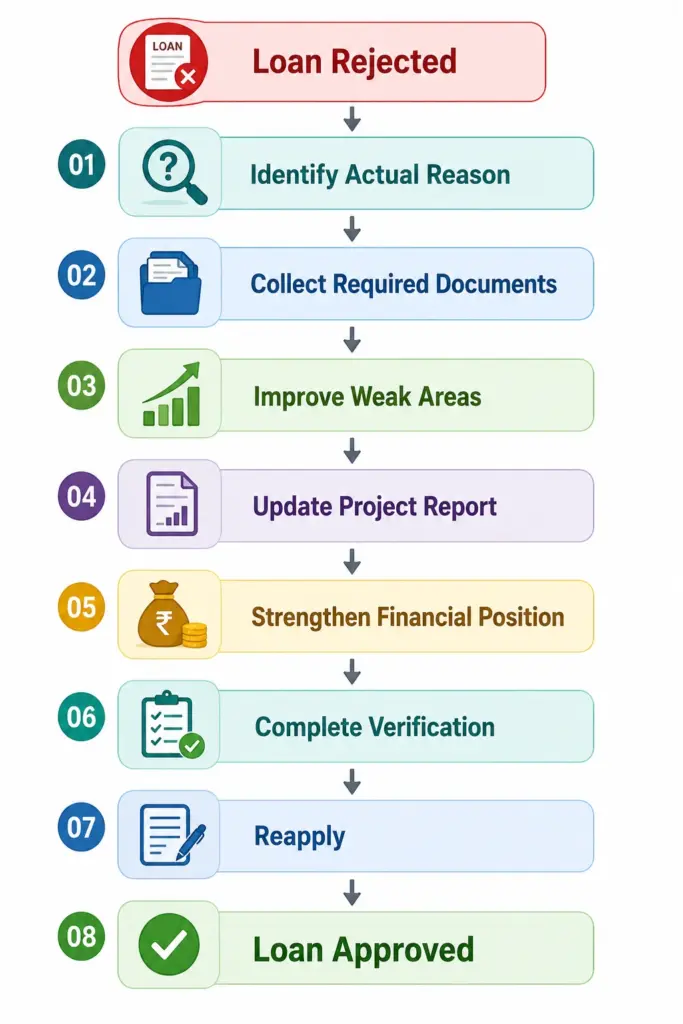
Mudra Loan Rejection Roadmap
A Mudra Loan rejection should be treated as a starting point for improvement, not the end of the financing process. Before reapplying, identify the actual rejection reason, correct the weaknesses in your previous application, and prepare stronger supporting evidence.
Follow this practical roadmap:
Which Problems Should You Fix First?
Not all rejection reasons have the same impact on your Mudra Loan application. Some issues, such as incomplete documentation or eligibility gaps, should be resolved immediately because they can prevent the bank from processing your application further. Other areas, such as financial ratios or business improvements, can be strengthened over time to increase your overall approval chances.
Use the priority matrix below to understand which issues deserve your immediate attention before submitting a fresh Mudra Loan application.
Focus first on the issues that have the greatest impact on Mudra Loan approval. Use the priority matrix below to identify what should be corrected before reapplying.
| Priority | Problem to Fix | Recommended Guide |
|---|---|---|
| Immediate | Documentation Correct missing, outdated, incomplete, or mismatched documents. | Read Documentation Guide → |
| Immediate | Eligibility Verify business activity, ownership, licences, registrations, and premises. | Read Eligibility Guide → |
| Immediate | Project Report Revise project cost, projections, cash flow, and loan requirement. | Read Project Report Guide → |
| High | CIBIL and Credit History Clear overdue dues, correct report errors, and improve repayment behaviour. | Read CIBIL Issues Guide → |
| High | Banking Habits Avoid cheque returns, irregular deposits, and unexplained transactions. | Read Financial Issues Guide → |
| Medium | Financial Ratios Improve cash flow, DSCR, profitability, margin money, and debt position. | Improve Financial Strength → |
| Medium | Business Improvements Strengthen operations, turnover records, business viability, and verification readiness. | Read Bank Verification Guide → |
| Later | Reapplication Submit a fresh application only after correcting the earlier weaknesses. | Read Reapplication Strategy → |
| If Required | Appeal or Complaint Consider escalation only after identifying the actual rejection reason. | Read Appeals & Complaints Guide → |
Focus on High-Priority Improvements First
Always begin by correcting Documentation, Eligibility, and Project Report issues, as these are among the first areas banks evaluate during credit appraisal. Once these fundamentals are in place, work on improving your CIBIL profile, financial strength, and banking habits to further strengthen your application.
If your application was rejected despite meeting the basic requirements, review the relevant guides on Bank Verification, Reapplication Strategy, or Appeals & Complaints before taking the next step. Addressing the right issues in the correct order can significantly improve your chances of Mudra Loan approval.
How Banks Evaluate Risk Before Approving a Mudra Loan
Approving a Mudra Loan is much more than checking documents or verifying the applicant’s CIBIL Score. Banks conduct a comprehensive risk assessment to determine whether the proposed business is capable of generating sufficient income and repaying the loan on time. During this process, several factors are evaluated together to arrive at the final lending decision.
Character
Banks assess the applicant’s credit discipline, repayment history, banking behaviour, and overall financial credibility. A good repayment record, transparent financial dealings, and honest disclosure of information help build confidence in the applicant.
Capacity
The bank evaluates whether the business has the operational capability to generate stable income. Business experience, management skills, industry knowledge, and operational efficiency all contribute to this assessment.
Capital
Applicants are generally expected to invest their own funds in the business. Adequate promoter contribution demonstrates financial commitment and reduces the overall lending risk for the bank.
Business Viability
Every business proposal is examined to determine whether it is commercially feasible. Banks review market demand, competition, business model, expected sales, and long-term sustainability before approving the loan.
Cash Flow
Cash flow is one of the most important indicators of repayment ability. Banks analyse whether the business can generate sufficient monthly cash to meet operating expenses while comfortably paying loan instalments.
Repayment Ability
The primary objective of every loan assessment is to determine whether the borrower can repay the loan within the agreed tenure. Profitability, projected income, existing liabilities, and financial commitments are carefully reviewed during this stage.
Verification
Banks verify the authenticity of the business through document verification, telephone confirmation, field visits, and business premises inspection. Any inconsistency discovered during verification may delay or adversely affect the application.
Industry Risk
Certain industries carry higher business risks due to seasonal demand, intense competition, regulatory changes, or market uncertainty. Banks consider these industry-specific risks while evaluating the application.
Branch Recommendation
After completing the appraisal, the branch prepares its recommendation based on the applicant’s overall risk profile. A positive recommendation from the branch significantly strengthens the likelihood of loan approval.
Internal Lending Policy
Every bank follows its own internal credit and lending policies in addition to the PMMY guidelines. Factors such as branch-level exposure, sectoral limits, portfolio performance, and overall credit policy may also influence the final approval or rejection decision.
Key Takeaway
No single factor guarantees Mudra Loan approval. Banks evaluate the applicant’s character, financial strength, business viability, repayment capacity, verification findings, and internal lending policies together before making a lending decision. Preparing a complete, accurate, and well-supported application significantly improves the chances of approval.
Most Common Mistakes Made by Applicants
Many Mudra Loan applications are rejected or delayed because of avoidable mistakes rather than a complete lack of business potential. Even a small inconsistency in documents, financial figures, registrations, or verbal explanations can create doubts during the bank’s appraisal process.
Use the following checklist to identify common weaknesses before submitting or resubmitting your Mudra Loan application.
| ✓ | Common Mistake | Why It Matters | Learn More |
|---|---|---|---|
| ❌ | Incomplete Documents | Missing KYC, quotations, licences, bank statements, or signatures often lead to immediate rejection. | Documentation Issues → |
| ❌ | Unrealistic Financial Projections | Overestimated sales or profits reduce the credibility of your Project Report. | Project Report Guide → |
| ❌ | Incorrect Loan Amount | Requesting more or less than your actual business requirement raises concerns during appraisal. | Loan Planning Guide → |
| ❌ | Weak Repayment Capacity | Low cash flow, poor profitability, or high existing debt increases lending risk. | Financial Issues → |
| ❌ | Inconsistent Business Turnover | GST, ITR, bank statements, and Project Report figures should remain consistent. | Financial Consistency → |
| ❌ | Wrong Business Category | Incorrect business activity or ownership details may create eligibility issues. | Eligibility Guide → |
| ❌ | Poor Interview Preparation | Applicants should confidently explain their business model, loan purpose, and repayment plan. | Rejection Reasons → |
| ❌ | Hidden Liabilities | Undisclosed loans or overdue accounts are usually identified during credit appraisal. | CIBIL Issues → |
| ❌ | Weak Banking Habits | Cheque returns, irregular transactions, and poor account management reduce bank confidence. | Banking Habits → |
| ❌ | Outdated Registrations | Expired licences or mismatched business registrations may delay or prevent approval. | Registration Issues → |
Final Checklist Before Submission
Before applying, confirm that your documents are complete, financial projections are realistic, registrations are current, and all liabilities have been disclosed. The information provided in your application, Project Report, bank statements, tax records, and interview should remain consistent.
Correcting these mistakes in advance can reduce processing delays, improve the quality of the branch recommendation, and increase the likelihood of a favourable Mudra Loan decision.
Expert Advice by CA Manish Gugliya
A successful Mudra Loan application depends on preparation, consistency, and a clear understanding of how banks assess risk. Follow these practical tips before applying or reapplying.
Submit Complete Documentation
Never apply with missing, outdated, unsigned, or inconsistent documents. Review your KYC, bank statements, registrations, quotations, and business records before submission.
Prepare a Realistic Project Report
Use practical sales estimates, reasonable expenses, correct project costs, and achievable profit projections. Avoid inflated figures that cannot be supported.
Understand the Actual Rejection Reason
Do not assume that CIBIL is the only reason for rejection. Identify whether the issue relates to documents, eligibility, financial strength, verification, or internal lending policy.
Improve Your CIBIL Profile
Clear overdue payments, avoid repeated loan enquiries, correct inaccurate credit information, and maintain timely repayment behaviour before applying.
Maintain Healthy Banking Transactions
Avoid cheque returns, frequent low balances, unexplained transfers, irregular deposits, and excessive cash withdrawals that may weaken the bank’s confidence.
Request Only the Required Loan Amount
Your loan request should match the genuine cost of machinery, equipment, working capital, and other business needs. An excessive amount may increase perceived lending risk.
Keep Financial Records Updated
Maintain current GST returns, Income Tax Returns, sales records, bank statements, and financial statements. All figures should remain reasonably consistent.
Prepare for Verification Visits
Keep your business premises operational, registrations available, stock and machinery verifiable, and staff informed about the proposed loan and business activity.
Revise the Application After Rejection
Do not submit the same application again without changes. Correct the identified weaknesses, update projections, strengthen supporting evidence, and then reapply.
Treat Rejection as Feedback, Not Failure
A rejected application often highlights correctable weaknesses. Use the bank’s observations to prepare a stronger, clearer, and more bank-ready proposal.
The strongest Mudra Loan applications are complete, transparent, realistic, and supported by consistent financial and business information.
Frequently Asked Questions
What is the most common reason for Mudra Loan rejection?
Mudra Loan applications are rarely rejected for only one reason. Common causes include incomplete documents, weak repayment capacity, unrealistic financial projections, eligibility gaps, poor banking habits, CIBIL issues, and negative verification findings. Banks usually assess all these factors together before making a final decision.
Can I get a Mudra Loan approved after rejection?
Yes. A rejected application may be approved later if you identify the actual reason, correct the deficiencies, update the Project Report, improve financial records, and submit a stronger application. Reapplying without making meaningful changes may lead to another rejection.
Does a good CIBIL Score guarantee Mudra Loan approval?
No. A good CIBIL Score improves your credit profile, but it does not guarantee approval. Banks also review business viability, cash flow, documents, eligibility, repayment capacity, existing debt, verification findings, and internal lending policies.
Can a new business get a Mudra Loan?
Yes. New businesses may qualify for a Mudra Loan if the proposed activity is eligible and the applicant presents a realistic business plan, sufficient promoter contribution, proper quotations, relevant experience, and a convincing repayment strategy.
How important is a Project Report for Mudra Loan approval?
A Project Report is very important because it explains the business model, project cost, loan requirement, expected turnover, expenses, profitability, cash flow, and repayment capacity. Unrealistic or inconsistent projections can weaken the application.
Can missing documents cause Mudra Loan rejection?
Yes. Missing KYC records, bank statements, registrations, quotations, licences, financial records, or signatures can delay processing or result in rejection. Documents should be complete, current, accurate, and consistent with the information provided in the application.
Does bank verification matter in Mudra Loan approval?
Yes. Banks may verify the business premises, business activity, ownership, machinery, stock, turnover, contact details, and information provided in the application. Negative or inconsistent verification findings can significantly reduce approval chances.
Can I appeal against a Mudra Loan rejection?
You may submit a written representation or complaint if the rejection appears to be based on incorrect information, a misunderstanding, an unresolved CIBIL error, unreasonable delay, or improper processing. However, correcting genuine deficiencies and reapplying may be more effective than appealing in some cases.
Should I change the bank before reapplying?
Changing the bank may help when the earlier rejection was influenced by branch-level policy, sector exposure, or an unsuitable lending approach. However, changing the bank will not solve problems related to weak documents, poor CIBIL, low cash flow, or an unviable business proposal.
How long should I wait before reapplying?
There is no single waiting period suitable for every applicant. You should reapply only after correcting the issues that caused the earlier rejection. CIBIL, banking, turnover, or repayment-related weaknesses may require several months of improvement, while documentation errors may be corrected sooner.
Does GST registration affect Mudra Loan approval?
GST registration may be relevant when it is applicable to the business. Banks may compare GST turnover with bank statements, Income Tax Returns, sales records, and financial projections. Significant inconsistencies can raise concerns during credit appraisal.
Are home-based businesses eligible for Mudra Loans?
Yes. A home-based business may qualify if the activity is genuine, legally permitted, commercially viable, and properly documented. The applicant should provide suitable address proof, business evidence, registrations where required, and a clear explanation of how the business operates.
What financial ratios do banks evaluate?
Banks may evaluate DSCR, profitability, gross profit margin, net profit margin, current ratio, debt obligations, promoter contribution, working capital requirement, and projected cash flow. The exact assessment varies according to the business, loan amount, and bank policy.
Can I revise the Mudra Loan amount before reapplying?
Yes. You may revise the loan amount if the original request was excessive, insufficient, or unsupported by project costs. The revised amount should match machinery quotations, working capital needs, promoter contribution, projected income, and repayment capacity.
Is CMA Data compulsory for every Mudra Loan application?
CMA Data may not be compulsory in the same format for every small Mudra Loan case. However, banks may still require projected financial statements, fund-flow details, working capital calculations, profitability estimates, and repayment analysis depending on the loan amount and proposal.
How can I improve my Mudra Loan approval chances?
Prepare complete documents, maintain healthy banking transactions, improve your CIBIL profile, disclose all liabilities, request a reasonable loan amount, prepare realistic financial projections, keep registrations updated, and be ready to explain the business during verification or discussion.
Can multiple small issues lead to Mudra Loan rejection?
Yes. Several minor weaknesses can collectively make an application appear risky. For example, slightly inconsistent turnover, weak bank balances, incomplete quotations, unclear loan utilisation, and poor interview responses may together result in rejection.
Does business experience matter for Mudra Loan approval?
Yes. Relevant experience, technical knowledge, training, or previous exposure to the proposed activity can increase the bank’s confidence. New entrepreneurs can strengthen their proposal through qualifications, market research, supplier arrangements, and a practical operating plan.
Can Mudra Loans be approved without collateral?
Mudra Loans are generally intended to be provided without traditional collateral security under the PMMY framework. However, approval is still subject to the bank’s assessment of eligibility, repayment capacity, business viability, documentation, and applicable guarantee or lending arrangements.
What is the best preparation before applying for a Mudra Loan?
The best preparation is to review eligibility, arrange complete documents, check your credit report, calculate the correct loan requirement, prepare a realistic Project Report, maintain sufficient promoter contribution, update registrations, and rehearse clear answers about the business and repayment plan.
Can hidden liabilities affect Mudra Loan approval?
Yes. Existing loans, overdue accounts, credit card dues, guarantees, informal borrowings, or other financial obligations can affect repayment capacity. Hiding liabilities may damage credibility if they are discovered through credit reports, bank statements, or verification.
Why does the bank compare turnover across different records?
Banks compare turnover shown in GST returns, Income Tax Returns, bank statements, sales records, and the Project Report to assess authenticity and consistency. Large unexplained differences may indicate unreliable records or overstated projections.
Can poor banking habits lead to rejection?
Yes. Frequent cheque returns, low balances, irregular deposits, unexplained cash transactions, overdue charges, and repeated account irregularities may indicate weak financial discipline. Maintaining stable and transparent banking activity can strengthen the application.
Is rejection by one bank binding on other banks?
No. A rejection by one bank does not automatically require every other bank to reject the application. However, genuine weaknesses such as poor CIBIL, high debt, ineligibility, or weak repayment capacity may lead to similar decisions elsewhere unless corrected.
Should I submit the same Project Report when reapplying?
Not automatically. The Project Report should be reviewed and updated after rejection. Revise outdated quotations, assumptions, turnover projections, expenses, loan requirement, promoter contribution, cash flow, and repayment calculations before submitting it again.
Final Checklist Before Applying for a Mudra Loan
A final review before submitting your Mudra Loan application can help you avoid common mistakes that lead to delays or rejection. Use the printable checklist below to ensure your documents, financial information, and business details are complete, accurate, and ready for bank verification.
Printable Mudra Loan Application Checklist
Final Mudra Loan Application Checklist
Review and tick every item before submitting your application to the bank.
| Check | Document or Requirement | Status |
|---|---|---|
| □ | Aadhaar and PAN details verified | Ready / Pending |
| □ | Business registration updated | Ready / Pending |
| □ | Address proof updated | Ready / Pending |
| □ | Latest bank statements arranged | Ready / Pending |
| □ | GST returns available, if applicable | Ready / Pending |
| □ | Income Tax Returns available, if applicable | Ready / Pending |
| □ | Project Report prepared | Ready / Pending |
| □ | CMA Data checked and updated | Ready / Pending |
| □ | Machinery and equipment quotations collected | Ready / Pending |
| □ | Margin money arranged | Ready / Pending |
| □ | Financial projections reviewed | Ready / Pending |
| □ | CIBIL report checked | Ready / Pending |
| □ | Existing loans and liabilities disclosed | Ready / Pending |
| □ | Business location ready for verification | Ready / Pending |
| □ | Registered mobile number active | Ready / Pending |
| □ | Email ID active and accessible | Ready / Pending |
| □ | Mudra Loan application form reviewed | Ready / Pending |
| □ | All supporting documents signed | Ready / Pending |
| □ | Verification documents properly organised | Ready / Pending |
| □ | Requested loan amount properly justified | Ready / Pending |
| □ | Complete application file ready for submission | Ready / Pending |
Before You Submit
Before handing over your application to the bank, make sure every checkbox is ticked. A complete application with accurate documents, realistic financial projections, an appropriate loan amount, and a professionally prepared Project Report demonstrates your readiness and reduces the chances of avoidable objections during the appraisal process.
Explore All Mudra Loan Rejection & Solution Guides
Explore our complete library of Mudra Loan guides to understand every stage of the approval process—from identifying rejection reasons and improving documentation to preparing a stronger application and learning from real success stories.
📌 Mudra Loan Rejection Reasons
Understand the most common reasons why Mudra Loan applications get rejected and how banks evaluate overall lending risk.
Explore Guide →📄 Mudra Loan Documentation Issues
Learn how document errors, missing records, and KYC inconsistencies delay or lead to rejection—and how to avoid them.
Explore Guide →✅ Mudra Loan Eligibility Issues
Check business eligibility, ownership, registrations, licences, and compliance requirements before applying.
Explore Guide →💳 Mudra Loan CIBIL Issues
Understand how credit score, repayment history, existing loans, and credit behaviour affect loan approval.
Explore Guide →📊 Mudra Loan Financial Issues
Improve cash flow, profitability, DSCR, banking habits, promoter contribution, and overall financial strength.
Explore Guide →📑 Mudra Loan Project Report Issues & Solutions
Prepare a professional, bank-ready Project Report and avoid the most common DPR and financial projection mistakes.
Explore Guide →🏦 Mudra Loan Bank Verification
Prepare for phone verification, site inspections, business verification, and other checks conducted by banks.
Explore Guide →🔄 Mudra Loan Reapplication Strategy
Learn how to improve your application after rejection and increase your approval chances before reapplying.
Explore Guide →⚖️ Mudra Loan Appeals & Complaints
Understand appeal procedures, complaint mechanisms, escalation options, and your rights after rejection.
Explore Guide →🌟 Mudra Loan Success Stories & Case Studies
Read real-life approval stories, practical lessons, and proven strategies that helped applicants secure Mudra Loans.
Explore Guide →Conclusion
A Mudra Loan rejection should not be viewed as a permanent setback. In most cases, banks do not reject applications because of a single issue. Instead, they evaluate the complete risk profile of the applicant by examining documentation, business eligibility, financial strength, credit history, Project Reports, business viability, cash flow, repayment capacity, verification findings, and their internal lending policies before making a lending decision.
The good news is that most rejection reasons are correctable. By preparing complete and accurate documents, maintaining healthy financial records, improving your CIBIL profile, preparing a realistic Project Report, and ensuring consistency across your application, you can significantly improve your chances of securing Mudra Loan approval.
If your application has already been rejected, focus on identifying the actual reason instead of immediately submitting another application. Correct the weaknesses, strengthen your business proposal, and reapply only after your application is genuinely bank-ready. A systematic approach is far more effective than repeatedly applying without addressing the underlying issues.
This guide serves as your central resource for understanding every stage of the Mudra Loan approval process. Explore the detailed guides in each cluster to learn about specific rejection scenarios, implement practical solutions, and prepare a stronger, more confident, and bank-ready Mudra Loan application that meets the expectations of lenders.