
Financial assessment is one of the most important stages of the Mudra Loan approval process and a common reason why many applications are rejected. Before approving a loan, banks evaluate whether the applicant and the business have the financial capacity to repay the borrowed amount. Even if all documents are submitted correctly, weak financial indicators can affect the bank’s lending decision.
Many applicants believe that a good CIBIL score alone is enough to get a Mudra Loan. In reality, banks assess the complete financial health of the business. They review income, business turnover, profitability, cash flow, existing loan obligations, promoter’s capital contribution, banking behaviour, and overall repayment capacity before making the final decision.
In this guide, you will learn how banks perform financial assessment for Mudra Loans and understand the major financial issues that can lead to rejection. Each section also includes links to detailed guides, helping you identify financial weaknesses and improve your chances of loan approval.
Quick Navigation: Explore Financial Issues That Affect Mudra Loan Approval
Every financial parameter plays a different role in the Mudra Loan approval process. Use the quick navigation below to explore the specific financial issue you want to understand in detail.
| Financial Issue | Detailed Guide |
|---|---|
| Source of Margin Money | Read Full Guide → |
| Weak Business Net Worth | Read Full Guide → |
| Cash Flow vs Profit | Read Full Guide → |
| Promoter's Capital Contribution | Read Full Guide → |
| Negative Banking Habits | Read Full Guide → |
| Income Tax Return Verification | Read Full Guide → |
| GST Turnover Mismatch | Read Full Guide → |
| High Existing Debt | Read Full Guide → |
| DSCR and Repayment Capacity | Read Full Guide → |
| Low Gross Profit Margin | Read Full Guide → |
What Are Financial Issues in Mudra Loan?
Financial issues in a Mudra Loan refer to the factors that banks evaluate to determine whether an applicant has the financial strength and repayment capacity to manage the proposed loan. Instead of relying on a single indicator, banks conduct a comprehensive financial assessment by reviewing the applicant’s income, business turnover, profitability, cash flow, existing liabilities, banking behaviour, tax compliance, and capital investment. This assessment helps the bank understand the overall financial health of the business before approving the loan.
What Is Financial Assessment?
Financial assessment is the process through which a bank analyses the financial position of both the applicant and the business. The objective is to determine whether the business generates sufficient income and cash flow to repay the loan without financial stress. During this stage, banks may verify bank statements, Income Tax Returns (ITR), GST returns, project reports, CMA data, and other financial records to ensure that the information provided is accurate and consistent.
Why Do Banks Evaluate Financial Health?
Every Mudra Loan is expected to be repaid from the income generated by the business. Therefore, banks carefully evaluate the applicant’s financial health before sanctioning the loan. They assess whether the business has stable sales, reasonable profitability, adequate working capital, manageable debt obligations, and sufficient promoter investment. Factors such as cash flow, gross profit margin, and Debt Service Coverage Ratio (DSCR) play a crucial role in this evaluation because they directly affect repayment capacity.
If you want to understand how banks compare business income with actual cash availability, read Cash Flow vs Profit:
Similarly, to learn how banks measure repayment capacity, refer to DSCR Explained:
Document Verification vs Financial Verification
Many applicants confuse document verification with financial verification, but these are two different stages of the loan process.
Document verification focuses on checking whether the required documents are complete, genuine, and up to date. This includes identity proof, address proof, business registrations, GST certificates, Income Tax Returns, and bank statements.
Financial verification, on the other hand, goes much deeper. Banks analyse the financial information contained in these documents to evaluate the strength of the business. For example, they compare GST turnover with bank credits, verify income declared in ITRs, calculate profitability, review existing loan obligations, and assess whether the business generates sufficient cash flow to repay the proposed loan.
To understand these verification stages in detail, read:
How Financial Weaknesses Increase Lending Risk
Financial weaknesses increase the risk of loan default, which is why banks carefully identify them before approving a Mudra Loan. Even applicants with a good credit history may face rejection if the bank finds significant financial concerns. Common issues include weak business net worth, insufficient promoter contribution, unexplained margin money, high existing debt, low profit margins, poor banking habits, or inconsistent financial records.
For example, a business with strong sales but poor cash flow may struggle to pay monthly EMIs. Likewise, high existing loan repayments can reduce repayment capacity even if turnover appears satisfactory. Banks also review banking behaviour, such as cheque returns, irregular account operations, and frequent EMI defaults, because these indicate financial discipline.
You can explore these financial risk factors in the following detailed guides:
- Source of Margin Money
- Weak Business Net Worth
- Promoter’s Capital Contribution
- Negative Banking Habits
- High Existing Debt
- Low Gross Profit Margin
Understanding these financial issues before applying allows you to identify weaknesses, correct them in advance, and present a stronger, more bank-ready Mudra Loan application.
How Banks Evaluate Your Financial Position Before Approving a Mudra Loan
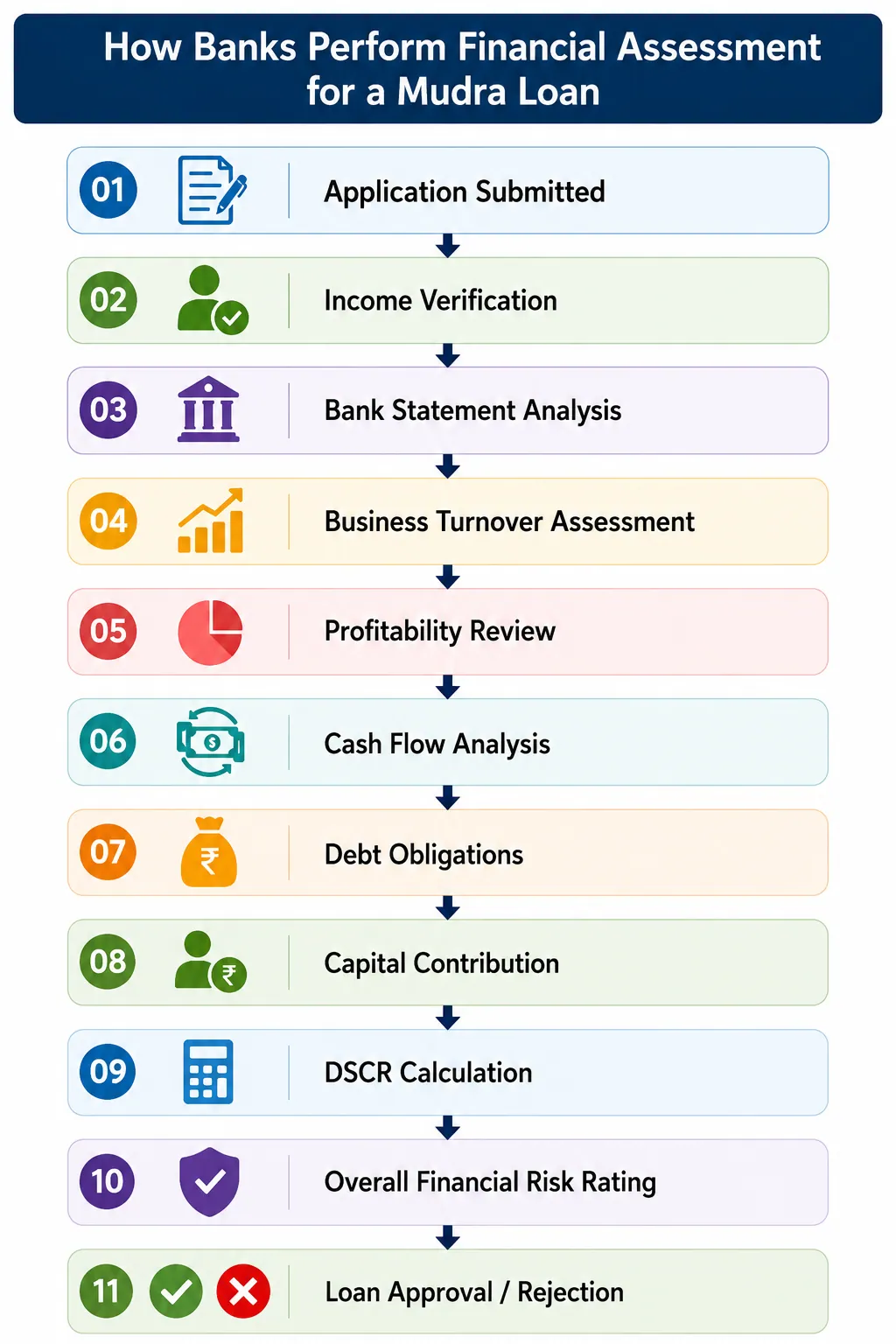
The flowchart below illustrates the step-by-step financial assessment process followed by banks before approving a Mudra Loan. At each stage, the bank verifies a different aspect of the applicant’s financial health, including income, banking transactions, business performance, profitability, repayment capacity, and existing financial obligations. The final lending decision is based on the overall financial risk assessment rather than a single factor such as CIBIL score or business turnover alone.
Common Financial Reasons for Mudra Loan Rejection
| Financial Issue | Why It Matters | Detailed Guide |
|---|---|---|
| Margin Money | Shows the applicant's own investment and the source of contribution. | Read Guide → |
| Weak Net Worth | Indicates the financial strength of the business and its owner. | Read Guide → |
| Cash Flow Problems | Determines whether the business can generate enough cash to repay EMIs. | Read Guide → |
| Low Promoter Contribution | Shows the promoter's financial commitment and confidence in the business. | Read Guide → |
| Poor Banking Habits | Reflects financial discipline and the regularity of account operations. | Read Guide → |
| Income Tax Issues | Helps the bank verify the applicant's declared income and tax compliance. | Read Guide → |
| GST Turnover Mismatch | Validates whether reported business sales are consistent across records. | Read Guide → |
| High Existing Debt | Increases the repayment burden and reduces eligibility for additional finance. | Read Guide → |
| Low DSCR | Indicates weak capacity to repay loan instalments from business income. | Read Guide → |
| Low Gross Profit Margin | Raises questions about profitability, sustainability, and business viability. | Read Guide → |
Complete Guide Library
The following in-depth guides explain the most common financial issues that banks evaluate before approving a Mudra Loan. Explore the guide that matches your situation to understand the reason behind the issue and learn practical steps to improve your financial profile before applying.
Source of Margin Money for Mudra Loan
Banks expect applicants to invest a reasonable amount of their own funds in the business before seeking external finance. A genuine source of margin money demonstrates financial commitment and reduces the lender’s risk. This guide explains acceptable sources of margin money, common mistakes applicants make, documentation requirements, and how proper financial planning can improve your chances of approval.
Read More → https://projectreportbank.com/mudra-loan-source-of-margin-money/
Weak Business Net Worth
Business net worth reflects the overall financial strength of the enterprise and plays an important role in loan assessment. Low owner’s equity, accumulated losses, or a weak financial position may indicate higher lending risk and reduce the bank’s confidence in repayment capacity. This guide explains how banks calculate net worth and practical ways to strengthen your business finances before applying.
Read More → https://projectreportbank.com/mudra-loan-weak-business-net-worth/
Cash Flow vs Profit
Many businesses report healthy profits but still struggle to meet day-to-day financial obligations due to poor cash flow. Banks analyse both profitability and actual cash availability before approving a Mudra Loan. This guide explains the difference between profit and cash flow, why working capital management matters, and how better cash flow improves repayment capacity.
Read More → https://projectreportbank.com/mudra-loan-cash-flow-vs-profit/
Promoter’s Capital Contribution
Banks prefer applicants who invest their own money in the business because it reflects confidence, commitment, and financial responsibility. A higher promoter’s contribution often lowers the lender’s risk and strengthens the overall loan proposal. This guide explains how banks evaluate promoter investment and the role it plays during financial assessment.
Read More → https://projectreportbank.com/mudra-loan-promoters-capital-contribution/
Negative Banking Habits
Your bank statements reveal more than just account balances. Frequent cheque returns, EMI defaults, overdrafts, irregular transactions, or consistently low balances can negatively influence the bank’s assessment. This guide explains how banking behaviour affects Mudra Loan approval and the steps you can take to build a healthier banking profile.
Read More → https://projectreportbank.com/mudra-loan-negative-banking-habits/
Income Tax Return Verification
Income Tax Returns help banks verify declared income and assess the financial consistency of the applicant. Missing returns, incorrect income reporting, or discrepancies between financial records can delay processing or result in rejection. This guide explains how banks verify ITRs and the common issues applicants should resolve before applying.
Read More → https://projectreportbank.com/mudra-loan-income-tax-return-verification/
GST Turnover Mismatch
Banks compare GST returns with bank statements, project reports, and other financial records to verify business turnover. Any mismatch may raise concerns about the accuracy of financial information and increase the need for additional verification. This guide explains the common causes of GST turnover mismatches and how to maintain consistency across financial documents.
Read More → https://projectreportbank.com/mudra-loan-gst-turnover-mismatch/
High Existing Debt
Existing loans, EMIs, credit card dues, and other financial liabilities directly affect repayment capacity. If the debt burden is already high, banks may hesitate to approve additional borrowing under the Mudra scheme. This guide explains how lenders assess existing debt, calculate repayment obligations, and determine whether the business can comfortably manage another loan.
Read More → https://projectreportbank.com/mudra-loan-rejected-due-to-high-existing-debt/
Understanding DSCR
The Debt Service Coverage Ratio (DSCR) is one of the most important financial indicators used during Mudra Loan appraisal. It helps banks determine whether the business generates sufficient income to repay loan instalments. This guide explains how DSCR is calculated, the ratio preferred by lenders, and practical strategies to improve repayment capacity.
Read More → https://projectreportbank.com/mudra-loan-dscr-explained/
Low Gross Profit Margin
Gross Profit Margin indicates how efficiently a business earns profit from its sales. A consistently low margin may suggest pricing issues, high operating costs, or weak business sustainability, increasing the bank’s lending risk. This guide explains how banks interpret gross profit margins and practical ways to improve profitability before applying for a Mudra Loan.
Read More → https://projectreportbank.com/mudra-loan-rejected-low-gross-profit-margin/
Financial Health Checklist Before Applying for a Mudra Loan
Before submitting your Mudra Loan application, review the checklist below to ensure your financial profile is strong enough for the bank’s assessment. Completing these steps can significantly improve your chances of faster approval and reduce the risk of rejection due to financial weaknesses.
✅ Financial Health Checklist
Maintain sufficient own capital (margin money) for the business.
Improve your business net worth by strengthening owner’s equity.
Maintain positive and consistent cash flow to support business operations.
Avoid cheque bounces, EMI defaults, and other negative banking habits.
Keep healthy and regular bank statement transactions with adequate balances.
File Income Tax Returns (ITR) accurately and on time every year.
Ensure consistency between GST returns, bank statements, and declared turnover.
Reduce unnecessary existing loans, EMIs, and credit card liabilities.
Improve your Debt Service Coverage Ratio (DSCR) before applying.
Monitor and improve your business profitability and gross profit margin regularly.
Financial Issue vs Recommended Solution
| Check | Financial Health Point | What You Should Do | Guide |
|---|---|---|---|
| ☐ | Maintain Sufficient Own Capital | Arrange genuine margin money and maintain clear proof of its source. | Read Guide → |
| ☐ | Improve Business Net Worth | Strengthen owner’s equity, retain profits, and reduce accumulated losses. | Read Guide → |
| ☐ | Maintain Positive Cash Flow | Ensure sufficient cash remains available for operating expenses and loan repayments. | Read Guide → |
| ☐ | Maintain Adequate Promoter Contribution | Invest a reasonable amount of your own funds to demonstrate commitment. | Read Guide → |
| ☐ | Avoid Cheque Bounces | Avoid cheque returns, EMI defaults, frequent overdrafts, and irregular transactions. | Read Guide → |
| ☐ | Keep Healthy Bank Statements | Maintain regular business transactions, adequate balances, and disciplined account operations. | Read Guide → |
| ☐ | File Income Tax Returns Regularly | File accurate ITRs on time and ensure the declared income matches other financial records. | Read Guide → |
| ☐ | Ensure GST Consistency | Match GST turnover with bank credits, ITR figures, and the project report. | Read Guide → |
| ☐ | Reduce Unnecessary Debts | Repay avoidable loans, reduce EMI burden, and control credit card liabilities. | Read Guide → |
| ☐ | Improve DSCR | Improve operating income, reduce debt obligations, and plan a manageable repayment schedule. | Read Guide → |
| ☐ | Monitor Business Profitability | Review pricing, purchase costs, and gross profit margin before applying. | Read Guide → |
Expert Advice by CA Manish Gugliya
Before applying for a Mudra Loan, focus on building a strong financial profile rather than simply completing the application form. The following practical recommendations are based on common financial issues observed during Mudra Loan assessments and can help improve your chances of loan approval.
📊 Maintain Proper Financial Records
Keep accurate financial records throughout the year. Well-maintained records help banks verify your business more efficiently.
🏦 Separate Business & Personal Banking
Always use a dedicated business bank account. Healthy banking habits improve credibility during loan assessment.
Learn about Banking Habits →
✅ Avoid Cheque Returns
Cheque bounces, EMI defaults, and frequent overdrafts create a negative banking profile that may reduce your approval chances.
Read Detailed Guide →
📑 Keep GST & Income Tax Records Consistent
Ensure that your GST returns, Income Tax Returns, bank statements, and project report report similar financial information.
GST Turnover Guide → |
ITR Verification →
💰 Monitor Cash Flow Every Month
Banks evaluate your ability to generate cash for EMI repayment, not just annual profit. Review monthly cash flow regularly.
Cash Flow vs Profit →
📈 Improve Your DSCR
Maintain a healthy Debt Service Coverage Ratio by improving operating income and reducing unnecessary debt.
Understand DSCR →
🤝 Invest Your Own Capital
Applicants who contribute their own funds demonstrate greater financial commitment and reduce the lender's risk.
Promoter Contribution → |
Margin Money Guide →
📉 Reduce Existing Liabilities
Repay unnecessary loans and reduce your EMI burden before applying for additional finance.
High Existing Debt →
📋 Prepare Realistic Financial Projections
Support your application with practical financial projections, a professional Project Report, and realistic CMA Data based on actual business performance.
🔍 Review Overall Financial Health
Before applying, review your net worth, profitability, cash flow, banking behaviour, debt obligations, and tax compliance. Address weaknesses before approaching the bank.
Business Net Worth → |
Gross Profit Margin →
Frequently Asked Questions
Why do banks analyse financial strength before approving a Mudra Loan?
Banks analyse financial strength to determine whether the applicant has the capacity to repay the loan on time. They review income, business turnover, profitability, cash flow, existing liabilities, banking behaviour, and overall financial stability before making the final lending decision.
Is profit more important than cash flow?
No. Both profit and cash flow are important, but banks often give greater importance to cash flow because loan repayments are made from available cash, not accounting profit. A profitable business with poor cash flow may still struggle to pay EMIs.
How much margin money should I arrange?
There is no fixed margin money requirement for every Mudra Loan application. The amount depends on the loan size, bank policy, and business type. Banks also verify that the source of margin money is genuine and properly documented.
What is considered a good DSCR?
Most banks prefer a Debt Service Coverage Ratio (DSCR) above 1.25, although the acceptable ratio may vary depending on the bank’s internal credit policy, industry, and overall financial assessment. A higher DSCR indicates stronger repayment capacity.
Can existing loans lead to Mudra Loan rejection?
Yes. High existing EMIs, business loans, personal loans, or credit card liabilities can reduce your repayment capacity. If the bank believes that taking another loan will create financial stress, your Mudra Loan application may be rejected.
Why do banks verify GST returns?
Banks compare GST returns with bank statements, Income Tax Returns, and project reports to verify the actual business turnover. Any mismatch may require additional clarification and could delay or affect loan approval.
Are Income Tax Returns compulsory for every applicant?
Not always. The requirement depends on the applicant’s business type, turnover, loan amount, and applicable tax laws. However, where available, Income Tax Returns help banks verify declared income and assess financial consistency.
Can poor banking habits affect loan approval?
Yes. Frequent cheque returns, EMI defaults, irregular account operations, excessive overdrafts, and consistently low bank balances can create a negative financial impression. Healthy banking behaviour improves your credibility with the lender.
How can I improve my business net worth?
You can improve your business net worth by increasing owner’s capital, retaining profits within the business, reducing unnecessary liabilities, controlling losses, and strengthening your overall financial position before applying for a Mudra Loan.
What financial records should I prepare before applying?
Applicants should keep important financial documents ready, including recent bank statements, Income Tax Returns (if applicable), GST returns, project reports, CMA data, business financial statements, details of existing loans, and documents supporting the source of margin money.
Can low profit margins still qualify for a Mudra Loan?
Yes. A business with relatively low profit margins may still qualify if it demonstrates stable cash flow, manageable debt, healthy banking behaviour, and sufficient repayment capacity. Banks evaluate the overall financial health of the business rather than relying on a single financial ratio.
Which financial issue causes the highest number of Mudra Loan rejections?
There is no single financial issue responsible for most Mudra Loan rejections. In many cases, applications are rejected because of a combination of factors such as weak cash flow, high existing debt, low DSCR, inconsistent GST or Income Tax records, poor banking habits, inadequate promoter contribution, and weak business profitability. Addressing these issues before applying can significantly improve your chances of loan approval.
Conclusion
Financial strength is one of the most important factors in every Mudra Loan approval. While many applicants focus primarily on their CIBIL score or business turnover, banks conduct a much broader financial assessment. They evaluate cash flow, profitability, repayment capacity, existing liabilities, promoter contribution, banking behaviour, tax compliance, and overall business stability before making a lending decision.
Financial issues such as inadequate margin money, weak cash flow, low Debt Service Coverage Ratio (DSCR), high existing debt, inconsistent GST or Income Tax records, and poor banking habits can significantly reduce your chances of approval. Fortunately, most of these issues can be identified and corrected before submitting a Mudra Loan application through proper financial planning and accurate record keeping.
Preparing complete financial documents, maintaining consistent business records, improving cash flow, reducing unnecessary liabilities, and presenting realistic financial projections can greatly strengthen your loan proposal. A well-prepared financial profile not only improves the likelihood of approval but also builds greater confidence with the lending bank.
Use the detailed guides in this Mudra Loan Financial Issues cluster to understand each financial parameter in depth, resolve specific financial weaknesses, and submit a stronger, more bank-ready Mudra Loan application with confidence.
-
Mudra Loan Financial Issues: Complete Guide to Financial Reasons Behind Mudra Loan Rejection
-
Mudra Loan Source of Margin Money – Documents Banks Require Before Sanction
-
Mudra Loan Rejected Due to Weak Business Net Worth – How Banks Actually Evaluate Your Financial Strength
-
Mudra Loan Cash Flow vs Profit – Why Banks Care More About Cash Flow
-
Mudra Loan Promoter's Capital Contribution – How Much Own Investment Improves Approval Chances
-
Mudra Loan Negative Banking Habits – Cheque Bounces, Irregular Transactions & Their Impact
-
Mudra Loan Income Tax Return Verification – How Banks Use ITR to Assess Your Eligibility 2026
-
Mudra Loan GST Turnover Mismatch – Complete Practical Guide by CA Manish Gugliya
-
Mudra Loan Rejected Due to High Existing Debt – FOIR, EMI Burden & Practical Fixes (2026)
-
Mudra Loan DSCR (Debt Service Coverage Ratio) Explained – How Banks Actually Check Your Repayment Capacity 2026