

Many Mudra Loan applicants face challenges such as application rejection, processing delays, incomplete documents, weak Project Reports, unrealistic financial projections, or low credit profiles. In most cases, these issues can be corrected with proper preparation before reapplying.
Successful Mudra Loan approvals often result from identifying the actual reason behind the initial rejection and taking the right corrective action. Applicants may improve their Project Report, update financial information, strengthen their business plan, complete missing documents, improve their CIBIL Score, or choose a more suitable bank before submitting a fresh application.
This guide brings together real Mudra Loan success stories and case studies from different business situations. Each story explains what went wrong, the improvements made before reapplying, and the key factors that helped secure final loan approval. By learning from these real approval journeys, you can avoid common mistakes, prepare a stronger application, and improve your chances of obtaining a Mudra Loan.
What You’ll Learn in This Guide
This guide will help you understand the practical improvements that turned weak or rejected Mudra Loan applications into successful approval cases. You will learn:
- Why some rejected Mudra Loan applications later get approved
- The real factors behind successful Mudra Loan approvals
- What changed between the initial and improved applications
- How applicants improved their CIBIL Score and credit profile
- How Project Report corrections strengthened loan applications
- Why realistic financial projections improved approval chances
- How a stronger business plan influenced the bank’s decision
- When changing the bank or branch helped the applicant
- How missing or incorrect documents were corrected
- The most important lessons every Mudra Loan applicant should follow
Why Real Mudra Loan Success Stories Matter
Real Mudra Loan success stories offer practical insights that go beyond general banking guidelines. They show how actual applicants overcame challenges, corrected mistakes, and secured loan approval. Learning from real cases helps you understand what banks expect and how to prepare a stronger application.
Practical Learning Over Theory
Real-life examples are easier to understand than theoretical explanations. They demonstrate how applicants solved problems and successfully improved their loan applications.
Shows How Banks Evaluate Applications
Success stories reveal the factors banks consider during credit appraisal, including Project Reports, financial projections, business viability, documentation, and repayment capacity.
Helps Avoid Common Mistakes
By studying real approval journeys, applicants can identify common errors such as incomplete documents, weak financial planning, unrealistic projections, or poor business presentation before applying.
Builds Confidence After Rejection
Many case studies prove that an initial Mudra Loan rejection is not the end of the process. With the right improvements, many applicants later receive approval.
Highlights the Importance of Proper Preparation
Successful applicants usually invest time in correcting weaknesses, updating documents, strengthening their Project Report, and preparing a realistic business plan before reapplying.
Provides Actionable Lessons
Each success story offers practical takeaways that you can apply to your own Mudra Loan application to improve approval chances and avoid unnecessary delays or rejection.
Common Reasons Applicants Finally Get Approved
The following table summarises the most common weaknesses found in unsuccessful Mudra Loan applications, the improvements made by applicants, and the final outcome after correction.
| Initial Problem | Improvement Made | Final Result |
|---|---|---|
| Weak Project Report | Revised Project Report | Approved |
| Poor Financial Projections | Updated Financial Projections and CMA Data | Approved |
| Low Credit Score | Improved CIBIL Score and Credit Profile | Approved |
| Wrong Bank Selection | Applied to a More Suitable Bank | Approved |
| Missing Documents | Submitted Complete Documentation | Approved |
| Weak Business Plan | Improved Business Strategy and Plan | Approved |
| Initial Rejection | Corrected Deficiencies and Reapplied | Approved |
Real Success Story Library
Every successful Mudra Loan approval has a story behind it. Some applicants improved their Project Report, while others strengthened their financial projections, completed missing documents, enhanced their credit profile, or changed their business strategy before reapplying. The following real success stories and case studies demonstrate how practical improvements helped applicants overcome challenges and secure Mudra Loan approval. Explore the guides below to understand what worked, why it worked, and how you can apply the same lessons to your own loan application.
Application Analysis: Before vs After Approval
A successful Mudra Loan application is often the result of careful improvements rather than luck. This case study compares an application before and after key corrections, highlighting changes in documentation, financial information, Project Report, and overall presentation. It helps applicants understand how small improvements can significantly influence a bank’s lending decision.
Read the complete case study →
https://projectreportbank.com/mudra-loan-application-analysis-before-after/
25 Real Mudra Loan Rejection Cases
This guide presents 25 real-life Mudra Loan rejection cases, explaining why applications were initially declined and how many applicants eventually resolved the underlying issues. These practical examples help entrepreneurs identify common mistakes and understand how to avoid them before applying.
Read the complete case study →
https://projectreportbank.com/25-real-mudra-loan-rejection-cases/
Financial Projections Approval Case Study
Accurate financial projections play a crucial role in loan approval. This case study explains how revising sales estimates, expenses, cash flow, and CMA Data helped an applicant present a more realistic business proposal and successfully obtain Mudra Loan approval.
Read the complete case study →
https://projectreportbank.com/mudra-loan-financial-projections-approval-case-study/
Approved After Changing the Bank
Not every bank branch evaluates applications in the same way. This success story explains how selecting a more suitable bank and presenting a stronger application resulted in Mudra Loan approval after an earlier unsuccessful attempt.
Read the complete case study →
https://projectreportbank.com/mudra-loan-approved-after-bank-change-case-study/
Approved After Improving the Business Plan
A strong business plan helps banks understand the viability and future potential of a business. This case study demonstrates how refining the business model, market analysis, and growth strategy significantly improved the applicant’s chances of loan approval.
Read the complete case study →
https://projectreportbank.com/mudra-loan-approved-after-business-plan-change/
From Missing Documents to Loan Approval
Incomplete documentation is one of the most common reasons for delays and rejection. This real success story shows how submitting the correct documents, updating KYC records, and completing the application file led to a successful Mudra Loan approval.
Read the complete case study →
https://projectreportbank.com/mudra-loan-success-story-missing-documents-to-approval/
Home-Based Business Success Story
Many entrepreneurs believe that operating from home reduces their chances of receiving a Mudra Loan. This case study proves that with proper documentation, business planning, and successful verification, home-based businesses can also secure bank finance.
Read the complete case study →
https://projectreportbank.com/home-based-business-mudra-loan-success-story/
Approved After Improving Credit Score
A weak credit profile can affect loan approval, but it is often possible to improve it. This success story explains how correcting credit issues, improving the CIBIL Score, and demonstrating better financial discipline helped an applicant receive Mudra Loan approval.
Read the complete case study →
https://projectreportbank.com/mudra-loan-approved-after-credit-improvement/
Project Report Success Story
A professionally prepared Project Report can significantly strengthen a Mudra Loan application. This case study explains how correcting business assumptions, financial estimates, and project details helped the applicant gain the bank’s confidence and secure funding.
Read the complete case study →
https://projectreportbank.com/mudra-loan-project-report-case-study/
Approved After Initial Rejection
An initial rejection does not always mean the end of the financing journey. This real-life case study explains how the applicant identified the actual reasons for rejection, corrected the weaknesses, and successfully obtained Mudra Loan approval after reapplying.
Read the complete case study →
https://projectreportbank.com/mudra-loan-approved-after-initial-rejection-case-study/
Lessons Learned from These Success Stories
These real Mudra Loan success stories show that approval usually depends on preparation, accurate information, and timely correction of weaknesses. The following lessons can help applicants prepare a stronger and more bank-ready application.
Preparation Matters More Than Luck
Successful applicants carefully reviewed their eligibility, documents, financial position, business requirements, and repayment capacity before submitting or resubmitting their applications.
Banks Prefer Well-Prepared Applicants
A complete and clearly presented application helps the bank understand the business, assess risk, and make a lending decision with greater confidence.
Project Reports Influence Decisions
A realistic and professionally prepared Project Report explains the business model, project cost, profitability, cash flow, and repayment capacity to the bank.
Documentation Must Be Complete
Missing, outdated, or inconsistent documents can delay verification or result in rejection. Applicants should organise and verify the complete document file before applying.
Financial Projections Must Be Realistic
Sales, expenses, profit, working capital, cash flow, and repayment estimates should be practical and supported by the actual scale of the proposed business.
Credit Improvement Can Work
Applicants can strengthen their credit profile by clearing overdue payments, correcting credit-report errors, reducing debt, and maintaining disciplined repayment behaviour.
A Strong Business Plan Matters
Banks are more comfortable financing businesses with a clear customer base, practical operating strategy, realistic market demand, and a convincing plan for growth.
Choosing the Right Bank Helps
A suitable bank or branch may better understand the applicant’s industry, local market, loan requirement, and business model, resulting in a more appropriate assessment.
Professional Guidance Saves Time
Expert assistance can help identify application weaknesses, prepare realistic projections, organise documents, and present the business proposal more effectively.
Rejection Can Be Corrected
An initial rejection is not always final. Once the actual reason is identified and corrected, the applicant may submit a stronger application with better approval prospects.
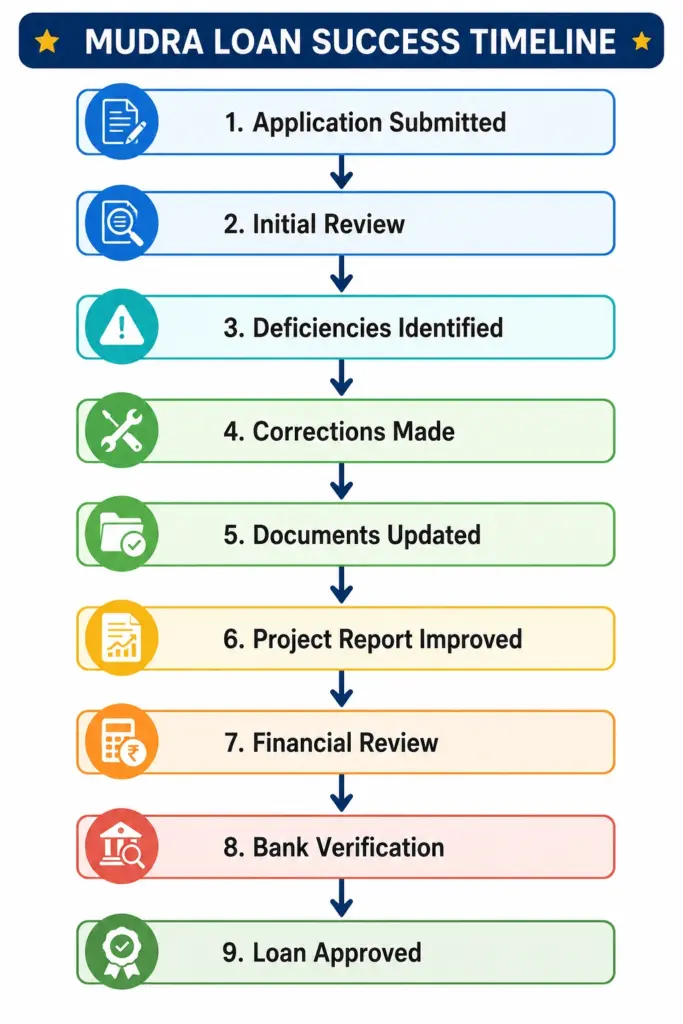
Mudra Loan Success Timeline
Before vs After: What Changed?
The following comparison shows how practical improvements can strengthen a weak Mudra Loan application and make it more suitable for bank appraisal.
| Before Improvement | After Improvement |
|---|---|
| Incomplete documents | Complete and properly organised documentation |
| Weak Project Report | Professional and bank-ready Project Report |
| Poor financial projections | Realistic and supportable financial projections |
| Low credit score | Improved credit profile and repayment discipline |
| Weak business plan | Stronger and more practical business strategy |
| Wrong bank selection | Suitable lender or branch selected |
| Missing quotations | Complete and valid machinery or equipment quotations |
| Poor interview performance | Better preparation and clearer business presentation |
Expert Advice by CA Manish Gugliya
Successful Mudra Loan approvals rarely happen by chance. They are usually the result of careful planning, accurate documentation, realistic financial preparation, and timely corrective action. Based on practical experience in preparing Project Reports and assisting MSME borrowers, the following recommendations can help you submit a stronger and more bank-ready Mudra Loan application.
✔ Learn from Real Success Stories
Study successful Mudra Loan applications to understand what banks expect. Learning from real approval cases is more valuable than repeating common application mistakes.
✔ Prepare an Original Project Report
Never submit a copied or generic Project Report. Banks expect realistic business information, practical financial assumptions, and project details specific to your business.
✔ Maintain Accurate Financial Records
Keep your bank statements, GST records, Income Tax Returns, and financial information updated and consistent before applying for a Mudra Loan.
✔ Improve Banking Habits Early
Maintain healthy banking transactions, avoid cheque returns, and manage existing loan repayments responsibly for several months before applying.
✔ Use Realistic Financial Estimates
Avoid overstating sales, profits, or business growth. Banks are more confident in realistic financial projections supported by practical assumptions.
✔ Prepare for the Bank Discussion
Understand your business model, loan requirement, repayment plan, and future goals so you can confidently answer the branch manager's questions.
✔ Keep Documents Updated
Verify that all KYC documents, registrations, quotations, licences, and supporting records are current, complete, and ready before submitting the application.
✔ Correct Every Rejection Reason
If your application was previously rejected, identify every weakness and resolve it before reapplying instead of submitting the same application again.
✔ Choose the Right Bank Branch
Select a bank or branch that understands your business activity and has experience financing MSMEs under the Mudra Loan scheme.
✔ Seek Professional Guidance When Needed
For complex business proposals or higher loan requirements, professional assistance can improve documentation, financial planning, and overall application quality.
Success Factors That Banks Appreciate
Banks evaluate much more than documents or CIBIL Score before approving a Mudra Loan. A well-prepared application supported by realistic financial information, proper documentation, and a genuine business proposal significantly improves the chances of approval. Use the following checklist to ensure your application meets the key expectations of the bank.
Complete Documentation
Submit all required KYC documents, business records, quotations, licences, and supporting documents without omissions.
Realistic Project Report
Present a professionally prepared Project Report with practical assumptions, accurate costs, and realistic financial projections.
Positive Banking Habits
Maintain healthy banking transactions, avoid cheque returns, and demonstrate responsible financial behaviour.
Consistent Financial Records
Ensure bank statements, GST returns, Income Tax records, and other financial information are accurate and consistent.
Relevant Business Experience
Demonstrate knowledge, experience, or skills related to the proposed business activity whenever possible.
Proper Quotations
Provide genuine and updated machinery, equipment, or supplier quotations that support your project cost.
Adequate Margin Contribution
Show your own financial contribution wherever applicable to strengthen the bank's confidence in the project.
Practical Repayment Capacity
Demonstrate that projected business income is sufficient to repay the loan comfortably within the repayment period.
Genuine Business Activity
Ensure your business operations, premises, and proposed activities can be verified during the bank's assessment.
Honest Disclosure
Provide complete and truthful information throughout the application process. Transparency builds credibility with the bank.
Complete Case Study Library
Explore these detailed Mudra Loan case studies to understand how applicants identified weaknesses, corrected their applications, and improved their chances of approval. Each guide highlights a different challenge and the practical steps taken to overcome it.
Application Analysis: Before vs After Approval
This case study compares a weak Mudra Loan application with the improved version submitted later. It explains how corrections in documentation, financial information, business presentation, and the Project Report strengthened the applicant’s profile. The before-and-after comparison helps readers understand how even small but focused improvements can influence the bank’s appraisal and create a more complete, credible, and bank-ready application.
25 Real Mudra Loan Rejection Cases
This detailed guide examines 25 practical Mudra Loan rejection cases involving documentation gaps, weak credit profiles, unrealistic projections, business viability concerns, verification issues, and other common problems. Each case provides useful lessons for applicants who want to understand why banks reject applications and what should be corrected before reapplying. It is a valuable reference for identifying avoidable mistakes early.
Financial Projections Approval Case Study
This case study explains how poor financial estimates were replaced with realistic sales, expenses, profit, cash flow, working capital, and repayment projections. The revised financial information helped the bank better understand the applicant’s business potential and repayment capacity. It demonstrates why accurate projections and properly prepared CMA Data can make a major difference during Mudra Loan appraisal and final approval.
Approved After Changing the Bank
Sometimes an application may be suitable, but the selected bank or branch may not fully understand the business model or loan requirement. This case study shows how choosing a more appropriate lender, improving the application, and presenting the proposal more clearly helped the applicant obtain approval. It also explains why bank selection should be based on suitability rather than convenience alone.
Approved After Improving the Business Plan
A weak or unclear business plan can make it difficult for the bank to assess market demand, profitability, and future growth. This case study explains how improvements in the business model, customer strategy, operations, market analysis, and repayment planning created a stronger proposal. The revised business plan helped the applicant present a more practical and convincing case for Mudra Loan approval.
From Missing Documents to Loan Approval
Incomplete documentation can delay processing or prevent the bank from completing its assessment. This case study explains how the applicant identified missing records, updated KYC details, arranged business documents, and submitted a complete application file. The improved documentation helped the branch verify the proposal more efficiently and move the application toward approval without unnecessary confusion or repeated document requests.
Home-Based Business Mudra Loan Success Story
Home-based entrepreneurs often worry that operating without a separate commercial premises may reduce their approval chances. This case study demonstrates how a genuine business activity, proper address evidence, clear operating arrangements, complete documentation, and a practical Project Report helped a home-based applicant secure finance. It offers useful lessons for small service providers, manufacturers, traders, and other entrepreneurs working from home.
Approved After Improving the Credit Profile
A weak CIBIL Score or irregular repayment history can create concerns during credit appraisal. This success story explains how the applicant reviewed the credit report, corrected errors, cleared overdue amounts, reduced unnecessary debt, and maintained better repayment discipline. These improvements strengthened the overall credit profile and helped the bank reconsider the application with greater confidence in the applicant’s financial responsibility.
Mudra Loan Project Report Case Study
A generic or poorly prepared Project Report may fail to explain the business requirement and repayment capacity clearly. This case study shows how revising project cost, working capital, profitability, cash flow, market assumptions, and financial projections created a stronger proposal. The improved report helped the bank understand the business model, evaluate feasibility, and assess the loan requirement more effectively.
Approved After an Initial Mudra Loan Rejection
An initial rejection does not always end the financing journey. This case study explains how the applicant identified the actual reasons for rejection, corrected application weaknesses, updated supporting documents, improved financial information, and prepared more thoroughly before reapplying. The final approval demonstrates why applicants should respond to rejection with careful analysis and corrective action instead of immediately submitting the same application again.
Frequently Asked Questions
Can a rejected Mudra Loan application be approved later?
Yes. Many Mudra Loan applications are approved after applicants identify the actual reasons for rejection and correct issues such as incomplete documentation, weak Project Reports, unrealistic financial projections, poor credit history, or business-related deficiencies before reapplying.
What improvements usually lead to Mudra Loan approval?
Common improvements include preparing a professional Project Report, updating financial projections, completing missing documents, improving the CIBIL Score, strengthening the business plan, maintaining better banking habits, and selecting a suitable bank branch.
Are Project Reports important in real success cases?
Absolutely. A well-prepared Project Report helps banks evaluate business viability, project cost, profitability, cash flow, repayment capacity, and overall feasibility. Many successful applicants secured approval after revising their Project Report.
Does changing the bank improve approval chances?
In some situations, yes. If another bank or branch has better experience with your business sector or MSME lending, submitting a stronger application to a more suitable lender may improve your chances of approval.
Can improving my CIBIL Score help?
Yes. A healthier credit profile demonstrates responsible financial behaviour. Clearing overdue loans, correcting credit report errors, and maintaining timely repayments can strengthen your Mudra Loan application.
What is the most common reason for later approval?
The most common reason is correcting weaknesses identified during the initial application. This may include improving documentation, financial information, Project Reports, business planning, or credit history before submitting a revised application.
Are home-based businesses eligible for Mudra Loans?
Yes. Home-based businesses can qualify for Mudra Loans if they satisfy the bank’s eligibility criteria, maintain genuine business activity, provide proper documentation, and successfully complete the verification process.
Should I revise financial projections before reapplying?
Yes. If your original financial estimates were unrealistic or inconsistent, you should update sales forecasts, expenses, cash flow, profitability, and repayment calculations before submitting another application.
How important is complete documentation?
Complete documentation is essential because banks verify applicant identity, business ownership, financial information, quotations, and supporting records before approving a Mudra Loan. Missing documents often delay processing or result in rejection.
Can business plan improvements influence bank decisions?
Yes. A practical business plan with clear market analysis, realistic growth strategy, operational planning, and repayment capability helps banks assess business viability and improves approval prospects.
What can I learn from rejection case studies?
Rejection case studies help you understand the practical reasons behind unsuccessful applications, the corrective actions taken by successful applicants, and the strategies that ultimately resulted in Mudra Loan approval.
Are all Mudra Loan approvals based on high CIBIL Scores?
No. While credit history is an important consideration, banks also evaluate business viability, Project Reports, financial strength, repayment capacity, documentation, verification findings, and overall eligibility before approving a loan.
How long should I wait before reapplying?
There is no fixed waiting period. You should reapply only after identifying the actual reasons for rejection, correcting all deficiencies, and preparing a stronger application supported by updated documents and financial information.
Should I prepare a new Project Report after rejection?
In most cases, yes. If the original Project Report contained unrealistic assumptions, calculation errors, or incomplete information, preparing a revised and bank-ready Project Report can significantly improve your chances of approval.
Where can I read more real Mudra Loan approval stories?
You can explore the detailed guides in this Mudra Loan Success Stories & Case Studies cluster, where each case study explains the applicant’s initial challenges, the improvements made, and the practical steps that ultimately led to successful Mudra Loan approval.
Conclusion
Every Mudra Loan approval story highlights one important lesson: successful financing is usually the result of careful preparation rather than luck. Applicants who prepare accurate documentation, submit a realistic Project Report, maintain reliable financial records, and take timely corrective action are far more likely to receive a positive decision from the bank.
The real success stories and case studies in this cluster demonstrate how banks evaluate applications in practical situations. They show how improvements such as revising financial projections, strengthening business plans, completing documentation, improving credit profiles, or choosing a more suitable bank can significantly increase the chances of Mudra Loan approval.
If your Mudra Loan application has been rejected or delayed, treat it as an opportunity to strengthen your application instead of giving up. Identify the actual reasons behind the decision, resolve every weakness, and reapply with a more complete, bank-ready proposal.
Explore all the detailed guides in this Mudra Loan Success Stories & Case Studies cluster to learn from real approval journeys, avoid common mistakes, and prepare a stronger Mudra Loan application with greater confidence.
-
Mudra Loan Success Stories & Case Studies: Real Approval Journeys and Lessons Learned
-
Mudra Loan Application Analysis: Before-and-After Case Study Under Pradhan Mantri Mudra Yojana (PMMY)
-
Mudra Loan Rejection Case Studies: 25 Real Mistakes, Bank Logic, and Winning Fixes
-
How Proper Financial Projections Turned a Mudra Loan Rejection into Approval
-
Mudra Loan Approved After Bank Change – A Comparative Case Study (PMMY, Business Plan & Evaluation Differences)
-
Mudra Loan Approved After Business Plan Change – A Practical Case Study & Step‑by‑Step Guide
-
From Missing Documents to Loan Approval – A Real Mudra Loan Success Case Study
-
Home Based Business Mudra Loan: How a Rejected Application Finally Got Approved
-
Mudra Loan Approved After Credit Improvement – Real CIBIL Success Story (By CA Manish Gugliya)
-
Mudra Loan Project Report Case Study: How Correcting a Project Report Turned Rejection into Approval