Project Report Bank

Many Mudra Loan applicants believe that having a good CIBIL Score and submitting all the required documents is enough to secure loan approval. While these factors are important, they are only part of the bank’s overall assessment. Before sanctioning a Mudra Loan, banks conduct a detailed verification process to confirm that the information provided in the application is accurate and reliable.
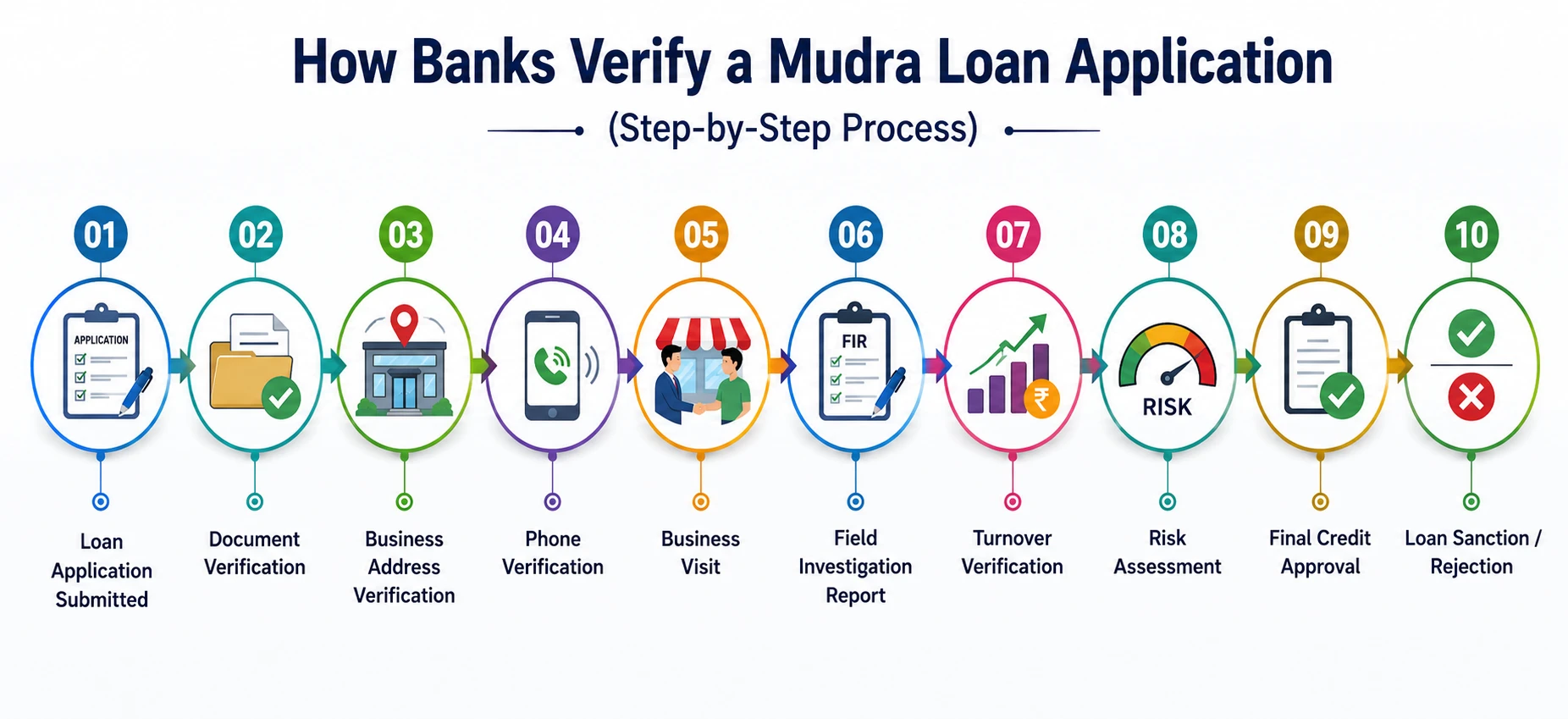
Bank verification is one of the most critical stages in the Mudra Loan approval process. During this stage, the bank verifies whether the business actually exists, is operational, matches the details mentioned in the application, and demonstrates the capacity to utilize and repay the loan. Depending on the nature of the business, verification may include phone calls, field visits, site inspections, turnover verification, and preparation of a Field Investigation Report (FIR).
This Mudra Loan Bank Verification cluster serves as your complete knowledge hub on the entire verification process. It brings together detailed guides covering every stage of bank verification—from business verification and phone verification to manufacturing unit inspections, rented premises verification, home-based business checks, re-verification, and the reasons why some applicants fail verification. By understanding these verification procedures in advance, you can prepare your business effectively and significantly improve your chances of Mudra Loan approval.
This guide explains every important stage of Mudra Loan bank verification. Select any topic below to read the related detailed guide.
Bank verification is one of the most important stages in the Mudra Loan approval process. While documents and CIBIL Score provide valuable information, banks also verify whether the business genuinely exists, is actively operating, and has the capacity to repay the loan. This verification helps banks make informed lending decisions and minimizes the risk of approving unsuitable applications.
One of the primary objectives of bank verification is to identify fraudulent or misleading loan applications. Bank officials verify the applicant’s identity, business location, and supporting documents to ensure that all information submitted is genuine. This process protects the bank from financial fraud while ensuring that Mudra Loans reach deserving businesses.
Banks conduct verification to confirm that the business is operating at the declared address and matches the details provided in the application. Field visits, phone verification, and site inspections help establish that the business is genuine and actively functioning.
A business must have the financial capacity to repay the loan. During verification, banks evaluate business activities, customer flow, inventory, production capacity, or service operations to determine whether the business can generate sufficient income to repay the loan on time.
Verification also helps banks understand how the business operates on a day-to-day basis. Depending on the type of business, officials may inspect machinery, stock, office setup, employees, client records, invoices, or other operational evidence to verify the information provided in the application.
Every loan carries a certain level of financial risk. Bank verification helps identify inconsistencies, incorrect information, or businesses that may not be financially stable. This allows banks to make responsible lending decisions and reduce the chances of future loan defaults.
Mudra Loans are designed to support genuine micro and small businesses. Verification helps banks ensure that the loan is intended for legitimate business purposes and is likely to be used for business expansion, working capital, or asset creation rather than non-business activities.
Bank verification is much more than a routine formality—it is a comprehensive assessment of the applicant’s business, financial credibility, and operational stability. Applicants who maintain accurate records, provide truthful information, and cooperate during the verification process generally have a stronger chance of obtaining Mudra Loan approval.
Explore our detailed guides covering every important stage of the Mudra Loan bank verification process. Select the topic relevant to your situation to understand the bank’s checks and prepare your business correctly.
Understand the complete business verification process followed by banks before approving a Mudra Loan. This guide explains how banks confirm the existence, ownership, location and operations of the business. It also covers phone calls, document checks, physical visits, turnover assessment and the preparation of verification reports. Read this guide first to get a complete overview of the different checks that may take place before the final loan decision.
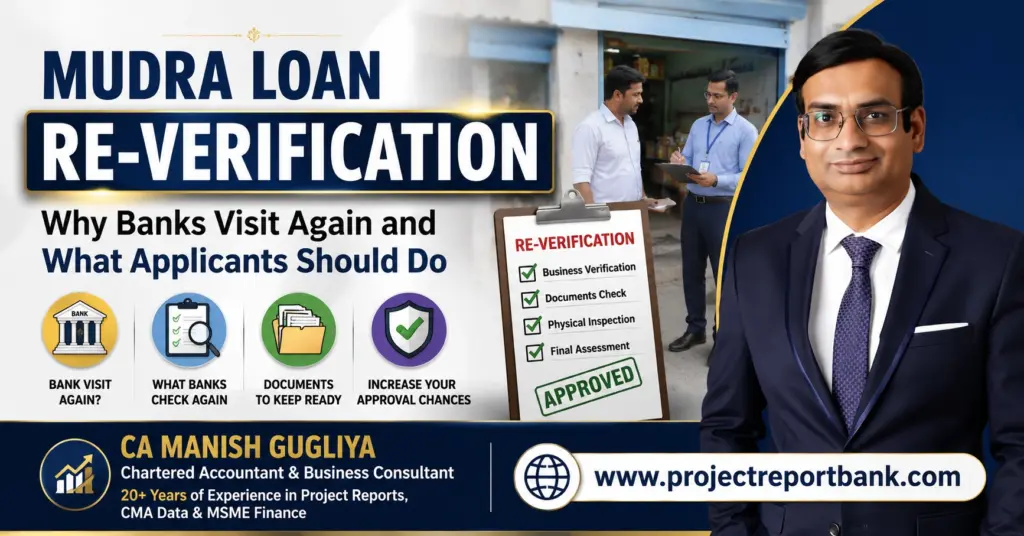
Read Full Guide →A bank may conduct re-verification when the first verification report is incomplete, negative or inconsistent with the loan application. This detailed guide explains why re-verification happens, what information may be checked again and how applicants should respond. It also discusses the importance of correcting address, documentation, turnover or operational discrepancies before the second visit. Proper preparation for re-verification can help resolve doubts and prevent avoidable rejection.
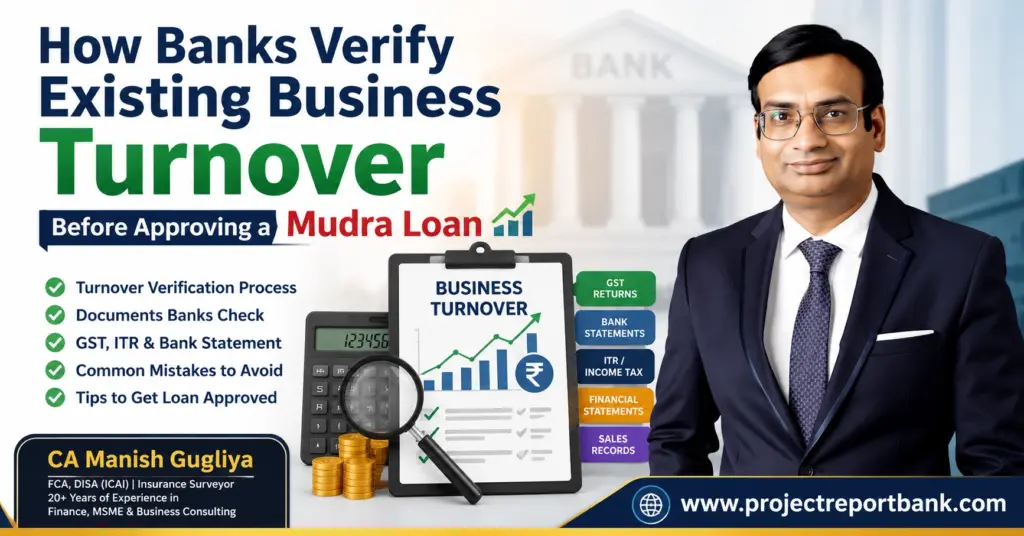
Read Full Guide →Banks do not always accept the turnover stated in the application without supporting evidence. This guide explains how declared sales may be compared with bank statements, GST returns, income tax records, invoices, purchase bills and actual business activity. It also highlights common differences that can create doubts during appraisal. Understanding these checks allows applicants to present realistic turnover figures and maintain proper evidence before applying for a Mudra Loan.
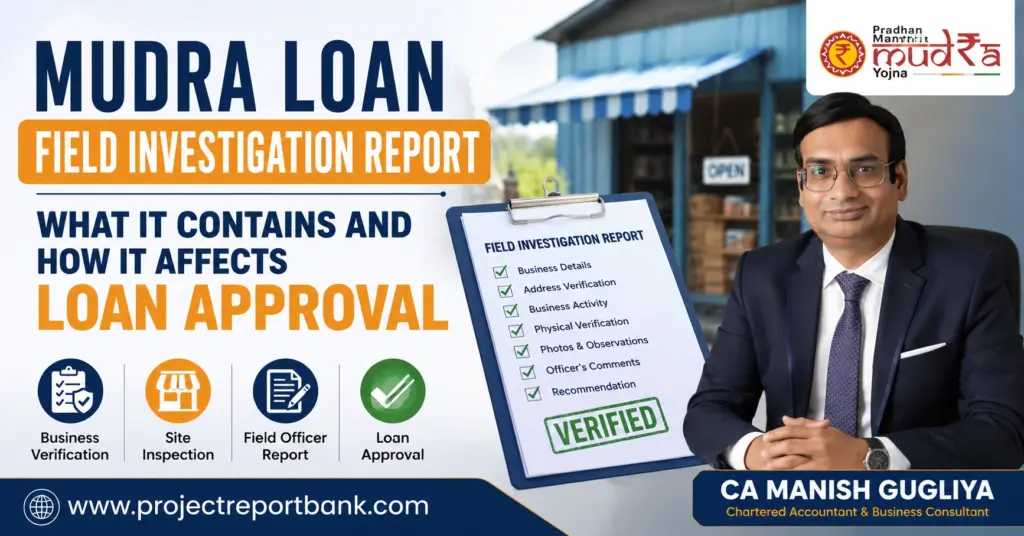
Read Full Guide →A Field Investigation Report can significantly influence the bank’s lending decision. This guide explains what a field investigator may verify during a business visit, including the business address, ownership, activity, stock, machinery, employees and local reputation. It also discusses how positive and negative observations are recorded. Applicants can use this information to understand what investigators expect and avoid inconsistencies that may weaken the verification report.
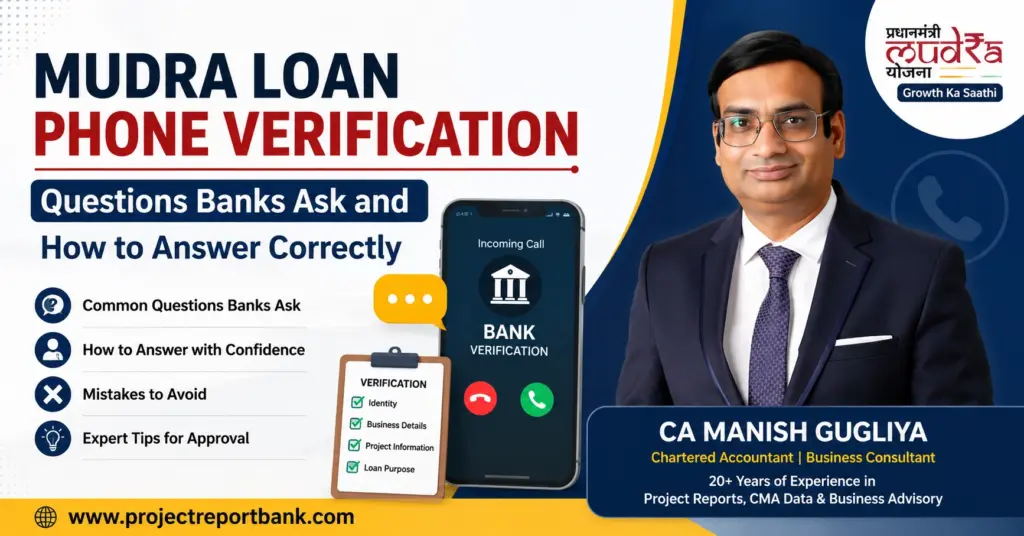
Read Full Guide →Phone verification may appear simple, but incorrect or inconsistent answers can create doubts about the application. This guide explains who may receive the verification call, the questions commonly asked and how banks confirm business, employment, address and loan-purpose details. It also covers missed calls, unreachable numbers and conflicting responses. Applicants should keep their registered mobile number active and provide clear, truthful answers that match the information submitted in the application.
Read Full Guide →Service businesses may not have large stocks, machines or visible production activity, so banks use different verification methods. This guide explains how offices, professional services, repair units, consultants and other service providers may be assessed. Banks may examine client records, equipment, invoices, workspace, qualifications and transaction history. The guide helps service-business owners understand how to demonstrate genuine operations even when their business model depends mainly on skills, contracts or recurring clients.
Read Full Guide →Manufacturing businesses are often subjected to detailed site inspection because the bank must confirm machinery, production capacity, raw material, finished stock and operational readiness. This guide explains what officials may inspect at an existing or proposed manufacturing unit. It also covers electricity, licences, workers, quotations and installation status. Properly preparing the unit and keeping supporting records available can help applicants demonstrate that the proposed project is practical and capable of generating income.
Read Full Guide →Operating from rented premises does not automatically create a problem, but the bank must verify the applicant’s right to use the location. This guide explains the role of the rent agreement, landlord confirmation, utility bills, business registration and address consistency. It also discusses informal rental arrangements and recently shifted businesses. Applicants should ensure that all records carry the correct address and that the landlord or premises owner can confirm the genuine business arrangement.
Read Full Guide →Many small businesses operate successfully from residential premises, but applicants must still prove that genuine business activity takes place there. This guide explains how banks may verify a home-based unit, including workspace, equipment, inventory, customer records, registrations and family confirmation. It also highlights the importance of separating personal and business information wherever possible. Proper evidence can help show that a home-based business is active, organised and capable of repaying the proposed loan.
Read Full Guide →A closed or non-operational business during a verification visit can create serious concerns, but the outcome depends on the actual reason. This guide explains what may happen if the shop, office or unit is closed, temporarily inactive, under setup or operating irregularly. It also discusses how applicants can provide evidence, request clarification or prepare for another visit. Timely communication and genuine supporting documents may help prevent an incorrect negative conclusion.
Read Full Guide →The guides below explain the major stages and situations involved in Mudra Loan bank verification. Each article focuses on one specific verification issue so applicants can understand the bank’s expectations, prepare the correct evidence, and reduce the risk of delays or rejection.
The Mudra Loan business verification process helps the bank confirm that the enterprise mentioned in the application is genuine, active, and capable of using and repaying the proposed loan. Verification may include checking the business address, ownership, nature of activity, documents, turnover, stock, machinery, employees, and customer activity. Banks may also use phone calls, physical visits, and third-party field reports. Understanding the complete process allows applicants to prepare their premises and records before the bank begins its assessment.
A bank may conduct Mudra Loan re-verification when the first verification is incomplete, doubtful, negative, or inconsistent with the application. Re-verification may also take place when the applicant submits additional documents, corrects an address, explains a temporary business closure, or requests reconsideration. During the second verification, the bank may check the same facts again or focus only on disputed points. Applicants should correct genuine shortcomings, keep supporting evidence ready, and provide consistent information throughout the process.
Banks verify business turnover to determine whether the sales and income declared in the Mudra Loan application are realistic. They may compare the stated turnover with bank statements, GST returns, income tax records, invoices, purchase bills, UPI receipts, cash deposits, stock levels, and actual business activity. Large differences between declared turnover and available evidence can raise concerns about repayment capacity or misrepresentation. Applicants should report realistic figures and maintain records that support the turnover mentioned in the application and project report.
A Mudra Loan Field Investigation Report records the observations made during the physical verification of the applicant and business. The investigator may check the business address, operational status, ownership, stock, machinery, employees, local reputation, and consistency of the submitted information. Photographs, neighbour enquiries, and applicant discussions may also form part of the report. A positive FIR supports the loan application, while major discrepancies may lead to clarification, re-verification, delay, or rejection.
Phone verification allows the bank to confirm important information without immediately visiting the business premises. The applicant may be asked about the business activity, loan purpose, address, experience, turnover, existing loans, and repayment plan. Banks may also contact references, employees, landlords, suppliers, or customers where appropriate. Missed calls, inactive numbers, unclear answers, or statements that do not match the application can create doubts. Applicants should keep their registered phone active and answer all questions truthfully and consistently.
Service businesses are verified differently because they may not maintain large stock, heavy machinery, or a traditional shop setup. Banks may examine the office arrangement, professional equipment, client records, invoices, contracts, qualifications, transaction history, and recurring service income. For consultants, repair businesses, agencies, professionals, and digital service providers, the focus is usually on genuine operations and the ability to generate stable cash flow. Maintaining clear client and income records can make verification easier.
During the site inspection of a manufacturing unit, bank officials may verify the factory location, machinery, production setup, electricity connection, raw material, finished goods, workers, licences, and operational capacity. For a proposed unit, the bank may inspect the site, quotations, installation plan, and readiness to begin production. The actual setup should broadly match the project report and loan purpose. Proper documentation and a realistic production plan help the bank assess whether the manufacturing project is technically and financially viable.
A business operating from rented premises can qualify for a Mudra Loan, but the bank must confirm that the applicant has a genuine right to use the location. Verification may include the rent agreement, rent receipts, landlord confirmation, electricity bill, business registration, signboard, and consistency of the address across documents. Informal or expired rental arrangements can create difficulties. Applicants should ensure that the landlord is aware of the business and that all relevant records reflect the correct premises address.
Home-based businesses are common among small manufacturers, online sellers, consultants, service providers, and self-employed applicants. During verification, the bank may check whether a dedicated workspace, equipment, stock, records, or actual business activity exists at the residence. It may also review registrations, invoices, customer transactions, and family confirmation. Applicants should clearly explain how the business operates from home and maintain enough evidence to establish genuine business activity.
If the business is closed or not operational when the bank conducts verification, the field report may raise concerns about its existence or continuity. However, a temporary closure does not always mean automatic rejection. The applicant may need to explain the reason, such as weekly closure, illness, renovation, relocation, seasonal activity, or a newly proposed business. Supporting documents, photographs, invoices, stock records, landlord confirmation, or a request for re-verification may help establish that the business is genuine.
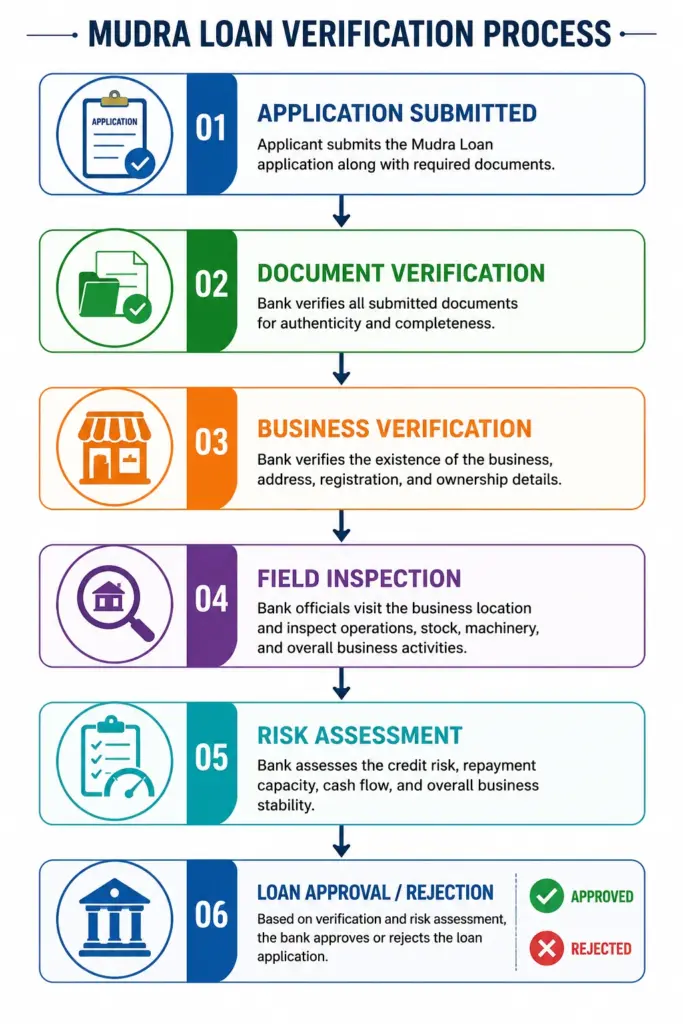
The Mudra Loan verification process follows a structured approach to help banks assess the authenticity, operational status, and financial viability of a business before making a lending decision. Although the exact procedure may vary slightly between banks, most lenders follow a similar sequence of verification activities to confirm that the information provided in the loan application is accurate and reliable.
The infographic below illustrates the typical step-by-step verification journey—from submitting the loan application and document verification to field inspection, risk assessment, and the final approval or rejection of the Mudra Loan application.
Banks may use different verification methods depending on the applicant, business type, loan amount and information submitted. The table below explains the purpose of each major verification stage and links to the relevant detailed guide.
| Verification Type | Purpose | Detailed Guide |
|---|---|---|
| Document Verification | Validate the authenticity, accuracy and completeness of the records submitted with the loan application. | Read Guide → |
| Phone Verification | Confirm the applicant’s identity, business details, address, loan purpose and other information by telephone. | Read Guide → |
| Business Verification | Verify that the business genuinely exists, operates as stated and matches the information provided in the application. | Read Guide → |
| Site Inspection | Inspect the physical business premises, machinery, stock, employees and operational setup. | Read Guide → |
| Field Investigation | Assess the actual operational status, address, ownership, reputation and consistency of the business information. | Read Guide → |
| Turnover Verification | Validate business income and sales by reviewing bank statements, GST records, invoices and other evidence. | Read Guide → |
| Re-Verification | Resolve discrepancies, incomplete findings or doubts identified during the first verification. | Read Guide → |
Bank verification is conducted to confirm that the information provided in the Mudra Loan application is genuine and consistent with the actual business. Even eligible applicants can face verification issues if the bank finds discrepancies, incomplete records, or difficulties in confirming business operations. Understanding these common mistakes can help you prepare in advance and improve your chances of loan approval.
If the business address mentioned in the application does not match the actual operating location or supporting documents, the bank may not be able to verify the business successfully. Always ensure that your business address is consistent across your application, registration certificates, utility bills, and rent agreement.
A closed business during the verification visit may create doubts about whether the business is genuinely operational. If the closure is temporary due to holidays, renovation, relocation, or seasonal operations, inform the bank immediately and provide supporting evidence whenever possible.
Related Guide: https://projectreportbank.com/business-not-operational-during-mudra-loan-verification/
Banks may cross-check invoices with bank transactions, GST returns, suppliers, and purchase records. Fake, altered, or unverifiable invoices can seriously damage the applicant’s credibility and may result in immediate rejection.
Declaring unrealistic turnover that cannot be supported by bank statements, GST records, invoices, or accounting records creates significant verification concerns. Applicants should always disclose accurate and verifiable business income.
Related Guide: https://projectreportbank.com/how-banks-verify-business-turnover-for-mudra-loan/
Differences between the loan application, project report, phone verification, field visit observations, and supporting documents may lead the bank to question the authenticity of the application. Ensure all information remains accurate and consistent throughout the verification process.
Banks frequently contact applicants during phone verification. An incorrect, switched-off, or unreachable mobile number may delay verification or create unnecessary doubts about the application.
Related Guide: https://projectreportbank.com/mudra-loan-phone-verification/
Although a signboard is not always mandatory, it helps bank officials easily identify the business location during physical verification. A clearly visible business name board strengthens the credibility of the business premises.
During field verification, investigators may speak with employees, neighbours, or family members. If they are unaware of the business operations or provide conflicting information, the verification report may become unfavourable.
If the business appears inactive, has no customers, stock, machinery, or visible operations during the inspection, the bank may conclude that the enterprise is not functioning as claimed. Applicants should be prepared to explain temporary closures or newly established businesses with supporting documents.
Related Guide: https://projectreportbank.com/business-not-operational-during-mudra-loan-verification/
Missing licences, incomplete financial records, outdated rent agreements, inconsistent business registrations, or insufficient supporting documents can delay verification and reduce the bank’s confidence in the application. Maintaining well-organized and updated documentation makes the verification process smoother.
Most Mudra Loan verification failures are caused not by a lack of eligibility, but by inconsistencies between the application and the actual business. Maintaining accurate records, keeping the business operational, providing truthful information, and cooperating during verification can significantly improve the chances of loan approval.
Proper preparation before the bank’s verification visit can significantly improve your chances of Mudra Loan approval. A well-organized business, accurate records, and consistent information help the bank complete the verification smoothly while reducing unnecessary doubts or delays. Use the checklist below to ensure your business is ready before the verification process begins.
✔ Keep this checklist ready before the bank official or field investigator visits your business.
| ✔ Checklist Item | Why It Is Important |
|---|---|
| Keep Original Documents Ready | Keep original identity, address, business registration, GST, Udyam, rent agreement, and other supporting documents readily available for verification. |
| Inform Employees or Family Members | Ensure employees or family members know about the expected bank visit and can accurately explain the business if required. |
| Ensure the Business Is Operational | Keep the shop, office, factory, or workspace open and functioning during the expected verification period. |
| Keep Invoices and Bills Available | Maintain purchase invoices, sales invoices, quotations, and other business records that support your operations and turnover. |
| Update Your Contact Number | Make sure your registered mobile number is active so you don't miss any verification calls from the bank. |
| Display a Business Name Board | A visible business signboard helps bank officials easily identify your business premises during the field visit. |
| Maintain GST, Udyam & Registration Records | Keep GST registration, Udyam Registration, Shop & Establishment Licence, and other applicable business registrations updated and accessible. |
| Organize Financial Documents | Arrange bank statements, financial statements, cash flow records, and tax documents in an orderly manner for quick review. |
| Keep Stock or Business Assets Available (If Applicable) | Trading and manufacturing businesses should ensure that inventory, machinery, equipment, or raw materials are available for inspection. |
| Remain Available During Verification | The applicant or an authorized representative should be present to answer questions and provide clarification during the verification process. |
Preparing for bank verification is not about creating an artificial impression—it is about ensuring that your business accurately reflects the information provided in your Mudra Loan application. Consistent records, an operational business, organized documentation, and transparent communication help build the bank’s confidence and can improve the likelihood of a successful verification and loan approval.
The bank's verification process varies depending on the nature of your business. Different business models require different types of physical verification, supporting documents, and operational evidence. The table below highlights what bank officials generally focus on during verification for each business type.
| Business Type | Verification Focus |
|---|---|
| Trading Business | Stock availability, purchase & sales invoices, customer activity, supplier records and business operations. |
| Manufacturing Unit | Machinery, production process, raw materials, finished goods, workers and manufacturing capacity. |
| Service Business | Office setup, client records, service contracts, equipment, staff and operational activities. |
| Home-Based Business | Dedicated workspace, business equipment, operational evidence and separation from residential use. |
| Rented Premises | Valid rent agreement, landlord confirmation, business occupancy and address verification. |
Bank verification is one of the most critical stages of the Mudra Loan approval process. In my experience of working with MSMEs, business finance, project reports, and Mudra Loan cases, many genuine applications are delayed or rejected not because the business is ineligible, but because the verification process reveals inconsistencies or incomplete information. Proper preparation, transparency, and organized documentation can significantly improve your chances of successful verification.
💡 Tip 1: Never Treat Verification as a Formality
Bank verification is an important part of the credit assessment process. Every observation made by the verification officer may influence the final loan decision.
💡 Tip 2: Ensure Your Application Matches the Actual Business
The information provided in your application, project report, financial documents, and discussions with bank officials should accurately reflect your actual business operations.
💡 Tip 3: Keep Business Records Well Organized
Maintain updated business registrations, GST records, bank statements, invoices, financial statements, and other supporting documents for quick verification.
💡 Tip 4: Inform Employees or Family Members in Advance
Employees or family members present during the verification visit should be aware of the business activities and expected bank inspection to avoid conflicting information.
💡 Tip 5: Keep Your Registered Mobile Number Active
Many banks complete an important part of the verification through phone calls. Ensure your registered mobile number remains active and accessible.
💡 Tip 6: Avoid Exaggerating Turnover or Business Capacity
Never overstate your sales, production capacity, customer base, or business income. All claims should be supported by genuine records and financial evidence.
💡 Tip 7: Display a Visible Business Signboard
A properly displayed business name board helps verification officers quickly identify your premises and enhances the credibility of your business location.
💡 Tip 8: Be Honest and Transparent During Verification
If the bank official asks questions about your business, provide clear, factual, and consistent answers. Transparency builds confidence during the verification process.
💡 Tip 9: Cooperate Fully During Re-Verification
If the bank requests a second verification due to missing information or discrepancies, respond promptly and provide all required clarifications without delay.
💡 Tip 10: Maintain Written Records of Every Clarification
Whenever you submit additional documents, explanations, or clarification letters to the bank, keep copies for your records. Proper documentation can be helpful if any verification issue arises later.
Successful Mudra Loan verification is not about creating a perfect appearance—it is about demonstrating that your business genuinely exists, operates as described, and is supported by accurate documentation. Careful preparation, honest communication, and complete records are the most effective ways to improve your chances of loan approval.
A successful Mudra Loan verification depends on accurate information, proper documentation, and a genuine operating business. The comparison below highlights factors that generally improve approval chances and situations that commonly increase the risk of loan rejection.
| Situation | High Approval Chance | High Rejection Risk |
|---|---|---|
| Business Operational | ✔ | — |
| Correct Business Address | ✔ | — |
| Reachable Phone Number | ✔ | — |
| Proper Business Records | ✔ | — |
| Business Closed During Visit | — | ✔ |
| Fake Turnover Declaration | — | ✔ |
| Wrong Business Address | — | ✔ |
| Missing Documents | — | ✔ |
| Unavailable Applicant | — | ✔ |
| Major Information Mismatch | — | ✔ |
Below are answers to some of the most common questions about the Mudra Loan verification process. Understanding these aspects can help applicants prepare effectively and avoid common verification-related issues that may delay or affect loan approval.
Banks conduct business verification to confirm that the applicant’s business genuinely exists, is operational, and matches the information provided in the loan application. Verification also helps assess repayment capacity and reduce the risk of fraudulent applications.
During a field verification visit, the bank official or field investigator may inspect the business premises, verify the address, observe business activities, check stock or machinery (where applicable), and interact with the applicant or employees. The observations are recorded for credit assessment.
Phone verification is commonly conducted by many banks, but the exact verification process may vary depending on the bank’s internal policies, loan amount, and the applicant’s profile. Applicants should always keep their registered mobile number active and reachable.
Yes. Home-based businesses can qualify for a Mudra Loan if the bank is satisfied that genuine business activities are being carried out. Maintaining a dedicated workspace, proper documentation, and business records can strengthen the verification outcome.
Banks generally verify turnover by reviewing bank statements, GST returns (if applicable), sales invoices, purchase records, financial statements, and other supporting documents. The declared turnover should be consistent with the available evidence.
A Field Investigation Report (FIR) is a report prepared by the bank’s field investigator after visiting the business premises. It records observations regarding business operations, address verification, infrastructure, customer activity, and other relevant findings that assist in the loan evaluation process.
A bank may conduct re-verification if it finds inconsistencies, incomplete information, or requires additional confirmation after the initial verification. Re-verification helps clarify doubts before making the final lending decision.
If your business is temporarily closed due to holidays, renovation, seasonal operations, or other genuine reasons, inform the bank immediately and provide supporting evidence if required. Lack of communication may result in an adverse verification report.
Keep your original documents ready, ensure the business is operational, display a business signboard, organize financial records, inform employees about the visit, and remain available to answer questions. Proper preparation helps the verification process proceed smoothly.
No. Successful verification is only one part of the overall credit assessment. The bank also evaluates factors such as eligibility, financial position, repayment capacity, documentation, business viability, internal credit policies, and overall risk before taking the final loan approval decision.
Bank verification is one of the most important stages in the Mudra Loan approval process and involves much more than simply checking documents. Banks use multiple verification methods—including phone verification, business visits, field investigations, site inspections, and turnover assessment—to confirm that the information provided in the loan application accurately reflects the applicant’s actual business operations. These verification activities help banks assess the authenticity, operational status, and financial viability of the business before making a lending decision.
For applicants, understanding how the verification process works is equally important. Proper preparation, accurate documentation, transparent communication, and consistency between the application and the actual business can significantly reduce avoidable mistakes and improve the likelihood of a successful verification. Being proactive before the bank’s assessment often makes the verification process smoother and more efficient.
This Mudra Loan Bank Verification cluster has been created to help you understand every stage of the verification process in detail. Whether you want to learn about phone verification, field investigation, turnover verification, site inspections, home-based business verification, or re-verification, each guide provides practical insights to help you prepare with confidence. Explore the detailed articles in this cluster to strengthen your application and approach the bank’s verification process with greater clarity and readiness.