Key Takeaways
- A roller flour mill project report or DPR is the central planning and appraisal document required before committing capital to a wheat flour mill project, serving as a blueprint for business operations and supporting bank loan applications, government approvals, and investment decisions for entrepreneurs and MSMEs.
- A commercial roller flour mill typically processes wheat grains into atta, maida, suji/semolina and bran, with project viability driven by capacity, wheat procurement cost, extraction ratio, product mix, selling prices, capacity utilisation and working capital cycle.
- A professional roller flour mill DPR for bank loan must cover total project cost, means of finance, working capital assessment, 5–7 year financial projections, DSCR, break-even analysis, ROI, IRR, payback period and sensitivity analysis, with CMA data mandatory for manufacturing loans above ₹10 lakh per RBI guidelines.
- Project Report Bank, led by CA Manish Gugliya (FCA, DISA, 20+ years’ experience), prepares customised DPRs, CMA Data and financial models for roller flour mill projects across India.
- Detailed guides on setup cost, machinery, process, capacity, plant layout, project finance, projections, feasibility and ROI/IRR are linked throughout this article for deeper study.
Roller Flour Mill Project Report & DPR – Overview
A roller flour mill is an industrial manufacturing plant that converts raw materials wheat into multiple finished products-wheat flour (atta), refined flour (maida), semolina (suji), bran and other by-products such as flour germ-using a system of steel rollers, plansifters, purifiers and pneumatic conveying. This distinguishes it from a small scale flour mill or atta chakki unit, which typically produces only whole wheat flour with limited capacity and product range.
India has around 800 large flour mills, and the flour milling industry processes approximately 12–15% of total wheat consumption in the country, converting roughly 10.5 million tons of wheat annually. The India market position in wheat flour production remains strong, driven by population growth, urbanisation and rising demand for packaged flour.
A roller flour mill project report is the structured document that brings together technical, financial, commercial and risk analysis before a promoter commits capital or approaches a bank. Key cost factors that determine viability include wheat procurement cost and quality, extraction ratio, product mix, by-product realisation, capacity utilisation, power cost, logistics and finance cost. This article provides a structured overview of what a roller flour mill DPR covers, while specialised topics are addressed in separate in-depth guides linked from relevant sections.
Project Report Bank is a Chartered Accountant–led project finance advisory platform focused on customised DPRs and financial modelling for flour mill plants and wheat processing projects-not a template marketplace.
What Is a Roller Flour Mill DPR or Detailed Project Report?
A detailed project report for a roller flour mill is a comprehensive document covering the business plan, technical setup and investment cost of the proposed project. It must follow a structured layout for clarity and typically includes: promoter background, project concept, industry overview, market assessment, proposed capacity (TPD), manufacturing process description, machinery list, land and building details, utilities and water supply requirements, manpower and staffing requirements covering both technical and administrative personnel, raw material sourcing plan, an implementation schedule for phased activities, project cost, means of finance, working capital, projected financial statements, profitability estimates, cash flow, DSCR, break-even analysis, ROI, IRR, payback period and sensitivity analysis.
The depth of the DPR may differ depending on whether it is prepared for internal investment evaluation, a bank term loan, working capital limits, expansion of an existing mill, or investor discussion. A well-prepared DPR helps both the promoter test feasibility and the lender assess viability, but no DPR by itself guarantees loan sanction or profitability.
Promoters who need a bank-ready roller flour mill DPR, CMA Data or financial model can contact CA Manish Gugliya through ProjectReportBank.com for professional preparation and advisory support.
Roller Flour Mill Business Model and Product Mix
A commercial flour mill business earns revenue by procuring wheat in bulk, milling it into atta, maida, suji and bran, and selling through B2B channels (bakeries, food manufacturers, wholesalers, civil supplies department tenders) and B2C channels (retail branded packs, institutional supply). The project report must assess demand for wheat products and other cereals in the target market, including local consumption patterns for flour products.
Profitability depends not just on tonnage milled but on extraction ratio, product mix, by-product realisation from bran, packaging formats and distribution strategy. Wheat quality and a sourcing strategy covering procurement channels and storage are critical for stabilising margins. The flour mill project report should clearly define the intended business model-job-work milling, own-brand packaged flour, institutional supply, government tender participation, or a combination-as this affects capacity, working capital and risk profile. For promoters exploring related wheat flour mill projects, the same principles apply.
Roller Flour Mill Setup Cost – Investment Overview
Setup cost for a roller flour mill varies widely based on plant capacity in TPD, level of automation, imported versus Indian roller flour mill machineries, land cost in the concerned state, civil construction quality, storage infrastructure (silos versus godowns), utilities, packing systems and plant location factors. Flour mill project costs for very small units (500 kg/day to 1 MT/day) may range from ₹9–27 lakh, while medium commercial mills (100 TPD) may require ₹12–18 crore in total project outlay. Larger plants at 200–300 TPD can involve ₹30–75 crore depending on specifications.
Any serious promoter should base decisions on project-specific cost estimates and actual quotations rather than generic benchmarks. For a detailed analysis, refer to Roller Flour Mill Setup Cost in India.
Machinery and Equipment Required for a Roller Flour Mill
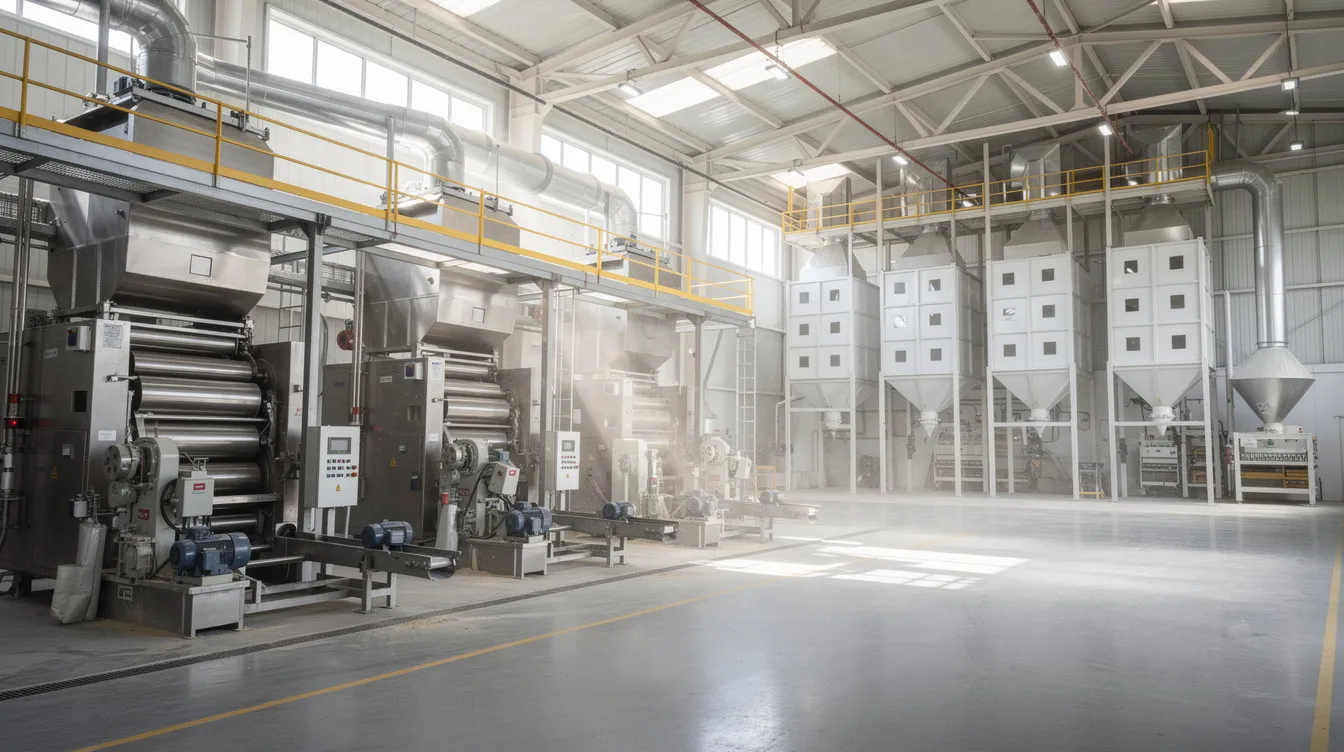
The machinery configuration is the backbone of any flour mill project and must align with desired capacity, automation level and product mix. A roller flour mill uses various machinery for purification and milling, and a 500TPD flour mill project typically includes multiple milling machines. Major equipment categories include: wheat receiving and storage systems, pre-cleaning and cleaning equipment (vibratory separators, aspirators, destoner units used in the manufacturing process, magnetic separators, scourer machine), wheat conditioning systems with spray damper for tempering milling, roller mills, a high square plansifter, purifiers, bran finishers, air classifiers, pneumatic flour mill machines of 800–1000 length for the conveying system, flour blending equipment, weighing and automatic packing machines, dust collection systems, and electrical panels.
The DPR should list machinery required with capacities, supplier details and indicative costs. Integration between main equipment, auxiliary systems and automation significantly impacts energy consumption and product quality. For a granular equipment breakup, see Roller Flour Mill Machinery & Equipment Cost.
Roller Flour Milling Process – From Wheat to Atta, Maida and Suji
The roller flour milling process starts with wheat receipt, sampling and testing, followed by the main stages: cleaning continuously through pre-cleaning and cleaning equipment, grading, conditioning (moisture adjustment), milling through multiple roller passes in the milling section, sieving and separation via plansifters, purification, blending, quality control and packing. Wheat grains consist of endosperm, embryo and enveloping skins, and the process is designed to efficiently separate these components into finished products.
Quality control measures should address general tests in the manufacturing process including testing methods such as bleach figure, empirical scale pH measurement, and use of reagents including acetic acid reagent, potassium iodide and acid sodium pyrophosphate for analytical data and grade quality assessment. The DPR should include a simplified process flow chart, typical extraction ratios and key quality-control points. Even small changes in recovery percentages materially affect revenue. For step-by-step details, refer to the Roller Flour Milling Process & Flow Chart.
Choosing the Right Roller Flour Mill Capacity (TPD)
Production capacity selection is among the most critical decisions in a roller flour mill project. Roller flour mills can process 300 to 1000 tons of wheat daily at large scale, though many promoters begin at smaller capacities. Primary factors affecting optimal capacity include wheat availability, local flour market demand, competition, distribution network, working capital access, infrastructure and the promoter’s execution capability.
A DPR should model capacity ramp-up over 3–5 years rather than assuming full installed capacity from day one. Smaller capacities may suit initial entry but limit economies of scale, while very large capacities demand robust marketing and procurement systems. Refer to Roller Flour Mill Capacity Planning in TPD and production capacity for detailed guidance.
Land, Building and Plant Layout Requirements
Location and plant layout major provisions directly influence logistics cost, efficiency, food-safety compliance and future expansion. Typical components include raw wheat receiving area, raw material storage godowns or silos, main production block (multi-storey steel structure), finished goods warehouse, packaging section, QC laboratory, utility area (transformer, DG set, compressors), administrative block, and circulation space.
The manufacturing plant layout should show logical material flow from reception to dispatch. Regulatory compliance including FSSAI licensing, pollution control clearances, fire safety and GST registration must be addressed at the site-selection stage. For area norms and layout planning, see Roller Flour Mill Land, Building & Plant Layout requirements.
Roller Flour Mill Project Cost and Means of Finance
The DPR must summarise total project cost and means of finance clearly, as this is central to both promoter decision-making and bank appraisal. Project cost heads typically include land and site development, factory building, plant and machinery (including taxes and transport), electrical installations, utilities, laboratory equipment, preliminary and pre-operative expenses, contingencies and margin for working capital.
Means of finance usually cover promoter equity contribution (promoter contribution of 10–25% is typically required by banks), term loan, possible subordinated loans and other sources. The term-loan tenure and repayment schedule must align with projected cash flows and DSCR. For a deeper breakup, see Roller Flour Mill Project Cost and Means of Finance.
Working Capital Requirement in a Roller Flour Mill
In my experience preparing DPRs for manufacturing projects, working capital is the most frequently underestimated component in flour mill project planning. Major working-capital components include raw wheat inventory (often built up during harvest for favourable pricing), packing material stock, finished goods inventory across applications wheat scenario, trade receivables and supplier credit. A DPR must include raw material sourcing and working capital needs assessment based on realistic inventory days and credit terms, not just a percentage of sales.
A project can be profitable on paper but face cash-flow stress if working-capital limits are inadequate. For detailed working-capital modelling, see Roller Flour Mill Financial Projections & Working Capital planning.
Financial Projections in a Roller Flour Mill Project Report
Bankable flour mill project reports should include integrated 5–7 year financial projections with break-even analysis and profitability estimates. Banks expect accurate projections of capacity utilisation and revenue. Key assumptions include wheat purchase price, extraction ratios for atta/maida/suji/bran, selling prices, power and fuel consumption, manpower costs, interest, depreciation and tax.
Flour mill financial projections must include byproduct revenue models-bran sales can contribute meaningfully to overall profitability. A flour mill at 70–80% capacity can achieve 18–24% net profit margins when assumptions are realistic. Projections must be internally consistent: production volumes must tie to capacity utilisation, and details processing of raw material consumption must reflect extraction ratios. Different scenarios (base, optimistic, stressed) help evaluate robustness.
DSCR and Bank Loan Assessment for Roller Flour Mill Projects
The Debt Service Coverage Ratio measures whether available cash flow adequately covers debt servicing obligations (interest plus principal). Financial metrics such as DSCR and ROI are critical for bank loan applications, and a Debt Service Coverage Ratio above 1.5 is crucial for approval in most lending institutions. The typical loan repayment timeline for flour mills is 2–3 years of moratorium followed by structured repayment.
Banks examine promoter background, total investment cost, projected profitability, cash flow, DSCR, security, working-capital assessment, wheat slection and procurement strategy, and sensitivity to adverse changes. No specific DSCR value guarantees sanction-final approval depends on overall credit analysis and promoter profile.
Roller Flour Mill Feasibility Study and Project Viability
A roller flour mill project report should embed a structured feasibility study covering market, technical, financial and operational dimensions. DPRs include market feasibility and technical specifications as core components.
Market analysis includes identifying competitors, pricing strategies and local demand for atta, maida and suji in the concerned state. Technical feasibility covers choice of process technology, machinery, equipment for cleaning, conditioning and milling, layout, and ability to meet product quality standards. Financial feasibility evaluates profitability, break-even, DSCR, ROI and IRR. Operational feasibility examines procurement logistics, storage, skilled manpower availability and risk factors.
For a deeper framework, see Roller Flour Mill Feasibility Study & Project Viability analysis.
ROI, IRR, Payback Period and Sensitivity Analysis
ROI measures return on total capital employed, IRR represents the discount rate at which NPV becomes zero, and payback period indicates time to recover initial investment. These should not be viewed in isolation or based on overly optimistic assumptions.
Sensitivity analysis is essential because roller flour profitability is highly sensitive to wheat purchase prices, flour selling prices, extraction ratio, capacity utilisation, power tariffs and interest rates. Sensitivity analysis considers variations in raw material prices and production costs under adverse scenarios. The DPR should show base-case metrics and stress-tested outcomes. For advanced evaluation, see the detailed guide on Roller Flour Mill ROI, IRR, Payback & Sensitivity Analysis.
Key Assumptions That Drive Roller Flour Mill Profitability
In flour milling, seemingly small changes in key assumptions can materially alter project viability. The most critical assumptions include: average wheat purchase price, expected selling price and product mix, extraction ratios for each product, capacity utilisation ramp-up, power tariff and consumption per tonne, labour cost, distribution expenses, interest rates on term loans and working capital, and credit periods. The food processing industry demands that assumptions be based on recent market data, actual quotations and conservative estimates. Transparent assumptions build credibility with bankers and make the financial model a multipurpose service tool that can be updated as conditions change.
Information Required to Prepare a Roller Flour Mill DPR
Promoters should compile these inputs before engaging a consultant:
- Promoter profile and existing business details
- Proposed location, land status and same plant expansion plans if applicable
- Proposed capacity (TPD), operating shifts and product mix
- Machinery quotations from suppliers of flour milling machines
- Building layout and construction estimate
- Wheat purchase sources, indicative price band and storage strategy
- Target markets, selling channels and price expectations
- Staffing requirements covering technical and administrative personnel
- Desired funding pattern (own funds, bank loans, working capital)
- Banking relationships and collateral availability
A financial model needs to incorporate actual vendor quotations for machinery rather than generic estimates. Timely data collection avoids multiple revisions during tight bank submission timelines.
Roller Flour Mill DPR for Bank Finance and Term Loans
Banks require a detailed project report for loan applications. DPRs are essential for securing bank loans or government approvals, and documentation must support investment decisions for entrepreneurs and MSMEs. CMA data is mandatory for loans above ₹10 lakh per RBI guidelines, and the CMA Data should be derived from the same financial model as the DPR to avoid inconsistencies.
A DPR supports the credit appraisal process but does not by itself guarantee loan sanction. Final sanction remains subject to the bank’s credit policies, promoter profile, financial position, security, CIBIL/credit history, regulatory compliance and project viability.
Common Mistakes in Roller Flour Mill Project Reports
Common errors that reduce credibility include: assuming very high capacity utilisation from year one, ignoring wheat price volatility, using overly optimistic extraction ratios, inadequate working capital planning, underestimating power cost and maintenance, and copying generic financial projections not aligned with actual machinery or location. Mismatches between project cost in the DPR and actual machinery quotations are frequent red flags. All calculations-DSCR, ROI, IRR and payback-must be cross-checked across DPR, CMA Data and loan forms. I strongly recommend that promoters get draft projections reviewed by an experienced financial professional before submission, particularly for medium and large scale roller flour mill projects.
Why Professional Financial Modelling Matters
A true roller flour mill DPR must be backed by a robust financial model integrating production, sales, raw material consumption, operating expenses, working capital, debt structure, interest, depreciation and tax. When well-designed, any change in key inputs automatically updates all financial statements and ratios, enabling meaningful sensitivity analysis and avoiding calculation errors that bankers quickly detect during appraisal.
Who Should Prepare a Roller Flour Mill DPR?
A robust mill project report requires inputs from promoters, machinery manufacturers, civil engineers, Chartered Accountants and financial consultants. While machinery suppliers provide useful technical notes and project profiles referenced by organisations like Engineers India Research Institute, independent financial analysis should be led by experienced professionals. My role as a practising Chartered Accountant focuses on financial modelling, feasibility assessment, cost structuring, DSCR analysis and bank documentation support.
Professional DPR & Project Finance Assistance from Project Report Bank
ProjectReportBank.com specialises in customised Detailed Project Reports, CMA Data, financial projections and project-finance advisory for manufacturing units including roller flour mills. Typical engagement scope includes finalising project cost and means of finance, preparing 5–7 year projections, working-capital assessment, DSCR and repayment analysis, break-even and sensitivity analysis, and drafting a structured DPR aligned with bank expectations. Services may also include CMA Data preparation, guidance on loan documentation and support in responding to bank queries.
Professional fees start from ₹25,000 depending on project size, complexity and scope. Payment terms: 30% advance at commencement and 70% after submission of the first complete draft, before final release.
Planning a roller flour mill and need a bank-ready DPR, CMA Data or financial model? Connect with CA Manish Gugliya through ProjectReportBank.com for professional project-report and financial-planning assistance.
Detailed Roller Flour Mill Planning Guides
This article serves as the central hub for roller flour mill project reports and DPRs. For deeper analysis on specific topics, explore these detailed guides:
- Roller Flour Mill Setup Cost in India – overall investment and key cost factors
- Roller Flour Mill Machinery & Equipment Cost – equipment types and costing
- Roller Flour Milling Process & Flow Chart – process stages and extraction
- Roller Flour Mill Capacity Planning – TPD & Production Capacity – sizing the plant
- Roller Flour Mill Land, Building & Plant Layout – site and layout planning
- Roller Flour Mill Project Cost & Means of Finance – financing structure
- Roller Flour Mill Financial Projections & Working Capital – projections and cash flow
- Roller Flour Mill Feasibility Study & Project Viability – viability assessment
- Roller Flour Mill ROI, IRR, Payback & Sensitivity Analysis – investment returns
Read the relevant guides before finalising your flour mill business plan so that capacity, technology, cost and financing choices are made on a well-informed basis. For integrated support-from feasibility assessment to DPR preparation and bank loan documentation-reach out to Project Report Bank for end-to-end professional assistance.
FAQs – Roller Flour Mill Project Report and DPR
What is typically included in a Roller Flour Mill Project Report?
A complete roller flour mill project report normally covers promoter background, project concept, industry and market overview, proposed capacity and product mix, manufacturing process description, machinery list with indicative cost, land and building requirements, utilities and manpower, implementation schedule, regulatory considerations including FSSAI compliance, total project cost with item-wise breakup, means of finance, working-capital assessment, 5–7 year financial projections, DSCR, break-even, ROI, IRR, payback and risk analysis. For bank finance, the DPR is typically accompanied by CMA Data consistent with the main report figures.
How much investment is required for a roller flour mill in India?
Investment varies substantially. A very small unit (500 kg/day to 1 MT/day) may require ₹9–27 lakh. Medium commercial roller mills (50–100 TPD) may need ₹7–18 crore, while large plants at 200–300 TPD can involve ₹30–75 crore. The actual figure depends on capacity, automation, machinery specification, land cost, storage infrastructure and location. I recommend project-specific cost estimation based on actual quotations before approaching banks. Refer to the setup cost guide for a structured understanding.
What is the ideal capacity for a new roller flour mill?
There is no universal ideal capacity. The appropriate size depends on local and regional demand, competitive landscape, wheat availability, promoter’s marketing and procurement capability, working-capital strength and long-term plans. Smaller capacities may be more manageable initially but limit economies of scale. Evaluate at least two capacity options during feasibility analysis.
How do banks evaluate the feasibility of a roller flour mill project?
Banks examine promoter credentials, total project cost, means of finance, collateral, projected profitability and cash flows, DSCR, working-capital assessment and compliance with internal lending norms. They typically benchmark assumptions against industry experience and perform sensitivity checks-such as the impact of rising wheat prices or falling selling prices-to test whether the project can still service debt comfortably. A robust DPR with transparent assumptions strengthens the appraisal outcome.
What determines profitability in a roller flour mill?
Profitability is driven by wheat purchase price, flour selling prices, extraction ratio, product mix (percentage of atta versus maida versus suji), by-product realisation from bran, capacity utilisation, power cost, working capital cycle and finance cost. Flour mills achieve net profit margins of 18–24% at 70% capacity utilisation when these variables are well managed. Minor changes in any of these assumptions can significantly alter project viability, which is why sensitivity analysis is essential in every flour mill project report.