
Key Takeaways
- A bankable poha processing plant project report must integrate technical setup (machinery, capacity, process), market assumptions (product mix, selling price, distribution) and financial projections (P&L, balance sheet, cash flow, DSCR) into a single, internally consistent document.
- Profitability, debt service coverage ratio, working capital planning and raw material procurement strategy carry as much weight in bank appraisal as machinery quotations and plant layout.
- Different plant scales (small, medium, industrial) follow the same DPR logic but vary in total project cost, automation level, working capital cycles and risk profiles; poha manufacturing project costs range from ₹5 to ₹40 lakh depending on capacity and configuration.
- This hub article connects to 15 specialised guides covering process flow, machinery, capacity, cost, projections, bank finance and feasibility, forming a complete poha and rice flakes processing knowledge hub.
- All guidance is India-focused and written from the perspective of a practising Chartered Accountant experienced in preparing poha processing plant DPRs for bank loans, project finance and subsidy-linked schemes.
Introduction: Poha, Rice Flakes and the Need for a Proper DPR
Poha, also called flattened rice, beaten rice or rice flakes, is a staple food consumed across Indian households daily. From Maharashtra to West Bengal, from Odisha to Karnataka, poha serves as a breakfast item, snack base and ingredient in regional dishes. India’s poha market size is estimated at ₹8,500 crore annually, and the product enjoys consistent year-round consumption rather than seasonal demand cycles. This makes the processing business a genuinely relevant food processing opportunity.
Even though poha is a technically simple product, commercial poha production becomes complex once we factor in paddy quality, plant capacity, utilities, automation, product mix, packaging strategy and distribution channels. The standard manufacturing process involves cleaning, soaking, roasting, flaking, grading, and packaging, but each step has financial implications that affect yield, cost and quality. A high-quality product is achieved through careful control of each step in the processing chain.
Creating a comprehensive project report for a poha processing plant is essential for securing bank loans and for the promoter’s own decision-making. In my experience as a Chartered Accountant, lenders do not finance machinery lists; they finance well-structured projects where capacity, raw material planning, revenue projections, DSCR, working capital and sensitivity analysis all align. A poha processing plant project report and DPR is the primary document used by banks, investors and promoters to judge technical feasibility, commercial viability and financial sustainability. This hub article provides a structured overview of every major component and points to specialised, deeper guides where detailed tables, calculations and technical notes are needed.
Poha Processing Plant Project Report & DPR: What It Covers
A detailed project report for a poha plant, in the Indian banking context, is a formal document prepared for term loan appraisal, working capital assessment, subsidy applications and investor evaluation. It is not a brochure or a machinery catalogue.
A professional poha manufacturing plant project report should contain:
- Project summary and promoter profile (background, financial strength, experience)
- Business model, market overview and target customer segments
- Technical configuration: process type, machinery, plant layout, capacity
- Raw materials: paddy variety, yield assumptions, procurement strategy
- Location details, land, building and regulatory environment
- Utilities and manpower planning
The financial sections are equally critical:
- Detailed project cost and means of finance (share capital, term loan, unsecured loans, subsidy)
- Projected profit and loss account, projected balance sheet, cash flow statement
- Working capital assessment with inventory, receivable and creditor norms
- DSCR over the full loan tenure, break even analysis, ratio analysis
- Sensitivity analysis under adverse scenarios
Internal consistency matters. Proposed poha production capacity must align with machinery rating, paddy requirement, power load, manpower, storage and sales projections. If the machinery is rated for 500 kg/hr but the DPR projects sales requiring 2,000 kg/hr, the report fails at the first review. A bankable poha manufacturing plant DPR will generally cover at least 5 to 7 operating years of projections, especially when assessing long-tenure term loans and DSCR trends.
Understanding the Poha Manufacturing Process
The DPR needs enough technical detail to validate capacity, utilities, quality and food-safety compliance. It does not need to read like an engineering manual.
The main stages in the paddy to poha manufacturing process are:
- Paddy selection and incoming quality check
- Cleaning and de-stoning to remove dust, stones and broken grains
- Soaking and conditioning: paddy is soaked for 8 to 12 hours to soften the grain structure
- Steam parboiling at 100 to 120°C for 20 to 40 minutes, which gelatinises the starch
- Drying: roasted paddy is dried to 10 to 12% moisture before flaking
- Flaking using a roller flaker to produce flat rice flakes of controlled thickness
- Grading and sieving to separate thin, medium and thick grades and remove broken pieces
- Packaging into retail pouches or bulk bags
The selection of appropriate paddy varieties directly impacts grain expansion and breakage rates, which in turn affect yield and raw material cost per kg of finished poha. Different configurations (traditional roasting, continuous roasters, automatic conveyor systems) are possible and should be described in the poha processing project report according to the proposed technology level.
For a fully detailed technical sequence and diagrams, refer to the guide on detailed Poha manufacturing process and process flow chart.
Plant Machinery and Equipment
Machinery selection for a commercial poha manufacturing plant depends on capacity, product mix (thick, medium or thin poha), desired automation level and packaging strategy. The DPR should describe each machine category with its function, tentative capacity, power rating and whether it is semi-automatic or fully automatic.
The main machinery groups include:
| Equipment | Function | Indicative Cost (INR) |
|---|---|---|
| Paddy cleaner and de-stoner | Removes dust, stones, broken grains | ₹40,000 to ₹1,50,000 |
| Soaking tank (200 to 1,000 kg/batch) | Softens paddy over 8-12 hours | ₹60,000 to ₹2,00,000 |
| Roasting drum or continuous roaster | Gelatinises starch, reduces moisture | ₹80,000 to ₹2,50,000 |
| Flaking mill (roller flaker) | Produces flat rice flakes | ₹1,50,000 to ₹5,00,000 |
| Vibro sifter and grader | Separates grades and broken flakes | ₹60,000 to ₹1,50,000 |
| Automatic packing machine | Packs into pouches or bags | ₹1,50,000 to ₹4,00,000 |
Total machinery cost for a small poha manufacturing unit ranges from approximately ₹3 to ₹9 lakh. Quotations should be cross-checked for installation, freight, taxes, control panels and civil or electrical work, as machinery and equipment cost is often under-estimated in generic templates.
For capacity-wise configurations and more granular technical notes, see the guide on Poha plant machinery and equipment cost.
Capacity Planning for a Poha Processing Plant
Realistic capacity planning is the foundation of any poha production unit project report. It drives project cost, raw material requirement, utilities, manpower and revenue potential.
Key inputs to analyse before finalising installed capacity:
- Expected market demand in the target geography
- Paddy availability and procurement logistics
- Promoter experience and operational capability
- Available land and building space
- Access to working capital for seasonal paddy stocking
- Distribution capacity and credit terms with buyers
Installed capacity (the theoretical hourly or daily rating of machinery) differs from practical achievable output. Working days per year, shift configuration, maintenance downtime and ramp-up period after commissioning all reduce actual production below the nameplate figure.
DPRs that assume 90 to 100% capacity utilisation from year one are routinely questioned by bankers. A more credible approach ramps utilisation gradually, for instance 50 to 60% in year one, 70 to 75% in year two, and 80% or above from year three onward.
Detailed formulas, utilisation curves and sample scenarios are available in the guide on Poha plant capacity planning and production capacity.
Land, Building and Plant Layout
A successful poha processing plant requires an effective plant layout to optimise production flow, ensure hygiene and support safe operations. The DPR should describe or sketch the layout covering:
- Raw paddy receipt and storage area
- Pre-cleaning, soaking and roasting sections
- Flaking and grading line
- Packaging room and finished goods storage
- Quality control and lab area
- Utilities area (boiler, electrical panels, fuel storage)
- Office, staff amenities and loading docks
Land required depends on capacity, type of fuel system (biomass boilers need more space than gas systems), storage strategy for seasonal paddy stocks and future expansion plans. A linear material flow from paddy intake to finished poha dispatch, with minimal cross-movement, reduces handling cost and contamination risk.
For detailed square-footage planning and layout options, consult the guide on Poha plant land and building requirements.
Paddy Procurement and Raw Material Planning
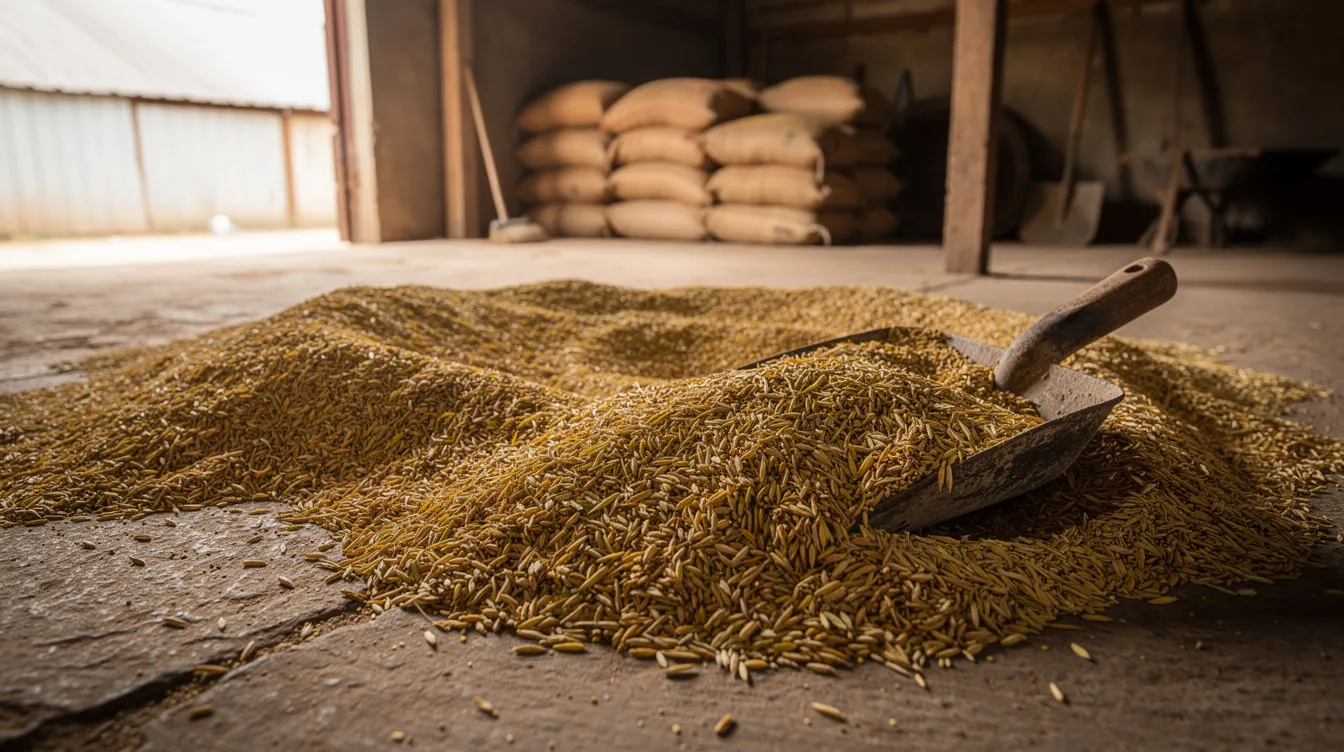
Paddy procurement is the single largest cost driver in a poha manufacturing business. Raw material cost typically accounts for 55 to 65% of total operating cost in most poha plants.
The DPR should address:
- Preferred paddy varieties (short or medium grain; parboiled vs raw) and their effect on flaking quality
- Moisture level at procurement and its impact on yield
- Expected paddy-to-poha conversion ratio, which is often around 75% for small units (approximately 1.3 kg paddy per 1 kg poha)
- Broken grain percentage and its effect on selling price of the finished product
- Procurement seasons, buying strategy (direct from farmers, mandi, traders) and storage arrangements
- Months of paddy inventory to be carried and the resulting working capital impact
Proximity to paddy-growing regions is crucial to reduce transportation costs and ensure raw material supply. A realistic poha project feasibility report will not assume a single flat paddy price throughout the year; it should allow for seasonal price variation and procurement timing.
The in-depth guide on paddy procurement for Poha plant covers yield assumptions, inventory norms and risk-mitigation strategies in greater detail.

Power, Fuel, Water and Manpower Requirements
Utility and manpower planning must match the chosen plant capacity, machinery configuration and shift pattern.
Electricity: connected load covers motors for cleaners, conveyors, rollers, compressors and packing lines. A semi-automatic plant may need 7 to 56 HP depending on hourly throughput. Energy efficiency measures should be considered to minimise costs in the processing operation.
Fuel and thermal energy: the roaster or parboiler uses biomass (rice husk, briquettes), LPG, PNG or coal. The DPR should specify fuel type, expected consumption per tonne and storage arrangements. Continuous supply of power, clean water, and steam is mandatory for processing operations.
Water: soaking, conditioning, boiler feed, cleaning and sanitation. A West Bengal project processing approximately 450 tonnes of paddy per year required approximately 10,000 litres per day.
Manpower: the DPR should specify skilled, semi-skilled and unskilled workers per shift, plus supervisory, quality control and maintenance staff. Labour cost feeds directly into operating expenses.
For detailed utility calculations matched to plant sizes, see the guide on utilities required for Poha processing.
Poha Processing Plant Project Cost
Financial assessments should include a detailed project cost estimate outlining fixed and working capital. The project cost structure in a poha plant DPR must be broken into clear heads acceptable to banks and subsidy schemes.
Typical fixed-asset heads:
- Land and site development
- Civil construction and building
- Plant and machinery (including installation, freight and taxes)
- Electrical installations
- Utilities (boilers, compressors, DG sets)
- Furniture, computers, office equipment, laboratory instruments
Intangible and pre-operative components include preliminary expenses, fixtures pre operative charges, interest during construction, consultancy, trial-run expenses and contingency provision.
Poha manufacturing project costs range from ₹5 to ₹40 lakh depending on capacity, automation and location. Margin for working capital is usually built into the total project cost for bank appraisal, especially under term-loan-plus-working-capital structures.
For capacity-wise project cost ranges and sample capital-cost tables, refer to the guide on Poha plant project cost and means of finance.
Means of Finance for a Poha Manufacturing Plant
The means of finance section in a poha plant project report shows the proposed mix of promoter contribution (equity), term loan, unsecured loans, subsidies and internal accruals for expansion projects.
Banks look for a reasonable promoter margin. The exact debt equity ratio depends on project risk, collateral, scheme guidelines and promoter financial strength rather than a fixed universal rule. For new units, the structure typically includes a term loan for fixed assets plus separate working capital limits.
Several government schemes support poha processing plant investment:
- PMFME provides a 35% credit-linked capital subsidy for food processing units
- PMEGP offers 15 to 35% capital subsidy up to ₹50 lakh
- Mudra loans provide up to ₹20 lakh without collateral
- State food processing schemes offer interest subvention and capital grants
Subsidy components should be clearly shown but not treated as guaranteed until formally sanctioned. Projections should remain viable even without subsidy wherever possible. The funding pattern, repayment schedule and DSCR must stay aligned so that annual instalments are realistic compared to projected cash generation.
Revenue Model and Product Mix
A realistic revenue model in a poha manufacturing business plan must be built around product grades, packaging options and target customer segments.
Common product variants include thick, medium and thin poha, regional speciality rice flakes, value-added or flavoured poha mixes, and by-products such as broken poha (chura) for low-price markets. Graded poha is packed into BOPP pouches or bulk bags depending on the sales channel.
Packaging formats to address in the DPR:
- Retail pouches (200 g, 500 g, 1 kg) for branded sales
- Bulk HDPE or jute bags for wholesalers and institutional buyers
- Private-label or contract manufacturing arrangements
The chosen product mix affects average selling price, packing material cost, distribution margins, marketing spend, capacity utilisation and working capital. Branded retail packs require more packaging material and distributor credit but command higher profit margin.
Explore the specialised guide on Poha revenue model, product mix and market strategy for sample product-mix tables and channel-margin analysis.
Operating Cost and Cost of Production
The operating cost section of a poha processing plant project report converts technical assumptions into per-kg cost of production and annual expenditure estimates.
Major variable costs: raw paddy and material cost, packing material cost, fuel expenses for roasting and parboiling, electricity, transport for incoming paddy and outgoing finished goods, and direct labour linked to production volume.
Major fixed or semi-fixed costs: salaries of key staff, factory rent or property taxes, repairs and maintenance, insurance, administration expenses, quality control expenses, charges selling and distribution, marketing overheads.
Interest on term loan and working capital, along with depreciation, are also part of the cost structure and must be derived from the project-cost and means-of-finance sections. Raw material cost and recovery or yield can affect production economics more than any other single variable.
Detailed costing formats and margin analysis are available in the guide on Poha plant operating cost and cost of production.
Profitability and Break-Even Analysis
Projected profitability in a poha processing plant depends primarily on contribution per kg (selling price minus variable cost), fixed costs and achievable capacity utilisation.
Key profitability indicators in a poha manufacturing project report:
- Gross profit margin
- EBITDA
- Net profit before and after tax
- Cash profit (net profit plus depreciation)
Net profit margins for branded retail poha are typically in the range of 16 to 22%, while bulk or loose poha operations achieve lower margins. Break-even typically occurs at 48 to 55% of installed capacity, making the ramp-up period in the first two years critical to cash-flow management.
Profitability estimates are not guarantees. They are based on assumed paddy prices, yields, selling prices and finance costs, all of which should be transparently documented in the DPR.
For deeper margin benchmarking and scenario comparisons, see the guide on Poha manufacturing profitability and break-even analysis.
Financial Projections Required in a DPR
Banks and investors assess poha processing projects largely through projected financial statements. The project report must include a financial model with 5-year projections at minimum, and longer if the term loan tenure extends beyond that.
Financial projections typically include Profit and Loss statements, Cash Flow statements, and Break-Even Analysis, along with:
- Projected balance sheet showing total assets, current assets, current liabilities, share capital and reserves
- Fixed-asset and depreciation schedule
- Term-loan repayment schedule with interest calculations
- Working capital assessment with inventory and receivable norms
- Financial analysis through profitability ratios, debt ratios and coverage ratios
All projections must be built bottom-up from operational inputs: daily production capacity, working days, yield percentage, selling price, cost of paddy, fuel and labour. Generic industry averages copied from template reports are easily identified and questioned during credit appraisal.
Refer to the focused guide on financial projections for Poha DPR for sample projection formats and banker expectations.
Working Capital Requirement
The working capital cycle in a poha processing business includes seasonal stocking of raw paddy, conversion into finished goods, and credit extended to distributors and wholesalers.
Working-capital components to cover in the DPR:
- Raw paddy inventory (potentially several months if stocking post-harvest)
- Packaging material stock
- Work-in-process where relevant
- Finished goods inventory
- Trade receivables from distributors and wholesalers
- Trade creditors or supplier credit
Poha plant working capital requirement must be reconciled with projected sales, procurement seasonality and credit terms. Under-estimating it can lead to cash-flow stress even in an otherwise profitable unit. Banking facilities for working capital include cash credit limits, overdrafts, bill discounting and, in some cases, working-capital term loans.
The dedicated article on working capital for Poha processing plant provides detailed cycle diagrams and banker-style assessment formats.
Explore the Complete Poha Processing Plant DPR Guide
Each aspect of a poha plant DPR is covered in detail in the following specialised guides. Use this navigation to examine any section in greater depth.
| DPR Area | Detailed Guide |
|---|---|
| Manufacturing Process | Poha Manufacturing Process & Process Flow Chart |
| Machinery | Poha Plant Machinery & Equipment Cost |
| Capacity | Poha Plant Capacity Planning & Production Capacity |
| Land & Layout | Poha Plant Land, Building & Layout Requirements |
| Raw Material | Paddy Procurement & Raw Material Planning for Poha Plant |
| Utilities | Poha Plant Utilities, Power, Fuel & Manpower Requirements |
| Project Cost | Poha Plant Project Cost & Means of Finance |
| Revenue | Poha Revenue Model, Product Mix & Market Strategy |
| Operating Cost | Poha Plant Operating Cost & Cost of Production |
| Profitability | Poha Manufacturing Profitability & Break-Even Analysis |
| Financial Projections | Poha Plant Financial Projections for DPR |
| Working Capital | Working Capital for Poha Processing Plant |
| DSCR | DSCR & Loan Repayment Capacity for Poha Project |
| Bank Finance | Bank Loan, Term Loan & Project Finance for Poha Processing Plant |
| Feasibility & Returns | Poha Plant Feasibility, ROI, IRR, Payback & Sensitivity Analysis |
DSCR and Loan Repayment Capacity
The debt service coverage ratio is the ratio of cash available for debt servicing (typically cash profit adjusted for repayments) to the actual term-loan obligations (principal instalments plus interest) in a given period. From a lender’s perspective, DSCR is a primary indicator of whether a poha processing unit can meet its repayment commitments over the full loan tenure, not just in the initial years.
The debt service coverage ratio must be 1.25 or above for most bank approvals. Some lenders prefer 1.5 or higher for added comfort. Poha plant DSCR calculations should be based on cash profit (profit after tax plus depreciation) and should correspond with the projected cash-flow statement. Overly optimistic capacity utilisation or selling prices can artificially inflate DSCR; therefore, realistic assumptions and sensitivity analysis are critical.
For step-by-step DSCR computation examples and banker-style interpretation, see the guide on DSCR and loan repayment capacity for Poha project.
Bank Loan, Term Loan and Project Finance
Most commercial poha processing plant investments in India are financed through a mix of term loan for fixed assets and working capital limits, subject to credit appraisal by banks or financial institutions. A project report is required for bank loan applications.
Key documents and inputs normally required:
- Detailed project report following the lender’s or scheme’s prescribed format (for example, the PMEGP DIC prescribed format)
- Credit monitoring arrangement data (CMA data is required for loans above ₹10 lakh)
- KYC and net-worth details of promoters
- Machinery quotations, building estimates
- Land or lease documents
- Regulatory approvals plan and projected financial statements
Banks also examine promoter track record, existing banking conduct for expansions, proposed security or collateral, coverage under CGTMSE (which offers collateral-free loans up to ₹2 crore), and eligibility under government food-processing or MSME loan scheme options.
Sanctioning a poha plant term loan is always at the lender’s discretion. A sound DPR improves the chances but does not guarantee approval.
For a structured checklist of requirements and explanations of different funding products, consult the guide on bank loan, term loan and project finance for Poha processing plant.
Feasibility, ROI, IRR, Payback and Sensitivity
Beyond profitability and DSCR, a complete poha project feasibility report evaluates investment attractiveness using multiple metrics:
- Return on Investment (ROI): average annual profit relative to total capital employed
- Internal Rate of Return (IRR): the discount rate at which net present value of cash flows equals zero
- Projected pay back period: time taken to recover initial investment from net cash flow. A 750 kg/day poha unit can achieve payback in 4 to 6 years under realistic assumptions.
- Cash flow patterns across the full projection period
Key sensitivity scenarios to test in the DPR:
- Paddy price increase of 10 to 20%
- Selling price reduction
- Lower capacity utilisation than planned (e.g., 50 to 60% instead of 80%)
- Higher fuel or electricity cost
- Higher working capital requirement due to extended buyer credit
- Increase in loan interest rate
Identifying risks such as price fluctuations and supply chain disruptions can guide risk mitigation strategies. A robust feasibility analysis shows how these variations affect profitability, DSCR and payback, helping promoters and bankers judge risk without relying on a single base case.
Detailed financial-modelling approaches are covered in the guide on Poha plant feasibility, ROI, IRR, payback and sensitivity analysis.
What Makes a Poha Plant DPR Bankable?
While assessing a poha project, I normally examine whether the DPR is internally consistent and commercially defensible rather than merely long or detailed. A strong poha plant detailed project report differs from a weak one in several observable ways.
Attributes of a bankable DPR:
- Realistic plant capacity with a documented utilisation ramp-up over 2 to 3 years
- Credible, verifiable machinery quotations with installation and freight included
- Region-specific paddy pricing and yield assumptions, not generic national averages
- Clearly phased project execution schedule
- Adequate promoter contribution aligned with the lender’s norms
- Prudently structured debt-repayment schedule with DSCR remaining acceptable over the full tenure
- Adequate provision for working capital, including seasonal paddy stocking
- Transparent, justifiable selling-price assumptions for each product grade
- Sensitivity scenarios covering adverse movements in paddy price, utilisation and interest rate
A DPR should not project 90% capacity utilisation while simultaneously assuming insufficient paddy procurement, inadequate working capital or storage capacity. While no DPR can eliminate business risk, a bankable poha plant DPR allows lenders and promoters to understand the range of possible outcomes and to structure facilities accordingly.
Common Mistakes in Poha Processing Plant Project Reports
Many poha processing plant project reports are rejected or heavily modified by banks because of avoidable errors. Having reviewed many such reports, I see the same patterns repeatedly.
Technical and commercial mistakes:
- Copying generic capacity figures without considering local market demand or paddy supply
- Using unrealistic paddy-to-poha yield assumptions (assuming 85 to 90% recovery when practical yield is closer to 75%)
- Ignoring seasonal procurement cost variation and storage requirements
- Under-estimating utility requirements, installation charges and freight on machinery
Financial-modelling errors:
- Assuming 100% capacity utilisation from the first year of commercial production
- Treating selling price as constant across all years without adjustment for inflation or competitive pressure
- Misclassifying fixed and variable costs, distorting break even analysis
- Using arbitrary loan tenures and instalments unrelated to cash-flow capability
- Inflating DSCR using only optimistic scenarios
- Confusing accounting profit with cash available for debt repayment
Documentation gaps include missing explanation of approvals (FSSAI, pollution, factory licence), incomplete promoter background, absence of working-capital assessment and lack of sensitivity analysis in the projected financial statements. Sound business decisions require treating the DPR as a planning document rather than a formality.
Small, Medium and Industrial Poha Processing Plants
The same DPR principles apply across project scales, but investment, automation level and risk exposure differ.
A small poha processing unit typically operates at a few hundred kg per day with semi-automatic machinery, limited branded packaging and local or regional market focus. Total project cost for such units may fall in the ₹5 to ₹12 lakh range. Promoter involvement is hands-on, and the working capital cycle is tighter because volumes are lower.
A medium-scale poha plant introduces higher mechanisation, conveyors, improved material handling, and a mix of bulk and branded sales. Organisational structure becomes more formal, working capital needs increase, and the plant may serve institutional buyers alongside wholesale distribution. Project costs for such units can range from ₹15 to ₹35 lakh.
An industrial poha processing plant operates high-capacity continuous lines with advanced roasters, automatic flaking systems, integrated quality-control labs, multi-SKU product portfolios and pan-regional distribution. Procurement and logistics systems are more complex. Such plants demand correspondingly larger investment, stronger promoter credentials and more detailed project financials. DPRs should specify the intended scale and automation level so that cost, utility, manpower and revenue assumptions remain aligned.
Poha Manufacturing Business Opportunity in India
Flattened rice manufacturing remains a relevant business opportunity because of established consumer familiarity and daily household consumption. Poha is a staple breakfast food in India. Market demand for poha spans households, institutional catering, food-service operators and modern retail.
Branded packaged poha demand is driving 12% year-on-year growth as urban consumers shift from loose poha to hygienically packed, branded alternatives. The global poha market size is projected to reach USD 17.43 billion, indicating that the product has relevance beyond the Indian market as well.
Rice-growing states with strong paddy availability and existing agro-processing infrastructure offer better raw-material economics for new promoters. Value-added products (ready-to-cook poha mixes, fortified rice flakes) and e-commerce distribution can improve realisations, but they also require stronger branding, packaging and quality control reflected in the DPR’s cost structure.
Opportunity alone does not ensure success. The viability of each poha manufacturing business in India depends on project-specific execution, cost control and financial discipline. Market research and a clear market study should inform the DPR rather than generic industry trends.
Approvals and Registrations
Any poha factory project report should outline the key approvals, licences and registrations relevant to the proposed location and scale.
Business formation and MSME registrations:
- Choice of legal entity (proprietorship, partnership, LLP, company)
- PAN, TAN and Udyam (MSME) registration for scheme eligibility
Food-processing compliances:
- Poha manufacturing must comply with licensing regulations from bodies such as FSSAI; the type of licence depends on turnover
- Statutory approvals such as FSSAI registration, GST registration, and local municipal licences are required
- Factory licence where applicable; adherence to food safety, labelling and hygiene standards
- Proper quality control procedures are necessary to meet food safety standards
Other typical requirements:
- GST registration for interstate sales or threshold turnover
- Pollution-control consents when fuel systems warrant them
- Fire and safety clearances
- Labour-law compliances
- Legal Metrology approvals for packaged weights and measures if selling in retail packs
- Trademark or brand protection for branded poha products
Exact approvals depend on state, fuel type, capacity, plant layout and legal form. Promoters should verify current regulations with competent professionals and concerned authorities before committing investment.
Preparing a DPR for an Existing Poha Unit Expansion
DPRs are not only for greenfield projects. Many poha mill promoters need detailed reports when expanding capacity, adding new product lines or upgrading equipment.
Additional elements expansion DPRs should cover:
- History of the existing unit, including current production capacity and utilisation trends
- Last 3 years’ audited financial statements and balance sheet
- Existing banking facilities and repayment track record
- Credit monitoring arrangement data showing historical cash flow and banking conduct
The expansion DPR must distinguish between existing fixed assets and new investment, showing incremental revenue, incremental operating costs and the combined DSCR after considering both old and new loans. Banks assess whether the existing poha unit is operating efficiently and profitably; weak historical performance may require more conservative projections or higher promoter contribution.
Process improvements (automation, better fuel systems, improved paddy procurement) should be quantified in terms of expected savings or yield gains and built explicitly into the financial projections.
How CA Manish Gugliya Approaches a Poha Plant DPR
My approach to preparing a poha processing plant project report starts with project-specific inputs rather than template assumptions.
The initial data-gathering stage involves understanding the promoter’s background, proposed capacity and location, targeted markets, existing experience in agro-processing, and risk appetite regarding debt and equity. I then review machinery quotations, land and building plans, raw material availability, utilities, manpower plans and marketing strategy before structuring project cost and means of finance.
The financial model is built from the technical side up. Starting with paddy input per day, yield assumptions, working days and capacity utilisation, I derive production volumes, sales, operating costs, gross profit and net profit, working capital and DSCR over the loan tenure. This ensures that the P&L, balance sheet and cash flow are tied to physical reality rather than arbitrary percentages.
All projections in a poha plant DPR are estimates based on shared assumptions. They are designed to support decision-making and credit appraisal, not to provide guaranteed results or returns. The goal is a document that enables both promoters and lenders to assess investment opportunities with clarity.
When Should an Entrepreneur Prepare the DPR?
A detailed project report for a poha plant should ideally be prepared once the promoter has broad clarity on capacity, location, product mix and machinery type, but before committing to irreversible construction or machinery orders.
Prerequisites for meaningful DPR preparation:
- Shortlisted land or region
- Tentative plant capacity based on market opportunity assessment
- Indicative machinery quotations from 2 to 3 suppliers
- Preliminary feedback on achievable selling prices
- Initial view on how much promoter capital is available
Preparing the DPR too early (with vague assumptions) can mislead decisions. Preparing it too late (after most spending decisions are locked in) reduces flexibility to optimise capacity, funding structure and risk profile. The DPR should be treated as both a planning tool and a bank-finance document; it helps refine the business model even if the promoter changes capacity or phasing after discussions with lenders.
DPRs should be updated if there is a delay between preparation and loan application, especially when paddy prices, interest rates or project scope have changed.
Conclusion: Integrating Technical and Financial Planning in a Poha Processing Plant Project Report
A successful poha processing project does not depend merely on buying a poha mill. It rests on integrated planning of paddy procurement, plant capacity, machinery configuration, utilities, manpower, working capital, marketing and finance. Each element affects the others: paddy price drives raw material cost, which drives working capital, which affects cash flow, which determines DSCR, which influences whether the bank loan is sanctioned.
A well-structured poha processing plant project report and poha processing plant DPR should present a coherent picture across technical, commercial and financial sections, with realistic assumptions and clear sensitivity analysis. Promoters, bankers and investors all benefit from transparent projections and honest risk assessment. Strong DPRs enable informed decisions about investment opportunities in flattened rice manufacturing, whether the project is a new unit or an expansion.
Readers should use this hub article together with the linked in-depth guides on process flow, machinery, capacity, project cost, profitability, financial projections, working capital, DSCR, bank finance and feasibility to build a complete, bankable poha plant DPR. While no project report can eliminate business risk, disciplined planning and realistic financial modelling improve both the viability of the poha plant and its acceptance in formal credit appraisal.
Frequently Asked Questions (FAQ)
These questions address practical issues entrepreneurs often raise when planning a poha processing plant DPR, beyond what is covered in the main sections. Answers are indicative; promoters should adapt them to their specific capacity, location, lender and scheme requirements.
What is a practical minimum capacity for a commercial Poha processing plant?
While very small units can operate at a few hundred kg per day, bank-financed commercial plants typically consider capacities where fixed costs and loan servicing are justified. There is no universal “ideal” tonnage. The right capacity depends on local market demand, paddy availability, promoter capital and the minimum threshold at which operating costs, depreciation and loan instalments can be covered from sales. For most term-loan-backed projects, capacities below 300 to 500 kg per day may struggle to demonstrate adequate DSCR over a 5 to 7 year loan tenure.
How long does it usually take from DPR preparation to starting production?
Timelines vary, but a realistic sequence includes bank appraisal and sanction (4 to 12 weeks depending on lender), documentation and disbursement formalities, ordering and delivering machinery (6 to 12 weeks), civil construction and installation, power and utility connections, trial runs and regulatory approvals. From DPR submission to commercial production, 6 to 12 months is a reasonable planning horizon. The DPR should include a project implementation schedule outlining this timeline.
Can the same Poha plant DPR be submitted to different banks?
The core technical and financial content (process description, machinery list, project cost, projections) can usually be reused across banks. Each bank, however, may have its own formats, annexures and CMA data requirements. The project report must follow the lender’s prescribed format, and the promoter or consultant should adapt workings, ratio computations and security details to match each lender’s appraisal template.
Do I need a separate feasibility study before preparing the DPR?
For many small and medium poha projects, a well-researched DPR itself functions as the feasibility study. It covers market overview, technical configuration, financial projections and sensitivity analysis. For large industrial plants or projects in unfamiliar geographies, a more formal market and feasibility study may be advisable before locking in high capital commitments. The feasibility study can then feed directly into the DPR’s assumptions.
How often should I update my Poha plant project report and projections?
Projections should be revisited whenever there is a meaningful change in paddy prices, interest rates, capacity plan, product mix or project timeline. If more than 6 to 8 months pass between DPR preparation and loan application, assumptions on raw material cost, selling price and utility tariffs should be verified and updated. For ongoing poha units, annual reviews aligned with actual performance help compare plan versus reality and refine future decisions.