
Key Takeaways
- A butter manufacturing plant project report in India must integrate technical design-covering process flow, machinery, cold chain, and utilities-with detailed financial projections, project cost, means of finance, and bank-ready DSCR and break-even analysis.
- The biggest drivers of butter plant cost and profitability are cream and milk procurement economics, capacity utilisation, refrigeration and cold storage expenses, packaging requirements, and market realisations from both retail and institutional buyers.
- A bankable detailed project report for a butter manufacturing plant should present project cost, means of finance, working-capital assessment, sensitivity analysis, and projected financial statements over a 5–7 year horizon.
- Land, dairy-grade civil works, butter manufacturing plant machinery (batch churn or continuous systems), utilities, cold storage, and food safety systems form the core of butter plant setup requirements.
- CA Manish Gugliya and ProjectReportBank.com support entrepreneurs and dairy processors in preparing customised DPRs and butter manufacturing project reports for bank loans in India.
Introduction: Butter Manufacturing Plant Project Report (India Focus)
Establishing a commercial butter manufacturing plant in India involves far more than acquiring a butter churn and sourcing cream. A comprehensive project report is essential for establishing a butter manufacturing plant-one that coordinates milk and cream procurement, plant capacity planning, process technology, machinery selection, cold storage, packaging, regulatory compliance, capital expenditure, and working capital into a coherent, bankable document.
A butter manufacturing plant project report, as I prepare it in my practice, is a detailed project report (DPR) that combines technical configuration-process flow, butter manufacturing equipment, utilities, refrigeration, quality systems-with complete financial projections and project finance analysis. It is designed to serve both as an internal planning tool and as a document that banks can appraise for term loan and working-capital facilities.
This article targets entrepreneurs, integrated dairies, existing milk processors, investors, and promoters who want a practical, project-oriented guide to setting up an industrial butter manufacturing plant in India. The same project finance and DPR methodology used for related dairy fat projects applies here, and readers evaluating broader milk-fat processing may find additional resources on ProjectReportBank.com helpful.
Butter Manufacturing Industry in India: Market & Demand Drivers
India’s organised dairy ecosystem continues to expand, with butter, ghee, and other dairy products forming a key value-added segment for cooperative and private dairies. Approximately 6.5% of India’s total milk production is directed towards butter, while a significant share supports related milk-fat products like ghee.
Major demand segments for butter include retail table butter, bakery and confectionery applications where butter is used in cooking, baking, and as a spread, QSR chains, hotels, restaurants, and catering operations, packaged food products, and institutional bulk buyers. Growth in baked goods, ready-to-eat foods, and food-service outlets is driving increasing demand for consistent, industrially produced butter.
Beyond dairy butter, related food processing industries present comparative context. The global peanut butter market was valued at USD 4.58 billion in 2025 and is projected to reach USD 6.51 billion by 2034, growing at a CAGR of 4.0% from 2026 to 2034. Consumer focus on health and convenience drives peanut butter consumption, and peanut butter’s application in bakery and nutritional products broadens demand across food industries. The global plant-based protein market is expected to reach USD 29.9 billion by 2033. While peanut butter manufacturing involves entirely different equipment-peanut roasting and grinding machines, peanut peeling machines, peanut cleaning systems, and peanut butter grinders-these adjacent market trends underscore the broader opportunity in food products manufacturing. A peanut butter manufacturing plant typically requires 5,000 to 10,000 MT capacity, and peanut butter production costs comprise 70-80% of total operating expenses, illustrating how raw material consumption dominates economics in both dairy and non-dairy food industries. A peanut butter manufacturing business, like dairy butter production, demands careful attention to supply chain, quality, and distribution. While natural dairy butter retains its importance for flavour, bakery performance, and premium positioning, the global market for spreads and alternatives continues to evolve alongside it.
What Is an Industrial Butter Manufacturing Plant?
An industrial butter manufacturing plant differs fundamentally from small-scale production in capacity (handling hundreds to thousands of kg daily), hygiene standards, automation, and regulatory compliance. Butter is produced by churning milk cream, and the finished product typically contains 80–82% milk fat and 16–17% water, with a melting point of 98.6°F and smoke point of 350°F.
Key sections of a commercial butter production unit include cream reception and chilling, cream standardisation, pasteurisation, cooling and ageing, churning or continuous butter making, working and kneading, moisture and salt adjustment for table butter, packaging, refrigeration, and cold storage. The industrial butter manufacturing process is designed for continuous, repeatable quality with strict control over fat content, moisture, salt, and microbiological parameters.
Modern dairy butter processing plants often integrate butter production with other dairy streams-milk, curd, skim milk powder, or ghee-sharing utilities and refrigeration. The DPR should clearly document the chosen process technology and how it fits the target production capacity and product mix.
Types of Butter & Product Mix Planning
Product selection directly impacts machinery and technology requirements, packaging, cold storage, and butter manufacturing business profitability. The main categories include:
- Consumer table butter (salted and unsalted) for retail distribution
- White butter for specific requirements in regional markets
- Bakery and industrial butter with defined plasticity and melting profiles
- Bulk blocks (5 kg, 10 kg, 20 kg) for institutional buyers and food processors
Consumer butter requires small retail packs with strong branding, while institutional butter is packed in larger blocks with simpler packaging. Product mix decisions influence packaging machinery selection, cold storage layout, shelf life planning-butter has a shelf life of 1–3 months when refrigerated-and working-capital locking in finished goods inventory. The butter manufacturing unit project report should explicitly state the assumed product mix and average realisation per kg for each segment.
Industrial Butter Manufacturing Process & Process Flow
Banks and investors expect a clear, step-wise description of the industrial butter manufacturing process, supported by a butter production process flow chart in the DPR annexure. Butter production requires pasteurisation of cream before churning, and milk reception involves chilling raw milk before processing.
The typical process flow includes:
- Milk or cream procurement
- Cream reception and chilled storage
- Filtration and standardisation of fat content (a centrifugal separator is used to extract cream from milk when separation is integrated)
- Cream pasteurisation
- Cooling and ageing for fat crystallisation
- Churning in a batch industrial butter churn or continuous butter making machine
- Buttermilk separation
- Washing (where adopted)
- Working and kneading
- Salt and moisture adjustment
- Packaging
- Cold storage and dispatch
Batch churn systems offer flexibility for smaller capacities with lower initial cost, while an automatic butter production line using a continuous butter making machine provides higher throughput and more consistent moisture and salt control at higher capital expenditure. The butter manufacturing project report should indicate key yield assumptions-fat recovery typically ranges from 96–98% in well-controlled plants, with total fat losses averaging 2–5% in Indian operations.
Raw Materials & Inputs for Butter Production
Sourcing high-quality raw materials is fundamental for butter manufacturing. Raw material logistics significantly impact the profitability of dairy plants, and milk cream is the key raw material for butter production. Raw material requirements include:
- Fresh cream from cow or buffalo milk (purchased or separated in-house)
- Salt for table butter variants
- Permitted food additives where legally applicable
- Packaging materials (laminated foils, cartons, corrugated boxes, labels)
- Cleaning and sanitation chemicals for CIP systems
- Laboratory consumables
The DPR must define cream quality parameters: fat percentage, SNF, microbial load, temperature on arrival, and procurement radius. How raw milk or cream procurement is organised-own collection network, cooperative tie-up, bulk coolers, or purchase from other dairies-is a critical input to any butter manufacturing plant feasibility study. The connection to dairy farming and milk collection infrastructure cannot be understated.
Butter Manufacturing Plant Capacity Planning
Butter plant capacity should be sized based on realistic cream availability, target markets, and financial prudence-not solely on maximum capacity offered in machinery catalogues. Key capacity parameters include litres of milk handled per day, potential cream volume, expected fat recovery, kg of butter per day, and operating days per year (typically 270–330 days).
Seasonal fluctuations in milk supply affect cream availability and capacity utilisation. Even large operators like AmulFed Dairy report annual butter plant utilisation of approximately 49%, reflecting the impact of seasonality on fixed-cost absorption. Conservative utilisation assumptions-especially in the first 2–3 years-are essential. The DPR should include scenarios at 30%, 50%, and 70% utilisation to help banks understand how DSCR and break-even levels change with actual versus planned production volumes.
Butter Manufacturing Plant Machinery & Equipment
Butter manufacturing plant machinery selection drives both capital expenditure and operating efficiency. Detailed machinery specifications are required for processing equipment, and quotations from credible dairy machinery manufacturers should support the butter plant DPR. Butter manufacturing machinery includes churning and pasteurisation equipment as core components. Major equipment groups include:
- Milk and cream reception and weighing systems
- Cream storage tanks and milk chillers
- Cream separators (if integrated)
- Cream pasteuriser (batch or HTST)
- Ageing vats and cooling tanks
- Batch butter churners or continuous butter making machines
- Butter worker and kneader
- Buttermilk handling tanks
- Pumps, pipelines (SS 304/316), and CIP system
- Refrigeration plant and chilled-water system
- Boiler or hot-water generator
- Butter packaging machine for consumer and bulk packs
- Cold-room equipment and electrical panels
- Laboratory equipment
Batch butter churn setups suit smaller capacities with lower initial investment and higher labour costs, while continuous systems deliver higher throughput and product consistency at higher automatic butter manufacturing plant cost in India. Promoters evaluating related dairy fat processing machinery may also review resources on ghee plant machinery and equipment cost for comparative reference.
Automatic Butter Manufacturing Plant & Level of Automation
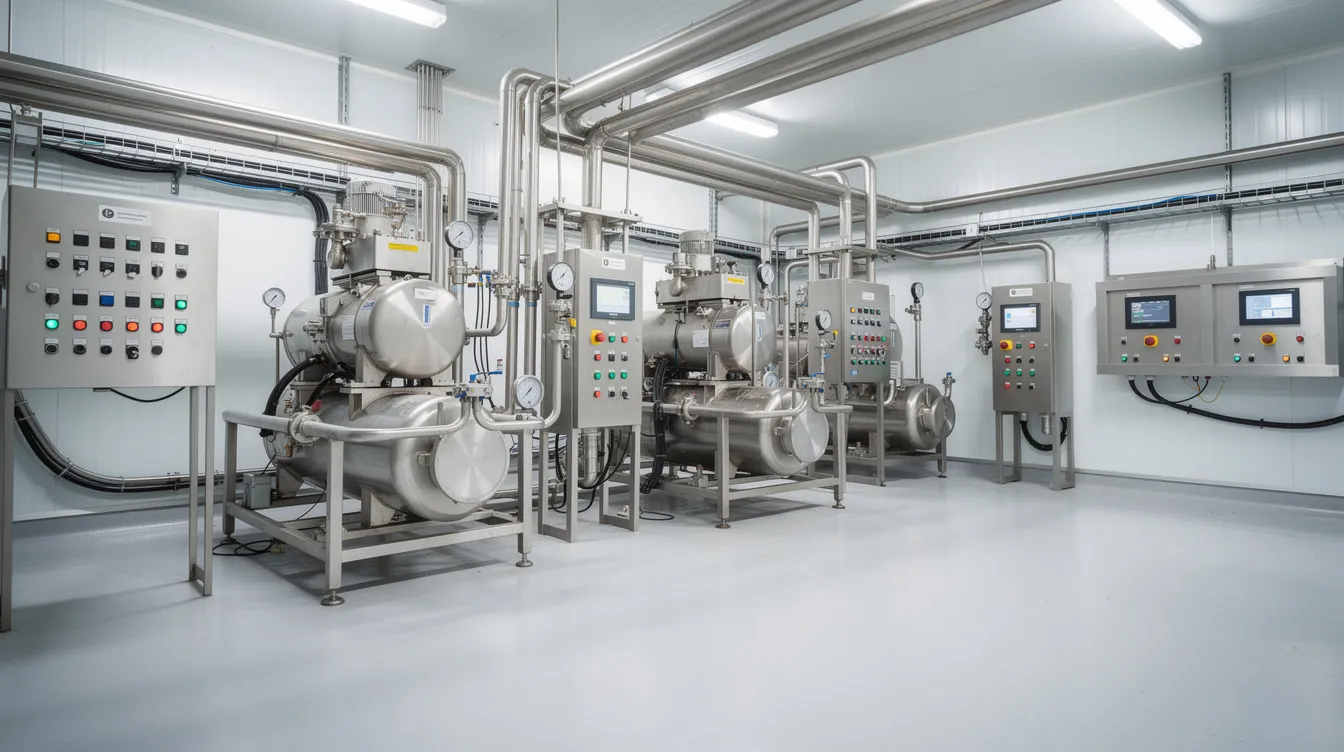
An automatic butter manufacturing plant may incorporate automated cream handling, temperature controls, flow metering, continuous butter-making, in-line moisture and salt control, automatic packaging, palletisation, and CIP. Higher automation reduces manual handling, improves product consistency and hygiene, and may lower variable labor costs, but increases initial butter processing plant cost and demands skilled operators.
The DPR should compare semi-automatic and more fully automatic butter production line configurations, showing qualitative pros and cons. Automation decisions should align with target capacity, quality certifications required by clients (such as large-brand private label supply), and availability of skilled technical manpower requirements in the region.
Land Requirement & Butter Factory Building Layout
There is no single standard land requirement for a butter plant in India-it depends on capacity, integration with other dairy products, and provision for future expansion. Functional zones to plan include:
- Milk and cream reception area
- Processing hall and cream handling section
- Butter processing and packaging areas
- Cold rooms and finished-goods storage
- Utilities block (boiler, refrigeration, DG set, water treatment)
- Laboratory and QC area
- Administrative block and staff hygiene facilities
- Loading and unloading bays
The butter plant layout should follow food-safety norms with separate flows for raw and finished products, hygienic zoning, washable surfaces, adequate ventilation, and pest control. MoFPI cost norms suggest technical civil works cost around ₹15,000 per square metre for dairy processing buildings. Setup requires securing licenses and selecting suitable land early in the implementation process.
Utilities Required for a Butter Manufacturing Plant
Utility requirements are critical for both technical feasibility and operating cost estimation. Key utilities include:
| Utility | Purpose |
|---|---|
| Electricity | Motors, refrigeration compressors, pumps, lighting, machines |
| Steam/Hot Water | Pasteurisation, CIP cleaning |
| Chilled Water/Glycol | Cream cooling, butter storage |
| Potable/Process Water | Processing, cleaning |
| Compressed Air | Automation valves, packaging |
| Backup Power (DG Set) | Grid reliability backup |
Refrigeration capacity is a major component of both butter production plant cost and operating expenses. According to industry data, making one metric tonne of butter requires approximately 28 kWh of electricity and 330 litres of water. Refrigeration and cold storage alone account for roughly 35% of total energy consumption in dairy plants. Butter production costs include raw materials and utilities as primary components. The DPR should also describe the proposed effluent treatment plan, as environmental impact assessments may be needed for large-scale dairy projects and pollution clearance is a regulatory requirement.
Cold Storage & Cold Chain Requirements
Butter production is sensitive to temperature and requires robust cold chain management. Cold chain logistics must be established for storing and transporting butter at every stage:
- Cream chilling before processing (~4°C)
- Butter cooling after formation
- Finished-butter cold rooms at appropriate set-points
- Refrigerated dispatch to distribution network
Required cold-room capacity depends on daily production, average inventory holding period, packing format, and dispatch cycles. Cold-chain continuity-insulated vehicles or reefer vans, temperature-controlled loading docks, and coordination with distributors’ storage-is essential for maintaining product quality and meeting transportation requirements.
Butter Packaging Formats & Packaging Line
Packaging choices affect butter plant cost, labour requirement, branding, and working-capital. Common formats include consumer packs (50 g to 1 kg), institutional blocks (5–20 kg), and private-label packs. Packaging equipment includes foil-wrapping machines, thermoform-fill-seal lines, bulk-block formers, cartoning machines, and check-weighers.
The DPR should outline the planned share of consumer versus bulk packaging, required line speed, and packaging size specifications. Packaging material barriers against oxygen and light directly influence shelf life and brand positioning.
Quality Control & Food Safety Management
An industrial butter manufacturing plant in India must implement robust quality control and food safety systems aligned with FSSAI regulations. Quality control measures should be incorporated throughout the butter production process. HACCP plans are crucial for ensuring food safety in butter production, and implementing standard operating procedures ensures consistent product quality.
Key parameters monitored include cream quality and microbial load, fat content, moisture percentage, salt content, acidity, and organoleptic attributes. The in-house laboratory should be equipped with fat analysers, moisture meters, incubators, and microbiological testing setups. The butter plant DPR should outline proposed quality systems, traceability arrangements, and product recall preparedness.
Licences & Regulatory Approvals for Butter Manufacturing Plant in India
Regulatory compliance is essential for food safety standards. Actual licences depend on plant capacity, location, and legal constitution. Typical requirements include:
- Business entity registration
- FSSAI licence for dairy processing
- Udyam registration (for eligible MSMEs)
- GST registration
- Pollution-control consent (air and water)
- Factory licence and fire safety clearance
- Legal metrology registration for pre-packaged retail butter
- Labour-related registrations (ESI, EPF) where applicable
The detailed project report for butter manufacturing plant should list applicable licences, their status, and timelines for the implementation roadmap.
Butter Manufacturing Plant Setup Cost Structure
Butter manufacturing plant setup cost in India varies significantly by capacity, technology, automation level, land cost, and integration with other dairy operations. Capital expenditure components include:
- Land and site development
- Civil construction and factory building
- Butter manufacturing plant machinery and equipment cost
- Utilities (boiler, refrigeration, water treatment, electrical)
- Cold storage rooms
- Packaging line and laboratory setup
- Material-handling equipment
- Preliminary and pre-operative expenses
- Contingencies and margin money for working capital
The DPR should specify which costs are based on supplier quotations versus standard engineering estimates. Promoters comparing broader milk-fat processing investments may also review the industrial ghee manufacturing plant setup cost for reference. The estimated cost should reflect the specific requirements of each project’s capacity and location.
Butter Manufacturing Plant Project Cost & Means of Finance
Project cost aggregates all fixed assets, pre-operative expenses, preliminary expenses, contingencies, and working-capital margin into a consolidated view of total butter manufacturing project cost. Typical means of finance include:
- Promoter’s equity contribution
- Unsecured loans from promoters or group entities
- Bank term loan
- Capital subsidy or incentive (where verified as eligible)
The proposed debt-equity ratio should be consistent with the project’s capacity to generate cash for loan servicing. The butter plant DPR should show realistic phasing of capital expenditure and term-loan drawdown aligned with the construction timeline. Financial feasibility includes assessments of fixed and working capital requirements.
Working Capital Requirement for Butter Manufacturing Plant
Working capital finances day-to-day operations until receivables are collected. Main current assets include raw milk and cream inventory, butter-in-process, finished butter stock in cold storage, packaging material inventory, trade receivables, and minimum cash balances. Current liabilities include supplier credit, packaging vendor payables, and utility bills.
Butter production costs are influenced by market demand and supply, and working-capital assessment should consider that institutional buyers may require longer credit periods than retail distributors. Operating expenses for butter production include labor and packaging as ongoing components. The DPR should describe proposed banking facilities-cash-credit limits, WCDL, or overdraft-as part of the butter manufacturing plant bank loan discussion.
Revenue Model & Sales Strategy for Butter Manufacturing Business
A clear revenue model is critical for butter manufacturing project finance. Market analysis should consider target consumer segments and demand trends. Possible sales channels include:
- Branded retail through distributors
- Direct institutional sales to bakeries, confectioners, hotels, and restaurant chains
- Supply to food-processing companies
- Private-label manufacturing for retail brands
- Bulk industrial butter for large-scale users and cheese manufacturers
The DPR should indicate assumed sales mix, average selling prices per kg for each channel, and distribution strategy. The butter manufacturing project report should avoid overly optimistic price assumptions and show sensitivity to market price fluctuations across suitable channels.
Butter Manufacturing Plant Profitability Drivers
Cost management is vital in maximising profitability in butter production. Key drivers include:
- Procurement price of milk and cream (the largest single operating cost)
- Fat recovery efficiency and butter yield
- By-product realisation from buttermilk
- Selling prices across different butter grades
- Capacity utilisation rates
- Energy and refrigeration costs
- Packaging cost and labor costs
- Finance costs and distribution expenses
The DPR should project a profit and loss statement for at least 5–7 years, showing how margins evolve as capacity utilisation ramps up. This article deliberately avoids promising fixed profit percentages-a profitable business outcome depends on managing the levers described above.
By-Products & Additional Revenue Considerations
Butter manufacturing generates by-products, primarily buttermilk, which can be further processed or sold. Utilising by-products like buttermilk can enhance the overall economics of dairy operations. Buttermilk can be sold as a flavoured or plain beverage, used in other dairy products, or processed further.
While by-products can enhance revenue, conservative assumptions on by-product realisation should be used in any butter manufacturing plant feasibility study. Integration with other dairy lines-curd, lassi, paneer, or ghee-provides additional avenues to utilise skim or buttermilk streams.
Financial Projections in a Butter Manufacturing Plant DPR
A robust butter manufacturing plant project report in India must present integrated financial projections. Financial projections should include break-even analysis and profitability estimates. Key statements include:
- Projected profit and loss account
- Projected balance sheet
- Projected cash-flow statement
- Depreciation schedules and interest calculations
- Term-loan repayment schedules
- Working-capital assessment
- Year-wise break-even analysis
- DSCR, ROI, and IRR indicators
- Ratio analyses (gross margin, net margin, current ratio, debt-equity ratio)
The project report should outline market potential and financial viability with transparent assumptions to support a comprehensive butter manufacturing plant feasibility study.
DSCR, Break-Even Analysis & Return Indicators
DSCR (Debt Service Coverage Ratio) measures whether projected cash accruals-profit after tax plus non-cash charges-are sufficient to service interest and principal repayments. Banks typically expect butter plant DSCR to remain above a prudent threshold (often 1.25–1.50) across the loan tenure.
Break-even analysis calculates the level of butter sales at which contribution equals fixed costs. High fixed costs from automation and refrigeration can raise the break-even point-typically, butter plants reach break-even at 60–70% capacity utilisation. ROI measures returns on total butter manufacturing plant investment, while IRR represents the discount rate at which the project’s net present value becomes zero. Identifying risks and developing mitigation strategies is an important aspect alongside these indicators. These are estimates based on assumptions and should be presented transparently in any butter manufacturing project report for bank loan.
Sensitivity Analysis for Butter Manufacturing Projects
Sensitivity analysis is especially important in dairy processing because raw-material prices and product realisations can fluctuate. The DPR should show scenarios for:
- Changes in cream or milk procurement price (+/- 10–15%)
- Variations in butter selling price
- Different capacity utilisation levels
- Changes in energy and fuel costs
- Adjustments in working-capital cycle
For each scenario, the impact on profitability, cash flows, DSCR, and payback period should be highlighted. Such analysis helps both promoters and lenders understand project resilience rather than relying on a single base-case projection.
Technical, Market, Financial & Operational Feasibility
A complete butter manufacturing plant feasibility study examines four dimensions:
- Technical feasibility: Milk and cream availability, butter manufacturing equipment selection, utilities, cold storage, plant layout, and manpower requirements
- Market feasibility: Local and regional demand analysis, competition from established brands, pricing patterns, institutional buyer opportunities, and factors affecting distribution
- Financial feasibility: Projected profitability, DSCR, break-even, ROI, and IRR confirming sustainable investment under realistic assumptions
- Operational feasibility: Milk procurement logistics, production scheduling, maintenance, quality control, cold-chain management, and MIS systems
Relationship Between Butter & Ghee Processing
Butter and ghee are related milk-fat products but involve distinct processes and markets. Ghee is produced by heating butter or cream to remove moisture and milk solids, whereas butter retains these components. Machinery overlaps partially at the cream-handling stage but diverges significantly at processing and packaging.
Promoters considering end-to-end milk-fat value chains should also study the industrial ghee manufacturing process and production line. Separate DPRs or integrated DPR sections are needed for butter versus ghee operations.
Integrated Butter & Ghee Manufacturing Opportunity
Some promoters may consider an integrated butter and ghee plant, sharing milk procurement, cream separation, utilities, and cold storage. Potential advantages include better utilisation of milk fat, diversification across product lines, and improved utilisation of boilers and refrigeration. However, an integrated configuration is not automatically more profitable-a separate techno-economic analysis must compare stand-alone butter plant versus integrated butter-ghee project configurations.
Butter Manufacturing Plant Project Report for Bank Loan
Banks expect a butter manufacturing project report for bank loan to present a complete picture. Key contents include:
- Promoter background and experience
- Project concept, location, and installed capacity
- Butter manufacturing process description and machinery list
- Project cost and means of finance
- Implementation schedule and regulatory approvals
- Market analysis and sales strategy
- Operating cost estimates and financial projections
- Working-capital requirement and DSCR calculations
- Break-even analysis, ROI and IRR, and sensitivity analysis
Assumptions must be transparent-with clear notes on their basis-to build banker confidence. A carefully prepared butter plant DPR supports both internal decision-making and bank discussions but does not by itself guarantee loan sanction.
Key Risks & Risk Mitigation in Butter Manufacturing Projects
| Risk | Mitigation |
|---|---|
| Milk/cream procurement volatility | Long-term procurement arrangements, diversified supplier base |
| Seasonal supply shortages | Conservative capacity planning, flexible product mix |
| Price competition from established brands | Focus on quality, niche products, institutional contracts |
| Cold-chain breakdowns | Backup chillers, preventive maintenance, DG sets |
| Energy cost increases | Energy-efficient refrigeration, heat recovery systems |
| Regulatory non-compliance | Proactive licensing, environmental and FSSAI compliance |
| Underutilised capacity | Realistic ramp-up schedules, multiple market channels |
Inadequate capacity utilisation is a common risk-the DPR should incorporate realistic ramp-up schedules and flexible product strategies.
How CA Manish Gugliya & ProjectReportBank.com Can Assist
As a Chartered Accountant experienced in DPR preparation and project finance, I assist project promoters with:
- Preparation of detailed project reports for butter manufacturing plants
- Project cost estimation and structuring means of finance
- Projected financial statements and cash-flow projections
- Working-capital assessment and CMA data preparation
- DSCR, break-even, ROI, and IRR analysis
- Sensitivity analysis across key operational variables
- Bank finance and project-finance documentation support
All projections are prepared based on data and assumptions shared by the promoter, combined with industry benchmarks, and tailored to the specific capacity, technology, location, and marketing plan of the proposed plant. Professional DPRs support bank appraisal but do not guarantee loan approval, which depends on individual bank policies.
Serious promoters, dairy processors, and investors are welcome to contact ProjectReportBank.com for customised butter manufacturing plant project report preparation and financial planning support.

Frequently Asked Questions (FAQ)
What is the typical implementation timeline for a butter manufacturing plant in India?
A structured implementation timeline is necessary for project execution. Implementation typically spans from DPR preparation through financial closure, civil construction, machinery ordering, installation, trial runs, and commercial production. Initial setup can take 12 to 18 months to complete, depending on capacity and complexity. Early finalisation of plant layout, machinery specifications, and utility design helps avoid delays during construction and commissioning phases.
Can an existing milk processing plant be upgraded into an industrial butter manufacturing plant?
Many existing dairies can add butter production by installing cream-handling equipment, churning or continuous butter-making machines, packaging lines, and additional cold storage, subject to layout and utility sufficiency. A focused butter manufacturing unit project report should still be prepared to capture incremental investment, additional working capital, and revised profitability for the expanded configuration.
How is a continuous butter making machine different from a traditional butter churn?
A continuous butter making machine processes cream in a steady flow with integrated control of churning, working, moisture, and salt adjustment, providing higher throughput and more uniform product than batch churns. Batch churns remain suitable for smaller capacities and lower capital budgets, while continuous systems are preferred for large commercial butter manufacturing plants where product consistency and production efficiency are priorities.
Is it necessary to have dedicated refrigerated vehicles for a butter manufacturing plant?
While owning reefer vehicles is not mandatory, the plant must ensure distribution partners or hired logistics providers maintain cold-chain conditions for butter during transport. The DPR can consider either in-house refrigerated transport investment or outsourced cold-chain services-the choice affects whether costs appear as capital expenditure or operating expenses.
How does a butter manufacturing plant project report in India differ from a generic business plan?
A butter plant DPR is more detailed and bank-focused, including technical process descriptions, machinery lists with specifications, utility sizing, regulatory requirements, granular cost estimates, and standardised financial projections with DSCR and break-even analysis. A generic business plan may cover vision and marketing but typically lacks the depth of techno-economic calculations and banker-ready financial modelling required for project finance in India.
Conclusion: Butter Manufacturing Plant Project Report & Setup Requirements
Establishing a commercial butter manufacturing plant in India demands coordinated planning across technical design, plant capacity, machinery and utilities, cold storage and cold chain, regulatory compliance, and robust financial structuring. No single element in isolation determines success-it is the alignment of raw-material procurement, process technology, packaging, market access, project cost, working capital, and financing structure that creates a viable enterprise.
A well-prepared butter manufacturing plant project report translates these interdependent elements into a coherent plan that promoters can use for decision-making and banks can appraise for term loan and working-capital facilities. Promoters should invest professional effort in preparing realistic projections, sensitivity analysis, and a clear risk-mitigation framework rather than relying on overly optimistic margin assumptions.
Entrepreneurs, dairy companies, and investors planning an industrial butter manufacturing project in India are invited to approach CA Manish Gugliya and ProjectReportBank.com for assistance in preparing a customised DPR, financial projections, and bank-finance documentation tailored to their specific project configuration.