
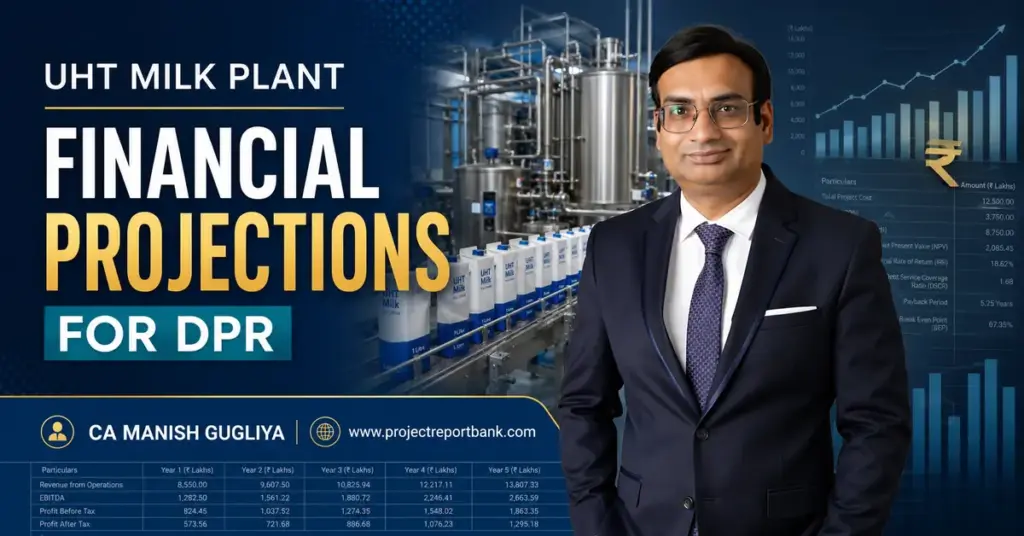
Key Takeaways
- UHT milk plant financial projections for DPR are a structured, interlinked set of projected financial statements that translate installed capacity, product mix, raw milk costs, packaging expenses and financing terms into year-wise profitability, cash flow and loan repayment schedules.
- A bankable UHT milk plant financial model in India must integrate realistic capacity utilisation trajectories, net selling prices (not MRP), variable and fixed operating costs, working-capital cycles and term-loan repayment into one consistent set of projected statements covering at least five years.
- Lenders focus on cash accrual, DSCR (debt service coverage ratio), current ratio and sensitivity under adverse assumptions such as higher raw milk prices or lower capacity utilisation-not just headline profit or IRR.
- All numerical examples in this article are illustrative only and must be replaced with actual quotations, market research and project-specific data before submitting a DPR; projections are estimates, not guaranteed results.
- A practising Chartered Accountant like CA Manish Gugliya can assist promoters in structuring assumptions, preparing integrated projections and presenting a lender-ready UHT milk plant bank loan DPR.
Introduction: Why Financial Projections Decide a UHT Milk Project’s Bankability
For any UHT milk processing and aseptic packaging project in India, the Detailed Project Report lives or dies on the quality of its UHT milk plant financial projections-not merely on machinery quotations or market optimism. UHT production facilities experience high capital intensity due to specialised machinery and infrastructure requirements. A lender releasing ₹10–50 crore against such assets needs far more than a manufacturer’s brochure.
Banks and investors want to see how a proposed installed capacity converts into production volume, projected turnover, operating profit, cash accrual and loan repayment capacity over the next five years. The global UHT milk market stood at 130.97 billion litres in 2025 and is projected to reach 205.42 billion litres by 2034, reflecting strong market growth driven by urbanisation, rising demand for shelf stable dairy products and limited refrigeration infrastructure in emerging economies. The global UHT processing market size was USD 5.12 billion in 2025 and is expected to reach USD 16 billion by 2034. While these macro trends favour new capacity, plant-level viability depends entirely on how well financial projections capture raw milk price volatility, aseptic packaging costs, energy consumption, product mix and distribution expenses.
UHT milk plant financial projections for DPR are forward-looking financial statements built from these operational realities. Poorly prepared projections often delay or derail bank finance.
I am CA Manish Gugliya, FCA and DISA (ICAI), and over more than 20 years of practice I have prepared and reviewed bankable DPRs, CMA Data and financial models for dairy and food processing projects across India. This article shares the analytical framework I apply when structuring UHT milk processing plant financial analysis for promoters seeking term loans and working-capital limits.
What Are UHT Milk Plant Financial Projections?
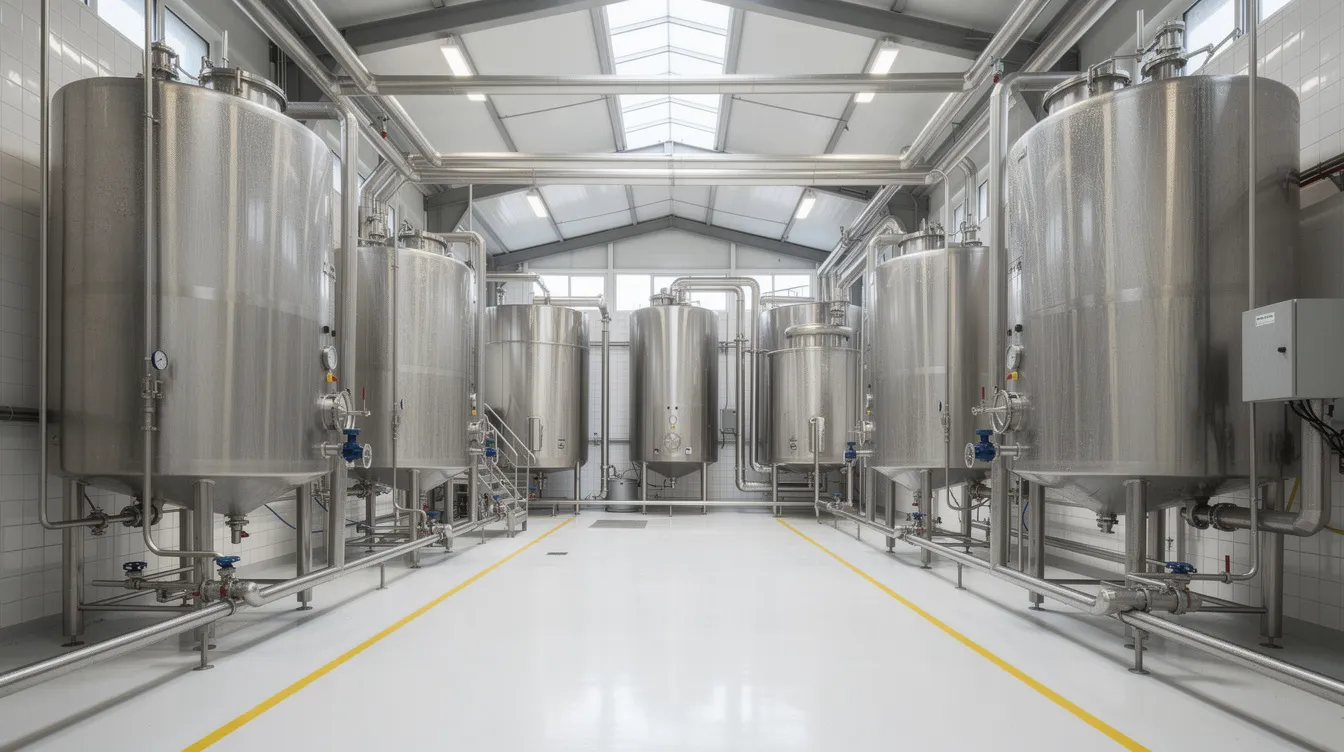
UHT milk plant financial projections are a structured, interlinked financial model that translates technical and commercial assumptions into projected financial statements for five to seven years. UHT processing requires heating milk to 135–150°C for 1–2 seconds, and the treatment requires both a steriliser and sterile packaging-so the model must account for processing-line economics, not just milk volumes.
A complete UHT milk processing plant financial model in India typically includes:
- Production and capacity utilisation projections
- Product-wise sales and revenue projections
- Raw-material and packaging-cost estimates
- Employee, utility and overhead projections
- Projected profit and loss account
- Projected balance sheet
- Projected cash-flow statement
- Working-capital assessment
- Term-loan repayment schedule with interest calculations
- Depreciation schedules
- Key financial ratios and DSCR
- Sensitivity and scenario analysis
These projected financial statements must reconcile with each other. Closing inventory from cost sheets should match the balance sheet, interest and depreciation must flow from loan and asset schedules into the projected P&L, and cash flows must match changes in bank balance and borrowings. Projections are based on management assumptions; a Chartered Accountant can assist in structuring and reviewing them, but cannot “certify” future profits or guarantee any outcome.
Why Financial Projections Are Essential in a UHT Milk Plant DPR
Banks now treat UHT milk plant DPRs as decision documents. Without credible projections, even technically sound projects struggle to secure term loans and working-capital limits.
UHT milk plant financial projections are used to:
- Test commercial viability, including profitability and break-even capacity
- Quantify total capital investment and funding requirements
- Determine promoter contribution versus term loan (typically 20–25% equity under NDDB/government scheme norms)
- Estimate working-capital limits for raw milk and packaging inventories
- Assess whether the project generates adequate annual cash accrual to maintain comfortable DSCR
Lenders evaluate whether, after meeting raw milk, packaging, utilities, salaries, taxes, interest and principal obligations, the project still generates enough cash. The UHT processing market is expected to grow at a CAGR of 13.50%, and the global UHT processing market is projected to grow at a steady CAGR of 5% to 11%, but high initial capital investments and tight margins at plant level make advance financial planning essential. Properly structured five-year financial projections for a UHT milk plant also help promoters see the impact of slower capacity ramp-up before committing capital.
Establishing the Base Financial Assumptions
Every UHT milk plant DPR must include a clearly documented assumptions section. Below is an illustrative assumptions framework-all figures are examples only and must be replaced with actual quotations, market data and proposed financing terms.
Operational assumptions:
- Installed capacity: e.g. 10,000 litres per hour, operating 16 hours per day
- Operating days per year: e.g. 300 days (after planned maintenance)
- Year-wise capacity utilisation: e.g. 40% in Year 1, rising to 75% by Year 5
- Process loss / saleable yield: e.g. 98.5% of processed milk is saleable
Marketing and pricing assumptions:
- Product mix: standardised UHT milk, toned milk, flavoured milk, fortified UHT milk
- Pack sizes: 200 ml, 500 ml, 1 litre
- Average net selling price per litre: ₹70–₹110 for retail plain; ₹100–₹160 for flavoured variants; ₹45–₹52 for institutional bulk
- Annual price escalation: e.g. 2–3% per year
Cost assumptions:
- Raw milk procurement: ₹45–₹60 per litre depending on region and fat/SNF content
- Aseptic carton and closure cost per pack (from supplier quotation)
- Power tariff, steam/fuel cost, water charges
- Salary structures and annual increments (8–10%)
- Maintenance at approximately 5% of plant and machinery cost
- Marketing and freight costs per litre or as a percentage of sales
Financial assumptions:
- Project cost breakup: land, building, machinery, utilities, pre-operative expenses, contingencies
- Proposed debt-equity ratio (e.g. 75:25)
- Term-loan interest rate (e.g. 12–14%) and tenure with moratorium
- Working-capital interest rate
- Depreciation rates as per applicable law
- Corporate tax rate assumption
- Receivable and payable periods
Do not use any “standard” benchmarks blindly. All figures must be validated against actual quotations, local raw milk markets and current lending terms.
Capacity Utilisation and Production Projections
Converting installed capacity into realistic year-wise production is the foundation of UHT milk plant revenue projections. UHT milk processing plants typically require 100–200 million litres capacity at scale, but even mid-sized units must model ramp-up carefully.
Formula:
Annual saleable production (litres) = Installed daily capacity × Operating days × Capacity utilisation (%) × Saleable yield (%)
Illustrative example (all figures are for demonstration only):
| Year | Daily Capacity | Operating Days | Utilisation | Yield | Annual Saleable Litres |
|---|---|---|---|---|---|
| 1 | 160,000 L | 300 | 40% | 98.5% | 18,912,000 |
| 3 | 160,000 L | 300 | 60% | 98.5% | 28,368,000 |
| 5 | 160,000 L | 300 | 75% | 98.5% | 35,460,000 |
Capacity utilisation in UHT plants typically ranges from 30% to 90% during the first few years of operation. Constraints to cross-check include raw milk availability during flush and lean seasons, aseptic filling line speed, CIP and maintenance downtime, warehouse capacity and demand build-up period. Detailed engineering calculations for line sizing are discussed in the guide on UHT milk plant capacity planning and line balancing.
Capacity-utilisation assumptions must remain identical across production sheets, cost of production workings and the projected profit and loss account to avoid inconsistencies noticed by bankers.
Product Mix and Sales Revenue Projections
UHT milk plant revenue projections should be built product-wise and pack-wise, not by multiplying total litres by one average price. A UHT plant can produce various products, including flavoured and fortified milk as well as cream.
Illustrative revenue projection (sample year, all figures illustrative):
| Product | Pack Size | Litres Sold | Net Realisation/L (₹) | Revenue (₹ Lakh) |
|---|---|---|---|---|
| Plain UHT Milk | 1 L | 12,000,000 | 75 | 900.00 |
| Toned UHT Milk | 500 ml | 4,000,000 | 72 | 288.00 |
| Flavoured Milk | 200 ml | 2,000,000 | 120 | 240.00 |
| Institutional Pack | 1 L | 3,000,000 | 50 | 150.00 |
Net realisation depends on channel mix-modern trade, general trade, online and institutional bulk each carry different distributor margins. Rising health awareness drives consumer demand for fortified UHT milk products, and health conscious consumers increasingly seek dairy products with added nutritional value and nutritional benefits. UHT milk’s distribution can avoid refrigerated transport, allowing access to broader markets including regions with limited cold storage infrastructure.
Flavoured or value-added variants may carry higher contribution per litre but often lower volumes initially. For deeper discussion on SKU strategy and pricing architecture, refer to the guide on UHT milk plant revenue model and product mix.
Raw Milk and Other Variable-Cost Projections
Raw milk typically accounts for the largest share of operating cost. In fact, raw milk constitutes 70–80% of total operating expenses in most UHT milk processing units. The profitability of UHT plants depends heavily on effective management of raw material costs and operational efficiency. The major cost drivers in UHT plants are raw milk, packaging, and utilities.
Major variable-cost items to project include:
- Raw milk litres required (saleable litres plus process loss)
- Standardisation inputs (skimmed milk, cream)
- Stabilisers and flavours for specific SKUs
- Aseptic cartons and closures
- Corrugated boxes and secondary packaging
- Cleaning chemicals and QC consumables
- Outward freight and sales commissions
Raw milk quantity should be calculated from saleable litres plus process loss, not guessed as a percentage of revenue. Similarly, carton consumption must allow for wastage and overfill. Milk procurement pricing volatility can significantly impact profit margins in UHT facilities, so adding scenario notes where raw milk price increases by 10–15% is advisable. The distinction between purely variable costs (raw milk, cartons), semi-variable costs (maintenance) and fixed costs (salaries, insurance) affects contribution margin and break-even analysis.
Packaging-Cost Assumptions and Financial Impact
Aseptic packaging materials are more expensive than standard low-density polyethylene packaging. For plants targeting premium retail packs, cartons, closures and pre-printed materials can significantly affect per-litre cost and working-capital requirements. Major UHT milk processors such as FrieslandCampina source from packaging specialists, and key players include Tetra Pak, GEA Group, and Alfa Laval in the processing equipment and packaging space.
Key assumptions to capture:
- Carton supplier and basic price per thousand packs
- Printing, design and closure costs
- Expected wastage percentage on the filling line (typically 0.5–2%)
- Minimum order quantity, lead time and supplier credit period
The per-litre contribution must reflect actual packaging cost per pack size. Technical steps that create wastage and changeover losses are detailed in the guide on aseptic filling and packaging process for UHT milk. How the selection of particular packaging systems affects capital cost and per-pack material cost is covered under aseptic carton packaging systems and costs. Lenders often compare packaging-cost assumptions with vendor quotations; unrealistic underestimation is a common red flag.
Utility and Processing-Cost Projections
Power, steam, water, chilled water, compressed air and CIP chemicals together make up a sizable share of operating cost. Utilities and energy generally account for 10% to 15% of operating expenses in UHT plants. Estimates should be based on equipment specifications rather than arbitrary percentages.
Typical data points required from the technical team:
- kWh per hour for the UHT section, homogeniser and aseptic filling line installed
- Steam consumption per litre of milk processed
- Water consumption for process and CIP
- Diesel or gas consumption for boilers
The financial model should compute unit consumption per 1,000 litres processed and multiply by projected volumes and expected tariffs. The choice between direct UHT processing and indirect systems may change energy consumption and product loss; this is discussed in the guide on direct versus indirect UHT processing technology. For detailed utility sizing, refer to UHT milk plant utility requirements and costs.
Fixed Operating Expenses and Overheads
Fixed and semi-fixed expenses continue regardless of monthly production, making realistic budgeting essential for accurate break-even and DSCR calculations. Regulatory compliance standards like HACCP, ISO, and FSSAI are necessary for UHT processing facilities, and the associated costs must be budgeted.
Key fixed costs to project year-wise:
- Salaries and wages (staffing needs include skilled personnel for thermal processing, QC, maintenance and administration)
- PF/ESI contributions
- Factory overheads and quality-control lab expenses
- Insurance for assets and stocks (typically 1–2% of insured value)
- Repair and maintenance (approximately 5% of plant and machinery cost)
- Security, housekeeping and professional fees
- Trade promotions, advertising and dealer network support
Costs that escalate annually at a defined rate (salaries at 8–10%) should be separated from those linked to sales volume. A schedule of manpower count and average cost by grade helps lenders assess whether staffing is aligned with planned capacity and automation level.
Capital Cost, Depreciation and Interest Calculations
The capital-cost schedule bridges the technical DPR and the projected financial statements. Machinery costs account for the largest portion of capital expenditure in a UHT milk processing unit. Initial capital investments for UHT plants are significantly high.
Major capital items include land, civil construction, UHT processing equipment, aseptic packaging lines, utilities (boiler, chilling plant, compressors), laboratory equipment, vehicles, pre-operative expenses and contingencies. Detailed cost benchmarks are covered in the guides on UHT milk processing plant setup cost in India and UHT milk plant machinery and equipment cost. Layout requirements are discussed under UHT milk plant land, building and hygienic layout requirements.
Once project cost and means of finance are finalised-equity, term loan and subsidy if applicable-they flow into a term-loan schedule showing disbursement, interest during construction and commencement of repayment. This structure is detailed under UHT milk plant project cost and means of finance.
Depreciation is computed asset-wise or block-wise in accordance with applicable accounting and tax provisions. Annual depreciation feeds into the projected profit and loss account, while accumulated depreciation reduces net fixed assets on the projected balance sheet. Interest expense appears separately for term loans and working-capital borrowings.

Projected Profit and Loss Account
The UHT milk plant projected profit and loss account summarises how revenue, cost of production and overheads translate into EBITDA, profit before tax and profit after tax for each projection year. Gross profit margins for UHT milk processing typically range from 25–35%.
Recommended line items: Net revenue, raw milk consumption, packaging consumption, power and fuel, direct wages, manufacturing overheads, cost of goods sold, gross profit, administrative and selling expenses, EBITDA, depreciation, interest, profit before tax, tax provision and profit after tax.
Illustrative P&L summary (₹ Lakh, all figures illustrative):
| Particulars | Year 1 | Year 3 | Year 5 |
|---|---|---|---|
| Net Revenue | 1,200 | 2,100 | 2,800 |
| Cost of Goods Sold | 900 | 1,470 | 1,890 |
| Gross Profit | 300 | 630 | 910 |
| Overheads & Selling | 120 | 180 | 220 |
| EBITDA | 180 | 450 | 690 |
| Depreciation | 80 | 75 | 70 |
| Interest | 70 | 55 | 35 |
| PBT | 30 | 320 | 585 |
| Tax | 8 | 80 | 147 |
| PAT | 22 | 240 | 438 |
EBITDA and profit margins should be cross-checked against realistic industry expectations and competitive landscape pressures. Projections with abnormally high margins undermine credibility during bank appraisal. While this statement indicates profitability, it does not fully capture cash availability for loan servicing.
Projected Cash-Flow Statement
Many first-time promoters focus only on projected profit, but lenders pay equal or greater attention to cash flow because loan instalments are paid from cash, not accounting profit.
The structure covers: profit after tax, adding back depreciation to derive cash profit, adjusting for changes in working capital (inventory, receivables, payables), capital expenditure, loan drawdowns, equity infusion, interest and principal repayment.
Key distinction: If Year 1 PAT is ₹22 lakh and depreciation is ₹80 lakh, cash profit is approximately ₹102 lakh. But after deducting working-capital build-up (say ₹60 lakh for inventory and receivables) and principal repayment (say ₹25 lakh), net cash available is only ₹17 lakh. This gap between accounting profit and actual cash is precisely what lenders scrutinise.
Banks compute DSCR directly from UHT milk plant cash flow projections. Cash-flow timing during the first year of operations-start-up losses, build-up of receivables and stocks-is crucial. Underestimation here is a common reason for cash crunch.
Projected Balance Sheet
The UHT milk plant projected balance sheet shows financial position at each year-end and is essential for assessing solvency, leverage and liquidity.
Asset side: Gross fixed assets, accumulated depreciation, net fixed assets, capital work in progress, current assets (raw milk and packaging inventory, finished goods, trade receivables, cash and bank balances, input tax credits).
Liability and equity side: Promoter capital, retained earnings, term-loan outstanding balance, working-capital borrowings, trade creditors for milk and packaging, statutory liabilities.
Closing balances must reconcile: net profit from the P&L adds to reserves, depreciation matches the fixed-asset schedule, and changes in borrowings and cash match the cash-flow statement. Inconsistencies across these three statements are quickly noticed by bankers and can force repeated revisions of the DPR.
Working-Capital Projections
For UHT milk plants, working capital requirements can be significant due to the need for inventory and receivables management. Raw milk purchases are often paid on short credit, packaging materials are ordered in bulk, and finished goods may be stored for several weeks before sale.
Main drivers include:
- Procurement cycle and payment terms with milk producers
- Packaging-material inventory norms and minimum order quantities
- Finished-goods stock level considering that UHT milk has a shelf life of 3 to 6 months without refrigeration
- Credit period to distributors and institutions
- Supplier credit period and minimum cash balance
The model should convert these into financial numbers-finished-goods inventory in days of cost of goods sold, receivables in days of sales, creditors in days of raw-material purchases-and compute the net working-capital requirement for each year, clearly showing bank-funded and promoter-funded portions.
Underestimating working capital can lead to liquidity stress even when the project is profitable on paper. Overestimation inflates interest cost and lowers returns. Projections should be neither aggressive nor excessively conservative.
Term-Loan Repayment and Interest Schedule
The term-loan repayment schedule is a critical part of UHT milk plant loan repayment projections and must align with realistic cash accrual from operations.
Typical elements include:
- Loan amount sanctioned and drawdown pattern
- Moratorium on principal (e.g. 12–18 months after commercial operations date)
- Repayment frequency (monthly or quarterly) and tenure (e.g. 7–9 years including moratorium)
- Principal and interest split for each instalment
- Interest calculated on opening outstanding balance
- Closing balances carried to the projected balance sheet
Repayment obligations must be matched with projected cash accrual and DSCR, rather than working backwards to force a preferred ratio. For instance, if Year 3 cash accrual (PAT + depreciation + interest) is ₹375 lakh and debt service (principal ₹140 lakh + interest ₹55 lakh) is ₹195 lakh, DSCR works out to approximately 1.92×-a comfortable level for most lenders.
Financial Ratios Used in DPR Appraisal
Once all projected statements are ready, the UHT milk processing plant financial analysis must summarise key indicators:
- Debt-equity ratio: Gearing level; many schemes prescribe maximum 3:1 or 4:1
- Current ratio: Liquidity measure; lenders often require ≥1.00
- DSCR: (Cash profit + interest) ÷ (interest + principal repayment); banks usually want minimum 1.25–1.50
- Interest coverage ratio: EBIT divided by interest; comfortable at 2× or above
- Gross profit margin and EBITDA margin: Cross-checked against dairy industry norms
- Return on capital employed: Minimum 12% under many government schemes
- Break-even capacity utilisation: Level at which all fixed and variable costs are covered
Break-even analysis for UHT lines usually spans 3 to 5 years, influenced by capacity utilisation and milk procurement efficiency. For deeper explanation of break-even charts and margin of safety, refer to the guide on UHT milk plant profitability and break-even analysis. Acceptable ratio thresholds differ among banks, so DPRs should avoid claiming that any single ratio automatically guarantees loan approval.
Sensitivity and Scenario Analysis
A robust UHT milk plant financial model should not present only a single “perfect” case. It must demonstrate how results change under reasonable variations.
Illustrative sensitivity summary (all figures illustrative):
| Scenario | Change Applied | EBITDA (₹ Lakh) | DSCR |
|---|---|---|---|
| Base Case | As planned | 450 | 1.92 |
| Higher Raw Milk Cost | +10% milk price | 345 | 1.52 |
| Lower Selling Price | -8% realisation | 370 | 1.60 |
| Lower Utilisation | 50% instead of 60% | 290 | 1.30 |
Lenders often focus on the downside to test resilience. Under NDDB scheme norms, DSCR must remain ≥1.5 even after applying 10% sensitivity to both milk sales and procurement cost assumptions. Sensitivity analysis strengthens the credibility of UHT milk plant financial projections for bank loan appraisal by demonstrating that promoters have considered risks rather than assuming everything will go perfectly. The global UHT milk market is projected to reach USD 205.42 billion by 2034, reflecting UHT milk market growth across Asia Pacific, North America and other regions, but plant-level returns depend on local realities.
Importance of Quality and Shelf-Life Assumptions in Financial Modelling
UHT processed milk is sold as a long shelf life product, but financial projections must realistically account for rejects, leakage, microbial failure, market returns and near-expiry discounting. Quality control and reducing wastage are critical in the UHT production process to avoid contamination.
These factors affect the numbers through increased process losses, additional packaging-material wastage, write-off of expired stock, reverse logistics costs and additional marketing support. Assumptions for rejection and return percentages should be based on experience from similar plants and explicitly shown in cost-of-goods workings. Technical protocols that minimise such losses are discussed in the guide on UHT milk quality control and shelf-life testing. Ignoring shelf-life related losses can overstate projected turnover and margins.
Common Mistakes in UHT Milk Plant Financial Projections
Many DPRs for UHT plants are rejected or returned by banks due to avoidable errors:
- Assuming full capacity utilisation from the first year
- Using MRP instead of realistic net realisation after distributor margins and discounts
- Ignoring packaging wastage and supply chain disruptions affecting carton availability
- Underestimating raw milk price volatility between flush and lean seasons
Technical oversights:
- Not providing for maintenance shutdowns and CIP downtime
- Assuming uniform energy consumption at all load levels
- Ignoring shelf-life related returns and expired stock write-offs
Financial-structure errors:
- Ignoring working-capital interest in the projected profit and loss account
- Creating loan-repayment schedules inconsistent with cash accrual
- Applying arbitrary depreciation or tax rates
- Failing to reconcile projected P&L, balance sheet and cash-flow figures
Copying UHT milk plant DPR financial projections format or data from unrelated dairy projects or other geographies is a common and costly mistake, as local milk production pricing, distribution and competitive landscape conditions vary widely.
How to Make UHT Milk Plant Projections More Bankable
“Bankable” projections are not those showing the highest profits but those that are well-documented, internally consistent and supported by realistic assumptions and market research.
Practical steps:
- Obtain current quotations for UHT processing equipment, aseptic packaging lines and civil works
- Validate raw milk availability and pricing through local dairies, cooperatives or dairy farming networks
- Prepare a clear marketing and distribution plan supporting sales-volume assumptions
- Use conservative yet achievable capacity utilisation trajectories
- Separate each product and pack format in the revenue projections
- Build an integrated Excel-based model that automatically updates P&L, balance sheet, cash flow, ratios and DSCR when assumptions change
- Align term-loan repayment with cash accrual and provide reasonable working-capital margin
- Conduct at least basic sensitivity analysis
Update projections whenever there is a significant change in project cost, capacity, implementation schedule, product mix or financing terms before final submission to lenders. Efficient plant operations combined with sound financial modelling are what separate successful UHT milk plant projects from those that struggle with cash flow irregularities.
Role of CA Manish Gugliya in DPR Financial Planning
CA Manish Gugliya is a practising Chartered Accountant with over two decades of experience in preparing UHT milk plant DPRs, financial projections and CMA Data for bank finance in India.
He typically assists promoters with:
- Structuring operational and financial assumptions for UHT milk plant financial projections for DPR
- Reviewing project cost and means of finance for internal consistency
- Preparing integrated financial models covering P&L, balance sheet, cash flow, working capital, loan repayment schedule and key ratios
- Translating projections into a lender-friendly DPR format
- Evaluating cash accrual and repayment capacity
- Conducting ratio and sensitivity analysis
- Assisting in preparation of CMA Data for submission to banks
While a Chartered Accountant can provide professional assistance and independent review, the projections remain estimates based on management’s assumptions and should not be described as guaranteed or “certified future profits.”
Conclusion
Credible UHT milk plant financial projections for DPR must connect technical capacity, product mix, pricing, raw milk and packaging costs, utility consumption, capital cost, working capital and loan structure into one coherent financial picture. In an industry where raw materials required for UHT milk production carry seasonal price swings and aseptic packaging costs fluctuate with global market conditions, the margin for error in financial modelling is narrow.
Banks and investors assess not just projected profits but also cash flow, DSCR, liquidity ratios and resilience under adverse scenarios. Industry trends point to increasing demand for long life dairy products, and technological advancements in ultra high temperature processing continue to improve supply chain efficiencies, but plant-level success still depends on disciplined financial planning during the pre feasibility study and DPR stage.
Entrepreneurs, dairy companies and consultants planning a UHT milk processing and aseptic packaging project in India are welcome to contact CA Manish Gugliya through ProjectReportBank.com for customised DPR preparation, financial projections for bank loan assessment and related CMA Data support.
Frequently Asked Questions
What financial projections are required in a UHT milk plant DPR?
A bankable UHT milk plant DPR normally includes five-year projections covering production and capacity utilisation, product-wise sales volume and revenue, detailed operating-cost estimates, projected profit and loss account, projected balance sheet, projected cash-flow statement, working-capital assessment, term-loan repayment schedule and key financial ratios including DSCR. These statements must be internally consistent and reconciled with each other so that lenders can assess financial viability across the entire loan tenure.
How many years of financial projections should be prepared?
Most Indian banks expect at least five-year financial projections for a UHT milk plant, aligned with the proposed loan tenure. If the repayment period extends beyond five years, projections should cover the full tenure up to the final repayment year. For internal feasibility analysis, promoters may extend projections further to calculate net present value or IRR, but these are supplementary to the core lending-period projections.
How is UHT milk plant revenue projected in practice?
Revenue is projected by estimating annual saleable litres for each product and pack size, multiplying by realistic net realisation per litre after deducting trade margins, discounts and taxes, and summing across all SKUs. This requires documented assumptions on year-wise capacity utilisation, product mix across plain, flavoured and institutional categories, and channel-wise pricing supported by actual market research rather than assumed MRP.
How is DSCR calculated for a UHT milk plant project?
DSCR is calculated for each projected year by dividing cash available for debt servicing-typically cash profit after tax plus interest on term loan-by the sum of interest plus scheduled term-loan principal repayment for that year. Banks normally examine both the average DSCR over the loan tenure and the lowest single-year DSCR to judge repayment comfort, with minimum acceptable levels generally in the range of 1.25 to 1.50 depending on the lender.
Can a Chartered Accountant certify projected profits of a UHT milk plant?
A Chartered Accountant can help design the financial model, review the reasonableness of assumptions, check internal consistency across projected statements and present findings in a professional format. However, projections remain forward-looking estimates based on management inputs about future market conditions, costs and operational performance. They cannot be treated as a guarantee or certification of future profits, sales or loan approval by any financial institution.