Most entrepreneurs walking into a bank for their first Mudra loan believe that if their documents are complete, approval is guaranteed. I have seen this assumption play out hundreds of times across my 20+ years as a Chartered Accountant working with small businesses, startups, and MSME borrowers. The truth is more nuanced – and understanding it early can save you months of frustration.
Banks evaluate two distinct things when you apply for a Mudra loan: your business viability and your documentation quality. One proves that your business makes practical sense. The other proves that you are who you say you are, your business exists, and the numbers are real. Focusing heavily on one while neglecting the other is one of the most common reasons applications get delayed or rejected.
This article gives you a clear, experience-based comparison of business profile vs documents for Mudra loan approval, explains how banks actually weigh each factor, and provides practical steps to strengthen both before you submit your application.
The short answer: Both your business profile and your documents are equally critical – but they serve entirely different purposes during loan appraisal. Documents establish factual proof and legal compliance. Your business profile demonstrates viability and repayment capacity. Neither can fully compensate for serious weaknesses in the other. A strong business idea with missing documents won’t get past initial screening. Perfect documents with a weak or unrealistic business plan won’t convince the loan officer to recommend approval. You need both working together.
What Is a Business Profile for Mudra Loan?
In banking terms, a business profile is the qualitative and semi-quantitative picture of your enterprise that tells the lender whether your business can realistically repay the loan. A business profile introduces a company’s identity, history, and offerings. It is aimed at marketing and networking – but in the context of a Mudra loan, it becomes a critical assessment tool for the bank.
A business profile focuses on brand identity, mission statements, and client portfolios. Business profiles summarize company information and operations. Business profiles help build credibility and attract opportunities – and in this case, the “opportunity” is financial assistance from the bank.
Here are the key components banks look at:
- Promoter or owner experience – Your educational background, years in the trade, technical skills, domain expertise. Banks want to know if you understand the business you are running or planning to start.
- Industry knowledge and market demand – What is the demand for your product or service in your location? Who are your competitors? What is your pricing strategy? Is there room for growth?
- Financial planning and cash flow – Expected revenue, costs, profit margins, seasonality. How will cash flow support regular loan repayments?
- Market positioning and business stability – Existing customer base, repeat orders, location advantage, supplier relationships. What makes your business sustainable?
- Owner contribution and investment – How much of your own money have you invested? Promoter’s equity shows commitment and reduces the bank’s risk.
Business profiles are typically concise and reader-friendly. A business profile acts as a marketing pitch to attract customers or investors – and when presenting to a bank, it serves the same function. A business profile highlights achievements and storytelling in a polished format, but for loan purposes, it must be grounded in realistic, verifiable data.
Business profiles help in assessing company credibility. A business profile targets prospective clients and external partners – and the bank is your most important partner in this context.
This is what creates confidence in the lender that your loan will be repaid – not just on paper, but in practice.
Table of Contents
What Are Mudra Loan Documents?
Business documents are functional, legal, financial, or operational records used for governance. They handle legal compliance and internal operations. Business documents record factual and legally enforceable data and procedures.
In the Mudra loan context, “documents” refer to every physical or digital paper the lender requires to verify your identity, address, business legitimacy, and financial health. Documents are required for loan applications and verification. Documents include financial statements and identification proof.
Here are the major categories of documents required for a Mudra loan:
- Identity Proof – Aadhaar card, PAN card, passport, Voter ID, or Driving License. Every applicant must submit valid identity documents.
- Address Proof – Utility bills, rent agreement, aadhaar card with current address, or ownership documents confirming your residential and business address.
- Bank Statement – Usually the last 6 months. This shows your financial activity, cash flow patterns, and whether your account reflects genuine business transactions.
- Business Registration and Proof – Udyam Registration (MSME registration), shops and establishment license, GST registration (where applicable), trade license, or any other documents proving your business exists legally.
- Financial Records – Income Tax Returns (ITR) for past 1-2 years if applicable, balance sheet, profit and loss account for established businesses. These become more critical for higher loan amount categories.
- Quotations and Estimates – For machinery, equipment, or civil works where the loan proceeds will be used to purchase assets. Helps the bank verify cost estimates.
- Project Report – Particularly required for Kishore, Tarun, and Tarun Plus categories. This is the document that bridges your business profile with your financial projections.
- Entity Formation Documents – If your business is a partnership, LLP, or private company: partnership deed, Memorandum and Articles of Association, list of directors or partners.
- Other Documents – Trade references, photographs of business premises, asset-liability statements, existing loan details, sales achieved in the current financial year.
Business documents provide evidence of transactions and regulatory reporting. Examples of business documents include contracts, financial statements, and tax filings. Business documents serve stakeholders such as courts and tax authorities. The legal weight of business documents includes contracts and permits. Business documents include legally binding contracts and financial statements. Business documents support legal compliance and operational transactions.
Business documents can range from short forms to lengthy legal or financial records – and in a Mudra loan application, you will encounter both.
The purpose of each document is specific: identity proof confirms who you are, bank statement confirms financial activity, business registration confirms legality, quotations confirm cost accuracy, and the project report confirms business feasibility.
Business Profile vs Documents: How They Compare at a Glance
| Factor | Business Profile | Documents |
|---|---|---|
| Primary Purpose | Demonstrates business viability, repayment capacity, sustainability | Provides legal compliance, identity verification, financial proof |
| Best For | Convincing the loan officer that your business will succeed | Satisfying regulatory requirements and verification processes |
| Bank Verification Method | Field visits, market checks, promoter interviews, competitor analysis | KYC verification, bank statement scrutiny, tax return matching, GST checks |
| Common Issues | No defined business plan, weak experience, unrealistic projections, unclear market demand | Missing or outdated ID/address proof, mismatched information, incomplete bank statement |
| Time to Improve | Takes longer – requires building experience, market research, preparing realistic projections | Can be fixed relatively quickly – gathering, updating, certifying documents may take days to weeks |
| Impact on Approval | Weak profile may lead to rejection, smaller loan amount, or higher interest rates even with perfect documents | Missing or incorrect documents often block the application before business profile is even assessed |
| How to Strengthen | Prepare realistic financial projections, demonstrate market knowledge, show owner contribution | Keep all documents updated, ensure consistency across papers, arrange properly before submission |
The key takeaway: documents establish the foundation of trust and legality. Your business profile builds the structure on top of that foundation. Without a solid foundation, the structure cannot stand. Without a strong structure, the foundation serves no purpose.
Initial Application Screening
This is the very first stage where most applications succeed or fail – and it is entirely document-driven.
When your Mudra loan application reaches the bank, the first thing that happens is not a business assessment. It is a document check. The bank officer verifies whether your application form is complete, whether all required documents are attached, whether your KYC is valid, and whether basic information matches across documents.
If your aadhaar card shows one address, your rent agreement shows another, and your bank statement is linked to a third address, your file will be flagged immediately. If your bank statement does not show regular business transactions consistent with your declared activity, that raises questions before anyone even reads your business profile. If your business registration is expired or your PAN is not linked to your aadhaar, the application may not move forward at all.
According to a KPMG/NITI Aayog assessment report, documentation gaps – missing or mismatched KYC, incomplete bank statements, missing project reports – are among the top reasons for Mudra loan rejection or delay.
Common uses of business profiles include introducing the company to potential clients – but at this initial screening stage, the bank is not yet looking at your business story. They are checking whether you have submitted what is required.
Winner: Documents – At the initial screening stage, documentation completeness is what determines whether your file moves to the next level. A strong business profile cannot help if your documents are incomplete or inconsistent. However, documents alone will only get you past the gate – they will not get you the loan.
Business Viability Assessment
Once your documents clear initial screening, the real evaluation begins – and this is where your business profile becomes the deciding factor.
The loan officer now assesses whether your business makes practical sense. Is there genuine market demand for your product or service? Does the borrower have relevant experience or skills? Is the business location appropriate? Are the financial projections realistic? Can the business generate enough cash flow to service the loan?
This is where banks look beyond paperwork. A first-time retail shop owner may have every document in perfect order – identity proof, address proof, bank statement, quotations, business registration – but if the business plan shows no understanding of local competition, unrealistic revenue estimates, or no clarity on customer acquisition, the bank will hesitate. Business profiles are often used for marketing and networking, but in this context, the profile must demonstrate practical business understanding, not just aspirational claims.
For Tarun and Tarun Plus categories, the project report becomes critical because it translates your business profile into numbers – market analysis, cost estimates, means of finance, turnover projections, and repayment schedules.
Consider this: an established food processing unit with strong sales history, experienced promoter, repeat customers, and clear growth potential will always receive more favorable evaluation than a new applicant with no experience, no market research, and inflated projections – even if both have identical documentation.
Banks finance viable businesses – not just well-organized paperwork.
Winner: Business Profile – At the viability assessment stage, your business profile determines whether the bank believes you can repay the loan. Documents support your claims, but they cannot create viability where none exists. The trade-off is that even the strongest business profile needs documented evidence to back it up.
Risk Evaluation and Credit Decision
Risk evaluation is where both business profile and documents come together – and where the project report acts as the critical bridge between the two.
Banks assess repayment risk through multiple lenses:
- Credit history – Your CIBIL score and past repayment behavior. This is documented evidence of financial discipline.
- Financial analysis – Bank statement patterns, ITR data, existing loan details. These documents allow the bank to quantify your financial position.
- Repayment capacity calculation – Based on projected income, margins, and expenses from the project report. This connects your business profile (revenue expectations) with your documentation (historical financial data).
- Field verification – For higher loan amounts, banks send officers to visit business premises to confirm that operations are real, inventory exists, and the business profile claims are truthful.
- Collateral assessment – Although MUDRA loans are collateral-free for amounts up to ₹10 lakh, banks still evaluate overall assets and liabilities to understand financial stability. No collateral is required for loans up to ₹10 lakhs, but that does not mean the bank ignores your financial position.
The project report is the document that connects everything. It takes your business profile – market demand, experience, business model – and presents it alongside your financial documentation – costs, revenue, margins, repayment schedule. When the project report is realistic and well-prepared, it gives the loan officer confidence to recommend approval. When it contains copy-paste content or unrealistic projections, it damages your entire application.
Winner: Tie – At the risk evaluation and credit decision stage, neither element dominates. Documented financial evidence quantifies risk, while the business profile justifies why that risk is acceptable. A weak project report – which bridges both – can undermine an otherwise strong application from either direction.
Long-term Business Success
This factor extends beyond loan approval into what happens after you receive the funds – and it is surprisingly relevant to how banks think about lending.
Entrepreneurs who take the time to build a genuine business profile – realistic financial projections, market research, clear understanding of costs and margins – tend to use loan funds more effectively. They expand operations strategically, manage cash flow properly, and repay on time. This creates a positive credit history that makes future borrowing easier and often at better interest rates.
On the other hand, applicants who focus only on getting documents in order without genuine business planning often struggle after receiving the loan. Without a clear understanding of market demand, competition, or financial management, the business may not generate enough income to support repayment. This leads to defaults, which damages the borrower’s credit record and makes future financial assistance harder to obtain.
Small businesses that start with a solid business foundation – whether in manufacturing, trading, or services – and maintain proper documentation throughout their operations build a track record that benefits them across all financial institutions, including small finance banks, non banking financial companies, and micro finance institutions.
The Pradhan Mantri Mudra Yojana (PMMY), launched as a government initiative to support micro units development, has disbursed approximately Rs. 40.07 lakh crore across more than 57 crore accounts as of March 2026. The scheme operates through banks, non banking financial companies, micro finance institutions, and small finance banks – with MUDRA functioning as a refinance agency. MUDRA stands for Micro Units Development and Refinance Agency. The scheme’s success depends not just on disbursement numbers but on whether borrowers actually build sustainable businesses.
Winner: Business Profile – Long-term business success is driven by the strength of your business planning, market understanding, and financial management. Documentation supports the process, but it is the business profile that determines whether the enterprise actually thrives after receiving the loan.
Which One Matters More? Scenario-Based Analysis
Before discussing what to prioritize, let me explain what banks typically decide in four common scenarios:
Strong Documents + Weak Business Profile
The application clears initial screening smoothly. But during viability assessment, the loan officer finds no clear business plan, unrealistic projections, or no market demand. Result: rejection or significantly reduced loan amount. Documents alone cannot guarantee Mudra loan approval.
Strong Business Profile + Poor Documents
The business idea is sound, the promoter has experience, and the market demand is clear. But missing business registration, outdated address proof, or an incomplete bank statement blocks the application at the screening stage. Result: application delayed or returned for document completion. Even the best business idea cannot overcome major documentation gaps.
Strong Business + Strong Documents
Both aspects are solid. Documents are complete and consistent. The business profile demonstrates clear demand, realistic projections, and promoter credibility. The project report connects both effectively. Result: smooth approval with favorable terms.
Weak Business + Weak Documents
Neither aspect supports the application. Result: certain rejection.
Business Profile vs Documents: Which Should You Prioritize?
- Focus on strengthening your business profile if you already have your documents in order but lack a clear business plan, realistic financial projections, or market research. Prepare a detailed project report. Conduct basic market analysis. Write your business details section carefully. Demonstrate your experience and owner contribution. Show the bank why your business will succeed.
- Focus on completing your documentation if you have a solid, running business but have not organized your papers. Get your Udyam Registration. Ensure your aadhaar card, PAN, and bank statement are updated and consistent. Prepare quotations for any equipment or assets you plan to purchase. Get your GST registration if applicable. Understand what to do before applying.
- Take the balanced approach for the best approval chances. Neither element should be neglected. The Mudra scheme provides financial assistance across multiple categories – Shishu loans offer up to ₹50,000 for startups, Kishore loans range from ₹50,001 to ₹5 lakh, Tarun loans provide ₹5 lakh to ₹10 lakh for established businesses, and Tarun Plus loans range from ₹10 lakh to ₹20 lakh. As the loan amount increases, both documentation requirements and business profile scrutiny intensify.
MUDRA loans are available for non-farm businesses only. Applicants must be aged between 18 to 65 years. MUDRA loans are collateral-free for amounts up to ₹10 lakh. These eligibility conditions apply regardless of whether you are applying through a bank, small finance banks, non banking financial companies, or micro finance institutions.
The strongest all-around approach is to treat your business profile and documentation as two halves of the same application. Both are necessary for sustainable business success.
Common Reasons Good Businesses Get Rejected
Even businesses with strong fundamentals face rejection when:
- Missing documents – A single missing document like a quotation for equipment, proper business registration, or updated bank statement can hold up the entire file.
- Wrong or mismatched information – Name spelled differently on aadhaar card and PAN. Address does not match across documents. Business activity described differently in different places.
- Poor project report – Copy-paste project reports downloaded from the internet, with generic data that does not match your actual business, are immediately obvious to experienced loan officers.
- Unrealistic projections – Inflating revenue estimates or underestimating costs. Banks have industry benchmarks and can spot inflated numbers.
- Incomplete quotations – Vague or outdated quotations for machinery or equipment undermine cost estimation.
- Weak repayment explanation – Not clearly showing how monthly cash flow will cover EMI payments.
- Inconsistent information – Details in the application form not matching the project report or bank statement.
Every one of these issues has a solution – but the solution requires attention and effort before you submit your application.
Common Reasons Perfect Documents Still Fail
On the other side, complete documentation does not guarantee approval when:
- No viable business model – The product or service has no clear market demand in your area.
- No relevant experience – The promoter has no background in the industry. While getting a Mudra loan without business experience is possible, it requires demonstrating compensating strengths.
- Poor planning – No understanding of costs, margins, competition, or pricing strategy.
- Low market demand – Opening a business in an oversaturated market without any differentiation.
- Weak financial assumptions – Projected margins that do not align with industry norms or local market conditions.
- Incorrect loan purpose – The stated purpose does not match the actual business need. Mentioning the loan purpose correctly matters more than most applicants realize.
Practical Tips to Strengthen Your Business Profile
Based on my experience working with hundreds of entrepreneurs and small businesses across India:
- Prepare realistic financial projections – Base your revenue estimates on actual market conditions, not aspirational targets. If similar businesses in your area earn ₹2 lakh per month, do not project ₹8 lakh without strong justification.
- Conduct basic market research – Know your competitors, their pricing, their strengths and weaknesses. Show the bank you understand where your business fits.
- Demonstrate experience clearly – Whether it is years of working in the same industry, technical training, or apprenticeship, document it. If you are a first-time entrepreneur, highlight transferable skills.
- Show owner contribution – Banks look favorably on promoters who have invested their own money. It shows commitment and reduces risk.
- Organize quotations properly – Get detailed, dated quotations from reputable vendors for every major purchase the loan will fund.
- Explain your business model clearly – How do you make money? Who are your customers? How do you reach them? Keep it simple but specific.
- Build repayment confidence – Show the bank exactly how your monthly income will cover loan repayment after all expenses.
Practical Tips to Improve Documentation
- Keep all documents updated – Expired IDs, old address proof, or outdated bank statements create unnecessary delays. Ensure everything is current.
- Match information across all documents – Your name, address, and business details should be consistent on every document you submit.
- Avoid overwriting or corrections – Overwritten documents look suspicious. If corrections are needed, get fresh copies.
- Submit readable copies – Blurred photocopies, cut-off edges, or illegible stamps cause problems. Use clean, clear copies.
- Arrange documents properly – Follow the sequence the bank expects. Keep originals ready for verification.
- Double-check the application form – Fill every field accurately. Leave nothing blank without explanation.
- Maintain a minimum 6-month bank statement – Ensure it reflects regular business activity. A dormant account raises questions.
Mistakes Applicants Frequently Make
In my practice as a CA, I see these mistakes repeatedly:
- Focusing only on documents and assuming the business profile will take care of itself
- Ignoring the project report or treating it as a formality rather than a strategic document
- Using copy-paste business plans that do not reflect their actual business or location
- Providing unrealistic sales estimates that cannot withstand basic scrutiny
- Listing the wrong business activity in the application form
- Missing quotations for major assets the loan is meant to fund
- Poor financial planning – no clarity on costs, margins, or break-even timelines
- Inconsistent information across different documents and the application form
Each of these mistakes is avoidable with proper preparation. If you are unsure about any aspect of your application, seek professional guidance before submitting.
Expert Advice from CA Manish Gugliya
After working with small businesses, startups, manufacturing units, service providers, and retail shop owners for over two decades, here is what I tell every entrepreneur who walks into my office:
Banks finance viable businesses – not just paperwork. Your documents prove that your business exists and that you are eligible. Your business profile proves that your business deserves funding. Both are essential, but understanding the difference is what separates approved applications from rejected ones.
Documents support the business story. Think of your documentation as evidence presented in court. It must be complete, consistent, and credible. But evidence alone does not win cases – the argument (your business profile) must be compelling.
The project report is the bridge between the two. A well-prepared project report takes your business profile – your experience, market understanding, growth potential – and connects it to your documented financial data. It translates viability into numbers that the bank can evaluate. This is why I always recommend investing serious effort in your project report rather than treating it as a formality. A professionally prepared project report can significantly improve your chances of Mudra loan approval.
Whether you require funds for a Shishu category startup or a Tarun Plus expansion, the principle remains the same. Build your business case first, then support it with thorough documentation.
Frequently Asked Questions
Can excellent documents guarantee Mudra loan approval without a strong business profile?
No. Complete documentation gets your application past the initial screening stage, but the bank still evaluates business viability, market demand, promoter experience, and repayment capacity. I have seen applications with perfect paperwork get rejected because the business model was not viable or the financial projections were unrealistic. Documents are necessary but not sufficient.
Can a strong business idea overcome incomplete documentation?
Not usually. Even if your business is well-established with a strong customer base, missing documents – such as an outdated aadhaar card, incomplete bank statement, or absent business registration – will delay or block your application at the screening stage. Banks have regulatory requirements they cannot bypass. Complete your documentation first, then let your business strength carry the evaluation.
Can a project report improve approval chances?
Absolutely. The project report is the single most important document that connects your business profile to your financial documentation. It presents your market analysis, cost estimates, revenue projections, and repayment schedule in a structured format that loan officers can evaluate systematically. A realistic, well-prepared project report significantly strengthens your overall application.
Does business experience matter for Mudra loan approval?
Yes, it matters – but it is not always mandatory. Banks prefer applicants with relevant experience because it reduces perceived risk. However, first-time entrepreneurs can qualify if they demonstrate adequate skills, training, market knowledge, or mentorship. The key is showing the bank that you understand the business you are entering, even if you have not operated one before.
Which document is most important for Mudra loan?
No single document can be called the most important – but if I had to prioritize, the bank statement and the project report carry the most weight in practical evaluation. The bank statement shows your actual financial behavior, and the project report shows your business planning. Together, they form the core of the bank’s assessment.
What happens if one document is missing?
Typically, the bank will return your application or ask for the missing document before proceeding. This causes delays but does not necessarily mean rejection – unless the missing document is critical (like identity proof or bank statement). The best practice is to verify all documents required before submission.
How do banks verify business profile claims during application review?
Banks use multiple methods: field verification visits to your business premises, checking inventory and operations, speaking with customers or suppliers, comparing your projections with industry benchmarks, verifying quotations with vendors, and reviewing your credit history through CIBIL. For higher loan amounts especially under Tarun and Tarun Plus categories, physical verification is common.
Does GST registration matter for Mudra loan?
GST registration is not mandatory for all Mudra loan applicants – it depends on your turnover and business type. However, if GST is applicable to your business and you are not registered, it raises compliance concerns. Having GST registration and filing returns regularly strengthens your documentation and shows the bank that your business operates within regulatory requirements.
Is Udyam Registration compulsory for Mudra loan?
Udyam Registration is strongly recommended and most banks now expect it. As an MSME registration issued by the government, it serves as official proof that your enterprise is recognized as a micro or small unit. While not always technically mandatory for Shishu category loans, having it simplifies the process across all categories.
What if my financial projections are unrealistic?
The bank will likely reject your application or reduce the loan amount significantly. Loan officers are experienced professionals who evaluate hundreds of applications – they know typical margins, costs, and revenue patterns for different industries. Over-optimistic projections are one of the most common reasons for rejection. Always base your projections on actual market conditions and be prepared to justify every number.
Can I get a Mudra loan for a new business without any past income proof?
Yes, Shishu loans offer up to ₹50,000 for startups specifically, and new businesses are eligible across categories. However, without past income proof, the bank relies more heavily on your business profile, project report, promoter experience, and market analysis. Your documentation requirements shift toward quotations, business plan, and owner contribution rather than historical financial records.
Do women entrepreneurs get any special consideration?
The Mudra scheme has historically focused on encouraging women entrepreneurs, and many financial institutions offer slightly preferential interest rates or prioritization. However, the evaluation criteria remain the same – business viability and documentation quality. Being a woman entrepreneur does not exempt you from needing a strong application.
Can I apply for a Mudra loan through multiple banks simultaneously?
While there is no explicit rule against approaching multiple banks, applying simultaneously can create complications – especially if multiple credit inquiries appear on your CIBIL report. It is better to prepare your application thoroughly using the comprehensive MSME Mudra loan guide and approach one institution at a time with a complete, well-prepared file.
How long does the Mudra loan approval process take?
For Shishu category loans with complete documentation, approval can happen within 7-14 days. Kishore and Tarun categories typically take 2-4 weeks depending on the bank, documentation completeness, and field verification requirements. Incomplete documentation or weak business profiles extend this timeline significantly.
Does the loan category affect how much weight banks give to business profile vs documents?
Yes. For Shishu category (up to ₹50,000), documentation carries more weight as the amounts are small and business profile assessment is relatively lighter. For Kishore loans ranging from ₹50,001 to ₹5 lakh, both become important. For Tarun loans providing ₹5 lakh to ₹10 lakh and Tarun Plus loans ranging from ₹10 lakh to ₹20 lakh, detailed business profiling with a comprehensive project report is essential alongside complete documentation.
What should I do if my application was rejected previously?
First, find out the exact reason for rejection. If it was documentation-related, gather the missing or corrected documents. If it was viability-related, revisit your business plan and project report with professional guidance. Address the specific weakness before reapplying. Do not simply resubmit the same application to a different bank – the underlying issue will likely cause the same result.
A successful Mudra loan application is built on both a strong business profile and complete, accurate documentation. Neither should be neglected. A well-prepared project report, realistic financial estimates, and organized supporting documents significantly improve the overall quality of your application and your chances of approval.
If you need professional assistance with bank-ready Project Reports, CMA Data, or complete Mudra Loan documentation, feel free to reach out to CA Manish Gugliya (FCA) for practical, experience-based guidance tailored to your specific business.
- Can a Startup Get Easy Mudra Loan Approval? (Expert Guide by CA Manish Gugliya)

- How Financial Discipline Improves Mudra Loan Approval
- Why Proper Project Costing Helps Mudra Loan Approval
- Turnover vs Profit for Mudra Loan: What Really Matters for Approval?
- Income Assessment in Mudra Loan Approval Explained
- How Banks Judge Business Stability Before Mudra Loan Approval
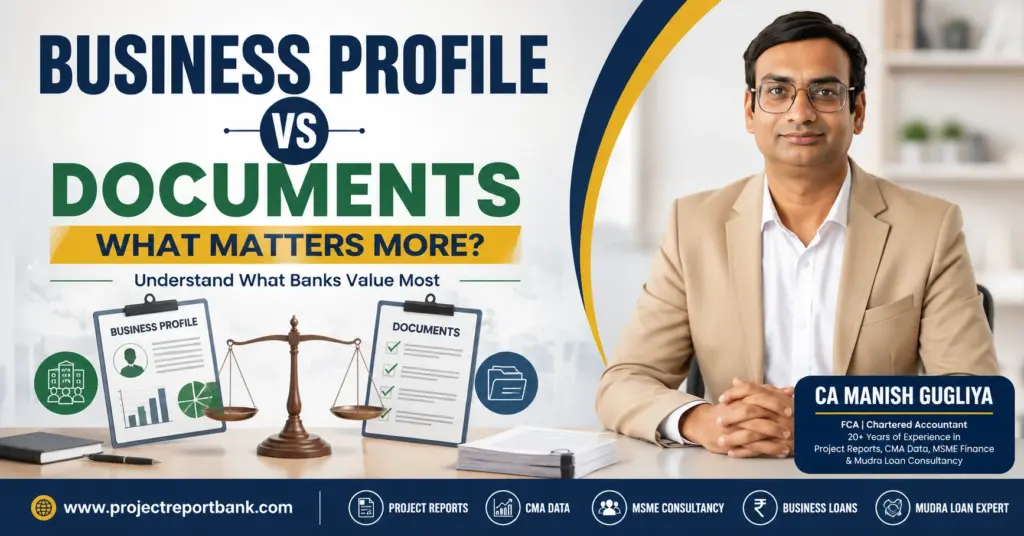
- Business Profile vs Documents: Which Matters More for Mudra Loan Approval?
- Common Reasons Banks Hesitate to Approve Mudra Loans
- Why Banks Approve Some Mudra Loan Applications Faster Than Others