Key Takeaways
Yes, a sanctioned Mudra Loan can be cancelled before disbursement in some situations, both by the bank and by the borrower. Here are the most important points this article covers:
- A sanction letter is a conditional promise – it does not guarantee money in your account until all conditions are fulfilled and disbursement is completed.
- Banks can cancel a sanctioned Mudra loan for valid reasons such as fake documents, non-compliance with sanction conditions, or adverse verification findings.
- Borrowers can also voluntarily cancel before disbursement, usually without any negative CIBIL impact if no dues are pending.
- Every borrower has the right to ask for a written reason for cancellation and raise a formal complaint if the cancellation appears unfair or arbitrary.
- This article is written by CA Manish Gugliya (FCA) for ProjectReportBank.com, based on 20+ years of practical experience in MSME finance, project reports, CMA data, and Mudra loan consultancy.
Direct Answer: Can a Sanctioned Mudra Loan Be Cancelled Before Disbursement?
Let me give you a straight answer. Even after a bank issues a formal sanction letter for your Mudra loan under Pradhan Mantri Mudra Yojana (PMMY), the loan can still be cancelled before the loan amount reaches your account. This applies to all categories – whether you applied for a Shishu, Kishore, or Tarun loan.
Here is the short answer:
- Yes, the bank can cancel a sanctioned Mudra loan before disbursement if valid reasons exist.
- Yes, the borrower can also cancel before disbursement, usually by giving a written request.
- No, a sanction letter alone does not create an absolute right to disbursement without fulfilling all conditions.
When cancellation is legally possible:
- Discovery of fake or forged documents during verification
- Incorrect information in the application or project report
- Failure to submit documents required under sanction conditions
- Adverse CIBIL report or negative field verification after sanction
- Expiry of sanction validity date
- Borrower’s own written withdrawal request
When cancellation may be unfair or improper:
- Cancellation without giving any written reason
- Cancellation based on personal bias of branch staff
- Demanding unofficial payments or commissions
- Forcing the borrower to purchase unrelated insurance or financial products as a hidden pre-condition
The maximum loan amount under PMMY is ₹10,00,000 and no collateral security is required for Mudra loans. Eligible borrowers include individuals and partnership firms engaged in non farm sector activities. RBI and PMMY guidelines expect banks to follow fair lending practices and proper communication, but each bank also applies its own internal credit policy. Applicants must not be defaulters to any bank.
To truly understand cancellation, you must first know the difference between loan application, approval, sanction, and disbursement – which I will explain next.
Table of Contents
Understanding the Difference: Application, Approval, Sanction and Disbursement
Most Mudra loan borrowers get confused between “approved”, “sanctioned”, and “disbursed.” This confusion leads to wrong expectations and frustration when a loan is cancelled or delayed.

Let me break down each stage clearly:
- Loan Application: You fill the Mudra loan form and submit it with your project report, identity proof, address proof, and other documents at the nearest branch or online portal.
- Loan Approval: The bank’s internal credit team evaluates your proposal and decides it is acceptable in principle. For small Mudra loans, this step is often not communicated as a separate letter.
- Loan Sanction: A formal written sanction letter is issued mentioning the sanctioned loan amount, interest rates, margin, repayment period, and specific sanction conditions you must fulfil.
- Loan Documentation: You sign the legal documents – loan agreement, hypothecation deed, demand promissory note, standing instructions, etc.
- Loan Disbursement: The final stage where the loan amount is actually credited to your current or savings account, or a Mudra card is issued.
Practical example: Suppose you apply for a ₹3,50,000 Kishore category Mudra loan for a small trading business. The bank approves it internally, issues a sanction letter with conditions like submitting Udyam registration and shop licence. Only after you comply with these conditions does the bank disburse the money. Mudra loans are available in categories: Shishu loans are up to ₹50,000, Kishore loans range from ₹50,001 to ₹5,00,000, Tarun loans range from ₹5,00,001 to ₹10,00,000, and Tarun Plus loans can go up to ₹20,00,000 for repeat borrowers – with loan amounts ranging from ₹50,000 to ₹20 lakhs across categories.
A sanction is a conditional promise subject to fulfilment of all terms. For a detailed explanation, read the guide on difference between Mudra Loan approval, sanction and disbursement.
Once this difference is clear, it becomes much easier to understand when the bank is allowed to cancel and when you can question the cancellation.
Can the Bank Cancel a Sanctioned Mudra Loan Before Disbursement?
From my two decades of experience in MSME finance, I can confirm that banks do have the right to cancel a sanctioned Mudra loan before disbursement – but only for genuine and recorded reasons. If only a sanction letter has been issued, cancellation is typically easier than after partial disbursement.
Genuine grounds for cancellation include:
- Fake or forged documents discovered during verification (PAN, Aadhaar, income proof, GST registration)
- Major incorrect information in the application – false turnover, wrong address, or hiding existing loans
- Failure to complete sanction conditions within the validity period (e.g., not submitting Udyam registration, business licence, or quotations)
- Sanction validity expired – for example, sanction valid for 90 days but borrower did not complete documentation
- Adverse verification findings – non-existent business premises, serious CIBIL issues discovered later, or negative field visit report
- Regulatory compliance issues such as updated KYC or AML norms, or internal policy changes
- Borrower giving a written request to withdraw
Real-life example: A small transport operator sought a Mudra term loan for a vehicle purchase. After sanction, the bank discovered during verification that his existing vehicle was already under seizure by another finance company. The bank cancelled the sanction citing undisclosed liabilities and risk.
When cancellation can be challenged:
- No reason given in writing despite repeated requests
- Conditions changed at the last minute – such as suddenly demanding collateral when the Mudra loan was sanctioned as collateral-free under the flagship scheme
- Branch staff insisting on unofficial commission or bundling of insurance policies and cancelling when borrower refuses
In such unfair cases, borrowers can escalate within the bank and use formal complaint mechanisms, which I discuss later.
Common Reasons Why a Sanctioned Mudra Loan Gets Cancelled Before Disbursement
In our experience at ProjectReportBank.com, most cancellations happen due to a small set of repeating reasons. Many are preventable if the borrower is properly guided and the documentation is solid.
Conditional Sanction Not Complied With in Time
A conditional sanction means the bank has approved your loan subject to you fulfilling certain conditions – like depositing margin money, providing shop licence, stock statement, guarantor KYC, or machine quotation. If you fail to meet these within the validity period, the sanction lapses automatically. To understand this better, read what is conditional sanction in a Mudra Loan.
Negative Findings During Pre-Disbursement Verification
Banks often conduct a field visit before disbursement. If the shop is closed, the address does not match, declared machinery does not exist, or the nature of business is entirely different from what was declared in the application, the bank will cancel. This is especially common in manufacturing and service sector proposals where physical verification matters.
Problematic CIBIL or Existing Loan Behaviour
Sometimes the bank re-checks CIBIL before disbursement. If new defaults, write-offs, or fresh loans appear in your credit report – especially within the last six months – the bank’s sole discretion may lead to cancellation. Maintaining clean credit needs is essential during the processing period.
Issues With Documents Required Under Mudra Yojana
Missing or inconsistent KYC, business proof, financial statements for higher loan amount categories, or suspicious documents raise red flags. If your turnover declared in the project report does not match your bank statement or GST returns, the bank may doubt the genuineness and cancel. A situation where the loan is approved but not moving to sanction is also common when document issues surface early.
Internal Policy or Compliance Restrictions
The branch may be forced to cancel if exposure limits, sector caps, or risk parameters are breached under the bank’s internal board-approved policy. This is generally recorded in internal notes and is not always communicated in detail to the applicant.
Borrower’s Own Request to Cancel or Postpone
Sometimes entrepreneurs change their plan, find better funding from partners or family, or decide to scale down the project. In such cases, they give a written request to cancel. For more on bank-driven cancellation specifically, see can a sanctioned Mudra Loan be cancelled by the bank.
Just as the bank can cancel, the borrower also has the option – which I explain next.
Can the Borrower Cancel the Mudra Loan After Sanction but Before Disbursement?
The borrower is usually free to cancel or not proceed with a sanctioned Mudra loan at any time before disbursement by giving a written request. A cancellation request must be submitted in writing to the lending institution, and it must be submitted before the disbursement order is processed.
Voluntary cancellation means you decide not to take the loan amount after receiving the sanction letter – perhaps due to lower business requirement, a better offer from another bank, or a change in your project plan.
Financial implications:
- If no money is disbursed and no loan account is opened, no repayment obligations exist. There is no EMI or interest liability.
- Mudra loans can be cancelled without penalties if not disbursed. Many public sector banks charge low or zero processing fees for Mudra loans, but borrowers should inquire if any processing fees are non-refundable upon cancellation.
- Borrowers must provide valid reasons for loan cancellation and obtain written confirmation of cancellation to avoid future issues.
Impact on CIBIL and future loans:
- A cancellation before disbursement does not impact the credit score negatively. The loan enquiry may reflect in internal records, but fresh applications are usually allowed.
- However, repeated cancellations without reason may create a negative impression at the same branch, even if your CIBIL remains unaffected.
Documentation for borrower-initiated cancellation: Submit a short application on plain paper quoting your loan reference number, date of sanction, reason for not availing the loan, and a clear request for closing the proposal. Always ask for written acknowledgment from the bank.
I advise borrowers to take expert guidance before cancelling, especially if they may need higher funding later from the same or another bank.
What Happens After Cancellation of a Sanctioned Mudra Loan?
Cancellation is not the end of the road. It only means that particular sanction is not being used, and you can still plan for future finance.
What happens in the bank’s system:
- The proposal is marked as “cancelled” or “not availed”
- Any undisbursed limit under the Mudra scheme is released
- Documents may be archived; original papers submitted for verification are usually returned on request
Can you apply again?
In most cases, yes. You can reapply to the same bank or another bank under Mudra Yojana, especially if the reason for cancellation has been resolved. A fresh application means a fresh appraisal – new project report, updated documents required, and a new CIBIL check.
Time gap and fresh documentation:
- Banks may expect a reasonable gap (a few months) if the earlier cancellation was due to weak financials or business viability concerns
- All key documents – KYC, bank statement, ITRs, quotations, licences – must be updated to the current date
Impact on future decisions:
- If cancellation was due to adverse verification or fake documents, future Mudra loans may be difficult at that bank and sometimes elsewhere
- If cancellation was voluntary for genuine reasons, impact is usually minimal, especially if explained properly in the new application
After understanding what happens post-cancellation, you should clearly know your rights if the bank cancels unfairly.
Borrower’s Rights If the Bank Cancels a Sanctioned Mudra Loan
Even though Mudra loans are small-ticket financial assistance for micro enterprises and small manufacturing units, borrowers still have rights under fair banking practices and the govt grievance redressal system.

- Right to Know the Reason: You can insist on a clear and specific reason for cancellation. Vague terms like “policy issue” or “management decision” should be further explained by the branch.
- Right to Written Communication: The bank should give a written message – SMS, email, or letter – stating that the sanctioned Mudra loan has been cancelled and why.
- Right to Clarification and Discussion: You can request a meeting with the branch manager or credit officer to understand the problem and explore if it can be resolved.
- Right to Grievance Redressal: If unsatisfied, escalate to the bank’s regional office, nodal officer, or customer care as per their grievance policy.
- Right to Complain to Higher Authority: If still unresolved or clearly unfair, approach the Banking Ombudsman under the RBI Integrated Ombudsman Scheme. For a detailed guide on how to draft and escalate such complaints, read Mudra Loan complaints and Ombudsman process.
Always keep copies of all communications – sanction letter, cancellation messages, emails, and notes of meetings. These are critical for any future complaint or re-application.
Once you know your rights, the next step is a clear action plan.
What Should You Do If Your Sanctioned Mudra Loan Is Cancelled?
Here is a practical, step-by-step action plan based on real banking and Mudra consultancy experience:
- Collect All Relevant Papers: Gather your sanction letter, application copy, SMS and emails from the bank, and any internal notes or checklists shared by the branch.
- Request Written Reason: If you only received an oral message, submit a polite written request asking for the specific reason. Mudra loan cancellation requires a formal application process, and cancellation requests should include the loan reference number and reason for cancellation.
- Verify Sanction Conditions: Compare the original sanction conditions with what you actually completed. Check if any document or compliance item is still pending from your side.
- Meet the Branch Manager: Schedule a face-to-face meeting, carry all documents, calmly explain your position, and ask if the decision can be reviewed.
- Rectify Curable Issues: If the problem is a missing licence, outdated bank statement for the last six months, or incomplete project report, arrange them quickly and request reconsideration.
- Escalate the Complaint: If cancellation appears unfair or against bank guidelines, follow the internal grievance process and then, if needed, approach the Ombudsman.
- Consider Applying Again: If the issue cannot be resolved, plan a fresh Mudra loan proposal with improved documents and realistic cost projections – possibly with expert help from ProjectReportBank.com.
Prepare a small personal checklist summarising your proposal status, pending documents, and discussion notes to stay organised throughout this process. Cancellation requests must be submitted before loan disbursement to keep the process clean.
Common Mistakes That Lead to Cancellation of Sanctioned Mudra Loans
Many cancellations could have been avoided if the borrower had paid attention to details and timelines after sanction. Here are the key mistakes:
- Ignoring Sanction Conditions: Treating the sanction letter as final approval without reading conditions like margin deposit, proof of ownership, licence, or insurance requirement.
- Delay in Submitting Documents: Taking too long to submit KYC updates, quotations, rent agreement, or residence proof, causing sanction validity to expire.
- Wrong or Inconsistent Information: Mismatch between application, project report, and actual business – such as different turnover figures, business activity, or address details.
- Non-Cooperation During Verification: Avoiding calls, not being present at the site during field visit, or not allowing bank staff to inspect stock and machine inventory.
- Delay in Accepting Sanction Terms: Not signing loan documents or not confirming acceptance within the time allowed, leading the bank to believe the borrower is no longer interested.
- Overestimating Loan Amount: Requesting a higher Mudra loan amount without sufficient justification or supporting it with a proper project report and financials.
Careful reading of the sanction letter, timely submission of documents, and honest communication with the bank can prevent most cancellations.
Expert Advice from CA Manish Gugliya: How to Avoid Cancellation Before Disbursement
Based on my 20+ years advising MSME borrowers on availing loan facilities under government schemes, here is what I recommend to every first-time Mudra borrower:
Handling a Sanctioned Mudra Loan: Read every clause of the sanction letter on the day you receive it. Clarify doubts with the branch immediately and note all timelines in writing. Do not assume that sanction means the money is coming automatically.
Best Practices Before Disbursement: Keep your business premises active and presentable for verification. Maintain your main bank statement properly – regular income generation and savings transactions help. Avoid taking multiple new loans from other banks while your Mudra loan is under process in the non corporate or company category.
Documentation Checklist: For categories covered under Mudra Yojana, generally keep these documents ready – Aadhaar, PAN (identity and passport size photo), address proof, Udyam registration, business proof, 6–12 months bank statement, last 2–3 years ITR (for Kishore and Tarun categories), GST registration if applicable, and a realistic project report. Applicants must provide ID proof and address proof as basic eligibility requirements. Educational qualifications depend on the proposed activity, especially for manufacturing or service sector businesses. Application forms are available on the bank’s website, and Mudra loans can also be applied online at udyamimitra.in. No collateral security is required for Mudra loans.
Communication With Banks: Always use written emails or letters for important requests. Be polite but firm. Confirm all verbal commitments in writing through a formal request or follow-up email.
Record Keeping: Maintain a dedicated Mudra loan file – physical or digital – with all applications, quotations, approvals, sanction letters, supporting site visit reports (if any), and correspondence.
At ProjectReportBank.com, we help borrowers prepare strong project reports, CMA data, and complete documentation for MSME finance that significantly reduces the risk of cancellation after sanction.
Myths vs Facts About Cancellation of Sanctioned Mudra Loans
Many entrepreneurs depend on hearsay from agents or references from friends, which creates unnecessary confusion. Let me clear the air:
- Myth: Once a Mudra loan is sanctioned, the bank must disburse and cannot cancel. Fact: Sanction is conditional. If documents required are not completed or serious issues are found, the bank is allowed to cancel before disbursement at its sole discretion.
- Myth: Cancellation of a sanctioned Mudra loan will always damage my CIBIL score. Fact: If no money was disbursed and there is no overdue, the impact on CIBIL is usually minimal. Enquiries may show, but score impact is negligible compared to an actual default.
- Myth: If one bank cancels my sanction, I can never get a Mudra loan again from any bank in India. Fact: Many borrowers successfully obtain Mudra loans later from the same or another bank after correcting the earlier problems and preparing better documents.
- Myth: Sanction letter is equal to money in the account. Fact: Disbursement happens only after documentation, verification, and fulfilment of all sanction terms within the validity period.
- Myth: Every cancellation is illegal and I can always claim compensation. Fact: Cancellation is legal if done for valid, recorded reasons. Compensation is generally not awarded unless there is clear deficiency in service or violation of banking rules.
Relying on proper guidance and written policies is always safer than depending on informal advice.

Frequently Asked Questions on Cancellation of Sanctioned Mudra Loans
Here are focused FAQs covering the most common practical doubts of Mudra borrowers on this subject.
Can a sanctioned Mudra Loan be cancelled before disbursement?
Yes. Both the bank and the borrower can cancel a sanctioned Mudra loan before disbursement. The bank may cancel for reasons like fake documents, non-compliance with sanction conditions, or adverse verification. The borrower can cancel voluntarily by submitting a written request.
Will cancellation of a sanctioned Mudra Loan affect my CIBIL score?
If no loan amount was disbursed and there is no overdue or default, cancellation typically does not impact your CIBIL score negatively. However, the loan enquiry may remain visible in your credit report.
Can I appeal if my sanctioned Mudra Loan is cancelled by the bank?
Yes. Firstly, escalate within the bank – meet the branch manager, then contact the regional office or nodal officer. If still unresolved, you can file a complaint with the RBI Integrated Ombudsman.
Can I apply again for a Mudra Loan after cancellation?
Yes, you can generally reapply to the same bank or another bank. You will need to submit a fresh application with updated documents and undergo a new credit appraisal.
Can another bank sanction my Mudra Loan if one bank has cancelled it?
Yes. Each bank evaluates Mudra loan proposals independently. However, they will look at your credit history, prior enquiries, and may ask about the earlier cancellation. Honest disclosure and better documentation improve your chances.
Are processing fees refundable if a sanctioned Mudra Loan is cancelled before disbursement?
It depends on the bank’s policy and what is stated in the sanction letter. Many public sector banks charge low or zero processing fees for Mudra loans. Always ask upfront whether fees are refundable or non-refundable upon cancellation.
How long is a Mudra Loan sanction letter valid?
Validity varies by bank – typically 30 to 180 days. If you do not complete documentation and comply with conditions within this period, the sanction may lapse and requires revalidation or fresh processing.
Can I reduce the loan amount instead of fully cancelling?
In many cases, yes. You can request the bank to reduce the sanctioned amount if your credit needs have changed. This is usually easier than full cancellation and may require a revised sanction letter.
Can the bank force me to buy insurance and cancel on refusal?
No. As per RBI fair practices guidelines, bundling of insurance or other products as a mandatory condition for loan disbursement is discouraged. If a bank cancels solely because you refused to buy an unrelated product, you can raise a complaint.
What should I do if the bank is delaying disbursement after sanction without any clear reason?
Submit a written request asking for the status and expected disbursement date. If there is no response within a reasonable time, escalate to the bank’s grievance cell. Unreasonable delay without communication may constitute deficiency in service.
Does sanction guarantee disbursement of a Mudra Loan?
No. Sanction is a conditional approval subject to verification, documentation, and compliance with all terms. Disbursement happens only after every condition is satisfied within the validity period.
Is there any time limit for submitting a cancellation request?
A cancellation request must be submitted before the disbursement order is processed. Once money is credited to your account, a different process (prepayment or closure) applies.
Can persons running a trading or service sector business get Mudra loans?
Yes. Mudra loans are available for income generation activities across trading, manufacturing, and services. Small manufacturing units, micro enterprises, and non corporate businesses including sole proprietorship and partnership firms are all covered under this scheme.
Conclusion
A sanctioned Mudra loan under Pradhan Mantri Mudra Yojana can indeed be cancelled before disbursement – either by the bank for valid and documented reasons, or by the borrower through voluntary withdrawal. This is not unusual, and as per PMMY data, a noticeable gap has always existed between sanctioned and disbursed amounts across India.
Careful reading of the sanction letter, timely fulfilment of every sanction condition, and maintaining honest, complete documentation greatly reduce the risk of cancellation. Borrowers seeking financial assistance under this scheme should not feel helpless – they have clear rights to written communication, clarification, and formal grievance redressal if a cancellation appears unfair or arbitrary.
Good project reports, realistic sales and cash flow estimates, and complete documents required for the chosen Mudra loan amount help banks gain confidence and avoid last-minute cancellations. I encourage you to explore the detailed Mudra loan guides available on ProjectReportBank.com before taking any major decision about cancellation, re-application, or escalation.
With proper guidance and transparent communication, most genuine Mudra borrowers can successfully obtain and use their loan for business growth without ever facing cancellation issues. Stay informed, stay prepared, and your funding journey will be far smoother.
- Can You Delay Accepting Mudra Loan Disbursement? Everything Borrowers Should Know

- What Happens on Mudra Loan Disbursement Day? (Practical Guide by CA Manish Gugliya)

- Partial Mudra Loan Disbursement: Reasons and Next Steps
- Can Banks Release Mudra Loan in Installments? (Practical Guide by CA Manish Gugliya)
- Does the Bank Verify Documents Again Before Disbursement?
- Can a Sanctioned Mudra Loan Be Cancelled Before Disbursement? (Practical Guide by CA Manish Gugliya)
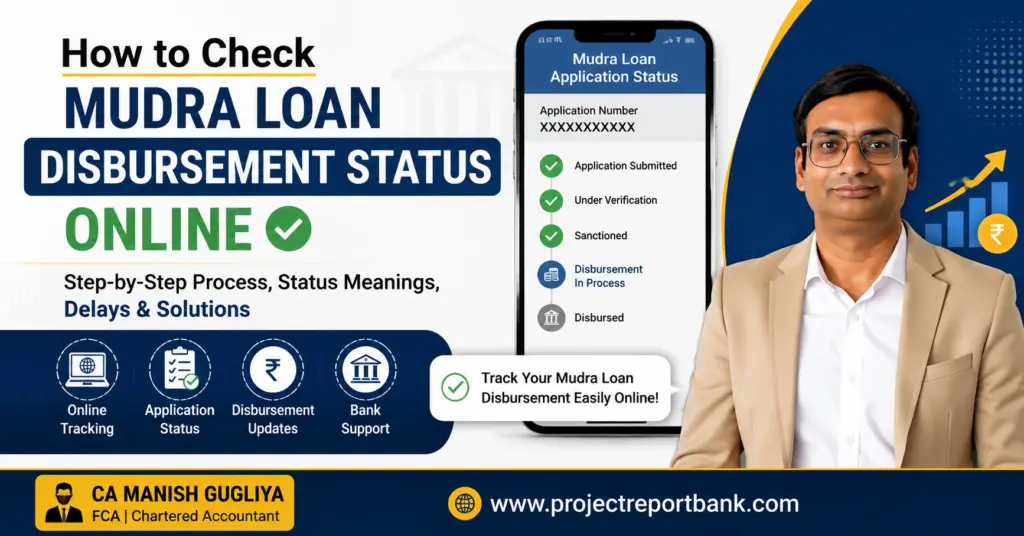
- How to Check Mudra Loan Disbursement Status Online
- Mudra Loan Amount Not Credited After Disbursement Approval: Reasons, Timeline & What You Should Do
- Documents Required Before Mudra Loan Disbursement: Complete Post‑Sanction Checklist