Key Takeaways
- Conditional sanction in a Mudra loan is a provisional internal bank approval granted under Pradhan Mantri Mudra Yojana (PMMY). It means the loan is approved in principle, but no loan amount is disbursed at this stage.
- The borrower must complete all pending conditions (documents, site visit, margin money proof, KYC, business proof) within the validity period to move toward final sanction and disbursement.
- A conditional sanction does not guarantee loan disbursement. The bank or financial institution can still reject the Mudra loan if verification fails, documents are mismatched, or conditions are not met honestly and on time.
- Conditional sanction letters may have a validity period (typically 30 to 90 days), and borrowers must satisfy conditions within a stipulated timeframe to avoid cancellation of sanction.
- This guide is written by CA Manish Gugliya, based on 20+ years of practical experience handling Mudra loans, MSME finance, and business loan sanctions across public and private sector banks.
Introduction: Conditional Sanction in Mudra Loans Explained
You check your phone and see an SMS from your bank: “Your Mudra Loan application has been conditionally sanctioned.” Your first reaction is relief. You think the money will hit your account within a day or two.
That assumption is wrong, and it causes real problems for thousands of applicants every year.
A conditional sanction is only a provisional approval stage for mudra loans under the Pradhan Mantri Mudra Yojana (PMMY), not the final sanction or disbursement. The scheme, launched on April 8, 2015, by the Prime Minister, provides collateral free credit to non-corporate, non-farm enterprises for income generating activities. It supports income generation and employment creation across the country. Applicants must be aged between 18 to 65 years, and eligible businesses include small producers and service providers. Agricultural activities are not eligible for Mudra loans.
Mudra Yojana offers loans up to ₹20 lakh for businesses under four categories:
- Shishu loans are up to ₹50,000
- Kishore loans range from ₹50,001 to ₹5,00,000
- Tarun loans range from ₹5,00,001 to ₹10,00,000
- Tarun Plus loans are from ₹10,00,001 to ₹20,00,000
MUDRA stands for Micro Units Development and Refinance Agency, a flagship scheme designed to address the credit needs of micro units and small enterprises engaged in non-farm income generating activities. Mudra loans support non-corporate small and micro enterprises, including those in food processing, trading, services, and manufacturing.
Whether you run a small kirana store, a tailoring unit, or a transport service, understanding the conditional sanction stage is critical. Many borrowers lose their loan simply because they did not understand this step or respond to the bank on time.
In this guide, you will learn: the exact meaning of conditional sanction, why banks use it, common conditions listed in the sanction letter, the document checklist, how long it remains valid, whether the bank can reject after conditional sanction, your rights as an applicant, practical tips to convert conditional sanction into disbursement, and frequently asked questions.
Everything here is based on practical banking experience from handling thousands of Mudra loan files. Exact practice may differ from bank to bank and branch to branch.

Table of Contents
What Is Conditional Sanction in a Mudra Loan?
Conditional sanction is an internal loan approval by the bank where the Mudra loan is agreed in principle, but subject to fulfillment of specific conditions before release of funds. Think of it as the bank saying: “We are willing to lend, but first you need to complete these pending items.”
At this stage, the credit officer or branch manager has completed basic credit appraisal, recommended the loan, and the sanctioning authority has approved it with conditions recorded in the system or in the conditional sanction letter. The lender has reviewed your eligibility criteria, looked at your business plan, assessed your credit history, and found the case broadly acceptable.
A conditional sanction means loan approval is given in principle. But here is what many applicants miss: no money is released. The loan amount is not yet disbursed. You cannot withdraw or use funds for your business until all conditions are met and final sanction plus disbursement approval is given.
This practice is common across commercial banks, small finance banks, RRBs, cooperative banks, and NBFCs offering Mudra loans under PMMY. Mudra loans are available through banks, NBFCs, and MFIs. No collateral is required for loans up to ₹10 lakh, and loans under Mudra Yojana are collateral-free for amounts up to ₹10 lakh.
Here is a realistic example. A small mobile shop owner applies for a ₹3 lakh Kishore Mudra loan. The bank completes its initial assessment, finds the applicant and business broadly eligible, and issues a conditional sanction SMS. The conditions listed: submit GST registration certificate, provide latest six months’ bank statement, and allow site inspection of the shop premises. Until these three items are completed and verified, the bank will not move to final sanction or release the ₹3 lakh.
Mudra loan interest rates are usually lower than traditional loans. Current interest rates for Mudra loans start at 9.05% per annum, and interest rates for Mudra loans are deregulated by banks, which means each financial institution sets its own rate within a broad range. These terms (interest rate, tenure, repayment structure) are typically indicated at the conditional sanction stage, but finalized only at the time of formal sanction.
The difference between what the bank records internally and what the borrower sees (SMS, email, or a conditional sanction letter) is simple: the bank’s system flags the case as “conditionally approved,” while the applicant receives a communication listing outstanding items. Both point to the same thing: more work is needed before money flows.
Why Do Banks Issue Conditional Sanctions for Mudra Loans?
Banks use conditional sanction to manage risk and to keep the Mudra loan process moving forward even when some checks or documents are still pending. Micro and small enterprise lenders issue conditional sanctions to manage financial risk. Rather than rejecting a partially complete application outright, the bank locks in the case and gives the applicant a clear list of what is needed.
Common reasons a bank issues conditional sanction instead of straight final approval:
Missing documents. Trade license, latest ITR, GST registration, Udyam Registration, or business registration certificates are not yet submitted. Many individual borrowers running micro enterprises lack complete paperwork at the time of applying.
Site inspection pending. The field officer has not yet visited the business premises to verify stock, assets created, capital assets, and the proposed activity. This is standard for Kishore and Tarun category loans.
Project report or CMA data needs clarification. The bank may need adjustments to sales projections, working capital cycle estimates, or cost breakdowns before the credit committee gives full clearance.
Margin money not yet confirmed. Some banks require proof of the borrower’s own contribution (savings, FD, or cash brought into business). Until this is verified, the bank keeps the sanction conditional.
KYC or address verification is under process. Aadhaar verification, PAN validation, or cross-checking the business address against other documents may still be running.
Credit history review. The bank may want to confirm a satisfactory credit track record or check whether the applicant has successfully repaid previous loans before releasing funds.
Conditional sanction allows the bank to “block” an indicative loan amount, interest rate band, tenure, and type of facility (term loan or working capital) while still protecting itself with conditions. For the mudra scheme, especially in the Shishu and Kishore category, this approach helps speed up approvals while still complying with internal credit policy, RBI guidelines, and PMMY norms.
Consider a transport operator seeking a Mudra loan to buy a three-wheeler for passenger service. The bank completes initial appraisal, finds the borrower eligible, and issues conditional sanction. The conditions: submit RC (registration certificate) transfer in applicant’s name, mark hypothecation of the vehicle in the bank’s favor, and provide insurance with the bank as beneficiary. Once these are done, the loan is finally sanctioned and loan extended to the applicant.
Conditional sanction is a positive step. The bank is broadly convinced about the case. But it still requires action from the borrower before funds are released.
Common Conditions Mentioned in a Mudra Loan Conditional Sanction Letter
The conditional sanction letter lists specific points the borrower must complete. These conditions vary by bank, loan amount, business type, and internal credit policy. Common conditions in MUDRA sanctions include submitting missing documents or business proof.
Below is a reference point for typical conditions you may encounter:
| Typical Condition in Mudra Conditional Sanction Letter | Plain-English Explanation for Borrower |
|---|---|
| Submit KYC documents (PAN, Aadhaar, photo, address proof) | Prove your identity proof and where you live or run your business. |
| Business proof: GST certificate, shop act license, Udyam Registration, partnership deed, or other legal entity registration | Show that your business exists legally and is registered with the right authority. |
| Quotations or invoices for machinery, equipment, vehicle, furniture, or stock | Justify the proposed loan amount by showing exactly what you will purchase. |
| Latest bank statements (6 to 12 months) for all accounts | Let the bank verify your cash flow, turnover, and EMI paying capacity. |
| Site inspection or business verification by bank official | A bank officer will visit your shop, factory, or service location to check if the business is real and operational. |
| Margin money proof (own contribution) | Show evidence that you have put your own money into the business, usually via a bank deposit or savings account balance. |
| Guarantor KYC and income details (where applicable) | If the bank requires a guarantor based on risk, the guarantor must submit identity proof, address proof, and income proof. |
| Property or asset verification | If any collateral or third-party security is involved; though standard PMMY loans upto rs 10 lakh are usually collateral free. |
| Corrections in project report or CMA data | Fix specific numbers: sales projections, expense estimates, working capital cycle as flagged by the banker. |
| Minimum credit score or no overdue in previous loans | Your CIBIL must meet the bank’s threshold, and you should have no defaults on covering loans or other existing credit. |
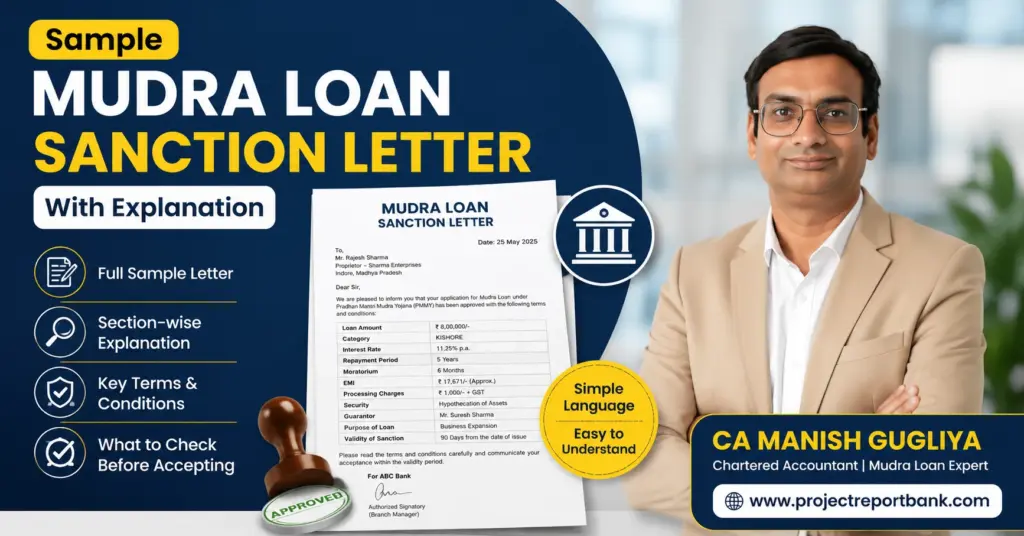
Read every line of the conditional sanction letter carefully. If any term is unclear, ask the branch officer for a simple explanation. Keep a copy for your records. You can also review our guide on Mudra loan sanction letter format to understand what a proper sanction letter looks like.
Real banks never ask for advance fees to convert a conditional sanction into cash. If anyone demands upfront payment to “release” your Mudra loan, that is a fraud. You can verify whether a Mudra loan sanction letter is genuine before acting on it.

Difference Between Conditional Sanction and Final Sanction in Mudra Loans
Many applicants confuse conditional sanction with final sanction. This confusion often leads to delay, missed deadlines, or even cancellation of the Mudra loan. Here is a clear side-by-side comparison:
| Comparison Point | Conditional Sanction | Final Sanction / Disbursement Stage |
|---|---|---|
| Approval status | Provisional; approved in principle | Confirmed; definitive approval |
| Conditions | Major conditions still pending | All major conditions completed and verified |
| Disbursement of funds | No funds released; disbursement of funds is held until specific requirements are met | Funds ready for release; partially or fully disbursed |
| Documentation | Basic documents checked; gaps remain | Full documentation, signatures, and loan agreements executed |
| Bank verification | Some verifications pending (KYC, site visit, CIBIL, income, business proof) | All required verifications completed |
| Risk for bank | Higher risk; hence conditions attached | Reduced risk after full due diligence |
| Borrower’s action | Must submit documents, facilitate inspections, provide clarifications | Must sign agreements, provide ECS/mandates, comply with final terms |
| Communication form | Often SMS, email, or conditional letter | Formal sanction letter specifying interest rate, EMI, tenure, moratorium, processing fee |
Conditional sanction is not a legal commitment to disburse. The bank can withdraw it if conditions are not met or if new adverse information surfaces. Final sanction, combined with execution of loan documents, creates binding rights and obligations for both the bank and borrower.
For a deeper breakdown of each processing stage, read our guide on the difference between Mudra loan approval, sanction, and disbursement.
What Happens After Conditional Sanction? Step-by-Step Process
Conditional sanction sits in the middle of the loan process, not at the end. The borrower still has several steps before money is credited.
Here is the complete Mudra loan workflow:
Application Submitted ↓ Credit Appraisal ↓ Conditional Sanction ↓ Conditions Completed ↓ Final Approval ↓ Sanction Letter Issued ↓ Loan Agreement Signed ↓ Disbursement
Stage 1: Loan application submitted. The applicant fills out the loan application online via the JanSamarth portal or offline at a branch. You can apply online through this portal. The application includes basic details, business profile, category (Shishu, Kishore, Tarun, or Tarun Plus), and requested loan amount. Documents required include identity proof and business details at this initial stage.
Stage 2: Credit appraisal. The banker checks eligibility, CIBIL report, existing borrowings, basic viability of the business, and compliance with PMMY guidelines. For more on what happens during this phase, see our article on Mudra loan under credit appraisal.
Stage 3: Conditional sanction. The loan is recommended and approved internally with specified conditions. The borrower receives SMS, email, or a conditional sanction letter.
Stage 4: Condition completion. The applicant submits remaining other documents, allows the bank officer to conduct site inspection, and answers any project-related queries. This is the next phase where most delays occur.
Stage 5: Final approval. The sanctioning authority confirms all conditions are met and generates the formal Mudra sanction letter. You can see a sample Mudra loan sanction letter for reference.
Stage 6: Documentation and agreement. Signing of application-cum-agreement, loan documents, hypothecation agreement, standing instructions or ECS mandate, and any guarantor documents.
Stage 7: Disbursement. Release of funding as per requirement. Working capital amounts go to the borrower’s current or savings account. Term loan amounts may be paid directly to a supplier or vehicle dealer. Approval for Mudra loans can take a few days if documents are complete; for Tarun category cases with site inspections, expect 10 to 15 working days.
Timely response from the applicant during this period reduces Mudra loan disbursement delay. Banks may put files on hold or close them if the borrower is not responsive.

Documents Usually Required After Conditional Sanction
Most conditional sanctions under Mudra loans relate to pending or incomplete documentation. Having a clear checklist helps applicants avoid repeated bank visits.
Identity proof: PAN card, Aadhaar card, voter ID, or any acceptable KYC document as per bank norms. All eligible borrowers must have valid identity documents.
Address proof: Aadhaar, electricity bill, rent agreement, or other valid proof for both residence and business address. If the business premises is rented, a landlord NOC may also be needed.
Business proof: GST registration, Udyam certificate, shop and establishment license, trade license, partnership deed, or registration certificate. For a beneficiary micro unit entrepreneur running a non corporate entity, the bank needs proof that the proposed activity is legitimate and operational.
Bank statements: Six to twelve months of statements for all operative accounts. The bank uses these to judge turnover, cash flow, and repayment capacity. The assessment is assessed based on actual transaction patterns.
Financial papers: Latest ITRs, provisional profit and loss account, balance sheet, or a simple income declaration for very small micro units where ITR is not filed. Income proof requirements vary; some banks accept an affidavit for Shishu category while others insist on formal returns.
Project report and CMA data: For Kishore and Tarun categories, a project report explaining the business model, cost of project, working capital needs, and repayment capacity for the requested loan amount is often mandatory. The report should demonstrate that the applicant has the necessary skills and a viable business plan to repay the loan.
Quotations and invoices: Detailed quotes for machinery, vehicle, equipment, furniture, or renovation to justify loan end-use. These must match the amounts mentioned in the loan application.
Margin money or own contribution proof: Bank statement showing savings, cash deposit slips, or capital introduction records proving the borrower has skin in the game.
Additional documents: Photographs, landlord NOC (if business premises is rented), guarantor KYC, or any bank-specific forms. Some lenders ask for proof of educational qualification for certain services or professional activities.
Validity of Conditional Sanction and Possibility of Rejection
Most banks keep conditional sanction valid for a limited period, often 30 to 90 days depending on internal policy. During this window, the borrower must complete all listed conditions and submit required documents.
What happens after the validity expires?
- The bank may ask for fresh documents or updated bank statements.
- The case may be re-appraised if the applicant’s financial position or CIBIL score has changed.
- The bank may cancel the conditional sanction and close the file if there is no response from the borrower.
Borrowers must satisfy conditions within a stipulated timeframe to avoid cancellation of sanction. If you sense a delay on your side, inform the branch and request an extension in writing. Some banks grant extensions at their discretion, but there is no automatic right to one.
Can a bank reject a Mudra loan after conditional sanction?
Yes. A conditional sanction does not guarantee loan disbursement. The bank can legally decline to proceed if:
- Verification of address, business, or stock is unsatisfactory.
- Major information in the loan application or project report is found to be false.
- CIBIL score deteriorates, new defaults appear, or existing EMIs become overdue during the pending period.
- Suspected fraud, forged documents, or benami activity is detected.
- Internal bank or RBI policy changes make the case ineligible (for example, restriction on certain allied agricultural activities or negative-list businesses).
- The proposed business or other legal entity structure does not comply with the mudra scheme norms.
In the Umakant Ashok Giri vs SBI case (July 2023), the court held that once a bank accepts a complete Mudra loan application with all required KYC documents, it must communicate sanction or rejection in writing within 14 working days. This ruling underlines that banks cannot indefinitely sit on applications, but it also confirms they retain the right to reject if conditions are genuinely unmet.
For more on this topic, see our detailed article on whether a sanctioned Mudra loan can be cancelled by the bank.
Conditional sanction is a positive indicator, not a guarantee. Stay honest and cooperative during verification.
Applicant Rights and Common Mistakes During Conditional Sanction Stage
Your rights as a Mudra loan applicant at conditional sanction stage:
You have the right to know exactly which conditions are pending and by when they must be completed. Ask for a copy of the conditional sanction letter or written communication listing all conditions. You can request simple explanations of banking terms, interest rate calculations, processing charges, and whether a guarantor or credit guarantee is being sought. If the loan is ultimately rejected, you are entitled to a clear reason, subject to bank and regulatory norms. If there is unfair delay or non-response, use the bank’s grievance redress channels: branch manager, regional office, nodal officer, and if needed, the Banking Ombudsman.
Financial assistance under the mudra scheme is a government-backed initiative. Banks cannot deny processing your application without valid reason under PMMY norms. The scheme exists to serve the credit needs of the beneficiary micro unit, and every eligible applicant deserves a fair hearing. Eligible businesses include micro enterprises engaged in manufacturing, trading, and services. The needs of the beneficiary should be assessed properly.
Common mistakes borrowers make at this stage:
- Ignoring bank calls, SMS, or emails, and delaying document submission beyond the validity period.
- Submitting incomplete or mismatched documents. For example, different addresses across Aadhaar, bank passbook, and GST registration create red flags.
- Providing fake bills or inflated quotations to increase the maximum loan amount. This is the fastest route to rejection and potential legal trouble.
- Assuming conditional sanction equals final approval and making financial commitments, ordering machinery, paying advances, signing rent agreement for new premises, before disbursement actually happens.
- Changing the business plan, end-use, or loan requirement without informing the bank.
- Taking additional loans or credit card debt during the appraisal period, which worsens CIBIL and repayment capacity when assessed based on updated credit reports.
- Not maintaining a healthy bank balance; cheque bounces during this period send a negative signal about your repayment capacity.
Maintain transparency, respond quickly, and keep written acknowledgements (receipts, email confirmations) of every document submitted to the bank.

Expert Tips from CA Manish Gugliya to Convert Conditional Sanction into Final Disbursement
These tips come from over 20 years of handling MSME and Mudra loan cases with various public and private sector banks. Each one addresses a real bottleneck I have seen borrowers face during the stage of growth development and funding of their micro units.
- Visit the branch immediately after receiving the conditional sanction SMS. Understand every pending condition face to face. Phone calls are helpful, but an in-person visit gets faster results.
- Prepare a realistic project report. Show sales, expenses, and EMI capacity based on actual numbers, not over-optimistic figures. A business plan grounded in real cash flow data is far more convincing than inflated projections.
- Keep photocopies and scanned copies of all documents. If any paper is misplaced or needs re-verification, you can resubmit within hours instead of days.
- Self-attest all copies and carry original documents when visiting the bank for verification. Banks verify originals on the spot and return them.
- Maintain a healthy average balance in your bank account and avoid cheque bounces during the appraisal and conditional sanction period. The bank monitors your account activity.
- Do not change your mobile number or business address without notifying the bank while your loan application is under process. Lost communication is one of the top reasons files go dormant.
- Request written clarification if any condition seems unclear or inconsistent with PMMY guidelines. Politely discuss alternatives if a guarantor or security arrangement is difficult. Under the mudra scheme, loans availed under Shishu and most Kishore cases should not normally require collateral.
- Follow up regularly in a polite manner. Ask for realistic timelines for site visit, final sanction, and disbursement. Track your Mudra loan processing stage timeline so you know what to expect.
The growth development and funding needs of small enterprises depend on timely credit. Treating the conditional sanction stage with urgency and seriousness is the difference between getting your business loan disbursed and watching your file gather dust.
Frequently Asked Questions on Conditional Sanction in Mudra Loan
After receiving conditional sanction, can I change the loan amount or purpose?
Minor adjustments, such as slightly reducing the loan amount or updating a quotation, may be possible before final sanction. The bank will need to re-appraise the changed figures. Major changes to the loan amount or the proposed activity usually require a fresh application. Inform the branch before making any changes; do not assume they will accept modifications without review.
Will interest start from the date of conditional sanction or from disbursement?
Interest on Mudra loans is charged only after disbursement, not from the conditional sanction date. Until funds are actually credited to your account or paid to the vendor, no interest accrues. The interest rate, which starts at 9.05% per annum and varies by bank and category, applies only from the date of actual fund release.
Can I apply with another bank if one bank gives conditional sanction but is delaying disbursement?
You can approach another bank, but be aware of practical complications. Every new loan application generates a CIBIL enquiry, and multiple enquiries in a short period can hurt your credit score. If you decide to pursue a second bank, formally close or withdraw the first application. Running parallel applications without disclosure may lead to rejection at both institutions.
Is a guarantor compulsory for all Mudra loans after conditional sanction?
PMMY guidelines do not mandate guarantors for all cases. Shishu loans up to ₹50,000 rarely require one. For Kishore and Tarun category loans, individual banks may ask for a guarantor based on their internal credit policy, especially if the borrower’s credit history is thin or the loan amount is higher. If the bank asks for a guarantor, discuss whether this is a firm requirement or if providing additional business proof or income proof can serve as an alternative.
Does conditional sanction improve my chances of getting other business loans?
A conditional sanction by itself is not visible to other lenders on your CIBIL report the way a disbursed loan is. It may indicate that one bank finds your profile broadly acceptable, but every new lender will conduct its own independent appraisal. What strengthens future applications is a track record where you have successfully repaid previous loans and maintained a satisfactory credit track record, not simply having received a conditional approval elsewhere.
Conclusion: Handle Conditional Sanction Carefully to Secure Your Mudra Loan
Conditional sanction under Pradhan Mantri Mudra Yojana is a strong positive signal, but it remains a provisional stage. No funds are released until all conditions are fully met and the bank issues its formal sanction letter.
Promptly submit required documents, cooperate during site inspection and verification, and maintain full honesty in all declarations. These three actions move your file from conditional to final sanction faster than anything else. Careful handling of this stage helps small businesses, traders, and service providers secure working capital and term loan amounts they need without unnecessary delay or rejection.
Read our connected guides on Mudra loan sanction letter formats, downloading your sanction letter online, and reasons for Mudra loan disbursement delay to understand the full Mudra loan journey from application to final credit.
As a Chartered Accountant with over 20 years in MSME finance, I have seen thousands of conditional sanctions convert into successful disbursements. The ones that succeed share one trait: the borrower treated conditional sanction as the starting line for completing documentation, not the finish line. Use this knowledge to navigate your Mudra loan process with confidence.
- Hidden Terms and Conditions in a Mudra Loan Sanction Letter

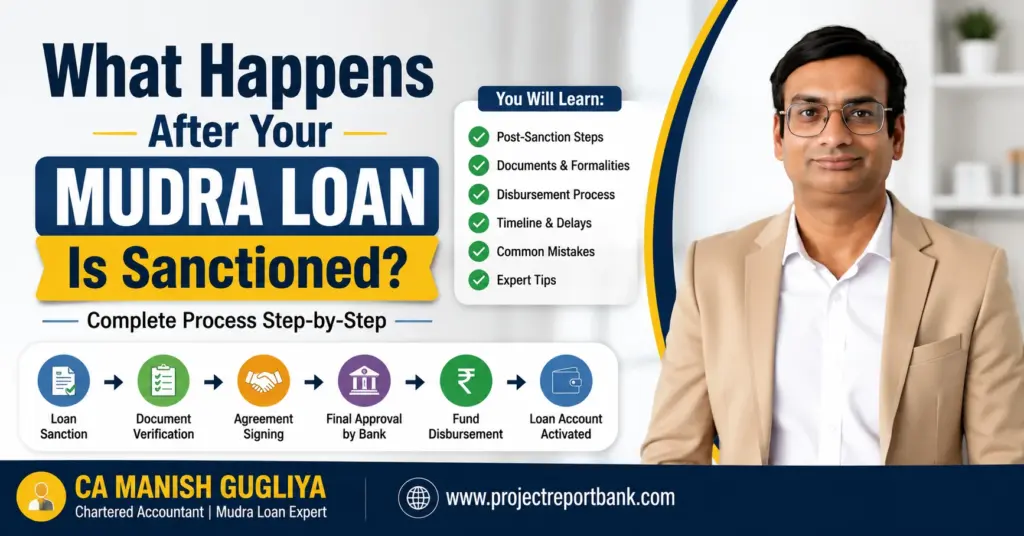
- What Happens After Your Mudra Loan Is Sanctioned?
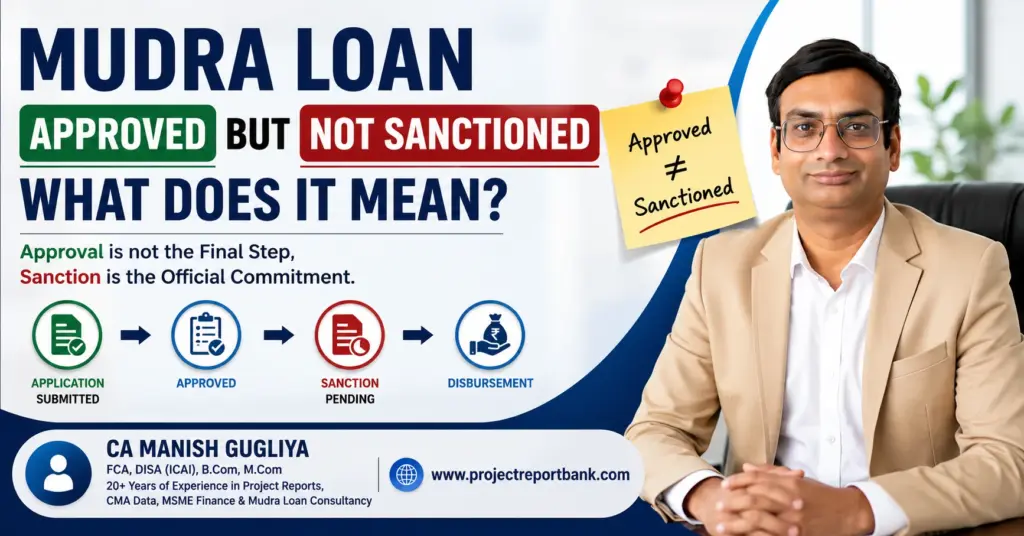
- Mudra Loan Approved but Not Sanctioned: What Does It Really Mean?
- What Is Conditional Sanction in a Mudra Loan? Meaning, Conditions, Documents & Next Steps
- Can a Sanctioned Mudra Loan Be Cancelled by the Bank? Complete Guide (2026)
- Difference Between Mudra Loan Approval, Sanction and Disbursement
- How to Check Whether Your Mudra Loan Sanction Letter Is Genuine

- Mudra Loan Sanction Letter Format: Every Section Explained
- Sample Mudra Loan Sanction Letter with Explanation