Key Takeaways
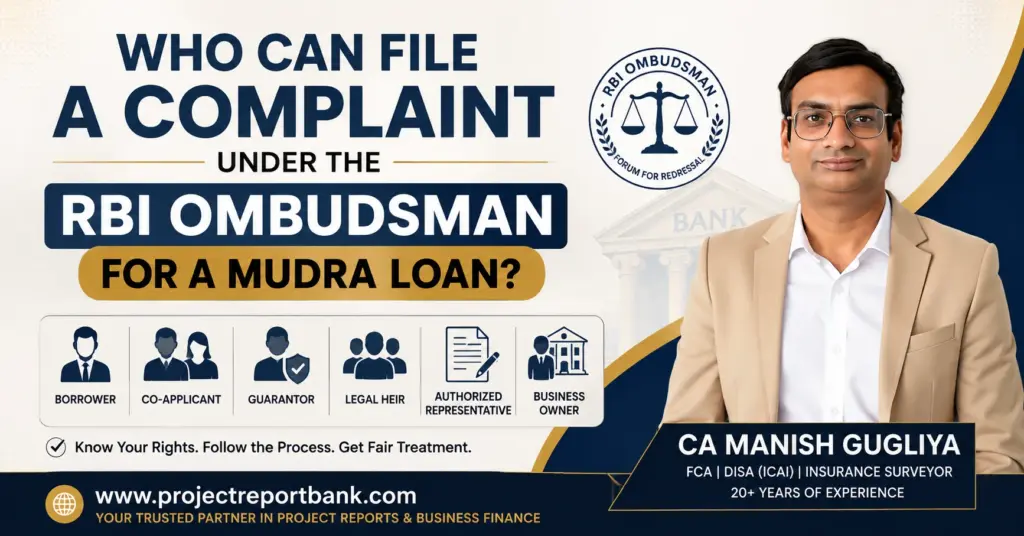
Borrowers, co-applicants, guarantors, legal heirs, MSME owners, and other directly affected persons can file an RBI Ombudsman complaint for a Mudra loan under the integrated ombudsman scheme.
- You must first lodge a complaint with your bank or NBFC (the regulated entity) and wait up to 30 days or receive an unsatisfactory reply before approaching the ombudsman office.
- Your complaint must relate to customer complaints involving deficiency in service-such as delay, wrong rejection, non-disbursement, extra charges, or violation of RBI/PMMY guidelines.
- Complaints can be filed online, free of cost, on the Reserve Bank of India’s Complaint Management System (CMS) portal.
- The RBI Ombudsman scheme was originally established in 2006 and has been updated several times since.
I, CA Manish Gugliya (FCA), will walk you step-by-step through eligibility, documents, examples, and expert tips in this article.
Introduction
Under Pradhan Mantri Mudra Yojana (PMMY), collateral-free loans are provided to small businesses across India. Mudra loans are categorized into three types: Shishu (up to ₹50,000), Kishore (₹50,001 to ₹5,00,000), and Tarun (₹5,00,001 to ₹10,00,000). The maximum loan amount under PMMY is ₹10,00,000.
Many small borrowers face issues-delays, rude behaviour, unfair charges-with banks and NBFCs. The RBI Integrated Ombudsman Scheme gives these customers a free, independent forum to resolve customer complaints when the bank’s grievance redressal fails.
The core question: who can file RBI Ombudsman complaint for Mudra loan? Not only the main borrower, but also co-applicants, guarantors, legal heirs, partners, directors, and authorised representatives can be eligible in many circumstances.
Before approaching the ombudsman, a complainant must first complain to the bank and wait 30 days or receive an unsatisfactory reply. Throughout this article, I’ll use real-life style examples (a Shishu loan of ₹40,000, a Kishore loan of ₹3 lakh) to keep things easy to understand. As CA Manish Gugliya with 20+ years helping MSME borrowers at Project Report Bank, I’ve seen these cases firsthand.
Table of Contents
What Is the RBI Integrated Ombudsman Scheme?
The RBI Integrated Ombudsman Scheme, notified in November 2021, merged earlier ombudsman schemes for banks, NBFCs, and digital transactions into one framework. Complaints can be filed against banks and financial institutions that are regulated entities of RBI. It covers deficiency in service such as delay, refusal, unfair charges, and violation of RBI directions.
Since Mudra loans are given by banks and NBFCs covered under this scheme, most genuine Mudra loan complaints fall within its scope. The process is simple:
Customer → Bank Complaint → 30 Days Wait / Unsatisfactory Reply → RBI Ombudsman → Resolution
The scheme is handled by the reserve bank through its CMS portal and the centralised receipt and processing centre, with complaints assigned to the appropriate RBI office. Complaints can be made in english, hindi, or several regional languages.
Basic Eligibility to File an RBI Ombudsman Complaint
Before filing, these basic conditions must be met:
| Eligibility Point | Check |
|---|---|
| You are a customer (or authorised representative) of the regulated entity | ☐ |
| Eligibility includes being a customer of the bank involved | ☐ |
| Complaints regarding Mudra loans must concern a deficiency in service from the lender | ☐ |
| You already complained to the bank | ☐ |
| You waited 30 days or got unsatisfactory reply | ☐ |
| Matter is not pending in any court or tribunal | ☐ |
| Complaint is filed within allowed time period | ☐ |
| Complaint is genuine, not frivolous | ☐ |
“Deficiency” in the Mudra context means: excessive delay, wrong rejection, rude behaviour, unfair charges, not following PMMY guidelines, or not giving reasons in writing. The consumer education and protection department of RBI oversees these standards.
Only one forum can be used at a time-you cannot run the same dispute in consumer court and RBI Ombudsman simultaneously. Filing is free, with no payment of any kind required.
Who Can File a Complaint for a Mudra Loan?
Several categories of persons connected with a Mudra loan can be eligible, as long as they are directly affected and basic conditions are met.
Borrower
The primary borrower-the person or business in whose name the Mudra loan was sanctioned-is always eligible. Customers who applied for a Mudra loan can file complaints with the RBI Ombudsman. For example, if Ravi applied for a Shishu Mudra loan of ₹45,000 and his bank delayed disbursement for 60 days without explanation, he can complain after exhausting the bank’s grievance channels.
Co-applicant
A co-applicant is a joint borrower who signs the Mudra application alongside the main borrower. If husband and wife are co-applicants for a Kishore loan of ₹3 lakh, either can file the complaint-especially if one is ill or unavailable. Mentioning all names and the loan account number helps RBI identify the case.
Guarantor
A guarantor promises to pay if the borrower defaults. They can file when the bank’s actions directly affect their security, credit record, or rights-for example, the bank marking the guarantor’s CIBIL report as “default” without proper notice. Learn more about rights and responsibilities of a Mudra loan guarantor and who can become a guarantor for a Mudra loan.
Legal Heir
If a Mudra borrower dies and the bank mishandles the account-continues charging penalties, sends recovery agents despite the family’s request to settle-a legal heir (spouse, child) can approach RBI Ombudsman. Attach the death certificate and proof of relationship when filing.
Authorized Representative
Complaints can also be made by authorized representatives of the borrower. This can be via Power of Attorney, Board Resolution, or authority letter. A son filing for his elderly father, or a staff member handling banking for a shop owner, are common cases. RBI may ask for the authority document, so attach it upfront.
MSME Owner
MSME owners whose banks violate RBI or PMMY complaint guidelines for Mudra loans-such as insisting on collateral where not required-can file a complaint after the 30-day wait.
Partnership Firm
When a Mudra loan is in a partnership firm’s name, any partner authorised in the deed or authority letter can file. The complaint should mention the firm’s name, PAN, and loan account number.
Proprietorship
For a proprietorship like “M/s Sharma Kirana Store,” the proprietor (Mr. Sharma) files the complaint. Attach identity proof and documents linking the proprietor to the firm (GST registration, shop licence).
Company
Private limited companies can also avail Mudra loans. The complaint must be filed by an authorised director or company secretary per Board Resolution. Attach the Resolution, PAN, and CIN.
Any Person Directly Affected
Sometimes a person not formally named as borrower can still be affected-for instance, a joint account holder whose salary account is debited for Mudra EMIs without consent. In such borderline cases, detailed facts and documents are essential to set up standing.
Who Cannot File a Complaint?
| Eligible | Not Eligible |
|---|---|
| Borrower, co-applicant | Stranger with no link |
| Guarantor affected by bank action | Competitor or business rival |
| Legal heir | Person with personal dispute only |
| Authorised representative | Anonymous complaint without details |
A complaint will be rejected if the same issue is already pending before a court or tribunal. RBI can also reject complaints filed with fake documents, or cases that differ from genuine grounds of service deficiency. A neighbour annoyed that someone else got a loan, but who suffered no loss, cannot lodge a valid complaint.
Situations Where Mudra Borrowers Can File RBI Ombudsman Complaints
Common valid complaints include delays in loan processing or unauthorized charges. Other valid grounds:
- Illegal rejection without written reasons
- Bank demanding collateral for a collateral-free Mudra loan (can banks ignore RBI and PMMY guidelines?)
- Forced insurance as a condition for loan sanction
- Mis-classification of account as NPA despite regular payment
- Non-updation of loan closure in CIBIL
- Staff misconduct combined with service failure
Pure policy decisions-like general tightening of Mudra lending in a sector or district-without guideline violation may not qualify as deficiency.
Documents Required Before Filing
| Document | Purpose |
|---|---|
| Written complaint to bank (with date) | Proves you approached bank first |
| Bank’s reply or acknowledgement | Shows receipt and response |
| Mudra loan application & sanction letter | Establishes loan relationship |
| Account statement | Shows debits, non-disbursement |
| Identity & address proof | Confirms complainant identity |
| Authority documents (if representative) | Establishes standing |
| Supporting evidence (emails, SMS, screenshots) | Backs up your claim |
Arrange documents in chronological order-it helps the ombudsman office understand the sequence faster. Ensure all copies are clear and readable; blurred screenshots can slow down resolution.
When Should You File the Complaint?
Timing matters. Complaints must be filed within one year of the incident in most cases, and specifically within 90 days of receiving an unsatisfactory reply under the updated scheme provisions. Filing too early or too late leads to rejection.
Simple timeline: complaint to bank on 1 January → wait until 31 January → if no satisfactory reply, file with RBI Ombudsman before the applicable date.
Decision tree:
- Bank replied within 30 days but you’re unhappy → file with RBI
- Bank did not reply in 30 days → file with RBI
- Already in court → do not file with RBI

Cases Where RBI Ombudsman May Reject the Complaint
The RBI Ombudsman does not review lender commercial decisions if not related to service deficiency. Other rejection grounds include:
- Complaint filed before approaching the bank
- Filed beyond time limit
- No proof of deficiency provided
- Frivolous or vexatious complaint
- Same complaint already resolved or examined
- Complaint relates only to interest rate within RBI norms
Rejection by the ombudsman does not stop you from using other remedies like consumer court-you can continue pursuing your case through the appellate authority or legal channels.
Step-by-Step Process to File Complaint
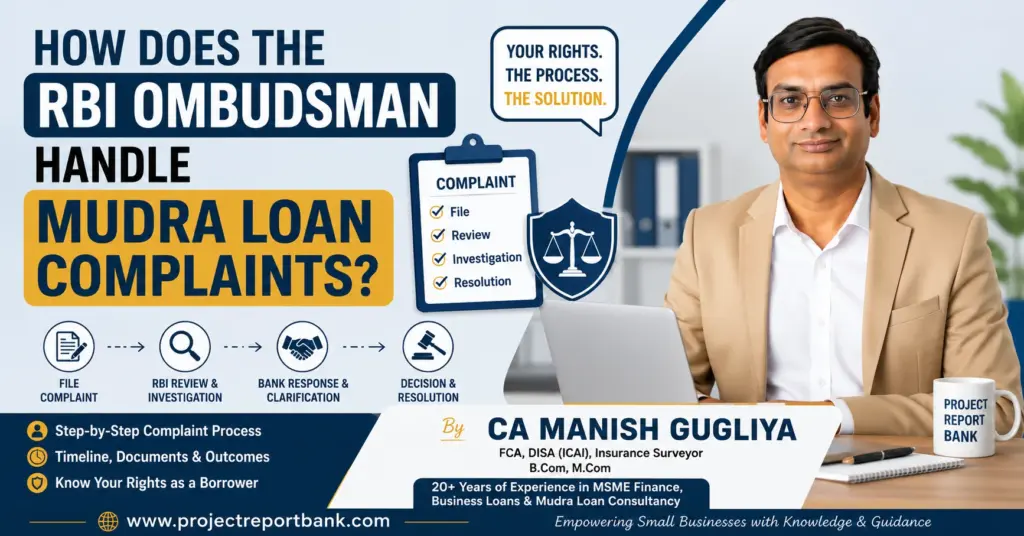
- Complain to bank/NBFC – Write a clear, factual letter or email with your loan account number and relief sought.
- Wait 30 days – Keep record of the date and content of any reply.
- Collect documents – Prepare a summary in date order.
- File online – Customers can submit complaints digitally on the RBI Complaint Management System. Complaints can be submitted online or via post in physical mode. Select the correct category, fill details, and upload documents.
- Receive acknowledgement – Save your complaint number for tracking.
- Investigation – RBI forwards the complaint to the bank and may request additional information.
- Resolution – Possible outcomes: bank corrects the error, refunds charges, pays limited compensation as an award, or the complaint is rejected with reasons.
For a detailed walkthrough, see RBI Ombudsman complaints for Mudra loans.
Practical Examples of Who Can and Cannot Complain
- Shishu borrower (₹40,000) faces 60-day disbursement delay → Eligible
- Co-applicant complains about wrong EMI amount on Kishore loan → Eligible
- Guarantor’s CIBIL marked “default” without notice → Eligible
- Legal heir faces rude recovery agents after borrower’s death → Eligible
- Son files as authorised representative for ill father → Eligible
- Partner files on behalf of partnership firm → Eligible
- Competitor tries to complain because rival got a loan → Not eligible
- Neighbour complains with no direct loss or damage → Not eligible
- Person files without ever complaining to bank → Not maintainable
- Duplicate complaint after consumer court order on same grounds → Not maintainable
Compare your own situation with these examples before deciding your next step.
Common Mistakes Applicants Make
- Skipping bank’s grievance redressal and going directly to RBI
- Writing emotional, lengthy complaints without clear facts or satisfaction sought
- Not attaching the bank complaint copy or acknowledgement
- Mixing unrelated issues in one complaint
- Filing multiple complaints for the same issue
- Misunderstanding RBI Ombudsman as a loan approval authority
- Demanding unrealistic compensation for small service lapses
Write short, polite, fact-focused complaints. Provide complete information so no clarification stage is needed.
Expert Advice by CA Manish Gugliya
With 20+ years helping MSME borrowers improve their banking outcomes, here are my practical tips:
- Keep written records of every interaction with the bank about your Mudra loan
- Read the sanction letter carefully and request explanations in writing
- Escalate within the bank (branch manager → regional office → nodal officer) before going to RBI
- Attach only relevant, clear documents-not random paperwork
- Avoid threatening language; stick to facts
- Quote specific RBI/PMMY guidelines if you know them
- Check your CIBIL report after loan closure to ensure correct reporting
- Seek professional help only if amounts are large or issues are complex
- Be honest about your own lapses (late EMIs) and focus on provable service deficiency
- Understand that RBI Ombudsman aims at fair resolution, not punishment of bank staff
- Use this facility responsibly and only after genuinely trying to get the bank to provide a proper resolution
For deeper guidance on Mudra loan guarantor documents, visit this resource.
Frequently Asked Questions
Can I file an RBI Ombudsman complaint if my Mudra loan was only rejected and never sanctioned?
Yes. If the bank rejected your application without giving written reasons, or violated PMMY guidelines, it counts as deficiency. You must still complain to the bank first and wait 30 days. However, a mere commercial decision to reject-where no guideline violation or discrimination occurred-cannot be challenged through this link.
Can I complain to RBI Ombudsman only about wrong CIBIL reporting of my Mudra loan?
Incorrect credit bureau reporting by a bank is treated as deficiency in service, especially when it affects your ability to get future loans. First ask the bank to correct the entry. If not resolved in 30 days, approach the Ombudsman with proof of the error and your request to the bank.
Is it compulsory to file the RBI Ombudsman complaint online?
No. While the online CMS portal is preferred and fastest, RBI also accepts complaints through email or physical forms sent to the ombudsman office (for example, offices in cities like Chandigarh and others). However, online filing gives instant receipt and easy tracking.
How much time does the RBI Ombudsman usually take to decide Mudra loan complaints?
There is no fixed number of days for every case. Many complaints are resolved within a few months, depending on complexity, response from the bank, and completeness of documents. Promptly answer any clarification queries from RBI to avoid delay.
Do I need a lawyer or CA to file an RBI Ombudsman complaint for my Mudra loan?
Hiring a lawyer, CA, or consultant is not compulsory. The system is designed so ordinary customers can file complaints filed in simple language themselves. Professional help may be useful in complex or high-value matters, but for most small Mudra loans, a well-written factual complaint is enough.
Conclusion
Many categories of people-borrowers, co-applicants, guarantors, legal heirs, MSME owners, business entities, and authorised representatives-can be eligible to file an RBI Ombudsman complaint for Mudra loan issues, provided they are directly affected and basic conditions are met.
Always use the bank’s grievance redressal system first. Keep proper written records, respect time limits, and focus on clear deficiency in service. Know your Mudra loan customer rights, use them responsibly, and refer to other Project Report Bank resources for deeper guidance on RBI and PMMY rules.
Disclaimer: This article provides general information based on publicly available government and RBI sources. Rules may differ based on your specific case and the deposit size or type of your lending institution. Always verify the latest updated scheme details on the official RBI website before filing.
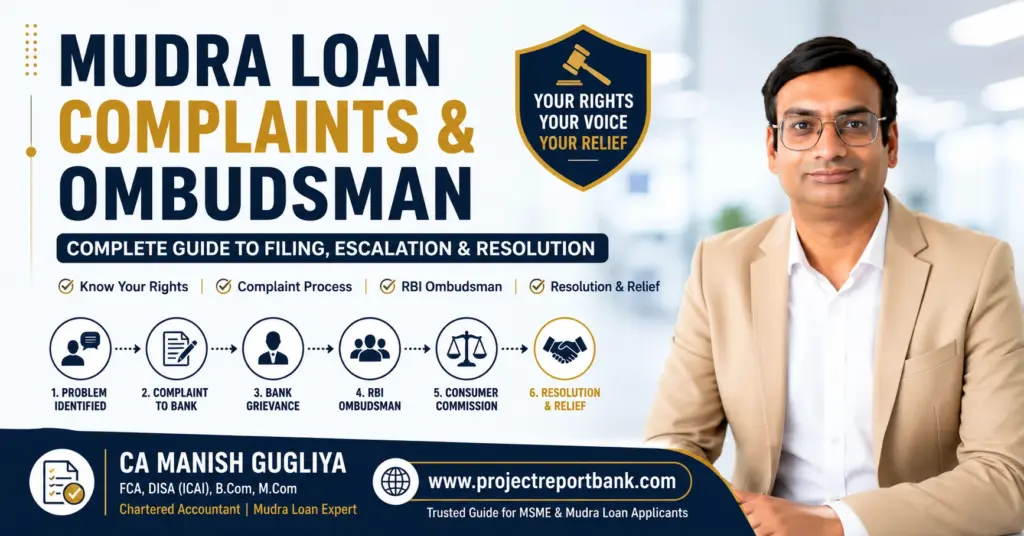
- Mudra Loan Complaints & Ombudsman: Complete Guide to Filing, Escalation & Resolution

- Can a Bank Blacklist You for Filing a Mudra Loan Complaint?

- Can a Mudra Loan Complaint Affect Future Loan Approval?
- Common Mistakes That Lead to Mudra Loan Complaint Failure
- RBI Ombudsman Mudra Loan Relief: Practical Guide for Small Borrowers
- Can the RBI Ombudsman Reject Your Mudra Loan Complaint? Reasons Explained
- Consumer Commission vs RBI Ombudsman: Which Is Better for Mudra Loan Disputes?
- Bank Grievance Redressal System for Mudra Loans: Complete Guide
- RBI Ombudsman Mudra Loan Complaint – Detailed Guide by CA Manish Gugliya