Many entrepreneurs assume that a good CIBIL Score and basic eligibility are enough to secure a Mudra Loan. However, a significant number of applications are rejected because of weak or poorly prepared Project Reports. Banks rely on the Project Report to understand the purpose of the loan, evaluate the business proposal, estimate financial requirements, and assess whether the business can generate enough income to repay the loan. Even a promising business idea may fail to secure approval if the Project Report contains incomplete information, unrealistic assumptions, or calculation errors.
Before approving a Mudra Loan, banks carefully analyse the overall feasibility of the proposed business. They review the business model, project cost, machinery quotations, working capital requirement, CMA Data, financial projections, and repayment capacity. Any inconsistency, inaccurate calculation, copy-paste content, or unsupported financial estimate increases the lender’s risk and can result in the application being delayed or rejected.
This Mudra Loan Project Report Issues & Solutions cluster serves as a comprehensive guide to help applicants understand the most common Project Report mistakes that lead to loan rejection. It explains why these issues matter, how banks evaluate Project Reports, and provides access to detailed solution guides covering business plans, project costs, CMA Data, financial projections, working capital calculations, business viability, and other critical aspects. By understanding and correcting these issues before applying, you can prepare a stronger, bank-ready Project Report and significantly improve your chances of Mudra Loan approval.
What You'll Learn in This Guide
- Why banks carefully evaluate Mudra Loan Project Reports
- Common Project Report mistakes that can lead to rejection
- Business Plan requirements and the importance of complete information
- Missing or incorrect CMA Data mistakes
- Financial projection errors and unrealistic estimates
- Incorrect Project Cost calculation mistakes
- Machinery cost and quotation-related issues
- Working Capital calculation errors
- Industry-specific Project Report requirements
- How banks assess business model viability
- Why copy-paste Project Reports should be avoided
Why Is the Project Report So Important for Mudra Loan Approval?
A Project Report is one of the most important documents in a Mudra Loan application because it helps the bank understand your business proposal and determine whether it is financially viable. Rather than approving a loan based only on your current financial position, banks evaluate the future earning potential of your business. A well-prepared Project Report gives confidence that the business can generate sufficient income to repay the loan on time.
The Project Report forms the foundation of the bank’s credit appraisal process. It contains essential details such as the business model, project cost, machinery requirements, working capital needs, financial projections, and repayment plan. Bank officials use this information to assess business risk, verify the feasibility of the project, calculate the actual loan requirement, and evaluate repayment capacity. A realistic and professionally prepared report also supports the branch manager in recommending your loan for approval, while inaccurate or incomplete reports can significantly increase the chances of rejection.
How Banks Evaluate a Mudra Loan Project Report
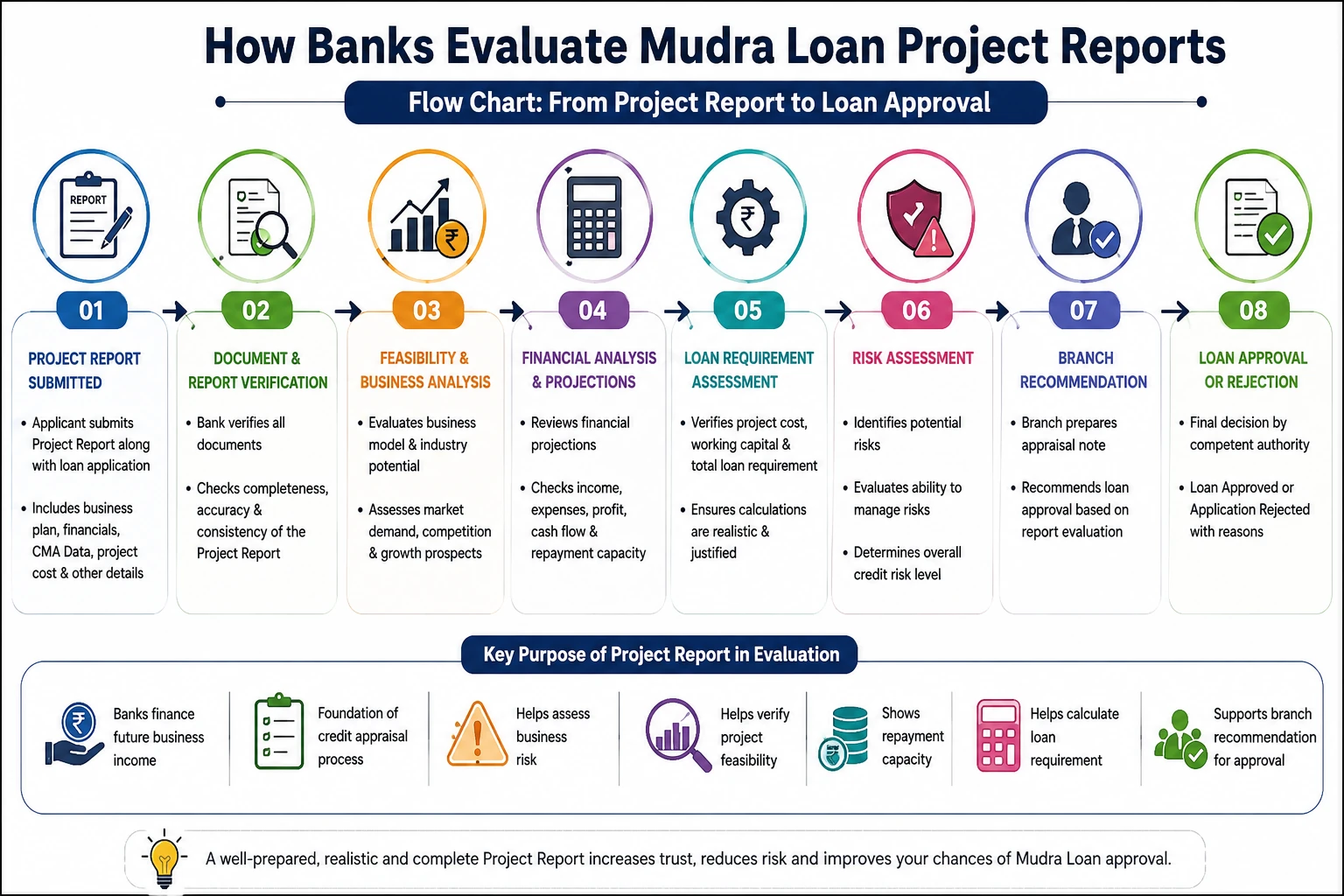
This flowchart illustrates the complete credit appraisal process followed by banks when evaluating a Mudra Loan Project Report. From reviewing the business idea and financial projections to assessing repayment capacity, project cost, working capital requirements, and overall business feasibility, each stage helps determine whether the proposed business is suitable for financing. Understanding this process enables applicants to prepare a realistic, accurate, and bank-ready Project Report, significantly improving their chances of loan approval.
Most Common Project Report Issues That Lead to Mudra Loan Rejection
A well-prepared Project Report is one of the most important documents in the Mudra Loan approval process. It is much more than a formality—it helps the bank understand your business idea, estimate project costs, evaluate repayment capacity, and assess the overall feasibility of the proposed venture. Even applicants with a good CIBIL score and strong business experience may face rejection if their Project Report contains significant errors or unrealistic information.
Banks commonly reject Mudra Loan applications because of incomplete reports, copied templates, incorrect financial calculations, unrealistic projections, weak business planning, or inaccurate CMA Data. The good news is that most of these issues can be corrected before submitting your application. Below are the most common Project Report mistakes that banks identify during credit appraisal, along with links to detailed guides explaining how to avoid them.
Incomplete Project Report
An incomplete Project Report immediately raises concerns about the seriousness and preparedness of the applicant. Missing sections such as the business profile, project cost, means of finance, financial projections, working capital requirements, machinery details, or repayment plan prevent the bank from conducting a proper credit appraisal. As a result, the application may be delayed, additional documents may be requested, or the loan may be rejected altogether.
Every Project Report should present a complete picture of the proposed business, explaining what the business will do, how it will generate income, and how the loan will be repaid. Even if the business idea is promising, missing information reduces the bank’s confidence in the proposal. Before applying, verify that every required section is complete, consistent, and supported by relevant documents.
Read the detailed guide:
https://projectreportbank.com/mudra-loan-rejected-due-to-incomplete-business-plan/
Copy-Paste Project Report
Many applicants download free Project Report templates from the internet and submit them without making meaningful changes. Banks can easily identify generic or copied reports because they often contain irrelevant information, incorrect assumptions, mismatched financial figures, or business activities that do not match the applicant’s actual proposal.
A copied Project Report fails to demonstrate a genuine understanding of the business and weakens the credibility of the application. Every Mudra Loan proposal should be customized according to the nature of the business, investment requirements, location, production process, expected sales, and market conditions. A personalized report gives banks greater confidence in the applicant’s planning and business knowledge.
Read the detailed guide:
https://projectreportbank.com/mudra-loan-rejected-copy-paste-project-report/
Unrealistic Financial Projections
Financial projections help banks estimate whether the proposed business can generate sufficient income to repay the loan. Applicants sometimes prepare exaggerated sales estimates, unrealistic profit margins, or overly optimistic growth assumptions that cannot be supported by market realities. Such projections increase the perceived credit risk and reduce the credibility of the Project Report.
Banks compare projected figures with industry benchmarks, business capacity, investment size, and market demand. If the estimates appear unrealistic, the loan proposal may require revision or be rejected. Financial forecasts should always be practical, data-driven, and supported by reasonable assumptions.
Read the detailed guide:
https://projectreportbank.com/mudra-loan-rejected-incorrect-financial-projections/
Incorrect Project Cost
Project cost is the foundation of the entire loan proposal because it determines the amount of finance required and the applicant’s contribution. Errors such as underestimating machinery costs, ignoring installation expenses, excluding working capital, or adding unsupported expenditures create inconsistencies in the application.
Banks carefully verify every component of the project cost before approving finance. If the estimated investment does not match quotations, market prices, or business requirements, they may question the feasibility of the proposal. Preparing an accurate and properly supported project cost improves the reliability of the Project Report and helps determine the correct loan amount.
Read the detailed guide:
https://projectreportbank.com/mudra-loan-rejected-due-to-incorrect-project-cost/
Wrong Working Capital Calculation
Many businesses require sufficient working capital to purchase raw materials, maintain inventory, pay salaries, and meet daily operating expenses. Incorrect working capital calculations often result in either underfunding or overfunding the business, making the Project Report less reliable.
Banks examine working capital assumptions carefully because inadequate operating funds may affect business continuity after loan disbursement. Calculations should be based on realistic inventory cycles, receivable periods, creditor terms, and monthly operating expenses. Proper working capital estimation demonstrates sound financial planning and increases confidence in the proposal.
Read the detailed guide:
https://projectreportbank.com/mudra-loan-rejected-wrong-working-capital-calculation/
Incorrect CMA Data
CMA (Credit Monitoring Arrangement) Data summarizes projected financial statements and is widely used by banks during loan appraisal. Errors in sales projections, profitability, balance sheets, cash flow statements, or ratio analysis create inconsistencies between the Project Report and the financial assessment.
Banks depend on CMA Data to evaluate repayment capacity, business sustainability, and financial strength. Even minor calculation mistakes may significantly affect loan eligibility. Preparing accurate CMA Data that matches the Project Report ensures consistency throughout the application and reduces the likelihood of rejection.
Read the detailed guide:
https://projectreportbank.com/mudra-loan-rejected-missing-incorrect-cma-data/
Weak Business Model
A Project Report should clearly explain how the business will generate revenue, attract customers, compete in the market, and remain profitable over time. If the business model lacks clarity or fails to demonstrate commercial viability, banks may conclude that the business carries excessive repayment risk.
A strong business model identifies the target market, products or services, pricing strategy, competitive advantages, and expected sources of income. The bank must be convinced that the business can operate successfully and produce sufficient cash flow to repay the loan. A well-defined business model greatly strengthens the overall loan proposal.
Read the detailed guide:
https://projectreportbank.com/mudra-loan-rejected-business-model-not-viable/
Machinery Cost Problems
Machinery quotations play a significant role in determining the project cost. Problems such as outdated quotations, inflated prices, missing supplier details, or unsupported machinery estimates often create doubts about the authenticity of the proposal.
Banks usually verify machinery costs against supplier quotations and prevailing market prices. Any discrepancy may result in requests for revised quotations or a reassessment of the loan amount. Applicants should always obtain genuine quotations from reliable suppliers and ensure that machinery specifications match the proposed business activity.
Read the detailed guide:
https://projectreportbank.com/mudra-loan-machinery-cost-rejection/
Industry-Specific Errors
Different industries have different investment patterns, operating cycles, regulatory requirements, and financial assumptions. A Project Report prepared using a generic template may overlook these industry-specific factors, reducing its credibility during appraisal.
Banks expect manufacturing, trading, service, food processing, retail, and other businesses to include information relevant to their respective sectors. Industry-specific data improves the accuracy of cost estimates, revenue assumptions, and operational planning. Customizing the Project Report according to the business category significantly improves its quality and acceptance.
Read the detailed guide:
https://projectreportbank.com/mudra-loan-industry-specific-project-report-mistakes/
Poor Business Planning
A Project Report should demonstrate that the applicant has carefully planned every aspect of the proposed business. Weak planning, unclear objectives, missing implementation schedules, inadequate market research, or undefined operational strategies indicate insufficient preparation and increase the bank’s perception of risk.
Good business planning explains how the business will be established, managed, marketed, and expanded over time. It also addresses funding requirements, expected challenges, and repayment strategies. A well-organized business plan reassures the bank that the applicant understands the business and is capable of managing it successfully.
Read the detailed guide:
https://projectreportbank.com/mudra-loan-rejected-due-to-incomplete-business-plan/
Unrealistic Business Assumptions
Many Mudra Loan applications are rejected because the assumptions used in the Project Report are overly optimistic or unsupported by practical evidence. Examples include expecting immediate high sales, assuming unrealistic market demand, underestimating operating expenses, or projecting exceptionally high profits within a short period.
Banks evaluate every assumption against market conditions, industry benchmarks, business experience, and investment capacity. Practical assumptions make financial projections more believable and improve the overall credibility of the proposal. Applicants should ensure that every estimate in the Project Report is based on realistic business conditions rather than optimistic expectations.
Read the detailed guide:
https://projectreportbank.com/mudra-loan-rejected-unrealistic-project-report/
Quick Navigation: Mudra Loan Project Report Guides
Before exploring the detailed explanations below, use this quick navigation hub to jump directly to the Project Report issue most relevant to your Mudra Loan application. Each guide explains why banks identify that particular problem during loan appraisal and provides practical solutions to improve your chances of loan approval.
Explore Mudra Loan Project Report Guides
Select the issue most relevant to your application and read the detailed guide to understand the rejection reason, correct the weakness, and prepare a stronger Mudra Loan Project Report.
Project Report Rejected?
Understand the main reasons banks reject Mudra Loan Project Reports and how to correct them.
Read Complete Guide → 02Industry-Specific Mistakes
Learn why generic reports fail to address the unique requirements of different industries.
Read Complete Guide → 03Business Model Not Viable
See how banks assess revenue potential, market demand, profitability, and repayment capacity.
Read Complete Guide → 04Machinery Cost Mistakes
Understand how inflated, unsupported, or outdated machinery quotations affect approval.
Read Complete Guide → 05Incomplete Business Plan
Identify missing sections that prevent banks from properly evaluating your proposal.
Read Complete Guide → 06Copy-Paste Project Report
Learn why generic downloaded templates reduce credibility during bank appraisal.
Read Complete Guide → 07Wrong Working Capital
Understand how incorrect operating-fund estimates can lead to underfunding or rejection.
Read Complete Guide → 08Incorrect Project Cost
See how errors in machinery, setup costs, working capital, and promoter contribution affect appraisal.
Read Complete Guide → 09Missing or Incorrect CMA Data
Learn how inconsistencies in projected statements and financial ratios weaken the application.
Read Complete Guide → 10Incorrect Financial Projections
Understand how unrealistic sales, profit, and cash-flow forecasts create repayment concerns.
Read Complete Guide → 11Unrealistic Project Report
Identify unsupported assumptions, exaggerated growth expectations, and inconsistent estimates.
Read Complete Guide →Complete Guide Library
The following guides cover every major Project Report issue that can affect your Mudra Loan approval. Each article explains a specific reason for rejection, why banks identify it during credit appraisal, and the practical steps you can take to correct the problem before submitting your application. Explore the guide most relevant to your situation to prepare a stronger, bank-ready Project Report.
Mudra Loan Project Report Rejected? Complete Reasons & Solutions
A rejected Project Report does not always mean your business idea is weak. In many cases, the rejection is caused by avoidable mistakes such as incomplete information, unrealistic financial assumptions, incorrect project cost, weak business planning, or calculation errors. This guide explains the most common reasons why banks reject Project Reports and provides practical solutions to improve your application before reapplying.
Read the complete guide:
https://projectreportbank.com/mudra-loan-project-report-rejected/
Industry-Specific Project Report Mistakes
Every business sector has different financial assumptions, operational requirements, and investment patterns. Using a generic Project Report often results in missing industry-specific details that banks expect during appraisal. Learn how to prepare a Project Report that accurately reflects your business category and improves your approval chances.
Read the complete guide:
https://projectreportbank.com/mudra-loan-industry-specific-project-report-mistakes/
Business Model Not Viable
Banks carefully assess whether your proposed business can generate sustainable income and repay the loan. If your business model lacks clarity, realistic revenue sources, or competitive advantages, the proposal may be considered high risk. This guide explains how banks evaluate business viability and how to strengthen your business model.
Read the complete guide:
https://projectreportbank.com/mudra-loan-rejected-business-model-not-viable/
Machinery Cost Mistakes
Incorrect machinery quotations, inflated equipment costs, outdated supplier estimates, or unsupported pricing can reduce the credibility of your Project Report. This guide explains how banks verify machinery costs and how to prepare accurate quotations that support your Mudra Loan application.
Read the complete guide:
https://projectreportbank.com/mudra-loan-machinery-cost-rejection/
Incomplete Business Plan
A Project Report with missing business details, operational plans, implementation schedules, or financial information prevents banks from properly assessing the proposal. This guide explains which sections must be included in a complete business plan and how missing information can lead to rejection.
Read the complete guide:
https://projectreportbank.com/mudra-loan-rejected-due-to-incomplete-business-plan/
Copy-Paste Project Report
Submitting a generic Project Report downloaded from the internet is one of the most common reasons for rejection. Banks can easily identify copied templates that contain unrealistic or inconsistent information. Learn why customized Project Reports carry greater credibility and improve loan approval chances.
Read the complete guide:
https://projectreportbank.com/mudra-loan-rejected-copy-paste-project-report/
Wrong Working Capital Calculation
Working capital is essential for meeting the day-to-day operating expenses of a business. Incorrect calculations may result in insufficient funding or unrealistic financing requirements. This guide explains how banks calculate working capital and how applicants can estimate it accurately.
Read the complete guide:
https://projectreportbank.com/mudra-loan-rejected-wrong-working-capital-calculation/
Incorrect Project Cost
An inaccurate Project Cost can affect every financial calculation in your Mudra Loan proposal. Errors in machinery costs, installation expenses, working capital, or capital contribution often raise concerns during bank appraisal. This guide explains how to prepare an accurate Project Cost statement.
Read the complete guide:
https://projectreportbank.com/mudra-loan-rejected-due-to-incorrect-project-cost/
Missing or Incorrect CMA Data
CMA Data is one of the most important financial documents used during loan appraisal. Errors in projected balance sheets, profit and loss statements, cash flow, or financial ratios can significantly weaken your application. This guide explains how to prepare accurate and bank-ready CMA Data.
Read the complete guide:
https://projectreportbank.com/mudra-loan-rejected-missing-incorrect-cma-data/
Incorrect Financial Projections
Banks rely heavily on projected sales, expenses, profitability, and cash flow to assess repayment capacity. Overstated income or unrealistic profit estimates can reduce confidence in your Project Report. This guide explains how to prepare practical financial projections that match business realities.
Read the complete guide:
https://projectreportbank.com/mudra-loan-rejected-incorrect-financial-projections/
Unrealistic Project Report
A Project Report built on unrealistic market demand, exaggerated growth expectations, unsupported assumptions, or inconsistent financial estimates is unlikely to satisfy bank appraisal standards. This guide explains how to prepare a realistic Project Report that reflects practical business conditions and significantly improves your chances of Mudra Loan approval.
Read the complete guide:
https://projectreportbank.com/mudra-loan-rejected-unrealistic-project-report/
Comparison Table: Good Project Report vs Poor Project Report
| Factor | ✅ Good Project Report | ❌ Poor Project Report |
|---|---|---|
| Business Plan | Complete, well-structured and clearly explains the business. | Incomplete or missing important sections. Read Guide → |
| Project Cost | Based on genuine quotations and actual investment requirements. | Estimated randomly or unsupported. Read Guide → |
| CMA Data | Accurate and consistent financial statements. | Missing or contains calculation errors. Read Guide → |
| Working Capital | Properly calculated using realistic business assumptions. | Incorrect calculation leading to funding gaps. Read Guide → |
| Financial Projections | Realistic sales, profit and cash flow estimates. | Overestimated revenue and unrealistic profits. Read Guide → |
| Machinery Cost | Supported by supplier quotations. | Unsupported or inflated machinery costs. Read Guide → |
| Industry Analysis | Relevant to the proposed industry. | Generic information copied from templates. Read Guide → |
| Business Model | Clear revenue model and commercial viability. | Weak or unclear business concept. Read Guide → |
| Repayment Capacity | Clearly justified with projected cash flow. | Weak repayment justification. Read Guide → |
| Risk Assessment | Business risks identified with mitigation strategy. | Risks ignored or not discussed. Read Guide → |
| Overall Quality | Customized, professional and bank-ready. | Generic copy-paste report with inconsistencies. Read Guide → |
Project Report Preparation Checklist Before Applying
Use this checklist before submitting your Mudra Loan application to ensure that your Project Report is complete, accurate, and ready for bank evaluation.
- Business profile prepared with complete business details
- Owner’s KYC and personal information verified
- Business activity clearly explained
- Target market and customer profile identified
- Business model and revenue generation explained
- Industry analysis included
- Project cost accurately calculated
- Means of finance and promoter’s contribution specified
- Genuine machinery quotations attached
- Working capital requirement properly calculated
- CMA Data prepared and verified
- Financial projections (Sales, Profit & Cash Flow) reviewed
- Profitability projections checked for accuracy
- DSCR (Debt Service Coverage Ratio) calculated
- Sales assumptions supported by realistic market estimates
- Risk assessment and mitigation strategies included
- Repayment capacity clearly justified
- All calculations cross-checked for consistency
- Supporting documents attached with the Project Report
- Final review completed before submitting the Mudra Loan application
Pro Tip: A complete, realistic, and error-free Project Report significantly improves your chances of Mudra Loan approval. Review every item in this checklist before submitting your application to avoid common objections during the bank’s credit appraisal.
Top Mistakes Applicants Make While Preparing Mudra Loan Project Reports
Many Mudra Loan applications are rejected not because the business idea is weak, but because the Project Report contains avoidable mistakes. Banks carefully examine every report to verify whether the proposed business is practical, financially viable, and capable of repaying the loan. Even minor errors in financial calculations, market assumptions, machinery costs, or business planning can reduce the credibility of the application.
Preparing a customized, accurate, and realistic Project Report significantly improves the chances of loan approval. The following are some of the most common mistakes that applicants make while preparing Mudra Loan Project Reports and the practical steps to avoid them.
Using Free Templates
Many applicants download free Project Report templates from the internet and submit them with minimal modifications. These generic reports often contain outdated information, irrelevant business details, incorrect financial assumptions, and inconsistent calculations that do not match the applicant’s actual business. Banks can easily identify such reports during appraisal, which reduces confidence in the proposal.
A Project Report should always be prepared according to your specific business activity, investment requirement, and market conditions. A customized report demonstrates proper planning and improves the credibility of your application.
Read the detailed guide:
https://projectreportbank.com/mudra-loan-rejected-copy-paste-project-report/
Inflating Business Income
Some applicants intentionally overestimate expected sales, profit margins, or business growth to improve their chances of obtaining a higher loan amount. However, banks compare these projections with industry standards, investment size, production capacity, and local market demand. Unrealistic financial projections often create doubts about the reliability of the entire Project Report.
Your financial estimates should always be practical, evidence-based, and supported by reasonable business assumptions. Realistic projections help banks accurately assess repayment capacity and business viability.
Read the detailed guide:
https://projectreportbank.com/mudra-loan-rejected-incorrect-financial-projections/
Ignoring Market Demand
A successful business depends on customer demand, yet many Project Reports fail to explain whether sufficient demand exists for the proposed products or services. Without market analysis, banks may question the long-term sustainability of the business.
Your Project Report should explain the target customers, competition, pricing strategy, and expected demand in the local market. Demonstrating a clear understanding of market conditions strengthens the business proposal and increases the bank’s confidence in your business model.
Related guide:
https://projectreportbank.com/mudra-loan-rejected-business-model-not-viable/
Copying Another Business
Every business has different investment requirements, operating expenses, customer segments, and financial projections. Copying another person’s Project Report often results in inconsistent figures, irrelevant business descriptions, and unrealistic assumptions that do not match your own business.
Banks expect every Mudra Loan Project Report to be unique and prepared specifically for the proposed business. A customized report reflects genuine planning and improves the overall quality of the loan application.
Read the detailed guide:
https://projectreportbank.com/mudra-loan-rejected-copy-paste-project-report/
Wrong Machinery Quotations
Machinery quotations are one of the most closely verified components of the Project Report. Applicants sometimes submit outdated quotations, unsupported estimates, or inflated machinery prices without obtaining quotations from genuine suppliers. These inconsistencies raise questions about the accuracy of the project cost.
Always obtain recent quotations from reliable vendors and ensure that machinery specifications match the proposed business activity. Accurate quotations improve the credibility of the Project Report and help banks determine the correct financing requirement.
Read the detailed guide:
https://projectreportbank.com/mudra-loan-machinery-cost-rejection/
Ignoring Working Capital
Many applicants focus only on purchasing machinery and equipment while ignoring the working capital required to operate the business after loan disbursement. Without sufficient funds for raw materials, inventory, salaries, rent, and daily expenses, the business may struggle to operate effectively.
Banks carefully evaluate working capital requirements before approving a Mudra Loan. Preparing realistic working capital calculations demonstrates proper financial planning and improves repayment confidence.
Read the detailed guide:
https://projectreportbank.com/mudra-loan-rejected-wrong-working-capital-calculation/
Preparing CMA Manually Without Checking
CMA (Credit Monitoring Arrangement) Data summarizes projected financial statements and plays a key role in bank appraisal. Preparing CMA Data manually without thoroughly checking formulas, calculations, and financial consistency often results in errors that can affect loan approval.
Before submitting your application, verify that the CMA Data matches the Project Report, projected financial statements, and repayment calculations. Even small calculation mistakes can create unnecessary objections during the credit appraisal process.
Read the detailed guide:
https://projectreportbank.com/mudra-loan-rejected-missing-incorrect-cma-data/
Submitting Outdated Reports
A Project Report prepared several months or years ago may no longer reflect current market prices, machinery costs, business conditions, or financial assumptions. Banks prefer reports that contain the latest quotations, updated financial projections, and current business information.
Before submitting your Mudra Loan application, review the entire Project Report to ensure that project costs, machinery quotations, working capital estimates, and financial projections are up to date. A current and accurate report significantly improves the credibility of your loan proposal.
Read more:
https://projectreportbank.com/mudra-loan-project-report-rejected/
Expert Advice by CA Manish Gugliya
Expert Advice by CA Manish Gugliya
These practical recommendations can help applicants prepare a more accurate, realistic, and bank-ready Mudra Loan Project Report while avoiding common mistakes that often lead to objections or rejection.
Never Submit a Generic Project Report
Your Project Report should reflect your actual business activity, investment requirement, location, market conditions, and financial assumptions. Generic templates often contain irrelevant or inconsistent information that banks can easily identify.
Read Detailed Guide →Prepare Industry-Specific Financials
Sales cycles, operating expenses, profit margins, and working capital requirements differ across industries. Prepare projections that match the actual operating pattern of your proposed business.
Read Detailed Guide →Keep Machinery Quotations Genuine
Use recent quotations from reliable suppliers and ensure that the machinery specifications, quantity, and cost match the business activity mentioned in your Project Report.
Read Detailed Guide →Verify Every Project Cost Calculation
Cross-check machinery cost, installation expenses, furniture, deposits, preliminary expenses, working capital, and promoter contribution. Every component should be accurate and supported wherever required.
Read Detailed Guide →Match Working Capital With Actual Operations
Calculate working capital using realistic inventory levels, credit periods, monthly expenses, receivables, and business cycles. An incorrect estimate can create serious funding gaps after loan disbursement.
Read Detailed Guide →Prepare CMA Data Carefully
CMA Data, projected balance sheets, cash flow statements, profitability figures, and financial ratios should be properly calculated and fully consistent with the Project Report.
Read Detailed Guide →Avoid Unrealistic Sales Projections
Do not inflate expected sales, growth rates, or profit margins merely to justify a higher loan amount. Banks prefer conservative and evidence-based projections supported by business capacity and market demand.
Read Detailed Guide →Explain Business Viability Clearly
Clearly explain your target customers, demand, pricing, revenue model, competitive advantage, expected profitability, and repayment capacity. The bank should understand how the business will generate sustainable income.
Read Detailed Guide →Maintain Consistency Across Financial Statements
Sales, expenses, profit, cash flow, balance sheet figures, project cost, loan amount, and repayment calculations should support one another. Inconsistent figures may reduce the credibility of the entire proposal.
Read Detailed Guide →Get the Project Report Professionally Reviewed
A professional review can identify calculation errors, missing sections, unsupported assumptions, and inconsistencies before the application reaches the bank. This can improve the overall quality of your Mudra Loan proposal.
Read Complete Guide →Frequently Asked Questions
Why do banks reject Mudra Loan Project Reports?
Banks reject Project Reports when they find incomplete information, unrealistic financial projections, incorrect project costs, weak business planning, inaccurate CMA Data, or unsupported machinery quotations. A Project Report should clearly demonstrate that the proposed business is financially viable and capable of repaying the loan. A well-prepared, realistic, and customized report significantly improves the chances of approval.
Can a copied Project Report cause rejection?
Yes. Banks can easily identify generic or copy-paste Project Reports because they often contain irrelevant business information, inconsistent financial figures, and unrealistic assumptions. A copied report reduces the credibility of your application and may lead to objections or rejection. Every Mudra Loan Project Report should be prepared specifically for your business.
Is CMA Data compulsory?
CMA (Credit Monitoring Arrangement) Data is not mandatory for every Mudra Loan application, especially for smaller loan amounts. However, many banks ask for CMA Data to evaluate projected sales, profitability, cash flow, repayment capacity, and financial strength. When required, it should be accurate and consistent with the Project Report.
What makes a business model viable?
A viable business model clearly explains how the business will generate revenue, attract customers, manage expenses, compete in the market, and repay the loan. Banks also evaluate market demand, pricing strategy, profitability, and long-term sustainability before considering the business financially viable.
How are Project Costs verified?
Banks verify Project Costs by reviewing machinery quotations, supplier estimates, working capital calculations, installation expenses, and supporting documents. They also compare the proposed costs with prevailing market prices and similar businesses to ensure that the investment estimates are realistic and justified.
Why is Working Capital calculation important?
Working Capital represents the funds required for day-to-day business operations such as purchasing raw materials, maintaining inventory, paying salaries, and meeting regular expenses. Incorrect Working Capital calculations can result in insufficient operating funds or excessive financing requirements, both of which may affect loan approval.
Can unrealistic financial projections lead to rejection?
Yes. Overestimated sales, unrealistic profit margins, or unsupported growth assumptions reduce the credibility of the Project Report. Banks compare projected figures with industry standards, investment size, business capacity, and market conditions. Practical and evidence-based financial projections improve the chances of loan approval.
Do machinery quotations matter?
Absolutely. Genuine machinery quotations help banks verify the Project Cost and determine the appropriate loan amount. Outdated, inflated, or unsupported quotations may lead to additional verification or objections during credit appraisal. Applicants should always obtain quotations from reliable suppliers before preparing the Project Report.
Can I prepare the Project Report myself?
Yes, you can prepare the Project Report yourself if you have a clear understanding of business planning, financial projections, Project Cost calculations, Working Capital estimation, and CMA Data preparation. However, many applicants prefer professional assistance to avoid calculation errors, inconsistencies, and documentation issues that could delay or affect loan approval.
Should every industry have a different Project Report?
Yes. Manufacturing, trading, service, food processing, retail, and other businesses have different operating cycles, investment requirements, profitability patterns, and Working Capital needs. A Project Report should always be customized according to the specific industry rather than using a generic template.
How often should financial projections be updated?
Financial projections should be updated whenever there are significant changes in project costs, machinery prices, business plans, market conditions, or expected sales. If a Project Report is several months old, it is advisable to review and update all financial estimates before submitting the Mudra Loan application.
Who should prepare a Mudra Loan Project Report?
A Mudra Loan Project Report should ideally be prepared by someone who understands business planning, Project Cost estimation, financial projections, CMA Data, and banking requirements. Whether you prepare it yourself or seek professional assistance, the report should be accurate, realistic, customized, and consistent with the documents submitted to the bank.
Conclusion
A professionally prepared Mudra Loan Project Report is much more than a supporting document—it is the foundation of your loan application. Banks rely on it to evaluate the feasibility of your business, estimate repayment capacity, assess financial strength, and measure the overall credit risk before making an approval decision. An accurate, well-structured, and realistic Project Report demonstrates that you have carefully planned your business and are prepared to use the loan responsibly.
Many Mudra Loan applications are delayed or rejected because of avoidable Project Report issues such as unrealistic financial projections, incorrect project costs, weak business planning, missing or inaccurate CMA Data, copy-paste reports, unsupported machinery quotations, and incorrect Working Capital calculations. Fortunately, most of these deficiencies can be corrected through proper planning, industry-specific financial assumptions, accurate calculations, and consistent documentation before submitting the application.
If you are preparing a Mudra Loan application, take the time to review every aspect of your Project Report carefully. Use the detailed guides in this Mudra Loan Project Report Issues & Solutions cluster to understand each Project Report requirement, correct specific weaknesses, strengthen your loan proposal, and submit a professionally prepared Mudra Loan application with greater confidence and a higher likelihood of approval.
-
Mudra Loan Project Report Issues & Solutions: Complete Guide to Avoid Project Report Rejection
-
Mudra Loan Rejected Due to Industry Specific Project Report Mistakes – What Banks Really Expect 2026
-
Mudra Loan Rejected Because the Business Model Was Not Viable – How to Improve Your Project Report 2026
-
Mudra Loan Rejected Due to Machinery Cost: Practical Guide to Fix & Avoid This Problem (2026)
-
Mudra Loan Rejected Due to an Incomplete Business Plan 2026 – What Every Project Report Must Include
-
Mudra Loan Rejected Due to Copy Paste Project Report – How Banks Detect Generic DPRs and What to Do Next
-
Mudra Loan Rejected Due to Wrong Working Capital Calculation – How Banks Really Assess Your Requirement 2026
-
Mudra Loan Rejected Because the Project Cost Was Incorrect – How to Estimate It Properly 2026
-
Mudra Loan Rejected Due to Missing or Incorrect CMA Data – Complete Preparation Guide 2026
-
Mudra Loan Rejected Because of Incorrect Financial Projections – Common Mistakes to Avoid 2026
-
Mudra Loan Rejected Due to Unrealistic Project Report – How to Make It Bank-Ready (2026 Complete Guide)
-
Why Your Mudra Loan Project Report Gets Rejected and How to Improve It (2026 Guide)