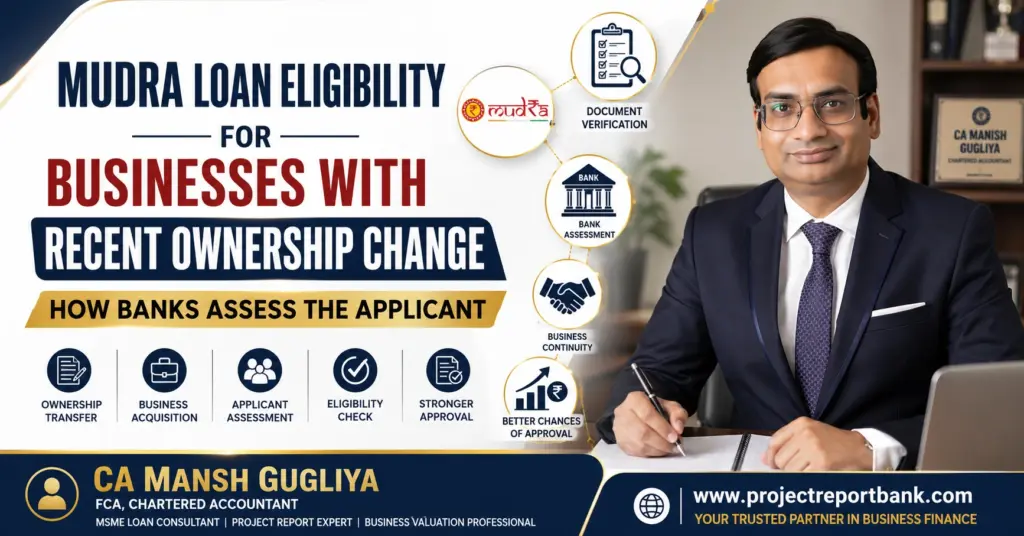
Buying an existing business instead of building one from scratch is a smart move many entrepreneurs make every year. But when it comes to applying for a Mudra loan on a recently transferred business, most applicants are unsure whether banks will even consider their application. In my 20+ years of practice as a Chartered Accountant helping MSMEs secure business finance, I have seen this confusion repeatedly. This guide explains exactly how banks assess mudra loan eligibility for businesses with recent ownership change, what documents you need, and how to avoid rejection.
Key Takeaways
Banks across India do sanction mudra loans to businesses that have undergone recent ownership change – provided the applicant can demonstrate genuine business continuity, updated statutory registrations, and clear repayment capacity. Here are the essentials:
- Ownership changes like purchase of a running proprietorship, family transfer, inheritance, or partner change are all eligible scenarios, but each is assessed differently by the lender.
- Mudra loans are available up to ₹10 lakh under Pradhan Mantri Mudra Yojana (PMMY), and no collateral is required for loans up to ₹10 lakh.
- Banks verify ownership documents, GST and Udyam updates, and actual business operations through field inspection before sanctioning any collateral free business loan.
- Eligibility for a Mudra loan requires business continuity proof – not just paper ownership.
- Final approval, loan amount, and interest rate always depend on the bank’s internal appraisal and PMMY/RBI guidelines. No consultant or CA can guarantee sanction.
Table of Contents
Basics of Mudra Loans and Ownership Change Scenario
The Pradhan Mantri Mudra Yojana was launched on 8 April 2015 as a flagship scheme of the Government of India to provide institutional credit to micro enterprises and non corporate small businesses engaged in manufacturing, trading, and services. The mudra scheme is extended through commercial banks, small finance banks, RRBs, NBFCs, and MFIs – all acting as Member Lending Institutions. Mudra stands for Micro Units Development and Refinance Agency, which provides the refinance agency function to support these lenders.
PMMY loans are classified into four categories:
| Category | Loan Amount |
|---|---|
| Shishu | Up to ₹50,000 |
| Kishore | ₹50,001 to ₹5 lakh |
| Tarun | ₹5 lakh to ₹10 lakh |
| Tarun Plus | ₹10 lakh to ₹20 lakh |
Shishu loans offer up to ₹50,000 for very small credit needs, while Kishore loans range from ₹50,001 to ₹5 lakh. Tarun loans range from ₹5 lakh to ₹10 lakh, and Tarun Plus loans range from ₹10 lakh to ₹20 lakh for those who have availed and repaid a previous Tarun loan. The maximum loan under standard PMMY is ₹10 lakh, though mudra loans up to ₹20 lakh are available for non-farm activities under the Tarun Plus category introduced in October 2024.
The core question this article answers: If I have just purchased, inherited, or taken over a small business in 2024–2025, can I get a Mudra loan on that business? The answer is yes – subject to proper ownership proof and continuity.
Many entrepreneurs prefer buying an existing kirana shop, salon, or small service business because it comes with an existing customer base, ready licences, and immediate cash flow. Eligible businesses include vendors, shop owners, and service providers across non-farm sectors. The purpose of the loan must be for income-generating activities – working capital, equipment, or expansion.
Common misconceptions include beliefs that banks finance only original owners, that any ownership change leads to automatic Mudra loan rejection, or that old financial records do not matter after transfer. None of these are true. You can even apply for a Mudra loan online through portals like Jan Samarth.

What Counts as Ownership Change for Mudra Loan Eligibility?
The bank first tries to understand what exactly has changed – person, entity, or just shareholding – because mudra loan eligibility is assessed on the new applicant plus the continuity of the same business. The business must fall within eligible sectors for Mudra funding, which covers non-farm micro and small enterprises but excludes agriculture production businesses. Mudra loans are not available for agriculture production businesses or allied agricultural activities directly.
Here are the scenarios banks consider as ownership change:
- Purchase of an existing proprietorship – for example, buying a running salon in June 2025, where GST, trade licence, and shop act registration are transferred or freshly obtained in the buyer’s name.
- Business takeover through a formal business transfer agreement involving asset sale, goodwill purchase, or stock purchase. Banks insist on clear clauses about liabilities and handover date.
- Family business transfer – father-to-son, husband-to-wife, or between siblings. Despite being within family, banks still treat the new owner as a fresh applicant.
- Gifted business and inheritance through Will or legal heirship. Updated GST registration and Udyam Registration showing new ownership are critical.
- Partnership changes – admission of a new partner, retirement of an old partner, or conversion from proprietorship to partnership. Significant changes in partners or profit sharing signify a material ownership shift.
- Conversion of sole proprietorship into LLP or company, or change in major shareholding. Banks see this as a change in ownership structure that triggers fresh KYC and eligibility checks.
Changes treated as “significant” typically include: change in controlling owner, change in legal entity type, or multiple ownership changes within 12–18 months before application. Minor internal restructuring without change in control is generally less sensitive but must still match documents like GST, Udyam, and bank account names.
For a deeper understanding of how ownership structure affects Mudra loan decisions, applicants should review how banks evaluate control and documentation alignment.
Why Banks Are Extra Cautious After Ownership Change
Mudra loans are collateral free – no security or collateral is required. This means whenever there is a recent ownership change, the risk of misuse increases, and scrutiny becomes tighter. Here is what concerns the bank:
- Genuineness of operations – some applicants “purchase” paper businesses or licences just to qualify for the Pradhan Mantri Mudra Yojana limits without running actual activity. Banks are trained to spot these.
- Business continuity – is the same location active? Is the same type of activity continuing? Are customers and suppliers still engaged after the transfer?
- New owner’s experience – does the borrower have relevant industry experience? A salaried IT employee suddenly taking over a complex fabrication unit with no prior exposure raises red flags.
- Timing of transfer – sudden ownership transfers just before loan application suggest possible diversion of funds or an attempt to escape previous liabilities or CIBIL issues.
- Previous owner’s financial baggage – banks review whether the previous owner had loans, overdues, or write-offs with the same branch, and whether any liabilities remain unsettled.
- Fraud prevention – fake business acquisitions and round-tripping of funds are real concerns for every lender handling government scheme funding.
These concerns do not mean automatic rejection. They simply mean that documentation, verification, and project report quality must be stronger for recently transferred businesses. Applicants must be aged between 18 to 65 years and must not have any history of loan defaults to qualify. The business should demonstrate ongoing operations after the ownership transition.
How Banks Assess the New Applicant and the Business
For mudra loan eligibility after ownership change, banks perform a combined assessment of (a) the new proprietor or partners as individuals, and (b) the existing business performance and continuity.
Applicant’s Experience
Banks evaluate years in the same industry, prior role (employee, supervisor, or manager), technical qualifications, and entrepreneurial background. For example, a person who worked 7 years as a mechanic and now buys a small garage in Indore is viewed more positively than someone with zero relevant experience. If you have no prior business experience, your application faces additional scrutiny.
Business Continuity
Key factors include:
- Existing customer base and repeat clients
- Standing arrangements with suppliers
- Retention of key employees
- Continuity of premises with a valid rent agreement or ownership proof
- Comparison of old GST returns with recent sales figures to confirm the business was not dormant before transfer
Financial Assessment
Previous financial statements (last 2–3 years), GST returns, and bank statements of the beneficiary micro unit are used to gauge average sales, seasonality, and gross profit – even if they were in the previous owner’s name. Banks then project future cash flow under the new owner and calculate repayment capacity and DSCR, especially for Kishore and Tarun category loans. Lenders examine the new owner’s financial stability and credit history carefully.
Credit Assessment
Banks check the CIBIL score of the new applicant, existing EMIs (home loan, vehicle loan, credit card), repayment behaviour, and general banking habits. The previous owner’s CIBIL is usually not a direct basis for rejecting the new applicant, but any connected liabilities taken over under the business transfer agreement are considered.
Each bank has its own internal scoring model. Under PMMY guidelines, they must satisfy themselves about genuine end-use and timely repayment before sanctioning any loan amount.

Documents Required After Ownership Change for Mudra Loan
For Mudra loan approval after business transfer, documentation must clearly establish who owns the business now, what was transferred, and whether statutory registrations match the new ownership. Documents are required when applying for a Mudra loan – and after ownership change, the list is longer than usual. New owners must provide legal proof of ownership transfer. Updated documentation is necessary after a change in business ownership.
Here is the complete checklist:
Ownership Transfer Documents
- Business transfer agreement, sale deed, or purchase agreement
- Gift deed or family settlement deed (for family transfers)
- Succession or inheritance documents with effective date and scope
Statutory Registration Updates
- GST registration amendment showing new proprietor or firm
- Udyam Registration update in the new owner’s name
- Trade licence and Shop & Establishment certificate updates
- Sector-specific licences (FSSAI for food businesses, factory licence for manufacturing)
KYC Documents
- PAN card and Aadhaar card (identity and address proof)
- Passport size photographs
- Current address proof – electricity bill, property tax receipt, or rent agreement
- Documentation required includes bank statements and updated KYC details
Business Proof
- Current rent agreement or property ownership proof for business premises
- Latest electricity bill of the business location
- NOC from landlord if the rent agreement still carries the old owner’s name
Financial Documents
- Last 12 months’ bank statements (old and new owner if separate accounts)
- GST returns for at least last 4–8 quarters
- Previous financial statements and income tax returns
- Provisional financials post-transfer showing current stage of operations
Other Documents
- Projected balance sheet and profit & loss statement
- A detailed project report explaining the takeover and future plan
- Quotations for machinery or renovation
- Declaration regarding old liabilities
A business plan detailing growth strategies is required for larger loans, especially in the Tarun and Tarun Plus categories. Banks may ask additional documents specific to ownership-change risk. Incomplete or inconsistent ownership papers are among the most common reasons for Mudra loan rejection in such cases.
How Banks Verify Ownership Change and Business Continuity
After receiving documents, banks under PMMY carry out multiple levels of verification before sanctioning a Mudra loan to a newly transferred business.
- Document verification – cross-checking PAN–Aadhaar match, name in GST and Udyam, execution date of transfer deed, matching signatures, and ensuring no mismatch in addresses or licence details.
- Field verification and site inspection – bank officials or empanelled agencies visit the shop, office, or industrial unit to confirm that the business is actually running. They check name boards, stock on display, staff presence, and general activity. Details of the field investigation process matter significantly for approval.
- Customer and supplier verification – for Kishore and Tarun range loans, banks may call key customers or suppliers to confirm dealings have continued after ownership change.
- Employee and asset verification – interaction with long-term staff, physical verification of existing stock, machinery, tools, and checking whether assets match what is declared in the application form.
- Business activity verification – inspectors check whether the nature of business matches the declaration. Claiming a manufacturing unit while only trading from a small godown will raise immediate questions.
Multiple negative observations – business closed during visit, poor neighbour feedback, frequent ownership changes in 1–2 years – can result in rejection after site inspection even if paperwork appears formally correct.

Common Reasons for Mudra Loan Rejection After Ownership Change
Rejections after recent ownership change usually stem from a combination of documentation gaps, weak continuity, and risk factors. Here are the most common reasons:
- Insufficient business continuity – business closed for months after transfer, no fresh GST returns, negligible banking transactions, or mismatch between claimed and actual turnover. Learn more about business continuity as a rejection factor.
- Fake or doubtful ownership transfer – no proper sale deed, only a handwritten note without witnesses, or transfer done just days before filing the application.
- Incomplete documents – GST not updated to new owner, Udyam Registration still in old name, licence or trade certificate mismatch, or address in KYC not matching business premises.
- Poor applicant profile – weak business experience, low repayment capacity after adding proposed EMI, CIBIL score issues, or heavy existing debt.
- Operational red flags – business not operational during verification, neighbours reporting the unit hardly opens, or multiple ownership changes within a short period.
- Previous owner’s unresolved liabilities – old statutory dues or supplier disputes taken over without proper planning, stressing cash flow.
Rejection is not final. Applicants can rectify issues, update registrations, strengthen records, and re-apply after improving their overall profile and documentation.
Practical Tips to Improve Mudra Loan Approval Chances After Ownership Change
Many recently transferred businesses do get Mudra loans approved when they prepare systematically. Applications are processed quickly if documents are complete. Here is what works:
- Complete all legal transfers first – sale deed, gift deed, family settlement, or partnership reconstitution must be executed and registered before initiating any loan application.
- Update GST, Udyam, and all key licences within 30–60 days of transfer. Keep acknowledgement copies and amended certificates filed neatly.
- Maintain uninterrupted operations – keep the shop or factory open regularly, continue serving major customers, maintain adequate stock, and avoid closures around inspection time.
- Route business transactions through the current account – avoid frequent unexplained cash deposits or withdrawals, and ensure no cheque bounce pattern. Strong banking habits matter more than most applicants realise.
- Prepare a professional project report explaining why you purchased or inherited the business, past performance, realistic future projections, and exact utilisation of the loan – whether for working capital, machinery, or renovation.
- Organise a complete document file with KYC, ownership papers, financials, licences, rent agreement, and photographs of premises so the bank officer can quickly process your case.
- Be honest during verification – never hide previous business failures or loans during the bank interview. Explain what you have learnt and how you will manage better.
- Seek professional guidance for complex cases – inheritance disputes, multiple owners, or high-turnover businesses benefit from an experienced Chartered Accountant who understands PMMY documentation and banking expectations.
Case Studies: Mudra Loans After Ownership Change
These are illustrative scenarios based on real-world banking patterns to help you understand how banks think. Names and locations are changed.
Case 1 – Retail Shop Purchase (Approved) Ramesh bought a running grocery shop in Jaipur in 2024 with a proper sale deed. He updated GST and Udyam within 45 days, maintained good banking turnover, and had 5 years of retail experience. He secured a ₹4 lakh Kishore Mudra loan for working capital. The key factor: strong continuity and relevant experience.
Case 2 – Manufacturing Unit Transfer (Approved) A small fabrication unit in Indore was transferred in early 2025. The buyers retained key staff, renewed factory licences, produced 2 years of old financials plus a detailed project report, and obtained a Tarun category loan for new machinery. The key factor: retained employees and clean documentation.
Case 3 – Inherited Family Business (Approved) A son inherited his late father’s auto-parts shop in 2023. He regularised legal heirship documents, updated GST, and applied for a Kishore Mudra loan to expand inventory. Approved because of clear succession and unbroken operations.
Case 4 – Non-Updated Records (Rejected) Priya purchased a beauty parlour but did not amend GST or trade licence. The business remained mostly closed for two months. The field officer reported very low activity, leading to rejection despite formal transfer papers. The key factor: incomplete statutory updates and weak activity.
Case 5 – Partnership Reconstitution (Approved) A reconstituted partnership firm – old partner retired, new partner joined – obtained Mudra funding after submitting the amended partnership deed, demonstrating stable turnover, and showing proper form filings. The key factor: seamless transition with no disruption in operations.
Myths, Mistakes, and FAQs About Mudra Loan Eligibility After Ownership Change
Many new owners are confused by rumours. Let me set the record straight.
Myths vs Facts
Myth: Recently purchased businesses never get mudra loans. Fact: They do, if continuity and documentation are strong. Banks finance current eligible owners, not just original owners.
Myth: Old business records are useless after ownership change. Fact: Previous financial statements, GST returns, and bank statements under the old owner are a critical reference point for banks assessing business viability.
Myth: Experience is not important for small loans like Shishu. Fact: Even for shishu loans, banks evaluate whether the applicant can run the business. For Kishore and Tarun, experience carries significant weight.
Myth: Ownership transfer automatically causes rejection. Fact: It triggers additional verification, not automatic rejection. Properly documented transfers with genuine business activity get approved regularly.
Common Mistakes to Avoid
- Applying before completing the legal transfer
- Not updating GST or Udyam Registration
- Keeping the business closed on inspection day
- Providing inconsistent information in the application vs other documents
- Ignoring CIBIL issues or existing EMIs
- Submitting a copy-paste project report without realistic numbers
- Not maintaining a rent agreement in the new owner’s name
Conclusion and Author Note
Ownership change alone does not disqualify a business from the mudra scheme. What matters is transparent ownership, updated registrations, real business activity, and the new owner’s repayment capacity. Treat your bank as a risk partner – share accurate details, maintain disciplined banking, and approach financial assistance under Pradhan Mantri Mudra Yojana as support for sustainable growth, not quick money.
Each lender’s decision is subjective and based on its own risk assessment within the framework of PMMY and RBI guidelines. Mudra loans are available for non-corporate small businesses across India, and there is no blanket rule preventing recently transferred businesses from accessing this credit facility. Applicants must be aged between 18 to 65 years, and the business must fall within eligible sectors.
About the Author: CA Manish Gugliya (FCA) is a Chartered Accountant and MSME loan consultant with over 20 years of experience in Mudra loan consultancy, project report preparation, CMA data, business valuation, and helping entrepreneurs prepare bank-ready documentation. If your case involves complex business purchase, inheritance, or partnership change, professional guidance can help you structure your application for the next phase of your business growth.
Frequently Asked Questions
Can I get a Mudra loan immediately after buying a business?
There is no fixed minimum waiting period prescribed under PMMY. However, banks are more comfortable when at least 3–6 months of smooth operations, updated statutory registrations, and consistent banking transactions are visible after the transfer. You can apply online or at a branch, but having your documentation complete significantly improves processing speed.
Will the bank check the previous owner’s CIBIL score?
Generally, the previous owner’s CIBIL is not a direct basis for rejecting your application. Banks assess the new borrower’s credit history. However, if you have formally taken over liabilities of the previous owner through the business transfer agreement, those obligations are factored into your repayment capacity calculation.
Is a fresh project report required after ownership change?
Yes. Banks typically require a fresh project report from the new owner explaining the takeover, current business status, how the loan will be utilised, and realistic financial projections. A well-prepared project report is often the difference between approval and rejection for individuals applying under the Kishore or Tarun categories.
What if my business licences are still being transferred when I submit the application?
If business registration documents like GST, Udyam, or trade licence are still in the old owner’s name, most banks will not process the application until amendments are complete. Licence mismatch is among the top reasons for rejection. Complete all statutory updates before you fill and submit your loan application.
Are inherited or family-gifted businesses eligible for Mudra loans?
Yes. Inherited or gifted businesses can apply under PMMY. The applicant must provide legal heirship documents, gift deed, or family settlement deed along with updated GST and Udyam Registration. Banks treat inherited businesses favourably when operations have continued without interruption and the new owner demonstrates the ability to expand and manage the enterprise.
- Can Bank Reduce Mudra Loan Amount Without Your Consent? Complete Practical Guide (2026)


- What to Do If You Cannot Pay Your Mudra Loan EMI (2026 Guide)

- Can a Bank Refuse a Mudra Loan Because the Target Is Completed? Complete Guide (2026)

- Bank Refused My Mudra Loan Application – What Are My Rights?

- Mudra Loan for Used Vehicles (2026): Eligibility, Documents, Bank Rules & Complete Guide

- Rejected Mudra Loan – What to Do Next? Appeal Process Explained (2026)

- Mudra Loan Project Report Madhya Pradesh – Bank-Ready DPR & CMA Guide

- Project Report for Mudra Loan Maharashtra: Complete Guide for MSMEs, Startups and Small Businesses (2026)
- Mudra Loan Uttar Pradesh: Complete Guide for MSMEs, Startups and Small Businesses (2026)
- Mudra Loan Bihar 2026: Eligibility, Documents, Online Application Process & Project Report Guide

- Jan Samarth Mudra Loan 2026: Complete Guide to Online Application, Eligibility, Documents & Approval Process

- MSME Mudra Loan: Complete Guide for Small Businesses, Startups & Manufacturing Units in India (2026)
- Is the Mudra Loan Subsidy Real or Fake? Get the Facts Here

- Mudra Loan Without CIBIL Score: How to Qualify and Apply

- Mudra Loan for Used Machine (2026 Guide) – Eligibility, Documents, Valuation & Approval Tips