
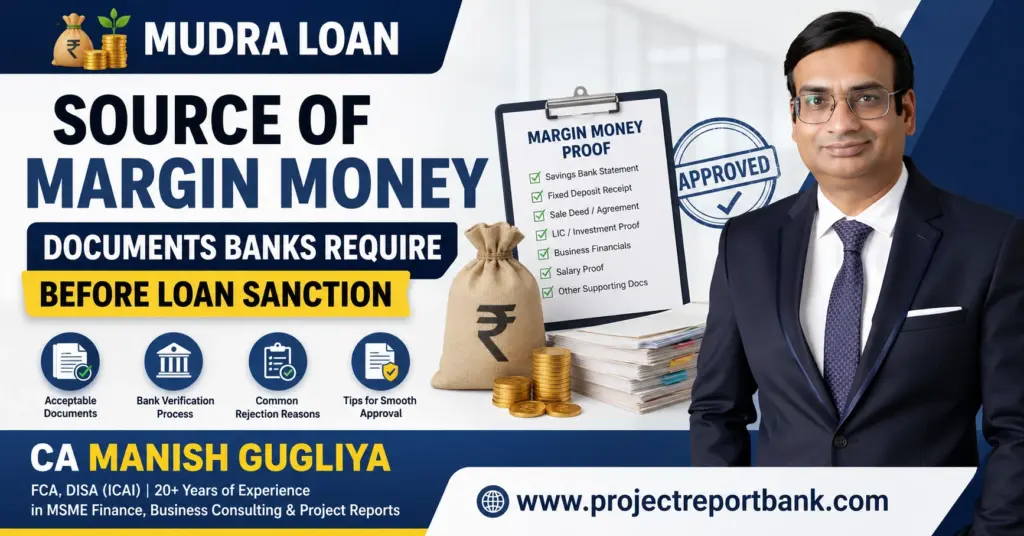
Many Mudra Loan applicants believe that simply arranging margin money is enough for loan approval. However, banks are equally concerned about where the money came from. Before sanctioning a Mudra Loan under the pradhan mantri mudra yojana, banks carefully verify whether the applicant’s own contribution is genuine, legally sourced, and available for business use. If the source of margin money cannot be explained with proper documents, the loan may be delayed or even rejected.
This guide explains exactly what documents required, how banks verify each source, common rejection triggers, and practical steps you can take right now to avoid problems.
Key Takeaways
- For any Mudra Loan under PMMY, banks do not just check your project report and CIBIL score – they also demand clear proof of the source of margin money before sanction.
- MUDRA loans are classified into four categories: Shishu, Kishore, Tarun, and Tarun Plus. Banks require evidence of the source of margin money primarily for Kishore and Tarun applications.
- Acceptable margin money proof includes bank savings, fixed deposits, sale of property or vehicle, LIC or investment maturity, business profits, salary savings, agricultural income, and genuine family gifts – all backed by documents.
- Borrowed funds (personal loan, gold loan, credit card cash) or last-minute cash deposits usually create problems unless properly disclosed and supported with paperwork.
- This article gives you the complete list of documents banks accept, how verification works in practice, common rejection reasons, real examples, and a practical checklist from CA Manish Gugliya to help you avoid Mudra Loan rejection due to margin money issues.
Table of Contents
Understanding Margin Money in Mudra Loan (PMMY)
Imagine a small trader walking into a bank to apply for a ₹5 lakh Mudra Loan. He has arranged ₹1 lakh as his own contribution. Everything seems fine – until the loan officer asks, “Where did this ₹1 lakh come from?” and the trader has no clear answer.
This is where most applicants stumble.
Margin money is the portion of the project cost contributed by the borrower from their own resources. It is separate from the loan amount the bank provides. For example, if total project cost is rs 5 lakh and the bank finances ₹4 lakh as a Mudra Loan, the entrepreneur must bring ₹1 lakh as margin money. You may also hear terms like “promoter’s contribution” or “own contribution” – banks practically treat all of them as proof that the business owner is sharing financial risk.

Under the mantri mudra yojana pmmy, the margin money percentage is not fixed by RBI. The margin requirement depends on the lending bank’s policies and the loan category. Different commercial banks and financial institutions may ask anywhere from 5% to 25% based on risk assessment and the applicant’s profile.
Here is how margin expectations differ across categories:
- Shishu: Shishu loans offer up to rs 50,000. Shishu loans typically do not require margin money.
- Kishore: Kishore loans range from ₹50,001 to 5 lakh. Margin usually required, often around 15% in practice.
- Tarun: Tarun loans provide rs 5 lakh to 10 lakh. Margin contributions ranging from 5% to 25% are common for Kishore and Tarun loans.
- Tarun Plus: Tarun Plus loans range from rs 10 lakh to ₹20 lakh, available for borrowers who have successfully repaid previous loans.
Margin money is usually not refundable as it forms the borrower’s stake in the project. MUDRA loans are collateral-free up to ₹10 lakh, yet banks still insist on margin money because it shows seriousness, reduces default risk, and builds discipline. No collateral is required for loans up to 10 lakh, but your own investment still matters.
MUDRA loans are designed for non corporate small businesses – whether you are in trading, food processing, manufacturing, or services. The loan is assessed based on your proposed activity, business plan, and financial profile. Understanding how promoter’s capital contribution works is essential before you apply.
Why Banks Verify Source of Margin Money
Banks do not just look at the amount of margin money – they dig into its origin. This is especially true for mudra loans where many individual borrowers bring cash at the last moment without any trail.
Here is why verification matters:
- Anti-money laundering compliance: Under RBI’s KYC and AML norms, every bank or financial institution must ensure funds are legal and traceable. Unexplained money raises immediate red flags.
- Credit risk assessment: Stable savings or long-term investments redeemed for the project are viewed much better than sudden unknown cash deposits. Banks prefer margin money to come from the borrower’s own resources rather than other loans.
- Financial discipline signals: Regular small savings in a bank statement send a very positive signal. Sporadic large cash entries do the opposite.
- Income consistency check: Lenders cross-check with income tax returns, GST turnover, and existing EMIs to ensure margin money is consistent with the applicant’s overall income profile.
Common sources of margin money include personal savings and retained business earnings. When these sources are clearly documented, loan processing moves fast. When they are not, expect delays or outright rejection – a hidden reason many applicants never realize.
Accepted Documents as Proof of Margin Money in Mudra Loan
Banks prefer documentary evidence that exists within the financial system – primarily bank statements, FDs, investment papers, and registered sale deeds – rather than verbal explanations.
For each type of source, bank officers normally expect to see both:
- The underlying transaction documents (sale deed, policy document, salary slip, etc.)
- A matching credit entry in the applicant’s bank statement
Original documents may be checked during verification, while self-attested photocopies are kept on file with the application. Requirements for Shishu category may be slightly relaxed, but for Kishore and Tarun loans upto rs 10 lakh, documentation becomes stricter. Loans under PMMY can reach up to ₹20 lakh for Tarun Plus, where scrutiny is even more detailed.
Government schemes may provide financial assistance for margin money in specific sectors – check with your state’s MSME department if applicable.
MUDRA loans support various business activities like manufacturing and services. The mudra scheme is available for eligible borrowers across these sectors, and the documents below apply regardless of your business type.
Savings Bank Statement as Margin Money Proof
A 6–12 month savings bank statement is usually the first document banks examine for margin money verification.
What works well: An applicant investing ₹80,000 from a savings account where monthly savings of ₹7,000–₹8,000 are clearly visible. This gradual pattern makes the amount believable. Consistent salary credits or business receipts with a steady saving pattern are considered very strong evidence.
What creates trouble: A sudden deposit of ₹1 lakh cash just 3 days before the loan application. This will always be questioned. You must be ready with a proper explanation and extra documents.
Banks may ask for passbook copies or system-generated PDF statements duly stamped by the bank to place in the Mudra Loan file.
Fixed Deposit Receipts (FDRs) and Term Deposits
Many applicants break their old FDs or RD accounts to arrange margin money for setting up or expanding a business under mudra yojana.
Documents needed:
- Original FD receipt or deposit advice
- Bank confirmation letter
- Bank statement showing FD maturity or premature closure and credit of funds
Using an FD with the same lending bank is often easier – the officer can see it in the system and mark it as margin money proof without extra paperwork. However, creating a fresh FD a week before the application and then closing it immediately may still raise questions.
Sale of Property as Source of Margin Money
If part of property sale proceeds (plot, house, shop) are used as own contribution, banks insist on proper legal proofs.
Key documents:
- Registered sale deed
- Buyer–seller payment schedule
- Bank statement showing receipt via cheque, RTGS, or NEFT
- Payment acknowledgement from builder or registrar receipt
If sale proceeds are received partly in cash and partly through bank, only the banked portion is normally treated as clean, acceptable margin money. For large amounts, banks may also check whether the transaction is reflected in ITR or capital gains computation. Capital assets sold for funding your business must have a proper paper trail.
Sale of Vehicle as Source
Consider this: an owner sells an old commercial vehicle for ₹2 lakh and uses ₹1 lakh as margin money to purchase a new vehicle under a Kishore or Tarun Mudra Loan.
Essential documents:
- Copy of RC transfer
- Sale letter or delivery note
- Copy of buyer’s ID
- Seller’s bank statement showing receipt of payment by cheque, UPI, or RTGS
If payment is received fully in cash without any receipt, banks may not comfortably accept it as a reliable source unless other strong support is available.

Maturity of LIC Policies and Other Investments
Many borrowers use maturity value of LIC policies, postal schemes, mutual funds, shares, or bonds as their contribution to the Mudra project. The beneficiary micro unit benefits when the applicant has planned savings.
Documents needed:
- LIC policy bond and maturity intimation letter
- Surrender value receipt
- Demat statements or mutual fund redemption statements
- NSC or KVP discharge receipts
- Bank statement showing credit of maturity proceeds
Investment maturities are viewed very positively because they demonstrate planned saving behaviour. If investments are held in a family member’s name but used for the applicant’s margin money, banks may ask for a gift deed or consent declaration.
Existing Business Savings and Retained Profits
For existing micro enterprises engaged in upgrading under the scheme, margin money often comes from accumulated business profits. This is a strong reference point for banks.
Documents needed:
- Current account statement of the business
- Last 1–3 years’ financial statements
- GST returns and basic profit and loss summary showing retained profits
Example: A small manufacturing unit retaining ₹3 lakh profit over two years and now using it as own contribution for a ₹10 lakh expansion project. Banks compare the business banking pattern and cash flow with financials to ensure the claimed profits are realistic.
Salary Savings as Margin Money
Many first-time entrepreneurs use their past employment salary savings to start a business. These applicants require funds from their accumulated salary income, and banks understand this path well.
Documents needed:
- Last 6–12 months salary account statement
- Salary slips
- Form 16 or income tax return showing salary income
- Any FD or RD created from these savings
Banks like to see a clear pattern: monthly salary coming in, household withdrawals happening, and a part being saved consistently. If large cash is deposited in a salary account without clear relation to salary or other documented income, it will invite extra questions during appraisal. No special educational qualification is needed for mudra loans, but your financial discipline matters.
Agricultural Income as Source
While agricultural businesses are not eligible for MUDRA loans directly (loans are available for non-corporate, non-farm small enterprises), agricultural income can still be used as margin money for non-farm businesses like trading, food processing, or small manufacturing.
Typical documents:
- Land ownership records (7/12 extract, Khasra-Khatauni, Jamabandi)
- Sale receipts from mandi or traders
- Agricultural bank account statement
- ITR showing agricultural income disclosure, if available
Even though agricultural income is exempt from tax, banks prefer at least a basic documentary trail linking crop sale proceeds to the margin money parked in the savings account.
Family Financial Support and Gifts
It is common for parents, spouse, or siblings to support the applicant, especially for young entrepreneurs. This is perfectly acceptable if handled correctly.
Documents needed:
- Written gift deed or declaration on plain paper
- ID and PAN copy of donor
- Donor’s bank statement showing outflow
- Applicant’s bank statement showing matching inflow via banking channel
Repeated small gifts from relatives just before application may be treated as suspicious if the relatives’ income profile does not support such transfers. Unofficial “adjustment entries” or gifts only on paper, without a real bank trail, are strongly discouraged and may lead to outright rejection. The donor must be a real person with verifiable income – not just a name on a letter.
Borrowed Money and Cash as Margin Money – What Banks Really Accept
Here is the hard truth: banks expect margin money to be from your own funds. Using borrowed money as “own contribution” goes against the basic spirit of Mudra Loan guidelines under the mudra scheme.
How banks treat different borrowed sources:
- Personal loans or business loan taken just before application: The new EMI will be counted when calculating repayment capacity. Many banks either reduce the maximum loan amount or refuse to accept borrowed funds as proper margin.
- Gold loans: Small gold loans against household jewellery are sometimes tolerated, but large fresh borrowings raise risk flags and affect DSCR calculations.
- Credit card cash withdrawals: Almost never accepted as clean margin money.
- Informal hand loans or loans from friends: Without documentation, these are invisible to banks or worse – suspicious if detected.
Interest rates for MUDRA loans are generally lower than traditional loans, which is precisely why banks are careful about who gets them. Covering loans with borrowed margin defeats the purpose.
Regarding cash: Banks do not reject genuine cash savings automatically. But they will insist on a convincing explanation and supporting proof like past withdrawals or business income records. Cash deposits above certain thresholds without proper declared income can trigger income tax department queries. Applicants should avoid rotating cash from friends just to show money during verification – experienced credit officers identify these tactics quickly.
How Banks Actually Verify Margin Money and Typical Rejection Reasons
After receiving the Mudra Loan application and business plan, banks run a step-by-step verification of margin money before sanction. Applications are processed within a few days if documents are complete, but margin money issues can delay things for weeks.
The verification process:
- Officers review 6–12 month bank statements, checking every large or unusual credit entry
- They compare bank entries with supporting documents: sale deeds, LIC maturity letters, salary slips, business financials, agricultural records, and family gift declarations
- They cross-check with income tax returns, GST turnover, existing EMIs, and CIBIL reports to ensure the financial story is logical
- For larger loans, physical verification or additional document requests may follow
Common rejection triggers:
- Sudden large cash deposits without source proof
- Showing borrowed funds as own contribution
- Fake or backdated gift letters
- Margin money not matching ITR income
- Same money rotating between family accounts
- Negative banking habits visible in account history
Beyond margin money, banks also evaluate the viability of your business and project report quality. A satisfactory credit track record and clean banking history make everything smoother. You can check the detailed reasons for Mudra Loan rejection for a complete picture.

Checklist, Real Examples, Mistakes to Avoid, and Practical Tips from CA Manish Gugliya
This section combines a practical document checklist, two case studies, a do-not-do list, and professional advice based on 20+ years of Mudra Loan experience.
Document Checklist for Margin Money Proof
- Identity proof: PAN card, aadhaar card
- Address proof: utility bills, rent agreement, property documents
- 6–12 month bank statements (savings or current account)
- FD, RD, LIC, or investment papers if used as margin source
- Sale deeds or vehicle sale documents with payment proof, if relevant
- Salary slips, Form 16, or ITR for salaried applicants
- Agricultural land records and mandi receipts, if applicable
- Written gift deed or declaration with donor’s ID and bank proof
- Business financials, GST returns, and profit-loss statements for existing micro units
- Business registration documents (Udyam Aadhaar, shop license, other documents as needed)
You can apply for a Mudra loan online or offline. Mudra loans are available from banks, non banking financial companies, micro finance institutions, and small finance banks. You can apply online through the JanSamarth portal. Applicants must be aged between 18 to 65 years. Eligible businesses include shop owners, vendors, and service providers across trading, manufacturing, and services. Each legal entity or other legal entity type can apply if it meets the eligibility criteria.
For help organizing your complete Mudra Loan file, prepare all other documents alongside margin money proof.
Positive Example
A woman entrepreneur plans a ₹7 lakh manufacturing project under Kishore category. She needs ₹1.5 lakh as margin money. She brings:
- ₹80,000 from savings accumulated over 10 months (visible in bank statement)
- ₹50,000 from a matured recurring deposit (RD receipt and bank credit shown)
- ₹20,000 as gift from parents (gift declaration, parent’s bank statement showing transfer)
The bank officer verifies each source, finds everything consistent with her ITR, and clears margin money verification within two days. Loan extended without delay.
Negative Example
A trader claims ₹1.5 lakh margin money for a Tarun category loan. His entire margin consists of cash deposited in the last 10 days. He has no bills, no ITR showing matching income, and no clear explanation. The bank flags the deposits, asks for supporting proof, and when nothing is produced, reduces the sanctioned amount significantly. The applicant’s previous loans history was also weak.
Mistakes to Avoid
- Depositing large cash just before applying
- Moving money between family accounts without paperwork
- Hiding existing loans or EMIs
- Producing fake rent or gift receipts
- Not maintaining any banking history
- Giving different explanations to different officers
- Ignoring the processing fee timeline and submitting incomplete files
Practical Tips from CA Manish Gugliya
- Start planning margin money at least 6–12 months before application. The next phase of your business deserves advance preparation.
- Keep money in bank, not at home. Every major deposit should have a documentary trail.
- Match your financial declarations in ITR with reality. Banks will cross-check.
- If you have necessary skills but limited credit history, build it gradually through small banking transactions.
- Be completely transparent with the lender. Disclose all liabilities and sources honestly.
- MUDRA (mudra stands for Micro Units Development and Refinance Agency) provides a credit guarantee structure, but your own credibility still matters.
- Maintain working capital discipline even before the loan – it reflects well on your application.
The assets created from your Mudra Loan investment should generate enough cash flow to repay. That starts with honest, well-documented margin money.
Frequently Asked Questions on Mudra Loan Source of Margin Money
Below are answers to the most common practical doubts about margin money in mudra loans. Note that exact rules can differ slightly between banks and branches – these answers reflect general banking practice.
Is margin money compulsory in every Mudra Loan under PMMY?
For very small Shishu loans (up to ₹50,000), most banks do not ask for visible margin money. However, for most Kishore and Tarun loans, banks expect some own contribution, especially when the project cost goes beyond ₹1–2 lakh. The percentage is not rigid – based on risk, a banker may ask for 5% to 25% margin or even higher if the applicant’s profile is weak. The eligibility and margin are assessed based on each case.
Can relatives or friends give money for my Mudra Loan margin?
Genuine financial support from parents, spouse, siblings, or close relatives is generally acceptable if routed through a bank and supported by a gift deed or declaration along with the donor’s bank statement. Informal cash hand loans without documentation, especially from people whose income profile does not justify the amount, are usually viewed with suspicion. Always use banking channels and keep written records.
Can I use cash savings kept at home as margin money?
Banks know many small businesses save cash, but when such cash is suddenly deposited just before application without any record of earning, it becomes hard for the bank to treat it as clean margin money. If cash must be used, it should ideally come from past recorded withdrawals or documented business income and be deposited well in advance with bills or books to support it. The bank needs to see a believable story, not just numbers.
Can I take a personal loan or gold loan to arrange my margin money?
Technically you can borrow, but then it is not truly “own contribution.” The new EMI will be counted when the bank checks whether you can afford Mudra Loan EMIs on top. Many banks either reduce the loan amount or do not accept borrowed funds as proper margin. This route should be used very carefully and only after discussing openly with the branch manager. Hiding such borrowings is one of the fastest ways to get rejected.
How many months of bank statement are required to prove margin money source?
Most banks ask for at least 6 months’ bank statement for savings or current accounts. Some demand 12 months for larger Kishore and Tarun mudra loans upto rs 10 lakh. Longer history is helpful because it shows how the margin money was gradually built and reduces suspicion about recent large deposits. Always provide the most recent statements – old or outdated statements are another common rejection trigger.
Arranging margin money is only one part of the process. Being able to prove its genuine source with proper documentation is equally important. Maintain transparent financial records, organize supporting documents before applying, and understand how your bank verifies funds. This preparation can be the difference between a quick sanction and months of frustration. Explore other Mudra Loan guidance articles by CA Manish Gugliya for practical advice on project reports, CMA data, bank verification, and loan sanction strategies.
- Can Bank Reduce Mudra Loan Amount Without Your Consent? Complete Practical Guide (2026)


- How Long Can a Bank Legally Keep a Mudra Loan Application Pending? (2026 Complete Guide)

- Mudra Loan Delayed for Months: Your Rights, Timelines & Complaint Options (2026 Guide)

- Can a Bank Force You to Open a Current Account for Mudra Loan? Complete Legal Guide (2026)

- Can a Bank Refuse to Accept a Mudra Loan Application? Complete Guide (2026)

- What to Do If You Cannot Pay Your Mudra Loan EMI (2026 Guide)

- Cross-selling by Banks During Mudra Loan – What Is Optional? Complete Practical Guide (2026)

- Is Insurance Compulsory with a Mudra Loan? Complete Guide (2026)

- Can a Bank Refuse a Mudra Loan Because the Target Is Completed? Complete Guide (2026)

- Mudra Loan Eligibility 2026: Complete Guide by CA Manish Gugliya

- Is Guarantor Mandatory for Mudra Loan? (2026 Complete Guide by CA Manish Gugliya)

- Can a Bank Legally Ask for Security in a Mudra Loan 2026 ?

- Bank Refused My Mudra Loan Application – What Are My Rights?

- Mudra Loan for Used Vehicles (2026): Eligibility, Documents, Bank Rules & Complete Guide

- Rejected Mudra Loan – What to Do Next? Appeal Process Explained (2026)
