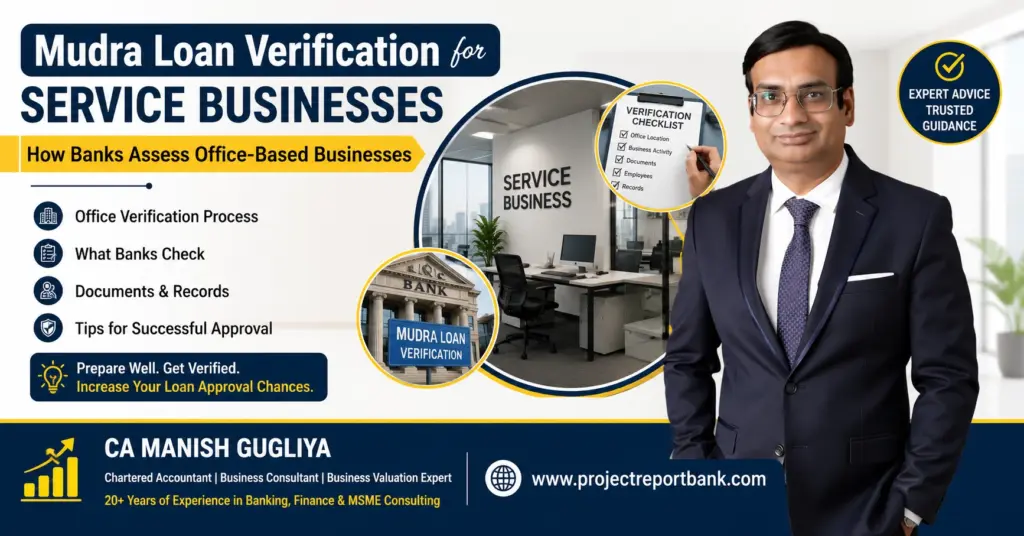
Key Takeaways
Here is a quick summary of everything this article covers about Mudra loan verification for service businesses:
- Every bank or financial institution usually conducts a physical site visit for office-based Mudra loan applicants before final sanction, especially for Kishor and Tarun category loans.
- During the visit, officers mainly check: whether the office actually exists, whether real business activity is happening, whether basic documents are in order, and whether the borrower has successfully repaid previous loans or has any overdue accounts.
- A simple name board, an active workspace with staff and computers, basic client records, and honest answers to officer questions normally meet the eligibility criteria for most genuine service businesses.
- Common mistakes like a locked office, missing name board, or address mismatch with documents can delay or even kill your application-even if your business is perfectly legitimate.
- The rest of this article gives you a detailed Mudra loan office verification checklist, a real case study, common mistakes, FAQs, and expert tips from CA Manish Gugliya based on 20+ years of experience handling Mudra loan files.
Introduction – Why Mudra Loan Office Verification Matters for Service Businesses
Many CA firms, IT companies, coaching classes, consultants, architects, and freelancers believe that banks only physically verify factories or shops before approving a loan. This is simply not true. If you run an office-based service business and apply for a Mudra loan, the bank will almost certainly visit your office before sanctioning funds.
Under the Pradhan Mantri Mudra Yojana (PMMY), which was launched on April 8, 2015, banks provide financial assistance to micro enterprises through loans upto rs 10 lakh without collateral security-and some schemes now extend upto rs 20 lakh under the Tarun Plus category. Because no collateral is required for loans up to Rs. 10 lakhs, banks depend heavily on physical verification and office inspection to reduce fraud and confirm that the business is real.
Mudra loan verification for service businesses focuses on several things: your office address, actual business activity, document accuracy, financial discipline, and whether you have a satisfactory credit track record or any badly handled previous loans. Banks need to see with their own eyes that the enterprise is operational.
I am CA Manish Gugliya, FCA, DISA (ICAI), with over 20 years of professional experience preparing Mudra loan project reports, CMA Data, DPRs, and handling office verification issues for service businesses across India. In this article, I will explain exactly what bank officers check during a site visit, how to prepare your office, what mistakes cause rejection or delay-even when basic eligibility criteria are met-and practical tips to make the process smooth.
Table of Contents
What Is Mudra Loan Verification & How Banks Check Service Businesses
Mudra loan verification for service businesses is a combination of document checking, office visit, business activity confirmation, and credit history review that banks carry out before sanctioning your loan. It is not a single step-it is a process with multiple layers.
Every bank or financial institution follows internal risk management rules along with RBI guidelines. Before a loan is extended, the bank must confirm that your office exists at the stated address, that the business is genuine, and that the loan purpose is a valid service activity-not for personal use or an ineligible category. The PMMY scheme covers loans for micro enterprises engaged in income-generating, non-farm activities, which includes a wide range of services from consulting to coaching to digital marketing.
Document Verification
The first layer is document verification. This covers your KYC documents (Aadhaar, PAN), business proof such as trade license or GST registration where applicable, Udyam Registration certificate, rent agreement or property papers, and financial records like bank statements and income tax returns. Typical required documents include identity proof, address proof, and financial statements. The bank checks whether all details are consistent-your name, business name, address, and nature of business should match across every document.
Telephonic Verification
Some banks also make telephonic verification calls. Officers may call you directly to confirm basic details like your working hours, office address, number of employees, or monthly turnover. In some cases, they may call your landlord (if rented premises) or even a reference point you provided during the application.
Physical Verification (Office Inspection)
The most important layer for service businesses is the physical verification-the actual Mudra loan office inspection. Field verification of the business may be performed by lenders if required, and for most Kishor and Tarun category applications, it is almost always done. A bank officer visits your office during working hours, observes the setup, checks whether real work is happening, and notes findings in an internal report.
What Makes Service Business Verification Different
For office-based Mudra loan applicants like digital agencies, coaching institutes, architects, tax consultants, travel agencies, and IT companies, the focus is on office setup, client work, and stability-not on machines or heavy stock. Unlike manufacturing units where banks inspect machinery and raw materials, service business verification is about people, processes, and proof of client engagement.
Credit and Repayment History
Banks also pull your CIBIL report or equivalent credit bureau score. They look at existing EMIs, whether you have successfully repaid previous loans, any written-off or “settled” accounts, and your overall repayment discipline. A borrower who is a defaulter on any existing loan faces serious hurdles. If you want to understand how CIBIL affects Mudra loan approval, that is a separate but important topic.
Basic Eligibility Checks
Along with verification, banks confirm basic eligibility criteria: you must be an Indian citizen with a viable business proposal, your age should be between 18 and 65 at the time of final repayment, and the proposed activity must be a non-farm, non corporate small business eligible under PMMY. The loan amount must fall within PMMY limits:
- Shishu loans are up to Rs. 50,000
- Kishore loans range from Rs. 50,001 to Rs. 5 lakhs
- Tarun loans range from Rs. 5 lakhs to Rs. 10 lakhs
- Tarun+ loans range from Rs. 10 lakhs to Rs. 20 lakhs
Eligible borrowers include proprietorship and partnership firms, as well as individual borrowers running micro units. Mudra loans are available for non-corporate small businesses, and the scheme covers a vast range of sectors including services, trading, and manufacturing. Mudra loans offer up to Rs. 20 lakhs for micro enterprises, though the most common service business applications I see fall in the Kishor and Tarun categories.
Primary lending institutions for mudra loans include commercial banks, small finance banks, NBFCs, and MFIs. Interest rates for Mudra loans are deregulated and reasonable, varying by lender. Repayment tenure for Mudra loans can vary based on the loan amount and the bank’s internal policy. Loans under PMMY can be used for income-generating, non-farm activities, and mudra loans can fund working capital or asset acquisition depending on what the business needs.
Mudra loans are available for various income-generating activities-not just for salons and repair shops but also for consultants, architects, digital service providers, coaching centres, and many more service categories.
How Bank Officers Physically Verify an Office-Based Service Business
Mudra loan office verification normally happens after the preliminary screening of documents and credit history check. Once the branch officer is satisfied with your papers on the surface, a physical visit is scheduled. Officers can visit during working hours, sometimes with prior notice (a phone call) and sometimes without.
The Typical Flow of a Bank Site Visit
Here is how it usually works in practice. The officer receives your loan file from the branch. They may call you to confirm the address and your availability, or they may simply show up during business hours. When they arrive, the first thing they notice is whether there is a name board or signage outside. They then enter the office, look around, meet the owner or responsible person, observe staff and workspace, ask a few questions, and note everything in a standard site visit report-sometimes with photographs.

Types of Service Businesses Commonly Inspected
Virtually every type of office-based service business gets inspected for Mudra loans above the Shishu category. Here are examples from my practice:
- CA firm or tax consultant office
- Advocate or legal services office
- Architect or interior designer studio
- Digital marketing agency
- Software development or IT company
- Coaching institute or tuition classes
- Travel agency or event planning company
- HR consultancy or recruitment firm
- GST consultant or financial consultant
- Insurance advisor
- Graphic designer or freelancer workspace
- Online service providers working from a dedicated office
What Officers Check: Office Location
The officer verifies that the actual address matches what you wrote on your application, rent agreement, electricity bill, and GST or Udyam registration. They check whether the office is in a commercial building, a residential flat being used commercially, or a co-working space. They also note ease of access and nearby landmarks-something like “Near Palasia Square, Indore” or “Opposite XYZ School, Pune” helps the officer (and the bank file) locate your premises without confusion.
If you are operating from rented premises, specific documentation requirements apply that you should be aware of.
Office Name Board
A visible name board is one of the first things the officer looks for. It should show your business name, your name (where relevant), and a contact number. This should match the details on your application, Mudra loan project report, GST registration, or Udyam certificate. A missing name board is one of the most common and easily avoidable mistakes.
Office Setup Observations
Inside the office, the officer makes quick observations:
- Is there basic furniture-desks, chairs, a reception area?
- Are there working computers (desktops or laptops)?
- Is there a printer, internet connection, and phone?
- Are there files, registers, or client folders?
- Does the workspace look functional, or does it look freshly set up just for the visit?
An empty office or one that appears newly painted with no working furniture creates serious doubt. Banks are not looking for expensive interiors. They want to see a workspace where real work happens.
Judging Real Business Activity
This is where the officer spends the most attention. They look for signs that actual business activity is taking place:
- Staff sitting at desks and working
- Phone ringing or client calls happening
- Computers with work open-design software, accounting tools, email
- Open files, current invoices, quotations, or work orders
- For coaching institutes: timetable on the wall, batch list, student attendance register
- For IT or graphic design: design drafts, project management tools, code editors
If the officer sees no activity-no staff, no open work, no sound-it raises a red flag. Even if you are a small operation with just two people, having those two people visibly working makes all the difference.
Employee Verification
The officer may casually ask your staff a few questions: “What do you do here?” “How long have you been working?” “What services does this company provide?” They compare these answers with what you stated in your application. If your application says 5 employees but only 1 person is sitting in the office, it creates inconsistency.
Checking Proposed Asset Purchase or Usage
For service businesses applying for funding to purchase capital assets like computers, printers, software licences, or office furniture, the officer may ask to see the quotations and check if the proposed activity matches the quantum of the loan requested. Though service businesses are not about heavy equipment, the assets created from loan utilisation should be visible or clearly planned.
For a broader understanding of how different business types are assessed during verification, you can read about the complete Mudra loan business verification process.
The Bottom Line on Physical Verification
A clean, simple, active office normally satisfies the officer-even if it is small, rented, or in a shared building. What matters most is that your story, documents, and visible activity all match. Banks are not trying to find fault. They are trying to confirm that the beneficiary micro unit is real and that the loan will be used properly.
Office Verification Checklist, Common Mistakes & Practical Preparation Tips
From my experience as CA Manish Gugliya, many good Mudra loan files for service businesses are delayed or rejected only because the office was not properly prepared for inspection. The business itself was fine. The entrepreneur had the necessary skills and knowledge. But a locked door or a missing name board killed the application. Let me walk you through exactly how to prepare.

Office Location and Accessibility
Make sure the address on all your documents-rent agreement, electricity bill, GST registration, Udyam certificate, bank application-is exactly the same. Even small differences (like “Floor 2” versus “Second Floor” versus no floor mentioned) can create confusion. Before the officer’s visit, ensure your office entrance is clearly accessible and identifiable. If your area is confusing to navigate, share a Google Maps pin or written directions with the bank officer.
Install your name board before the visit. The name should match your business registration. If you are a proprietorship, your own name and business name should both be visible. Include a working phone number on the board.
Documents to Keep Ready
Keep these documents in a single, well-organised file-originals and one set of photocopies:
| Document | Mandatory / Optional | Why Bank Checks It |
|---|---|---|
| Aadhaar Card | Mandatory | Identity and address verification |
| PAN Card (personal and business if applicable) | Mandatory | Tax identity and financial linking |
| GST Registration | Mandatory if registered; Optional if below threshold | Business proof and turnover verification |
| Udyam Registration Certificate | Mandatory | Confirms MSME status and sector |
| Shop & Establishment Certificate | Where applicable | Legal compliance for business premises |
| Rent Agreement or Property Papers | Mandatory | Office address proof and tenure |
| Latest Electricity Bill | Mandatory | Address and premises confirmation |
| Professional Registration (ICAI, Bar Council, etc.) | If applicable | Validates professional eligibility |
| Last 6-12 months Bank Statements | Mandatory | Cash flow, turnover pattern, financial discipline |
| Income Tax Returns (1-3 years) | Recommended | Income proof and tax compliance |
| GST Returns (if registered) | Recommended | Revenue cross-check |
| Project Report / CMA Data | Highly recommended | Supports loan justification |
| Quotations for equipment / assets | If purchasing assets | Validates loan utilisation plan |
To apply for a Mudra loan, KYC, financial, and business ownership documents are required. Having them ready and organised signify professionalism and save time during inspection.
Business proof can include a trade license or GST registration where applicable. Applicants can also apply online through the JanSamarth portal, but physical verification still happens before final disbursal regardless of how you apply.
Client and Business Records
Keep 10–20 sample invoices, quotations, client agreements, coaching fee receipts, student attendance lists, work orders, or email printouts that show you are regularly providing services and receiving money in your bank account. For online service providers-graphic designers, remote IT consultants, content writers-screenshots of freelance platform profiles, payment receipts, or project dashboards work well.
These records provide a clear reference point for the officer to assess based on actual business activity rather than just your verbal claims.
Financial Records
Your last 6–12 months of bank statements are critical. Officers look at:
- Regular credit entries (client payments)
- Monthly cash flow pattern
- Existing EMI payments (to assess repayment capacity)
- Any bounced cheques or irregular activity
If you have income tax returns for 2–3 years, keep them ready. For GST-registered entities, keep recent GST returns printed. A basic profit statement or CMA Data showing your turnover, expenses, and margins helps the officer understand your business economics and supports the loan amount you are requesting.
A simple business plan may support the application for obtaining a Mudra loan, and officers often look favourably on applicants who can clearly explain their revenue model and how the loan will help them grow to the next phase.
Common Mistakes During Mudra Loan Office Verification
Here are the mistakes I see most often-and every one of them is avoidable:
- Office closed when the officer visits. This is the number one killer. If your office is not operational during verification, the officer writes a negative report.
- No name board at the entrance. The officer cannot find or identify your business.
- Address mismatch. Your application says one address, your rent agreement says another, and your GST shows a third.
- Different activity observed. You applied as a digital marketing agency, but the officer finds a grocery store or a residential living room.
- Empty or fake setup. A freshly rented room with one table and no work happening.
- Documents unavailable. You cannot produce originals when asked.
- Applicant absent. No one knowledgeable is present to answer questions.
- Inconsistent answers. Your application says monthly turnover of ₹2 lakh, but your bank statement shows ₹30,000.
- Non-working phone number. Officer calls the number on the application and no one picks up.
- Staff unaware of business basics. Your employee cannot explain what services the company provides.
Fraud cases reported in the media-like the Ahmedabad case where an agent used forged documents to get a Mudra loan sanctioned in someone else’s name, or the Vadodara case where an ex-banker was found to have bypassed inspection protocols-show exactly why banks take verification seriously. When processing standards are skipped, fraud happens, and both the bank and genuine applicants suffer.
How to Prepare 1–2 Days Before the Visit
Here is a practical preparation sequence:
- Clean your office. Not spotless-just professional and tidy.
- Switch on all equipment: computers, printers, internet router.
- Arrange your document file in the order listed above.
- Brief your employees on basic business facts: when the business started, what services you provide, how many clients you typically handle, approximate monthly revenue.
- Keep original documents easily accessible-not locked in a drawer you cannot find the key to.
- Make sure at least one responsible person (ideally you, the applicant) is present during expected visit hours.
- If you step out, leave a staff member who can call you back immediately.
Practical Tips from CA Manish Gugliya
Based on 20+ years of handling Mudra loan files, here are my top tips for service business owners:
- Keep a one-page business profile ready-services offered, year of establishment, key clients, team size, monthly revenue range. Hand it to the officer when they arrive.
- Prepare a simple projected income vs EMI comparison showing you can comfortably repay the loan.
- Never give exaggerated turnover numbers. If your bank statement shows ₹50,000 monthly credit, do not claim ₹3 lakh turnover.
- If you are a new business, be honest about it. Explain your background, your necessary skills, and how you plan to grow. No educational qualification barrier exists for Mudra loans-what matters is your ability to undertake the proposed activity.
- If you work partly from home and partly from client sites, explain this clearly rather than hiding it.
- For freelancers: show your laptop setup, online portfolio, client communication, and payment records. Digital presence is your office.
- Keep your GST returns and bank statements consistent. Any major gap raises questions.
- If you possess professional certifications (CA, architect, advocate), display them on your office wall.
- Do not borrow someone else’s office for the day. Officers are trained to spot fake setups.
- If your office is in a co-working space, keep the co-working agreement and your dedicated desk arrangement documented.
- Respond to the officer’s phone calls promptly. A non-reachable applicant creates doubt.
- If you have availed any previous loan and repaid it successfully, mention this-it strengthens your case.
- Maintain a visitor register or appointment diary. It shows client activity.
- For coaching institutes: display batch schedule, student attendance, and fee receipts prominently.
- Prepare a proper Mudra loan project report and CMA Data for your service business. This document-with realistic revenue build-up, expense list, and cash flow projections-strongly supports your office verification findings and helps the officer justify the loan proposal to their credit department.
Supporting Your Application with a Strong Project Report
A well-prepared project report acts as a bridge between what the officer sees in your office and what the bank’s credit committee needs to approve the file. It covers the nature of your services, your market, projected income and expenses, break-even analysis, and loan repayment schedule. When the officer’s site visit report says “active office, genuine business” and your project report shows viable financials, the approval process becomes much smoother.
If your project report has been rejected before, it is worth getting it professionally prepared the second time.
Red Flags That Can Cause Rejection
These issues can directly lead to rejection after site inspection:
- Fake or shared office without proper arrangement or permission from the co-working provider
- Misleading information about the nature of business, number of employees, or turnover
- No visible business activity over months-an office that exists only on paper
- Contradictory answers about turnover, services, or loan purpose
- Proof that previous loans were overdue, written off, or “settled” recently-making the borrower a defaulter in the bank’s system
- The enterprise does not match the details given in the application or project report
Banks assess risk carefully. Even individuals with a good credit score can face issues if the physical verification raises concerns. The loan is assessed based on the overall picture-documents, credit, and physical verification together-not any single factor alone.

Real Practical Example: Digital Marketing Agency in Indore
Let me share a case from my practice. A young entrepreneur in Indore applied for a ₹5 lakh Kishor category Mudra loan to expand his digital marketing agency. He had a rented office, two employees, and about 8–10 regular clients.
Initial verification issues:
When the bank officer visited the first time, the name board was missing (it had fallen off and was never replaced). The office was technically open, but the owner was out meeting a client. One employee was present but could not find the rent agreement or electricity bill. The officer left without completing the report.
Improvements we suggested:
We helped the applicant install a proper name board matching his Udyam registration name, organised all documents in a single file, briefed both employees on basic business details, prepared a clean one-page business profile, and created a proper CMA Data sheet showing his monthly revenue of ₹80,000–₹1,00,000 against a proposed EMI of about ₹11,000.
Second visit and approval:
When the officer returned, everything was in order. The owner was present, explained his services clearly, showed invoices and client agreements, and the officer could see both employees working on live projects on their computers. The loan was sanctioned within 10 days of the second visit.
This case shows that the quantum of effort needed to prepare is not large-but skipping it can cost you weeks of delay or outright rejection.
FAQ – Mudra Loan Office Verification for Service Businesses
Here are answers to common questions that service entrepreneurs ask during consultations, beyond what is covered above.
Is office verification compulsory for all Mudra loans?
For shishu loans (up to ₹50,000), some banks rely mainly on document and telephonic verification. But for Kishor and Tarun category loans-which is where most service business applications fall-banks almost always conduct at least one physical visit. It is not always written in the public scheme guidelines as a mandatory step, but it is standard internal bank practice across most commercial banks, small finance banks, and NBFCs.
Can banks verify rented offices, home offices, or co-working spaces?
Yes. Banks mainly care about genuine business activity and correct documentation, not whether you own the premises. If you operate from a rented office, keep a valid rent agreement in the applicant’s name. If you work from a home office, ensure the workspace is clearly separate from living areas and business activity is visible. Co-working spaces are also acceptable if you have a formal agreement and a dedicated workspace.
What happens if the office is closed when the bank officer visits?
Some banks reschedule the visit, but a closed office creates negative remarks in the file. It signals that the business may not be operational, and it can delay your Mudra loan by weeks. In some cases, repeated closure leads to outright rejection. Always ensure someone responsible is present during working hours, especially in the days after you submit your application.
How can online freelancers or digital service providers show business activity during verification?
If you are a graphic designer, remote IT consultant, content writer, or any digital service provider, show your laptop setup with ongoing work, your online portfolio or freelance platform profile, payment screenshots or bank credit entries from clients, and email or chat records of current projects. A website or Google Business Profile in your business name also helps. The officer needs to see that you are actively providing services and earning income-the medium (online versus offline) matters less than the reality of work.
Does a weak CIBIL score or previous delayed EMI automatically fail Mudra loan office verification?
A weak credit score is a serious issue, but it does not automatically mean rejection in every case. If your current business is strong, you can provide a clear explanation for past delays, and you show proof of improved financial discipline (recent months of on-time payments), some banks may still consider your application depending on their internal guidelines. However, if you are a defaulter on an existing loan or have a recently “settled” account, most banks will not proceed regardless of how good your office looks. Covering loans or clearing overdue amounts before applying can help.
Can I apply for a Mudra loan if I don’t have GST registration?
Yes. GST registration is not mandatory for all Mudra loan applicants. Many service businesses operating below the GST threshold are eligible for Mudra loans without GST. However, if your turnover requires GST registration and you have not obtained it, this becomes a compliance concern. Udyam Registration is generally expected and easy to obtain.
Need help preparing for your Mudra loan office verification?
If you are a service business owner preparing for a Mudra loan and want to make sure your project report, CMA Data, and documentation are bank-ready, feel free to reach out to me-CA Manish Gugliya. With 20+ years of experience in Mudra loan documentation and bank finance proposals, I help entrepreneurs across India prepare files that pass verification smoothly and improve approval chances. A professionally prepared project report is not just paperwork-it is the foundation that makes the bank say “yes.”
- Can Bank Reduce Mudra Loan Amount Without Your Consent? Complete Practical Guide (2026)


- What to Do If You Cannot Pay Your Mudra Loan EMI (2026 Guide)

- Can a Bank Refuse a Mudra Loan Because the Target Is Completed? Complete Guide (2026)

- Bank Refused My Mudra Loan Application – What Are My Rights?

- Mudra Loan for Used Vehicles (2026): Eligibility, Documents, Bank Rules & Complete Guide

- Rejected Mudra Loan – What to Do Next? Appeal Process Explained (2026)

- Mudra Loan Project Report Madhya Pradesh – Bank-Ready DPR & CMA Guide

- Project Report for Mudra Loan Maharashtra: Complete Guide for MSMEs, Startups and Small Businesses (2026)

- Mudra Loan Uttar Pradesh: Complete Guide for MSMEs, Startups and Small Businesses (2026)

- Mudra Loan Bihar 2026: Eligibility, Documents, Online Application Process & Project Report Guide

- Jan Samarth Mudra Loan 2026: Complete Guide to Online Application, Eligibility, Documents & Approval Process

- MSME Mudra Loan: Complete Guide for Small Businesses, Startups & Manufacturing Units in India (2026)

- Is the Mudra Loan Subsidy Real or Fake? Get the Facts Here

- Mudra Loan Without CIBIL Score: How to Qualify and Apply

- Mudra Loan for Used Machine (2026 Guide) – Eligibility, Documents, Valuation & Approval Tips