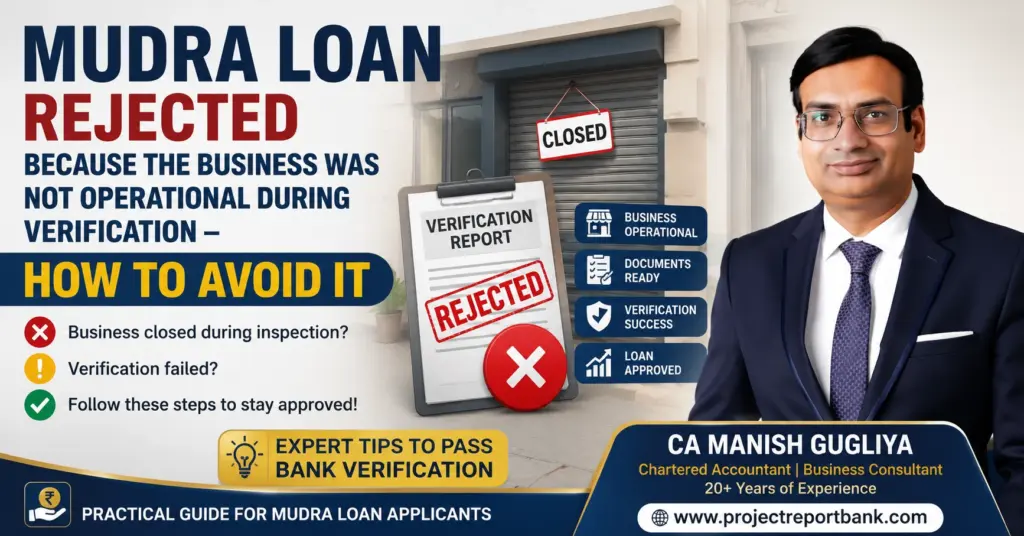
Key Takeaways
- Many mudra loan applications are rejected not because of a low cibil score or missing documents, but because the business was found closed or not running during the bank’s physical verification visit.
- “Business not running during verification” can include simple situations like a weekly off, the business owner stepping out for 1–2 hours, a festival holiday, or a unit still under setup – but banks may still mark the case as non-operational if the situation is not properly explained in advance.
- In my experience as CA Manish Gugliya, applicants who keep the shop open, display a proper signboard, maintain basic stock or machinery, and keep invoices and registrations ready usually pass mudra loan business verification smoothly.
- If the officer visits when premises are closed, the applicant must immediately contact the bank branch, provide proof and a written explanation, and politely request a re-verification with supporting documents.
Introduction: Why a “Closed” Business During Verification Can Kill Your Mudra Loan
Imagine this: a trader in Indore applies for a ₹3 lakh Kishore mudra loan in 2025. His documents are complete. His cibil score is above 700. The branch manager seems positive. But two weeks later, the loan is rejected. The reason written in the file? “Business not running during verification.”
This is not a rare case. I have seen it happen dozens of times across banks like SBI, PNB, Canara Bank, and several non banking financial companies and micro finance institutions that disburse loans under the mudra scheme.
Banks do not rely only on papers. They send a field officer to physically check whether the shop, unit, or office is actually working at the address given in the mudra loan application. Even a genuine business can fail this check if the shutter is down, the signboard is missing, there is no stock, or neighbours say “no such business here.”
In this article, I will explain how mudra loan verification really happens, what “business not operational” means in practice, and how you can prepare so that this issue never becomes the reason for mudra loan rejection. Mudra loans include Shishu, Kishore, Tarun, and Tarun Plus – four categories that cover everything from street vendors needing a shishu loan of up to ₹50,000 to established small enterprises applying for a tarun loan of ₹5 lakh to ₹10 lakh. Tarun Plus loans offer ₹10 lakh to ₹20 lakh for repeat borrowers. Kishore loans provide ₹50,000 to ₹5 lakh for business growth. Mudra loans can be applied for by small business owners and vendors, and you can apply for a mudra loan online or offline.
This article is based on my 20+ years of helping small businesses with project reports, CMA data, and MSME business financing – focusing on real bank practices, not theory.
Table of Contents
Why Banks Conduct Physical Business Verification for Mudra Loans
Physical verification is a compulsory risk control step for most kishore and tarun loans, and even for many small shishu loans if the loan amount is near the upper limit. MUDRA – which stands for Micro Units Development and Refinance Agency – is a government backed initiative, and banks must ensure the money goes to real business operations.
RBI guidelines and internal bank policies require lenders to confirm that the business exists at the address written in the mudra loan application form and project report. This is primarily to prevent fraud. Banks have seen fake cases: non-existing shops, borrowed premises, closed units, or people taking a business loan and using it for personal expenses. Physical inspection is the main tool to avoid sanctioning an unjustified loan.
Mudra loans are available for non-farm, income-generating activities – from food processing units to beauty parlours. Because these are collateral free loans, verifying business viability through physical inspection partly substitutes for collateral in the bank’s risk assessment.
The officer’s report becomes a key document in the credit file. If the report says “business not found” or “shop closed,” most branch managers will reject the application even if documents, cibil report, and business plan look fine. A lack of a clear business plan combined with no visible operations is an almost certain path to denial.
Non-verification can lead to loss of the bank’s confidence entirely, and unverified business profiles may be flagged or removed from the bank’s processing pipeline. This verification is not harassment – it is a normal process for all unsecured business loans under the mudra scheme.
What Does “Business Not Operational” Actually Mean During Verification?
In many rejection letters, the reason is written as “business not found” or “unit closed during visit.” This phrase can cover many different real-life situations.
- Shutter down during normal hours: The shop or office appears locked during a weekday afternoon. Even if you simply stepped out for lunch, the officer records “premises closed.”
- Office locked, no staff: No employee is present. The place is dark and silent.
- Manufacturing unit idle: Machinery is installed but not running. No workers present. No raw material visible.
- Empty premises: Only a few chairs, no goods, no equipment – the place looks abandoned.
- Business shifted to a different address: The mudra loan file still has the old address. The officer visits the old place, and neighbours say “they left months back.” This triggers a “business not found at registered address” remark.
- Under-construction or newly painted premises: No signboard, no stock, no clear setup. The officer is not convinced that commercial activity has started.
- Seasonal or part-time operations: Coaching classes that run only in the evening, ice-cream shops that operate mainly in summer, or weekly market stalls – if the officer visits at the wrong time, the place looks closed.
Timing is important; businesses should ideally ensure they are operational when verification is expected. Even a 100% genuine business can be tagged as “not operational” if there is no visible activity and no one available to explain the situation.
What Actually Happens During a Mudra Loan Verification Visit?
After the branch is broadly satisfied with your documents and mudra loan application form, they assign a field officer, business correspondent, or marketing staff for site verification. Here is the step-by-step process that most banks follow:
- Phone call (sometimes): The officer may call the mobile number on your application to confirm the landmark. But often, the visit is a surprise.
- Surprise visit: Usually during normal business hours – say 11:00 am to 4:00 pm on working days.
- Address check: The officer matches the address on the project report and KYC documents with the actual board and door number.
- Signboard and premises check: They look for your business signboard, then enter the premises to see whether real business activity is going on.
- Photographs: Typically 4–8 photos – outside signboard with shutter open, inside view showing counters, machinery, stock, seating, and sometimes you with your aadhaar card.
- Neighbour enquiry: Officers commonly talk to nearby shopkeepers, house owners, or security guards. They ask simple questions: “Since when is this shop running?” “Do customers come regularly?” “Who is the owner?”
- Written report: After returning to the branch, the officer prepares a report mentioning date, time, whether the business was open, type of business activity seen, approximate stock, owner’s presence, and a recommendation – “recommended” or “not recommended.”
This report heavily influences final loan approval or rejection. Business verification can sometimes lead to temporary operational pauses for the applicant while the report is being processed.
What Bank Officials Usually Check During Business Premises Verification
Here is a practical table of what officers observe during a mudra loan verification visit:
| Verification Item | What Bank Checks | Common Problem |
|---|---|---|
| Business Signboard | Name matching loan application, permanently fixed | No signboard or handwritten temporary board |
| Shop/Office Interior | Organized, functional setup | Dark, dusty, or empty room |
| Business Activity | Customers, calls, work in progress | No visible activity at all |
| Machinery & Tools | Working condition, relevant to declared business | Brand-new machines still packed or absent |
| Inventory/Stock | Raw material, finished goods on shelves | Zero stock or irrelevant items |
| Furniture & Fixtures | Counters, racks, chairs as per business type | Only a plastic chair and bare walls |
| Electricity Connection | Lights and fans on, active meter | Disconnected or dark premises |
| Cleanliness | Well-maintained, professional appearance | Neglected, cobwebs, dusty |
| Documents On-Site | GST, Udyam, licenses displayed or accessible | No papers available at premises |
| Owner/Staff Presence | Owner or informed staff available | Locked shop, nobody to answer questions |
| Business Records | Invoices, registers, bill books | No written records of any kind |
| Owner’s Confidence | Clear answers about sales, suppliers, plans | Confused, contradictory, or evasive replies |
Walk through these points every morning during the expected verification window. If each item checks out, your chances of a positive report improve significantly.

Common Real-Life Reasons Businesses Fail Mudra Loan Verification
As a Chartered Accountant, I often see rejections after site inspection with one simple internal note: “Business closed at the time of visit – not recommended.” Here are the patterns I have observed across cases from 2018 to 2025:
- Closed during peak hours: The business owner stepped out for bank work, a medical visit, or school pickup. The shutter was down for just 1–2 hours, but that was exactly when the officer visited.
- Address mismatch: The business recently shifted but the mudra loan file, aadhaar card address, or project report still had the old address. Officer visits the old place, finds nothing.
- Premature application: Some applicants start painting, interior work, or machinery installation only after applying. When verification happens, the unit is half-constructed with no stock or proof of trading.
- Fake or borrowed arrangements: Borrowed shops used only for photographs, rented tables inside another person’s business for one day, or empty godowns claimed as factories. Banks have seen such tricks and treat “too empty” premises with suspicion.
- Seasonal or evening-only operations: No signboard, no neighbour confirmation, and no written explanation about special timings given to the branch.
Banks may freeze accounts or flag applications if businesses are unverified or inactive during the critical verification period. Compliance failures in this regard can result in significant time delays or outright rejection.
Seasonal, Part-Time and Home-Based Businesses: Special Verification Challenges
Many of my mudra loan clients run seasonal or time-specific businesses – ice-cream carts in summer, cracker shops during Diwali, coaching classes from 5 pm to 9 pm, or home-based tiffin services. These can easily look “closed” during a daytime surprise visit.
For example, a coaching class that functions only in evenings will have a locked door at 2 pm. A tourism business during monsoon will appear almost shut.
How to handle this:
- Inform the bank in writing about your actual working season and timings.
- Attach a simple one-page note with the mudra loan application explaining your schedule.
- For home-based businesses, arrange one room clearly as a business area with a small signboard, product samples, basic stock, and invoices.
Service area businesses can verify without a physical storefront by providing operational evidence – like delivery challans, courier receipts, and online order histories.
Documentation is crucial for verifying businesses during periods of inactivity. Banks do allow seasonal and home-based businesses under Mudra, but the onus is on the applicant to show clear physical proof. Platforms – including banks – require documentation to confirm business legitimacy during the verification process.
Documents and Evidence That Prove Your Business Is Operational
While physical activity is the most important factor, strong documents make it easier for the field officer and branch manager to believe the business is genuine, even on a quiet day.
Registration and licensing documents:
- GST registration certificate showing trade name and address
- Udyam Registration for MSME – businesses not registered on the Udyam portal face higher rejection rates
- Shop and Establishment license or local trade license
- FSSAI license for food processing units
Utility and tenancy evidence:
- Latest utility bill (electricity or water) in the name of the owner or landlord at the same address
- Rent agreement or rental agreement or property tax receipt
- Internet or telephone bills for the office
Transaction documents:
- Purchase bills from suppliers and sales invoices
- Delivery challans, e-way bills, transport receipts
- Bank statements of your current account or savings account showing regular transactions related to business activity
On-site records:
- Simple stock register, daily sales notebook, printed price lists
- Visiting cards, printed bill books, and photographs of setup
Required documents for mudra loans include PAN, aadhaar card, and business proof. You need to submit a business plan for kishore and tarun loans. Aligning official business information across all platforms and documents aids verification significantly.
Maintaining a Google Business Profile with correct address and timing, or even a simple Facebook page, adds extra comfort to the banker. A basic online identity is not mandatory but genuinely helps.
How to Prepare Before Bank Verification: Practical Checklist
Most failures due to “business not running during verification” are preventable with 2–3 days of focused preparation. Here is a practical checklist you can follow along with your document file preparation:
✓ Keep the shop or unit open continuously between at least 11:00 am and 5:00 pm on all working days for 7–10 days after submitting the mudra loan application
✓ Avoid long lunch breaks or going out together during this period
✓ Put up a clear, permanent-looking signboard matching the exact business name in the application
✓ Clean the entrance, keep lights and fans switched on
✓ Arrange visible stock, samples, or tools according to your business type
✓ Keep one small file on the counter with photocopies of GST/Udyam, PAN, aadhaar card, rent agreement, 6–12 months bank statements, key purchase and sales bills, and the project report submitted to the bank
✓ Ensure all family members and employees know about the loan application
✓ If the owner must step out, a responsible person should be present who can call the owner immediately and show basic documents
✓ Maintain cleanliness and organization throughout the premises
✓ Keep a simple business plan and repayment plan ready to explain verbally

What If Your Business Is New or Still Under Setup When Verification Happens?
Many first-time entrepreneurs apply for a mudra loan when the shop is just being painted or machinery is being installed. Banks are willing to fund such setups under the mudra scheme, but only if the story is clearly communicated and physically visible.
For a new business that has not yet started full operations:
- Complete basic setup before verification – signboard installed, interior roughly ready, main machinery delivered (even if not fully connected), and some initial stock on shelves.
- Attach a one-page “setup status note” with the application explaining the current stage and expected timeline.
- If the officer visits during installation, they should see workers, cartons of machines, wiring work – this shows genuine preparation. A totally empty hall with only promises on paper leads to negative remarks.
New businesses must rely even more on a proper project report, realistic simple business plan, and CMA data so the banker feels comfortable giving time for the unit to become fully operational after disbursement. Applicants must be aged between 18 to 65 years to meet basic mudra loan eligibility criteria.
What to Do If the Officer Visits When the Shop Is Closed
Despite best planning, genuine emergencies happen – illness, family functions, sudden stock purchases – and sometimes the officer’s unannounced visit coincides with a closed shutter.
Usually the officer will still write an adverse remark like “closed at 1:30 pm, neighbours say rarely open.” However, this does not always mean the case is dead.
Steps to take immediately:
- Visit the bank branch within 1–2 working days after knowing about the visit.
- Politely request a meeting with the branch manager or loan officer.
- Provide a written explanation on plain paper mentioning exact date, time, and genuine reason for closure – medical emergency, local festival, weekly off.
- Attach supporting proof where possible: medical slip, shop-board showing weekly off day, or local association letter.
- Request re-verification formally, assuring the shop will remain open for the next 7–10 days.
In my experience, many branches agree to a second visit if they are otherwise positive about the mudra loan proposal. But repeated closure, inconsistent explanations, or inability to show any business documents will reduce chances even with re-verification. Transparency and prompt communication are critical.
Practical Case Study: How a “Closed Shop” Remark Was Successfully Resolved
This is an illustrative example based on common cases I have handled, with names changed for privacy but facts kept realistic.
Background: In August 2024, a small garment shop owner in Bhopal applied for a ₹3.5 lakh Kishore mudra loan to expand stock before the Diwali season. The project report, bank statements, and credit history were prepared properly. The branch seemed supportive.
The problem: The field officer visited on a Tuesday at 2:00 pm, which happened to be the shop’s weekly off. The shutter was closed. Nearby shopkeepers were also closed due to a local bandh. The officer marked “premises closed – business not confirmed.”
Corrective action: After learning about the visit from a follow-up call, the applicant came to me. We helped him draft a clear written explanation, attached WhatsApp messages from the local market association announcing the bandh, and requested the branch manager for a second verification.
Result: Re-verification was done the following Friday at 12:00 noon. The shop was fully open with visible stock, customers, and bills. The officer took fresh photographs, spoke to multiple neighbours, and wrote “business operational – recommended.” The mudra loan was approved and sanctioned within the next 10 days.
A negative remark due to timing can sometimes be reversed if the business is genuine and the response to the bank is timely, documented, and respectful.
Mistakes I Frequently See as a Chartered Accountant During Mudra Loan Verification
After reviewing hundreds of mudra loan files across states like Madhya Pradesh, Maharashtra, Uttar Pradesh, and Bihar, I repeatedly see the same verification-related mistakes.
Planning mistakes:
- Starting real business operations only after expecting loan approval instead of beginning on a small scale before applying
- Giving a wrong or incomplete address – sometimes at a different address from where the business actually runs
- Using someone else’s shop temporarily for photographs
Documentation and coordination issues:
- Rent agreement not yet executed, signboard still not ready
- Employees not informed about possible officer visit
- Wrong mobile number in application leading to missed calls from field staff
- Incomplete or mismatched documents between the application and physical reality – this alone causes most mudra loan rejections
Credibility-damaging practices:
- Showing one type of business activity in the project report (e.g., manufacturing) but premises looking like a pure trading shop
- No relation between requested loan amount and visible scale of operations
- Claiming high turnover without any supporting bank statement, GST return, or transaction history
- Existing loan defaults trigger immediate rejection, and banks quickly discover these through your cibil report
Some applicants avoid meeting the officer themselves and send relatives who cannot answer basic questions about purchase sources, cash flow, margins, or repayment capacity. This makes the officer doubt whether the business is actually controlled by the applicant.
Simple, honest alignment between on-paper details – business plan, project report, loan amount – and what the officer sees on the ground is the easiest way to avoid negative verification comments. Mismatched documents between different records remain the single biggest red flag.
Expert Tips from CA Manish Gugliya to Avoid “Business Not Running During Verification” Rejection
Here are practical tips from two decades of working with mudra loan applicants:
- Start small operations at least 1–2 months before applying for a mudra loan.
- Open a current account in your business name and route as many business transactions as possible through banking channels to build a strong transaction history.
- Keep two contact numbers on the application form to reduce missed calls from bank staff.
- Standardize all documents: same business name and address on aadhaar card (where possible), rent agreement, GST/Udyam, visiting card, signboard, and project report.
- Keep a one-page “business profile” ready that describes your products, working hours, approximate daily footfall, and how the loan amount will be used.
- Practice answering basic questions – why this business, expected monthly sales, main expenses, repayment plan – so you speak confidently during the visit.
- If your business is home-based or has unusual timings, proactively request through the branch that verification be done during your working hours.
- Maintain at least some stock or raw material on premises at all times, even in off season.
- Keep a clear business plan and basic business plan document accessible at the shop – not just with the bank.
- Display your business registration certificates, Udyam registration, and GST certificate visibly at the premises.
- Take your own dated photographs of the business every week during the application period as backup evidence.
- Build basic familiarity with nearby shopkeepers so they can confirm your presence during neighbour enquiry.
- Never give a business address proof that does not match your actual operating location.
- If you apply at the same bank where you hold your savings or current account, the existing relationship and regular transactions in your account support your case strongly.
- Remember that a cibil score below 650 often leads to rejection, so check your cibil score before applying. CIBIL score is not mandatory but preferred for mudra loans, so having a decent score helps.
Mudra loans are disbursed through scheduled commercial banks, regional rural banks, non banking financial companies, and micro finance institutions. Most banks follow similar verification norms, though strictness varies by bank branch and location. Many applicants underestimate this step – do not make that mistake.
Frequently Asked Questions on Business Not Running During Mudra Loan Verification
Small business owners often have doubts about verification even after reading detailed guidance. Here are answers to the most common questions I receive.
Can my Mudra loan be rejected if the shop was closed only once during verification?
Yes. For most banks, even a single visit where the shop was found closed during normal working hours can be enough for the officer to write a negative remark, and the loan is often rejected based on that report alone. If the reason was genuine and you respond quickly with a written explanation and proof, the branch may agree to a second visit – but this is at the bank’s discretion, not a legal right. Processing time for shishu loans is typically 7 to 10 working days, and verification usually happens within that window, so stay prepared.
Do banks always give prior notice before Mudra loan site inspection?
Some officers call before coming, but many visits are intentionally done without a fixed appointment to see the real condition of the business. Applicants should assume the officer can visit any working day during normal hours. Keep the premises open and operational for several days after submission. Banks reject applications silently based on the field report – you may not even know the exact date of the visit until it is too late.
My business runs only in the evening from my home. How can I pass verification?
Inform the bank in writing about your actual working hours and that the unit is home-based. Request that the visit be scheduled after your usual start time. Arrange a clearly defined work area inside the house with products, tools, a small signboard, and sample invoices. Udyam Registration is recommended for better loan approval chances even for home-based businesses. The eligibility criteria do not exclude home businesses, but the physical proof must be convincing.
What if my business is genuine but neighbours tell the officer that no such business exists?
This happens when you are new to the area, work mostly with online or outstation customers, or keep low stock. Compensate by showing stronger internal proof: licenses, invoices, online listings, courier receipts, and bank statements showing regular business transactions. Where possible, build basic familiarity with nearby shopkeepers before applying so they at least recognize your business name and can confirm it during verification.
Can I reapply for a Mudra loan at another bank after failing verification once?
You can apply at another bank or even the same bank again, but first correct the reasons for failure – incomplete setup, wrong address, or irregular business activity. You can apply for a mudra loan through any eligible lender, including scheduled banks, regional rural banks, and micro finance institutions. However, multiple failed verifications across banks create a negative impression. Category loans under each loan category have the same verification expectations regardless of which bank you approach. Fix core issues before reapplying. A strong project report, realistic clear business plan, working capital estimates, and visible business operations are the foundation for mudra loan approval at any institution.
Conclusion and Next Steps
“Business not running during verification” is one of the most common and most avoidable reasons for mudra loan rejection, even when cibil score, income, and documents appear satisfactory. The key is honest alignment between what is written in your mudra loan application and project report and what the officer sees physically at your shop, office, or unit – open shutter, clear signboard, visible stock or machinery, and basic records ready.
Treat the verification visit as an opportunity to build the bank’s trust. Show that the business is genuine, serious, and capable of using the loan amount productively and repaying EMIs on time. With proper preparation, even small enterprises and first-time applicants can pass this step confidently.
Need a professionally prepared Mudra Loan Project Report with CMA Data?
CA Manish Gugliya has helped numerous entrepreneurs prepare bank-ready project reports for Mudra Loans. A properly prepared report, supported by accurate financial projections and practical documentation guidance, can improve the quality of your loan application. While no consultant can guarantee approval, a strong and practical application significantly improves the chances. Learn more at www.projectreportbank.com.
- Mudra Loan Re-Verification – Why Banks Visit Again and What Applicants Should Do (2026)


- How Banks Verify Existing Business Turnover Before Approving a Mudra Loan 2026

- Mudra Loan Field Investigation Report – What It Contains and How It Affects Loan Approval 2026

- Mudra Loan Phone Verification – Questions Banks Ask and How to Answer Correctly 2026

- Mudra Loan Verification for Service Businesses – Office Inspection & Approval Guide 2026

- Mudra Loan Site Inspection for Manufacturing Units – What Bank Officers Verify Before Approval 2026

- Mudra Loan Verification for Rented Business Premises – What Proof Do Banks Require? 2026

- Mudra Loan Verification for Home-Based Businesses – Bank Rules and Approval Tips 2026

- Mudra Loan Rejected Because the Business Was Not Operational During Verification – How to Avoid It

- Mudra Loan Business Verification Process (2026): Step-by-Step Guide to What Banks Actually Check

- Mudra Loan Rejected Due to Industry Specific Project Report Mistakes – What Banks Really Expect 2026


- Mudra Loan Rejected Because the Business Model Was Not Viable – How to Improve Your Project Report 2026

- Mudra Loan Rejected Due to Machinery Cost: Practical Guide to Fix & Avoid This Problem (2026)

- Mudra Loan Rejected Due to an Incomplete Business Plan 2026 – What Every Project Report Must Include

- Mudra Loan Rejected Due to Copy Paste Project Report – How Banks Detect Generic DPRs and What to Do Next